Ethna’s Dream

Long time readers here will know that one of this Project’s ideas is “Other People’s Stories.” I’ve chosen to make that one of its principles for a couple of reasons. First, the Internet is full of folks telling their own stories, and this is fine (after all, to me those would all be “Other People’s Stories”). I wanted to do something different, to focus on how you and I experience a variety of words from a variety of writers with a variety of outlooks. The second is that I’m rather uncomfortable with promoting myself. That one’s complex.*  Like most writers or composers or artists I think my own work has value at some percentage over half the time. Which then, mathematically, allows that I doubt its value, or my handling of its value, or the costs of declaiming its value to the universe a bunch of the time too.

No one creates without the first thought. It would be impossible. And no one who cares about what they create, about their audiences, or about how much craft and care can be devoted to any art; without seeing the faults, the missed communication, the needs for just one more revision or tomorrow for any work.

Many of us create instinctively, because we have to — but sharing that work is a choice. I’m nearing 600 Parlando Project audio pieces presented here. I could have presented at least half or two-thirds of that easily with things Dave or I wrote, but I made a different choice. It’s less conflicted for me to publicly look at, to be honestly surprised and delighted at Emily Dickinson, William Butler Yeats, Carl Sandburg, Langston Hughes, Sara Teasdale, or Du Fu; and then to share that with you.

But there’s a problem with “Other People’s Stories.” I’m likely not understanding everything those authors intended.** And they’re their  stories, their  visions. I’ve talked recently here about how when I translate a poet who wrote in another language how I want to honor their work and transfer accurately their particular powers, and yet then become tempted to break off into something their work makes me see through my own eyes.

A long prolog to presenting today’s piece, one I wrote and titled “Ethna’s Dream.”  Ethna is Ethna McKiernan, a poet who I used to meet and talk about work with once a month or so, along with two to four others. Ethna cared and crafted her work over decades, and in her life did other useful work: running an Irish heritage book and art shop, working with the homeless. She’s currently in hospice, comforted by family, and the reports are that she’s now mostly in an out of what appears as sleep.

I couldn’t call Ethna a close friend. I always sensed a distance there. I think often of her none the less these days, and of every rudeness, awkwardness, or self-dealing on my part around her; and those or any number of things could have caused that. The very fact of writing a poem about her death, her dying, that mostest personal thing, seems problematic.

So, when you listen to my piece “Ethna’s Dream”  you now know all that. This is not a poem about those things I’ve discussed in prolog, or at least I hope so. Instead, my intent is that it’s a poem about what we should treasure of that sharing of the unconscious that we have with artists (including those whose main art is just living). What I present in “Ethna’s Dream”  is not a romantic, imaginary, sentimental metaphor in my own mind — though it may attract or repel you if you see it as such — it’s more at the essences of what we do, share, and take with art.

Ethna's Dream

There’s references to Bottom’s speech in Shakespeare’s A Midsummer Night’s Dream. Am I prettifying  myself up with pretentiousness, or comparing myself to the foolish play character? I wrote it, and yet I can’t tell.

.

There’s a player gadget to hear it below for many of you, but some ways of reading this blog won’t show it, so there’s this highlighted hyperlink to play it as well.

Thanks for reading and listening.

.

*One problem, leading to one fear, is that when offered the chance to promote myself I see myself as overdoing it, and coming off as a self-absorbed narcissist that runs on too long about the arts I work in, prattling about the obvious and the obscure in equally embarrassing ways. If you’re still reading at the footnote stage, you may have forgiven me for that.

**Beside just plain embarrassment of ignorance, we now more often talk about cultural appropriation in regards to this. The travesties of cultural appropriation are real, but my belief is that they should, must, be risked.

Lament (after Sheng-yu’s Lament by Mei Yao-che’en)

It was difficult to return to work on new pieces for this project yesterday. November was blustery and very gray, the whole world seemed to shiver. It was weather to huddle up, as curled and still and hidden as one could be. None-the-less I rode my bike to breakfast, and when I rode past a small pond I could see three ducks on the soon to be frozen water. I wondered; did they miss the migration memo? Are three enough of a formation to make the long southward flight? Are they waiting for a greater flock to gather that I suspect won’t be coming around?

Having completed my Kurt Vonnegut series, I am reminded of a whimsical concept his made-up religion Bokononism introduced: the “karass,” a term for a group of disparate people strangely linked together without their knowledge that yet still seem to be working with a common purpose and unknowable goal.

If so, poet Robert Okaji and I may be in such a flock.

Ostensibly independently, Okaji and I both find creating American English translations/adaptations of classical Chinese poetry rewarding. We even often use the same source of literal glosses of the poems since neither of us understand the language those poets wrote in. Okaji’s practices have informed some of what I do with translation in that he allows himself to extrapolate English poetry from these old poems where his or the modern American reader’s understanding might otherwise be puzzled, unsure, or unmoved.*  This weekend I read one of his adaptations, “Sheng-yu’s Lament (after Mei Yao-ch’en)”  and was struck, as he apparently was, by the depiction of grief and loss.

Okaji’s version is quite good, but I still wanted to try my own adaptation. I approach translating classical Chinese poetry like I approach translating from French, German, or Spanish. My primary goal is to understand first what the poet wants us to see, to sense — the imagery. With poetry the “word-music” is highly important in the original language, but generally I do not try to transpose the sounds or even the sound-organization of the original language into English. I do like to retain something of what I call “the music of thought” in the original poem, the order and arrangement of the images in the poem’s journey.

I always start wanting to honor the original poet, the original poem, but despite that I often get carried away with a desire to change the way the poem ends to something that occurs to me from the experience of the other poet’s poem. This may be a failure, a fault on my part, and so when I do that here I try to cite what liberties I took. Okaji has a concise way to handle this issue: he calls his adaptations into American English “After…” which gives one license to do what the muse wills.

Lament

Robert Okaji’s fine translation is available here, and he also includes the English-language gloss we both used to create our versions of this poem. Besides his blog which includes selections from the full variety of his poetry, you can download a selection of his “after…” poems adapted from the Chinese here.

.

I started out thinking about how to render the first word: “heaven” in the gloss, a word carried over by Okaji. Best as I understand Chinese culture, the term “heaven” often carries a connotation closer to the concept of “fate,” and I actually used fate in the second draft, and then reverted to heaven in the final version. I decided I needed the listener to be firmly in the experience of mourning and grief, and to a Westerner, heaven does that. My next problem to solve were two lines both plain and puzzling: “Two eyes although not dry/(Disc) heart will want die” Interestingly, they rhyme in the English gloss, and early-on I decided to make that into a refrain. The narrator seems stuck, and refrains are a great device to show that situation. Okaji plays his “after card” here, with the very fine “my heart slowly turns to ash” that may not be in the original but adds vividness.

I wanted to bring forward Mei Yao-che’en’s image in the next set of lines — that there are things that seem elusive, that we think of as gone, but they still exist —and there are objective, work-a-day methods to go into the depths to retrieve them. I was unable to find out any additional context for the Sheng-yu whose lament the poem is said to be reflecting. Given my own age I read this poem as an older man, a widower who has now also lost his son to death, although given the historical dangers of childbirth it could be a tale of a woman who died of childbirth complications and then the infant too dies. The poignant specifics of the pearl sinking into the sea asks for allusive meaning, pearls coming from oysters on seabeds, and so a returning, perhaps a child-soul coming forth and then returning to where it came from. Or given my old-man framing, a widower throwing a dead wife’s jewelry into the sea. If the story of Sheng-yu was known to Mei’s readers this might be understood more specifically, but lacking knowledge I let this specific mystery remain.

Mei’s lines “Only person return source below/Through the ages know self (yes)” are hard to grasp. Okaji made his estimate, and I made mine. My aim was in part to underline that this section is a contrasting development of the supposedly lost things in the depths of the earth or the sea.

Okaji’s adaptation ends strongly, and it seems to me to be a more likely accurate translation of the poem’s final line. While I like my solution to the next-to-last line, I decided to go with a much odder final line. In my choice, inspired by what I felt in Mei’s original poem, and from being an older person with many grievings — the dead whose immortality is, in part, made up of my remembrance of them — is that I do not have to dig down deep or dive deep to see them, that they are with me. In the thin depths of a mirror I find them, and that my fate is to join their fate soon enough in my passage of years.

Musically I wrote an entire other tune for this, a bit more R&B like, which I abandoned early in my attempts to record this. Instead, I returned to my thought of some unusual colors associated with the Velvet Underground, and particularly John Cale,**  the Welsh viola playing member of that band. I created another spare and eccentric percussion part inspired by Velvet’s drummer Maureen Tucker’s inventions, and then laid down an electric bass line that anchors the melody. My guitar part came next, not R&B at all this time, the atmospheric arpeggios perhaps subconsciously connected to Chinese string instruments. The top instrumental lines are a cello and viola.

You can hear my performance of this lament with either this highlighted hyperlink or where available, this graphical player gadget you may see below.

.

*Others who have informed my practice: Ezra Pound’s rather free translations from glosses of classic Chinese poets, and Thomas Campion, who based his most famous poem on Latin poet Catullus while adding his own flavor.

**Two early John Cale solo LPs The Church of Anthrax and The Academy in Peril,  like his settings for Nico recordings in the early Seventies, aren’t to everybody’s tastes but hearing them opened my mind then to different ways to combine orchestral instruments with modern songwriting and electric instruments. If you want to explore them now, I’d suggest starting with 1972’s The Academy in Peril  which is the most accessible.

God Made Mud

Let’s complete our series honoring American writer Kurt Vonnegut on the 99th anniversary of his birth with another piece taken from his novel Cat’s Cradle.  In the world of this novel there’s an imaginary religion created called Bokononism whose elusive founder writes psalms and prayers that reference Caribbean musical styles. Even though Vonnegut never set music to them, he seemed happy that others did during his lifetime.*
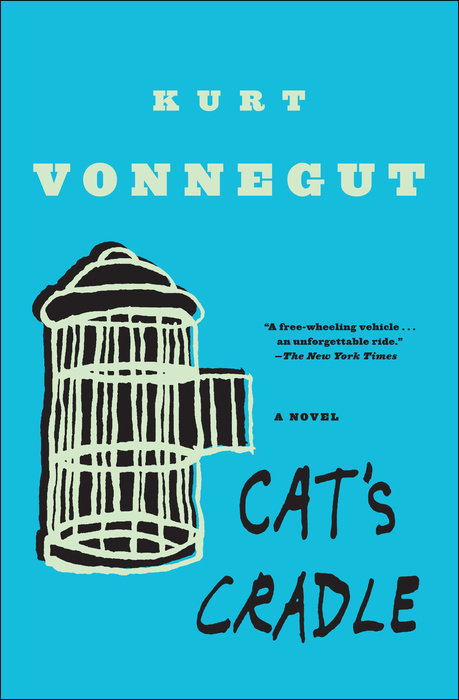
Cat’s Cradle is still in print, so why not buy or read it? Also for the curious, here’s a nice “behind the making of the book” listicle

.

The LYL Band, the loose organization of herded cats that Dave Moore and I have played under for about 40 years, performed several pieces using Bokonon’s psalms and other short passages we’d read in Vonnegut’s novels three days after his death was announced back in 2007. I wrote the music for these in that interim and did the vocals when they were performed “live in the studio” within two one-hour sets. As I mentioned in other episodes of this series, the performances aren’t perfect. For one thing, Dave is creating his keyboard parts on the fly after maybe hearing a quick run down and with nothing more than a chord chart. Given that I’m not a very good chord/rhythm player that’s a testament to him and what decades of playing together will do for a band. Another problem was that I was suffering from cold/allergies that day and my vocals had issues with congestion and phlegm.

I recorded those two sets, though I thought it a shame that my phlegm issues reduced the quality of the performances. Over the years since 2007 I’ve listened to those performances, and I found that I either had become inured to their sound or that the emotional moment of us honoring Vonnegut overcomes that.

“God Made Mud”  was the next to last song we did that day.** It’s probably the best of our Vonnegut Memorial stuff in terms of my vocals. “God Made Mud”  appears in Vonnegut’s novel as the text of “The Last Rites of the Bokononist Faith.”   The Bokononism that Vonnegut invented is used in the novel in various ways to satirize human nature and our search for meaning. For some readers — oddly enough, atheists and secure believers both — those insights into belief are the emotional core of the book. For those in non-Abrahamic religions, there are echoes of Buddhist teachings, intentional or otherwise, mixed in there too.

But by the time Vonnegut gets to “God Made Mud”  the sincerity of the final human situation, the miracle and the limits of our lives, completely overcomes the satire, and removed from the novel’s plot it moves me. It moved me then as we were performing it in the week of its author’s death, moved me later in consideration of other deaths and thoughts of gratitude for lives, and moves me again this autumn as I consider death and the approach of death by folks in my circle.

Click this highlighted hyperlink to hear the LYL Band’s performance of “God Made Mud”  —  or some of you may see a horizontal player gadget below this paragraph to play it. One last thing before I go: if you appreciate what this Project does and you think you know someone or some audience who might also appreciate these varied combinations of words and original music, help it continue by sharing links to the audio pieces or posts on social media or elsewhere. I almost never have the time to do that, and I’m bad at it anyway, so a good deal of this effort’s audience comes to it this way. Thanks!

.

* Oddly, most of those settings that I’ve heard make no reference to Caribbean musical styles implied in Vonnegut’s imaginary Bokonon texts. One of those styles, calypso, has lost most of its currency in North America, but in today’s piece I used a reggae feel as a reasonable substitute.

**The last song back in 2007? Dave Moore’s own meditation on last things “The Final Minute,”  which we presented here this summer.
The Great Machine (I Saw a Huge Steamroller)

Celebrating Kurt Vonnegut during this week that will mark the 99th anniversary of his birth allows two things to cross and connect, for he was born in 1922 on what would have been called Armistice Day then and will be called Veteran’s Day tomorrow in the US. Two decades later as a 20-year-old, he enlisted in the Army, served in WWII, and was rather famously a prisoner of war incarcerated in the German city of Dresden when it was subject to a massive firebombing raid from his own side.

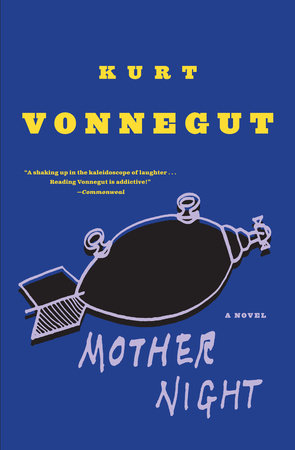
As one might imagine that experience impressed itself mightily on Vonnegut, who as a writer eventually dealt with the matter in his best-known novel Slaughterhouse Five.  But that was not his first novel to deal with WWII. That would be 1962’s Mother Night.

Mother Night, like all of Vonnegut’s novels remains in print. Mother Night does contain satire, but I’m not sure that as the cover blub above advertises that this one will shake up your kaleidoscope of laughter.

.

The short plot summary for Mother Night  is that it concerns the story of an American who was in Nazi Germany during the war, and who tells us that all-the-while working with American undercover efforts he made fulsome fascist propaganda broadcasts. This situation gives us all kinds of resonances: with important American Modernist Ezra Pound for example,*  with America’s own fascists, and with anyone who has ever found themselves working (for whatever reason) with a cause that they themselves feel they are not in alignment with.

The novel’s protagonist wrote “The Great Machine”  in the novel as a poem explaining how he and his beloved German wife had done what they felt was necessary to survive, and once again the novelist while in character allowed Vonnegut license to write poetry.

Abstracted from the novel, and as a stand-alone poem, it mentions nothing of the fascist double-life theme of Mother Night  however. Heard in this way, as the LYL Band performed it during the week of Vonnegut’s death in 2007, “The Great Machine”  speaks instead to refugees trying to escape violent situations by whatever means they can muster. In such events it’s not uncommon for the “you really must understand” class of commentators to mention that the refugees should not be fleeing but should stay and try to counter the violence in their own countries. I don’t know if it’s absolutely required, but such commentators almost never seem to have been in similar situations themselves. In the saddest reportage in Vonnegut’s poem, it says that most people do not, in fact, flee in these situations, but ignorantly or fatalistically accept becoming victims of The Great Machine that is History.

After our first two installments of our Vonnegut series it’s gotten darker here, but you can hear The LYL Band’s performance of this poem found in a novel with the player gadget below, or by clicking this highlighted hyperlink.

.

*Living during the war in Italy, Pound (who had been attracted to outsider political ideas, not just fresh approaches to literature) made propaganda broadcasts for the Italian Fascists. Pound, as with several other Axis broadcasters from Allied countries, was arrested at the war’s end and faced charges of treason, with a possible death sentence. American literary figures helped lobby to have Pound instead declared insane, reducing his culpability. British humorist P. G. Woodhouse was in Germany during the war and made Axis broadcasts, which his literary admirers and defenders characterized as not propagandistic.

It’s easy for us at this remove to forget how close at hand these issues were when Vonnegut was working on his novel. WWII was as close as September 11 2001 and the wars that followed are to us now in 2021.  Oddly though, American fascism, which had been a considerable issue during the ‘30s and ‘40s and is again now, was considered something of a comic non-entity in the 1962 world of his novel.

In a Disused Graveyard

To complete our Halloween series, here’s a poem by Robert Frost suitable for All-Saint’s and All-Soul’s Day: “In a Disused Graveyard.”

When I was a child and my father was alive, there would be times when my six sisters and I would be corralled up inside a Fifties American car for some long two-lane trip to a grandmother’s house or other destination. Yes it was crowded, and the wave-rolling suspensions of those pastel and chrome cars added another element: the possibility that one of us would vomit or simply rebel against the length of an uncountable trip.

To counter that, liquid Dramamine was administered to the younger kids from paper Dixie cups. This was given to suppress nausea, but the side-effect of sleepiness was welcomed too. Half of us might be drowsy to asleep and the other half just bored.

For that older half, my father introduced a car-ride game to help us endure the drive. It was called Zip, and I suspect it might have been something he learned with his family of mostly brothers back in the Model A era. Zip had simple rules. In the game, a handful of objects that could be spotted beside our rural roads could score points. A white horse would score 1 point. An old man with a white beard riding a bicycle would score 100 points. And cemeteries would score 10 points. The scoring child would need to shout “Zip” before any other and explain what scoring object they had spotted. It was an odd scoring system. White horses would be rare, and any spotting was subject to suits regarding — well spotting. Was that horse completely white? Did it count if it had a small blaze on the forehead? These days I am an old man with a white beard who rides his bicycle often, and I am still reminded that I could win most Zip games by spotting myself (if that is possible).  I can’t recall any of us scoring a come-from-behind miracle win from such in those days though,.

This meant cemeteries were the scoring thing. Any church steeple coming into our vision put us on the edge of our sagging seat-covered seats, tongue leaning on the fence of our teeth ready to “zip!” But the subtle player knew more, knew that some older farmhouses might have a private graveyard, or that there might be one where a church no longer was, its congregation consolidated in the ebb and flow of settlement.

Such would be Robert Frost unconsoled graveyard in his poem, with only past parishioners, homesteaders, and villagers buried there. And now we, as we travel our own roads, are picking out our own personal graveyards: grandparents, parents, aunts, uncles, siblings, friends, spouses. No farmhouse, no church, no village anymore.

Old Tombstone

“Sure of death the marbles rhyme” — also 10 points!

.

In such a graveyard the old stones, now much dated, contrast against our presence, alive, visiting such a place. Can this not seem to say there is a line between the living and the dead, a border, an underline — a place here, and a place there? As Frost reminds us, no, that’s a lie we act as if we believe, mostly, even if it can hardly fool a rock.

There are religious believers who pray for the dead on these first two days in November. And we could be praying for ourselves too once we reach an age of really knowing. Slightly premature ghosts, then we pray for those who’ve come to terms. After all, Yogi Berra was said to have said: “If you don’t go to other people’s funerals, they won’t go to yours.”

A simple acoustic guitar accompanied first-take today, as I’m pressed for time. The player gadget will appear for some, but this highlighted hyperlink is an alternative way to play my audio performance of “In a Disused Graveyard.”    Want to follow along with Frost’s original text? Here’s a link to that as well.

.

Summer 2021 Parlando Project Top Ten, numbers 10-8

It’s time for our quarterly look back at the pieces here the got the most listens and likes. We start today with the numbers 10 through 8. Each bolded listing as we count down from 10 to 1 is a link to the original post where I first discussed my encounter with the text used, and those original posts will also include the text of the poem used or a link to it.

10. I Am Laughing in the Dark Underground by Frank Hudson  The Parlando Project has from the beginning aimed to put other folks words to music we compose and play. Dave and I are both writers, so I could predominantly present work we wrote the words for here — but I find the encounter with other people’s words interesting for myself, and I hope it adds variety for you the reader and listener. Therefore, it was with some hesitation that I posted this self-written piece for the blog’s 5th Anniversary last month.

You can click on the bolded title above to read what I wrote about writing the words then, but in summary, this text came largely from my interrogating one of those vivid dreams that happen around dawn when you’re half waking and half still asleep. To hear the musical piece, you can use this highlighted hyperlink, or a player gadget that will appear below for some of you.

.

9. They’re Not the Grateful Dead by Dave Moore  By chance the next piece as we count down to number 1 is by alternate Parlando Project voice and frequent keyboard-contributing musician Dave Moore, though I wrote the music, sing it, and contributed one verse.*  This one mentions a series of  dead-too-soon musicians well-to-little-known to folks around our age. Anyone remember that sacrament to saccharine paean “If There’s a Rock and Roll Heaven (you know they’ve got a hell of a band)?   Well, this is Dave taking a skeptical look at that idea.

There’s a player device that some of you will see to hear Dave’s song as I performed it, and if you don’t see that, this highlighted hyperlink is another way.

.

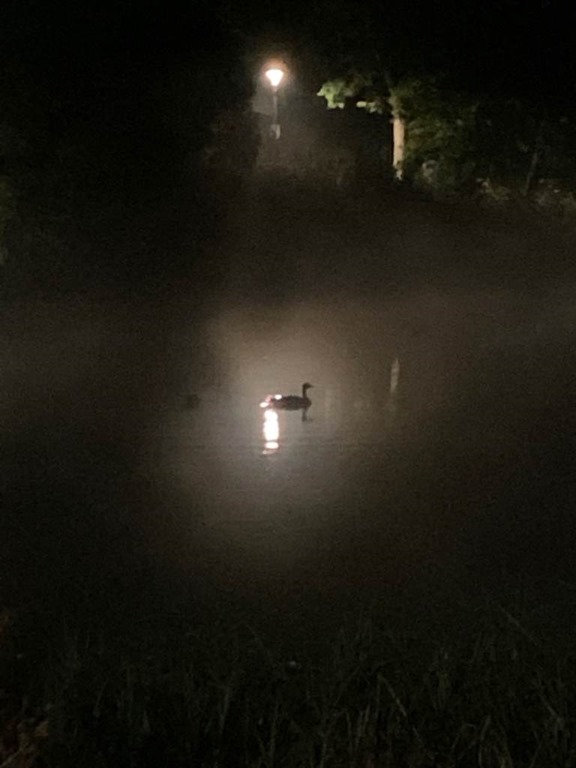
By Moonlight a Goose Can Be A Swan by Heidi Randen 1024

“By Moonlight A Goose Can Be a Swan”  a late summer photo by Heidi Randen

.

8. August by Helen Hunt Jackson  Speaking of deceased musicians, recent new member of the choir invisible Michael Chapman had a musical life that ran with some marvelously miscellaneous combinations. Early in his career a singer/keyboard player wanted him to join his backing band. Chapman would recount that he figured his own front-man career was launching just fine, and said no thanks. The keyboard guy? Elton John. Chapman was based out of Leeds in England then, and he wanted another electric guitar in his band. He picked up just such a fellow from Hull who had to be lured away from his band for Chapman’s. That guy’s name was Mick Ronson. Having been pried away from one band, Ronson soon left Chapman’s group for another, becoming the notable guitarist and arranger for David Bowie’s breakthrough Spiders From Mars band.

Musicians love those kind of stories, because it’s assumed that many will have “close, but missed it” tales of successful opportunities slipping from their grasp. How about writers? I give you Helen Hunt Jackson. Jackson was a grade school classmate of one Emily Dickinson. Like Dickinson she connected with Thomas Wentworth Higginson, the late-period Transcendentalist critic, activist, and editor. Higginson, you may remember, later gets his knocks from history for not fully recognizing and promoting Dickinson’s unorthodox verse, though after Dickinson’s death he arranged and helped edit the publication of collections of Dickinson’s work that started Dickinson’s career posthumously.

Jackson on the other hand ardently pushed Dickinson to publish while she lived, and for that effort she got little support from the living Emily.

I first ran into Jackson around the same time I watched the often satirical Wild Nights with Emily  movie a few years ago. That mixed-bag film portrayed Higginson as a nincompoop and Jackson as a simpering all-to-Victorian fustian. I’ve read a lot of bad 19th century verse looking for stuff to use here** so I figured it worth the risk to look at some of Jackson’s own poetry.

No, it’s not Modernist before it’s time in the same way that Dickinson’s can sometimes strike you, but it can be more vivid and effective than many of her contemporaries with higher surviving profiles, and this sonnet “August”  is a fine example of that. Here’s the highlighted hyperlink to play my performance,  and some will see a player below that can do that too.

.

*Dave, a keyboard player, led off his song with Nicky Hopkins, who’s one of the lesser-knowns in the grouping. As a bass player I couldn’t let that role in the song’s “catacosmic” band go unfilled, and so I added the Jaco Pastorius verse.

**My general read on the later 19th century was that the Modernists were correct in rejecting what poetry had come to by the beginning of the 20th century. Stale metaphor, simple messages, perfunctory expression, hard-walled gotta make my rhyme and meter exact verse — there was good reason to make it new.

Why Now, Vocalissimus

Today’s piece uses a very short poem I wrote in immediate reaction to some sad news I heard this weekend. Despite that news’ immediacy and particular sadness, the poem that resulted became something else, and I’m not sure why, even as I was writing it, revising it, and then figuring out today’s music and performing it. Being present throughout, shouldn’t I know?

Without stepping on anyone’s own living story, and my limited understanding and participation in it, let me just say that not one, but two poets that Dave Moore and I have known for many years have been dealing with potentially mortal illnesses this summer. I started intending to write a personal poem about considering their possible deaths, and some very tangled words started to emerge.

Why those words? I’ve already told you I don’t know for sure. Perhaps the words were tangled because I don’t feel I’ve been a supportive friend in their time of illness for complicated reasons which include my social awkwardness and not really knowing to what degree they would welcome that in their situation. The tangled words were awfully impersonal, even if the person wrestling with them was infused with emotions.

I decided to leave the tangled syntax of what came out, because I came to feel that their odd flow was a potentially striking effect, slowing the reader to consider them more closely. I made attempts to bring the personal in, but none of my considered words seemed to fit when I did. Could the impersonality too be part of the way the poem means? Yes, by this point I truly wondered what my poem — my own poem — meant.

Why Now, Vocalissimus

Why now, when it is already so
when I listen to people sing in the night,
that so many of them are dead?

And some of the words that comfort us,
or cause us to wonder at why we’re not,
were written by those who now never talk.

But if you go to silence for after all,
leaving just words, sundered breath,
will they be but husks, after seed has left?

When I completed the draft I used today, I thought it had become a poem that isn’t about particular people, but about us (you, I, anyone) wondering about what a poet leaves when their poems no longer have a choice but to remain silent on the page. I know that is a problematic mode. T. S. Eliot, who like many effective poets was right and wrong about why his poetry — much less poetry in general — worked, would approve of this poem’s impersonality; but in our century now we often expect poetry to include diaristic detail, and while the muse wouldn’t supply it, I myself expect that the poem should be specific about those that I’m thinking of — and yet to include explicit thoughts of that while they live seemed morbid and presumptuous. Even though I present this piece today, I’m not sure the poem is done with me yet.

Empty Milkweed Husk by Heidi Randen 1024

Poetry. Seeds. Speak it!

.

What’s with the weird Latin word in the title? It’s to lead you away from me and my particular poets in my thoughts, and back to just about the only appearance you’ll find of that word used in an English language poem: Wallace Stevens’ “To the Roaring Wind.”  In that poem “vocalissimus” is that voice of the muse that asks to become the voice of the poet; and by extension asks us to be the voice of the poet beyond their lifetime, which is what this project is about in our normal course of presenting other people’s words.

Let me leave you with one thought: you here who write, read, speak poetry are part of a continuum. Poet’s poems dream of being more than your poem — the ones with personal details, the ones without. Few will achieve that dream, but still they dream it, before and after the dreamer.

Many will see a player gadget below to play my performance of “Why Now, Vocalissimus.”   Some won’t, so I supply this highlighted hyperlink that will also play it.

.

To Poets Not Dying Young

Poems and songs about those artists who die young are easy to find.*  Why should that be? Well, tragic aspects there are plain to see and it’s easy to note the lost potential in an early exit. I think there’s a further factor too: we are much in love with the trope of young artists whose work is caught in a rising arc before falling with melted wings. It’s extraordinarily difficult for an artist to continue to impress or delightfully surprise over a long career. We artists repeat ourselves and are judged to have become stale — or we change and produce work that isn’t judged correct to be coming from us. Perhaps this is inevitable. Or maybe in part it’s us as readers, listeners, audience, who contribute some faults to this by always seeking new faces — or the practical use of any failures as telling markers to drop attention.

I’ve made no secret here that I’m old. I missed out on being a has-been and I’m not anyone’s coming thing in the arts. In a strange way I find that frees me from those burdens, and I only need to carry my age and infirmities while producing new work. This summer as the blog and listenership has its seasonal drop off, I’ve indulged myself and your attention with more work with texts written by Dave or myself. I do notice that the poetry I’m presenting here of mine is overwhelmingly focused on loss, something Dave usually avoids. Young poets, young musicians, often add gravitas with similar emphasis — and I should note, young artists can and do directly experience those things outside of the world of imagining. Experienced artists may more likely realize this is a choice, one that we are free to question and doubt. But, speaking for myself and my summer it’s been more at reporting. The everlasting crisis of the wider world continues — unjust losses there are still noted — but each day I think of the closer infirmities of those I know: small losses for me beating in resonance to their greater losses, and less specific worries and predictions for myself standing before me as I look through them to assay these others unavoidably present and particular ones. This is likely the selfish and self-contained man’s version of empathy.

.

To Poets Not Dying Young

I enjoyed some dissonant chord colors and an “Is it in major or minor?” rub in this one’s music.

.

Today’s piece uses a text of mine I call “To Poets Not Dying Young.”   The effect I’m trying to convey is the wearing of life on the body and soul of older poets who persist in their observation and writing, and it’s written in the hope that we, as audience, retain our ability to read and hear them. I do worry that the images are too enigmatic in this one, but maybe the connotations or some incantatory power will carry the effect through to you. Even to myself, their author, some of the images reflect more than one thing, and I’m not sure if that’s good or bad.

The Parlando Project plans to restore our usual service in presenting texts by other writers in upcoming pieces you’ll see here soon, but to hear this one you can use a player gadget below if you see it, or this highlighted hyperlink which will open a new tab window with an audio player.

.

*Here’s a post and a short and graceful poem linking several “died young” poets by American poet Anne Spencer.  And here’s a real-life ghost story post that has as its musical bit a poem by Carl Sandburg about another poet who died young.

And here are three to argue from the other side for older artists persisting. An aged Longfellow calls on the spirits of other older artists to make his case.  And his contemporary in Britain, Tennyson famously hymned a possibly deluded old Ulysses asking for one more voyage. And here’s another one of mine, in full rock fury recalling a young man who was once thought a coming man in his field and who persisted in making art past fame. If you didn’t like today’s musical piece, these five pieces will give you a wider sample of what we do here.

Silent Steps

Rabindranath Tagore is surely one of the most remarkable writers ever to win the Nobel Prize for Literature. If you’re a veteran of this project you might recall that a few years back when Bob Dylan won the same Nobel there were objections from poets and novelists that song-writing wasn’t literature, and that giving such a Nobel to Dylan was unprecedented and wrong.

While “Wrong” is a debate, unprecedented was an error on the part of the objectors, even though they often stated their objections from a stance of knowledge, craft, and learning. I was explaining this to someone earlier this summer, who had innocently asked your hosting windbag here if songwriters hadn’t taken over some of the place that poets occupied a century or more ago. The concise person would have just agreed with a “Yes,” but I wanted to tell him the story of the 1.5 songwriters who like Bob Dylan had already won a Nobel Prize for Literature.

The .5 songwriter in my tale was William Butler Yeats, a great poet who once decided that if the ancient bards presented their poems with music, that he should revive that practice. He went so far as to commission the building of instruments to accompany his poems and setup a tour from a professional performer* to realize this aim. “Yeats, The Musical” was not a success, and when Yeats won his Nobel it was largely for his poetry printed on paper.

Tagore was a much more significant songwriter than Yeats’ case, though Tagore wasn’t just a songwriter. He made other 20th century polymaths like Albert Schweitzer look like pikers, with copious literature in all forms, political activism, painting, teaching in several areas, social reform work, and more. But for those who spoke his native language, Bengali, he was a very well known and liked songwriter. Nor was he just a poet with a sideline as a lyricist. Tagore the composer had his hand in not one, not two, but three South Asian national anthems.

When Tagore won his Nobel for literature, there was one book most Westerners could read of his: Gitanjali,  a work he had translated himself into English. That title references songs, and from what I’ve read it consisted of Tagore’s prose-poem-ish adaptations of his song lyrics. Yeats himself knew this, remarking in an introduction in the 1912 English edition of the book that because Tagore was a songwriter all strata of his society knew his work intimately.

Today’s song is my adaptation of the 45th piece in that 1912 collection, using my own music. “Silent Steps”  may seem familiar even if you are not familiar with Tagore or his beliefs. I hear echoes of Hebrew psalms and prayers, and the other Middle-Eastern-origin religions such as Islam and Christianity too. Are you instead secular? I’ll come back to you.

I lightly adapted Tagore’s phraseology for much of this piece to make it more singable in English, because one of Gitanjali’s  chief issues is that it often doesn’t sing in our tongue. I departed more widely for the final verse. Tagore’s image there is hard for me to follow, and even if I haven’t clarified it much, I was moved to modify the image.

Tagore originally wrote this in English as the final stanza:

In sorrow after sorrow it is his steps that press upon my heart,
and it is the golden touch of his feet that makes my joy to shine.

See what I mean about hard to sing? But let’s get to the overall issue. What are, or whose are, the poem’s titular “silent steps?” To those familiar with Tagore’s beliefs, it’s the godhead, manifesting itself through nature and human consciousness attuned to it. Tagore is saying that human awareness that the godhead is present and manifest in its creation is consolation in times of sorrow. His “press upon my heart” is perhaps more at “seal,” as in the Hebrew Song of Songs  “Set me as seal upon thine heart, as a seal upon thine arm.” And the touch of the feet more at something like the Christian “If I could touch the hem of His garment, I know I would be made whole” line that has been used in many Christian song-settings.

Silent Steps

The text of my adaptation used for today’s song-setting of Tagore.

.

To be audaciously critical of the great man Tagore, his concluding stanza lacks visceral power. I thrashed around a bit to come up with a different image that may be adjacent to Tagore’s. My last stanza says in effect: as we walk in the footsteps of our life, trying to follow our precepts and finding in that journey the inescapable sorrows of infirmities and imperfection, we feel not only our own lowly footsteps on the path, but the pressures of (unrealized) perfection and completeness pressing on ourselves. All of our footsteps polish the surfaces of the paths we trod — and that the higher consciousness (the godhead consciousness for believers) does the same to us. We try to make life shine in our footsteps — and the limits of trials, troubles, and tribulations that press down upon us in turn polish us. Our joy shines because of those pressures, those rubs.

I said I would get back to the secular among this readership, because I don’t think the poem requires agreement with Tagore’s beliefs, or any adjacent religious beliefs either, to retain power. The godhead manifesting in a chariot would please the Biblical prophet Ezekiel, or 20th century Midwestern Afro-American Fenton Johnson, and so too the onrushing, unstoppable “time’s winged chariot” of 17th century English poet Andrew Marvell, who recasts that cosmic sound as a booty call. In American sports idiom, “hearing footsteps” is when a player senses a play-ending tackle is forthcoming. The successful player knows that, just as the unsuccessful one does — but the successful ones are able to continue to complete their task despite that knowledge.

For all I know, the heaven of death and reunion with the godhead and the heaven of oblivion may be two neighborhoods of the same city.

The small graphical player will appear below for some of you to hear my adaptation and performance of Rabindranath Tagore’s “Silent Steps.”   If you are reading this where that player doesn’t appear, this highlighted hyperlink will also open a new tab window to play it.  Thanks for reading and listening!

.

*From accounts Yeats was (like myself) somewhat pitch-challenged as a singer. And he didn’t exactly want his poems sung, thinking that a complex melody might detract from the words. Yeats instead choose some kind of middle-ground for the vocalist of which we have no extant recordings to demonstrate. From some research I did a few years back, the closest we may have to understanding what he was proposing was his “Song of the Wandering Aengus”  which Burl Ives and Dave Van Ronk and then Judy Collins performed back during the midcentury “Folk Scare.” Van Ronk said in performance that he learned it from an actor Will Holt who was also a folk singer, and it’s speculated that Ives and/or Holt may have learned the melody he used from another actor (Sara Allgood) with connections to the Abbey Theater, where Yeats was a foundational force. Here’s how I recounted that story a few years ago back here.

The Dragonfly

This summer, amid the seasonal lower traffic volumes for The Parlando Project, I’ve been featuring some uncharacteristic pieces where Dave Moore or I have written the words as well as the music. But today we’ll return to the proper mix, using a text by English Victorian poet, Alfred Lord Tennyson.

I saw today’s text first over at Kenne Turner’s blog, where it was included as a short stand-alone lyric poem entitled “The Dragonfly”  in the midst of a series of excellent  photos of varieties of this creature.  Here’s a link to that post which will also let you read the text I used. Other blogs have published the same text under this title, and I assumed it was a uncharacteristic very short nature poem by Tennyson. Let me thank Kenne for bringing this poem to my attention.

Long-time readers here will know I like concise poetry, and this one, so concentrated in its charged notice of this strange yet charismatic insect in a moment of transition captured my interest immediately. Earlier this month I performed “The Dragonfly”  along with Dave playing keyboards, and you’ll be able to hear how it came out below. Sure, it is a Victorian poem, though not excessively so. Just a few words might need 21st century explanation. That “sapphire mail” is the insect’s chitin exoskeleton portrayed as if armor, not a blue envelope delivered by some postman. “Crofts” is something of a Britishism and means a humble field. The moment Tennyson seems to be describing is the ending of the years-long nymph stage of the dragonfly, as the mature winged insect splits open its old hard exoskeleton emerging a moist new winged creature. In checking on the zoology of this, I read that dragonflies spend the majority of their life as immature, wingless, nymphs before becoming the strange fascination that we see, and only then think: dragonfly.

I’ve mentioned infirmities and transformations a good deal this summer, and I thought this transformation more clearly ecstatic in nature, and that it would be a good break from the more gothic material I’ve been working on recently.

So there I was, I had this text, cloaked in language and poetic diction that said “Victorian,” but also prophetically Imagist in its concise approach. I had music to perform it with, and then a decent recording that brought it into existence.

Dragon at the Door 1080

Summer, time to fly thro crofts wet with dew, and not just more screen time.

.

Then today, I decided to see what else I could say about this poem when I present it here. It was then that I found that it may never have been intended as a short poem, but was instead part of a long, very philosophic poem by Alfred Tennyson called “The Two Voices.”   Here’s a link to that text. When I say philosophic, that might sound a bit bloodless, but Tennyson’s own working title was “The Thoughts of a Suicide”  — and no, that’s not a literary plot, like “The Lady of Shalott.”   It appears* that “The Two Voices”  is something of a less-favored and less fully-achieved early attempt at the matter that produced what is thought of as Tennyson’s masterpiece “In Memoriam AHH.”   So, “The Dragonfly”  a simple nature poem? No, nature isn’t simple, even if beautiful. The matter Tennyson was grappling with was the unexpected death of his friend, supporter, and literary compatriot, Arthur Hallam, at the age of 22.

It would be appropriate to insert your favored curse word here. I’m an old man. The death of folks I know, then knew, is a commonplace of age, and painful, though touched too by a strange partnering with an idea that death is closer to me — if only demographically at this moment. But young, brilliant, helpful, a man with whom, it is recalled, would fall and roll down in the grass with the similarly young Tennyson, overcome by paroxysms of laughter at some bit of passing humor — how can one express that kind of loss?

Imagism says that you can enclose that unexpected death of a vibrant and cherished youth inside a short poem, made up of a moment of exacting and clarifying observation; a poem that is furthermore modest in its emotional expression and that doesn’t say what something like that event feels — showing instead what one examines with our two, small, dark eyes, our meager allotment compared to the giant multitudes of eyes that make up most of the dragonflies’ head.

Can it do that? I don’t know. Interesting to try. I sensed only this mysterious/glorious transformation when I first read “The Dragonfly”  excerpted from it’s longer setting in “The Two Voices.”   I really did intend for it to be a bit of a break here, but I’m left with informing you of my honest experience of this poem as I do regularly in this Project.

For some, the player gadget will appear below to hear The LYL Band perform Tennyson’s “The Dragonfly.”  Don’t see a player? Turns out a lot of ways to read this blog won’t show that, so I provide this highlighted hyperlink to open a new tab window and play it as well.

.

*Given that I’ve only seen Tennyson’s “The Two Voices”  in its entirety this afternoon, I’m not able to tell you more about it other than what I’ve quickly gathered. Victorian poetry doesn’t generally attract my attention, even if most of the Modernists that do attract me grew up during the Victorian era, and, even in rebellion, would be impacted by it.