I was reading a social media thread this week and John Keats name came up as a youthful gateway into poetry. Being a long-obsolete child, I don’t know if 21st century young people, and particularly young Americans, are introduced to Keats and the British Romantic poets in high school as I was, and as I suspect many of my ancestors were. It would be good to establish that the time of my youth was another era. Poetry was probably a bigger part of the arts, the arts an obligatory part of education, and we were only about a generation past the late 1920’s American poetry anthologies for young people that were oversubscribed with UK authors. We got Shakespeare and Milton and a smattering of 17th century poets from before the Americans even got up to bat, and we moved on to the principle British Romantic poets: Wordsworth, Coleridge, Byron, Shelly, and Keats.* The last three easily attractive to the adolescent mind and emotions.
That trio’s language was close enough to modern while far enough removed to seem a little exotic. The emotions in the poems, anger, desire, dread, disdain, close to the skin.
Did it help that all three could be fitted into foundational “live fast, die young, leave a beautiful corpse” models? Why is that stance catnip to so many young people? Is it a force multiplier for their considerations and thoughts to add as context that they are distressed, senses intent or bent, experienced in risk taken and disregarded, living or not caring about mortal danger?** Does that sound harsh to say? Well then, I sometimes see myself reaching for the same imminent mortality filter in my old age. Poets don’t necessarily outgrow this reflex.
It probably helped these poets that back in my youth we barely had our Buddy Holly and James Dean, and as yet no full constellation of dead young music and movie stars to compete with poets.
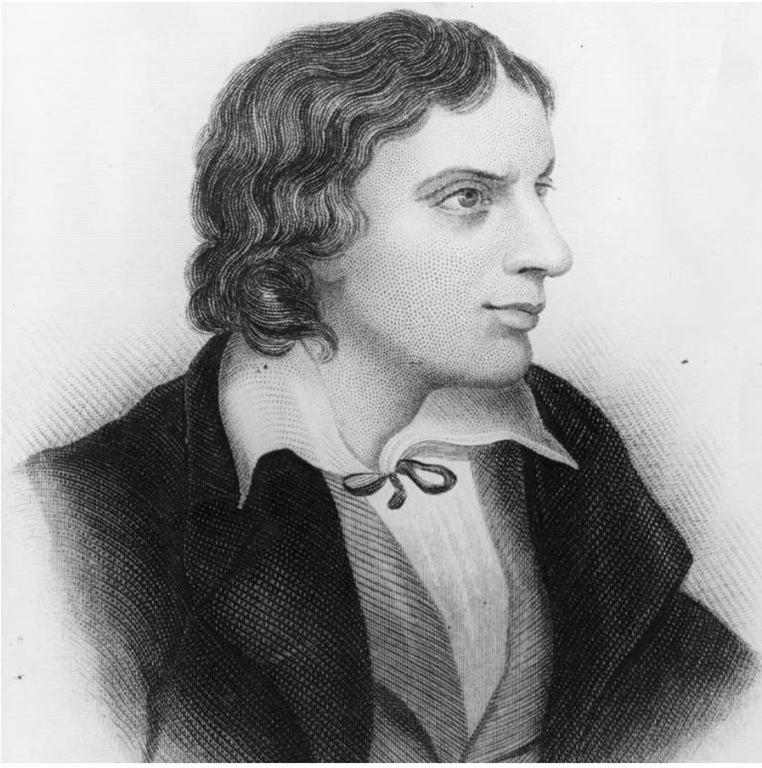
John Keats writes today about old age, which he didn’t get
.
Of the three young romantic poets, all doomed to die young,*** I was team Keats all the way. He seemed the wisest of them, and I could identify with his unprivileged background, and his earnestness about writing. I still remember telling myself that Keats died at 25 back in my twenties, and so I had better get on with my writing. Now past three-times that I don’t allow myself the luxury of worrying what years I squandered in incomplete, mistaken, or mediocre work, or of insufficient promotion of my best stuff, taking comfort that it will all be forgotten, even the best of it. In many cases, we old folks no longer play the immortality lottery, and so forego the costs and damaging mitigations of a busted ticket.
The romantic young Keats writes often of dun mortality while propounding the ardent song of beauty. Let me be clear: in Keats’ case, this dichotomy is more than a stance. Sometimes a young poète maudit risks finding themselves, embarrassingly, surviving – but this wasn’t Keats’ fate. With his medical training and caretaking through to the death of his brother he knew his own tuberculosis prognosis for a full year before he died. He wrote “The Human Seasons” in between that brotherly caretaking and his own onset, and in this poem he presumes a full lifetime, the titular seasons being perhaps a couple of decades each, while he’d be dead in three years. The dying was indeed young, but in consideration there’s these dancing words that still may ask for a tune. Here’s a link to Keats’ words.
You can hear my performance of John Keats’ “The Human Seasons” with the audio player you should see below. Audio player called home? No, likely just a side-effect of the way you view this blog, but I can prescribe that you take this highlighted link that’s been shown effective in opening a new browser tab with a working audio player of its own. Side effects include hearing my voice “of subjective quality,” acoustic guitar, cello, and contrabass.
.
*What about Blake? Nope, not in my schoolbooks, I had to seek him out on my own. Did my textbooks move on to Americans Whitman, Dickinson, and Poe? Yes. From my recall the American Fireside poets may have been already largely relegated out for high school readers, though I knew Longfellow from illustrated children’s books. Then there was some Browning, Tennyson, and “Dover Beach” and finally Frost, Eliot, and Sandburg – those final three still living, literally and in practice treated as contemporary poets.
**Beyond the self-imposed dangers some young people choose or are led into, I don’t want to minimize the real dangers externally inflicted on them: war and oppression exist, and such titanic Cronuses devour children. I’m speaking here of the young who generate or amplify mortal risks because it makes them seem louder.
***Shelley 29, Keats 25, and Methuselah Lord Byron at 36.

