My wife, who I suspect of having some strain of a woodland nymph in her genetic background, is going to take me to her elflin grot this summer – well, an off-the grid cabin on the North Shore of Lake Superior – close enough. During this stay, she will take supervisory woodland hikes where she will photograph fungi and wildflowers as part of documenting that nature is working up to spec. I, one of those who are old, will stay in the cabin and read poetry, a media format that doesn’t require any wired or wireless energy other than the long sunlight of a northern summer.
I’m unsure if this cabin will be explicitly in a bee-loud glade, but such plans make me think of William Butler Yeats, and here’s an early poem of his, written by a 20-something poet amplifying his Irish heritage amid the still extant 19th century fashion for antique fantasy.
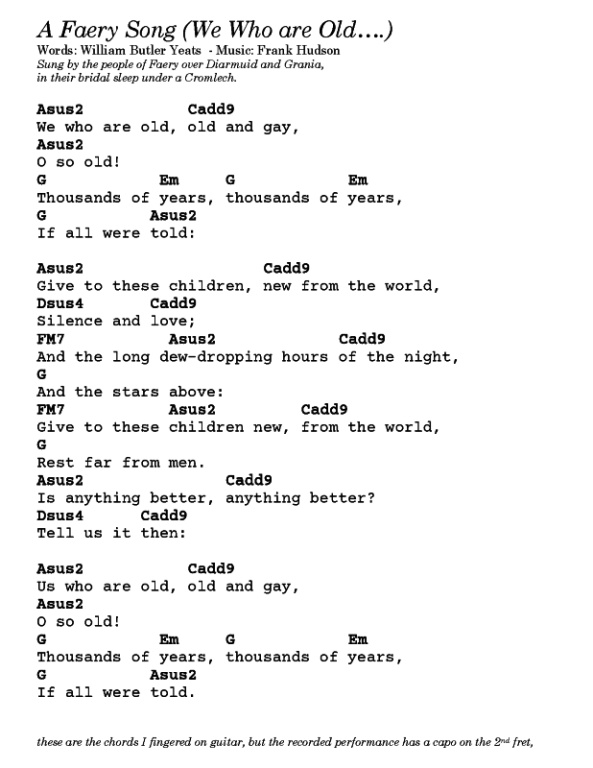
A chord sheet in case you want to sing it yourself
.
Yeats provides context for his lyric poem, with the note: “Sung by the people of Faery over Diarmuid and Grania, in their bridal sleep under a Cromlech.” Is there a tale alluded to there? Yes, and it’s a major part of Ireland’s bardic Fenian saga, set in the 3rd Century reign of king Cormac. The over-riding hero of these linked tales is a warrior with supernatural powers, Finn McCool,* who is the leader of the king’s army. McCool is not the hero of the Diarmuid and Grania part of story however, but a jealous third-wheel antagonist.
The story of Diarmuid and Grania has many retellings, which vary, but the general outline is that Cormac promises his daughter Grania to the aging great hero and warrior Finn. However, before this marriage can happen, one day in court Grania spies Diarmuid, who is a major young hottie of Lancelotian proportions. Not interested in the old Finn and the entire warlord power structure, she drugs Diarmuid with some enchantment potion causing him to carry her off elopement-style.**
There’s a great deal more to the tale, with a major twist that the noble Diarmund resists letting Grania seduce him sexually because he’s warrior-loyal to his leader Finn McCool; and even though the pursuing McCool, the great warrior who commands a literal “and whose army” wants to apprehend and likely kill him, he leaves a pre-Internet breadcrumb trail in hopes that the eloping couple would be found out.
Unless you’re Robert Bly booking your hero’s journey, there’s enough there that you may be wanting to just get on with Yeats’ short poem, but there’s one more detail in Yeats’ note: what’s a “Cromlech” where the fleeing couple bed down? No, that’s not the Gaelic-transcription-name for a low-powered Google notebook used in schools. It’s an ancient tomb made from piles of stones – no gmail or Google docs available there. The faeries looking over the Eros/Thanatos couple hiding in a tomb could have sung Thomas Campion’s loose translation of Catullus if they couldn’t book Yeats.
The skip-ahead reader, without all that backstory, might hear “A Faery Song” as a “Forever Young” blessing of young people by their elders and by the traditions of those elders. That’s a perfectly fine sentiment – and it’s not just some sweet cliché, but one I say is too rarely expressed. It was easy to think that way about the poem as I worked on the music and its recorded performance, being an aged man whose house has several young lovers moving through it. But I think Yeats was, in this context I’ve outlined, offering that ancient heritage, older than any living. may speak to comfort and guide the young, give them rest from the elders in power, from a world of men (gender and species). Of course, that is made from fantasy, faery fantasy. It is a dream of wishes.
I had one other reason to move this short poem up in my “maybe do this one” pile: I’ve been trying to catch up on blogs I follow after the absorption of National Poetry Month,*** and I came upon this post by a friend of this Project Lesley Wheeler where a dream was recounted:
This weekend I dreamed that my problem joints (knees, hips, an ankle that requires babying) were replaced by faery joints (in the dream, I knew faery was spelled with an e!). They looked like cloudy ice or crystal. I like the idea of being a human-faery cyborg.”
While we cannot fully dream anyone else’s dream, poets and poetry can fancy some of their substance. Reading this I figured this in addition: ever light and gossamer wings sprouting from out our backs, devices that would radiate and transfer the sciatica from too many hours sitting with books and blank pages of paper.
Yes, that’s but a dream – but we carry our bodies around to have dreams and maybe to shelter other’s dreams.
My musical performance of Yeats’ “A Faery Song” with that “e” is available to hear with the player gadget below. Has any such player dematerialized? No, it’s the Internet, that enclouded scrying crystal that will suppress the audio player when you’re reading this blog some ways – and so I offer this highlighted link that will open a new browser tab with its own audio player.
.
*All these names were originally in Gaelic, and how they are transcribed into English an inexact science. I can’t say in detail what choices went into rendering the name as “Finn McCool,” but you must admit it’s a most excellent name.
**Patriarchal gifting of daughters is historically accurate if grating. The quasi-sinister date-drugging gender reversal is hardly a clear symbol of women’s empowerment, and just exactly how sympathetically Grania is portrayed varies with the teller. In a play dramatizing this story that Yeats and George Moore later co-wrote, there was friction between the co-writers based on Yeats wanting a more sympathetic Grania. Another variation of the tale says that Diarmuid had a “love spot” on his forehead that caused any woman who looked at him desire him, and so dual-enchantment situation.
***I’m still weeks behind.