I’m going to be out on a limb in this Project’s treehouse of horror this Halloween. How so? With today’s post I’m starting to present what at completion will be a larger musical piece than this Project usually presents, and I’ve decided then to publish this poem setting in sections over a week, as movements or a kind of suite. That in itself is a bit ambitious. Among the hundreds of pieces the Parlando Project has issued, only two strike me as similar. The most ambitious of those two? I set with music all of T. S. Eliot’s Modernist landmark “The Waste Land” – and that piece too was presented here in sections, but it was composed and performed over a period of years. The other similar suite of songs goes back to the formative times of this Project: a series of songs largely written by long-time Parlando collaborator and keyboardist Dave Moore about the pioneering early 1950s late-night horror movie host Vampira – but as I recall, all those Vampira songs were written and recorded before the first one was published here. I knew what I had before I made them public.
Not so with this planned Halloween 2026 piece, which is Conrad Aiken’s narrative poem “The Vampire.” As I woke up this morning, I had a rough idea for the final section, and some music for that section recorded, but no vocals for that. But if I’m going to present this longer poem serially this week, I would need to start with the first section. I had Aiken’s words, and nothing else.
Conrad Aiken: harvest time or sundering time?
.
So after a quick breakfast and glass of iced tea, I was onto composing the music for what will be the first, and shortest, section of Aiken’s “The Vampire.” Working quickly, I started with modifying a drum sequence to use as a guide track for the rest. I next laid down two cello parts, a track using a pair of tape banks from the computer-emulated version of a 1960s’ tape storage “virtual instrument” the Mellotron,* and a clean electric guitar part. Despite the different instruments being sounded, and playing them one at a time, those three tracks were all played on an electric guitar, the non-guitar parts being played thru a MIDI pickup. I finished with an arco string-bass part – that one played on a little plastic keyboard MIDI controller because I want to use its volume wheel to articulate the bowed bass notes. “Real Musicians” and trained composers will recognize the simplicity of these parts. To explain myself, I’ve taken to calling compositions like this “Punk Orchestral.” This is shorthand to explain that just as a melodically simple 2-3 chord rock song played in an entirely non-virtuosic manner can still arguably be an effective piece, so too one might attempt the same thing with instruments we associate with “classical music.” The vocals here are both spoken and sung. I have a limited skill set for this sort of singing, but I’m the one handy to realize this composition.
As we start then with my series of “The Vampire” I feel called to do the Andrew Hickey** thing and warn listeners that this Aiken poem I’m presentingis a dark and distressing fantasy. I had considered a more playful Halloween piece this year, partially because my country and the world has generated non-imagined horrors a plenty. Perversely, Aiken’s poem may have captured my attention because it approaches those current practical levels of fear, terror, and pity – and it has (I believe) a message about the dangers of human fancies. Today’s section of the poem isn’t telling us yet what will occur before we reach the poem’s end, for Aiken opens his story quietly with the world of his poem meeting a distressed and mysterious creature. You can hear it with the audio player below. Has the world darkened, and you can find no such player? This highlighted link is your only hope (and fear) – it will open a new browser tab with its own audio player for the piece.
.
*One tape bank is a Mellotron string section, the other male choir voices. The voices are mixed very low today, for they are off in the distance in this part of the poem’s story.
**Hickey’s long-term project, A History of Rock Music in 500 Songs is amazing and goes further into detail and research on its subjects than even I do on mine. I think Hickey’s project’s title is less attractive than the series is – for yes, music nerds might be up for it, but it’s much more than that: it’s a still unspinning story about history, culture, capitalism, the large caldron of creativity, and racism, and sexism. Hickey is meticulous about warning listeners that they’re going to be hearing more than a treatise on what color a record’s original pressing label is or the most effective settings for a Fender Deluxe guitar amp.
Hans Arp was born split in two. His mother was French. His father was German. I just called him Hans, the name he was given at birth, but he used a French version of his first name as well, Jean.* He was born in Alsace–Lorraine, a set of disputed provinces that were alternatively French and German as wars whipsawed borders. During Arp’s lifetime, those two countries, those two languages, would be fighting as principals in two World Wars. Just by existing Hans Arp could be an enemy alien simultaneously in two ways.
Until this month I knew Arp vaguely as a 20th century modern artist, but while scrolling on Bluesky I saw four lines of an Arp poem that had been translated by Herbert Read as “The Exit To” posted. That immediately intrigued me.
These were eerie, surprising, wild lines – a kind of poetry that has long attracted me.** Was this all of the poem? Could I find it in its original language and work out my own translation for performance? What else could I find out about Arp and his art, visual and literary?
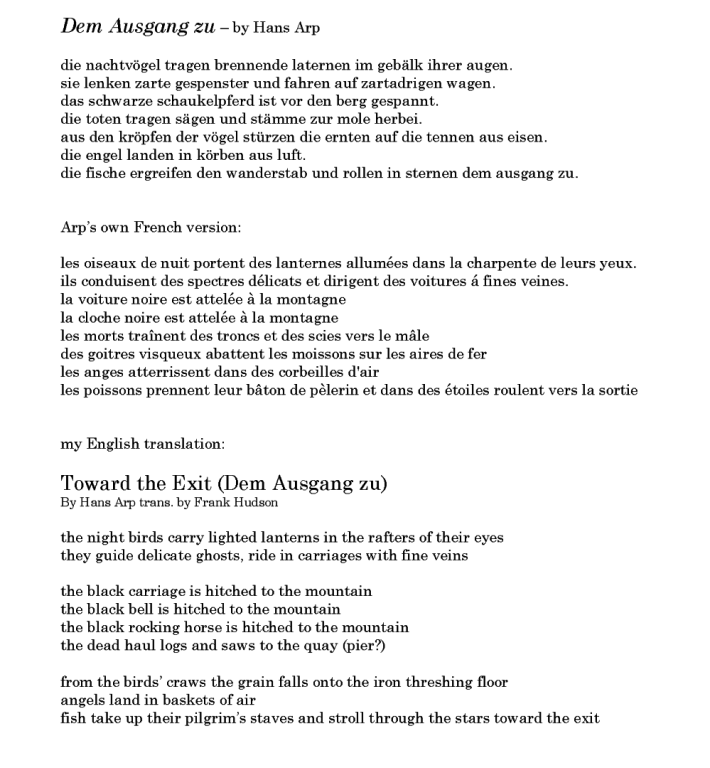
Luckily, I was able to quickly find Read’s 1968 book Arp, which covers Arp’s life and work. The book provides a good number of examples of that work, including not only the entire poem I was seeking in Read’s English translation, but the full text of two versions in the original German (as “Dem Ausgang zu”) and in Arp’s own French translation. Read spends most of the pages on the visual art, but tells us that Arp was a life-long poet that considered his literary work an integral part of his expression.
Arp’s lifetime reflects his dual nature. Born in a then German territory, and soon connected with the early 20th century avant garde in France and Germany, he fled to neutral Zurich Switzerland at the outbreak of WWI. Significantly for the fleeing Arp, Zurich was the birthplace of the nonsense-word-named art movement called Dada.
Dada was formed by young people from all the sides in the First World War, who didn’t want to be on any of the sides offered. As France and the various monarchies ground themselves into doit and wurst on the battlefield, the Dada folks were pretty sure that exuberant non-sense was the best rebuttal. Arp himself dispatched his German draft status by going to the German consulate in Zurich, genuflecting and making the Sign of the Cross at every picture of the German minister Hindenburg there, and making non-sense patterns on the forms. He did not seem to the German recruiters there to have a keen tactical mind, nor the possessor of the cool sanity required to make sacrificial charges and retreats through no-mans-land.
You, valued reader and possible listener, may counter that patriotism and bravery, like poetry and art of wisdom and clarity, are not valueless. I myself am a confused soul. I like to fancy that I, gratefully, can engage with either outlook – a variety. I do weigh and consider that this is a luxury. Earnest warriors and confounding satirists have each expended their lives in dialectic for that luxury in art.
A man such as the great French Surrealist poet Éluard I recently featured here can fight on what I think of as the good side of the two World Wars, and still write Dada and then Surrealist poetry. I know much more about Arp now due to the English poet and critic Herbert Read’s book about him – Read who was a decorated and profoundly discouraged vet of the WWI trenches who became committed to art, pacifism, and anarchism as a result, yet then felt compelled to serve his native country when the armies of fascism were arrayed against his nation in the second World War.
To the best of my initial knowledge, Arp seems like a fine person. Modest, unpretentious though a persistent artist, with a sense of humor and somewhat rare ability among his peers to see value and collaboration with women artists in his circle and romantic life. Spontaneously he took to abstraction in his visual artwork quite early in the 20th century, independently of, and often ahead of other Modernists. He explained this by saying that he felt humans are pretentious when they try to depict nature, and that instead they should create things like nature does – not reflected depictions, but abstract though attractive, palpable things like a stone or leaf.***
So where does that leave him with poetry? Dada enjoyed nonsense of course. Surrealism brought forth odd and even random combinations. We may be more accepting of these tactics in visual object than a poem, but in today’s poem the young Arp is using those Dada and Surrealist tactics in this 1912 poem before either movement had been declared. What are we to make of poetry such as this that seeks to surprise us without the comfort of giving a clear path to a denotative meaning?
We might be attracted to its novelty. We might take comfort in our surprise rather than displeasure in our confusion. We might choose to delight in our sense of disorientation. In the same way that we might enjoy the texture and shape of an abstract sculpture, we can enjoy the words as sounds and texture. But I suspect all these are fleeting things to most of us much of the time. So, let’s look at such Dada verse as Arp’s poem another way, the way I had to in order to make my translation. The world of generative AI could easily produce endless combinations of nonsense, but it’s trained to go the other way, to give us the very thing we’ll think is expected of it. Arp chose his words in German, and then went at it again and chose his words in French. A particular human made a particular set of choices. In Read’s account Arp did intend beauty in his art along with the humor, and he seems absent of any haughty sense of the hermetic artist who means to be misunderstood. He also had a sense of humor. My working understanding of the poem I perform today is that its mood is darkly humorous.
I’ve changed, and think I’ve improved, my last line since I recorded my musical performance earlier this week.
.
Long time readers here will recall my primary goal in translation: find the images and convey them vividly in contemporary English. I’ll continue to do this, even as Arp’s images wish to burlesque and fracture reality. When an AI LLM hallucinates (and we use that very term) we are disappointed in it. When another human wishes to speak of an altered reality we wonder at the purpose, the intent, even unexpressed or accepted-accidental intent. This isn’t stone or wood that’s being shaped abstractly, this isn’t a dollop of paint, these are words we must array to make our human sounds, and we will find it hard to avoid making shards of meaning out of them. Arp may be laughing as he wrote down these words in one language, and then another – two languages that would be fighting and killing each other multiple times in his era – but he’s also delighting in the sound and stretch of his words, and I tried to convey that in English too. In the first two lines I see reflective eyes and mysterious night. In the next three lines, a litany of time and movement constrained by something as old and massive as the mountain.**** I see a tree’s lifetime subject to a timber harvest, long ago logs, then cut down and floating away. The poem concludes with night birds in barn lantern light gobbling a season’s harvest that must then have needed the labor of a manual threshing floor to gather, while the divine (angels) are effervescently seen condensing in clouds (baskets of air). And the final line: (as “when pigs fly” in another idiom) fish are holding their hiking sticks walking through the stars, a rising litany of impossibility leading to a certainty, that the poem and all our human effort will end.
If Arp was to perform this poem at Zurich’s Cabaret Voltaire, would some patrons be availing themselves of the exit? For that matter, how many are still reading this far down in this post of mine, how many will want to hear this poem?
Did Arp intend for that to be in a cryptic poem about the absurdity of life’s effort? I can’t tell, but that’s what I found there, and he surely didn’t intend hard enough to prevent me from finding this.
You won’t have to work hard to hear my musical performance of Arp’s poem. I composed the guitar part in my head, silently, while doing other things this week, visualizing exactly the fingering I would use to play it. That’s something I used to do in my youth, but I can’t recall the last time I did it as an old man. I derived a chord structure from the guitar line for a piano part, laid down a bass line, and worked out a drum pattern, and there you go: angels in a basket of air. The audio player should be luxuriously there for you, brave listener. No player? No, Elon hasn’t muted Starlink, but you can also use this highlighted link which will open a new browser tab with its own audio player.
.
*I’m using Hans Arp as I relied here much on Herbert Read’s book, and Read uses Hans. Wikipedia lists him as Jean, says than name is preferred in English, but there’s a German language page under Hans. Arp seems to have continued to use Hans when speaking German, and Jean when speaking French throughout his life.
** Yes, I enjoy Dada, oftentimes more than I think I would, and I take pride that I work to make fresh English translations of Dada poems publicly available for poetic work that is hard to find online in English, but I have noticed that even my hardy audience, whose attention I’m grateful for, has little interest in this. I cut my recent early Paul Éluard Dada-style poem series short due to lack of interest.
***To give some flavor to Arp sense of unpretentious, humorous absurdity, here’s his 1921 account of Dada first being uttered as a name:
I hereby declare that on February 8th, 1916, Tristan Tzara discovered the word DADA. I was present with my twelve children when Tzara pronounced for the first time this word which has aroused in us such legitimate enthusiasm. This took place at the Café Terrasse in Zurich, and I wore a brioche in my left nostril. I am convinced that this word has no importance and that only imbeciles and Spanish professors can be interested in dates. What interests us is the Dada spirit and we were all Dada before the existence of Dada….The morality of idiots and their belief in geniuses makes me shit.’”
Arp’s last sentence there sums up a lot of my current newsfeed and the pronouncements of our honored and self-sacrificing leader and his cadre of acolytes.
****In the black horse hitched to the mountain litany I thought of an element of Arp’s biography summarized in Herbert Read’s book. Arp joined in and exhibited with The Blue Rider (Der Blaue Reiter) group of artists around the time he wrote this poem, and that brought to mind Franz Marc’s 1911 painting that I visit at one of my local art museums.
In my Human Seasons, I awoke to the first cold morning of fall, and I thought that this just completed Edna St. Vincent Millay musical piece would be just the thing to release and write about today. Oddly, I had started working on the music for this in the midst of summer. Millay’s poem is one of those that sits up on the page asking to be sung, and from such temptation I’d worked up the basic musical idea back in a time when I could hop on a bicycle just wearing the clothes I was wearing around the house. This morning I needed a wind-proof beanie, three layers across my torso, and I had to wiggle into tights. An old man getting into tights is a rickety procedure, a vignette unfitting association with carefree bike rides.
I asked myself yesterday “What did this song need?” How dressed? How many layers? I have been presenting a lot of songs recently featuring acoustic guitar, and the tracks I had from summer were just my voice and guitar – acoustic, yes, but at least there was some variety in that it was my large-bodied 12-string. I pick the 12-string harder than most, hitting the strings with more of the flat-pick surface. This produces a bell-like clang, and I thought I’d underpin that sound with some gamelan gongs. I then added a bass line and thought about a top-line riff. For some reason – woodwinds,* and I played the left-channel part using one of my sampled “Virtual Instrument” libraries with my MIDI pickup guitar. I tried to mix this oboe part to a realistic level as it would be if this was an actual acoustic ensemble playing this live instead of myself playing track by track in a “one-man-band” format. The gamelan gongs? I wanted them distant, as if they were outside the tavern window in the scene of Millay’s poem. The final mix of the song works best on headphones or modern ear-buds, so go ahead and put those in your ears if you have a set handy when you listen.**
In these musical choices I was trying to bring out the mystery I sensed in Millay’s words. “Tavern” could be read superficially as a desire to run a bread-and-breakfast or the like, perhaps somewhere in the Maine of Millay’s childhood. A nice enough way to understand the poem, but Millay put in something that undercuts reading it as a New York Times style section feature on charming getaways: a repeated reference to this inn she envisions being specifically for “grey-eyed people.”
If one searches for what “grey-eyed” might signify, you’ll get the usual cold under-contextualized information that search engines offer up. Grey is a very rare eye color. OK, is Millay saying she’s going to market her inn with some “Think Different” focus on gathering unusual people, perhaps the artists, writers, and bohemian figures of her youthful 1917 Greenwich Village times? Not impossible, but why then does she write about learning from the grey-eyed “long ago.” Is there something else about having grey eyes? There are results that say that eye color is supposed to be a sign of wisdom, including some that report it as an epithet applied to the famously wise Greek goddess Athena. OK, she learned something from the grey-eyed, but that seems an obscure way to say that, though evoking an air of generalized mystery with this grey-eyed matter seems to be part of her intent. The whole casting of her tavern in the poem doesn’t seem selective. It’s near the top of some mountain, but it would seem to be a welcoming place for all who come upon it. Is the voice in her poem going to ask everyone to take off their sunglasses or tinted contacts to see if they’re allowed in “Tavern.” I don’t hear those that arrive pleading at the door: “Look, my fake ID says my eye color right here!”
Another sense I got from this poem is that it was possibly in conversation with another poem, one by Christina Rossetti, her poem called “Up-Hill.***”I don’t know if Millay knew this poem, but it’s not so unlikely. In this case then the grey-eyed are the souls ascending up some mystic mountain toward a heaven or afterlife. They are grey-eyed because their eyes are clouded in the moments after death. One other, allied, possibility for why grey-eyed: her mid-19th century ancestors might have been pictured as early photographs, faces whose colorful eyes would all be rendered in shades of grey. Our poems, our songs, our memorialization, our celebrations around a table – these are to bring colors back to the grey eyed.
Grey-eyed in Carl Van Vechten’s photo, Edna St. Vincent Millay.
.
You can hear my performance of Edna St. Vincent Millay’s “Tavern” with the audio player below. No player on your mountain? Damn your eyes, or rather the way you’re reading this blog which might suppress showing a reader – but this highlighted link will open the door, or new browser tab, with its own audio player.
.
*It would have been subconsciously, but perhaps the mixture of oboe, 12-string guitar, acoustic bass, and unusual percussion may have been a ghostly presence in my mind from the times I saw an admired the musical ensemble named Oregon that used that mix of instruments.
Which reminds me of a tavern joke: An ego and a super-ego walk into a Freudian bar. The bartender says, “I’ll need to see an ID with that.”
**I used to have time and opportunity to check my mixes on various ways to listen to them. I particularly miss my old car for this, as it had a great stereo for revealing aspects of a recording mix. In my current living situation I often have no opportunity to mix my recordings on external speakers, much less give them a quality check with these extraverted noisemakers. A check I still do before release: listen to a new song on at least one pair of mobile-device ear-buds, which I assume are the most typical “hi-fi” system for modern listeners.
I have a fair number of “started” to “nearly-finished” musical pieces, but I for various reasons I’ve not been ready to release one for a week or so. This of course is a weird expectation on my part – it’s not normal to present original music that rapidly. Today is a day with a quiet studio space available where I could work on more, and yet here I am at a computer keyboard typing this.
I spent the weekend oddly enough watching two documentaries made over 60 years apart on people doing visual art. Both gave me resonances compelling me to write about them. The first I watched was a 40-minute piece directed by Ken Russell, first shown on the BBC in 1962, Pop Goes the Easel.
I was led to this film by reading a short excerpt from American history professor Sean Wilentz’s new Bob Dylan biography covering the bard’s early performing years. This is essentially the period covered in the recent Dylan Hollywood biopic, but the level of detail and narrative appears to be at the more granular level a book provides. In the excerpt, Wilentz recounts Dylan’s first trip to the UK in 1962, ostensibly to take a featured acting role in an original TV drama. Turned out Dylan was a washout as a conventional actor, so the teleplay was rejiggered to make him a folk singer who sang some songs, a role that he must have been entirely convincing in, though no video survives. While there, Dylan did what visiting American folk singers habitually did in those days, he absorbed Martin Carthy’s arrangements of a couple of British Isles folk tunes and fashioned them into his own songs.* For habitation, he had to put up with staying in the London flat of a beautiful young woman, an artist named Pauline Boty. Wilentz figures that Dylan got a song out of that too, a somewhat awkward song about a somewhat awkward affair, lashed to a floating-between-lyrics folk tune that I know as “Lily of the West.” **
Wilentz mentions the artist Boty had been in a documentary about young artists, and I found Russell’s Pop Goes the Easel online here to watch. After the tweed-suited and stiff to the point of parody series host intro,*** the film starts with the only artist in the movie I knew anything about before this month, Peter Blake. Blake is found, slightly chunky, closely approaching 30, bearded, dressed in work clothes, sawing on a door (I cannot help but make the Blakean pun that he’s cleansing the doors of perception, to be what they are: infinite). We are then led to a pair of younger, good-looking men of the narrow tie and nicotine milieu, who like Blake are making Pop Art out of the commercial detritus of contemporary culture: comics, SciFi prognostications, movie and pre-Beatles pop stars. Like Blake, we see them making their art and earnestly talking their gallery catalog place cards about it. Intercut are scenes of them cavorting in a clearly French Nouvelle Vague way about London and at a circus midway. Among these three young men, a beautiful woman also appears as part of the group, and the documentary’s final segment lets us know she’s the fourth artist. This is Boty.
All these 20-somethings are a bit self-consciously playing roles, but Boty is better at it, easily more charismatic. One quickly sees how she achieved the sobriquet “The Wimbledon Bardot” – but here’s the punch-line, the kicker: her artwork is also easily the equal of the three men. Not to slight those men, all of whom are clearly serious as the French would say about their art, and all of whom would be still making art into their eighties and into our current century. Boty though died Keats-like at 28 – her illness, cancer, a few years after this film was made. Maybe less than two-dozen of her art works survive. The film doesn’t show this of course, no more than Russell’s film knows it’s being made within a year of when Bob Dylan revolutionized song-lyrics or the Beatles made self-contained quartet bands of young artists a model to follow. But we as modern watchers are able to appreciate the unheard music on that black & white TV Grecian Urn as we hear the films found sound-track of pop music hits from the “decade” of the early 1960s that happened before The Sixties™.
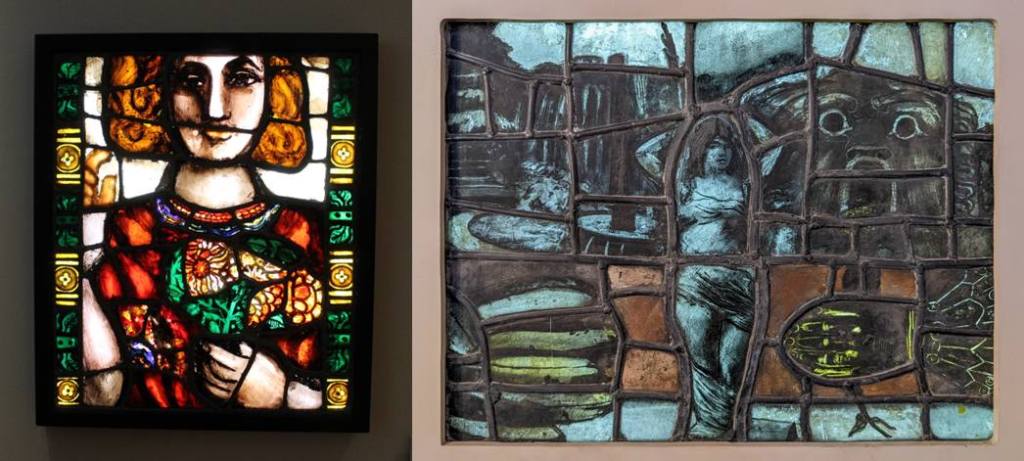
Only around a couple dozen of Pauline Boty’s art works are known to have survived. Some of her early work used stained glass, and here are two examples.
.
And then the next day of the weekend, I watched Who Is Martin Mull, a long-story-about-how-it-got made documentary about the singer/comedian/actor/visual artist Mull. In place of Ken Russell we have a work helmed by Bob Saget, a club comic and actor who admired Mull’s work. Apparently filmed over a period of years with extensive interviews and scenes of a 70-something Mull in his home studio working on his visual art, as well as testimony from friends and family about Mull’s character and achievements. Then in 2020 Saget unexpectedly died from a lonely hotel room closed-head-trauma injury after a fall on tour. Then in 2024, subject Mull died at age 80. From subsequent efforts of others, the film about a dead “cult figure” class actor made by younger sort-of-famous comic was completed this year. That’s remarkable, but it would generally promise to be either a work of the “you didn’t know all the dirt about” or the “gee, he’s dead, let’s all say nice things about ‘em” sort.
It’s not. It’s tender and relaxed about telling its story, and the story is a man who at the age in life of our British quartet of pop artists, and just four or so years later than them, graduated from a prestigious American art school. Just like the Pop/Easel artists, this American’s work seemed to be based on reexamining how we view the world through our commercially infused culture and art. His family, or at least his father, put no value on visual art and artists, and perhaps the US puts less value on art that the UK did or does, but Mull never envisioned the lottery work of trying to establish an artist’s career. As it turns out, he was also musically talented, and the suddenly post-Beatles and Dylan world offered work for musical performers. This is where I knew Mull’s work. In 1970 he had a fluke C&W hit when a gender-playful answer record/parody song of his, “A Girl Called Johnny Cash,” was recorded by a Nashville singer, and he began to tour himself as “Martin Mull and his Fabulous Furniture.” It was a weird act, but one that you might see reflected in others’ performing acts: Steve Martin, Biff Rose and Leon Redbone, or in other comics who would bring an instrument on stage like the Smothers Brothers, Neil Innes and Eric Idle, or folk musicians who told comic stories like Billy Connolly or even Leo Kottke.
But Mull the performer was his own thing. His act was performed in persona, a smarmy chap who deconstructed the nature of performance and audience expectations. The bit I remember most was his presentation of young white folks getting into the Blues by playing bottleneck slide on a ukulele using a nipple-equipped baby-bottle. The difficulty of the trick? He had to make that inefficient pairing work musically. How well could he make it work? He might be performing it while opening for an act like The Allman Brothers at some early 70s hippie musical ballroom or theater show. Live recordings indicate the joke went over, and the minstrel show critique inside the bit must have been absorbed by some.
After working that act for a decade or so, he transitioned to becoming a comic actor in TV and movies. It paid the bills. He found a happy marriage. Had a kid. Got old. But remember, that’s not the story. His story is an aged-American version of the young UK Pop/Easel artists in a way. The story is: he is, always was, a visual artist. He paints. He always paints. This might sound – the danger is it sounds – like a “weekend painter,” the hobbyist who paints to relax. But he insists – and the testimony of others in the film buttresses this – his constant internal conviction was: he’s an artist and the other stuff was just a “day job.” The amount of work, the decade after decade length of its effort, the variety and quality of that work, says this is not some vain-glorious affectation.****
.
The part that moved me the most? The scenes of Mull gratefully working on his art in his 70s in his studio space. This is inescapable: I think: that’s me – but the possible diagnosis of vain-glory is a differential yet to have all the test results returned for my case. It appears that, at least in general, Mull knew he was good. He did the work to make his work seem skilled to others. I can’t say the same for my own work, which I think has value, and also imperfections.
As my day progressed, I had to know the song Dylan is supposed to have written to visual artist Pauline Boty in 1962, and the surest way for me to know the song is to perform it. “Liverpool Gal” kept deep cover, even after decades of Dylan instigating the modern Bootleg/Special Edition album. For most of its life it was known by a single obscure performance of it done by a little-known act Lennon & Hyam live for a BBC radio broadcast in 1992. How Lennon & Hyam heard the song is mysterious. It wasn’t until a year ago that a rough performance by its author emerged, taped at a party in Minneapolis by local musician and writer Tony Glover back in 1963. Dylan stumbles on his own lyrics in that recording, and the song differs slightly from the Lennon & Hyam version. I quickly cobbled together a third version and a quick and dirty arrangement for acoustic guitar and my voice of subjective quality. Quickly – my studio-space time was now limited – I did four takes all the way through, the last one was the best I think. I call my interpretation “London Gal” as it dispenses with the appendix of Liverpool origins to a London-set story. Even cutting the final (dispensable) verse in my version, it’s a long song, over 7 minutes, ambling along in its plot like many a traditional folk song. Here it is via an audio player gadget. No gadget seen? Lennon and Hyam didn’t steal it to protect their monopoly position, and Tony Glover has joined the blues-harp choir invisible, but I also offer thishighlighted link to hear it via a new tab which will supply its own audio player.
.
*For Dylan, “Masters of War” and “Bob Dylan’s Dream” tunes were copped from “Nottamun Town” and “Lord Franklin” via Carthy. Paul Simon swiped a guitar arrangement for “Scarborough Fair” from Carthy on an early Sixties UK trip of his own. The Folk Process is promiscuous.
**Wilentz makes an interesting point: this early Dylan “love or something like it” song is a predecessor to the kind of complex songs about romantic relationships and power-relations that would become a Dylan specialty. This kind of writing seems so embedded in Dylan’s songwriting that it would probably come out anyway, but a moot court case could be made that Boty engendered it.
***Oh, let’s give Huw Wheldon his props: he was a decorated D-Day landing veteran, and as a producer he not only helped introduce Ken Russell, he boosted David Attenborough, and later Sir Kenneth Clark’s mighty Civilization series. His host job was largely to act as a flack-catcher to divert fellow Greatest Generation types from strafing the BBC for giving attention those frivolous young people.
****I gather the fine art world doesn’t truck much with the person who isn’t publicly artist first, not hyphenate – allowed to be an artist who becomes a celebrity, but the reverse is suspect of affectation. And there’s nothing in the film that says Mull did the grants application and hob-nobbing prerequisites for most modern American arts careers. He was AARP age before he had his first small gallery show.
I was reading a social media thread this week and John Keats name came up as a youthful gateway into poetry. Being a long-obsolete child, I don’t know if 21st century young people, and particularly young Americans, are introduced to Keats and the British Romantic poets in high school as I was, and as I suspect many of my ancestors were. It would be good to establish that the time of my youth was another era. Poetry was probably a bigger part of the arts, the arts an obligatory part of education, and we were only about a generation past the late 1920’s American poetry anthologies for young people that were oversubscribed with UK authors. We got Shakespeare and Milton and a smattering of 17th century poets from before the Americans even got up to bat, and we moved on to the principle British Romantic poets: Wordsworth, Coleridge, Byron, Shelly, and Keats.* The last three easily attractive to the adolescent mind and emotions.
That trio’s language was close enough to modern while far enough removed to seem a little exotic. The emotions in the poems, anger, desire, dread, disdain, close to the skin.
Did it help that all three could be fitted into foundational “live fast, die young, leave a beautiful corpse” models? Why is that stance catnip to so many young people? Is it a force multiplier for their considerations and thoughts to add as context that they are distressed, senses intent or bent, experienced in risk taken and disregarded, living or not caring about mortal danger?** Does that sound harsh to say? Well then, I sometimes see myself reaching for the same imminent mortality filter in my old age. Poets don’t necessarily outgrow this reflex.
It probably helped these poets that back in my youth we barely had our Buddy Holly and James Dean, and as yet no full constellation of dead young music and movie stars to compete with poets.
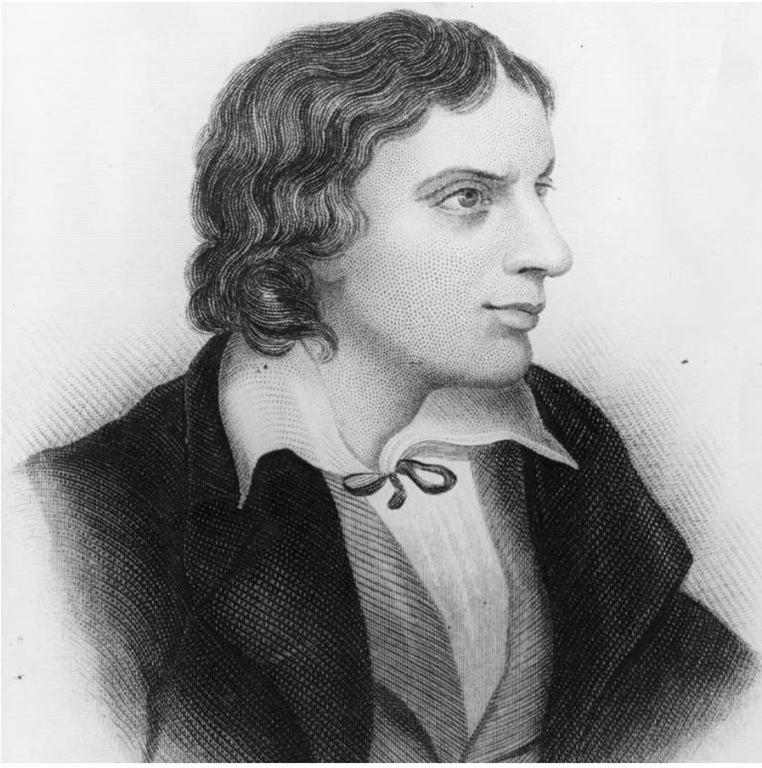
John Keats writes today about old age, which he didn’t get
.
Of the three young romantic poets, all doomed to die young,*** I was team Keats all the way. He seemed the wisest of them, and I could identify with his unprivileged background, and his earnestness about writing. I still remember telling myself that Keats died at 25 back in my twenties, and so I had better get on with my writing. Now past three-times that I don’t allow myself the luxury of worrying what years I squandered in incomplete, mistaken, or mediocre work, or of insufficient promotion of my best stuff, taking comfort that it will all be forgotten, even the best of it. In many cases, we old folks no longer play the immortality lottery, and so forego the costs and damaging mitigations of a busted ticket.
The romantic young Keats writes often of dun mortality while propounding the ardent song of beauty. Let me be clear: in Keats’ case, this dichotomy is more than a stance. Sometimes a young poète maudit risks finding themselves, embarrassingly, surviving – but this wasn’t Keats’ fate. With his medical training and caretaking through to the death of his brother he knew his own tuberculosis prognosis for a full year before he died. He wrote “The Human Seasons” in between that brotherly caretaking and his own onset, and in this poem he presumes a full lifetime, the titular seasons being perhaps a couple of decades each, while he’d be dead in three years. The dying was indeed young, but in consideration there’s these dancing words that still may ask for a tune. Here’s a link to Keats’ words.
You can hear my performance of John Keats’ “The Human Seasons” with the audio player you should see below. Audio player called home? No, likely just a side-effect of the way you view this blog, but I can prescribe that you take this highlighted link that’s been shown effective in opening a new browser tab with a working audio player of its own. Side effects include hearing my voice “of subjective quality,” acoustic guitar, cello, and contrabass.
.
*What about Blake? Nope, not in my schoolbooks, I had to seek him out on my own. Did my textbooks move on to Americans Whitman, Dickinson, and Poe? Yes. From my recall the American Fireside poets may have been already largely relegated out for high school readers, though I knew Longfellow from illustrated children’s books. Then there was some Browning, Tennyson, and “Dover Beach” and finally Frost, Eliot, and Sandburg – those final three still living, literally and in practice treated as contemporary poets.
**Beyond the self-imposed dangers some young people choose or are led into, I don’t want to minimize the real dangers externally inflicted on them: war and oppression exist, and such titanic Cronuses devour children. I’m speaking here of the young who generate or amplify mortal risks because it makes them seem louder.
***Shelley 29, Keats 25, and Methuselah Lord Byron at 36.
Longtime followers of this Project will know that I’m a proponent of early 20th century Chicago Afro-American poet Fenton Johnson. The “elevator pitch” for Johnson is that he slots in between Paul Laurence Dunbar and the slightly later Harlem Renaissance. Back then, prominent contemporary Black critics such as the remarkable polymath James Weldon Johnson categorized Fenton Johnson’s work as altogether “radical” and “full of despair,” enough so that they were of mixed feelings about the value of his verse.
Fenton Johnson’s poetry does speak at times of hardship, oppression, even hopelessness, but upon further reading of his overlooked work, there’s a side of him that’s aspirational. In his short-lived attempts to establish an Afro-American focused journal he presented himself as a conventional Black Republican, perhaps hoping that the Reconstruction era of his elders could still be invoked.* In addition, there’s another facet in his poetry: elements redolent of the modern Black Gospel music tradition which was forming up in Chicago while he was actively publishing just before WWI. The folks creating that music were attempting to fuse decidedly Black secular music like the Blues and Jazz with the older (slavery era) strains of spirituals and preexisting hymnal songs. If the somewhat younger Langston Hughes gets due credit as a premiere Jazz poet, Fenton Johnson seems to me to have been trying to do the same thing with his poetry and Afro-American gospel.**
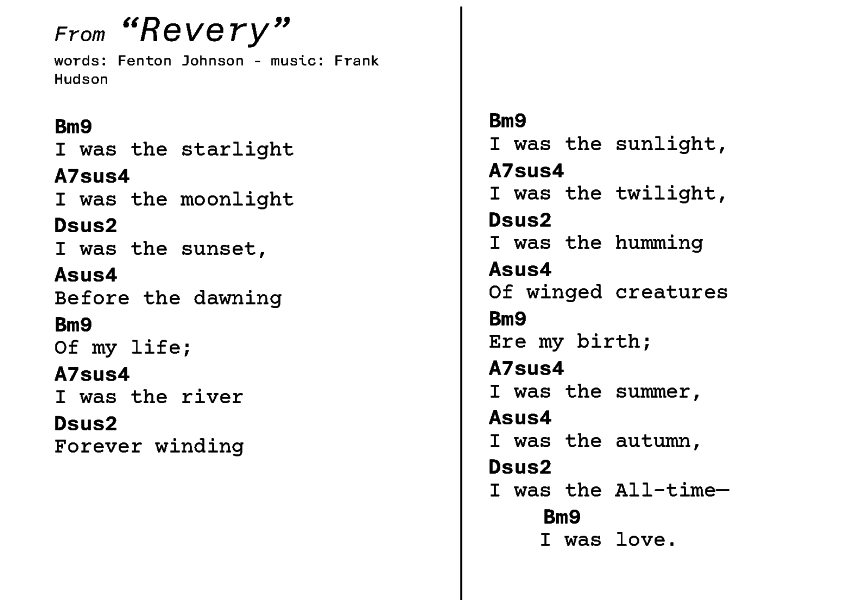
I could go on about Fenton Johnson, but instead I’ll try your attention by finishing up today by talking about making a musical piece out of his poem “Revery.” Earlier this month I for some reason saw the text from which I adapted this week for my performance. Published in 1915, “Revery” is one of the small number of Johnson’s poems available at the poets.org site. Reading those words, it struck me immediately that they could be a hymn to the Creator – or one could read it as a recounting of the “oversoul” that passes in an out of human lives. Having gone through September anniversaries for death and birth associated with Jimi Hendrix and John Coltrane, this poem attracted me. I started by thinking I’d condense Johnson’s published text to more succinctly bring out that sense of soul essence passing through our human lives. While I think I retain the “The Creator Has a Master Plan” sense of the poem***, in a human-limited lifetime I could see the result being used at a funeral.
The link above will show you Johnson’s full poem, which I shortened in my adaptation for performance.
.
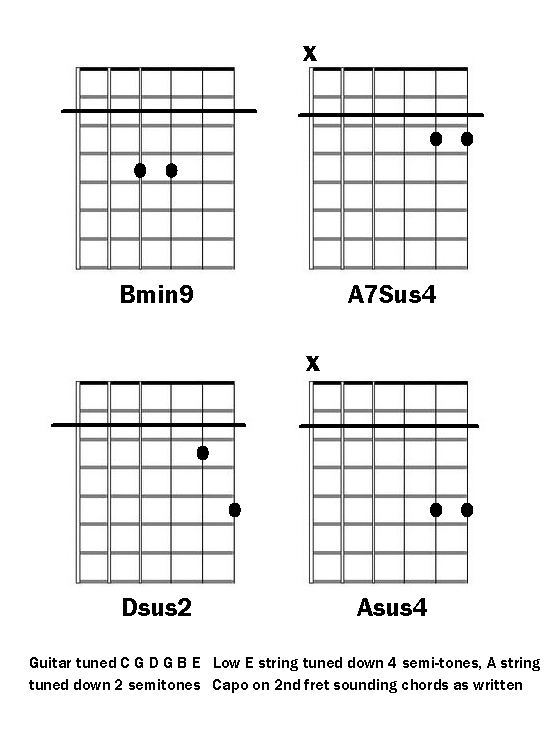
Beginnings of musical pieces have quite a variety of first movers for me. This one started when I saw a new-to-me voicing for a Csus2 guitar chord. Sus is short for a suspended chord, a favorite of mine. The sus recipe is to drop the 3rd of a chord, the note that makes a chord major or minor – even in a basic simple 3-note triad – but then put something else in its place. In a Csus2, it’s the second degree of the scale, D. From what I understand in classical harmony, sus chords are considered an unstable, transitional chord, one that traditionally asks for a quickly following major or minor 3rd decision to resolve it. Me? I don’t mind sounds staying out there in an unresolved fog for a good long time. I began to write the whole song with three sus chords and one minor 9th chord. To better fit my voice, I used a capo to shift the Csus2 voicing and the rest up two semi-tones, and if the minor9th is the resolving chord and key center, the recording of the song is in Bminor.
The alt-tuning and easy to finger guitar chord forms I used for this song. That A7sus4 could be given other names, and I think it has some sort of G flavor as I sound it. The 3rd chord in the picture, the one that started off the composition, has a so much deeper sound that the common conventional tuning Dsus2 voicing.
.
I’ve been doing a great deal of work in my studio space in the past month or so. Lots of multitudinous clean up and organizing work – rejiggering what goes where recording-wise and seeking a richer environment for my keyboard playing compatriot Dave to record there.**** All the bending and crawling around really challenges my elderly body – and my memory taunts me, recalling running some of the connections I was changing when I was a much younger man for whom diving under a desk or contorting myself to work in the backside of a low equipment rack was routine. I took a break, not even half-way done in this, and told myself I should allow my aching body a creative vacation day. And that was the day when I recorded this setting of Fenton Johnson’s “Reverie.”
I was feeling tremendous gratitude when playing this. I was using equipment accumulated slowly over decades arrayed in an ugly looking space that still had piles and boxes of stuff from the re-org to sell, give away, or store properly – but that ugly looking place sounds fine. In my monitoring headphones and when listening to the recording tracks later I was pleased as how well my space sounds. Some famous studios with envied sounds were not purpose-designed and architected rooms. Motown was a residential basement. Its reverb chamber was the house’s attic. Sound Techniques where Joe Boyd and John Wood produced the recordings of Nick Drake and the cream of British folk-rock was upstairs in a former dairy with a naturally reverberant high vaulted ceiling and slate-lined walls. Stax in Memphis was a neighborhood movie house, the floor still slanted to accommodate the now absent movie chairs. Bert Jansch and John Renbourn’s first significant LPs were recorded in an ordinary London flat, the sound treatment: whatever the odd furniture was in it.
My space? Low ceiling, and noise from those in the floor above can easily be an issue, but it’s irregular in floor plan without any complete parallel walls. Sound treatment? It’s frankly clutter and happenstance. Today’s piece is a simple, unadorned recording. The recorded solo acoustic guitar has no reverb or delay, what you hear is just it and the microphones in this odd shaped room where I’ve recorded since the 1990s. You can hear me rebroadcast the soul of Fenton Johnson from there with the audio player gadget below. No player to be seen? Has it passed over the horizon in the meat-wheel of rebirth? No, it’s just not displayed within some ways of reading this blog, and so I supply this highlighted link that will open a new browser tab with its own audio player.
*It may be confusing to 21st century readers, but before the New Deal era, the businessman oriented Republican party that was already associated with some conservative cultural stances was in the matter of Black Civil Rights still the Party of Lincoln, however weak that association had become.
**This working theory of mine is not (AFAIK) supported by any deep scholarship – it’s just a reasonable supposition by someone like myself with wide interests in music, poetry, and history. Remarkably little seems to be extant regarding Fenton Johnson’s privately expressed thoughts over his lifetime, and even those who knew him later in his life are now likely dead. A younger scholar interested in Afro-American culture could well take up investigating him.
***If you click on the link you’ll get a 34 minute Pharaoh Sanders spiritual Jazz piece that eventually meets up with an unforgettable vocal by Leon Thomas. Do your ears feel like praying for half-an-hour? I’m listening to it now as I finish formatting this for the blog.
****His keyboards can now be more often recorded in stereo. I now have a different vocal mic that may better suit his voice. When we record “live in the studio” we use loops I create with sequenced drums and bass, and these are now going to be separated tracks in my new plan and routing. We’re not going to start sounding like a Steely Dan record or anything, but the plan has promise.
In writing about Sara Teasdale last time here I mentioned that she has been grouped with a set of 20th century female poets as a “Songbird Poet.” The implied charge here is that these poets are less concerned with the deep meaning of poetry and are content to just make pleasant word-music.
If we are to attend the deeper meaning school, I’d have an opening to report that in nature the songs of birds are not all pleasant and meaningless – for they sing for desire, for companionship, to legislate territory, and for existential defense among other things. If birds are likely deficient in theology and philosophy, I’m too ignorant to know if a sense of avian metaphor is present.
I, of course, am being stubbornly literal there, Teasdale appears to be without feathers and everyone should know this, save for those who are sure the female mind is insufficient and therefore may have doubts. One of the things we may claim as humans is that we are a flexible sort of creature of many moods and levels. One kind of song, one kind of poetry? There’s no handy phone app that can identify our songs as one sort of human.
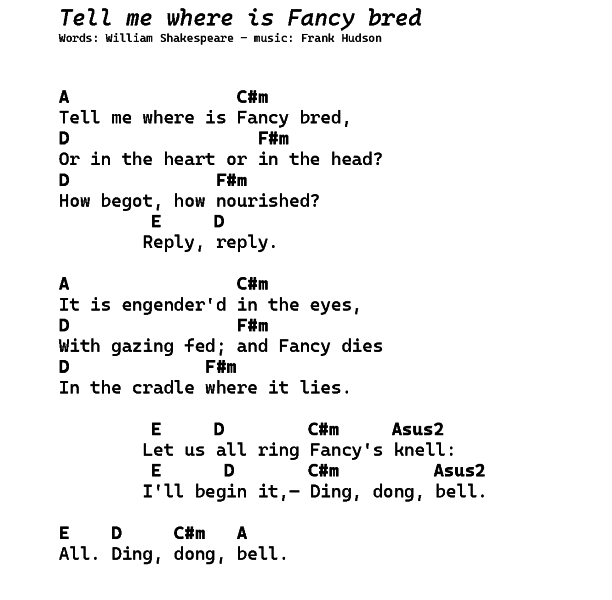
So, even if calling them “songbird poets” is plausibly belittling, as a person in this Project I have to say that making a song, something one appreciates uttering, can be a worthwhile thing. Here’s another minor poet who I’m sure we’ve kept in a parlor cage as a songbird, one William Shakespeare. This tidy little song, from his play The Merchant of Venice, talks about idle, surface-deep, love (“Fancy”). But wait – like is often the case with the Songbird Poets, there’s a more complex message inside it. In the play, one of a pair of lovers is given a test: a choice of three boxes and selecting the correct one will allow them to marry. Shakespeare, prefiguring the ding-dong theme played when the Jeopardy game-show contestants are making their final answer and wager, provides this song to fill the stage time as the lover thinks it over.*
I made a point to write this one entirely with my ham-handed skills on keyboards.
.
As a poem it seems simple doesn’t it. Sure, there’s some now-archaic language in it, but to modern readers or listeners, that probably only makes it seem more the nursery rhyme.
But it turns out there’s a little bit of metaphysics in the modest verse: where does “Fancy,” that insubstantial, fickle, flimsy love come from? From the mysteries of the heart and its desires? From some reasoning of the mind? Nope. It’s all from looks – all “I’d hit that” surface the singer warns – it’s hardly born, and it’ll die. Finally, the singer asks us to celebrate the death of that kind of infatuation, and joyously ring its funeral bell, as time is up and the lover must make their decision.
So, is a little song like a Fancy: never more than a flimsy, momentary thing? Or can it tell us something about food, partnership, where we are, where the predators are?
Well in the present case of my performance of Shakespeare’s song, I’m the dun, leaden box since I needed to use my voice for this, and I made a simple pealing accompaniment with a viol, a reed pump organ, and a harpsichord. You can choose to hear it with the audio player gadget below. No gadget? It hasn’t flown south in a honking V arpeggiation, it’s just hiding in the brush cover of some ways of reading this blog. I offer this alternative then, a highlighted link that will open a new tab with its own audio player.
.
*I believe that none of the music used in Shakespeare’s plays in his lifetime has survived. Merv Griffith, himself a gameshow host and producer, wrote the tune used on Jeopardy. I haven’t watched that long-running TV show in decades, yet his tune (in its original version) is still stuck in my head.
Well, as more-or-less promised, here’s a return to literary poetry that may probably meet audience expectations: a season-appropriate poem by American poet Sara Teasdale titled “September Midnight.” Teasdale’s been a long-time favorite here, which goes back to one of my models of setting literary poetry to music. She’s one of a group of American female poets firmly in the early-20th century Modernist era, reflecting by degrees a Modernist outlook, but without adapting Modernist poetic language and prosody. Others I’ve presented here multiple times with this stance would include Edna St. Vincent Millay and Elinor Wylie, or even Dorothy Parker and Margaret Widdemer.
Canon-wise I sense a push-pull with these poets. On one hand they provide a female poetic outlook that coincides with important cultural movements for women’s equality, but on the other hand they – somewhat like the “Georgian Poets” in Britain – get marked down for not getting on with the new prosody. Of course, sexist blinders enter into this – the very idea of writing from a woman’s perspective is still often weighed as “slight” by the male dons of poetry, who might be Modernist in verse but old-school patriarchs regarding what’s important. For much of their century, the more through-going Modernist women poets like Amy Lowell, Marianne Moore, Mina Loy, and H.D. had to dance backwards in high heels while Robert Frost’s metrical-syllabic net balls were allowed to freely score points with vers libre Modernists.
And all this happened as it slowly dawned on the summary American literary establishment that Emily Dickinson was quite possibly America’s greatest poet. All of which doesn’t necessarily make Sara Teasdale some sort of upper-level-of-the-Pantheon “great poet” in current 21st century estimate.*
Which brings me back to a point I make repeatedly: poetry isn’t some serial single-file hierarchy, which might well direct us to only read the top ten or so – or to carefully guard against anyone paying the slightest attention to poets ranking numbers 238 and below or something. Poetry isn’t poetry, singular – it’s poetries.
Poetry like Teasdale’s likes to be sung out loud, even if there are elements of old-fashioned poetic diction that come along for the ride. That means that this Project puts it thumb on the scale for her work.
Teasdale was a contemporary of T. S. Eliot in St. Louis Missouri, then a commercial hub in the middle of the U.S., but like Eliot her family has roots in New England. Like Dickinson, I can sense the American spiritual thread of Transcendentalism in her fabric, particularly when she writes about nature, as in this poem. Transcendentalists tend to see nature not simply as a handy metaphor for the divine or highest reality, but the very incarnation of it. Transcendentalist scripture isn’t a bound book of thoughts and laws, it’s the Book of Nature, observed.
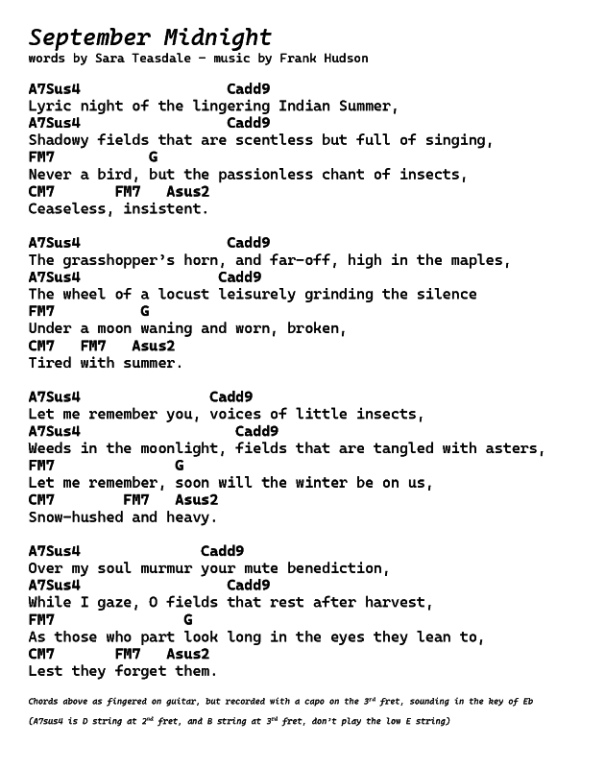
Chord sheet in case your grasshoppers and locusts want to sing this with you.
.
So besides falling easily into a singing voice (even one as limited as mine) her “September Midnight” is a Transcendentalist hymn I think, and the lesson it wants us to take after our breath and voices finish with it is that we do not presume to go to some heaven after we die, but that heaven (as in the sublime reality) is with us in the creation we are presently living.**
My song performance of Teasdale’s poem can be heard with the audio player below. If there’s no audio player to be seen, it’s not that you’ve forgotten our present heaven, but more likely that the way you’re reading this post eliminates showing the graphical audio player gadget. “If the doors of perception were cleansed everything would appear to man as it is, infinite,” wrote Blake. I write that you can click on this highlighted linkand a new browser tab will appear with its own audio player – not quite the same thing, but there’s music in it.
.
*Rankings inevitably become silly, and it’s hard to keep them contained into casual, personal preferences – but still one can fairly observe a 20th century progress with Dickinson from “somewhat interesting and eccentric” to “wow, there’s some deep stuff incredibly condensed into its own original and attractive prosody.”
**I’m thinking today of Annie Dillard, whose work I paid some slight attention to back in the Seventies where parts of what we later think of as The Sixties™ happened. I saw in an obit that she’s yet another American figure who left off from poetry to find an audience. Her one book of poems was quickly eclipsed by the audience for the prose of her second book, Pilgrim at Tinker’s Creek. Dillard’s “Tickets for a Prayer Wheel” briefly returned to print more than 20 years ago, and I’ve located and ordered a copy of it.
(Note: as I was proofreading this post, a notice came back that my order for “Tickets for Prayer Wheel” has been cancelled – now unavailable from that store. I’ll try to re-order this afternoon.)
Perhaps there are some out there who think 4 minutes of raging electric guitar isn’t enough, so I spent the afternoon today making a video release of the full nearly 9 minutes of my 2026 Jimi Hendrix Memorial piece. Here also are a couple follow-ups after that longish post last night.
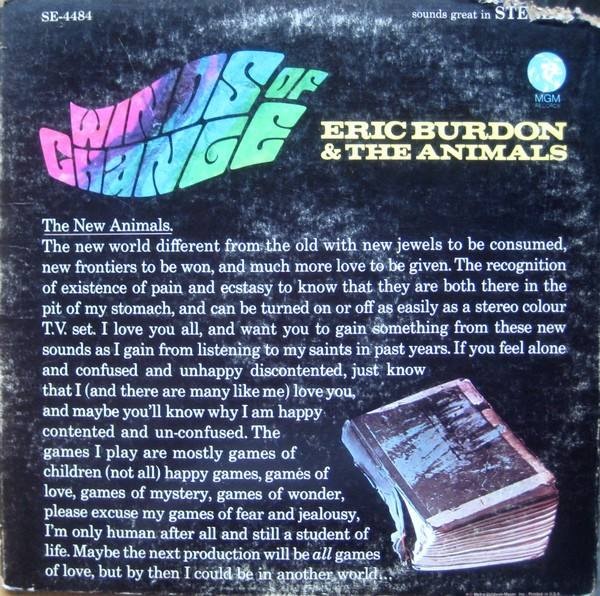
I wrote yesterday that Eric Burdon might have recorded his answer song “Yes, I Am Experienced” before the Jimi Hendrix Experience’s debut LP and its title song “Are You Experienced?” were released. I should have double checked that unlikely event, because that’s highly unlikely. Both groups, the Experience and The New Animals were forming and recording around the beginning of 1967, but Are You Experienced was released in the Spring and the New Animals’ “Winds of Change” album with the song I borrowed some words from was put out in Autumn.
Let me say a few more words about the New Animals’ LP though. Regardless of its unalloyed embrace of 1967 hippie ethos and the plausible charges of over-reach by Burdon as a wordsmith, it is a unique mix of spoken/chanted word with full-throated singing by the acclaimed singer. The new band was talented. It was produced by one Tom Wilson, the incredible Afro-American producer who had worked with Sun Ra, Cecil Taylor, The Mothers of Invention, Bob Dylan, Simon & Garfunkel, The Soft Machine, and the Velvet Underground.* Besides the song I borrowed some remembered words from yesterday, the LP’s title song chants the praises of a number of other historic and contemporary musicians. There’s a strongly sung expansion of the Rolling Stones “Paint It Black,” and the witty (and Top-40 charting) song lauding Burdon’s new hometown of San Francisco. The spoken word highlight for me is “The Black Plague” a Poe-worthy tale of class paranoia and separation.
It’s not everyone’s cup of tea. Burdon is audacious to pretentious. That’s part of what I love about him and this album, and I’m probably guilty of every sin he can be charged with, without the grace of being able to sing as well as he can. I was trying to describe how odd it is to my wife today by saying that the well-known LP it’s most like in its oddness is the Patti Smith Group’s debut Horses. With “Paint It Black” it’s got its boldly recast cover song ala Smith’s “Gloria.” Like Horses “Elegie” and “Break It Up” it has its Hendrix related and praise-for-departed-inspirational-artists songs. Weird tales? Smith “Birdland” has its considerable incantatory power, but the tale of Burdon’s “Black Plague” increments in it’s stately telling. Both band’s frontperson is comfortable slipping between spoken word and singing. And, of course, Horses isn’t for everyone either. AFAIK, Patti Smith has never spoken about any fondness for Burdon, but it wouldn’t surprise me that Lenny Kaye might have had some appreciation for the Animals, New or otherwise.
.
Much of the work in making the video came from finding and appropriating the photos of Hendrix and the New Animals I put in it. Most of the places I found them didn’t credit the photographers –and they should be credited. I increasingly feel bad about not doing that for videos. Luckily for my conscience, I have access to a couple of stock photo and video clip libraries as benefits to two programs I use, but their off-the-rack blandness can be unsatisfying too, although I worked to spice them up with some composting tricks in this one.
At one point I thought ethical AI might be a way out. I used Adobe’s Firefly product during its beta stage, which claimed to be trained only on work they had licensed. I even used it extensively for one of my Hendrix memorials a couple years ago. But there are more issues with AI than just training sources, and the stuff still produces mostly horseshoes and hand-grenades approximates. I like the additional audience that videos can bring, but these things keep me concentrating more on recordings.
.
*There a movie, documentary, book, something that should be made about Tom Wilson. What’s been tried at article length hasn’t found many sources, and death has claimed most of the artists he worked with. Maybe the best that could be done is a novel or roman à clef film imaging what his life must have been like for him.
I worry some that I’m shorting my appreciated audience its rations of expected poetry, what with the recent series of poorly received short Dadaist French translations – but if there’s one thing guaranteed when working in this self-managed Project it’s that I can go where chance and mood takes me. For those wondering if I’ve left more conventional poetry behind, I ask for a short dose of patience – I have variety in my soul, and I’ll be back to that soon.
But not today. Today this thing where Music and Words Meet will be about words meeting music.
Almost every year this century I’ve taken to noting the anniversary of the death of the American musician Jimi Hendrix. Initially it simply meant that on the morning of September 18th I’d plug in an electric guitar, turn the amp up loud, and play.* When the Parlando Project started in 2016 I began to publish some of those recordings memorializing Hendrix each September.
I’ve been thinking recently about an aspect of that decade called The Sixties.™ There was over its ten-year allotment (which carried over into the decade where a lot of what we think of as The Sixties™ happened, the merely The Seventies) an increasing appeal and practice of freedom in music. I believe this started first in Jazz.** Bebop liked to see how free one could be within ever more finely woven harmonic frameworks, which tempts one to point this out as a metaphor for the Afro-American experience. How expressive can you be though constrained? But as The Sixties™ approached, a new thing was coming into Jazz. No one worked too hard on what to call it: it was called “Free Jazz.”
A number of things happened within this expanding freedom, often all at once – in practice, decidedly all at once – harmonic structures were relaxed, no more making the rapid chord changes; improvisation became not just the rule of the featured solos, but the rule of entire compositions, and more than one musician could be soloing at once, even musicians in the “rhythm section;” allowed instrumental expression and articulations were expanded every which way into sounds that would have been considered defects in technique or propriety; and song length became limited only by the endurance of fiery young musicians.
Such endurance and allowance didn’t extend to audiences. Many of the practitioners of Free Jazz never knew substantial audiences that extended beyond fellow musicians of the same movement – but two who had achieved audiences took different paths through this freedom. One was Miles Davis, but I must leave him out for lack of time.
The other was John Coltrane, and this month it’s the centenary of Coltrane’s birth. As I worked on my annual Hendrix memorial I thought of this other great artist, one whose life can be properly studied like the lives of saints without inappropriateness. Coltrane did not start out as a young phenom. He was a perfectly average saxophonist in an age where there were many, many others, and like others in his era, heroin addiction tampered his resources early in his career. Somehow his dedication to his craft survived this, and even among his most ardent contemporaries, his study and practice regimen was legendary. By the late Fifties he could write and perform structures like “Giant Steps,” a set of abrupt, up-tempo, leaping chord changes that he would arpeggiate over – a task to challenge any post-BeBop Jazz player to the upmost.
Coltrane also made music with a popular footprint. He was featured on the most popular Jazz LP of all time, the Miles Davis Quintet’s Kind of Blue, and with his own quartet his revolutionary, yet popular, reconception of the Broadway tune “My Favorite Things” sold well and became a juke-box staple.
Coltrane’s “My Favorite Things” was Free Jazz adjacent, so that performance’s popularity with audiences was another achievement. Coltrane was the featured soloist on it and the chord changes were now sparce (as were the charts on the Kind of Blue LP), but the quartet’s rhythm section stayed in a catchy Jazz waltz groove on that record. Performing live around this time, Coltrane would feature fellow genius improviser Eric Dolphy, They might solo simultaneously and unleash extended articulations – outright Free Jazz in all its general audience baffling ways. As The Sixties™ continued, Coltrane increased the freedom in his work, live and on record. More soloists, extended rhythm sections sometime doubling bass and drums who were also freed to solo or extend themselves from strict time-keeping. This didn’t help Coltrane maintain his audience, but soon enough he was dying of liver disease, expiring during the “Summer of Love” in 1967. One of his last popular LPs was also among the last with the simpler Quartet, 1965’s “A Love Supreme.” “A Love Supreme” is one of the most overtly spiritual albums in history, and Coltrane seemed unconcerned that his devotion to extending musical freedom should bow to commercial expectations.
OK, what’s this LP cover doing in a post about Free Jazz, John Coltrane, and Jimi Hendrix?
.
Now if Free Jazz wasn’t topping record charts or filling large venues, that didn’t mean it wasn’t impacting popular music, by way of musicians appreciating musicians. In general, rock musicians weren’t Jazz musicians in theoretical knowledge or technical skills, but this call for musical freedom became quite broad in The Sixties™. I’m going to short change that history today, but rock musicians were listening to Jazz, and wanted to try to take part in this kind of Free Jazz expression.***
Which brings us to two rock musicians: Jimi Hendrix and Eric Burdon. Not a natural pairing it might seem, but a close one none-the-less. Eric Burdon was the lead singer of the Animals, a northern England R&B band with soul-Jazz tinges, that by 1966 had reformulated themselves as Eric Burdon and The New Animals – the new DBA designed to escape the clutches of a shady and money-skimming manager named Mike Jeffery. This new group was going to play “progressive rock,” the name I would have called the sort of Rock groups who wanted longer pieces with more expressionist soloing.****
Through a convoluted but happy set of accidents, that year the going-nowhere American Hendrix was taken to England by the now obsolete Old Animals bass player, Chas Chandler. If Chandler was tired of being screwed over by managers, he decided what he would do is become one – a supportive, musician centered one – and with Hendrix he could see the potential to make a ragamuffin couch-surfing Afro-American R&B player who loved Bob Dylan lyrics and SciFi into a going commercial concern.
Which he did. Alas, he needed front money to establish even a stripped-back power trio to launch Hendrix, the newly formed Jimi Hendrix Experience, and Chandler had to enlist his old devil Jeffery to get that cash. Over the next 3-4 years of a Jimi Hendrix career we now remember, Chandler’s role diminished and Jeffery’s role expanded – but in the winter of ’66-’67 Chandler’s old lead singer Burdon and his new band was hip to the idea of this new force Hendrix, and they concocted a tribute to Jimi and musical freedom to close the first side of their first LP, a short yet expansive jam they titled “Yes, I Am Experienced.”I wondered: how soon after Hendrix had released his first LP with the song “Are You Experienced?” did Burdon and the Animals do their tribute? A quick search result says Burdon released his “answer record” before that Hendrix LP that contained it – but I heard them in the correct order.
Back then I liked the Animals. I liked Eric Burdon and the New Animals as much, but there are elements about them that might be, well, embarrassing. Burdon was one of those ecstatic converts familiar to religious movements, all-in on what they understood about this upcoming Summer of Love, psychedelia in drugs and art, free love – and yes, this Free Jazz inspired expansion of musical arrangements and expression. So much so, that he embarrassed some acolytes of these things even in The Sixties™!
And so it was that Burdon’s lyrics on “Yes, I Am Experienced” have a mixture of enraptured naivete and cringe. Back in The Sixties™, I can remember my eventual LYL and Parlando musical partner Dave Moore finding Burdon’s performance there a tad pretentious,***** while liking the new band on the record, particularly guitarist/violinist/sitarist Vic Briggs.
So, for the 2026 version of my Jimi Hendrix memorial, I’m releasing this recording which adapts a few words from Burdon about Hendrix, but it’s mostly about taking the electric guitar and getting on with playing long solos using that instrument’s expressive colors, despite not being a John Coltrane.
I laid down the bass part with my Jack Casaday bass, using the melodic line there to inform the harmonic scheme for a vibraphone track. Then I picked up a somewhat problematic Telecaster that’s in my studio space, one that has a very noisy P90 neck pickup. Undaunted by buzzing from the single coil pickups plugged into a considerably overdriven amplifier, I played a one-pass freely expressive solo extending for nearly 9 minutes. It’s not really in Jimi Hendrix’s style, or Vic Briggs’ either. Perhaps it’s my style? Well, playing for 9 minutes you have to be somebody. I misremembered some of what Burdon went on about in his recording praising Hendrix, but I yelped out an adaptation of part of his lyrics, while the music has nothing to do with what the New Animals recorded in the winter of ’66-67.
What you can hear with the audio player below is less than 4 minutes of that, a foreshortened “single version” that fades out less than half-way in. If I have the time, I may indulge the full-length “album version” release a bit later. No player? This highlighted link will open a new browser tab with its own player.
The initial point of these annual exercises was to use Hendrix as an example to memorialize musical creators – to do this, however imperfectly with my musical limitations, because I’m alive and can do what I can do when they no longer can do such in a present moment – to notice, to underline, to pay attention to that, to feel it in my body. This is like what I try to do for the dead poets here other days: to bring them inside myself, a living being.
In point of fact, Eric Burdon is still alive. The evening before Jimi Hendrix died in a London flat after taking too-strong European formulary sleeping pills, he showed up at a gig in London with Burdon and his then new in 1970 group, one called War. Yes, the War who would put out sublime chill Latin-funk songs later in the merely Seventies. Eric, unlikely that you’re in the hardy audience here that indulges poetry and varied music, but this is the second or third time I’ve tipped my hat to you in this Project. I think you influenced me, though of course not as a convincing singer, but (oddly enough) as being naïve enough to do this anyway.
.
*This became easy for me to do after the death of my wife – no one to disturb. It’s become harder to do in the past couple of years – more folks who can be disturbed.
**As I wrote this, I thought: did avant garde orchestral-instrument art music do this first? As Andrew Hickey’s Law has it, “There’s No First of Anything,” but my casual thought on this was that a great deal of the “classical music avant garde” (yes, this sort of oxymoron was used) was focused on abstracted and system music in the mid-century. Yes, rules were broken and discarded, but often new rules or procedures for chance were brought in. Those designed abstractions might challenge audiences as much as Free Jazz did, but Free Jazz did it from what seemed to listeners as too much indulgence in unfettered human expression.
***Examples of direct influence: the Byrds’ “Eight Miles High” is a loose adaptation of Coltrane and Eric Dolphy’s live recording “India.” Highly underrated drummer John Densmore of The Doors often speaks of how the John Coltrane Quartet drummer Elvin Jones’ example showed him how to ground freer soloists without constraining them. Other rock drummers of this era, including Mitch Mitchell of the Jimi Hendrix Experience, used Jones as a model.
****Let’s be careful around music nerds: not to be confused with Prog Rock, a name generally given to bands as The Seventies dawned who were more influenced by European orchestral instrument composers than the American Jazz influenced bands of The Sixties™. Of course, these two things intermixed, but we must maintain distinctions!
*****The song’s fade out, as Burdon essays the “Good Morning Little School Girl”/”Sweet Little 16” trope of rock stars having sex with presumably underage girls is particularly objectionable. As a horny young man when the LP came out, I’m not sure I can claim retrospective acknowledgement of the power imbalances there so much as remembering the unintentionally comic idea of Burdon, a great singer without ever being able to sustain the erotic charisma of others of his era as an irresistible love god. Yes, there’s real harm in real life in such conceptions, but the aura of Bottom with the asses head in Midsummer’s Night’s Dream was unavoidable.