Well, as more-or-less promised, here’s a return to literary poetry that may probably meet audience expectations: a season-appropriate poem by American poet Sara Teasdale titled “September Midnight.” Teasdale’s been a long-time favorite here, which goes back to one of my models of setting literary poetry to music. She’s one of a group of American female poets firmly in the early-20th century Modernist era, reflecting by degrees a Modernist outlook, but without adapting Modernist poetic language and prosody. Others I’ve presented here multiple times with this stance would include Edna St. Vincent Millay and Elinor Wylie, or even Dorothy Parker and Margaret Widdemer.
Canon-wise I sense a push-pull with these poets. On one hand they provide a female poetic outlook that coincides with important cultural movements for women’s equality, but on the other hand they – somewhat like the “Georgian Poets” in Britain – get marked down for not getting on with the new prosody. Of course, sexist blinders enter into this – the very idea of writing from a woman’s perspective is still often weighed as “slight” by the male dons of poetry, who might be Modernist in verse but old-school patriarchs regarding what’s important. For much of their century, the more through-going Modernist women poets like Amy Lowell, Marianne Moore, Mina Loy, and H.D. had to dance backwards in high heels while Robert Frost’s metrical-syllabic net balls were allowed to freely score points with vers libre Modernists.
And all this happened as it slowly dawned on the summary American literary establishment that Emily Dickinson was quite possibly America’s greatest poet. All of which doesn’t necessarily make Sara Teasdale some sort of upper-level-of-the-Pantheon “great poet” in current 21st century estimate.*
Which brings me back to a point I make repeatedly: poetry isn’t some serial single-file hierarchy, which might well direct us to only read the top ten or so – or to carefully guard against anyone paying the slightest attention to poets ranking numbers 238 and below or something. Poetry isn’t poetry, singular – it’s poetries.
Poetry like Teasdale’s likes to be sung out loud, even if there are elements of old-fashioned poetic diction that come along for the ride. That means that this Project puts it thumb on the scale for her work.
Teasdale was a contemporary of T. S. Eliot in St. Louis Missouri, then a commercial hub in the middle of the U.S., but like Eliot her family has roots in New England. Like Dickinson, I can sense the American spiritual thread of Transcendentalism in her fabric, particularly when she writes about nature, as in this poem. Transcendentalists tend to see nature not simply as a handy metaphor for the divine or highest reality, but the very incarnation of it. Transcendentalist scripture isn’t a bound book of thoughts and laws, it’s the Book of Nature, observed.
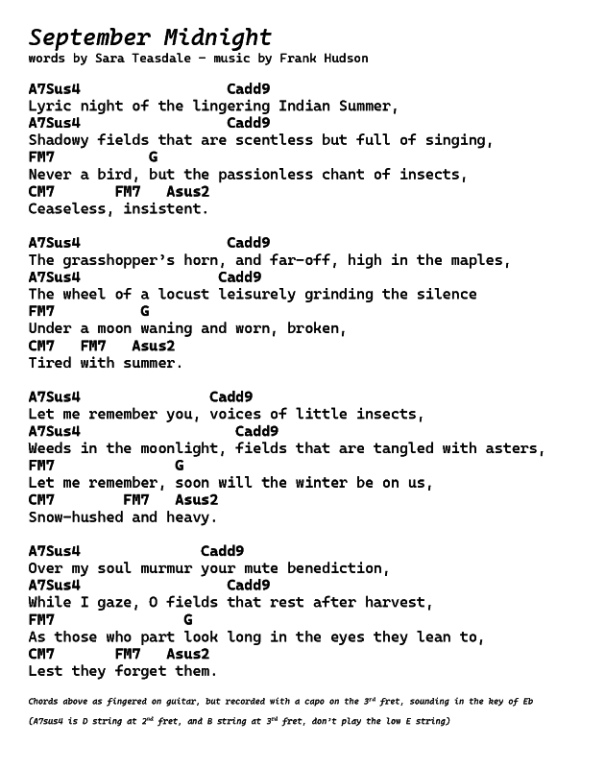
Chord sheet in case your grasshoppers and locusts want to sing this with you.
.
So besides falling easily into a singing voice (even one as limited as mine) her “September Midnight” is a Transcendentalist hymn I think, and the lesson it wants us to take after our breath and voices finish with it is that we do not presume to go to some heaven after we die, but that heaven (as in the sublime reality) is with us in the creation we are presently living.**
My song performance of Teasdale’s poem can be heard with the audio player below. If there’s no audio player to be seen, it’s not that you’ve forgotten our present heaven, but more likely that the way you’re reading this post eliminates showing the graphical audio player gadget. “If the doors of perception were cleansed everything would appear to man as it is, infinite,” wrote Blake. I write that you can click on this highlighted link and a new browser tab will appear with its own audio player – not quite the same thing, but there’s music in it.
.
*Rankings inevitably become silly, and it’s hard to keep them contained into casual, personal preferences – but still one can fairly observe a 20th century progress with Dickinson from “somewhat interesting and eccentric” to “wow, there’s some deep stuff incredibly condensed into its own original and attractive prosody.”
**I’m thinking today of Annie Dillard, whose work I paid some slight attention to back in the Seventies where parts of what we later think of as The Sixties™ happened. I saw in an obit that she’s yet another American figure who left off from poetry to find an audience. Her one book of poems was quickly eclipsed by the audience for the prose of her second book, Pilgrim at Tinker’s Creek. Dillard’s “Tickets for a Prayer Wheel” briefly returned to print more than 20 years ago, and I’ve located and ordered a copy of it.
(Note: as I was proofreading this post, a notice came back that my order for “Tickets for Prayer Wheel” has been cancelled – now unavailable from that store. I’ll try to re-order this afternoon.)


Ah, the Dillard books getting bought up fast! In grad school, I heard Teasdale at al. referred to as “The Songbird Poets”–apt enough for your approach but condescending as hell.
LikeLike
I first heard that term “Songbird Poets” via you, and yes yes there’s that tint of diminution that label — but I liked having a handy term for that group of American poets who wrote honestly of their 20th century experience in more traditional prosody. Even as late as the beginning of this Project, I had to get over my resistance to Millay sounding (in some poems) too archaic, until I could start to understand what she was conveying while dressed those 14-line costumes from the stage trunk. And I can’t stop saying: Teasdale just begs to be sung.
I’ve found a hardcover version of Dillard’s poetry collection via another store. More than twice as expensive, but then poetry’s cheaper than a tank of gas or sit-down table service restaurant meal.
LikeLiked by 2 people