They tell us: yesterday was the last hot day of the year, with temps peaking above 90 F. The summer night ended, like a fair or exhibition with fireworks lightning and booming thunder, and the coolness of fall seems to have arrived today. The urban trees here have just a touch of autumn colors on the edges of avant-garde branches. A city’s pretense is that it is artificial, a human-made place, but the trees are here to remind us.
The above cartoon presented without further comment.
.
I’ve said that when I look at what pieces were the most liked and listened to each quarter that the results often surprise me. The Parlando Project takes words (mostly poetry) and combines them with various original music. For practical reasons,* the poetry we use is largely in the public domain, poets whose reputation has usually settled to a stable level. We’ve done many pieces from such poets that retain readership into our century: Dickinson, Frost, Yeats, Stevens, William Carlos Williams, Eliot, Millay. I also enjoy reviving work by poets that once had considerable readership, but who have fallen out of favor or esteem: Longfellow, Teasdale, Sandburg for example. And there are poets that have higher profiles in the UK than here in the US: Edward Thomas and Thomas Hardy. And there’s my translations or adaptations of work outside of English: Du Fu, Li Bai, Rimbaud, Rilke.** That’s a big world of material, and my attempts good, bad, and indifferent are up in the archives for all to hear. But then there are the wildcards, the poets that only indefinitely reached and failed to retain much regard.
Apparently, Robert Gould Fletcher is one of those. He was identified early on as an Imagist, a form of early English language poetic Modernism that I think has values worth revisiting. Curious, I dipped into a couple of his many books from the first half of the 20th century and found a short nature poem that intrigued me. As I worked to set it to music my city had a summer storm whose aftermath was a striking yellow/green/brown sky tint. In the heat of that evening I started to recast Fletcher’s poem, producing a result that’s a “after a poem by” or “inspired by” work — but it wouldn’t exist without Fletcher.
Despite Fletcher’s non-existent current literary standing and my own low profile as a poet, “Yellow Air” was the most listened too and liked during our past warm summer. I wouldn’t have predicted that, which is a pleasure.
You can see Fletcher’s original text and the full text of my subsequent version along with guitar chords which you might use if you want to sing it yourself by clicking on this link to the original post. Or you can hear it straightaway with the player below.
.
*Submitting writers may know how slow and inconsistently editors will respond. Well, I found the response asking for permission to present poems here was even worse. If an unsought grant was ever to fall from the sky for this Project, I’d ask first for someone to bug and cajole rights holders for the rights to present more recent poems here.
**How much have we done this? Over 600 times! And all of the results are still available here via the archives. If you just want to sample the music more rapidly without my comments on the encounters with the text, the most recent 100 or so are available as podcasts on Apple podcasts or most other places that offer podcasts. Note that the Parlando Project podcasts are just that: the typically less than five-minute audio piece. From time to time I’ve considered a more conventional talking-about-stuff podcast, but I’m unconvinced the interest would replay the work on top of the research, composing, and recording effort that goes into this Project.
There were fewer audio pieces presented this past summer, so I’m going to abbreviate our traditional Top Ten review of the past season to reflect that — but I still kind of like this part of the Project, as I get to see what pieces got the most response. Like the Parlando Project in general, the most popular pieces tend to be quite various, and it’s often the pieces I’d least expect that bubble to the top. As a proper Top Ten, we’ll look at them as a countdown, starting with the 10th most liked and listened to one and ending with the most. The bold headings are links to the original posts in case you’re new here and would like to read what we said then.
Very briefly here are the pieces that make up numbers 10 through 6.
10. Arthur Hoehn by Frank Hudson. In the summer doldrums I felt free to include more of my own words. This is a short elegy for a classical music DJ who worked the overnight hours. I’m quite proud of the final lines of this one.
.
9. Staying the Night at a Mountain Temple by Li Bai. Another of my loose translations of a Tang Dynasty classical Chinese poem. I based my translation on my understanding of Li Bai’s (his name is also rendered as Li Po) general outlook. An example here of how I work with orchestral instruments.
.
8. Stratocaster by Frank Hudson. Really, this project is usually concerned with other people’s words, but this sideways ode to an ingenious radio repairman whose swoopy electric guitar design was enshrined in the Museum of Modern Art got a good amount of response.
.
7. The Dick and the Dame by Dave Moore. Alternate voice and keyboard player here Dave Moore says some of this is adapted from Robert Coover, but this really holds together as a poetic liturgy for pulp noir. Also I got to wail on guitar.
Getting ready to lock up my bike late this summer, and my attention is drawn to a message on top of the post.
.
Now let’s move on to the top 5 and say just a bit more about each of them.
5. From Cocoon forth a Butterfly by Emily Dickinson. We’ve done lots of Dickinson poems here over the years. Though we did this one in summer, it talks about harvest time. While poetically condensed, Dickinson observes harvest workers and the proverbially productive bee and contrasts them with a no doubt lovely, but also somewhat unoccupied butterfly. Is Dickinson, the poet, the butterfly? I’m not so sure. My understanding is that Dickinson’s domestic duties in her mid-19th century household, while less than those of poorer families, were also not insignificant. Is the butterfly then poetry, or the poem she’s written, or a fancied life of a full-time artist which she wasn’t? Dickinson ends with this point: at the end of it all, however joyful or laborious, is the Sundown, which is Extinguished. Like the Preacher in Ecclesiastes, I’m thinking she sees vanity in the whole scene.
.
4. To Whom It May Concern (Carry Them Away) by Kevin FitzPatrick. Dave and I both admired Kevin’s poetry and outlook, even if neither of us wrote like him — but then as I said elsewhere here this summer, too few poets write like Kevin. Here’s a short poem written entirely in another’s voice, whose words Kevin the poet recognizes deserve repeating, deserve attention, deserve concern. If I don’t write like Kevin, that essence, that principle, is part of what I do here with the Parlando Project.
.
3. Palingenesis by Henry Wadsworth Longfellow. Poets today read Dickinson (should) and Whitman (must), but few literary poets will admit to reading Longfellow now. Dickinson and Whitman are great rebels, geniuses of make it new. Longfellow worked in traditions, replanting them in America. If you want to rebel with your attention and consider Longfellow, I’d suggest the shorter lyrics. Was this lyric referencing Longfellow’s wife who died too young in his arms? I can’t say for sure, but I used it to reference my late wife who also died too young more than 20 years ago.
.
2. Generations by Frank Hudson. This is a tiny poem in a tidy setting. I’ve been noting recently the lack of perspective in many older persons’ views of the young. Old people are supposed to supply that perspective, to know from intimately observing things over longer time that stuff thought new is just a variation or a carrying forward of the flow of society. Instead, I see all too many who want to proclaim some past got it right and the present is a decadent signal of end times. So, in this short piece I cast myself as the sage of advice to the young, but with a twist.
.
What was the most popular piece this summer? Come back tomorrow for the answer.
100,000. Compared to some things on the Internet, a small number. Yet it would have seemed impossibly large to me when I started this Project. Today I checked stats and I see that it now looks like we’ll reach 100,000 listens for the Parlando Project audio pieces this week.
I won’t have time to write more tonight about this, but if you have just happened upon The Parlando Project, this is what we do: we take various words (mostly poetry) and combine them with original music we perform. This blog allows me to write about the experiences I have with those words (usually written by others) and what I felt as I performed them.
One unusual thing I did this spring to celebrate National Poetry Month was to re-release 31 pieces from the early years of this project. This was a way, despite reduced time and opportunities to create new pieces, to still celebrate and demonstrate the various poems and music combinations of the Parlando Project.
As part of this April celebration, I spent more time that I thought I would creating “lyric videos.” I figured I would just put in a couple of pictures in a video file and place the words to the poems on the screen in time with their appearance in the music, but they got a little more elaborate.
How popular were they? It doesn’t look like YouTube counts as views any plays of those videos from the inside-the-blog-posts thumbnail images, but it does count those who found them on YouTube itself. Given that sub-set it does count, the most popular of the April Poetry Month videos was our Parlando version of Yeats’ “He Wishes for the Cloths of Heaven.”No surprise there: William Butler Yeats’ poetry is welcome to so many ears around the English-speaking world. If I was to look at most viewed posts (a metric I don’t use in these Top Ten lists) four out of the top ten most viewed posts so far this year are concerning Yeats’ poems. Yeats is a Poetry’s Greatest Hits poet.
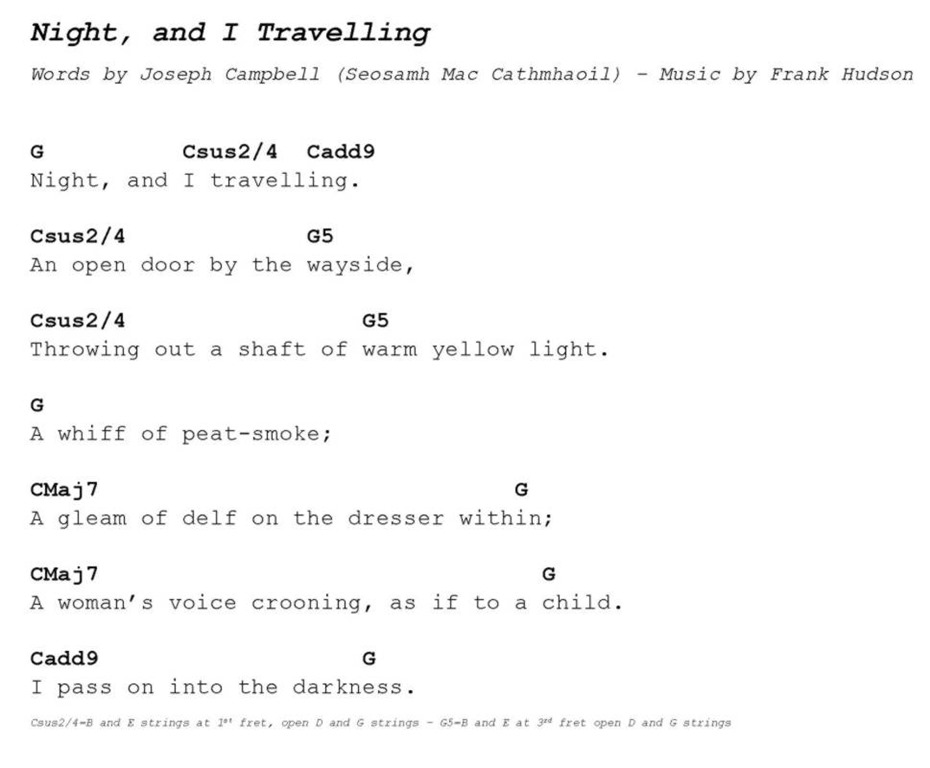
The most listened to and liked piece this past spring was an Irish poem, but it wasn’t by Yeats. It was one of the April Poetry Month re-releases though, “Night, and I Traveling” by too-little-known Belfast-born poet Joseph Campbell (who also published under the name Seosamh MacCathmhaoil).
I’m partway through a biography of Campbell that was an Anniversary gift from my wife. From it I’m getting more of a sense of the young man who wrote this poem — a poem which is remarkable not just for its tightly compressed and effecting scene, but for being published in 1909 so that it might be counted not just as the work of the first Irish poet to use free verse, but also as one of the earliest published examples of Imagism. It wasn’t until 1913 that F. S. Flint and Ezra Pound published their “A few Don’ts by an Imagiste” and laid out the three famous Imagist suggestions/rules, but before that in London Flint, Pound, and T. E. Hulme had been working out how to radically strip back poetry to a fresh, precise, and direct essence in the months before Campbell published “Night, and I Traveling.”
The chord voicings I used for the 12-string guitar part here are bit unusual.
.
I now know that Campbell was in London and meeting with those incipit Imagists in that first decade of the 20th century. Alas I don’t know how junior a partner he was in their meetings, but “Night, And I Traveling” is to my judgement as fine an early Imagist poem as the more famous and anthologized ones, arguably a more worthy example because of its empathetic attention to the isolated rural woman in a still-colonialized Irish hut in place of Pound’s damp impressionistic leaf-faced Paris Metro riders published four years later.* The biography, Joseph Cambell Poet & Nationalist by Norah Saunders and A. A. Kelly, reminds us that Campbell liked country walks at night. Campbell wrote: “Night walking — all my best thoughts, I find, come to me that way. Poetry, like devilry, loves darkness.” Devilry? Campbell did write some of the supernatural, and would mix Christian and pagan mythologies —but in this one, this night, he stays in our earthly plane. Am I reading too much into the poem to note the poem’s only simile has the lone woman crooning “as if to child” when there is no child depicted? Is that child dead? Or perhaps emigrated to America?
Not as popular as Yeats on YouTube, but here’s the “lyric video” I did for this piece
.
You can hear my performance three ways. The “lyric video” is above, an audio player gadget should be below, and this highlighted link is a backup for those ways of viewing this blog that won’t show the player. Thanks again for reading about these encounters and listening to our combinations of music and words.
.
*Make of this connection what you will: Pound and Campbell would both eventually be imprisoned by their own countrymen for acts during wartime.
Sometime before The Police made it an album title, this project’s alternate voice and keyboard player Dave Moore took to using the term synchronicity to explain some things that going forward cause significant effects where there was no pre-existing reason or even connection. Maybe me seeing Dave read a poem in a church while we were both teenagers would be an example. Or here’s another one: an American poet who had generated no interest in America travels to England and creates not one but two poetry careers. And then that runs together with the next three pieces in our countdown to the most popular piece with listeners over this past spring.
Robert Frost went to England largely unpublished and un-heralded in 1912. He was 37. If you were thinking of starting a fantasy draft league for poets in 1912, Frost could not be your pick. I’m not enough of a scholar to know all the reasons for this move, but it might well have been because some of what Frost was writing chimed with poetry that had been published and reached an audience in the UK, poetry that used a rhymed/metrical lyrical voice to portray unpretentious countryside settings. While living in England Frost met another writer, the 35-year-old Edward Thomas. Thomas, also not your fantasy poet draft pick — he wasn’t even writing poetry. The two took a liking to each other.
Frost rather quickly found an English publisher while in England, and published two book-length collections containing many of the poems he’s still best known for. American Ezra Pound took to praising Frost to Americans, and Frost’s career was launched!
4. The Aim was Song by Robert Frost. Coming in at number four in our spring countdown this year we find the now successful Frost with a poem published first in America. It’s a natural text for this Project because it uses music as a metaphor in a very musical poem. It’s been popular here over the years since I first presented it, and it was one of the most popular pieces among the 30 I re-released for National Poetry Month this April.
You can hear my performance of “The Aim Was Song” with a player many will see just below this paragraph, or with this alternative highlighted link, which is here for those that won’t see the player.
.
So, what happened to our Edward Thomas? Thomas’ writing was focused on work-for-hire, the scriveners gig-economy of the time set to fill column inches in magazines and newspapers. Thomas’ personal interests were present in some of those works: he was an avid walker, bicyclist, and amateur naturalist. Like Emily Dickinson, no plant is encountered in Thomas’ writing and is not given a specific name or description. And likewise birdsong. Thomas kept journals, and they too have passages filled with the countryside carefully observed.
Frost saw Thomas’ writing, declared to his friend that he already had the stuff of poetry, and analyzed Thomas’ situation as a “suffering from a life in subordination to his inferiors.” Thomas subsequently took up writing poems with the now published and becoming-known Frost’s encouragement. However, time was marching up on the pair with a large surprise — a world war was about to break out.
Thomas’ non-militarist outlook, his middle-age, and his family for which he was the sole support non-withstanding, Thomas seemed drawn to military service for his country. Frost moved back to America to further build on his growing reputation there. He put forth a standing offer for Thomas and his family to join him in the United States.
3. Gone Gone Again by Edward Thomas. Here’s a poem Thomas wrote during this time, and it’s a wistful evocation of war’s absences. In England Thomas is often thought of as a war poet, and there are reasons for that. But one of the uniqueness’s in his poems set during the time of WWI is that they avoid tableaus of the battlefields and the action set thereupon. “Gone Gone Again” is a poem of what’s not there: people, workers who are now soldiers.
Thomas enlisted, trained as a lieutenant, a most dangerous job in the warfare of the time. After duty in England (he helped make maps, an apt job for a man who so well knew the countryside) he shipped overseas to the battlefront, where he was shortly killed.
Like for some young poets and musicians, death was a good career move for Thomas. Friends posthumously published a collection of the freshly-written poems that Thomas had crafted in only a couple of years writing verse. Attention was paid in the UK to the “war poets” and everything Thomas wrote was read in the context of that cataclysmic event for Great Britain.
One poem Thomas wrote, based on a journal entry from a train ride he took on this very day, June 24th in the summer of 1914, became his best-known and loved poem in his home country: “Adlestrop.”You can hear my performance of “Adlestrop” here.
Or you can celebrate “Adlestrop day” with this “lyric video” from earlier this year.
.Most Americans don’t know this poem or Thomas. I didn’t, until 2016 when one summer day of unwonted heat the train I was to make was subject to what became an hours-long delay in arriving at Kingham. The heat was such that trains had been stopped for fear of track failure. I can recall the trees and foliage swaying in the summer breeze at the little station, some small bird activity, a station caretaker who arrived to drip a watering can into some hanging plants on the platform. It was only afterwards that I learned of this poem, set in the very next town on that trainline, the even littler town whose trainstop had been removed some years back. Rod Serling should have come out the station door with a skinny tie and a summer-cut suit to quip on that synchronicity. Did I miss him because I wasn’t looking for him, because I didn’t know any of that until after I had been in Kingham that afternoon? Thomas’ poem was, and to some significant degree still is, loved because a few days after Thomas was stuck in Adlestrop, an Archduke got assassinated and the slow-motion trainwreck of WWI broke out over the ensuing summer. Thomas wrote his most famous poem afterward, referring to his memory and journal entries, and so he likely intended this poem to be read, like “Gone Gone Again,” as a study in absences, a summer day with a peaceful nothing-urgent before “the guns of August.”
To hear “Gone Gone Again,” there’s a graphical player for some — and you others? This link.
.
2. Cock Crow by Edward Thomas. So, is Thomas only a war poet? Could he have been something else? I think it’s highly likely. He was a troubled man, some other calamity less nation-shared than a World War could have taken him early, but the more I read, even his slightest poems, the more I see why Frost was taken with him, and why even Americans who may not share the cathedral-plaque reverence given UK war poets might still discover him. When I read “Cock Crow” in a 1920’s anthology of Thomas’ contemporaries this past spring I was struck by how much fresher and less puffed up with ineffective references Thomas’ writing was set against the field. And Americans, whose culture received a 19th century dosage of Transcendentalism, love our closely observed nature poetry perhaps more than Brits. Maybe I feel a connection from that afternoon in Kingham, and that prejudices my reading?
Bird song occurs in “Cock Crow’s” title and text, and in reply I was pleased I was able to end my performance of it with a choral part. You can hear it with the player, or its backup, this link.
.
“Cock Crow” got a lot of listens. I thought it might be the most liked and listened to one, but when I totaled them all up this June, another piece beat it out. I’ll be back soon with the most popular piece this past spring. It’s a surprising one.
Tonight is Jazz Night here at the Parlando Project Top 10 countdown. I’m going to ask the folks who come here for the talk about words to murmur down quietly today as I speak about the music.
Funny how these quarterly counts sometimes become nice little “sets.” Both today and tomorrow’s segments as we countdown to the most popular piece this past spring are as good as any planned ones I could have devised. So, let’s get the musicians on stage!
7. Sonny Rollins, the Bridge, 1959 by Frank Hudson. Remember that the bold-face headings at the start of each entry in this countdown are links to the original post presenting them, where you can read what I had to say about it then. I had a lot to say about this one back in January, and so even though this is a piece where I wrote both the words and music, today I’m going to talk about how this (and many of our Parlando Project musical pieces) was realized.
With significant accuracy I hesitate to call myself a musician. My home instrument is the guitar, but even there my knowledge is not something to brag about, my skillset a bit unusual, but limited, and my consistency not up to a professional (or even many dedicated amateurs’) level. But I have a secret weapon: I can choose to compose or improvise (spontaneous composition) the things I present here. My Jazz guitar chops are not strong, but the chordal part was something I was able to execute. Listening back today to the second guitar part I improvised for this I think it was a good day with the wind at my back for me.
In another world I’d more often use other musicians who could add their skills to this enterprise, but logistically and financially the one-man-band approach is what makes it possible for me to express the variety of different musical ideas that I present.
To hear this or the other musical pieces here, use the player that may appear below, or this highlighted link.
.
6. Lenox Ave Midnight, an Extension by Langston Hughes. Another little miracle pulled from my limited, if a bit unusual, skill set? On a good day I can do a passible impression of a guitarist, but my keyboard playing is always naïve. The advantage I can find? Modern MIDI lets me use my mind where my fingers don’t know what to do. In a piece like this I figure out some kind of harmonic flavor by trial and error and my sketchy knowledge of music theory. I played that part and then improvised a right-hand part, editing on a MIDI “piano roll” to correct bad dynamics or altering notes I didn’t like. To an actual pianist this could be called “cheating.” To a composer, it’s called “composing.” You see, I use the term composer protectively, because I really do feel ashamed sometimes that I couldn’t play in real time with two hands the keyboard parts that to casual listeners make a sound like I could. And I think: to a real pianist realizing this simple composition would be a trifle. To me: achievement!
Near the end of this piece, to open up its musical world before I speak the two lines I added to Langston Hughes poem (the reason I call this piece “an extension”) I did something I rarely do here, which I personally try to avoid, because it really does feel like cheating to me. I used a couple of small loops of recorded melodic material from Apple Logic’s free-to-use loop library. My composer’s need here was that my simple and not very convincing saxophone part, that I did play on MIDI guitar, needed something to camouflage those issues.
Why does this bother me to do? After all sampled loops have been part of popular music since the hip-hop DJ’s started dropping riffs from vinyl records. Because I use “composer” as my excuse, my get-out-of-pretender-jail free card, I believe I (or at least some human present in the room with me in the creation process) should have played or scored the notes. I think the two short horn section loops used here sound fine, helped make this piece successful for listeners — but that’s why I feel guilty for using that tactic. Whoever played them, devised those short motifs, didn’t know what I was doing, wasn’t working in concert with my aims.
Now look, I don’t generally mind when other artists do this. Returning to words briefly now: I spent many an April here performing the words of Eliot’s “The Waste Land” which includes — even more than I imagined — squadrons of quotations and paraphrases from pre-existing works. Selection, curation, recombination, and recontextualization are easily defined as creative acts. Maybe my qualms and self-imposed rules in this have a most self-interested reason: I worry that the casual listener here will think I’m just reading poems over pre-recorded music, when I’m proud that I had to write and play and record the majority of the music on this Project, one track at a time.
Sonny Rollins, inspiring to me, yet my distance from that discipline shames me
.
5. Autumn Movement by Carl Sandburg. I stopped writing this post here yesterday, because what I had written so far seemed embarrassingly solipsistic, pretentious, and uninteresting to my audience, and yet also because some of the things I’m feeling as I write about my musical work are hard to condense into a reasonable length post — to be better, it would be even more. And so here we are at this, my presentation of a short nature poem by one of my heroes Carl Sandburg, illuminated by lovely music I made for it. How am I to feel about it tonight? Amazed that I, a non-musician, was able to make it? Or something that feels almost like shame or embarrassment that I present it publicly, when there are days I can’t play anything of any value? Knowing enough to know that what I know as a composer (little) and what I can bring to the composer as a player (limited). Knowing that at my age (old) there isn’t much lifetime to remedy those things.
This, though I cannot say I have sufficient understanding or skills, is where Jazz comforts me as no other art does. Jazz is always confronting the empty sky. Always a critique of silence — and able to the fears inside silence, now, not later, and with surprise and failure. There can be no surprise without failure. I’m a small man, it’s a big sky and a big silence. There are better musicians, better composers, but it’s a big sky and a big silence. This the musician’s and composer’s prayer: may music find a way.
It’s time to look back at the last quarter and see what pieces were the most liked and listened to during those months. I released (or re-released) 51 pieces since March 1st here, more than enough to return to our regular multi-post Top Ten countdown format, so let’s present numbers 10 through 8 today as we move toward the most popular one this spring. As usual, the bolded titles are links to the original post in case you’re new here and want to read what I said when I first presented them.
10. “Blackberries” by Kevin FitzPatrick. Kevin, who died last year, was a contemporary and fellow poet to Dave Moore and myself, and this charming poem about his early experiences as a life-long urban dweller (and reader of Irish poetry) getting used to his life partner Tina’s small rural farm is a fine addition to our Top Ten today. This audio performance is a live take, and in honor of our mood of remembrance that day, I decided to leave our longish instrumental prelude in place for the version you heard here.
The player gadget to hear the performance is below for many, and this highlighted link is a backup way to play it.
.
9. Sonnet To Beauty by Lola Ridge. While reading Lesley Wheeler’s new book about encountering poems in the context of one’s life, Poetry’s Possible Worlds, I was pleasantly surprised to find some poems there from modern New Zealand poets. If I had world enough and time, I’d like to be even more various here with the countries’ poets I present, even though most of what I know about New Zealand is from scholarly works: The Flight of the Concords and Wellington Paranormal. Despite sharing a name with an Australian settler poet, I’ve only presented a couple of emotionally riveting and under-known poems by Australian Modernist Kenneth Slessor as part of the Parlando Project — and what, not a single New Zealander? Oh, wait. There’s Lola Ridge. Ridge was born in Ireland in 1873, moved with her family as a preschooler to New Zealand. After a brief marriage, she left for Australia and then finally to America where she spent most of her life, though her early poetry does reflect her times in the Antipodes.
“Sonnet to Beauty” is likely one of those poems. Though Ridge soon became known early in the 20th century in the US as a staunch advocate of social reform and radicalism as well as knowing and interacting with many of the NYC area early 20th century Modernists, “Sonnet to Beauty” is a regular sonnet about the radical appeal of the artistic life — even while life may present buzzards misapprehended as if swans. Ridge lived that twin social and artistic radicalism thoroughly from most short accounts I’ve read.
When I presented Ridge’s poem this March it was easy for me to pair that twinned dedication with another contemporary of Dave, Kevin, and myself: Irish-American poet Ethna McKiernan. Ethna died this past winter. Yes, somedays it’s hard to see the swans instead of the certain buzzards.
Same deal, player gadget if you see it, highlighted link if you don’t.
.
The 3 poets whose words I use today: tilt, tilt, and look away. The light turns a buzzard out a swan?
.
8. The Pool by H. D. I said, re-released above, and here’s the story. Roughly a third of the listeners to this project’s audio pieces never read the posts I put up about my encounter with the poems or any thoughts I write on composing and realizing the original music. Instead, they find the recordings via podcast directories where I present only the musical pieces without the usual talking and joking that fills the running time of most podcast presentations. Having seen radio production done at a high level close-up for a couple of decades in my day-job life, I suppose I could have attempted a talking pod show about music and poetry — but if only for myself I see an appeal of these 5 minute or less podcasts that might serve as a palate cleanser between main courses of talk-talk-talk.
I’ve noticed that some of my most popular early episodes, ones that racked up a lot of listens in the early years of this Project, had rolled off the “last 100 episodes only” offering lists of most podcast directories, and so for April’s National Poetry Month I decided to “re-release” 30 of them. Even for the blog readers like you, I think many of them would be new to current readers here as well. Coming in at number 8 this Spring then is early Imagist Hilda Doolittle’s “The Pool,” a mysterious very-short poem about a tidal pool encounter. It’s so short and compressed that even at one and a half minutes of run time I had to creatively elaborate the text a bit to reach that length. I rather like the music I composed and realized for this little piece. A lot of listeners did too.
I have no new musical piece for today’s American celebration of freedom’s restoration, Juneteenth. I made moves toward one, but things didn’t move fast enough. In my wayward search I’ve been spending more time thinking about the Mid-20th century period 1940-65 that I wrote about a few posts back. During that period the Afro-American art form Jazz moved from being a predominant popular music style (though often performed by non-Afro-American musicians) to a multi-valent art music that intelligently reflected young Black artists, their concerns, and their adaptations.
That transformation is a complex thing, and this’ll be a short post. Early this century Ken Burns’ Jazz made the simplified case that this was a tragic arc. Art-music is something a smaller portion of people listen to, live with, care about. I don’t buy that singular tragic summary any more than I buy the companion theory held by others that the audience’s advancing stupidity is to be blamed instead. I suspect these theories are subject to the downhill-to-hell-in-a-handbasket generational syndrome that is ever repeated throughout time. Not that there aren’t things worth observing, worth reviving attention to, worth taking back out of the toolbox for reuse in these sorts of reverence for the past! After all, I’ve spent a good deal of time in this project drawing attention to and finding worth in early 20th century Modernist poetry. So, moldy figs, check.
I’ve spent a good deal of time this month listening to mid-century Black American Jazz, some of it from the end of that mid-century quarter when “free jazz” was the new thing. It’s not everyone’s cup of expresso-in-a-small-club. In Burns’ Jazz, several of the talking critics had it that these were the vandals that sacked Rome. Last night at dinner I tried to explain Albert Ayler to my spouse, who loves me enough to forgive that.* Want a simple blurb from me now on Ayler? Most people will be unable to listen to many of Ayler’s recordings with pleasure without significantly understanding something of its intent and context. There’s an argument to be made that art should never resort to that. My belief: sometimes one needs to be baffled, needs to ask questions on the parade from ear to heart. In the Jazz documentary, Stanley Crouch (the initial G is silent) would say of a player like Ayler “the emperor has no clothes.” I’d say he’s stripped naked.
Mid-Century was also an era when LP liner notes could be saying something. Here’s a bit written by Steve Young on 1965’s Black Arts/Free Jazz live album “The New Wave In Jazz.” I’m unable to find anything about what happened to this Steve Young.
.
So, it was Free Jazz in my ear as I approach this month’s American’s celebration of the restoration of freedom. Soon it’ll be American Independence Day. We Americans abundantly like the word freedom. Conceptually freedom is inherently a broad thing. People tore into the Capital crying freedom from votes they wished to disenfranchise. People were beaten on the Pettus bridge crying freedom to cast votes.
So, Freedom’s a broad thing. Freedom is like the meaning of life, self-evident and elusive. I think it’s to find your joy and to help others.
Here is today’s returning meeting of my original music and someone’s poetry, from one of the too-overlooked Afro-American artists of the last decade that was called The Twenties: Gwendolyn Bennett. She just called it “Song,” as broad a title as freedom for a complex thing that is Black American music. You can play it with the player below if you see that, or with this highlighted link.
.
*I told her I’d just spent the day reading LeRoi Jones/Amiri Baraka and listening to free jazz from 1965. Poetry and 50-plus-years-ago free-jazz combined will interest a few people, less perhaps than even the small crowd for either of those things by themselves — that’s you folks reading this far — and she’d just spent her day helping sick people. Sing heavenly muses: that I clearly have a higher calling.
Given the everything I’d rate between losses, troubles, and mere distractions I’ve gone through since late last autumn, I’m not in a mood this week to do the traditional Parlando Top Ten list for the past season. These are the same issues in repertory that have reduced the number of new pieces I was able to present here during that time. You, the audience for this Project, have stayed with this: readership to this blog is growing, overall listenership to the audio pieces is slightly up. Thank you. Thank you. Thank you. There’s more than three of you — I mean to thank all of you three times.
I know some of you do like these quarterly Top Tens, and I enjoy them myself — if only just to see what pieces from the variety presented here got the most response. That said, let’s rush through the numbers 10 up to 6 for the record:
You can see in those five pieces two from my memorial observance for the Irish-American poet McKiernan who I had the privilege to know and examine poetry with, and one from my February Black History Month celebration of Langston Hughes’ first poetry collection The Weary Blues. There in the middle, there’s one by long-time Parlando Project favorite Emily Dickinson. And my own piece in that group talks about the loss of Ethna and also my March memorial subject who Dave Moore and I also knew and worked with: Kevin FitzPatrick. If you missed any of these, each of that above list is a link to my original blog posting and the audio performance of it, just as the following ones bolded titles are.
We join the countdown to the most listened to and liked piece then at number 5.
Spring, a rebuttal.
.
5. Velvet Shoes by Elinor Wylie. A lovely, graceful winter poem by a too-often-overlooked poet from “The Last Twenties” in our previous century. I like the music and performance I created for this one just as much as I did when I created it back around the beginning of 2022.
One would think I’d be through with snow experiences this far into spring, but my morning bike ride today was in big wet flakes and a cold enough north wind. Wylie’s velvet snow is more the dry January sort, but then appreciating snow for its beauty qualities may be best done in past-tense. If so, you may enjoy listening to this one in what I hope is a pleasant spring.
.
4. Lenox Avenue: Midnight by Langston Hughes. “The rhythm of life is a Jazz rhythm” says the first line of Hughes’ poem. I did my best to honor that injunction from one of the first Afro-American poets to unabashedly celebrate that musical form. Although I’m a vary unskilled keyboard player I was able to compose a satisfying two-handed part using MIDI as a scoring tool. I wanted a saxophone solo too, which you can hear a bit of in this performance, but I just couldn’t score or execute enough articulation to “make it.” The piece’s final horn section flourish is one of my rare surrenders to using a sampled musical phrase.
Of course, motif sampling is now an oft honored tactic in the ongoing Afro-American musical tradition, so perhaps I shouldn’t view it as a failure on my part. On the audacity front: I decided to extend Hughes’ lyric which ended with “And the Gods are laughing at us” with a newly written affirmation from after the poem’s time of 1926, one that says that the young art of Jazz and of young writer Langston Hughes’ has answered those gods.
.
3. Sonny Rollins, The Bridge 1959. Staying with Jazz for this one, though with my own words straight through. There are beliefs — some sincere, some insincere — that Afro-American history is but a sorrowful tale, a grievance and a pandering response. If you can heartily do so, I ask you to improvise your own expletive response to the call of that fearful theory, one with as much eloquence and melodic force as you can deliver. Now our response may not be Sonny Rollins level improvisation. That’s not a reason not to — after all, Sonny Rollins wasn’t sure his improvisations were Sonny Rollins’ level improvisations. That’s the story in this piece.
I seem to lack the concentration, or the assured concentration of blocks of time, to do arrangements as full as the one I created for Frost’s poem right now. But you can still enjoy this one.
.
1. Stones by Ethna McKiernan. One answer to lack of compositional time is to write solo instrument pieces, which for me usually means acoustic guitar. Of the several pieces I did to introduce more of you to McKiernan’s range of poetry, this was the one that by far got the most listens this winter — in fact, more listens than any piece has received for more than a year during its first season after posting.
Before I leave you to listen to it, I want to say that beyond soothing my grief at Ethna’s death, that performing those pieces which used her words this winter made her seem closer than our too casual life connection sometimes had us. Wherever we voyage, the same waves lap the same sounds on the walls of our boats.
I started this inconstant month calling it “Unrequited March” — and I had this desire: to pay a more complete tribute to a recently departed poet I knew: Kevin FitzPatrick. In that task I wanted to see if I could rejoin with another voice and poet you’ve heard here: my friend Dave Moore.
Dave’s had some reduction in his ability to play keyboards, and he wasn’t sure how well his voice would hold up, but he was able to join me late last week as we took our usual “live in the studio” approach to doing some new pieces together, including a number of ones using FitzPatrick’s words. This requitement was doubly appropriate because Dave knew Kevin even longer than I did. Dave and I managed fine, and had a good time.
In the normal course of things those pieces would get worked on in the following week, but life has interrupted our singing back at death.
We are all racing forward and melting.
.
How? Even if one of this Project’s mottos is “Other People’s Stories,” I have qualms about telling other living persons’ events, so I don’t feel right discussing more details here today, but there have been hospitals involved, and some pretty long hours in the last two days in those places.
The outlook, best as I can predict it now, is that beyond my concerns with these other matters, my ability to work on audio pieces will be restricted for a while. If time allows, you might still hear some of the Kevin FitzPatrick related stuff yet this week.
Does it seem odd to work on art and our experience of it, even when other things must take precedence? That occurred to me too. Well, when I visited our newly hospitalized patient, they had two needs: music and Jacques Derrida. Go figure.