After our Anniversary Month celebrations, I’m returning to performances of some more poems by principal Surrealist poet Paul Éluard. It’s struck me that Éluard is less well-known to English speakers than he should be. I have only half-formed ideas why that may be so. Let me briefly list them.
Was it his politics? He was a self-avowed Communist – which as we know from the wisdom of our peerless American leader is correctly the name for anyone with a smidgen of concern for how the government might organize it’s efforts beyond the interests of the wealthy – but back in the midcentury when I was growing up, it meant support for corrupt one-man-rule authoritarians who erected bulwarks against free elections, sent spies and armed thugs against their opponents, and gloated in jails, prisons, and the power to exile. Despite his full-throated poetic odes to liberty and acknowledged heroism in the resistance to fascists during WWII and the run-up to that war, Éluard didn’t forthrightly oppose Communism when those things were mistakenly taken to be the bad things about Communism – before we knew better.
Was it Surrealism, or specifically being a Surrealist poet? Defined broadly, at least in my youth, Surrealism as a force in the visual arts was important and popular. How popular? Magritte, Dali, and Escher were inescapable as LP record-covers, posters, or reproductions on the wall. But Surrealist poetry? Not so much. Oddly, Surrealist poetry’s 19th century inspirations as well as its post-WWII descendants were popular enough. Baudelaire to Rimbaud to Bob Dylan to New York and Black Mountain School poets have substantial presence in our culture, but in the middle parts between the World Wars where we have Surrealists like Éluard, their Dada and Surrealist poetry falls into a memory hole.
Is it something as simple as the tastes of translators?* The masses of monolingual readers in English-speaking countries rely on them to embody poets like Éluard. They are an underappreciated and (even within the realm of poetry) underpaid lot – but they, for a large part, get to pick who we pay attention to. Maybe they just didn’t encounter or take a liking to Éluard? Particularly in his early poetry, which supplies the examples I’ve used so far, Éluard doesn’t have as much esoteric imagery as some other Modernists. It may sometimes be hard to explicate exactly what he’s saying in his poetry, but he often writes, at this point in his career, in what I read as plain-spoken colloquial speech that doesn’t dazzle with its decoration while remaining elusive in intent. I’m not immune to being caught by surprising language myself. Afterall, the first Éluard poem I ever translated (and likely his best-known in English) begins “She is standing on my eyelids…” – and once you translate that, you want to continue and complete a translation of the entire poem. Today’s poem, “Among Others,” doesn’t go that hard.
None of the above have stopped Spanish language poet Pablo Neruda from having a footprint in English-speaking culture that I casually measure as being a bit larger than Éluard’s. Go Figure.
This can’t be so: if I complete everything I’ve planned in this Éluard series, will this blog will be the site of nearly half of all the English translations of his French poems on the Internet?
.
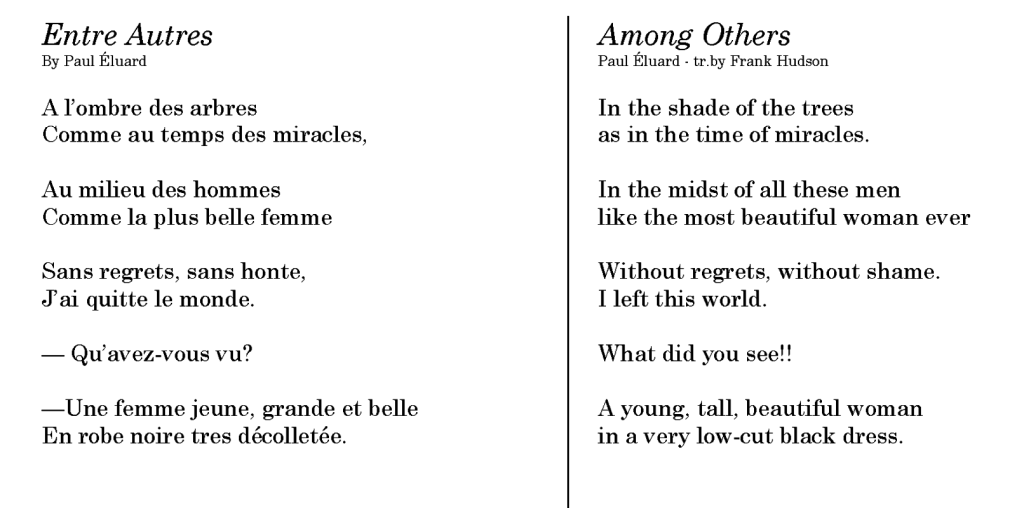
So, now let’s get to another of Éluard’s early poems, “Among Others.” My usual mode of translation is to try to convey the poem’s images. As a side effect, that allows me to land a beachhead without having forward intelligence as to what the poem means to say as if it was ordinary prose. Best as I can tell (I’m not a French linguist by any means) the language here is as plain as that in “The Red Wheelbarrow,” “Fog,” or “In a Station of the Metro” – poems from American Modernists in the demotic yet diffuse-meaning mode. There’s a single clue simile that something in Éluard’s short poem may call for extraordinary attention: “as in the time of miracles.” Could this be an ordinary bit of French idiom, or is it a tip that something miraculous is to occur?**
What is Éluard getting at in this poem? I’d say the betting odds are that he’s portraying some men talking about whatever they think is important and compelling, but the poet’s voice says that while he is among those men, his attention is on other, more carnal or incarnated thoughts, a vision of a desirable woman.***
Yet, as I worked with the poem, and as I finally performed it, I decided to place my bet on the longshot: that it’s not that the poem’s speaker’s thoughts are just like a woman, but that the poem’s speaker is, at least for that moment “in the midst of all these men,” seeing themselves as that vision of a young, tall, beautiful woman – in other words, in his image he gender changes.
Now, I am sporting with authorial intent there – but even in the first, best odds, version there could be an element in the male poet’s imagination seeing union with that woman.
Anyway, here’s my performance which is taking the long odds, including side-bets that my voice can put this song, from this point of view, over. There’s a good chance there’s a player gadget below. If not, don’t tear up your betting slip, there’s a highlighted link too – and if you click that, it’ll open a new browser tab with its own audio player.
.
*I base my estimate of Éluard’s popularity by casual searches for English-language translations of his poems on the Internet. I haven’t done any strict count, but my impression is maybe 10-20 poems are extant there. “L’Amoureuse” and “Liberté” have a footprint in English online, but the air gets thin quickly past those two poems.
**If an American football fan was to write about a “hail Mary play” we know not to call to imagination the venerated Blessed Virgin being hurled tens of yards through the air by desperate athletes. Some naïve translator-from-English making that image clear and literal would likely mistake the authorial intent.
***A more facile and time-granted musician might be tempted to musically quote one of the last hits from England’s The Hollies while they sing the poems last sentence.

