When I Peruse the Conquer’d Fame

Modernist American poetry has two parents, Emily Dickinson and Walt Whitman, but it’s been awhile since we’ve presented any Whitman here. Dickinson is a subversive Modernist, ironically skewing the expected tropes. Whitman on the other hand is the provocateur, the poet who is proud to say right out front everything he wishes to change.

As Whitman prepared his 1860 edition of his evolving Leaves of Grass,  he was about to cross a Rubicon of a sort. He had decided that erotic material needed to be added to his great collection. Since he wished to be all-inclusive and unabashed, starting with himself, that material would vary, but it would include expressions of male homosexual longing and relationships.

Whitman in 1860 - caricature from Harpers Monthly

Walt Whitman as caricatured in 1860 in Harper’s Weekly


Once again, my knowledge of the historical context here is not extensive, but some brief reading this weekend indicates that to the mid-19th century American audience, the homosexual elements of what Whitman was to publish was little or no more disturbing than the erotic element generally. For a man who was already wishing to revolutionize English poetry with his free-verse and universalist message including what would surely be considered shockingly fleshy writing about desire, longing, and connection was certain to complicate his goals for a wide audience. His leading ally within American High Culture, the Transcendentalist Ralph Waldo Emerson, counselled him to not include, or to greatly tone down that material.

Whitman didn’t take that council. The 1860 edition of Leaves of Grass  included a section, Calamus, that was full of love and desire between men. Emerson was right, that would complicate Whitman’s task of revolutionizing American poetry.

When Transcendentalist Thomas Wentworth Higginson* asked Emily Dickinson if she had read Whitman shortly thereafter, Dickinson replied: “You speak of Mr. Whitman. I never read his book but was told that he was disgraceful.” If one is of a speculative mind, one can imagine Emily Dickinson getting a plain brown wrapper delivery of Leaves of Grass  that she would never acknowledge.

This Monday is Veteran’s Day/Remembrance Day, and as he prepared the Calamus  poems Whitman was not a veteran or a survivor with war memories, as the American Civil War that would add another tremendous shaping force on his poetry was still more than a year off. Still he would write this moving comparison that I present today.

When I Peruse the Conquer'd Fame as published

Today’s poem as it appeared in the 1860 edition of “Leaves of Grass.”


“When I Peruse the Conquer’d Fame”  is a comparison of two things: fame and envy. Perhaps the fame part will strike you first, along with the implications of worth and value. The fame in the title most often comes to prominent men: victorious generals, Presidents who bask in their election and men who put their names on large buildings. The U.S. Presidents that Whitman would have had in mind then were bumbling ineffectual men, totally incapable of coming to grips with the immense and deadly crisis they were careening toward, but famous none the less.**  What generals would he have in mind? Napoleon or his adversaries perhaps, men who could shuffle the borders and crowned heads back and forth in tides.

And for comparison, Whitman sets out “the brotherhood of lovers.” Does he mean men who love men? As this is part of the homoerotic Calamus  poems section I think we need to accept that is significantly so. He goes on to praise the lovers who are steadfast in their love as aging and fate and even the numbing of time is arrayed against them.

This task of enduring love is not something unique to same-sex lovers, and I suspect that Whitman, the universalist, recognizes that too. But in his particular, he’s saying that unfaltering love which would not then be socially acknowledged is all the more extraordinary, though unknown compared to the war-heroes and political potentates.

Did Whitman, and I suppose myself in my choice to present this poem at this time, just dis veterans? That objection would assume that the two groups are mutually exclusive, at odds. That isn’t so. And if Whitman was here to answer he’d point out he spoke of Generals, Presidents, and rich men, not the soldiers he later comforted and whose wounds he dressed in the upcoming war.

And of course, in the U. S. today it’s Veterans Day, set aside for those who after their service may well have continued as or became those ardent lovers whatever their sexual orientation. We honor them for their service in the one regard, Whitman asks that we consider the second as well.

What of the other comparison, the one you may not have noticed, the one concerning envy? Whitman has chosen not to weigh his comparison between the two sets of roles only by their levels of objective fame, but specifically in the example of his own state of envy. He says he doesn’t envy those powerful and rich men—but of the “long and long” lovers, there he says he is bitterly envious.

Let me suppose Whitman was sincerely speaking here (he has almost no other mode in his poetry than sincerity). But there is an element in Leaves of Grass  where the poet speaking—“Walt Whitman” as the character in his great collection of poems—is meant to be an example, as his verse is an example, of an imperfect thing striving to find a different, better path to something new and not fully known. Whitman, like the best of Modernist art, like various America, like many veterans, ardent as a lover is running faithfully and with a heart open toward an affectionate and unknown future.

Once more I marshal the ranks of my marcato orchestral instruments for “When I Peruse the Conquer’d Fame”  into another “punk orchestral” piece. Harmonically, I’m working a three-chord trick here, just as if the composer/conductor’s podium was stocked with Ramones. Other than the use of a rock’n’roll drum set, the other unusual textures are mixed subtly into the low-end where there’s a contrabassoon line and Fender electric piano bass (ala Ray Manzarek). You can hear it with the player below.


*It’s possible that a canny Dickinson might have been telling Higginson what Higginson would want to hear, since Higginson, though au fait with political and social radicalism, was also of the opinion that Whitman was disgusting.

**Coincidentally, the U. S. President when the Calamus  poems including edition of Leaves of Grass  was published was James Buchanan, who may have been gay himself. Though Donald Trump has already selected Andrew Jackson as his favorite President, Buchanan may also prove to be indispensable to his legacy in that Buchanan has long been the consensus choice among historians as the worst-ever President of the United States.

The name of it is “Autumn”

Did Emily Dickinson mistake her tone, her presentation? This question occurred to me as I went off into the deeper, album cuts* of Dickinson’s work looking for autumn poems this fall. Her early poem, titled on posthumous publication “Autumn”  is charming and very much in a mainstream short poem tradition of the day. If she was seeking publication or just checking in on an honorable hobby of an upper middle-class** young woman, it would do.

The next Dickinson Autumn poem I found and presented, “Besides the Autumn poets sing”  is still charming, if self and otherwise referential in a sly way. If I was to “translate” it into the diction and particulars of New York in the 1950s it could be written by Frank O’Hara. I believe she intentionally means that poem’s opening word: “Besides,” and that is not a careless rendering of “beside”. That little “s” makes it a poem about what the poets of her time did “Besides” (meaning “in addition to,” or perhaps “surplus too”) Autumn, not merely poets rendering in verse the season while metaphorically writing en plein air. That makes the poem an expression of what is other than, or in opposition, to what a leading American poet of Dickinson’s day like William Cullen Bryant was writing.

If I was to read this poem in isolation, if it came to me “over the transom” would I make that assumption? I’ll be honest: I suspect most times I’d miss it. I’d hurriedly read the poem as another simple Fall season lyric. I’d miss that “s.”

Did Dickinson intend this slyness, if I’m right in my more careful reading? My understanding of her character is yes, she did. I could be wrong. If writers, if poets, can misunderstand how their tone will be read, certainly us readers, busy and full of our own prejudices, can also do our part to misread or read ourselves into their work.

But then I came onto this remarkable Dickinson poem, one that’s frankly strange on the surface: “The name of it is ‘Autumn’.”  Even now, over 150 years after it was written, this makes no pretense to being a conventional poem.

The first thing I noticed was that as a poem of fall, it doesn’t really work—or work the way we expect a poem on that subject to work. Yes, fall leaf color is a common trope for landscapes that have this event.*** But this poem goes overboard if that is all it’s trying to do. Yes, many of the autumn leaves are red, and yes we can say they are blood red. But if that was what Dickinson was intending, and if repetition of that trope might add to its power, I think many readers would think it’s overdone.

And so my first thought was, that must be Dickinson’s intent—to over-do it—because I now trust Dickinson as an artist, and feel from reading her that she often is seeking some doubleness in her expression.

But before I continue with my sense of the poem, let me alert you to two other readings that have been put forward to explain what this unusual poem is on about. The first is that it’s a poem about a particularly deadly section of the American Civil War in the fall of 1862. Historically aware readers often wonder why Dickinson (unlike her contemporary poetic revolutionary Whitman) doesn’t deal with this deadly domestic war directly. Unlike Whitman she didn’t live in close proximity to the battles, but she was the daughter of a politician who had been caught up in the slide into this war, and an avid reader of the journalism of the day. The Civil War reading says this is her recasting of the slaughter of these battles.

If one accepts that idea the images make sense, a strong argument for it. But I’m unsure how Dickinson, even as an aware news-reader, could have received this explicitly gory battlefield scene. I’m unsure that the Republican newspapers she read would have featured detailed descriptions of the slaughter.**** The only way I can imagine Dickinson having an opportunity to pick up these specifically blood soaked slaughter/war images would be if the somewhat self-sufficient semi-rural Dickinson homestead slaughtered their own animals for food and Dickinson (who came to be responsible for the gardening food aspect of the homestead) observed that.

The other reading is that this is a menstruation poem. Likewise, the images can be fitted to that conception. And while we know nothing of Dickinson’s gynecological history (which as readers we need to know, along with the sperm and motility counts of all male authors) there is no barrier here regarding Emily Dickinson’s experience and knowledge, and so I think this one is more likely.

The third possibility is that Dickinson did intend this to be another autumn poem, just with stronger imagery; and if she may have misread how the poem’s tone would be encountered by others, that by this time in her life she didn’t care. She could intentionally have brought in those things other, modern, readers have seen in it, warfare and menstruation, and created one of those bidirectional images where the thing signified and the images used to illuminate it are of roughly equal importance. One clue to that is that she’s once more making use of quotation marks. “The name—of it—is ‘Autumn—’” the first line seems to say we need to examine that word. What could we find on examination? One thing I, the punster, finds is “Awe-tum.” The other thing she may be saying is: “Well, it’s got a common name we might find unremarkable, a mere label for a season, but it’s serious business to nature.” Then, all that blood—and in my reading, the intimate linkage to human fertility—is to make that case, to drown that conventionality.

In such a case, the imagery takes over from the subject. If in the process of composition, the poem became not about autumn but about menstruation, then autumn becomes an intense outward image for what would have been a private, if widely shared experience.

Given that frankly feminist examination of literature is no longer a rare thing, I wonder how unprecedented this was poetically as a subject? Anyone know of any poem preceding Dickinson’s that has a plausible focus on menstruation? A passing line in the old ballad “Willie O’Winsbury”  doesn’t compare to this level of imagistic intensity.


Rather than some colorful fall landscape photo, here’s Anne Briggs whose singing helped bring the ballad “Willie O’Winsbury” to the fore.

Well, all that talk, and the comic incongruity of mansplaining my experience of Dickinson’s poem, but this poem is lovely again as word-music. Dickinson is famously sing-able, so I was charmed to put even my shaky voice on the line here. I keep thinking I’m building up to a big-time orchestral score or a mass of synthesizer lines, but today I’m musically down to just acoustic guitar once more. This past week, I found online an entire 90 minute coffeehouse set by Tom Rapp and Pearls Before Swine, and the melody today is similar to one used in Rapp’s “There Was A Man.”  I even planned singing a couple of verses of that song in a sort of a round with Dickinson’s, but I couldn’t make that work.

The text of Dickinson’s poem is here. My performance of it is available in a player you should see below, or on most podcast platforms or Spotify as the Parlando Project.


*(in geezer voice) In my day there were musical collections sold on disks, and they had to have a bunch of songs, not just the hits. A kind of wireless streaming service called “radio” sometimes played cuts that weren’t the ones that you’d pick out for your playlist. It was a primitive existence, but we didn’t know any better back then.

**It’s not straightforward to place the mid-19th century Dickinson household in class hierarchy. Clearly they were a prominent family in their town, so in the context of Amherst, likely the 1% for the latter half or more of Dickinson’s life. But Amherst also wasn’t a wealth center, thus my approximation.

***It occurred to me as I looked at my series of autumn poems I’ve been presenting this month, that there are large portions of this globe that don’t have the “theater of the seasons” that Dickinson’s Massachusetts and my upper Midwest share. The whole leaf-turning fall colors event is a big deal and traveling to rural areas where the largest canvases can be seen is a thing here. One academic paper behind a paywall that I found an abstract for even suggests that fall-colors tourism in the mid-19th century to New England places like the Franconia Notch might have contributed to this Dickinson poem.

****The political career and situation of Dickinson’s father is too complex a subject to detail today. He was a unionist Whig, who supported the compromises with slavery-states meant to prevent the Civil War, while likely opposing the practice of slavery itself. When the Whig party died out it was largely absorbed into the newly founded Republican party, which included those who were more militantly opposed to slavery and such compromise.

Dickinson’s father stood with the compromisers who thought preserving the union primary over the more aggressive anti-slavery factions of the Republicans. It was the election of the first Republican President, Lincoln, who presented himself as unifying those two wings of his new Party which was the proximal cause of the outbreak of the American Civil War—in other words, the slaveholders in slave-holding states figured Lincoln wasn’t serious in acceptance of the ex-Whig and unionist wing of Republicans and that he would allow the more abolitionist wing to take power.

Once the war broke out, there was considerable agitation in the North to settle with the Southern slave states, either to reform the pre-war union or to accept the formation of the new slaveholder Confederate nation. A prime argument for this was the deadliness of the ongoing war. So, in general, Republican papers in the day would not have been in the business of publicizing the grizzly nature of the warfare instead of bloodless gallantry and sacrifice.

Besides the Autumn poets sing

Since we’ve re-established that Emily Dickinson can do simple, here’s a lovely poem of hers that introduces more than a touch of “meta” to her poetry.

This poem’s first line starts the meta thing right off. You could quickly read the opening word as “Beside” without the s, and then the poets are singing in the presence of Fall. I suspect Dickinson wished to include that element but subvert it. “Besides”  means in this context “beyond that, in addition to.” So, there’s this thing: “Autumn” that poets sing about that is what? Well, it’s prosaic (i.e. prose and routine, not poetry and unique/charged). It’s small: “few,” and “little.”

Next stanza, the song now riffs with “few:” “A few…mornings,” “A few…eves.” Dickenson’s diction is still casual here, but she drops a couple of unusual adjectives with that repeated pair of fews. Unusual adjectives are often a weak crutch in poetry. Throw together some out-of-the-blue random adjective with a noun and you’re suddenly all surreal, poetically mysterious and creative—but more importantly, do these unexpected modifiers create a charged image?

“Incisive mornings,” is a bit of a play on words. Incisive here means not just perceptive, as in the coolness and lack of light predicting winter’s shorter days and lack of warmth: but taken in its other meanings, its winds are cutting and daylight is being incised, removed. “Ascetic eves” also speaks of removal, evenings no longer long with lingering light and it hints at spiritual matters this removal may reveal.

The second stanza ends with two references to poets, presumably examples of the ones mentioned as the poem opens: William Cullen Bryant, an older poet contemporary with Dickinson, and James Thomson, a Scottish poet of the 18th century. Neither are well-known today (though Bryant was a very important American cultural figure in his time). Dickinson mentions them and says that the stuff in their supposed Autumn poems are “gone.”*

In the context of these two stanzas, Dickinson is saying: the existing poets aren’t telling us much about autumn. I think that Dickinson’s sly inclusion of those two concise, precise, and original adjectives is cutting. She’s showing that in two words she can say more about autumn than they can in some long-winded poetry.

harvesters by Peter Bruegel the elder

Sheaves get mentioned in passing in Dickinson’s poem, so I get to exercise my love for Dutch painting


The second half of the poem has Dickinson unleashing her style of poetry against these musty odes. The third stanza’s word-music is just wonderful. I won’t dance about its architecture today—you can just read or listen to it—I’ll only point out that the end-words “brook” and “touch” have a lovely rhymish echo, even though they aren’t even slant rhyme. This stanza has the superb line “Sealed are the spicy valves” which partakes of the musicality but is an elusive image too. As I read it, I thought of gardeners in our climate planting garlic cloves this time of year, but garlic was not yet a thing in Emily’s New England. After an hour or so of trying to decode the image, to determine what specific spice plant in Dickinson’s time and place is referred to,**  I now think this a more generalized image of withered flowers. “Valves” is used only one other time in Dickinson’s poems, in the more famous “A Soul selects her own Society”  poem where they appear as “the Valves of her attention.” “Spicy” I’ve judged now is just a biologic/erotic reference to flowers pollination role. We may read the valves anatomically in various ways, but eyelids*** may be intended, as in the closing two lines of the stanza.

The final stanza is Dickinsonian too: nature in Dickinson’s poems is often personified in comical and non-charismatic species, here squirrels. Comically, her thoughts on the matter of autumn and poetry will be of great interest to the squirrel, and in this image she’s pointing out her non-existent status as a literary figure compared to Bryant et al.

It could just be a handy, casual sentiment to finish the poem, but Dickinson may be earnest in her concluding phrase: her mind is the sun that can illuminate the lack of sunlight as Winter solstice approaches.

Mostly acoustic guitar for the music performance today, though if you listen in the background you’ll hear a little harmonium and tambura. You won’t hear it in the rhythm or the instruments timbre, but I put a hidden reference to one James Marshall Hendrix in the music. You can read the full text of Dickinson’s poem here as you listen with the player gadget below.


*Thomson wrote the lyrics to “Rule Britannia,”  and Dickinson is likely referring to his long Miltonic blank verse poem called “The Seasons”  in her 16 line one. Bryant’s poetry may be largely forgotten, but his former cultural salience is still honored with a lot of school, street, park, and place names in the U.S.

**As an adult, Emily ran an extensive garden in the largely self-sufficient Dickinson family homestead, and in her youth she studied botany and produced a remarkable herbarium book filled with precisely identified plants—so it’s not crazy to think that she could have had a specific plant whose lifecycle she understood. A full-fledged farm field operated right across the road under Emily’s window at the homestead. The “sheaves” in Thomson’s poem wouldn’t have been abstract to her either.

*** If one wants to get more biographical in reading the poem, Dickinson famously went for treatment to Boston for some tantalizingly unspecified “eye problems” a few years after this early poem was written.

Dickinson’s Autumn

I sometimes wonder if I overstress the mysterious, even mystical, element in Emily Dickinson. Perhaps I’m overcorrecting for the too-limiting image of the charming eccentric writer of little poems that was her package-label when I first learned of her in the middle of the last century. I’ve since wanted to put the small print somewhere on the Emily Dickinson carton: contents may be unsettling during reading. Sold by weightiness, not boastful volume.

But Dickinson was at times a writer of lighter verse, enclosing seemingly cast-off poems in letters to friends. Her classmate (and in Dickinson’s lifetime, more literarily successful) friend Helen Hunt Jackson would write and publish casual poems about the seasons or travel. When Dickinson wrote this way, was she bending her art to expectations for women of her time, or was she expressing a playful side of herself? Humor, as in satire and incongruity, is an essential part of Dickinson’s verse, even her darkest verse. When it’s employed without mysterious, ambiguous themes, that same sense of humor can produce a poem like today’s “Autumn”  by Dickinson.

Even the part of me that loves to search for deeper meanings and undercurrents has trouble finding them in this poem. If forced to rely on that I could offer that her concluding remark that “Lest I should be old-fashioned, I’ll put a trinket on.” could be read as a comment on the loosening of plain-style 18th century Puritanism in Dickinson’s time. But let’s be serious: this is lighthearted, an example of the “happy Autumn” poem, and such things can make good songs.

Tree learning fall colors

Tiny clusters of turning leaves, like splatters on a green drop-cloth.


So I tried not to weigh this one down: major chords, acoustic guitar, bass, low Mellotron strings, and a touch of piano with the sustain pedal down. You can hear it with the player gadget below and read this short poem in its entirety by clicking this link.


Parlando Project Summer 2019 Top Ten part 3

Is everyone aligning themselves with autumn already? Here we’re looking back at summer and the audio pieces that the audience made their most liked and listened to, and we’re getting near the top of the countdown, moving toward the most popular single piece of the past three months. Today we look at numbers 4, 3, and 2.

4. Summer Silence by E. E. Cummings. Another one from our “Before They Were Modernists” series, “Summer Silence”  is an early E. E. Cummings poem published when Cummings was a college sophomore at Harvard. One doesn’t usually associate Cummings with constrained poetic forms, but “Summer Silence”  was written in 1913 in the Spencerian Stanza form, long before he could have learned from Hawk or Susan.

I try to do the best work I can with recording the music compositions here within the rapid pace I’ve accustomed myself to with this project. My equipment is modest, and my recording engineer’s skills are too, but I make the effort. That said, this one was recorded on a cell phone sitting in a cabin on the North Shore of Lake Superior: just me, an acoustic guitar, and a few summer birds that you can hear at the very end that wanted to enjoy July there too. The text of Cummings’ poem is available in the original post linked in bold above.


3. Higginson’s June by Thomas Wentworth Higginson. From another series, one that started before this summer but carried over into it: “The Roots of Emily Dickinson.” Higginson is essential to the Emily Dickinson story, the literary insider who Dickinson sought out in what I think was an attempt on her part to verify the worth of her unprecedented poetry. They met at least once, but the rest of the relationship was carried on via letters, of which we have only Dickinson’s side of the correspondence.

From Dickinson’s replies and Higginson’s later recounting, it’s been summarized that Higginson “didn’t get it,” thinking that her work needed some further polish to appeal to the mid-19th century public. Here in the 21st century we feel pretty smug about Higginson, thinking him like the infamous record exec who passed on the Beatles.*

Higginson had a highly eventful life outside of the Dickinson connection, as I’ve talked about in another post, but one thing I discovered this year was that Higginson at least dabbled in poetry himself. I can find no context for the poem of his I used here, but I speculated that it could be something he wrote in his youth. Whenever and for whatever reasons he wrote it, it is a good short summer lyric. And coincidentally it’s opening two lines could stand as the better judgment of Dickinson’s genius as it does in his poem for summer.

The music for this one is as electronic as “Summer Silence’s”  is acoustic. The text of Higginson’s poem to June is also in it’s original post bolded above.


Indian Pipes and 1st Edition of Dickinsons Poems

Higginson wrote the preface and helped edit and promote the publication of the first collection of Dickinson’s poems two years after her death. The flowers on its cover are usually called Indian Pipes and they were said to be a favorite of Dickinson’s. It’s a truly odd summer plant, which my living wife found and photographed in Northern Minnesota this year. The other common name for this translucent apparition: the ghost plant.


2. For You by Carl Sandburg. I kept going back to Sandburg this summer, and you the readers and listeners came along with me. Why? I frankly find him healing.

I started off this project in 2016 with a Sandburg-based audio piece which also served as a memorial for David Bowie; and for the 3rd anniversary of that launch I used this Sandburg poem as a memorial to my late wife who died near the beginning of this century.

That either of those Sandburg poems could be used as memorials does not make them passive elegies, and “For You”  is future-focused—just as it is full of ghosts. I’m not familiar enough to say how English speakers in the British Isles, in South Asia, the Antipodes, or elsewhere feel of the current times and challenges; but in Sandburg’s America when I read or listen to “For You,”  I too feel our ghosts and feel our future—close—even if each are unreal as we stand before the great door of a year with great hinges.

The text of “For You” is here if you’d like to read along.


*”Guitar groups are on their way out” is the famous rejection phrase, attributed to Dick Rowe of Decca Records. In Rowe’s defense, Beatles producer George Martin has been quoted that the Decca audition performance was not very good and that he wouldn’t have signed them on the basis of it either. A few months later, Rowe took a tip from George Harrison and signed another of those guitar groups, The Rolling Stones. Sometimes you get a second chance.

I Had a Terror Since September

How much do we know about Emily Dickinson as personality, as a living person? I can’t say that we know much at all. Originally, she was marketed as cypher, an enigma, a hermit/shut-in, and this reflected a valid aspect of the later parts of her life. The self alone is not a no-place, but it’s a hard-to-know place. In my lifetime there’s gradually been an understanding that it’s not the whole picture however.

Her youth seems to have included an above average circle of experiences for a woman of her class, time, and place. And her most productive writing years, those of her early thirties, seem a middle ground, with some travel amid mysterious and undetailed accounts of illnesses.

Her poetry, still revolutionary, no longer needs the biographical mystery to market it, but that doesn’t stop us. Its domestic strangeness makes some of us look for a Baedeker to help figure out the sites and landscape.

I say this because it appears that yet another attempt to portray a living Emily Dickinson is upon us. In 2017 we had A Quiet Passion  portraying an intellectually vital person dealing with a rigid society, and only this year we had Wild Nights with Emily  which tried to illuminate Dickinson’s emotional life and the revolutionary artistic aspects of her work. Both of these films have to deal with issues that any biopic about an author will: watching people write is boring second-unit stuff, connecting written work designed for the page to a visual performance is not straightforward, and what writers record in books is not a one-to-one reflection of their own personality and character. I’m willing to cut filmmakers some slack because of these unavoidable issues.

None-the-less, Dickinson,  one of the tentpole series that Apple TV+ has announced for its nascent Netflix/Amazon Prime/Hulu streaming video competitor this fall, is raising eyebrows and guffaws. Here’s the trailer.


Midway through Emily and Lavina rock-out in their underwear on ukulele and banjo.


Let me summarize some comments the trailer has drawn:

“That’s crazy pants”

“Instead of the classy story-telling Apple has promised for its new video service, this looks like a CW* series.”

“What were they thinking?”

“Portraying a famous recluse as a wild child? Really?”

Well I’m not going to predict anything (I’m bad at it). The hyper-fast cutting of the trailer should almost come with a strobe-light seizure warning and makes it even harder to determine how the series will work than a run-of-the-mill promotional clip, a form already infamous for misrepresentation. I’m not going to throw stones at the EDM soundtrack of the trailer though. Indeed, I’d hope Dickinson is as audacious as I’ve been here in mixing “wrong” music with older art.

A worry is that if it tries to modernize Dickinson without comic awareness and savvy, it could be unintentional comedy that goes nowhere. As with previous Dickinson movies, I suspect it will give in to the dramatic temptation to compress and confuse the time-line of Dickinson’s life. I know nothing of the show-runner’s previous work, but title-role-actor Hailee Steinfeld was great with vitalizing 19th century dialog in the Coen Brothers’ version of True Grit.

A list of recurring characters gives hope that the show will try to deal with some of the formative influences on Emily Dickinson: Susan Gilbert, the eventual sister-in-law and possible romantic partner, Benjamin Newton, generally recognized as a mentor to the young Dickinson who died at age 32, and George Gould, who Genevieve Taggard identified as once engaged to Emily and who might have continued to serve as a connection to outside literary and cultural forces per Taggard’s biography.

I’m even more heartened by the presence of actor Chinaza Uche in the regular cast, which indicates that Amherst’s African-American presence will be included. How complex will they allow that element to be?

Much of what we know about these people comes from Emily Dickinson’s letters, a form in which Dickinson performed, taking a series of personae. Within a variety of frames and masks understood and puzzling to the recipients, she herself remains unrevealed while revealing. The letters don’t tell us how Emily was like to be around, they tell us the ways that Emily wants to express herself on paper. Tantalizing and frustrating for biographers—when Dickinson writes of her life, the enigmatic poet side comes out.

Today’s piece is an example. Indeed, if one wants to contrast Walt Whitman to his fellow American mid-19th century poetic innovator Dickinson by saying that Whitman was able to write free verse while Dickinson was content to write irregular stanzas with looser than “proper” rhymes, passages like this from a letter from Dickinson to Thomas Wentworth Higginson in the spring of 1862 are vers libre without being published as such.

The first “tutor” she mentions in this letter is usually identified as the doomed Ben Newton, and the second may be Gould, who had to leave Amherst to seek a living, eventually traveling overseas. Other dramatis personae: Emily’s famous dog, Carlo, and her piano, the instrument she was known to have played in the home with some skill. But what is the terror since September? Illness? Artistic sturm und drang? It’s tempting to say that the letter-passage’s sundown and the hills reference another famous Dickinson poem, but what is the noise in the pool? Is it “public—like a frog?”

So, regardless of how entertaining, enlightening, or disastrous Dickinson  turns out to be, there’s evidence for presenting a rather outrageous, self-dramatizing, and rapidly thinking person who relates her own poetry to her life. That is, if the Dickinson of the letters is like the young, living, social Dickinson.

No dance-oriented Dickinson today listeners, and I had to be literal and include some piano due to the reference in the text, though no singing pond-frogs or dogs. The player gadget to hear me perform part of this letter is below. The full text of the letter to Higginson is here.


*The CW is a minor American broadcast TV network that targets its programming at younger audiences. Just to go on the record: as long-time readers here might suspect, I’m not immune to meta-rich transformation of historical subjects with references to modern phenomena. I love Upstart Crow  because it sitcom-frames Shakespeare’s life as if it was The Dick Van Dyke Show  (which itself was a Sixties recasting of Carl Reiner working on Sid Caesar’s show in the Fifties) with lots of wink-wink anachronisms. Dickinson may not have yet reached the level of dead-white-male canonization that allows Shakespeare to be deconstructed for laughs though.

A few updates, and why fewer new audio pieces so far this summer

Between revising my recording setup and spaces and some travel, I’ve been away from being able to create new audio pieces for much of the past month. I’ve missed that, and I hope you have too, though I have  been able to put together a few new things in the midst of this.

I was hoping to bridge this gap by presenting some things I have from older recording sessions featuring writing still in copyright, but so far I have received no response from those that seem to be the contact points for that—the usual when I seek to gain permissions. I assume this is just the inevitable result of a publishing industry focused on those business and revenue things they may need for survival. In an ideal world there’d be another me busy banging on the door of rights-holding publishers until they at least told me no or “Go away, we don’t want any.”

For you constant readers, in place of new audio pieces, I’ll leave you with just two brief follow-ups.

I’m reading a couple more Emily Dickinson books so that I won’t be so embarrassingly blank on certain questions. One is Aife Murray’s Maid as Muse,  it’s fascinating premise to look at the lives and possible influence of the Dickinson family’s Afro-American and Irish servants. The book also doesn’t overlook the basic fact that it was the presence of servants exchanging their focus and time that allowed Dickinson to produce poetry that valorized independent thought.

If by chance you read that last sentence and think, well there’s your white privilege and base economic exploitation that I’m too aware of or otherwise inoculated to by family heritage or economic class to engage in, think (as I do) that it’s some Asian factory that allows me a cheap computer* to write this and to create and/or record the Parlando Project audio pieces and someone in another place built the inexpensive electric guitar you hear.

The other Dickinson book is Lives Like Loaded Guns by Lyndall Gordon. Gordon seems to have a more polemical mood so far than Murray, though her wars are mostly laid in books. The book promises to help me understand the complicated way that Emily Dickinson’s almost entirely unpublished work managed to get published and find a considerable audience shortly after her death. Even early on in the book Gordon is presenting an understandable portrait of Mabel Loomis Todd, one of the producers of the first posthumous edition of Dickinson poems. Todd is often painted on cardboard: Emily Dickinson’s brother Austin’s mistress and nemesis of her brother’s wife, Emily’s intimate friend and often interpreted as lover Susan Gilbert Dickinson. A social climbing no-talent who glommed onto a real talent? Todd might be all that, but I’m already finding Gordon’s portrait of her illuminating.

As it seems it always is with Dickinson books I’m frustrated by a lack of chronological clarity. Murray’s book has a great deal on the life and influence of Maggie Maher, an Irish born servant who worked with Emily in the Dickinson house kitchen in the post American Civil War years just after Dickinson had already written the majority of her poems; and the admittedly juicy details of the Emily/Susan/Austin/Mable love rhombus are no doubt material to the way Dickinson’s poems emerged after her death, but the events of her brother’s “betrayal” of her friend/possible lover’s wife happened in the last years of Emily Dickinson’s life when she doesn’t appear to be writing or even collating her poetry.

Dr John Emily D

This is the place were you see pictures of these two together.


One last note: one of my personal favorite pieces over the past three years was “Blues Summit in Chicago 1974”  a short narrative of my reaction to watching a video a couple of years ago of a concert combining some pioneering “Great Migration” Afro-American blues musicians with some more likely white “Blues Revival” guys in front of an audience redolent of that titular year. In it I note that both the young guys and the old masters are all dead, and that some of the “young guys” died before their elders—well, except for one guy, Dr. John (stage name of Mac Rebennack) who was still living. “Can’t be the clean living” I remind listeners to that piece, as Mac had a long dance with heroin and other drugs. This year Dr. John in effect asked for a revision of that piece when life finally claimed him for death.

If you haven’t heard that piece, here it is as performed with the LYL Band a few years back, it’s available with the player below. And I’ve just got some good news on another piece that you’ll see here soon!


*I am moving to a new Macintosh computer for those “in-the-box” musical elements this summer as I want to use more of those tempting virtual instruments that allow me to work up to orchestral levels of scoring. My old computer was still working with occasional needs to account for its capacities, but it’s now nearly nine years old and eventually it won’t work. My hope is the new one will work as long as I do, but alas the “Apple Tax” is real and a few things about the new computer are frustrating despite its considerable cost. Still, I’m privileged to be able to afford it, and it’s so hard to find good help these days….

The Parlando Spring 2019 Top Ten Part 3

Now we’re nearing the topper-most of the top in our tip-top count-down of the most liked and listened to pieces this spring. Wait—did I just turn into a mid-20th century radio host? Out! Out! Commercial spirit! Timeless poetry knows no acne creams, Yardley scents, Thom McAn Beatle boots or white Levis. Well, maybe some of the music knows them—but honestly, it interrogates those pop intentions and asks us to re-evaluate that intent in the context of greater artistic accidents consciously or unconsciously evolved from the Modernist revolts of the last century.

No, no. Not that either. I mostly just want to make things that haven’t existed before, mix the known and the unknown, like and contrast the unlike, let poetry talk to music, and let music not shut up but talk back. As I do this, I look at things you and I and many others have looked at before and see if they’ve changed. And then sometimes I look at those poets whose names and poetry were writ in water.

It just so happens that our next three pieces in our count-down are from such writers, poets unknown to me, many literature students, and likely to you.

4. They Say Life is Precious. One of the principles of the Parlando Project is “Other Peoples’ Stories.” I don’t dislike memoir, self-narrative, words intended to establish or confess one’s selfhood. I couldn’t, or I’d have much less poetry to choose from to present here. But I feel that’s well served elsewhere, not just in literature but in blogs, podcasts, and social media. So, if and when we want that, we can find it. In the words of a wise boss I once had, it’s “ubiquitous everywhere.*”

What I do instead here is to encounter some other person’s words, see how they sound in my mouth, and ask myself what I hear, feel, and think when they are enthroned there.

I could suppose it’s a failure of a kind that a performance of one of my own poems is in this Spring Top Ten then. And indeed, I usually fall to using my own words when I find I’m behind in getting things posted because the research into the other writers adds to the tasks of writing, playing, and recording the music. “Well” I say to myself “At least I know that writer already.”

An unsafe assumption. We don’t really know ourselves effortlessly.

My favorite part of the music I did for this was the combination of bowed contra-bass with an upper register fretless electric bass part. What does that sound like? Listen below.


3. Everyday Alchemy. One of the things I love about this project is when I go crate-digging after poets I’ve never read and that I expect you haven’t either. Coming across this poem by Genevieve Taggard was one of those moments.

This is such a poem of sorrowful balance, yet it’s 11 lines contain a piercing analysis of society and its arrangements of obligations that are increasingly out of balance the farther down the chain one goes.

I’ve often spoken about the Confucian Odes  here, designated by the Chinese sage and his school as required instructional material for government functionaries. The Odes  are not, as educational poetry aids today might be, mnemonics of components, checklists or causes; but like “Everyday Alchemy”  they are mostly accounts of daily life near the bottom on the pyramid, a pyramid where the giant blocks of limestone are not lifted by alien magic.

If I were Confucius again, I’d select this poem as required reading. Anthology editors now, or of the future: include this poem! And in the meantime, you can listen to my performance of it with the following gadget.


Taggard's Bookplate

EX ARBOR, now dead with its ghost-pale sheets under a bookplate


2. Poppies on the Wheat. I reviewed the latest attempt at making Emily Dickinson cinematic this spring. TL;DNR: a mixed bag. The film had a consultant who’s a Dickinson scholar, something I’m not, and it’s likely they’ve read more and know more detail about Dickinson that I do. I wanted to cheer them on (forza Dickinson!)  and there were moments in the film where I could. But there were also moments, some of the funnier moments viewed (as intended) as comic bits, that made me feel like they were leading the viewers to misunderstand some of the characters I’ve covered in “The Roots of Emily Dickinson.”

I imagine the film creator’s response: “It’s a movie! Dramatic license! Evenhandedness isn’t entertaining!” Yup. Still felt unfair. It’s only after the movie that I’ve read more about and from Thomas Wentworth Higginson, the literary-connected “Preceptor” sought out by Dickinson who is thought to have misunderstood and underappreciated her genius. He’s used in the movie as a comic personification of The Patriarchy and White Privilege. The author of the second most popular piece this Spring, Helen Hunt Jackson gets one scene in the movie, where she’s portrayed as a vapid sentimental sort who Higginson prefers to the artistic rebel Dickinson.

Yes, that’s one of the reasons we so admire Dickinson, who is never sentimental, even if the 19th century seems to want and need sentimentality so badly. But that charge, of sentimentality, was also a sledgehammer used against most women writers of the age. The same slack I’d expect the film-makers would ask for in presenting their matter in the way present-day movie audiences might absorb it, is what I’d ask them to apply to Helen Hunt Jackson negotiating with her audience in her time.

Jackson’s “Poppies on the Wheat”  is a Wordsworthian sonnet whose argument in itself is a debate between practical commerce and the sentiments of memory and semi-wild beauty. Musically, it reflects a mood on my part this spring to put more focus on acoustic guitar. You can hear the result with the player below.


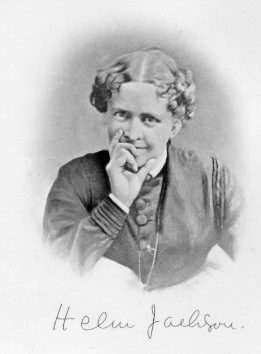
Helen Hunt Jackson defiant

Hard to tell personality from a picture, but those eyes and the start of a smile make Jackson look like she’s  about to dispute something or share a delicious secret.


That’s all but the most liked and listened to piece this spring, and I can tell you it was a run-away winner. Words from a famous poet or unknown one? Well, it’s sort of both. I’ll be back soon with that announcement.


*He laughed right after he said it, thinking it a fit pronouncement from the Department of Tautology Department.

The Parlando Spring 2019 Top Ten Part 2

Before we continue with our count-down of the most liked and listened to audio pieces this past spring, let me remind newcomers what the Parlando Project does. We take words (mostly other people’s, usually poetry) and perform them along with original music in various styles and sounds.

I really try to honor that intent for variety. My musical and singing limitations cannot be overcome just by intention—but the idea is to test limitations to see what will bend or break, not to treat them as barriers to be looked at from a safe distance off.

7. Water. One of our post series this spring I called “The Roots of Emily Dickinson.” I had the obligatory exposure to Dickinson during my education in the mid-20th century. My impression then was that she was treated as an approachable poet of the second rank. I think the shortness of her poems was part of that presumption of approachability, and that contributed to her subsidiary ranking too. And yes, the filter of gender stereotypes and prejudice had to be a factor. Common anthology poems like “Because I could not stop for death”  added a little gothic touch to our genteel high-school textbooks, and in my college life she got a place in American lit, though much less in more general literature or poetry courses.

But when you dive into Dickinson deeply you may find that the modest surface level of a Dickinson poem, which seems a homey back-lot pond, is rather a deep and mysterious well, and that you’ll run out of breath long before you touch the bottom of some of her little poems. If you’re curious like me, you can’t help but wonder: “What did Emily Dickinson think she was doing?”

So, this spring I looked at some of her models, confidants, and influences, and chief among them must be Transcendentalism, the hard to pin down American movement centered in Dickinson’s own region and time whose instigator and leading prophet was Ralph Waldo Emerson. I had fun in my original post on “Emerson’s Water”  by comparing Emerson’s fame and influence to Oprah Winfrey—but really, you’d have to add to Winfrey, Malcom Gladwell and the Dali Lama to get the range of Emerson’s influence.*  I was going to add some Robert Bly in there too, but though Emerson wrote poetry and influenced poets up to and including Robert Frost and Wallace Stevens, Emerson’s own poetry was not even wholly esteemed by other Transcendentalists.

Emerson’s poem “Water”  is still worth hearing, as many of you must have found here this spring. Back in The Sixties, when I first encountered the Transcendentalists’ story, I could see connections to the Hippie culture, and now in a generally more practical and materialist time I still see linkages. The Midwest had exceptionally widespread flooding issues this spring, and Emerson could have written “Water”  this year to address that. What’s Emerson got to say about water? The player is below.


Charles-Temple-Emily-Dickinson-silhouette

I could use this silhouette as metaphor for trying to understand Dickinson from what surrounded her. For the more mid-20th century among us: look at that chin and hear Charles Gounod’s music.


6. He Wishes for the Cloths of Heaven. William Butler Yeats is another familiar word-musician who supplies words to the Parlando Project. Perhaps I came closer to Yeats because I’ve ended up hanging around some Irish-American poets** once I moved to Minnesota, but if one is interested in musical sounding poetry in English, with things to consider beyond the inviting sound, eventually you’ll turn the corner and Yeats will be there.

The poem’s romantic closing lines are among several of Yeats’ that are well remembered by readers—memorability being one of the great tests of poetry. Hear those closing lines, for the first time or again, with the gadget below.


William Butler Yeats with cat

It was a classic battle of wills. The cat would not get up until Yeats agreed to get the cat food, and Yeats wouldn’t get the food until the cat got off his lap. Both were found and rescued in an emaciated state.***


5. May-Flower. From the roots present in Emerson, to the flower as expressed by Emily Dickinson herself, here’s the fifth most liked and listened to piece this spring.

Let’s return to the question of Dickinson’s intent. There some thought that this was written as merely a riddle-puzzle, that the reader was to guess the genus of the bloom from the clues in the poem. If that so, if that’s all, then it seems to me that Dickinson failed as a riddle-maker, as the clues don’t seem to determine the exact flower (and Dickinson, the avid botanist, would have had the knowledge to have done that). I decided to take her text and drill down to the mystical essentials she wrote of instead.

This is not the first time I’ve written of the psychedelic aspects of Dickinson. I can’t quite do the differential diagnosis on her eye problems (for which we know she needed medical attention) or decide on the theories that she may have had epilepsy or another disorder that could have caused auras and visual disturbances, but Dickinson often seems to be asking us to see differently, more intensely, as I believe she does here.

What kind of singular mind can toss this off as a riddle?

Hear my performance of “May-Flower”  with the player.


*All of these pop-culture comparisons understate the influence Emerson seems to have had in American academic life, also largely centered in New England at the time, but I don’t think they understate that Emerson’s readership in America’s 19th century extended deeply into the general literate class.

**Perhaps the most directly connected to Irish culture of them would be Ethna McKiernan. A footnote is not an adequate way to draw attention to the news that she has a new book, but she does.

***This is a joke, and only this footnote is serious. And don’t link to yesterday’s post for your homework as a cite that Carl Sandburg taught O’Hara, Baraka, and Wilbur about the building trades.

The Greatest Generation, or Thomas W. Higginson lands on Omaha Beach

I appreciate the attention readers here give to what I present, and so I’m going to warn you: this is a longer piece covering some historical topics that have not been as popular here as others. I plan to be back soon with a shorter post and  I promise a love poem set to music. Thanks for your attention and spreading the word about the Parlando Project. I value that!

Today is the anniversary of the WWII allies’ D-Day invasion of Northern Europe, and as each anniversary gets later the tributes to the sacrifices and courage of those who waded onto the beach amid the gun and cannon fire grow more glowing.

As one of America’s diverted poets once said, it is “altogether fitting and proper that we should do this.” And I say this knowing that this will likely be one of the least-read posts here. The audience for a blog about encounters with poetry and music is not a martial audience by and large. Even a poem like Slessor’s “Beach Burial”  recently presented here—a poem that is about war, though not really about battle or courage or warrior feats—will end up being one of the least noticed, read, liked, and listened to.

I speculatively assign that response—and the lessor response other stark war poems have received—to a number of things: that old battles are yesterday’s newspapers—or as we might say these days, just newspapers; that one of the things we might look for in the arts is a respite from, or at least a beautiful decoration for violent and horrific events. I’m casting no shade on you who have paid with your attention to what we do here for that—or your other judgements on the work we present. After all, I make those judgments myself all the time for my own reasons.

So now, having sincerely bowed to both those who were in the water on June 6th 1944 and you, dear reader and listener, I will diverge.

There is no Greatest Generation,* never was. Too much is assigned to generations, and if widely shared experiences and common events current to lifetimes has some glue to hold an aggregate together, extending “generations” to inner character and intrinsic resources of their membership, virtues and vices conferred merely from birth years is simplistic nonsense that should never be relied on.

I suspect wiser users of the term would correct me and say they do not mean that when they use the term, they mean the great things the WWII generation endured and did. Yes, I join them, there is value in noting that.

But one thing that literature teaches us, by doing its basic trick of letting us experience someone else’s life, is that the good and bad in human character and the challenges brought to bear on us are not unique to time and place. Are the challenges of WWII greater than the challenges of those of the trench soldiers of WWI that this project has featured? Are the privations of the Great Depression, followed by another World War and the following challenges of nuclear peace after great destruction worse than the challenges of 19th century American slavery followed by a Civil War followed by the continuing existence of a continent-wide republic after such trauma?

An Internet discussion mentioning these things often leads to claims and counter-claims of greatest evil: slavery, colonialism (which should include our “internal” American colonialism inflicted on our indigenous population), The Holocaust, Stalinism’s mismanagement, gulags and secret police, Pol Pot, and other evils whose incidental lack of notoriety should give them no cover. I’m sure there are appreciable differences in them, things philosophers could construct evaluative frameworks on. Don’t bother to comment or look for a poll feature to vote on the Greatest Evil or any generation associated with it. This will not be my point.

My point is: you, particularly the younger of those that read this, are the only generation that matters. If I need a silly name for you, a souvenir hat to show that you belong to this, then I’ll swallow my pendant’s pride and call you “The Greatest Generation.”

Do I want my own son, or you, to advance into shore batteries over an open beach or to try to hold Little Round Top without ammunition left? Do I wish it to be necessary to risk mobs, the bullies of privilege, or jail to secure basic freedoms? No, of course not. Nor can I be sure you will figure out what level of forgiveness and generosity vs. justice and retribution will succeed in the peace that all wars fail into. I would rather you figure out how to secure the things warriors were putting their lives in bond for without the war.

So why do I include these poems about war here? Here’s one reason, a personal one: I too often hear that arts and poetry in particular are a trivial activity, the first thing to be dispensed with when “reality” comes to call. And the arts in general, it’s said, aren’t they about vanity? Well, some of those warriors wrote, made and listened to songs. There were readers in foxholes. Call it pleasure, hope or need, some will hold onto poetry and music in any extremis.

And even the arts skeptics give us this: they pull those things out, music and poetry, for the funerals and anniversaries. Can we also realize that some of us hold to these things in life as well?

And here’s the more general reason: reading and listening to literature may remind you that those who pushed forward and those who opposed every good and bad thing are not historical figures, they have no powers or weaknesses because of the year they were born, no more than you do. They lived and died in their Imagist instant, just as you do, weighing duty, possibility, weakness, strength, love, hate, pretense, modesty, anger, resolve, justice and mercy. Seeing, doing, maybe not knowing. Literature shows us that all these things existed in each generation, gives us the evidence of what they feel like, how they exist, side-by-side.

That’s sort of like a poem may be. Those soldiers heading for the beach, like the words alone in a poem could not know fully what they meant. I do not mean by this a romantic claim that art or poetry equals their indominable authorial intent. There’s no measure of their last full measure, something we use art to teach ourselves. And anyway, as a working method our diverted poet settled that issue in his Gettysburg Address too, but chose to do it in his orated poem.

That said, now let me justify the post’s title. I’ve continued to read Thomas Wentworth Higginson’s writing this week, particularly his 1899 memoir, Cheerful Yesterdays.  Higginson is mostly known today as a footnote—kind of like the record company guy who passed on signing the Beatles—as the man in publishing who Emily Dickinson reached out to with a handful of poems and who then corresponded with her over a period of years when she was writing her groundbreaking poetry. Why didn’t he know right away what was on offer literature-wise with Dickinson?

I’ll confess I started his memoir in the middle, and I will now go back and read the start. From its “cheerful” title you may not have a good handle on its matter. It’s both breezy and polite and gripping and harrowing, a strange mix. I knew Higginson was (among other things) a slavery Abolitionist, and because of what he calls “The Sisterhood of Reforms” that he was involved in other social movements, including Feminism/Women’s rights. It’s in the middle, where I came in, that I learned about just what kind of Abolitionist he was.

Abolition included Fabian elements that sought to corral this basic evil legally and eventually end it, non-violent radicals and self-described “agitators” who put their lives on the line but would not morally take another’s life, and the “by any means necessary” crowd. The later was were Higginson lived, at least after 1850 and the Fugitive Slave Act. He was part of (seems to have been a principle in, though he characteristically refrains from claiming leadership) the Boston Vigilance Committee that sought to prevent captured slaves from being returned to their masters as that law required, and he grippingly relates his first hand participation in trying to prevent the last government-assisted attempt in Boston to do that, which includes his plan for a lightning strike by a cadre including himself on the city jail, where the enslaved man was held. The plan counted on an agitated mob in the streets as cover—a crowd who would be motivated to cause a ruckus by his own rable-rousing speech at Faneuil Hall, from where he would dash to the jail to lead the break-in!

Following chapters detail his organizing and gun-running during the “bloody Kansas” guerilla war fought around a plebiscite to decide if the new state would allow slavery, and his joining the John Brown/Harper’s Ferry conspiracy that he says was portrayed to him at first as an armed extension of the Underground Railroad, where a coordinated “jailbreak” of slaves would be accomplished, but which due to lack of funds and organizational ability became what was to be the opening battle in a general slave rebellion which disastrously failed. Particularly in the Brown story, Higginson’s quick-moving/hit the highlights narrative style seems an odd fit with the material. He’s sometimes ambiguous about Brown, and from his vantage point decades after the Civil War and Brown’s execution, he remarks that Brown’s outlook and mental state may have been compromised by Brown’s years in the struggle—but the events say that at the time he was putting himself at risk of felony imprisonment or even a charge of treason with only the surety of his faith in Brown and the necessity of his cause. During much of these activities, Higginson mentions that he was armed, and though he never mentions firing at anyone, presumably he wasn’t carrying pistols for sport.

If your vision when you have read the tale of Higginson in the Dickinson saga is of a rarefied literary critic whose wars were “laid away in books” you’ve understood him too quickly.

When the Civil War breaks out in 1861, the 38-year-old Higginson is raring to serve. He begins working to recruit soldiers almost immediately.* Within a year, he’s tasked with leading the first Afro-American regiment in the U.S. Army, which he takes up gladly.

This explains the oddest part of his rambling, Polonius-like  1862 “Letter to a Young Contributor”  magazine article that is often thought to have inspired Emily Dickinson to write Higginson. Near the end Higginson launches into a discussion of war as a subject for writing and a vocation for writers.

No doubt, war brings out grand and unexpected qualities, and there is a perennial fascination in the Elizabethan Raleighs and Sidneys, alike heroes of pen and sword. But the fact is patent, that there is scarcely any art whose rudiments are so easy to acquire as the military; the manuals of tactics have no difficulties comparable to those of the ordinary professional text-books; and any one who can drill a boat’s crew or a ball-club can learn in a very few weeks to drill a company or even a regiment.”

This seems like a combination of distain for the difficulties of military command (from a man who had already risked his own life and engaged in concerted acts which led to the death of others) and a bit of a backhanded and Americanized version of “The battle of Waterloo was won on the fields of Eton” line. But at the time this article was published, that was what Higginson was preparing to do. He was heading to South Carolina to take over that regiment of freed slaves.** Read in that knowledge it seems a bit like he’s trying to psych himself up for the task, or that someone has told him those things to convince him to go forward with the commission.

So, the first thing my wife asks when I tell her I’m reading Higginson’s memoir, is one you may be asking too. “Does he mention Emily Dickinson?” In this 1899 memoir, he does not. Due in some part to Higginson himself, the posthumous 1890 original edition of a large chunk of Dickinson poetry was an unexpected, multi-printing success, but this didn’t make Dickinson what she is today: one of the giants of American poetry. The “unexploded bomb” of Emily Dickinson took almost a century to explode slowly. She’s just one author he worked with, and since he knew many of the literary figures of the day, Dickinson wouldn’t be the only notable to mention. He knew Longfellow and Emerson, spent a day with the reclusive Tennyson, all persons of unfathomable fame then.

Suppose a 20th century music figure who knew Bob Dylan, had met all the Beatles, and worked with Stevie Wonder, while also having run with the Weathermen, the Panthers, fought with Che Guevara and was a co-founder of Ms. Magazine, was to write a memoir in 1999. How assuredly must there be a paragraph in that imaginary book that started. “Oh, by the way, one time, Joni Mitchell*** wrote me some letters. I wrote back asking if all those open-tunings were really necessary?”

But even without hypothetical metaphors, it does say something about the attention Higginson spent on an unknown woman poet’s poems in 1862. We might say, with hindsight: too little. But with the above context, we may be surprised at the attention he did  pay.

Back to metaphor: instead of taking the usual story of the boneheaded critic and the revolutionary artist, we might ask if someone was training to parachute into occupied France in 1944 to work with partisans,**** why would he care about poetry? Higginson apparently did.

If you’re a buff about 19th Century American history and culture, particularly the Abolitionist circle around Boston, Cheerful Days  is a brisk read and is available in the books section of archive.org. As I mentioned in introducing it, its tone is somewhat incongruous considering the deadly American crisis at its center, but no matter how much Higginson may be trying to shape his story modestly and discretely, it still gives insight to the times. I say that even though if you don’t have a basic understanding of the events leading up to the Civil War if may be confusing to you in places, as Higginson assumes some common knowledge of things his cohort lived through.


*Military recruitment at the start of the American Civil War was a much more localized and “free-enterprisey” kind of thing, and his connections with armed slavery resistance and the Kansas war meant he already knew who was ready to take up arms.

**Not yet citizens, not yet even really “freed” as the compromise taken at this point in the war before the Emancipation Proclamation was to treat slaves who crossed the lines as “contraband of war,” a term, however dehumanizing, that prevented them from being returned to their masters.

***I use Joni Michell pointedly here. Like Dickinson, she was considered a niche artist held in limited esteem in the 1990s. and only decades later is she more fully recognized for the level of originality and effectiveness in her work.

****Once more, I’m making a considered point here. Officers of Afro-American troops were not to be treated as prisoners of war, but to be summarily executed by decree of the Confederate government. In his memoir Higginson says he didn’t think they’d really do that.