I hope poetry is “the news that stays news” still this month, as I’ve trailed the U.S. Election Day with the pieces The LYL Band recorded while we awaited results back then. And today’s piece probably should have been ready for Veteran’s Day, the November 11th American holiday. “Highland 1955” is a piece by Kevin FitzPatrick, a Minnesota poet who was a quiet master of putting the experience of working-class and middle-class people into tight, well-crafted poems that work in their moments like a condensed short-story.
This is a fairly early poem in FitzPatrick’s career, published* in his 1987 collection Down on the Corner, but even so it shows how well he integrated his craft into a short poem so that it seems – on the surface – to be a casual, off-hand memory piece. I had the privilege of seeing how Kevin passed through on his work-in-progress drafts. I don’t think I’m making one of my “imagining more than was intended” stretches with what I’m about to say about it.
“Highland 1955” opens simply, with a variation that coincidently opens many a folk song about young lovers: it’s a morning in May, but the line-by-line development of the story FitzPatrick is going to make, is rapid and telling. It’s a weekday – a work day for working folks. It’s a 1950s post-war baby boom story, and the wife in the household is sleeping when she has the chance while the family is sleeping. Except one member of the family isn’t sleeping: her husband. He’s “rehearsing his music.” In the course of the collection it’s a part of, dedicated to his parents, we may gather this is the author’s family, that he was once awake too on such a morning.
Next line: the husband is “Back from Bataan.” I know author Kevin was concerned about “pre-requisite knowledge” in his poems, but here he chose only this briefest allusion. I’ll acknowledge: history fades – Bataan was where the last American forces retreated to when the Philippines were overrun by the Imperial Japanese armed forces near the beginning of the American involvement in WWII. Those that survived until capture became fewer after the prisoners-of-war were taken on a forced march on short rations (the infamous “Bataan Death March”) to eventual forced labor. Making this only a single word is a choice. This poem has to balance, because Kevin wrote considered and balanced poems.**
Before we leave that stanza, we learn that the father’s music is a side-hustle, he’s a wedding-singer-for-hire for needed additional income with the growing family.
The third stanza seems like a random digression. What’s the point? Sometime in the future the poet’s brother’s voice will be mistaken for his father’s. Kevin burns a modifier describing that voice “baritone” – that hyper-male register. The father here, working at dawn in his side-hustle to support his family, will serve as model for the sons as they grow into such a voice register. And there’s a point to this voice mistake Kevin wants us to know will occur: the non-immediate-family (“company”) will assume that the father, Bernie, would be singing for the art of it, but we’ve already learned, it’s a second job, a way to put bread on the table. Apparently, when the son imitates the father’s voice, he too sings quietly, for the listeners must shush themselves to hear it.
This mistake is reinforced with the poem’s punch-line, the episode of the neighbor “Mrs. Krause” who will assume Dad/Bernie is singing love songs to his spouse, who we know from the start is dead-tired and asleep. The quiet voice isn’t the sly tenderness of the mysterious romantic lover, it’s respect for the hardworking housewife.
So, here’s a compressed story of a man home from war’s horrors, raising kids, showing respect for his wife and family, and the images in the poem hardly seem like images at all: the separated Spring aubade of the sleeping woman and the man singing love songs – but to support her. Boys will grow into a low-pitched voice like their fathers. A man not so long ago separated by war’s horrors and caprices who now sells “in(as)urance.” This world wants, assumes, romantic love, but for working-class folks there’s a hard shell of shared work and endurance that surround that.
And one of the father’s sons will become a poet, a word-singer, who will write this. A song about work that is (or isn’t) confused as a song about love.
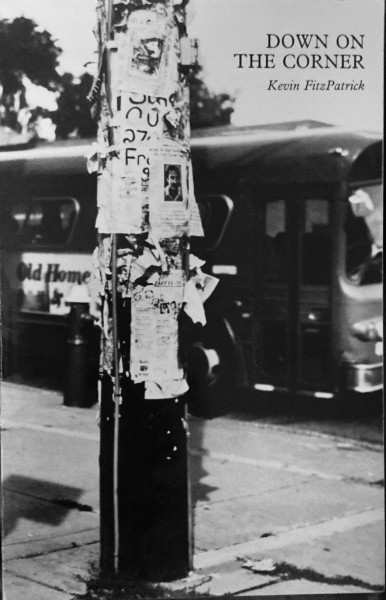
The Kevin FitzPatrick poetry collection that includes this poem is available from this web site.
.
You can hear the LYL Band perform Kevin FitzPatrick’s “Highland 1955” with the audio player below. Shh, there’s no audio player to be heard – or rather seen? Unlike Mrs. Krause’s kitchen window, it’s possible that your way of reading this blog doesn’t keep itself open to such an audio gadget, but I’ll offer this highlighted link as an alternative that will open a new tab with its own audio player.
.
*FitzPatrick’s poetry collections were published by a small press that was originally setup to publish the writing of Meridel Le Sueur, a mid-century Midwestern writer whose work also celebrated working folks lives.
** Kevin helped his dad write a book length memoir of that war-time experience, so there was another place to tell the long-form story.

