Riley’s Thanksgiving

I don’t know much about American poet James Whitcomb Riley, but then I gather that modern American literature doesn’t require us to know much about him. Going by the bullet points, I can say that he tried to be that now obsolete thing: a popular mass-market American poet in the era between Longfellow and before Frost and the Modernists. I read his good-sized Wikipedia article this morning just to make sure I wasn’t going to overlook or misstate some big aspect of his career, and found no special hidden element there requiring further investigation. The main thing that article impressed me with is how hard he personally worked to become a popular best-selling poet. He tried a great many routes: live readings and mixed-entertainment presentations, rural “common-folks” dialect verse, children’s books, submitting to literary magazines and working as a newspaper poet.*

I had looked briefly for Thanksgiving poems when a Riley poem named “Thanksgiving” popped up. My immediate reaction: “Not my kind of thing.” It had the form of sentimental verse without any attractive word-music. Here’s a link to the poem as Riley published it.

I’m not sure why I looked at it a second time. Perhaps other poems I found in my brief search also seemed weak candidates? On the second reading I noticed some more unusual elements in Riley’s poem. There are a couple of ways to write a Thanksgiving poem. One is to treat it as an autumn harvest poem, cataloging the bounty that nature has provided at the end of the growing season. Another is to write of the blessings one is grateful for. Riley makes moves toward those two approaches, but what he writes of includes as much distress as successful harvest. What emerges in this mixed accounting, once one gets past the antique and sometimes clunky language: thanksgiving for caring and love.

Caring and love? Sentimental claptrap? Pablum for the non-literary masses? As Thanksgiving 2026 approaches I now saw, felt, something else. Thoughts specific to our current lives overcame me, similar to reading the Robinson Jeffers poems I’ve featured earlier this month, or Conrad Aiken’s visions of an apocalyptic vampire. What has happened since last as Americans “our universal thanks were told?” My city, and several others, were overrun by crudely run armed groups who leaders claimed were seeking violent criminals. It was as if some madman proclaimed “You say you’re troubled by crime? Let’s tackle, beat, and gas some jaywalkers and drag some overtime parkers out the shattered windows of their cars while their kids watch. Document us doing this and we might arrest, beat, or yes, kill you.” I’m an elderly white European looking guy, my risk was to not like this behavior by my government and acting on that.** If I looked more like a person indigenous to the Americas, Africa, or Asia I might hesitate to go out in public. These masked guys made lots of mistakes, and they weren’t apologetic about it either.***

And these are only one set of outrages since last Thanksgiving. Wars of choice without consent, a vile and ineffective nationalism, planned extrajudicial airborne killings of hundreds of men in boats, copious self-dealing and corruption. Have I gone off on another digression from poetry and lost you reader?

And so, you’ve heard performances of poems lately here of fear, disgust, destruction, and endurance. When I performed live in the studio at noon-time on Election Day I could let those fears and doubts and bereavement about my country out.

Well, the election results just hours later are a hopeful sign. And in the midst of James Whitcomb Riley’s Thanksgiving poem this week I found this praise of love and caring, things that became necessary weapons and recompense to the outrages unleashed on us. Let me carve that out of the poem and make a song from it. You can see that I’ve compressed and rearranged Riley’s words to bring out those elements that touched me within the original poem.
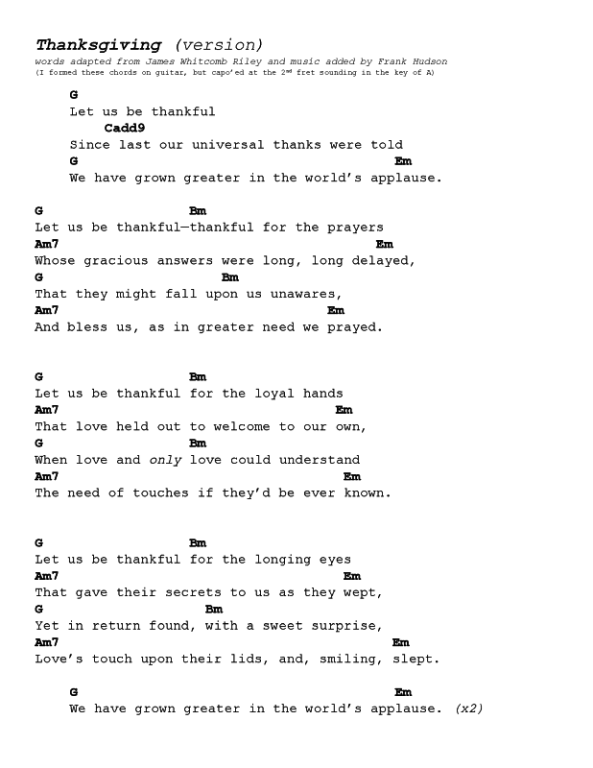
Riley's Thankgiving

A chord sheet in case you want to sing this yourself.

.

While cleaning and reorganizing a storage space this afternoon I found a relic of my youth, this cardboard case still containing a guitar I used in the early days of the LYL Band. I recalled the guitar was bought broken, its top coming unglued all along the bottom edge and its bridge lifted nearly completely off the face of the guitar. I recall I crudely glued the separated edge with some wood glue and clamped it down to dry somehow. To deal with the bridge I used a trapeze tailpiece, and I made a rough-hewn saddle out of a piece of plastic model car sprue. I opened the cardboard case lid, and this battered instrument was still intact after 45 years of storage. Inside the case pocket was an old set list and a set of fingerpicks from when I played fingerstyle back then. Before I figure out what to do with this genuine punk-folk artifact I decided it needed to be played at least one more time. I restrung it and recorded the guitar track you’ll hear below. If the Pilgrims came over in a leaky boat, this instrument is at least as creaky a conveyance, but it sounds remarkably like a guitar when recorded, if not an outstanding example of same. In contrast, the violin part was played on my newest guitar, a Swedish designed headless solid body electric with a MIDI pickup with which I can control a virtual instrument fiddle. One thing I read about Riley: in his various activities to present himself as an entertainer he learned to play guitar and violin, so I’m hoping his shade forgives my surgery on his poem.
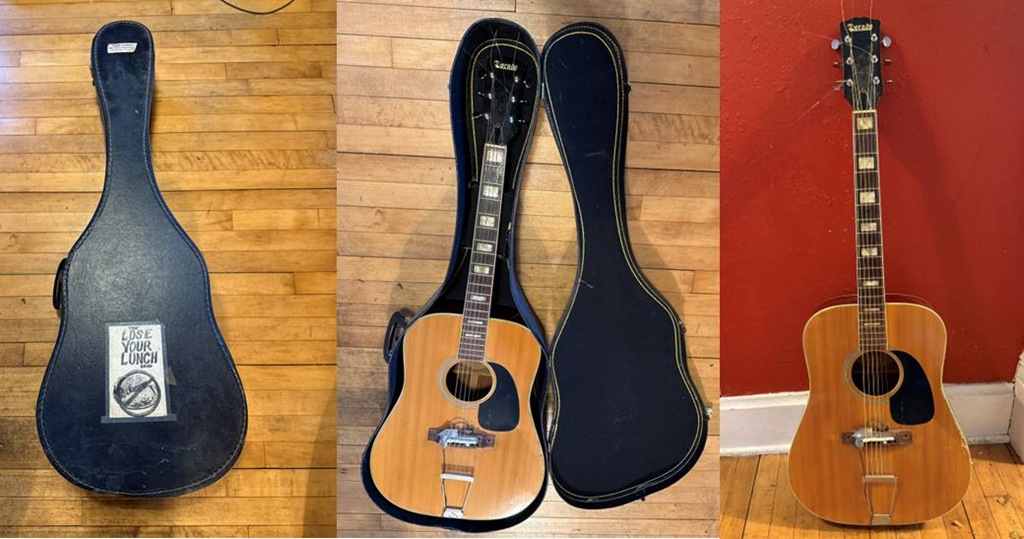
Dorodo Guitar and LYL case

Uncasing a guitar I played in the first year or two of the LYL Band
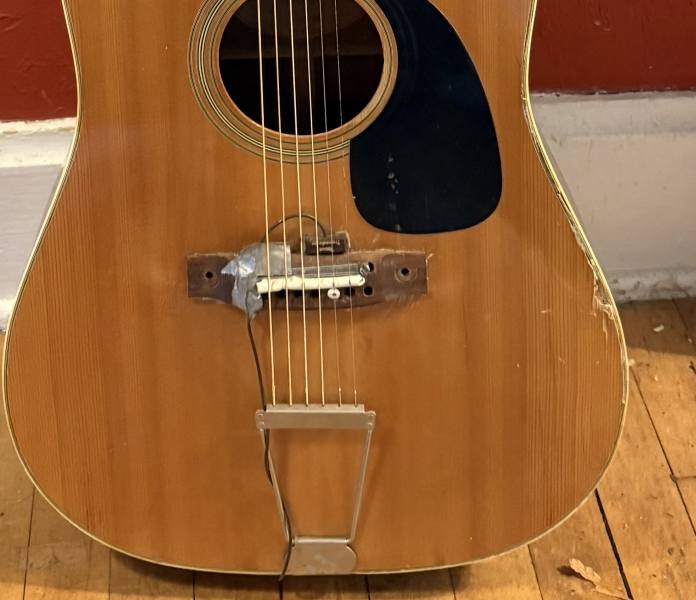
Dorodo Guitar closeup of punk rock lutherie

Closeup showing the punk-rock lutherie practices that made this bought-broken guitar playable

.

Audio player for my version of “Thanksgiving”  is below. No player? I won’t need to get out the bottle of Titebond and tack one on your devices screen, as I offer this highlighted link that will open a new tab with its own audio player.


.


*I’ve only looked at newspaper poets peripherally so far, but besides occasionally printing outside verse contributors, some newspapers had a regular poetry feature written by an employee in Riley’s time. My impression is that this was often analogous to the later 20th century newspapers of my lifetime having an editorial cartoonist and/or illustrator who would use their art to portray observations and opinions about subjects of interest to the general reader. With the exception of song-lyrics, poetry as a popular or pulp artform has largely disappeared for now.

**Freakishly, the first American citizen observer shot and killed – and on the street just beyond the alley my office window looks out on – was a poet. I spent a couple decades in nursing, and the second observer killed was a nurse filming on another street in my city who reflexively turned to help a woman Maced and knocked down next to him.

***Acts like getting groceries etc. for neighbors became common. I heard tales of taking folks to medical appointments with passengers huddling below window level beside the Average White Person driving them.
Highland 1955: A story of endurance in song

I hope poetry is “the news that stays news” still this month, as I’ve trailed the U.S. Election Day with the pieces The LYL Band recorded while we awaited results back then. And today’s piece probably should have been ready for Veteran’s Day, the November 11th American holiday. “Highland 1955” is a piece by Kevin FitzPatrick, a Minnesota poet who was a quiet master of putting the experience of working-class and middle-class people into tight, well-crafted poems that work in their moments like a condensed short-story.

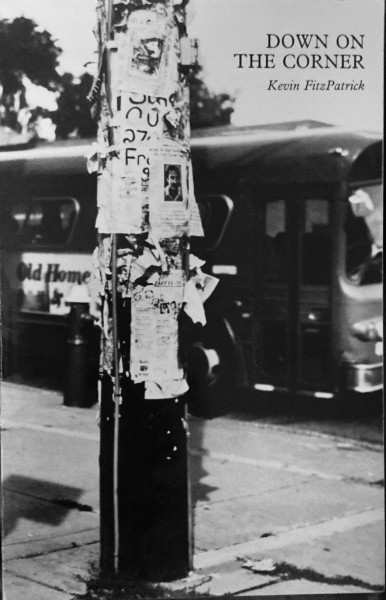
This is a fairly early poem in FitzPatrick’s career, published* in his 1987 collection Down on the Corner, but even so it shows how well he integrated his craft into a short poem so that it seems – on the surface – to be a casual, off-hand memory piece. I had the privilege of seeing how Kevin passed through on his work-in-progress drafts. I don’t think I’m making one of my “imagining more than was intended” stretches with what I’m about to say about it.

“Highland 1955”  opens simply, with a variation that coincidently opens many a folk song about young lovers: it’s a morning in May, but the line-by-line development of the story FitzPatrick is going to make, is rapid and telling. It’s a weekday – a work day for working folks. It’s a 1950s post-war baby boom story, and the wife in the household is sleeping when she has the chance while the family is sleeping. Except one member of the family isn’t sleeping: her husband. He’s “rehearsing his music.” In the course of the collection it’s a part of, dedicated to his parents, we may gather this is the author’s family, that he was once awake too on such a morning.

Next line: the husband is “Back from Bataan.” I know author Kevin was concerned about “pre-requisite knowledge” in his poems, but here he chose only this briefest allusion. I’ll acknowledge: history fades – Bataan was where the last American forces retreated to when the Philippines were overrun by the Imperial Japanese armed forces near the beginning of the American involvement in WWII. Those that survived until capture became fewer after the prisoners-of-war were taken on a forced march on short rations (the infamous “Bataan Death March”) to eventual forced labor. Making this only a single word is a choice. This poem has to balance, because Kevin wrote considered and balanced poems.**

Before we leave that stanza, we learn that the father’s music is a side-hustle, he’s a wedding-singer-for-hire for needed additional income with the growing family.

The third stanza seems like a random digression. What’s the point? Sometime in the future the poet’s brother’s voice will be mistaken for his father’s. Kevin burns a modifier describing that voice “baritone” – that hyper-male register. The father here, working at dawn in his side-hustle to support his family, will serve as model for the sons as they grow into such a voice register. And there’s a point to this voice mistake Kevin wants us to know will occur: the non-immediate-family (“company”) will assume that the father, Bernie, would be singing for the art of it, but we’ve already learned, it’s a second job, a way to put bread on the table. Apparently, when the son imitates the father’s voice, he too sings quietly, for the listeners must shush themselves to hear it.

This mistake is reinforced with the poem’s punch-line, the episode of the neighbor “Mrs. Krause” who will assume Dad/Bernie is singing love songs to his spouse, who we know from the start is dead-tired and asleep. The quiet voice isn’t the sly tenderness of the mysterious romantic lover, it’s respect for the hardworking housewife.

So, here’s a compressed story of a man home from war’s horrors, raising kids, showing respect for his wife and family, and the images in the poem hardly seem like images at all: the separated Spring aubade of the sleeping woman and the man singing love songs – but to support her. Boys will grow into a low-pitched voice like their fathers. A man not so long ago separated by war’s horrors and caprices who now sells “in(as)urance.” This world wants, assumes, romantic love, but for working-class folks there’s a hard shell of shared work and endurance that surround that.

And one of the father’s sons will become a poet, a word-singer, who will write this. A song about work that is (or isn’t) confused as a song about love.

Down on the Corner cover 600

The Kevin FitzPatrick poetry collection that includes this poem is available from this web site.

.

You can hear the LYL Band perform Kevin FitzPatrick’s “Highland 1955”  with the audio player below. Shh, there’s no audio player to be heard – or rather seen? Unlike Mrs. Krause’s kitchen window, it’s possible that your way of reading this blog doesn’t keep itself open to such an audio gadget, but I’ll offer this highlighted link as an alternative that will open a new tab with its own audio player.


.


*FitzPatrick’s poetry collections were published by a small press that was originally setup to publish the writing of Meridel Le Sueur, a mid-century Midwestern writer whose work also celebrated working folks lives.

** Kevin helped his dad write a book length memoir of that war-time experience, so there was another place to tell the long-form story.

Shine Perishing Republic: Meteors Not Less than Mountains

This post continues with the LYL Band’s noontime performance recorded on American Election Day, parts of which I’m sharing here this month. So far, I’d opened the live-in-the-studio session with a selection from a Stephen Vincent Benét poem “Litany for Dictatorships.”   Keyboardist/vocalist Dave Moore followed performing a poem, “Their Beauty Has More Meaning.”   Dave handed it to me after we performed it. “It’s by Robinson Jeffers” he told me.

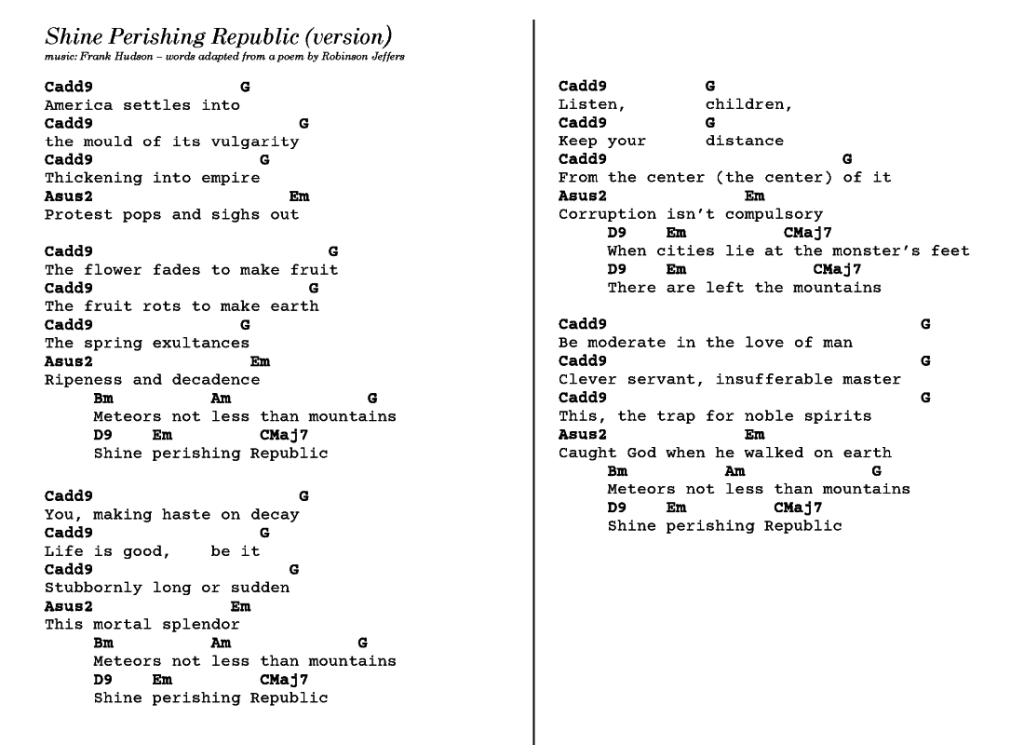
“I’ve got a surprise for you” I replied, “because this is the next one I have from my stack.” Slouching toward Bethlehem, I handed him this rough chord sheet.

Shine Perishing Republic

The above is my song-adaptation. To see the full text of Jeffers’ poem as he wrote and published it, see this link.

.

This wasn’t the first time I thought about performing this Robinson Jeffers poem. When I went looking for stuff to perform on Election Day, I revisited it again. I already had a couple of pieces I thought I’d do as spoken word combined with music, and so I was now looking for something singable – and for all of its applicable prophetic attitude, this poem of Jeffers just didn’t “sing” off the page for me.

The thought struck me: well then, translate it into a song.*  I took the text of the poem and started to extract the images from the somewhat Latinate rhetoric of the original. One thing that songs like and page-poems often eschew is a chorus, and so moving from poem to song I extracted a line from the middle of the poem, an image reflecting Jeffers’ characteristic focus on geological time compared to the brevity of humanity and its efforts and actions.

Did I help or hurt Jeffers poem with my version? I do think I modified the exact meaning that Jeffers intended his poem to have. His prophetic text (I mean that largely in the Biblical sense) reads as more despairing than what I performed. I flatter myself to think that I fractured but sharpened some of his images. For my purposes it succeeded because I’d much rather sing my version.

I find it interesting to read his poem as Jeffers wrote it and note that it was published just over 100-years-ago. The American Republic’s turn to empire then was largely North and South continental, and its position among the world’s nations, important but not so preeminent and essential. My current nation’s deluded emperor seems prone to all of the bully-boy actions of imperialism – while utterly lacking the skills of alliances, strategy, tactics, and logistics that empires require. Heartened as I am today by the results of the election that was ongoing while we performed this, I remain fearful for the world and my country – and ours is not the only unbalanced and lethal war-lord on this globe. I didn’t gloss over Jeffers troubling concluding image, that humanity, the people whose power we must rely on against kings and oligarchs, are not infallible either. The Bible has its tyrants Herod and Pilate, but Barabbas won a popular election.

My version with this chorus brings forward a thought I think was in Jeffers’ message. The lifetimes of all nations (measured against the entire sweep of history and of the earth nations draw lines upon) are like the bright but short augury of a meteor compared to the long geologic truth of a mountain. Our lives, our citizen lives, are shorter yet – but can our imperfect – though capable of acts of humane worth – republic shine yet as it flies?**

You can hear the LYL Band performance of my version of Robinson Jeffers’ “Shine Perishing Republic”  with the audio player below. Has any such audio player burned out across the sky and struck itself invisible into some earth-bound rocks?  This highlighted link will unearth a new tab with its own audio player then.

Odd isn’t it, that without coordination on our part, both Dave and I had thought of Robinson Jeffers poetry as we considered Election Day. After quickly finding his place in this musical adaptation he’d never heard, I’m grateful that Dave’s organ part helped ground its performance last week. To further bring forward that chorus I promoted from Jeffers’ text, I did the make-yourself-a-multitrack-group-of-backing-singers thing last weekend and mixed that with the live performance.

.

*Longtime readers here will know this is what I do when translating work from other languages into English for performance here. I generally don’t try to convey the original syntax or characteristic word order of other languages, and I don’t try to follow some one-for-one recreation of their word-music either. I ask myself, what are the images the poet is evoking, and how can I evoke them in vivid contemporary English? This isn’t necessarily the best way for all poems and purposes, but it’s the default way I go about that task.

**Is it possible this “meteors not less than mountains” was informed some way in Jeffers’ mind from scientific cosmology’s theory that our planet was formed by the accretion of smaller rocks in space colliding and forming our globe? Per this mechanism, there’d be no ancient mountains on our planet’s surface without the preceding mandate of those cosmic ballots being cast! Might this metaphor have occurred to Jeffers as he built his Tor House and Hawk Tower on the coast of California from rocks he hauled and set together “making stone love stone?”

If Jeffers knew of the early versions of the more current accretion theory of planet formation, it might have to have been through Chamberlin and Moulton’s pioneering planetesimal hypothesis.

That’s a bit of wild speculation on my part, but Jeffers’ younger brother Hamilton had achieved a doctorate in astronomy at the time Jeffers was writing his poem.

Their Beauty Has More Meaning, or parachuting from a trainwreck

So, a momentous American Election Day, and the LYL Band reconvened during the noon-hour while voters were still casting their ballots. If you recall, I – acting as recording engineer, musician, and half-time vocalist – played the first few notes on electric guitar, went to sit on the stool beside my microphone position, and…

…I’d moved the stool that morning to check some audio wiring patch points. My blind ass couldn’t see that, and I plopped butt-first on the floor.

No matter how ominous great human events are, there’s room for a pratfall.

When the LYL Band plays – and we’ve done that for over 45 years – we’ve followed a practice of alternating between song leaders. Recovering my dignity (such as it is) I’d done my Stephen Vincent Benét selection. It was Dave’s turn, and in the Parlando Project spirit he had a poem by Robinson Jeffers. Just as Dave didn’t know what I would play or what I’d be singing or speaking, I didn’t know what Dave was starting to perform. I had a recording software screen in front of me, keying drum sequences and occasionally checking levels while trying to inventory and retrieve my limited stock of musical skills within myself – but no lyrics or music, not even a scribbled chord sheet. My posterior may have been sightless when we were thrown down from heaven, but in this musical situation, I have the decades that Dave and I have played together to guide me. I’m not sure what I’m thinking when I spontaneously play with him, and that’s a strange, yet somehow pleasant feeling. On one level my mind fears and braces for what bands call “a trainwreck,” where timing and pitches collide, and as I begin to play my ears will sometimes hear that collision emerging. I must try to repair the parts of the train as they are exploding! Other times, when it starts to work, I feel like a cartoon character rebuilding the train-track while sitting on the front of the moving locomotive: how fast can the rails and crossties be laid-down? When playing, I’m hastily searching for the “good notes,” the safe ones that won’t conflict with what Dave is playing while trying to allow the ones that rub and stretch with the other parts in urgent ways.*

I happen to like loosey-goosey music that finds itself in the playing, though not all musicians and listeners do. Without brag or pride I say: when mixing the recordings later, I’m often surprised at what makes enjoyable sense to my ex-post-facto composer’s judgement from what I remembered as a frantic grab for the emergency parachute rip chord.

In the midst of all that, I’m hearing and trying to react to the words Dave is spinning out. This time, they seem slightly familiar, but I can’t be bothered to wonder much about that. We finish the single take, the one you can hear below, and Dave says it was a poem by Robinson Jeffers. Here’s a link to the text of that poem.

Robinson Jeffers on the rocks

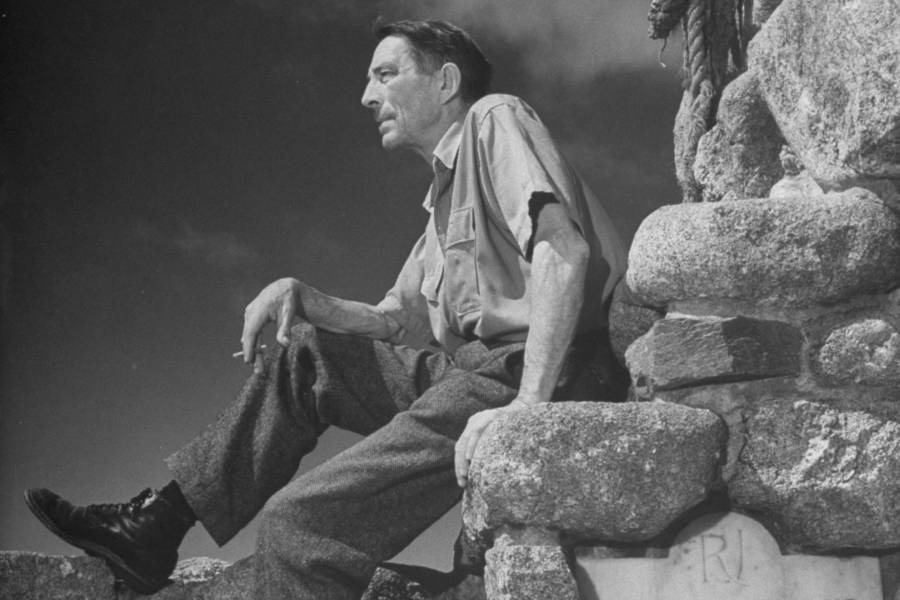
Robinson Jeffers, rock star, which is to say he built his own home out of rough-hewn stones.

.

I’ve always found Jeffers an odd case, and he interests me even if I suspect the two of us wouldn’t agree much. He’s a pioneer in the 20th century intensification of the 19th century American Transcendentalist theological examination of nature as the revealed truth – something I see in some contemporary poetry – but even if that approach retains currency, Jeffers take on these matters remains unusually strong and strange. He called a core tenet of his animating thought “inhumanism.” Today’s poem, chosen by Dave for performance, “Their Beauty Has More Meaning,”  examines the experience when the poem’s speaker (presumably Jeffers himself) examines a morning in its one-in-an-ages-long sequence of dawning and knows that he is as brief or briefer than a single day in the face of astronomical and geologic time. Even the birds and their birdsong, (always a handy metaphor for the musician’s or poet’s art) issues from any creature’s short life, though generations will perhaps repeat this utterance.

When Jeffers expresses his beliefs, one could find this outlook too fatalistic, even despairing – but in this example that Dave selected, Jeffers is, I think, at his most comforting. We, the ordinary people of this world (or the artists in it) are making our morning songs as best we can or must – beautiful to some ears at some moments, though we still have so little power to move the universe. Our “I Voted” stickers of last Tuesday are – at least at the individual level – tiny, constrained circles. Where I live, we’ve been through a year where the birdsong of whistles and car horns were arrayed against masked and armed troops, and two who did such were shot and killed. Is it comforting to know that we are small, temporary, things, doing the small, temporary things that are what we can do? In contrast, the self-styled great men who rule us think (as the previous piece in this series put it) that because they have great power, they must have great wisdom.

Jeffers wanted his message of human inadequacy to judge, and find lacking, the deadly engines of warfare – a human imitation of the great destructive acts of natural disasters. So strongly did he feel the human vanity in war that he steadfastly opposed WWII, the mighty violence that we often judge as on-the-whole necessary to oppose great human evils.

We finished playing Dave’s presentation of Jeffers’ poem. It was my turn at the mic. I had a chord sheet page for Dave, and a surprise. The nature of that surprise is part of the next post, coming up soon.

To hear the LYL Band perform Robinson Jeffers’ “Their Beauty Has More Meaning”  live in the studio on Election Day, you can pull the lever** for the audio player below. No player visible? You can request a provisional ballot – well, another way to get an audio player: this highlighted link that will open a new tab with its own audio player.


.


*We do use rough chord sheets for some pieces, we usually try to guess and announce the key center for a piece; but we don’t work out an arrangement between players, and the sheets are sketchy and undetailed. Is this the best way to do what we intend? I’m not sure, but it’s the way Dave and I have done this. With the rest of the Parlando Project pieces I’m increasingly working in the one-man-band scheme, playing and then rejecting or excepting the tracks I lay down or compose.

There are folks who intentionally skill themselves in free music improvisation, who come at the situation with more musical chops and theoretical knowledge. I admire, and praise that commitment, but I don’t believe art is essentially a hierarchy. I act instead on what I feel was the core belief of the 20th century folk revival and the later (but highly similar) punk-rock movement that saw music and art as the sharing of necessary expression.

**Old person reference. Voting machines used to be these 8-foot-high booth-sized contraptions where you flicked little levers like a pinball machine racking up points and then registered your choices with a bigger lever that felt like you were shifting a truck into gear when you yanked it over with a satisfying clunk. Filling little exam ovals with black ink lacks the tactile and auditory richness of the old ways. I could even say the modern silent ink seems like composition abstracted in musical notation while the old voting machines felt like grabbing a Bigsby whammy bar while slamming out a chord on a guitar.

Litany for Dictatorships, a Pratfall

Tuesday was Election Day in the United States, and I had a lot of hopes and fears. As a matter of displacement for those fears, it was also the day I’d scheduled to get back together with Dave Moore to make and record spontaneous musical performances. Like the election, an event I was looking forward to, while retaining some worries. I’ve spent the entire summer rewiring and repatching the recording system in my studio space with the goal of improving captures of this kind of performance. But as the months passed, both Dave and I were getting older. We first started doing this kind of playing and recording over 45 years ago to cassette tapes, and now we have to deal with the frailties and energy levels of old age to continue this.

Monday I tested the new scheme out, as best I could by myself. Everything seemed to be working. Dave would arrive at our accustomed mid-day hour Tuesday. That morning I repeated a quick sound-check and left everything powered up and ready for his arrival.

Dave carefully traversed the rickety stairs and I greeted him. I explained that there was now a computer system at his position running Mainstage* that would allow him to load a variety of soundbank instruments for his main keyboard. I said I’d show him how it worked after we tried an opening song.

So here was yesterday: a country (and to some extent, a world) awaiting to find out what would happen with America’s current ruling cabal and this more localized concern about two older poets/musicians trying to create something with sound and words. I stepped over to my microphone position wearing a Telecaster electric guitar strapped across my body and began to play the first few notes. Dave was looking at a new keyboard setup, and as is our customary scheme, neither of us would have forethought of what were going to play. I quickly told him what key center we’d start in. We were beginning – we had to begin, even not knowing more than that. I had a serious poem of tyranny and the end of empire to present. Heavy stuff.

Litany for Dictatorships

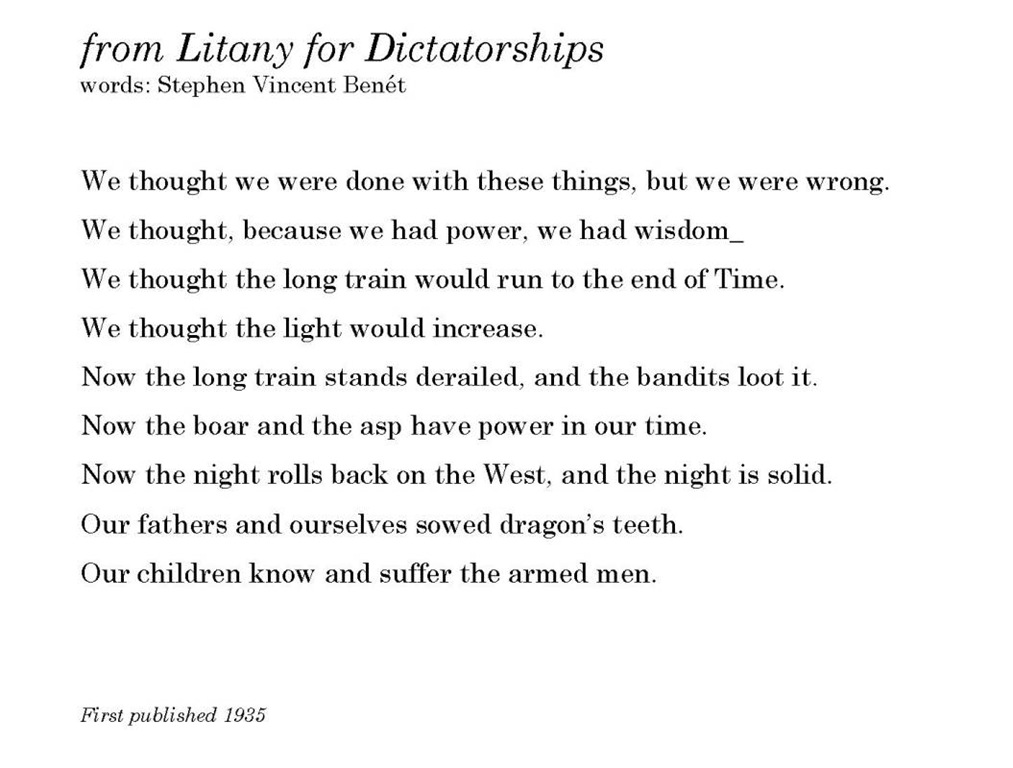
You can read the entirety of Stephen Vincent Benét’s harrowing poem at this link.

.

I keep a stool near my mic, just as I do at Dave’s position in the studio space, so neither of us has to stand for the whole recording session. I stepped back to sit on it –

But I’d moved the stool a few feet away, probably to check or adjust something during my soundcheck. So, there was no stool where my butt was heading. My fat ass sat down on thin air, which I would then traverse much more rapidly than Dave took to the entryway stairs. An utter comic pratfall.

And like any good comic pratfall, no injury, other than the illustration of pride in serious intent. Dave asked if I was all right. I said yes, got up and kept playing. Telecasters are a 76-year-old design, but they aren’t fragile – the guitar, as I, was still intact and in-tune. Five minutes or so later, there was the performance you can hear below with the audio player gadget of a portion of Stephen Vincent Benét’s “Litany for Dictatorships.”

Are you thinking that any such audio player must have fallen off your computer screen? Well, some ways of reading this blog suppress showing the player, but this highlighted link will order a recount and pop up returns of a new browser tab with its own audio player.


.


*Mainstage is an app sold by Apple that allows computer hosted instruments and effects to be selected and controlled from a simplified user interface during live performance or recording. As these things go, Mainstage is getting a bit long in the tooth, and there are more sophisticated systems that more sophisticated modern stage computer musicians might choose to use these days, but it allowed Dave to use the menu I’d set up with only a couple of minutes of instruction.