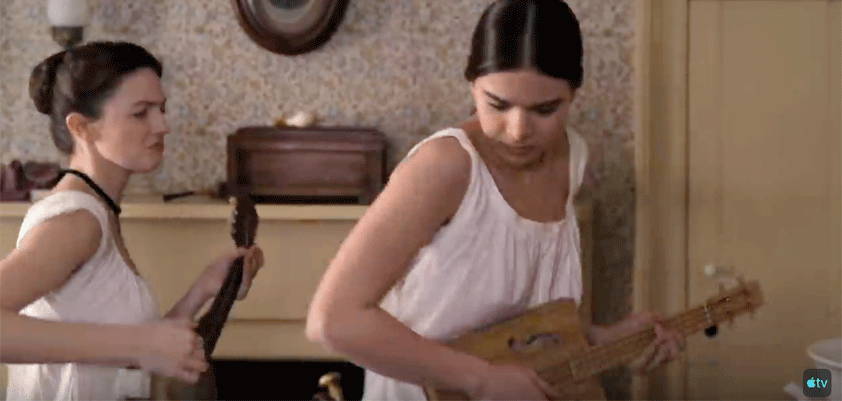
December seems so long ago doesn’t it? More so this spring in our current crisis. Back on the 10th of December I awoke, took my bike ride to breakfast in a pleasantly crowded café, where I read that it was Emily Dickinson’s birthday. While eating breakfast I decided I should try to make a Dickinson piece before the day was done.
This morning in March, I rode to that same café. Normally there are 20 or 30 folks there drinking coffee, eating breakfast, talking, reading or fiddling with notebooks or notebook computers during the morning on a weekday—more on weekends. Today they are to close their dining area for the duration at noon, and the two couples eating breakfast several empty tables apart (along with some not-present more) will need to do what I did and pickup takeout fare to keep this place a going concern.
Cold but sunny morning, and taking their last chance for awhile to have breakfast together.
When Emily Dickinson was a child, her family grew up not in the grander family house her grandfather had built and lost due to debts and business ineptitude, but in another house across the road from a cemetery. Some biographers think this molded the young mind of our great poet, but then the literature of that time had a decidedly gothic tinge to it anyway. And that’s not the place she lived as the poet we know.
Her father worked assiduously to repair the family wealth and regained the homestead. Emily’s room is in the front of the house. Out to her left would be the garden and orchard that she became the master of with the illness and eventual death of her mother. Below her, the kitchen where she and the family’s immigrant Irish servant fixed the family meals and baked. That garden and orchard is now gone as the world of her family and town moved on from its former rural self-sufficiency. Also gone is the 11-acre Dickinson meadow that would have been more or less straight-on in view for Emily at her writing table on one of her December birthdays.*
The famously sequestered Dickinson of her later adult years would have been living our current Covid-19 life of “social distancing” and stay-at-home self-isolation. You might think her poetry would be more solipsistic for that, but she really was a mind forever voyaging. The winterscape she portrays in this short poem is quite likely that Dickinson meadow or her bare garden.
Though the creation of the music and recorded performance of it was rapid even by this project’s quick pace, I don’t think it suffers from that at all as I listen to it again today. The post I wrote about it in December was not one of the most liked or read this winter, but the audio piece was listened to more than any other one during the past three months,** and by enough to score the top spot anyway.
As I consider my sequestered music making today—something I can create even in these times, by myself, playing each part in turn—I feel for those other musicians whose art and the revenue to support it requires a live venue, a paying crowd coming through the door. Of course, cooks, wait staff, musicians—small businesspeople for the most part and only a portion of our world—are not the only ones who will suffer through the duration of our current crisis, but they were in my thoughts as I write this.
Is Dickinson’s poem lighthearted and playful or more gothic in mood? My current reading of Dickinson is that it’s both. She is amazed at the shapes and filigrees of the barren landscape, yes—but it is a place of stilled and departed artisans as she portrays it. She sees an absence, that resonate line: “Summer’s empty room.”
My performance of Emily Dickinson’s “Snow” also known as “It sifts from leaden sieves” is available with the player gadget below.
As we continue our countdown toward the most popular piece of this ending winter, we come to a section coincidentally that’s all poets known by three names. You can’t plan something like that, but your listens and likes counted up that way.
4. “The Stare’s Nest at My Window” by William Butler Yeats. This poem grew on me after I selected it from a short collection of poems Yeats wrote on the Irish Civil War that followed Irish independence. Just after I read the series for the first time this winter, I mentioned to my wife that Yeats seemed to be too far into his mystical side for me to find something I could attach to in them. “The Stare’s Nest” seemed only the least bad for my use after that first reading, largely because I could grasp its word-music as promising.
I often work on the music and performance before I work on the research about the text and its background. I did so here, though one may think it perverse to do that—my setting and performance will then come from me working without a context, and without the best information about an author’s intent. Still, the setting I came up with accumulated considerable power for me, and even though it’s me playing all the parts I composed and reading Yeats’ words, my impression of “The Stare’s Nest” was transformed as I experienced what came from that combination. Though I made these components, the whole presented something I was unaware of.
What did I become aware of in the process of creating the piece? This poem I feel is perched somewhere between a prayer and a magical spell for his country.
3. “The Times are Nightfall” by Gerard Manley Hopkins. Speaking of word-music that pulls me into places I might not otherwise choose to go, Hopkins is an example. He seems to be a full-on Christian mystic with more than a touch of hair-shirt depressive in his soul that he doesn’t fight so much a seek to feel more fully.
But his metrical conception, his use of repeated sounds, I’ve liked from the first time I read him. He believed his ideas there (borrowed from the more Saxon ancestral branches of English poetry) worked better than the musical structures adopted from the Romance languages or from poetry in Latin.
One can test his theories by seeing how his hymn to dark winter works with music as I do here.
Yeats the great Irish poet and nationalist spent a good deal of time in England. Hopkins, the English poet with a distinctly English prosody was a priest unhappily sent to a post in the still colonized Ireland. Despite our world-wide virus crisis, St. Patrick’s Day will be celebrated by an Irish diaspora here in the United States this week.
2. from “Dirge” by Ralph Waldo Emerson. Emerson is better known as an inspirational force via his essays and influence on Transcendentalism than as a poet, but his influence was felt by poets and in poetry. The distinctly American poetry that emerged in the 19th century is almost completely made up of poets touched by him.
When I have dipped into Emerson’s own poetry it’s produced some of the most popular pieces during the run of this project, but I wasn’t looking to find another Emerson poem this winter. “Dirge” came forward in a round-about way from watching the Apple TV+ Dickinson, a streaming series presenting a youthful, passionate Emily Dickinson. That series fully intends to use our present culture as a lens and overlay to espie into Dickinson’s times, something that I think worked for its released first season, though it works most completely if one looks also with a more sober eye at this genius. The creators seem to have done their homework. Lot’s of little details and obscure Dickinson trivia are referred to. And speaking of Transcendentalists, they manage to have some wicked fun with those other three-names Henry David Thoreau and Louisa May Alcott—who are both skewered with lesser-known biographic facts that aren’t full pictures of those two by far, but make for some good scenes.
In one scene, Dickinson and a young man Dickinson is crushing on bond over their mutual love of Emerson’s “Dirge” for its gothic lines about a field of ghosts. I had to check out the poem. I worried that is might be a too long and how well the 19th century sentimentalism in the text would work for modern audiences, but trimmed a bit for length, the listeners here sure liked it this winter.
So, what’ll be the most popular piece here from the past few months? Will the author go by three names? Obscure author or well-known? American? British Isles? Translation from another language? Stay tuned.
In the last hour of 2019 I was sitting on the couch with my son as we exchanged video clips we thought each other should see. I mentioned that Neil Innes had just died, that he was part of the Monty Python circle, and that before Python he had founded a musical group that helped inspire the Pythons called the Bonzo Dog Do-Dah Band.
“I think I’ve heard of the Bonzo Dog Do-Dah Band.”
“Search for ‘Canyons of Your Mind’” I suggested. Sure enough, the magic of Internet searching brought up a video. “This is the most Sixties song ever” I promised.
Here’s the clip we watched.
Farcical fascicles found “In the wardrobe of my soul, in the section labeled shirts.”
.
I wasn’t sure if I needed to provide context for it. As the performance shows they’re sending up every bit of performative anguish over absent love as well as the worship of musicians offering it. And the lyrics? They should have mortally wounded a certain kind of Sixties metaphor that was supposed to transcend our mundane world. In the middle of it Neil Innes plays a guitar solo that was likewise a pig cupid’s dart to the heart of every guitar hero moment. Anyone got the tab for that?
Son was not impressed. He had just shown me a Franz Ferdinand video chock-full of early 20th century Dada and Constructivist art moves: Max Ernst, Kurt Schwitters, Alexander Rodchenko visual riffs. In contrast, the Bonzo’s Dada lacked the same danceable drive and sleek black stage dress of the smart and sharp 21st century Glaswegian rock band.
Oh well. I hadn’t seen the Franz Ferdinand videos he showed me and I was glad I saw them. They made me think how we are still working out the Modernist revolution as we enter another decade that will be called “The Twenties.”
Early in the last week, I watched an episode of Apple TV+ Dickinson with my wife. In it Emily was crushing on Benjamin Newton over their mutual admiration for Ralph Waldo Emerson’s poem “Dirge,” “The one where he’s on a plain with all those ghosts” as TV’s Emily has it.
That made we want to go back and check out Emerson’s “Dirge.” What might Dickinson have seen in it?
It is 19th century Goth, right full of death and lonely love for the dead. Emerson had suffered at least as much as his early 19th century peers in terms of early deaths in his circle, and his poem is quite similar to a poem Abraham Lincoln wrote around the same time that we’ve featured here. One of Emerson’s charms as an essayist was that his mind might take him anywhere while writing one, and the reader is afterward taken along for the ride. This one-thing-after-another move can also work in poetry, but when Emerson the poet does it, it generally doesn’t work for me. “Dirge” suffers for that.
Here’s the text of “Dirge” as Emerson published it. The TV show’s Dickinson latched right onto that arresting image, a rural plain full of ghosts, but Emerson buries the lede, putting another stanza before it. That stanza isn’t entirely bad, indeed its abandoned field with scanty corn could have conceivably informed Dickinson’s “Summer’s empty room” in her later poem we featured this December. I tried performing the poem in its entirety, but it was running nearly 8 minutes (longer than I like to use here) and so I then decided to cut to length by removing those stanzas that were Emersonian digressions. I’m not sure that’s the right way to go, though I think the listener might prefer my more single-threaded version. In some of the excised stanzas, Emerson made the poem’s setting distinctly his Concord hometown; and the mourned, missing folks: his siblings who died young. Specificity also works in poetry, but I’m not sure it strengthens this poem.
One more thing before I offer you a chance to hear my resulting performance. An 1850s Emily Dickinson would have been reading this kind of gothic romanticism in its moment. The element, performative or not, of contemporary personal emotion in poems was part of the change of 19th century Romanticism. Her models: Emerson, Emily Bronte, Elizabeth Barrett Browning, and others used that mode. Even Whitman made common use of it. Here’s something I find striking: Dickinson generally didn’t. Her poems make little use of sentimentality. She will use emotional words in her poems rather than images meant to invoke feelings in the 20th century Imagist manner, but those emotional terms often seem examined, observed, set to the side.
I asked my son if what put him off the Bonzos was that they were desecrating his musical religion. *
“No, you could have just picked a better one.”
Acoustic guitar and a mix of synthesizer sounds for today’s musical performance of Emerson’s “Dirge.” The player gadget to hear it is below. Don’t see it? Then this highlighted hyperlink will also play it.
.
*Pedantically one could draw a fairly direct line from the Bonzos to early Roxy Music to “Anarchy in the UK.” But no more footnotes today! If I’m going to excise Emerson’s digressions, why should I give myself license?
I’ve not engaged much in re-blogging, but two pieces I’ve read this week really struck me: one for an idea and examples of how it might be executed, and the other for a sharply-written essay on a novel from the same early 20th century era that much of the poetry we use comes from.
The idea? A professor and poet Lesley Wheeler, who teaches a course in American poetry from 1900-1950, gave this assignment in lieu of the conventional essay: “create 8 pages of a little magazine from the period, including a cover, masthead, mission statement, table of contents, and a few ‘solicited’ submissions (mostly real poems from the period, but they were allowed to make up one or two plausible imaginary modernists, too, and write poems in those personas). They also had to write reflective essays explaining their literary and design choices and providing a bibliography of models and other sources they consulted.”
That’s a powerful idea. She shows examples of some of the responses to the assignment, and I’d love to see more of what the respondents chose to do. No one lives in history, even those old dead people were immediate. Here’s a link to her post.
The essay came from an unexpected source. I follow a blog Yip Abides that features unusually framed urban-midwestern street photography, a genre that follows the photographic aesthetic of my late wife. He also likes to feature videos that have impressed him, often animation. Visual art and musically oriented blogs are a large portion of my follow list as my own portion of reading on literature is taken up almost entirely with things that directly apply to material for this project.
But this week, there was a post there about The Virginian, a novel I’ve never read, but one of that helped formulate a genre, “The Western,” that dominated popular entertainment in the mid-20th century much like a certain kind of SF/Fantasy dominated the last part of it and the beginning of our current century.
The blogger, Bob Roman, writing about The Virginian ranges perceptively over the areas I’d want a writer to cover. What’s the connection between the cowboy “necktie party” and KKK style lynchings and murders?* How much does the American frontier underlie some particulars in contemporary libertarianism? And there’s more. Well worth reading, and here’s a link to it.
And before I leave to write another post on a new audio piece, a few miscellaneous follow-ups on things discussed earlier in the year.
I’ve now seen the first episode, and so far it seems to be what I’d hoped it was: a tongue in cheek re-contextualizing of Emily Dickinson’s life which both comments on her actual mid-19th century issues and our own times. Last year’s theatrical film Wild Nights with Emily tried to do something like this and had its moments, but I thought the overall execution flawed. Wild Nights with Emily and Dickinson are both comedies, but it was as comedy that Wild Nights failed, its portrayals of Thomas Wentworth Higginson, Helen Hunt Jackson, and Mable Loomis Todd were all too broad. True, they are peripheral characters in Wild Nights, but that too was a choice. As best as I can tell from one episode Dickinson doesn’t make those choices and is the better for it as a comedy. The characters of Dickinson’s world are more rounded portrayals.
The first episode was full of little footnote-quality accurate factoids about the Dickinson family—the creators apparently wanted to show they had done their research. Two choices Dickinson appears to make could work or fail as the series continues: It may have trouble showing why Dickinson matters and it makes the choice to play Emily Dickinson as younger than she was.
At least in the first episode, Dickinson is represented as being recognized by some in her peer group as “a genius” and a few lines of one of her best known poems are repeated almost as often as the hook in a current pop song, but we so far get no sense of why her poems are crucial. This may change over more episodes of course, but it’s always hard to show what a writer does visually. If you do a biopic about a great performer you show an actor portraying them performing, if the simulation is good you’ve made your case. Watching someone write, or how that writing works inside the minds of readers, is not so easy to act.
The first episode seems to be set in 1852, when Dickinson was the age that actor Hailee Steinfeld who plays her is in real life, 22 years old. But this is before Dickinson wrote most of her poems. Chronology seems to be a difficult issue for filmmakers trying to portray Dickinson’s life, but if the show works, I’m willing to grant them license for being loose with that. More problematic is that they appear to be portraying Dickinson as a teenager rather than as a 20-something, much less the 30-something that apparently wrote much of the poetry. I’m aware that different times had different norms for childhood and youth, but were 22-year-olds acting more like 16-year-olds in 1852? I couldn’t help but think the history they were unintentionally demonstrating was the TV and Hollywood practice of having high-school age characters played by 20-something actors.
I’ve had to live through an era when Dickinson was thought of as an arid eccentric, frustrated spinster, and even as a corrective I’m not sure I want her now to be portrayed as only the hormone-saturated brain of our adolescences either. We’ll see how they deal with that as the show goes on.
The knowing comic anachronisms and indie soundtrack? Bring’em on! The Parlando Project obviously isn’t opposed to purposely doing that kind of thing.
In closing then another thing relating to a recent presentation of a Dickinson poem here. What might be behind that striking image of windblown snow starting to fill a field as “summer’s empty room” in Dickinson’s Snow poem? Well, it was one of those poems she enclosed in letters (one of Dickinson’s contemporary uses for her writing). This one went to Susan Gilbert, the woman some modern scholars posit was her lover, and who was certainly one of the intelligent intimates that helped sustain Emily. I think that was an image of longing in the otherwise “winter wonderland” mise en scène of Dickinson’s poem.
An audio piece? As we approach winter solstice, here’s one of my favorite Dickinson presentations from this project, “We Grow Accustomed to the Dark.” The player gadget is below.
*White-on-white lynchings and extra-judicial killings were a common trope in Western movies and TV shows of mid-century, while terrorism directed at Afro-Americans was almost never the subject of popular entertainment. Consciously or subconsciously, this could have been American culture trying to address that which it was loath to address.
We’re now nearing the top of our look back at the most liked and listened to audio pieces this past fall. Yesterday we used words from a trio of women writers, and today starts off the same way. If you missed the original posts on my encounter with these texts and creating the music for them, I’m including a link to them in each of their notices in this Top Ten series, and those linked posts also will show or link to the full texts. The player gadget to hear the audio performances with original music is after each listing below.
4. Autumn by Emily Dickinson. We start off again with Emily Dickinson. I can’t help it, every time I go looking for some additional texts I run into a short Dickinson poem that fascinates, and that’s just the sort of thing I like to use here.
Oddly, this one isn’t the weird, sly, or mystical Dickinson. It’s just a light piece of occasional verse. In my original post I noted that Dickinson’s classmate and friend Helen Hunt Jackson could have written and published this sort of poem, and it’s the sort of verse that would have fit well in the newspapers and periodicals of the time.
Of course, her times weren’t placidly occasional as this poem seems to be—they were less so than even ours are. She grew up in a time that the U.S. political system was falling apart, unable to solve the social and economic addiction to chattel slavery based along racial lines. Her own father was a local principal in one political faction trying to grapple with this.* The years of her greatest poetic output paralleled the bloody 4-year civil war that followed.
I can’t say for sure why Bob Dylan issued his Nashville Skyline album in 1969—another war-torn time. In that LP Dylan dared to write the simplest, even corny, statements; and the singer who had snarled and howled his words at the height of his fame sung them in a tenor croon. Is there some truth—or at least momentary respite—in those sentiments? Opinions differ. Dickinson’s “happy autumn” poem reads like that to me. My suspicions are that it was a part of her capacious mind (no one can be fierce all the time), that she wanted to show (in this early poem) that she could do those expected kinds of verse, and that maybe it was a resting place for her (as it could be for us) from the changeable world that refuses to change.
Brancusi’s Golden Bird by Mina Loy. It was a blockbuster trade. The United States sent Ezra Pound and T. S. Eliot, both powerhouse Modernists with a reverence for old school classicism to the European side in return for a scrappy English up-and-comer Mina Loy and a future draft pick which turned into W. H. Auden.
And as I noted in my original post, this poem of Loy’s was published in the same issue of The Dial that included a modest little contribution from Eliot: “The Waste Land.” You might have heard of that one.
It’s only lately that some have come to re-assess Loy. And talk about fierce, committed, and assertive writing by a woman—Loy could bring it.“Brancusi’s Golden Bird” is a high-energy hymn to Modernist art.
Separated at birth? Mina Loy and Patti Smith. Alas, Loy was more than a generation ahead of the electric guitar, a fault we’ve now remedied.
In the 21st century, Patti Smith, one of my heroes for demonstrating the uses of heroes, and a model for the value of guitars with poetry, has issued some below the radar explorations of various Modernist artists. Let her heart and mind go where it wants to go, but I do sometimes wonder if she’ll get around to Mina Loy, whose soul might resonate with hers.
Do Not Frighten the Garden by Frank Hudson. Yes, the Parlando Project continues to be about “Other People’s Stories.” That means it’s about how I react to others’ writing. There’s no lack of selfish pleasure in that. The thrill I get when I compose the right music for a text, or when I complete a translation of something from another language, or just perform a piece with some degree of satisfaction is more than enough.
And really, honoring other people’s work is important! If our poetry scene is only voices, however vivid and individual, speaking only their own words, then it risks being the silent forest for the trees.
In my defense, I offer that “Do Not Frighten the Garden,” is inspired by a phrase in one of poet Robert Okaji’s poems as I discussed in my original post on this. In all probability I wouldn’t have written my poem if I hadn’t read his poem. Writers in general are instructed to “Write what you know,” but like “Look before you leap” and “He who hesitates is lost,” opposites can be true. Particularly with the immediate lyric poem, there is another possible instruction: “Write what you didn’t even start to know until just now.”
And here’s my holiday wish to you, adventuresome reader and listener: that something we present here inspires you to see something differently or possible. Tomorrow we’ll be back with the reveal of the most popular piece this fall.
Continuing our review of the Top Ten most liked and listened to pieces this past season here at the Parlando Project, here are the next three.
My son likes to needle me by asking what old dead white men I’m presenting today on the blog. What could be my defense? I could respond that many of the poets whose texts I end up using were young when they wrote their poems—but he’s a teenager, and frankly the idea that Rilke wrote his poem “Autumn Day” that seems to be about the restlessness at the onset of old age when Rilke was still in his 20s wouldn’t impress him. Someone in their 20s may not be ancient to him, but they aren’t exactly young in the way he is either.
And dead? That state is somewhat masked by literature. The writer, especially the poet, is always whispering in your ear. Perhaps we can tell by clues of language if they are ghosts or more present confidants, but they both whisper just the same. Will they lie pretty or tell the truth? Ghosts and the living do both. Are the living wiser, do they know all that the ghosts know and more besides? Only if they have listened to the ghosts.
Are they white today? Yes, plenty pale. I talked to my son this month about the arbitrariness of “Western Culture.” I asked him “Just how white was Socrates? Just how white was Homer?” This week the news announced some finds from a Mycenean grave dating from Homeric times, and the featured picture was a pendant engraved with an African goddess. Well, we don’t have Homer in the Top 10 today, though we do know—however misunderstood and thus transformed—that ancient Greek and Chinese poetry influenced our founding English language Modernists.
An African goddess pendant found in an ancient grave in Greece.
And none of today’s trio are men today, which shouldn’t surprise long-time readers here.
7. Besides the autumn poets sing by Emily Dickinson. It’s remarkable how much Emily Dickinson, a woman born nearing 200 years ago can seem modern, maybe even more modern today than she seemed to her first readers at the turn of the 20th century. Back then she seemed the quaint and curious poetess, a little rough around the edges technique-wise, but bringing some charming homespun metaphors with just a bit of a gothic edge. Now we may read her as if she had time-traveled to read late 20th century European aestheticians and philosophers instead of Emerson.
I believe we’re more correct now. This old man has listened to the ghosts and they are often dunderheads regarding Dickinson. And besides, as I wrote in my original post about this piece, I think this poem is having some wicked fun with the old white male poets of her time.
As to the missing people of color, let me supply the answer to a clue in that original post. Though disguised by the acoustic music arrangement, I based the changes in my music for this around a cadence from Jimi Hendrix’s “Purple Haze.”
6. Song by Louise Bogan. Unlike Dickinson, I had nothing to reassess about Bogan when I first encountered her poetry while working on this project. Bogan’s song is as straightforward in its complexities and contradictions as Dickinson is sly. The stark emotional directness of Bogan’s poem challenged me as a singer. I decided to modify the text by using the classic Afro-American Blues line stanza form, repeating a line to add an opportunity for emphasis and shading.
I partially apologized for my voice needing to be the singer to get this song out as part of the Parlando Project in my original post. I try to not apologize for my musical limitations (doing so helps no one) but this is one of those pieces that I’ve composed for this project that I hope someone who is a better singer will take up.
5. November by Amy Lowell. Speaking of the blues, this piece by the born rich and died much too young promoter of concise Imagist poetry Amy Lowell uses bottleneck* slide guitar, a playing method associated with blues musicians.
Which brings me to another side point: American music is American music substantially because it has had Afro-American music to anneal its soul. Strange that: the colonizers’ sin driven by not having enough healthy indigenous people to exploit brought forth upon this continent a new music which is its leading artistic glory. I can’t write a poem much less a sentence to properly express that.
As I wrote in my original post on this piece, I’m still coming to grips with Amy Lowell. I suspect those bohemians who disrespected her were right and wrong, but I have no idea of the proportions. This poem of hers is quite good I think.
*I’d read about blues slide guitar, but I can still recall the first time I saw it played (in “The Sixties”) when a teenaged kid from the Twin Cities area named Don Williams removed from his authentic folk-scare Levi’s denim jacket pocket an actual severed bottle’s neck, tuned his guitar I think to open D, and played a John Fahey-ish rendition of “Poor Boy (a long way from home).” Reconstructing that moment, Don (like Amy Lowell) probably had access to material and cultural resources that I a poorer kid from a tiny town didn’t have—what a strange way for the blues to work!—but I remain grateful to this day for the introduction.
I woke up this morning to learn that it’s Emily Dickinson’s birthday—and I didn’t get her anything. Well, we do know how to do something here at the Parlando Project and that’s create musical presentations quickly, and it’s not like we’ve run out of Dickinson poems to use.
So today’s piece is a Dickinson poem about snowscapes. Having had the opportunity to visit the Dickinson family house in Amherst and hearing there that the area across the highway road was in Dickinson’s time a farm field helps me visualize Emily writing this. I can clearly sense her looking out the window from her bedroom writing table on that road and field that are this poem’s landscape.
This is Dickinson in her playful mode, but that doesn’t stop her mind from creating some exact and fanciful descriptions for the snowscape, starting right out with the snow fall being sifted like flour (do cooks still sift flour?) *
The least playful image in my mind is also the most striking in the poem, it’s a description of that farm field as “summer’s empty room”, not yet filled with snow (the furrows are still visible) and some now deserted plant stalks are jutting through picking up windy veils of snow. This is likely a poem written about an early winter, December, snow fall
In other work Dickinson can be harrowing or she might present us with some concise mysticism or philosophic equation, but that’s as close here to a darker note as we’ll get in this one. She seems content in her vision of a stilled winter and a smoothed and sparkling world—as I was today watching the white outdoors and below-zero temps just the other side of my glass as I wrangled a dense percussion track for this piece. It was afternoon before I moved on to a few keyboards. Then the final musical task was to add the 12-string electric guitar parts.
My electric 12-string, “recordless, but for them”
Long time readers here will know that the Twin Cities is something of a center for the 12-string guitar, an instrument I’ve used since shortly after I arrived here, but the electric 12-string remains a rare instrument here as it is elsewhere. Acoustic or electric, for each of the guitar’s conventional six strings the 12-string adds a paired string right next to it. Most of those additional paired-strings are conventionally tuned** an octave higher than the regular guitar strings, and the two strings when struck never quite vibrate in unison, adding a slight wobble that’s either charming or sea-sick depending on one’s taste and ear. I added to that with a whole load of echo, delay and reverb today, and all this called for the parts to be played sparsely and slowly. Even with an echo effect glitch*** that ruined the first couple of takes, I was able to lay down the parts quickly enough that you can hear it tonight with the player below. If you’d like to follow along with today’s poem (sometimes cataloged under its first line “It sifts from Leaden Sieves”)the full text is here.
*Emily would have sifted as the household’s baker. The flour in her time was less refined—and sifting also removes things like bugs or foreign matter that might be mixed in with the flour. And sifted flour is more suited for blending with other ingredients. Sifting seems metaphorical matter for creating art, doesn’t it?
**Conventionally the high B and high E strings are tuned in unison and the bottom 4 in octaves, but some players tune additional strings in unison rather than octaves (Steve Tibbetts and Huddie Ledbetter/Leadbelly for two unlike examples).
***User error on the part of the producer, engineer and musician, which is easier when they are all me. I also make the tea, so there’s no one else to blame.
Did you know that Emily Dickinson wrote a Thanksgiving poem? It’s not one of her “Greatest Hits” or anything, but it does represent a couple of Dickinsonian traits: skeptical humor and puzzling philosophical concision. You can read the text of it here as I discuss my encounter with it.
Dickinson didn’t use titles, and the first line, our entry into the poem, starts off with a strange tentativeness. What’s the series? All the days of our lives, of history? Or a series of holidays? I suspect the last, in that the next line throws up the American holiday inside quotes. It’s hard not to read “Thanksgiving Day” in Dickinson’s text without intonating the words with “air quotes,” that at least slightly dismissive way of saying “Well, you can call it that if you want.”
I’m not a Dickinson scholar but I get the impression that Dickinson uses quotes literally—that is, when she’s quoting someone*—but there is a sense here of our modern manner in the poems first half. And as the poem continues, its opening comments could be written this week by someone musing on the holiday. Yup, Thanksgiving is a strange mix: part a big meal, a gluttonous celebration; and part memories of worshiping dissenter pilgrims and family. And Dickinson, in her thirties as she wrote her poem, notes she’s not sitting at the kids table nor is she some honored elder closer to the pilgrims than the present. So, outsider in a middle place, she says she’ll post a review, from her “Hooded thinking.”
Maybe you’re visualizing The Handmaids Tale when you read “Hooded.” I think Dickinson is taking a bit of a religious acolyte’s stance in her review, even if playfully. Her two-word review: “Reflex Holiday.” You’re just going through the motions she seems to be saying.
One won’t get a turkey drumstick: Emily Dickinson on the left with her siblings.
The poem could end there, but Dickinson takes off in the second half in gnomic concision. This is often beautiful as word music, but it’s hard to follow her mind.
What’s the sharp subtraction for the early sum? A falling away from religious immediacy? Mankind’s fall from grace? Forgetting the history or piety of the holiday? The next two lines are even more weird. What the heck does “Not an acre or a Caption/Where was once a Room” mean? This is Dickinson the hermetic riddler. I’ve rolled that couplet around in my head for a week and it always slips from my grasp.
The tossed pebble wrinkling the sea lines have a Blakean tone. Here the mystic Dickinson is plain as any mystic can be in words: our lives, our actions, are small against creation—just visible, just for so long. Her final couplet seems to say that our thanks, our Reflex Holiday, is insufficient to the gift. This realization combined with the reflex action is, in a way, a more sublime and awe-some thanks.
What an odd poem! It starts out witty and lightly skeptical and (as best as I can figure it) closes on a humble mysticism.
Musically, I tried to hew to the mystery, if a strange resonant piano and wavery synth can portray that. The player is below. Thanks for reading and listening!
*If she is quoting a person, it may well be Sarah Hale, a New England journalist who campaigned for the importance of a Thanksgiving holiday during Dickinson’s day.
Modernist American poetry has two parents, Emily Dickinson and Walt Whitman, but it’s been awhile since we’ve presented any Whitman here. Dickinson is a subversive Modernist, ironically skewing the expected tropes. Whitman on the other hand is the provocateur, the poet who is proud to say right out front everything he wishes to change.
As Whitman prepared his 1860 edition of his evolving Leaves of Grass, he was about to cross a Rubicon of a sort. He had decided that erotic material needed to be added to his great collection. Since he wished to be all-inclusive and unabashed, starting with himself, that material would vary, but it would include expressions of male homosexual longing and relationships.
Walt Whitman as caricatured in 1860 in Harper’s Weekly
Once again, my knowledge of the historical context here is not extensive, but some brief reading this weekend indicates that to the mid-19th century American audience, the homosexual elements of what Whitman was to publish was little or no more disturbing than the erotic element generally. For a man who was already wishing to revolutionize English poetry with his free-verse and universalist message including what would surely be considered shockingly fleshy writing about desire, longing, and connection was certain to complicate his goals for a wide audience. His leading ally within American High Culture, the Transcendentalist Ralph Waldo Emerson, counselled him to not include, or to greatly tone down that material.
Whitman didn’t take that council. The 1860 edition of Leaves of Grass included a section, Calamus, that was full of love and desire between men. Emerson was right, that would complicate Whitman’s task of revolutionizing American poetry.
When Transcendentalist Thomas Wentworth Higginson* asked Emily Dickinson if she had read Whitman shortly thereafter, Dickinson replied: “You speak of Mr. Whitman. I never read his book but was told that he was disgraceful.” If one is of a speculative mind, one can imagine Emily Dickinson getting a plain brown wrapper delivery of Leaves of Grass that she would never acknowledge.
This Monday is Veteran’s Day/Remembrance Day, and as he prepared the Calamus poems Whitman was not a veteran or a survivor with war memories, as the American Civil War that would add another tremendous shaping force on his poetry was still more than a year off. Still he would write this moving comparison that I present today.
Today’s poem as it appeared in the 1860 edition of “Leaves of Grass.”
“When I Peruse the Conquer’d Fame” is a comparison of two things: fame and envy. Perhaps the fame part will strike you first, along with the implications of worth and value. The fame in the title most often comes to prominent men: victorious generals, Presidents who bask in their election and men who put their names on large buildings. The U.S. Presidents that Whitman would have had in mind then were bumbling ineffectual men, totally incapable of coming to grips with the immense and deadly crisis they were careening toward, but famous none the less.** What generals would he have in mind? Napoleon or his adversaries perhaps, men who could shuffle the borders and crowned heads back and forth in tides.
And for comparison, Whitman sets out “the brotherhood of lovers.” Does he mean men who love men? As this is part of the homoerotic Calamus poems section I think we need to accept that is significantly so. He goes on to praise the lovers who are steadfast in their love as aging and fate and even the numbing of time is arrayed against them.
This task of enduring love is not something unique to same-sex lovers, and I suspect that Whitman, the universalist, recognizes that too. But in his particular, he’s saying that unfaltering love which would not then be socially acknowledged is all the more extraordinary, though unknown compared to the war-heroes and political potentates.
Did Whitman, and I suppose myself in my choice to present this poem at this time, just dis veterans? That objection would assume that the two groups are mutually exclusive, at odds. That isn’t so. And if Whitman was here to answer he’d point out he spoke of Generals, Presidents, and rich men, not the soldiers he later comforted and whose wounds he dressed in the upcoming war.
And of course, in the U. S. today it’s Veterans Day, set aside for those who after their service may well have continued as or became those ardent lovers whatever their sexual orientation. We honor them for their service in the one regard, Whitman asks that we consider the second as well.
What of the other comparison, the one you may not have noticed, the one concerning envy? Whitman has chosen not to weigh his comparison between the two sets of roles only by their levels of objective fame, but specifically in the example of his own state of envy. He says he doesn’t envy those powerful and rich men—but of the “long and long” lovers, there he says he is bitterly envious.
Let me suppose Whitman was sincerely speaking here (he has almost no other mode in his poetry than sincerity). But there is an element in Leaves of Grass where the poet speaking—“Walt Whitman” as the character in his great collection of poems—is meant to be an example, as his verse is an example, of an imperfect thing striving to find a different, better path to something new and not fully known. Whitman, like the best of Modernist art, like various America, like many veterans, ardent as a lover is running faithfully and with a heart open toward an affectionate and unknown future.
Once more I marshal the ranks of my marcato orchestral instruments for “When I Peruse the Conquer’d Fame” into another “punk orchestral” piece. Harmonically, I’m working a three-chord trick here, just as if the composer/conductor’s podium was stocked with Ramones. Other than the use of a rock’n’roll drum set, the other unusual textures are mixed subtly into the low-end where there’s a contrabassoon line and Fender electric piano bass (ala Ray Manzarek). You can hear it with the player below.
*It’s possible that a canny Dickinson might have been telling Higginson what Higginson would want to hear, since Higginson, though au fait with political and social radicalism, was also of the opinion that Whitman was disgusting.
**Coincidentally, the U. S. President when the Calamus poems including edition of Leaves of Grass was published was James Buchanan, who may have been gay himself. Though Donald Trump has already selected Andrew Jackson as his favorite President, Buchanan may also prove to be indispensable to his legacy in that Buchanan has long been the consensus choice among historians as the worst-ever President of the United States.
Did Emily Dickinson mistake her tone, her presentation? This question occurred to me as I went off into the deeper, album cuts* of Dickinson’s work looking for autumn poems this fall. Her early poem, titled on posthumous publication “Autumn” is charming and very much in a mainstream short poem tradition of the day. If she was seeking publication or just checking in on an honorable hobby of an upper middle-class** young woman, it would do.
The next Dickinson Autumn poem I found and presented,“Besides the Autumn poets sing” is still charming, if self and otherwise referential in a sly way. If I was to “translate” it into the diction and particulars of New York in the 1950s it could be written by Frank O’Hara. I believe she intentionally means that poem’s opening word: “Besides,” and that is not a careless rendering of “beside”. That little “s” makes it a poem about what the poets of her time did “Besides” (meaning “in addition to,” or perhaps “surplus too”) Autumn, not merely poets rendering in verse the season while metaphorically writing en plein air. That makes the poem an expression of what is other than, or in opposition, to what a leading American poet of Dickinson’s day like William Cullen Bryant was writing.
If I was to read this poem in isolation, if it came to me “over the transom” would I make that assumption? I’ll be honest: I suspect most times I’d miss it. I’d hurriedly read the poem as another simple Fall season lyric. I’d miss that “s.”
Did Dickinson intend this slyness, if I’m right in my more careful reading? My understanding of her character is yes, she did. I could be wrong. If writers, if poets, can misunderstand how their tone will be read, certainly us readers, busy and full of our own prejudices, can also do our part to misread or read ourselves into their work.
But then I came onto this remarkable Dickinson poem, one that’s frankly strange on the surface: “The name of it is ‘Autumn’.” Even now, over 150 years after it was written, this makes no pretense to being a conventional poem.
The first thing I noticed was that as a poem of fall, it doesn’t really work—or work the way we expect a poem on that subject to work. Yes, fall leaf color is a common trope for landscapes that have this event.*** But this poem goes overboard if that is all it’s trying to do. Yes, many of the autumn leaves are red, and yes we can say they are blood red. But if that was what Dickinson was intending, and if repetition of that trope might add to its power, I think many readers would think it’s overdone.
And so my first thought was, that must be Dickinson’s intent—to over-do it—because I now trust Dickinson as an artist, and feel from reading her that she often is seeking some doubleness in her expression.
But before I continue with my sense of the poem, let me alert you to two other readings that have been put forward to explain what this unusual poem is on about. The first is that it’s a poem about a particularly deadly section of the American Civil War in the fall of 1862. Historically aware readers often wonder why Dickinson (unlike her contemporary poetic revolutionary Whitman) doesn’t deal with this deadly domestic war directly. Unlike Whitman she didn’t live in close proximity to the battles, but she was the daughter of a politician who had been caught up in the slide into this war, and an avid reader of the journalism of the day. The Civil War reading says this is her recasting of the slaughter of these battles.
If one accepts that idea the images make sense, a strong argument for it. But I’m unsure how Dickinson, even as an aware news-reader, could have received this explicitly gory battlefield scene. I’m unsure that the Republican newspapers she read would have featured detailed descriptions of the slaughter.**** The only way I can imagine Dickinson having an opportunity to pick up these specifically blood soaked slaughter/war images would be if the somewhat self-sufficient semi-rural Dickinson homestead slaughtered their own animals for food and Dickinson (who came to be responsible for the gardening food aspect of the homestead) observed that.
The other reading is that this is a menstruation poem. Likewise, the images can be fitted to that conception. And while we know nothing of Dickinson’s gynecological history (which as readers we need to know, along with the sperm and motility counts of all male authors) there is no barrier here regarding Emily Dickinson’s experience and knowledge, and so I think this one is more likely.
The third possibility is that Dickinson did intend this to be another autumn poem, just with stronger imagery; and if she may have misread how the poem’s tone would be encountered by others, that by this time in her life she didn’t care. She could intentionally have brought in those things other, modern, readers have seen in it, warfare and menstruation, and created one of those bidirectional images where the thing signified and the images used to illuminate it are of roughly equal importance. One clue to that is that she’s once more making use of quotation marks. “The name—of it—is ‘Autumn—’” the first line seems to say we need to examine that word. What could we find on examination? One thing I, the punster, finds is “Awe-tum.” The other thing she may be saying is: “Well, it’s got a common name we might find unremarkable, a mere label for a season, but it’s serious business to nature.” Then, all that blood—and in my reading, the intimate linkage to human fertility—is to make that case, to drown that conventionality.
In such a case, the imagery takes over from the subject. If in the process of composition, the poem became not about autumn but about menstruation, then autumn becomes an intense outward image for what would have been a private, if widely shared experience.
Given that frankly feminist examination of literature is no longer a rare thing, I wonder how unprecedented this was poetically as a subject? Anyone know of any poem preceding Dickinson’s that has a plausible focus on menstruation? A passing line in the old ballad “Willie O’Winsbury” doesn’t compare to this level of imagistic intensity.
Rather than some colorful fall landscape photo, here’s Anne Briggs whose singing helped bring the ballad “Willie O’Winsbury” to the fore.
Well, all that talk, and the comic incongruity of mansplaining my experience of Dickinson’s poem, but this poem is lovely again as word-music. Dickinson is famously sing-able, so I was charmed to put even my shaky voice on the line here. I keep thinking I’m building up to a big-time orchestral score or a mass of synthesizer lines, but today I’m musically down to just acoustic guitar once more. This past week, I found online an entire 90 minute coffeehouse set by Tom Rapp and Pearls Before Swine, and the melody today is similar to one used in Rapp’s “There Was A Man.” I even planned singing a couple of verses of that song in a sort of a round with Dickinson’s, but I couldn’t make that work.
The text of Dickinson’s poem is here. My performance of it is available in a player you should see below, or on most podcast platforms or Spotify as the Parlando Project.
*(in geezer voice) In my day there were musical collections sold on disks, and they had to have a bunch of songs, not just the hits. A kind of wireless streaming service called “radio” sometimes played cuts that weren’t the ones that you’d pick out for your playlist. It was a primitive existence, but we didn’t know any better back then.
**It’s not straightforward to place the mid-19th century Dickinson household in class hierarchy. Clearly they were a prominent family in their town, so in the context of Amherst, likely the 1% for the latter half or more of Dickinson’s life. But Amherst also wasn’t a wealth center, thus my approximation.
***It occurred to me as I looked at my series of autumn poems I’ve been presenting this month, that there are large portions of this globe that don’t have the “theater of the seasons” that Dickinson’s Massachusetts and my upper Midwest share. The whole leaf-turning fall colors event is a big deal and traveling to rural areas where the largest canvases can be seen is a thing here. One academic paper behind a paywall that I found an abstract for even suggests that fall-colors tourism in the mid-19th century to New England places like the Franconia Notch might have contributed to this Dickinson poem.
****The political career and situation of Dickinson’s father is too complex a subject to detail today. He was a unionist Whig, who supported the compromises with slavery-states meant to prevent the Civil War, while likely opposing the practice of slavery itself. When the Whig party died out it was largely absorbed into the newly founded Republican party, which included those who were more militantly opposed to slavery and such compromise.
Dickinson’s father stood with the compromisers who thought preserving the union primary over the more aggressive anti-slavery factions of the Republicans. It was the election of the first Republican President, Lincoln, who presented himself as unifying those two wings of his new Party which was the proximal cause of the outbreak of the American Civil War—in other words, the slaveholders in slave-holding states figured Lincoln wasn’t serious in acceptance of the ex-Whig and unionist wing of Republicans and that he would allow the more abolitionist wing to take power.
Once the war broke out, there was considerable agitation in the North to settle with the Southern slave states, either to reform the pre-war union or to accept the formation of the new slaveholder Confederate nation. A prime argument for this was the deadliness of the ongoing war. So, in general, Republican papers in the day would not have been in the business of publicizing the grizzly nature of the warfare instead of bloodless gallantry and sacrifice.