This is turning out to be an interesting Halloween experiment: announcing here that I’m going to present a suite of songs (or a multi-movement musical setting, whatever I’ll end up calling it) using Conrad Aiken’s narrative poem “The Vampire” – before I had conceived, composed, performed, or mixed them. And I did it quite late, with less than week before Halloween.
Scary? No, I’ve been too busy trying to complete this. I hope you’re enjoying the story unfolding with “new episodes” being released nearly every day – but if you’re coming to this post just now, I do suggest this way of hearing the pieces, in the proper order.
In Part 1 the world of the poem encounters a mysterious and distressed creature. In Part 2, this creature brings with it a frenzy of sorrow and deadly intimations, transmitted with disturbing dreams and visions. At the ending of that section, we’re told the creature has started to speak directly to the world of the poem. Today’s song tells us what the creature says.
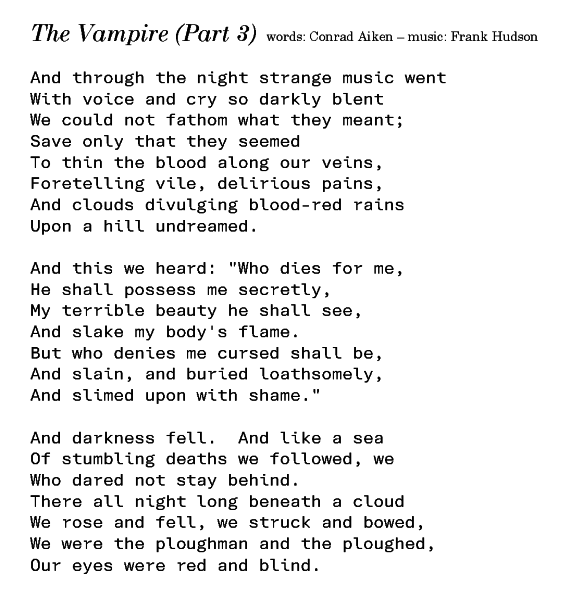
Aiken’s poem gathers power from the incantatory power of its rhymes, so I’ll forgive him using the archaic version of “blended” in line 2
.
In short, the creature announces that the citizens of the poem’s world have a choice: they will choose to worship and love her, or they will be slaughtered. This situation is so fantastic that the world seems in shock. Is this real? Is each citizen who has seen the portents in the earlier parts, and now has heard the creature’s dire pronouncement, insane or in trapped in some as yet unawakened nightmare?
Since this is a poem, we might see this is the dichotomy in most any fantastic poem: if it is proximally a poet’s imagined reality – how are we meant to take it? Yes, the poet could end the poem with an envoi “it was all a dream” or some other explicit framing device. Spoiler alert: Aiken will not do this. The world in this poem is doomed. In the midst of this horror is another horror: many (most) of the world’s people are enthralled by the creature, even after its tyrannical statement, most are following her around in some kind of adoring daze.
You may note that I’ve constantly used “the creature” and “it” to refer to the sinister eminence of Aiken’s poem until a couple of paragraphs ago. He never calls it a vampire outright, and his depiction so far has only had two elements in common with the vampire trope: it’s deadly, and it enchants its victims. The final section will include more depiction, including that that attraction has erotic dimensions. If I’ve avoided gendering the creature in my writing so far, Aiken doesn’t: his creature is a “she.”
Yes, I’m bothered by that, perhaps as much as I’m bothered by the rest of what is going to be described in the poem. I don’t know enough about Aiken to say if he consciously or subconsciously desires that choice’s resonance with misogyny, or the fear of female sexuality that can often underpin it.* I think I’ll probably say more after I’ve completed presenting the poem, but one thing that allowed me to engage with the poem when I could have cast it aside: it’s plausible that Aiken, its author, is a young heterosexual man who seeks to confront two things in his mind (or the minds of others like himself): that beauty and charisma is not a reliable sign of virtue, and that desire is a strong force with strong dangers surrounding it.**
The musical mode shifts again for Part 3. If last time I wanted a little fuzz-tone frenzy as the ominous visions and dreams are unleashed, today’s music returns to a quieter sort of weird folk with the cello, violin, guitar and now bass clarinet ensemble. The world’s populace is in enthralled shock, caught between disbelief and horror, with a third element (even more disturbing) to be introduced in the next part. I hope to complete that final section within the next two days, so check back for it. Oddly, for the first time in the suite of songs, today’s gentler music uses something like conventional harmonic cadences. “Well, I guess we’ve got a murderous tyrant ruling the world, but at least we’ve got a more conventional and attractive song structure.”
You are listening in order, right? If it’s the proper time to hear part 3 of “The Vampire,” there’s an audio player below for most of you. No player for you? I’m more accommodating than our story’s vampire, I offer this second way: a highlighted link that will open a new browser tab with its own audio player.
.
*Of course, women can do evil things, and some have evidenced overripe amounts of human villainy. If they’ve lacked a consistent power base in a largely patriarchal history, they’ve had their innings. Given such a history though – one that largely assumes male gender when creating a powerful character – Aiken’s choice is worthy of examination.
There’s an opportunity to write more about the male lothario vampire or the darkly attractive bad-boy-with-a-habit vampire tropes, and what they say to heterosexual women about their desires and attendant dangers, but in the interests of length and needs to complete the music, I’ll pass tonight.
**I think of the Shakespeare song from The Merchant of Venice recently presented here, which occurs within a play with a stock ethnic stereotype villain (though made a bit more humanized and complex by the Bard) where the little song is a parable about the deceptions of surface “fancy,” a polite word for desire.

