Higginson’s June

Here’s another post in our informal series “The Roots of Emily Dickinson.” Now a title like that may lead some to think I’m some sort of Dickinson scholar—which would be a fine thing to be, but I’m not. Frankly, when I started this project a few years back I assumed I’d present some Emily Dickinson poems. After all, not only do they famously fit well to music, but she was part of the poetry canon that I was raised on. Then something unexpected happened.

When I started to dig into Dickinson poems they grew mysterious, not just the elusive mystery of their intent or even their true subject, but the somewhat more external mystery of how they came to be written in the mid-19th century in a town in rural Massachusetts without any sure models for Dickinson’s new kind of poetry.

We know how many other writers assembled their machines and what fueled them. Shakespeare and Bob Dylan worked within successful entertainment enterprises, even if they were to reshape them. T. S. Eliot had a scholar’s interest in a wide range of art and spirituality across history, and after the trauma of WWI a significant part of the culture was waiting for someone to reassemble it however dolefully, even if it was in his Cubist collage. The Surrealists were crystal-clear about their influences and the impact of Freud and psychoanalysis. The G.I. Bill after WWII and the following post-war American prosperity introduced large numbers to colleges and college towns, including some who would likely not have attended before the war. This fueled not only the Beats, but the more academic-associated American poets of my youth. The 20th Century urban migration of Afro-Americans and the Talented Tenth tactics of the early 20th century U.S. Civil Rights movement encouraged the Harlem Renaissance and similar artists.

Emily Dickinson? It’s just not so clear to me. My best guess remains that she was a Transcendentalist of some sort in a household dominated by a father that wasn’t. Transcendentalism, staunchly individualist in it’s outlook has no mandatory dogma, but the sense that the intense, even visionary study of nature reveals the deepest spiritual truths seem to me to be its core. Received truths, any established customs and traditions, are to fall before this apprehension.

However individualist in philosophy, the Transcendentalists and the Boston publishing and cultural nexus were intimately connected socially in a way that Dickinson was not.

One incident, often judged as a quasi-accident* closed this circuit. In 1862 as the 31-year-old Dickinson had begun her extraordinary five years or so of white-hot poetic composition, she wrote Thomas Wentworth Higginson and enclosed a few of her poems. A string of correspondence ensues, and eventually the two met in person.

Dickinson’s letter is conventionally seen as a “cold call” prompted by Higginson writing a magazine article in The Atlantic “A Letter to a Young Contributor.”  That article is largely unremarkable if sensible, the subject one that is covered over and over wherever there are editors who accept written submissions. Submit clean, legible copy. Re-writing is as important as writing. Remember your audience and take pity on them. Hey, the editor is on your side—they, like the writer, want to produce good work.

And here we come to the next beat in the story as it’s usually told. Higginson is often portrayed as something of a doofus, the archetypal mansplainer who can’t understand Dickinson’s greatness. He suggests Dickinson write more conventionally and doesn’t think her work is suitable for publication. Presented with one of the founding geniuses of Modern poetry, he’s blind and hesitant.

Is that so? Well, there’s a lot we don’t know. First, we only have letters from Dickinson’s side of the correspondence. I’ve delayed this post so that I could at least read some of Higginson’s writing on other contemporaries of his and Dickinson, and one thing stands out from his later 19th century accounts of his life and times: he’s the soul of discretion (obscuring names for embarrassing incidents), generous even to his opponents, and extraordinarily hesitant in claiming credit for any of the things he may have been instrumental in. As an editor and literary critic, he seems to have a fairly good and objective eye, and he does not shy from pointing out shortcomings in writers he admires. I read his essay on Emerson written shortly after Emerson’s death, and his admiration for the man and his intellect does not keep him from agreeing with judgements about the faults of Emerson’s poetry. It therefore seems likely he could have suggested changes to Dickinson in his correspondence.

How artistically wrong would those suggestions have been? How harmful might they have been to the isolated Dickinson? Even if he was “wrong” could he have been tactically right about what mid-19th century audiences would tolerate? Here we don’t know the devilish details, but we know some things otherwise: Dickinson wrote most of her nearly two thousand revolutionary highly condensed poems as this correspondence was initiated. If Higginson squelched her or convinced her to temper her individuality, he must have been bad at it. If, on the other hand, what he said encouraged and kept her going, that would be consistent with what occurred.

Here’s something else we know objectively: in 1890 he was instrumental in getting Dickinson’s posthumous-published-career off the ground.**  He did not prevent and may have agreed with the conventionalizing of Dickinson’s punctuation, adding of titles to title-less poems, and so on—but historically those editions sold well right from the start and gained Dickinson a reading public. He added his prestige to the launch with the book’s introduction where he framed her (not yet knowing how well Dickinson would sell) as a sort of art brut phenomenon:

“In many cases these verses will seem to the reader like poetry torn up by the roots, with rain and dew and earth still clinging to them, giving a freshness and a fragrance not otherwise to be conveyed.”

This may be false, even if it’s an accurate advertisement for the impact reading Dickinson for the first time may have on a reader. Yes, Dickinson was likely a more conscious and careful artist than this impression leaves us with. But it worked! Remember, there was no Dickinson tradition to be misinterpreted when he did this. To a large degree, the reason we have an on-going debate about Dickinson that more than a handful of graduate students and eccentrics like me care about is because of his work in insuring that original edition.

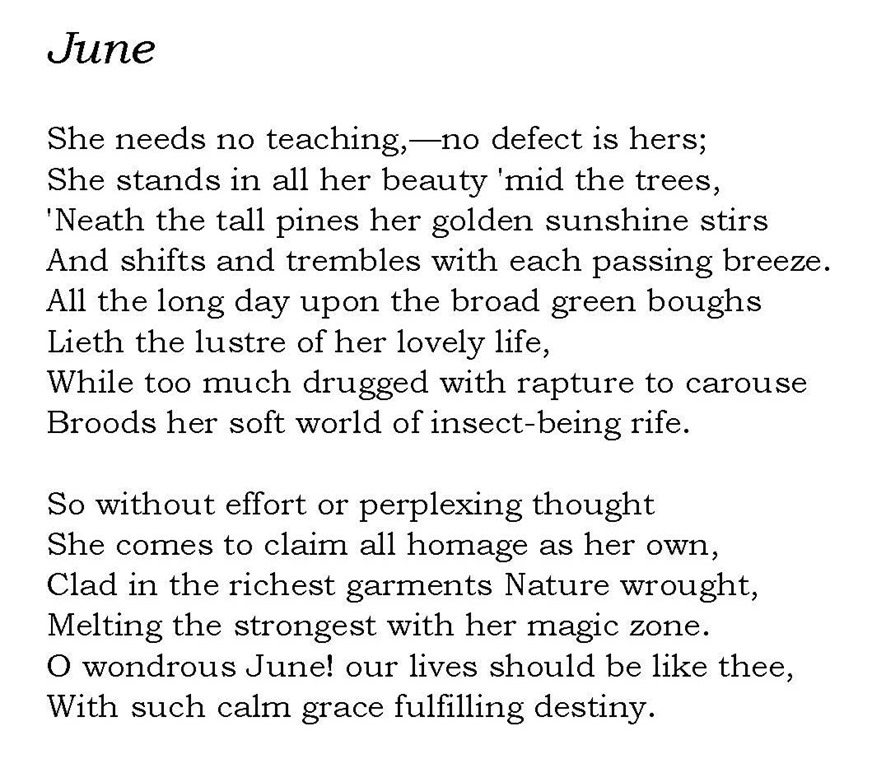
Now for a surprise. I did not know that Higginson had written poetry until I came upon this poem by accident while looking for June poems. I can find nothing about it, but in the absence of knowledge I’ll speculate it might be from Higginson’s college-age youth. Here it is:
June

I may be full of perplexing thought even if this June day isn’t


It’s a graceful sonnet. I’m not in love with the slightly over-egged consonance of the “Lieth the lustre of her lovely life” line, but I’d suspect other readers would point it out with appreciation. On the other hand, the vowels of the preceding line “All the long day upon the broad green boughs” are pleasing to me. And the poem’s fine opening line, referring to June’s summer overture, “She needs no teaching,—no defect is hers” is hard for me to not read, whenever it was written, as the proper way to approach Emily Dickinson’s genius. The ending of the octet “While too much drugged with rapture to carouse/Broods her soft world of insect-being rife” is a truly strange one, half awkward “poetic diction” perhaps necessary to make the rhyme, and half a striking William Burroughs a-century-too-early image of June on the narcotic nod as summer’s insect-being is partly suppressed for the moment.

The sestet is not as distinctive, and I wonder if “zone” was chosen for its rhyme rather than being the best word at the end of the 12th line, but overall more interesting than most 19th century American sonnets. In his “Young Contributor”  article Higginson sagely notes that duality of the critic who’ll offer criticism when they themselves are not accomplished in the arts they criticize. “People criticize higher than they attain” he says.

After all that, here’s Thomas Wentworth Higginson’s sonnet “June”  and my performance of it. The player gadget to hear it is below.


*The writer of the standard Dickinson biography Richard Sewell believed that regular Atlantic  reader Emily Dickinson was attracted to Higginson’s nature articles which he’d published in The Atlantic  prior to the “Young Contributor.”  Early Dickinson biographer Genevieve Taggard speculates that George Gould (which she identifies as Dickinson’s ex-fiancé) may have suggested Dickinson write Higginson.

**I’m still underinformed on all the details of how we got to the 1890 publication of the first large batch of Dickinson poems. Originally, Dickinson’s sister looked to Sister-in-Law and intimate friend Susan Gilbert Dickinson to shepherd the publication. Susan Dickinson said (after the successful Higginson-introduced 1890 edition) that she had a big idea for presenting Dickinson in a fuller way from the start, but the project didn’t seem to get off the ground in the mind of Dickinson’s sister who was legally the rights holder. In an example of the multivalent family dynamics of the Dickinson family, the mistress of Susan Gilbert Dickinson’s husband (Emily’s brother, Austin) Mabel Todd Loomis, was then brought in as well as Higginson to edit and arrange for the first publication of Emily Dickinson’s work. Where Higginson comes in within this series of connections and who selected who, I don’t know, but seeing the book to completion and getting it published and launched with notice and eventual surprising sales has to be presumed to be largely Higginson’s work. He was the man with the connections, track record and prestige after all.

The Life and Mind of Emily Dickinson by Genevieve Taggard

I’ve mentioned in passing that I was reading Genevieve Taggard’s 1930 The Life and Mind of Emily Dickinson  this spring. The busy schedule of this project, and life in general, slowed my reading-rate, but I thought I’d share a few brief thoughts about it after I finished it.

Once I read about this book, I immediately wanted to read it. First, because I was so struck by Taggard’s poem “Everyday Alchemy”  I presented here, and because as one of the first (if not the first*) full-length biographies of Dickinson, Taggard had access to people who had first and second-hand experience of Dickinson while Dickinson was still alive. I’m not sure if journalistic style interviews were considered appropriate for literary biographies written in the 1920s, but despite Taggard’s limited use of some personal testimony in the book, I can’t help but mourn what could have been documented by a talented journalistic writer early in the 20th century investigating Dickinson and her milieu. Taggard as a feminist and as a person working in Amherst for awhile as a professor, writes in her book about the society of 19th Century Amherst, but she does not write this in a first person “walk with the reporter” kind of way were you could directly share how she evaluates and comes upon her information.

Such an imagined book would have been much longer, and Taggard’s shorter work was not a best-seller in 1930 either, but now that Dickinson’s stature as an American literary icon is established, such a longer form examination of her times from an intelligent reporter would be so illuminating.

Taggard-Dickinson Title Page

One of the lovely things about holding this copy were the “Minneapolis Athenaeum” stamps reflecting the history of this public library


If The Life and Mind of Emily Dickinson  was launched today the big PR hook would be that, from local testimony, Taggard believed she had identified the main male love** of Emily Dickinson’s life as George Gould, and that they were engaged, but Dickinson’s father forbid their marriage. Taggard’s detail on Gould’s life and its possible illumination of Dickinson’s interests via letters—an important way that Dickinson expanded her world and emotional circle—was fascinating to me, even when it was speculative.

Taggard seems to be using a Freudian outlook at times in her analysis of Dickinson’s life, and the other main relationship that she develops throughout her book is that between Emily and her father Edward, an attorney and major figure in the town of Amherst who served in both the national and state legislature. One doesn’t have to have the 1920’s intellectuals’ belief in Freud to agree that this is likely a key relationship, particularly considering that Emily speaks of her mother as being less significant to her (and there’s likely a story there too). I’m sometimes struck by how much some of Emily Dickinson’s poetic expression has an exact but slant-wise way about it that reminds me of some legal writing, such as in contract law. I see the same thing at times in Wallace Stevens (a lawyer/poet).***

In her concluding chapters, Taggard makes the case of Dickinson’s literary greatness, which the ensuing decades have continued to expand and endorse.

It’s a shame, but Taggard’s book is not easily available. It’s not been kept in print, and as far as I know, it’s still in copyright. At least when I looked, used copies are not inexpensively and plentifully available. I was able to read an original edition of The Life and Mind of Emily Dickinson  from my public library—a little bit worn, brittle and brown. I looked at the ink stamps on the checkout slip from the ‘30s and ‘40s, and wondered a bit about those readers and what they thought of it, but this reader found it well worth reading.

Taggard Check Out

Some of the readers added light pencil marks throughout the book too. I couldn’t help but ask each time I saw one what led to that mark, slowing my reading of Taggard’s book even more.


No new audio piece today, but maybe you haven’t listened to my performance of Emily Dickinson’s “This World is Not Conclusion”  yet. It’s another of Dickinson’s skeptical hymns, this time full of abstractions and twists of that active mind that she charms us to follow anyway. Here’s the player gadget to hear it.


*Susan Dickinson’s daughter, Martha Bianchi published  The Life and Letters of Emily Dickinson  in 1924, and I haven’t read it. I’m unsure how much of it is biography and how much is a letters collection, but Taggard politely notes in an appendix that Bianchi got a number of dates wrong.

**There’s a lot of modern interest in Dickinson’s sexuality, with attention being paid to the idea that she was lesbian or bi. Given the lack of the kind of deep contemporaneous social investigation of 19th century Massachusetts society, this may be impossible to determine to the modern gossip level of who engaged in what sex acts with whom. Even at the non-Dickinson-scholar level where I live, it’s apparent to me that Dickinson had a very active mind and was highly attracted to other minds that were similarly energized regardless of if the minds were in male or female noggins.

***I’m not sure how large that group, lawyer/poet, is. The only other one that comes to mind is Tom Rapp, the less-known-than-he-should-be songwriter of “The Sixties.”

Much more dour than Stevens and Dickinson, but I could even see a bit of that “Tell me what it is by telling me what it isn’t” expressive mode in Robert Mueller’s little farewell speech yesterday—but has anyone tried singing that to the tune of “The Yellow Rose of Texas?”  I’ll bet Nancy Pelosi and William Barr could both read Dickinson’s “The World Is Not Conclusion”  and differ on what it says!

See Emily Play: May-Flower

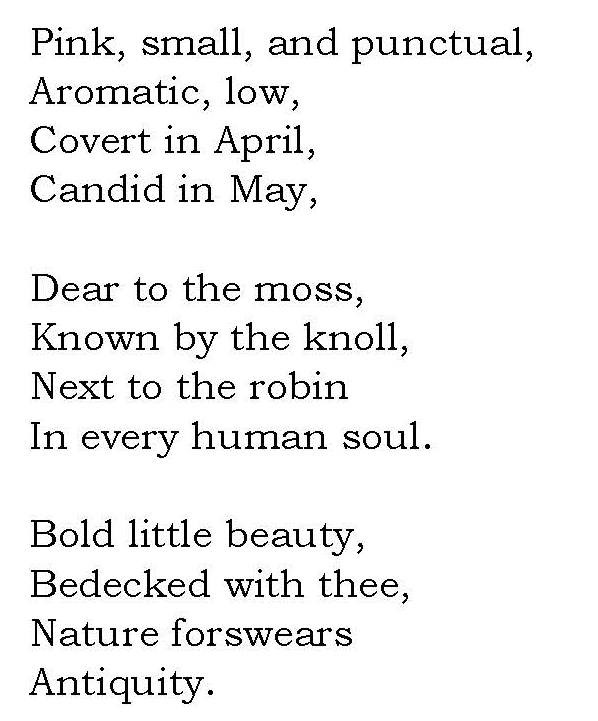
The great thing about Emily Dickinson and her around 2000 poems is that there’s always one you haven’t experienced yet—and just this week over at the Interesting Literature blog I saw this Dickinson spring poem. “May-Flower”  has Dickinson doing her most subtle music to accompany her most Blakean attention. Just like it says itself: it’s a “bold little beauty.”

It’s short and compressed, and if you read it quickly and silently it may seem slight and slide right by you. Spring, May, flowers, check. Robins. Yup, spring. Its abrupt ending might stop you for just a moment. It ends: “Nature forswears/Antiquity.”

Oh, I get it, the flowers in early May are new, there isn’t such a thing as antique flowers. Easy enough to see that—but the undercurrent is deeper, because this is another carpe diem poem, though this time without much bombast and no overt hey-baby-what-about… pickup lines. Yes, there are no old flowers, and so this flower will come and go with May.

Not many words in this poetry-machine, but without choosing any esoteric ones, Dickinson has made some choices that may arrest you the second time you read it. “Punctual,” the flowers know right when to be there. “Covert” those early signs of spring, like some advance spies. “Candid” for May, and spring fully here, no need to hide as a generic bud. Even “Dear” in “Dear to the moss” is a choice I wonder about. I’ve even read it incorrectly as “Near to the moss” once or twice, and sound-wise “near” works very well and is clear in meaning.  Does Dickinson want to pun on deer, another spring poem perennial? Does she want to pickup and connect that D sound from “Candid” in the line before it rather than predict the upcoming N sounds of “Known,” “knoll” and “Next?”

Which brings me to this: if you listen to the poem, or plant it in your own mouth, the sound is exquisite. Rhymes and near-rhymes abound without locking down to a scheme: “small/punctual/low/April/knoll/soul” and “every/beauty/thee/Antiquity,” and consonants and vowels are echoing each other too.

See Emily Play Games for May HD

Foreswears antiquity: I’m not sure if anyone who reads this will remember the poster I’m referencing here.


To perform “May-Flower”  I made some choices. First, to slow the listener down, and to give extra chances to hear that echoing sound-play, I repeated each line. And to emphasize the moment rather than its passing, I interleaved the first and second stanzas as responses to each other. In the last stanza, the responses are just additional echoes of that stanza’s lines.

For the music, I decided to refer to The Pink Floyd. No, not the auditorium and eventually stadium-filling rock band, but the original 1967 Syd Barrett-fronted line up, which was based more around the sound of that era’s electric organs with a taste of Barrett’s unique take on slide guitar. So, time to dabble and wobble organs and break out the Telecaster and a finger wrapped in a vase of glass.

Emily’s poetry-machine obliviates the need for dodgy recreational chemicals. Attention is the drug. This is not the first time I’ve referred to Emily Dickinson’s visionary side here. I see it coexisting with her skeptical wit. And this poem, for all it’s Blakean a heaven in a wild-flower aspect was also intended by the botanically knowledgeable Dickinson as a riddle, the correct answer is a particular New England wild-flower, the trailing arbutus.  See Emily play. There is no other day. Free games for May….

Here’s the text of Emily Dickinson’s May-Flower if you’d like to read along.

May-Flower text

This is the regularized version with conventional punctuation. Emily’s own was full of her dashes.

And here’s my performance of it with original music. Use the player below.


Wrapping Up National Poetry Month 2019

It’s been quite the April here as we ramped up activity to celebrate U. S. National Poetry Month. A lot of effort and time on my part, but since this project is based on the joy one finds in looking and listening to something and seeing what the encounter brings out, it’s been fun for me. I hope some of that always self-replenishing curiosity comes across to you as you read and listen here.

Here’s some of what happened this month.

Most blog posts here ever, nearly a daily schedule! There are blogs, ones that try to do different things than this one, that can carry on at that level for an extended period, but it took quite a lot of effort considering this project’s goals.

I completed a #npm2019 goal of performing all of T. S. Eliot’s longest section of “The Waste Land,” “The Fire Sermon,”  this month. I warned readers here that “The Waste Land”  isn’t poetry comfort food, but as I dived in, looking for things I could connect with in order to perform it, I found some unexpected things.

Before I started this serial performance, I thought I might struggle with misogynist/other portrayals of the women in Eliot’s masterpiece, but instead I found more empathetic depth there. Yes, it’s a bleak world for all in “The Waste Land,”  but I also got to experience a surprising amount of gender-blurring in the voices of “The Fire Sermon.”

In researching it this year I finally grasped the level of extensive sampling tactics used, where nearly every line references some prior artistic creation. I love an in-joke, the pendant in me rejoices in odd connections, but even as I came to better understand the sources I’ve left much of that out of my writing about it, because I believe the poem still communicates its experience out of the sound of juxtapositions and the variety of voices without one needing to know who first wrote the words or sang the songs Eliot drops into his poem. Considering hearing it this way: “The Waste Land” is a collage—you don’t have to know where the picture was clipped from to sense that you’re being asked to see unlike things next to each other.

t s eliot micophone

With a T and a S and L-I-@ / Here to rock this mic with my alley rats / Think you’re a sick rhymer with a mad dose / I’ve been to a Swiss asylum and been diagnosed / Dis a soft Thames flow while I sing my song / you might end up drowned like that Phoenician / Peace (that passeth all understanding) Out!


And lastly, I’m grateful for the broad music-ness of the poem that let me use what I think was a nice variety of musical styles along with Eliot’s words. Eliot wrote “You are the music while the music lasts”  and Stevie Wonder wrote “Music is what gives us memories, and the longer a song has existed in our lives, the more memories we have of it.” Eliot’s immediate experience of music is all over the poem. My task was to take those memories of another poet’s mind and to make them sound again.

Besides presenting a couple of poems by Emily Dickinson, I also enjoyed my “Roots of Emily Dickinson” series this April. Comparing Emily’s Bronte and Dickinson on hope was a great “aha!” moment for me. And Helen Hunt Jackson, who got skewered with a single funny scene in the recent Wild Nights with Emily  film, was a fascinating background character to run across, and Jackson’s “Poppies on the Wheat”  has been one of the most popular pieces here so far this spring.

Wild Nights with a chaperone 600

Would Emily Dickinson’s and family’s wild nights have been tamer if Gloria Bell was their chaperone? Discuss.


My own personal questions on what Emily Dickinson’s thoughts were about Afro-Americans and slavery, or even the bloody civil war that coincided with her most productive years as a poet, are still largely unanswered, but if I hadn’t gone looking for them I wouldn’t have run into the remarkable story of her Amherst contemporary Angeline Palmer and the bravery of three servants.

The blog audience has grown in response to this additional content, with April’s unique page views far exceeding any previous month. Listenership to the audio pieces were up too, and this April will likely set a record for the most listened to as well, though by a narrower margin than blog views.

As a practical matter, the amount of time and effort I put into things this National Poetry Month in April can’t be sustained. Unlike most blogs this is a two-pronged effort, with the production of the audio pieces coming first and then the blog post follows. I write almost all of the music for the audio pieces and I play and record the majority of the instrumental parts. But after that’s done, I’ve only started because then it’s time to write something interesting or illuminating about my encounter with the texts. Your readership tells me I’m succeeding sometimes.

This May I’m going to start some work on re-doing my main music production space. This is going to involve a lot of work, much of which I’ll need to do myself. My goal is to make it an even more streamlined, organized and functioning space. This will predictably reduce the amount of new audio pieces here for an interval, but afterward I hope it’ll make it possible to return to our normal 8-10 or so new pieces a month schedule.

However, because we’ve been at this a long time, there’s a lot of material in the archives, over 330 pieces, so there’s things here you may not have encountered yet. I try to mix the well-known with the nearly unknown. You can take a flyer on someone you’ve never heard, use the search function on the blog, or just try a random dive into the archives going back to 2016. Thanks for reading. Thanks for listening. Thanks for the likes, the follows, and particularly thanks for the shares and the links!

Wild Nights with Emily

I’ve been looking forward to this Emily Dickinson biopic since I first heard of it a few months back. I acknowledge the difficulty of making a film about writers, particularly if the film wants to give due weight to their writing, the least cinematic of art forms—but just because it’s difficult doesn’t mean it shouldn’t be tried.

From indications I was expecting Wild Nights with Emily to be irreverent, but I often like some irreverence, even about things I admire. The advance publicity used the hook that it was going to go strong on the theory that Emily Dickinson and Susan Gilbert were lovers. That’s a legitimate theory, with evidence to support it, but the trailer and the promo clip I saw indicated it was going to be one of those “Hey, famous artists go through all the wacky and awkward stuff we do, especially when they fall in love.”

Does that sort of thing diminish art or the people that make it? We should laugh at both devils and angels some of the time (just not all the time). For an example of literary irreverence that worked for me, I’ll point out Upstart Crow,  a series that turned Shakespeare into something between the Dick Van Dyke Show  and 30 Rock  using a passel of modern critical theories as comic premises.

Wild Night with Emily Poster

What’s with all the black. More Emily Dickinson goth moves?


As it turns out, Wild Nights with Emily  didn’t consistently work for me, though I’m glad I saw it and I admire the effort. It’s awkward in ways that alternately charm, puzzle, and just seem off. It tries for a complex structure that jumbles time-lines back and forth and the individual scenes seem very separate. There’s little character development, little sense of change or dynamics of Character A’s actions changing the course of Character B’s life outlook, even in the central love story. We see a scene or two of Susan and Emily falling in love as teenagers, but there’s no attempt to explain why Susan or Emily were attracted to each other instead of someone else, they just are. Nor is this attempted for any of the other relationships—some kind of lust/attraction spark occurs and bang they go off. It’s consistent enough that I think the writer/director Madeleine Olnek is making a point of this. Oddly, these connections go badly for the couples other than Susan and Emily. It’s kind of a bokeh effect thing: our lead couple just want each other, and that sort of works out, and everyone else is just mindlessly and brainlessly lusting.

Indeed, my impression was that the writer/director really was interested in making a point, or series of points. The film isn’t a biographical narrative* or love story or sex-positive comedy or an exploration of creativity, it’s more an illustrated lecture with actors given to illustrate those points. The disconnection of the scenes is just a new slide in the deck being shown. The points are all worthy ones, most of which I’d agree with. Dickinson was a mocker and questioner, not a conventional sentimentalist. No one understood how revolutionary her poetry was. Families are weird, and their secrets show that. The Patriarchy is blind to a whole lot of things.

Some of the scenes work well as illustrations for me. Some don’t. Your mileage may vary. Many scenes use humor to make their point. A couple of the scenes were Dada-weird (e.g. Lavinia and her fake cat). Others are very much “see the broadly underlined point.” Some are emotionally riveting in the same way that actors doing single scene can be as they instantly inhabit a character, but again, the film isn’t really a narrative. Nor does it go out of its way to say “I’m not a narrative” like other attempts to subvert the artist biopic genre like 32 Short Films about Glenn Gould  or  I’m Not There.  If you go to see it, go with that expectation and I think you’ll be more primed to absorb what it’s trying to do.

A couple of Olnek’s points I’m less sure of (she may be right, I’m no Dickinson scholar). She seems to be overcorrecting on the Dickinson was a hermit, always sequestered in her room thing. As far as her film shows it, it’s all a misunderstanding, and she just didn’t like Mabel Todd. The impression I get from my Dickinson biography research is that a much more sociable person did become increasingly withdrawn as she aged. And she seems to be saying that Dickinson directly sought publication, only to be rebuffed by the Philistines. Maybe there’s an earlier period I’m unaware of, but the testimony of among others, Susan Gilbert Dickenson herself included, was that the scattered publication of 11 or so poems in her lifetime was largely due to the efforts of others which Dickinson did not encourage.

A few times in the movie they use Dickinson’s poetry, spoken and with subtitles with scenes portraying something they relate to the poems. I’m favorable to that tactic—after all, the Parlando Project is doing that with music instead of film. I think that works in the film. The “Hope’ is a thing with feathers”  and “I died for beauty but was scarce”  examples were particularly memorable for me.

That’s my reaction to the film. I appreciate the effort that went into it, and the task it set out for itself isn’t easy.  Is it the best possible way to spread greater, deeper appreciation of Dickinson? Hell if I know. Worth a try.


*Maybe it’s just me, but has anyone done a straightforward Emily Dickinson timeline that says what Emily Dickinson was thought to be doing year to year? A good one would include links to the various theories regarding people that came and went in her life. I find some of this hard to keep straight and the non-linear choice of this movie obviously didn’t aim to help me. For example, the Mabel Todd/Austin Dickinson affair that started in 1882 happened very late in Emily’s life, more than a decade after she’s thought to have written the vast majority of her poems. And the first meeting with Thomas Wentworth Higginson in 1862 was when her amazing productivity was accelerating.

By the way the film’s bokeh effect makes Higginson and Helen Hunt Jackson look like comic idiots. Given the heroic things they tried to do in their time, I give them a little more credit than that.

The Lamp burns sure

What did Emily Dickinson think about the American Civil War, that great national trauma that occurred during her most productive time as a poet? And what did she think about the great national sin that was the cause of that war, slavery?

Emily Dickinson often writes puzzling poems, compressed like a set of speaker’s reminder notes on an index card. Despite occasional antique words and references to obsolete technology, Dickinson’s poems don’t really seem to dwell in a particular time or have any anchors in a time’s signature events. Instead we are left with the multiple capitalized idealized concepts that in the hands of most poets would doom a poem to vapid incorporeality—but the speed and brio of a Dickinson poem seems like the rush of thoughts, and that and they carry us along. All of this lets us see a remarkable mind thinking, but it doesn’t necessarily tell us the conclusions, only the methods by which it tries to reach them.

With many other American poets of her day we can tell what they thought of the Civil War and where they stood on the issues of slavery. Of course, we no longer read most of them, and we continue to read Dickinson. Even though my curiosity about these matters is personal, and in the end it doesn’t significantly change the originality and attraction of Dickinson’s work, I’ve still looked to see what I could find.

Dickinson’s father, Edward, was a politician, a member of the short-lived Whig party, and so there are political stands associated with him. The American Whig party, particularly for northern Whigs, was a “free soil” party. This meant that they did not stand for the abolition of existing slavery but wished to limit any expansion of the practice. Southern slaveholder interests were not content with that as a compromise. In an era when new territories and states were being added to the Union, they feared that they would eventually be too small a minority in a growing United States. In the 19th century before the Civil War, time and again these interests would come into conflict, and it was generally the Whigs who worked out some compromise that put off the Civil War. Edward Dickinson seems to have been an orthodox Whig, he supported those compromises, including voting for one of the last and most fateful of them, the Compromise of 1850 that gave the slave holders a Federal Fugitive Slave Act, giving license for bounty hunters of dubious ethics to haul escaped slaves back to the South (and financial rewards if they over-reached and just grabbed a free black person “by mistake”) and requiring local state authorities to assist in their efforts.

The injustices of the Fugitive Slave Act enraged Afro-Americans and energized abolitionist sentiments. And in the slave states who would secede at the start of the Civil War one of their chief complaints was that the Federal Government wasn’t doing enough to enforce this Fugitive Slave law against individual states that were hampering rather than aiding these “slave catcher” bounty hunters.

The Whig parties balancing act fell off the high wire shortly after that. It essentially split into two parties, the new Republican Party which was more adamant about free soil with no compromises, and eventually became the “party of Lincoln” and slavery’s abolition. The other part was the Constitutional Unionist Party which wanted to continue the Whig-style balancing act. Edward Dickinson seems to have aligned with the Constitutional Unionist faction, which completed the rapidly increasing progression to irrelevance for the Whigs.

On the other hand, both Edward and Emily Dickinson were on friendly terms with those who went the Republican route and even the more radical abolitionist bent. If yesterday’s story of Angeline Palmer might lead you to see a 19th century Massachusetts casting of To Kill a Mockingbird  with Edward as Atticus Finch and the young Emily as Scout, the reality of the Dickinsons is much more ambiguous.

I’ve found various critics and commentators who have sought to answer my questions about what Emily Dickinson thought on these things. Some point to Dickinson poems and have suggested readings of them, but these are most often unconvincing to me. She does have poems mentioning warrior courage, duty and loss, but none of them seem to say anything about the causes or necessity of the pressing war in her time. Even more rare are references to slavery or people of color in the poems.

The Lamp burns sure

Mysterious and burning. Dickinson’s mind by lamplight

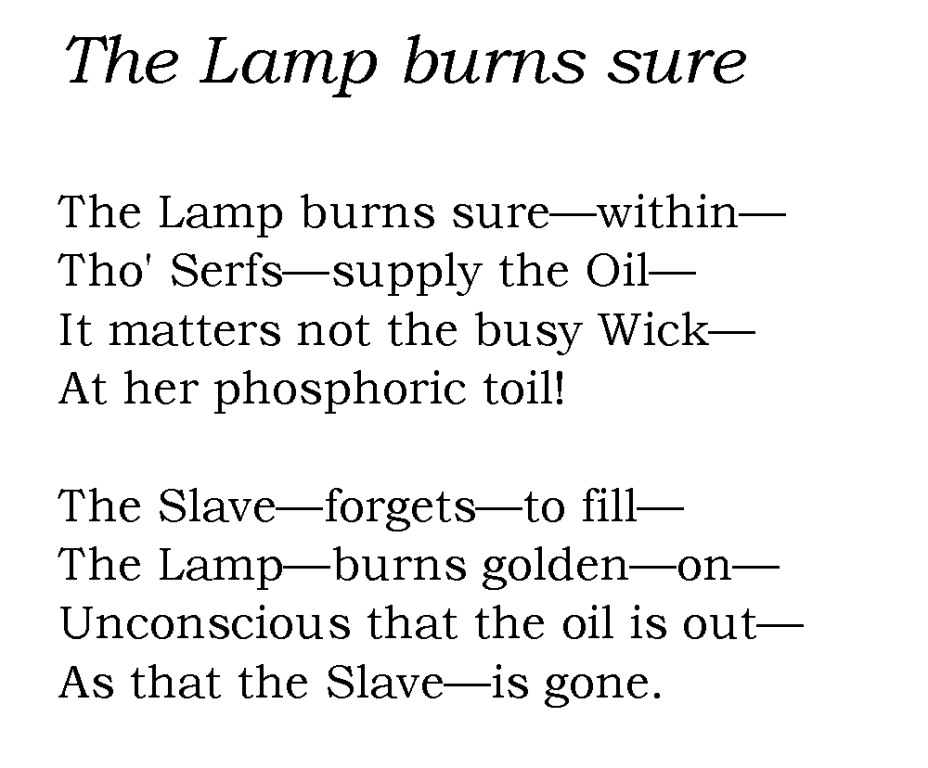
The poem I use for today’s piece is one of those rare ones. “The Lamp burns sure”  is Dickinson at her most compressed and ambiguous. The poem’s plot is clear enough, an oil lamp whose oil is supplied by slaves or serfs (the poem says both at first, muddying the waters if it’s talking about slavery) runs out of oil because they have stopped filling the reservoir. The lamp’s wick is so busy burning that it doesn’t notice that it’s out of fuel and would in the normal course of events burn itself out shortly. The poem does not proceed to that end however. It leaves us only with the wick’s obliviousness, and then breaking the tie between the oil bringer’s role as being a serf or a slave, leaves us with the final statement that the busily burning wick is also unaware that the oil is out because “the Slave —  is gone.” We don’t get to find out if the lamp is some Hanukkah mystery that will go on burning longer miraculously.

So, what does it mean, if it indeed means one thing? Some read it as a parable of creativity, that we’ll work ourselves past our resources in our passion. A key word there would be “within” indicating some imaginary inner lamp and the slave is just our body and emotional resources.

Some read it as a comment on the base labors that support a civilization that in turn supports arts, science or spiritual pursuits, and in that reading it’s an acknowledgment of the necessity of those labors—take them away, no light! The confusion of serf and slaves is a necessary confusion as it’s talking generally about civilizations.

And then some think, since this is a poem written in 1861 as the Civil War has broken out, and all the slave labor that has supported a large portion of the agricultural economy of the nation is now in question along with that nation itself, that this is not a generalized metaphor. The slave who’s gone, is an American slave, the light is an American light that will burn golden on.

Emily Dickinson's desk

Emily Dickinson’s desk with a whale oil lamp, a little luxury that could extend her writing hours

That last one would make it the closest to an Emily Dickinson statement on slavery and the Civil War. As I burn my own midnight oil tonight and I think of Emily Dickinson who wrote at night by the light of an oil lamp, I lean to the first reading. But some other day I might see something else and read it another way. I’d like to be surprised and to find out that Emily Dickinson’s keen and questioning mind could see what only some in her time could see about people of color and slavery, but that might not be the case. But here’s what I do find when I go to the music of that mind: a mind unafraid to be original and like Frederick Douglass in Robert Hayden’s poem, to believe freedom thought to be as needful as a heartbeat. Even if she didn’t free anyone from slavery like Lewis Frazier and his fellow servants in our last post, or agitate and orate like Douglass, I find there’s liberation there that burns sure.

Here’s my performance of Emily Dickinson’s “The Lamp burns sure.”  You can use the player below to hear it if you can see one. No player? Then use this highlighted hyperlink.

Emerson’s Water

Here’s another post in one of our National Poetry Month series: The Roots of Emily Dickinson. We’ve already touched on Emily Bronte, who’s fierceness inspired the American Emily; and Helen Hunt Jackson, a childhood classmate who encouraged Dickinson to publish her work.*  Today we look at a poem from the foremost public intellectual of her region and era, Ralph Waldo Emerson. We’ll see how it connects to Dickinson, and you may be surprised at how current Emerson’s thoughts about water are.

It’s difficult to think of a modern analog to Emerson. It’s not an exact fit, but Oprah Winfrey could be put forward—but that understates the level of Emerson’s pioneering in the mid-19th century when America was still seen as a backwater. Like Winfrey, Emerson’s approval or endorsement could do much to help a new writer come to the fore. Emerson’s opinions, not just on the arts, but on public culture in general, about how best to live and shape one’s own life, were widely distributed and read by a broad readership. But even if similar in fame and broad impact, Winfrey has never pretended to be a philosopher herself, while Emerson was viewed as a central figure in a movement called Transcendentalism. What is Transcendentalism is a book-length subject, but there are, within its core, beliefs in the powers of individual insight over religious authority and the desirability of a close reading of the book of nature.

Winfrey-Emerson

If it was the middle of the 19th century, the guy on the right might be your Oprah.


When I would read Transcendentalist writings more than a hundred years after they were written, in my 1960s, I would be struck with how often (if one gave some allowances for language changes) they sounded like a hippie critique of 20th century culture,** and in the half-century and more since, if I dip back into them, I find some of their focus surprisingly contemporary.

Was Emily Dickinson a Transcendentalist? I can’t say for sure, but it’s near certain that Transcendentalist ideas, particularly as expressed by Emerson, were familiar to her. His thoughts were in the newspapers and magazines she read in her lifetime. We know she had been given a book of his poems by a friend, and we know she read them, and even copied at least one of them in her own handwriting. It’s possible that she attended one of Emerson’s popular public lectures.

Emerson Poem Sacrifice copied by Dickinson2

Part of Emerson’s poem “Sacrifice” copied in Emily Dickinson’s own hand.


Emerson’s poetry rarely works well, and Dickinson is a great poet, yet in poems like today’s Emerson selection “Water”  I can see similarities between them. Emerson punctuated his poem as one purported sentence, but its syntax is impossible to follow, and so “Water”  is as fragmented as one of Dickinson’s heavily dashed poems. Incredible leaps occur from line to line with no attempt to bridge them with explanatory connections in either poet’s work. Emerson begins his poem with a striking phrase, similar to many of Dickinson’s great first lines: “The water understands/Civilization well;” but we soon meet a strange homey image of sticking a toe (or foot) in it, and Dickinson too loved to mix the universal and the mundane. Emerson’s poem develops with water personified as not having or having certain feelings, and then with little preparation we’re warned it can be the destroyer.

I think Emerson is making a very modern point here, one that he expressed also in his essay “Civilization.”   When water is respected and harnessed appropriately for its utility *** we are in harmony with nature’s nature. But, if we ill-use nature, we literally go against the tide, and water will be our destroyer.

If Dickinson was influenced by Emerson’s ideas and outlook, and if she picked up his individualist style that dares to be somewhat obscure to stay true to the individual’s perceptions, why is she so often a great poet while Emerson isn’t?

I think Dickinson makes better word choices both for sound and impact. Having “decketh,” “adoreth,” and “doubleth” as three wet dish-rags in a four-word stretch is enough to make Emerson’s poem soggy. And Dickinson has a talent for intriguing mystery that pulls us along even to places we don’t fully understand. She does that partly with her hymn/ballad rhythms which Emerson doesn’t use. Dickinson is usually more immediate too. A few posts back I stated that a poem is not about ideas, but the experience of ideas. In an Emily Dickinson poem, I’m more often able to feel I’m experiencing those ideas as the are perceived, where I feel Emerson is summarizing his thoughts after the fact.

Unafraid, I waded through the -eth words and performed Emerson’s “Water”  with my own music, and you can hear it with the player below. And here’s the text of Emerson’s poem if you’d like to follow along on the page.


*With the exception of one poem, which was published anonymously while Dickinson was alive, Jackson failed at that. Still, I think it possible that having some knowledge of her friend selecting poems for publication could have been motivation for Dickinson to create her hand-written booklets of poems which were found after her death.

**This is for good and ill. Idealistic critiques of society are important, but adventurers often take wrong turns. And idealists have a hard time figuring out viable new structures.

***Emerson’s Massachusetts led the nation in using water power for small to large industry in the 19th century. So, when the city of Minneapolis was founded largely due to it’s exploitable water power, a good portion of the city fathers had New England backgrounds. Many Minneapolis streets still bear the name of 19th century New England luminaries, including Emerson. Alas there’s no Dickinson Avenue, as Dickinson’s poems were not published until close to the end of the century.

“Hope” is the thing with feathers

We don’t usually associate Emily Dickinson with metapoetry or with the widespread sampling and recontextualizing such as found in T. S. Eliot’s “The Waste Land.”  But this poem from Dickinson, one of her best-known, could be engaging in something we could call that.

The poem starts off with a clear indication of reference, by putting its first word in quotes. Based on Emily’s unusual but internally consistent style, I don’t believe that she’s using quotes to indicate hope as concept, as an ideal (she capitalized words to indicate that sort of thing). If it’s a quote, she’s referencing someone else. Who said this “Hope?”

My chief candidate would be the poet and poem from our last post, Emily Bronte and Bronte’s poem “Hope.”  If you read and listened to “Hope”  in our last post you’ll know that “Hope”  isn’t a hopeful poem at all. Dickinson’s poem, on the other hand, is often viewed as praising hope, but if you read/listen to them together, Bronte’s poem sheds a different light on the much better-known “thing with feathers” poem.*

Dickinson seems to start where Bronte ended. Bronte’s hope has feathered wings, and it uses them to soar to heaven to never return. Dickinson starts with “hope” only specifically given the potential for flying away, but Dickinson has “hope” sticking around. Some read the feathered aspect of Dickinson’s image as cute, like a pet songbird, a friendly image, but I don’t think Dickinson does cute much, and I’m not sure she’s doing it here.

Punk Monk Emily

My wife sent me this and I believe the illustration is by Wendy MacNaughton.

.

What Dickinson says about hope in the rest of the poem has been read as outright praise, but if we take that fly-away-and-feathers link between Bronte and Dickinson, we should be alerted that there may be more shading the situation.

Hope and Hope is a thing with feathers

For those who’d like to read along, here’s today’s text and the Bronte poem it may be referencing

.

Dickinson’s hope sings without words, which is a statement of great ambiguity from a poet. Abstract sound that goes beyond meaning is part of poetry’s power, yes, but “without words” may also say that, for good or ill, hope is generalized and not realized by the specifics of the situation. A song without words could be like advice that things will always get better, always turn out fine. A friend or advisor that always tells you that; whose non-specific hope is constant and never relenting can be a “not today please!” thing after all.

The second stanza is an extended metaphor of the hope-birds sweet song in a storm. “Plucky little bird! Good for it!” Is one reading. But there’s an odd line in there that must be weighed too. If the storm is bad enough the bird might be abashed, embarrassed, Dickinson says. Why would that be? Is the hope-bird, shy, timid? Bronte’s hope is said to be in her poem’s first line, and that turns out to be a very severe flaw as Bronte develops it. Could it be even darker? Did the hope-bird say listen to my hope-song in the storm and not fear—oh, how embarrassing—category 5, your town is wiped out by the tornado or hurricane?

Am I being Debbie-downer here? Could be. But how else does one explain the “abash” in that line?**

The last stanza begins still carrying over that metaphor: hey New Englanders (and Minnesotans!) if it’s cold, the frozen center of winter, you can still hear the magical hope-bird. Out way beyond land on the strangest sea? You can hear it. The hope-bird is operational in any and all conditions!

More won’t-shut-up testimony about the hope-bird there. Is this fulsome praise? Recall Dickinson’s famous definition of poetry: “If I read a book and it makes my whole body so cold no fire can warm me I know that is poetry.” And in Wild Nights Wild Nights  she speaks about adventuring on chartless wild oceans. Not to paint Dickinson as an inner stone-cold Goth here, but cold and strange are not what she seeks to avoid. Dickinson says the hope-bird keeps “so many warm.” She doesn’t say everybody or herself.

What do I make of Dickinson’s concluding couplet? Many readings see it as a comment that hope isn’t self-serving, the crumb being reward for a pet or a tamed or otherwise human-habituated bird. Dickinson (unlike Bronte, whose hope is portrayed as fickle and even cruel) has just made much of hope’s seeming ubiquity. If we take it that she’s commenting ambiguously on someone else’s hope or Bronte’s portrayal of a fickle hope, she could have undercurrents in those last two lines. She may be saying “My hope is wild and unpredictable, maybe not as specifically feral and cruel as Bronte’s, but my hope is not my pet, not at my beck and call.”

Of course, a great deal of this reading depends on thinking that when Dickinson put hope in quotes she meant to refer to the title of Bronte’s poem whose protagonist is highly skeptical about hope. There’s another thing she might be quoting, a special use of the word. When Dickinson entered Mount Holyoke the students there were highly encouraged to make a sincere profession of religious faith. At the end of her single year there, Emily Dickinson was still in a small group that refused to make that profession. The school had a classification for those hard-cases. They were put down as “Without hope.”

Here’s my performance of Dickinson’s “Hope’ is a thing with feathers.”  Use the player below to hear it if you see that, or if you don’t, this highlighted hyperlink can play it.

.

*Somewhere in my reading this spring someone tipped me off to consider Bronte’s “Hope”  as an influence on this poem of Dickinson’s. I did, and this is what I found following that tip. However, I can’t find any note I made about where I first read that there might be a connection. I owe someone.

UPDATE: Thanks to another blog’s discussion of this poem, I think I’ve rediscovered where I may have read of this connection between poetic Emilys and “hope.” It could have been this post by Nuala O’Connor.

**I’m truly hesitant in this regard. I do believe in the intractable nature of the human condition, and I think Dickinson does too, but I don’t want to discount hope or “the peace that passeth all understanding” as a necessary part of dealing with those things.

Emily Bronte’s Hope

If Emily Dickinson had no real models for the revolutionary poetry she developed, she did have other poets she could look to. We know from her letters that one of them was Emily Bronte.

English author Emily Bronte and her two sisters Charlotte and Anne all wrote poetry and then novels, but Emily seems to have been the most avid poet of the trio. Starting in childhood Emily Bronte created along with her sister Anne a fantasy world they named Gondal in which they spun tales of adventure. At least some of Emily’s poetry was connected to that world, and so it’s possible that today’s hopeless piece titled “Hope”  is part of some fully imagined plot and isn’t autobiographical.

Emily Bronte

Emily Bronte. Plotting what to do to that useless hope when she’s uncaged?

One of America’s great contributions, an Afro-American contribution in large part, is The Blues. The Blues reaction to misfortune is almost inevitably to battle that misfortune in some way: to mock it, to hip others to it, to talk back to it and tell it that the speaker knows the score and may even settle that score with it some day. Most American Blues aren’t “woe is me, I’ve got it bad, and I’d rather be dead” it’s “I can tell you how much trouble I’ve encountered, but I’m still here.”

Emily Bronte is mocking too, but she’s mocking hope itself, not the unspecified troubles that have figuratively imprisoned the poem’s speaker. Hope is portrayed throughout as an external character, and that character is a pious creep, totally uninterested in easing the pain of the imprisoned speaker.

Still you have to hand it to Emily Bronte here. This is a rather impious poem from a preacher’s kid, even if it’s a character from her imagined world and this is only a momentary lament. Perhaps that’s part of what attracted Emily Dickinson to this fellow Emily. Dickinson is also a great mocker.

Does today’s Emily Bronte poem remind you of a well-known Emily Dickinson poem? Check back later this week and we’ll try to follow up on that—but until then, here’s today’s audio piece Emily Bronte’s “Hope.”  The player gadget is below for some of you, but if your blog reading software doesn’t show it, this highlighted hyperlink will also workFull text of Bronte’s poem for those who would like to read along is here.

.

Increased Posting Frequency for National Poetry Month

How is everyone finding the increased frequency of posts so far this April?

It’s been extra effort for me, but I’m enjoying what I’m finding out as I encounter these poems and poets. and I hope that comes across to you the listeners and readers.

I’ve got a lot more planned for National Poetry Month 2019. We’ll return to our serialized performance of T. S. Eliot’s “The Waste Land” soon, and I’ve got additional stuff in what’s turning out to be a “Roots of Emily Dickinson” series as we look at another poet who inspired this Founding Mother of modern American poetry.

Besides looking at Poetry’s Greatest Hits and poets like Eliot and Dickinson that are too large to ever get around, we’re also going to look at some more of the unusual, lesser-known, and should be better-known works again. If we have time, there may even be something new that Dave Moore or I wrote ourselves.

The Thing at the Window

Scenes of winter past: what is that thing bleeding some vital fluid outside my window?

What else? Some things I don’t know yet. This project is about exploration, and when you find one thing it often leads to another surprise. But you don’t have to wait, as there’s probably something to surprise you in the over 300 pieces available in our archives.

I’ll leave you today with the most listened too and liked audio piece of 2018, Emily Dickinson’s “We Grow Accustomed to the Dark.”  first released here last February.