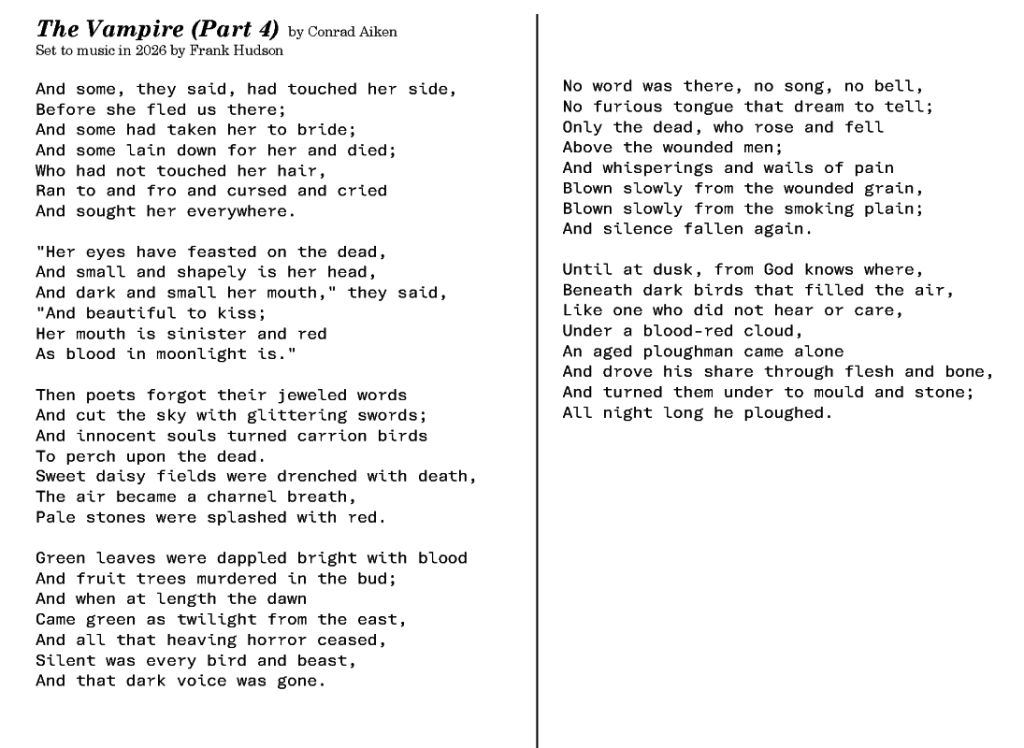
This is the final section in our Halloween series this year, a setting of Conrad Aiken’s narrative poem “The Vampire.” It’s the longest section of the four parts as I’ve divided it, and I find it by far the most disturbing. As I have done when releasing these movements in the musical piece, I urge you to listen to them in order, starting with Part 1.
I had this post all written and ready go before I finished mixing my recording of the last part late this afternoon. Before hitting publish, I decided to check to see if Aiken himself may have suggested some context when he published it. I had found Internet statements that the poem was first published in 1914, which I assumed was a simple uncontroversial fact. I even jumped to the conclusion that this publication must have been in Aiken’s first book-length poetry collection published that year. I got a copy of that book, Earth Triumphant and – it was not in it!* Another web search gave a variant publication date: 1916. I downloaded copies of all public domain Aiken poetry collections before 1931. Searched each one of them. No “The Vampire” in any.** I even searched for distinctive words to see if the poem the Internet calls “The Vampire” had another title or was only a portion of a longer poem. No winners. By this point I could even wonder, did Aiken even write this poem?
After supper I did more searching and found this tiny listing on The Internet Speculative Fiction Database that led me to the archives of The New Republic for April of 1924 where Aiken’s poem appears as “The Vampire (subtitle line) 1914.” In context that subtitle is almost certainly a reference to the beginning of WWI, that first great war of mechanized and chemical slaughter, not the Internet-mistaken date of the poem’s publication. It turns out that Aiken’s “The Vampire” is yet another poem where 1914’s world-wide war inspired eerie and apocalyptic poetry, some of which escaped their specific inspiration to become more generalized poems brought out on Halloween.
That plowman that ends Aiken’s poem made me think of William Blake’s “Drive your plow over the bones of the dead.”
.
So it’s apparently a 1924 poem from the time when Modernism was fully in ascendence, which makes its archaic (if effective) prosody and its unusual narrative style more anachronistic. Aiken knows this. He edited the Harvard literary magazine with T. S. Eliot for example and was an active critic and anthologist promoting current American poets – but he expressly admired a lot of French symbolist poetry. Perhaps he was thinking too of that American antecedent to those 19th century French poets he admired, Edgar Allan Poe? In my childhood, some Halloween costumes were made from old clothes, and if this poem’s storytelling is old-style, its terror might still come through, particularly in today’s section. Further violating a Modernist rules, Aiken is mostly telling here, not showing what exactly occurs when the mysterious creature arrives and reveals that the world’s populace will either love and worship her or suffer ignominious death. Throughout the poem, he mostly treats this situation with eldritch Lovecraftian rhetoric reflecting how strange and horrific the apocalypse strikes those experiencing it – but as today’s section gets underway, he adds the most horrific detail of all: many (most?) of the world’s people not only accept this deadly tyrant, they find her erotically attractive. In my last post I wrote that Aikin’s choice of a female gendered villain here is problematic. Thinking again this morning, and considering the erotic charge in the words of the subject populace’s reaction to the tyrannical “love me or die” vampire he portrays, and assuming Aiken assumes hetero-normative readers, then it’s possible (though unstated) that the hetero-normative women in the poem’s world are seeing a male identified vampire simultaneously with the female villain he’s describing.
Beyond the costume it wears, how old-fashioned and fantastic is this poem?
At the beginning of this series I wrote that when searching for a text to use for a Halloween piece this year I wanted to find something playful, because I have an overstock of disgust and fear for my country and the world right now. I did find pieces that might have fit the bill: benign ghosts, saucy witches, mischievous spirits. And then I read Aiken’s poem. I read a poem of the arrival of a deadly and narcissistic tyrant proclaiming that those in thrall to them must love them amid widespread devastation. This is what is most horrible – as savage as extra-judicial killings, dire mocking leadership, needless and cruel wars and callous destructions are, that express expectation that we love and bow down to its bringer disgusts me more. Or maybe the supreme horror is this: the sight of some of my fellows accepting – nay, even cheering such a creature on. And that’s what I ended up portraying today as I completed presenting Conrad Aikens poetic tale.
Happy Halloween. Enjoy your costumes, your microscopic candy-bars, and the twilight will-o-the-wisp fancies of wonderous spirits. Celebrate the treasures that are the memories of the ancestors. The grown men with masks and guns citing unilateral laws, such as they are, that apply to you but not them, expect at least your grudging acceptance, if not your loving worship of their faultless goals and grandeur. Set your Halloween joy in the first against the dire schemes of the latter.
Oh, and you can listen to my musical performance of the final section of Aiken’s poem with the audio player below. Out of candy-bars? No player? This highlighted link will open a new tab with its own audio player then.
*Given that the Earth of this poem is utterly devastated, it’d would have made an ironic inclusion though.
**This included his Pulitzer Prize for Poetry winning Selected Poems of 1929. I checked out a copy of the later 1961 edition too. No “The Vampire” there either. I also quickly checked a 1961 book length consideration of Aiken’s life and work written by Frederick Hoffman. “The Vampire” didn’t appear in the index. Checking out Reuel Denney’s 1964 Aiken book, no mention, though it does note the vampire that appears in Aiken’s 1916 “Jig of Forslin.” What remains a mystery? There’s no indication I’ve seen that Aiken was especially fond of the poem. No sense that it once stood out in regard from within the large corpus of work that the long-lived and prolific Aiken wrote and published. Someone is responsible for the many modern Internet occurrences and performances of this more than 100-year-old poem. My working theory there: someone in fantasy and horror fandom put it forward before literary scholars caught on to it.

