I worry I’m going to get all meta on you, writing posts on posts, but before I leave the Parlando Project’s 10-year anniversary, I thought I’d do a brief rundown of the most popular posts as a companion to the series on the most listened to audio pieces.
Typical posts here have changed over the years. Some of the earliest ones were quite brief – just small introductions to the audio pieces – and for the first couple of years they more or less duplicated the show notes for the podcast that distributes the audio pieces. At launch I had hopes short format (typically 2-5 minute) podcasts might be something that would find an audience. This didn’t turn out to be the case, though a small number of people do subscribe and download the audio from Apple Podcasts or other podcast directories.
Soon enough I realized that there was a much greater audience for the audio pieces from readers of the blog. The posts here got a bit longer and more substantial, to the point that a casual visitor might think the songs were a sidelight to the posts.* I myself remain hesitant to do the typical blog, the episodic personal journal thing. Other writers, with other personalities and experiences, can make that focus work, but for me I cringe when I fear I’ve slipped into a self-indulgent mode. I suppose I touch on that sort of thing obliquely, but the posts here have evolved into a casual record of my encounter with the poems and their poets: impressions I received from their art, interesting details I came across, occasional afterthoughts on how the music was made. Long time readers may have noticed a shift in tone over the years. As a writer I sometime use a specific supposed reader to guide my presentation, and for a great portion of the posts over the years I used my kid as that “reader in mind.” Now as far as I know, they’ve not read anything I’ve posted here, nor would they likely care to, but they and their peer group were who I imagined as I wrote many of the posts in the middle of the Project’s run.** Because of that, the posts over those years start out being addressed to a curious middle schooler and the age of this imagined reader increases through the teenage years.
Now In the last few years, the lodestar of that imagined childhood reader has become less prominent. I still think about speaking to the now 20-something demographic, but I’m also considering a broader, blurrier audience. And that audience has grown considerably, as best as I can tell. Spates of bot activity make the audience growth seem very dramatic, but when I analyze the granular breakdowns in the stats there are more “real” visits demonstrated amid the web scrapers.
Here then is the list of the most visited posts. As with the first-ten-years songs rundown, there’s a seniority bias in the list: all but one are from between 2017-2020. Every daily or weekly report I look at reminds me that some posts, written years back, addressed to a young teenager, are still getting visited.
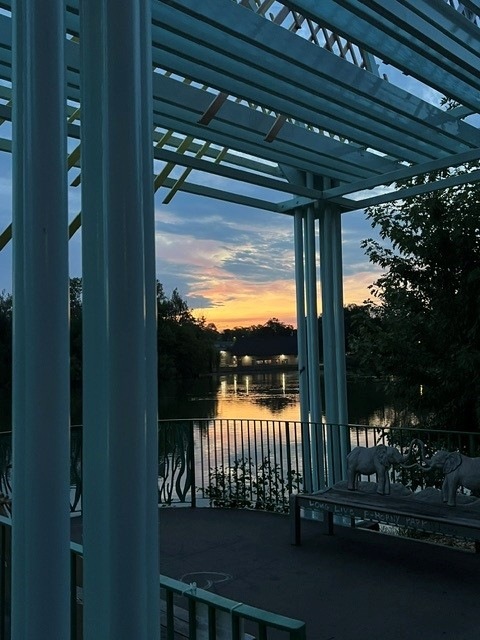
Sunset or sunrise? The Parlando Project’s 10-year Anniversary August is ending, but September begins.
.
10. The Aim Was Song. Frost’s poem is one of only two that appear on both the most listened songs and most read posts. I honestly can’t tell why this post, among the many Robert Frost posts I’ve published, is the most read. Possibly the popularity of the song I made from the poem.
9. The Sparrow. The outlier, a later post from 2024. Paul Laurence Dunbar’s short poem of poetry and music being put out there without assurance of an audience might just resonate generally with poets and musicians. But also, written by a pioneering Afro-American poet, it’s a metaphor for the great gift that Black artists have given to American culture.
8. Orpheus with his lute made trees, or springtime ambiguous. I don’t always do a explication of what a poem means, as I can be satisfied with a poem that goes all Marrianne Moore, sufficient just to be. But this popular post tries to untangle Shakespeare.
7. The Stare’s Nest at my Window. Here I write about Yeats causing me to read up on the particularities of the Irish Civil War, something that I knew nothing about before reading the poem. This is the second – with the Frost – that appears on both the song and blog posting Top Ten.
6. To A Friend Whose Work Has Come To Nothing. Yates again. Unlike other popular posts I can be pretty sure why this one gets so many visits: I did some research to find out who Yates’ “Friend” was, what the “Work” was, and how did that turn out in the end.
5. The Lake Isle of Innisfree. Yeats wants to dominate the middle innings of this list it seems. This one’s fun fact that may have drawn visits: it tells how this echt Irish poem (it’s even printed on the country’s passports), verse so full of rural charms, was inspired on a busy commercial street in London.
4. The Red Wheelbarrow. I assume the wide presence of this famous short Modernist poem on reading lists and school anthologies draws the hits, but I (uncharacteristically) spend more time talking about the musical tactics I used in setting it. Another schoolbook favorite, Sandburg’s “Fog” just made place 290, about a quarter of the way down, and with that one I wrote more about the poem than the music. Maybe this one generates a lot of disappointed “I searched for info on” folks?
3. “Hope” is the thing with feathers. I’ve written a few “hot takes” or “wild ass guesses” about what poems are getting at over the years, and this “I’ll bet you’ve never read this poem looking at it this way” post is the most popular of the bunch. The key supposition here is that avid poetry fan Emily Dickinson is commenting on a poem by a fellow Emily, Emily Bronte, in this well-known poem of Dickinson’s.
2. Poem 1 from Twenty Love Poems. I like me some Surrealist verse, but that doesn’t mean I’ll let the Surrealist off the hook for attitudes that I sense are being put forward. This is from a book of 20 love poems by the young Pablo Neruda that is extraordinarily popular in Neruda’s Spanish. The series opens with this one, and as I translated it for my performance I had to snort a bit at the macho overstatement I found in it. The same week I translated the last poem in the sequence, a much more measured and bittersweet love poem – still self-centered, but one I personally preferred to the opener. That post is popular too (#89), but not read as often as this one.
1. Chains At Her Feet. On one hand, I wouldn’t have guessed this one would top the list, if only because its audio piece is one of the minority of audio pieces here where I wrote the words, and wrote them likely thinking from the start to sing them. But then, every evening it appears on the daily leaderboard, mixed in with the most popular just-published posts. My best guess, the little-known photo in the post that shows a detail most visitors to the Statue of Liberty never see: that the grand lady welcoming immigrants is standing with a broken shackle and loosened chains at her feet.
*Eventually I’ve written some posts, even a couple of series of posts, that aren’t tied to any audio piece at all – but this remains a blog about the Parlando Project, and I personally still think the Project’s songs melding mostly literary poetry with the original music in differing styles is the point of it all.
**Might she someday age to the point she’d want to read these posts, or hear this music? I can’t say for sure, but given that things posted to blogs on the Internet share the impermanence of all things, they might not be there then.


I appreciate the amount of work that goes into a post like this. Thank you. I note that my interest is heightened when I know the poet or poem going in. I want to be the kind of reader who explores new territory and learns from the experience of new things. That hope is one reason I’m attracted to the Parlando Project. So often, though, your work has me consulting my inner muse and heading in another direction. There is value in that, likely, it’s why I keep returning. Thanks for your creative work. PD
LikeLiked by 1 person