I reckon when I count at all: our 900th Parlando Project audio piece

This is going to be a two-part post to celebrate reaching a milestone in this long-running project. This, the first part, will deal with the Emily Dickinson poem I adapted for this occasion, and the second, to follow, will be more a reflection on the decade or so of this Project along with a hazy look forward.

Let me quickly set out what the Parlando Project does: we take various words, mostly literary poetry not intended for performance, and combine them with original music in differing styles. Sometimes the words are sung, sometimes spoken, sometimes in-between. Mine is the voice you hear most of the time (though I know my voice is a limited thing), I’m the composer of most of the music, and I create recordings so you can hear the performances, playing most of the instruments and scoring the MIDI parts. Over the years, another poet/musician/singer Dave Moore has been the leading alternative voice, musician, and composer in this. Dave and I have performed as the LYL Band since the late 1970s. It was from within the LYL Band that the Parlando Project emerged.

Now onto today’s piece, that 900th one.

My appreciation for Emily Dickinson has grown while doing this Project. I still recall back in the early 1970s an American Literature professor telling me that most of Emily Dickinson’s poems can be sung to “The Yellow Rose of Texas”  or any number of other familiar tunes.*  That intrigued me, as I was a poet and writer who also wrote songs and was starting to figure out how to play the guitar – but at this time Dickinson was not yet a strong literary influence for me. As the esteemed Professor Hillyer put it in the piece that I quoted from earlier this National Poetry Month, I was still subject to that summation where “coy” moved to the point of “cloy.” I casually allowed that framing, that expectation, and largely lived my life considering other poets.

Doh! Working with her verse here in order to perform it with music expanded that quickly. It turns out she had many modes and moods, she was capable of highly compressed metaphysical poetry (even to a fault), and I sensed the dry but cutting sense of humor of a social satirist in many poems. The younger, ignorant, me had thought her this tragic spinster with needlework homilies, but as I needed to decide what was inside this clearly wider range of her verse I could read her with Frank O’Hara layers of irony and stance, accompanied by a cathedral-organ panoply of emotional stops.

Today’s poem is on the subject of poetry and the poets that create it, so highly appropriate for National Poetry Month.**  I strongly marked the word “reckon” that comes in the poem’s first line, this poem starts to present itself as an expression of mathematics. Reckon and reckoning were in the 19th century terms for calculation and by extension with the particular mathematical/geometric skills of navigation. Dickinson had something of a scientific education: classification, dependencies, range, were things she’d studied.***  The poem starts, asking what are the significant integers, the prime factors, that make up the universe.

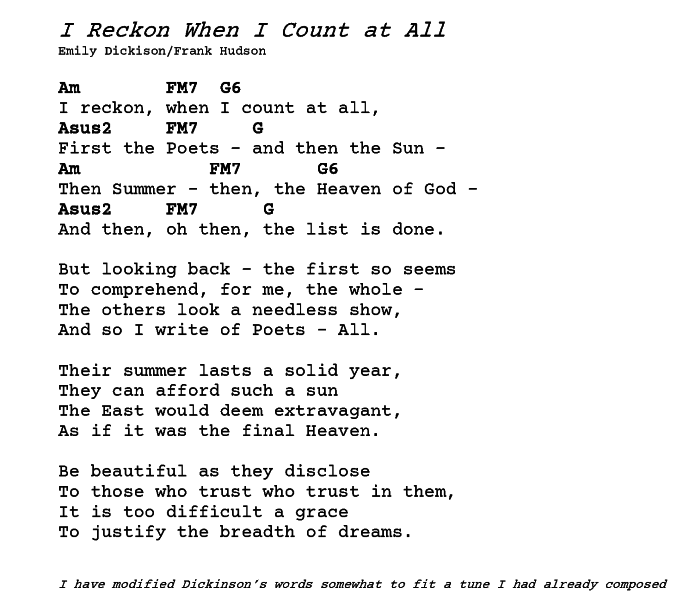
I reckon when I count

The chord cadence here was an experiment I was doing in close/but not the same symmetry, which is part of the reason I chose to modify Dickinson’s words instead of modifying the music.

.

The list begins with the poets, and then adds the sun (the source directly of nearly all of earth’s energy). Moving on, she oddly next lists the transient summer, but as an avid and knowledgeable northern climate gardener in a household that was across from a farm field, she honored that fecund season. She concludes the list with what seems like piety and a stopping point: “The Heaven of God.” Put a pin in that last item.

She soon corrects herself: the poets already contain all this. The sun? She proclaims poets are as illuminating, warming, and energy producing as the Sun. If summer grows crops, their creativity, poetry’s has no off-season. Poet’s, poetry’s, endlessness makes it as immortal as some heavenly realm. Now of course this is metaphysical math, and after all, the entire poem starts with “when I count at all,” indicating that she might think there are limitations with mathematical counting. The poem’s final stanza (as printed in Untermeyer’s book)**** is somewhat mysterious, but in a good way. There are a number of ways to understand it. There’s one I’d paraphrase as: “So I (as a poet and reader of poets) will continue to appreciate and engender the beauty of a poetry that can present a universe of the known but also that of the surmised and the uncountable. And those who can trust what can’t be quantified or found by earthly navigation: trust in the poets. Could they be wrong? Could their imaginationed maps and internal suns be wrong in the cold light of day? Perhaps, but you can’t count some things, any more than one can survey the time and distance of dreams.” That trust, Dickinson is saying is such as others would put in the “Heaven of God.” The “too difficult a grace” is saying that even grace can’t contain what poetry is. Others read this stanza as saying that the poets are in fact not trustworthy, even if Dickinson admires them all, and is one herself – but she’s sticking with poetry anyway even if she knows that the believers in a heavenly supremacy will not grant her grace, and in that reading the “those who trust” are trusting in the “final Heaven.” When I performed this, I was thinking more the former than the latter, but I really don’t know, I just had to feel someway as I sung it.

As mentioned in the footnote below, the version I used to start my work on today’s piece is not the most accurate representation of the extant poem in Dickinson’s own hand. I furthered that issue. This piece began with music I’d already composed and partly realized,  to which I decided to fit Dickinson’s text to. I could have modified the music, but I chose not to, and so added a few words to the shorter lines to fit the more symmetrical structure of the music. I made the most audacious change to the final line, adding “breadth” to make that line symmetrical. I did this because I liked the idea of returning to the sense that the poem started out exploring if the important things could be counted and sized, and one has no control over the length of dreams (or our lives for that matter). I also liked the homophone of it making its sound to a listener like “the breath of dreams,” which pleased the surrealist in me.

Everything I did there is not necessarily the admirable choice. I really wouldn’t know how to defend myself from charges of defacing the work of a great poet. I was guided by trying to make as arresting a song for the listener as I could – and I was thinking too about using this for the 900th Parlando piece – I was “counting” that occasion, and so like the poem I adapted, commenting on the ambiguity of counting poetry and the length of this Project. Did I make it interesting? You can hear my performance of “I reckon, if I count at all”  with the audio player below. No player? Well, you can’t count on that, because some ways of viewing this blog won’t show it, but this highlighted link will open a new tab with an audio player.


.


*This is because Dickinson often utilized “hymn meter” aka “ballad meter” used for many Protestant hymns and quite a few popular and very secular ballads from the British Isles, with an alternating 8 and 6 beat stanza. Other “you can sing them to” suggestions: “The Theme to Gilligan’s Island” and “Amazing Grace.”   I’m not sure which (or both, hymn and ballad) were what Dickinson had in mind, but some of her poetic influences also wrote literary ballads which were not meant to be sung, but used the meter of the songs.

**And it’s part of my #NPM2026 series, in that this poem appears in Louis Untermeyer’s between-the-wars anthology “Modern American Poetry.” I could have written (and thought about doing) a post on how Untermeyer frames Dickinson from within his era. His evaluation of her was favorable, but he doesn’t bring forward her humor even though he found room for “light verse” in his book. The poems he chooses include some of the Dickinson “Greatest Hits,” but few of her more metaphysical poems – and it omits some of the texts that later became oft favored, explicated, and excerpted.

***To the extent that academic education of women was proper for her time and place, the sciences were considered most appropriate. Men might study theology, law, the higher arts, abstract philosophy that lady brains certainly weren’t suited for, but science was viewed as more of a practical craft and set of knowledge. I suspect math might have been part of the gendered curriculum. I think too of the female “human computers” used in the early days of NASA and illustrated in the Hidden Figures movie, or the Benchley Park code-breakers.

****The version in Untermeyer’s anthology was printed in 1929 as a then yet unpublished Dickinson poem in the Atlantic magazine. This version differs from the handwritten manuscript, and also with other later published versions of the poem. The manuscript is in one of her famous fascicles and includes a number of alternative words that indicate that the poet herself was still in a mind of some variance. See this link for more info on the various versions of “I reckon, if I count at all.”

Cassandra

Louise Bogan is somewhat of a poet’s poet – and that’s sort of a mixed blessing. Earning that title means that other folks who work at the craft of poetry recognize the things she’s able to do even if they may not be noticeable by the general reader. Indeed, when done well, the kinds of skills Bogan had with the music of words or the music of thought may not be noticed because the poet deploys them without creaky prying levers, showy lifting, or grunts of effort.

Continuing our celebration here of National Poetry Month, I selected a poem of hers out of Louis Untermeyer’s between-the-world-wars anthology Modern American Poetry. It’s titled “Cassandra.”  We may therefore assume it’s in the voice of, or the shared experience of, this figure in classical mythology.* Cassandra had the gift of prophecy, but when she spoke her doomed predictions of the fall of Troy and the fate of those (on both sides) who took part of that conquest, she was more than disbelieved, she was deemed mad. Mixed blessing.

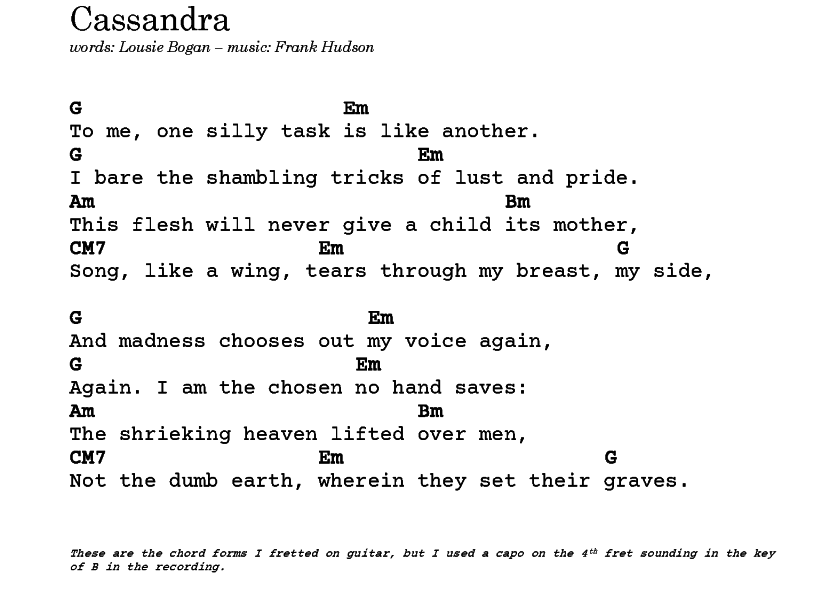
Cassandra

As I mention below, you could have heard this with Mellotron strings, but Cassandra predicted you won’t.

Of course, if you have the unerring gift of prophecy you might well know that’s how your messages will be received. Cassandra would also know her own fate (and like many Greek myths, it’s trigger-warning brutal) and she had to bear up under that too.

Louise Bogan took that paradox and put its facets into eight lines of pentameter with perfect rhymes. With a little less skill she might have chosen more space thinking that would demonstrate all the things she could do – and that poem would have been longer.

I love the opening two lines of this poem. Cassandra seems to be calling the gift of prophecy a “silly task,” a “trick” even if the myths say it was a gift from the gods, but she dismisses it as something any wise observer would say are the predictable extractions from the lust and pride of men. What a piece of characterization! The next four lines express knowing the future, and knowing too the foolishness of mankind, only adds pain. The concluding two: an unflinching statement of bearing up under the gift of being the knower-of. Her knowledge of fate gives her a vision of the gods of a “shrieking heaven.”

I tried quite a full arrangement of the music I wrote for this, with two tracks of Mellotron wheezing and some other things, and yet I struggled to come up with a mix that retained listener impact. This afternoon I decided to subtract, taking away track after track until I had just the voice, guitar, and bass – and sure enough there was more there with less. You can hear my performance of Louise Bogan’s “Cassandra”  with the audio player below. What, has my prediction failed – there’s no player to be seen? No, I know that would happen since some ways of reading this won’t show the player, and so I offer this highlighted link that will open a new browser tab with its own audio player.


.


*I read a little about Bogan’s life before posting this piece today. Are there reasons she’d empathize with the struggles of Cassandra? One summary of her life that I read is so well done that if you’d like to know more about her, you’d do well to take a few minutes to read this link rather than for me to try to restate it.

I keep thinking that I’d probably like reading more of Bogan’s poetry later this year – and yes, likely present some more of it here too.

Ethna McKiernan’s “The Day My Mother Gave Me Away to the Tinkers”

Here’s a poem that I’ve turned into a song for my second post honoring two Irish-American poets who led a St. Patrick’s Day poetry reading in Minnesota for several years before their death. Of the two, Ethna McKiernan had more direct ties to Ireland, having spent some time living in Dublin, and then in Minnesota running an Irish book and music arts store in the Twin Cities for many years.

For a part of those years I was acquainted with Ethna through the Lake Street Writer’s Group,* where a small group of poets shared works in progress and discussed on the side our lives and outlooks. When I look back on those years, I miss those writers, but I also fear I was inappropriate in critiquing their work, particularly Ethna. My style in that sort of thing tended to be highly detailed (picky might be a word), and even if I would lengthen my responses to their work in progress with “you could consider this or that alternative” because I believed in an honest “test reader” response without claiming to having some reliable recipe for a successful poem, or authority to ask them to change anything. That claim, that belief, should have opened me up to considering “so why then bother them (or myself) with these suggestions or reactions?” I have no academic training in poetry (Ethna did) and in my late twenties I gave up working at submitting for publication. Ethna did publish. She and Kevin each had several book-length collections as well as the usual small-press acceptances. All this would testify that whatever I thought about poetry’s workings, those ideas were unlikely to be commercially helpful.

Well, you can’t apologize to the dead. They either know better or not at all. I meant well, and I could be amazed by Ethna’s best poems. So, here’s to letting you know about their work here, which I hope is a pleasure for you. And if you would like more of that pleasure, Ethna’s last book, a new and selected collection finished as she was in her final illness, is available here from her Irish publisher.

I think I heard Ethna read today’s poem selection, “The Day My Mother Gave Me Away to the Tinkers,” more than once, including at one of those annual St. Patrick’s Day public readings, where it’s an apt choice, what with its Dublin setting. Before reading it, Ethna would instruct the listeners that, just as with many people of our shared generation,** her mother had issued the threat inside the poem’s title in jest, at worst during momentary frustration; and that the subject of her poem was but her teenage mind thinking in response “Well, I’ll take her up and that, and then she’ll be sorry.”

What else do I want you to know before you hear my song performance of this poem? First, for practicalities sake, there’s a man singing this mother-daughter poem. That might be a detriment. Otherwise? I made a mistake singing the name of a baker mentioned in the poem, Johnston Mooney and O’Brien. I dropped the “Johnston,” but at first figured no one would care, that it must be just some immaterial tiny particular bakery – but it turns out that firm is a famous and long-standing Irish baking concern, Oh well. I hope you enjoy the song anyway.

Johnston Mooney and O'Brien Nutty Doorsteps

Forgot the “Johnston?” Never darken (or spread jam on) my doorsteps again!

.

You can hear it with the audio player gadget below. Has any such audio player disappeared? No, the gadget’s mother hasn’t given it away, it’s just that some ways of viewing the blog must want the audio player to not be seen (or heard) – and so I offer this highlighted link that’ll open a new tab with its own audio player.


.


*Alternative voice here Dave Moore, and our other St. Patrick’s Day poet Kevin FitzPatrick, were principals of the Lake Street Writers Group.

**My own mid-century mother had her variation of this “give you away” phrase, and but seven kids to test her patience.

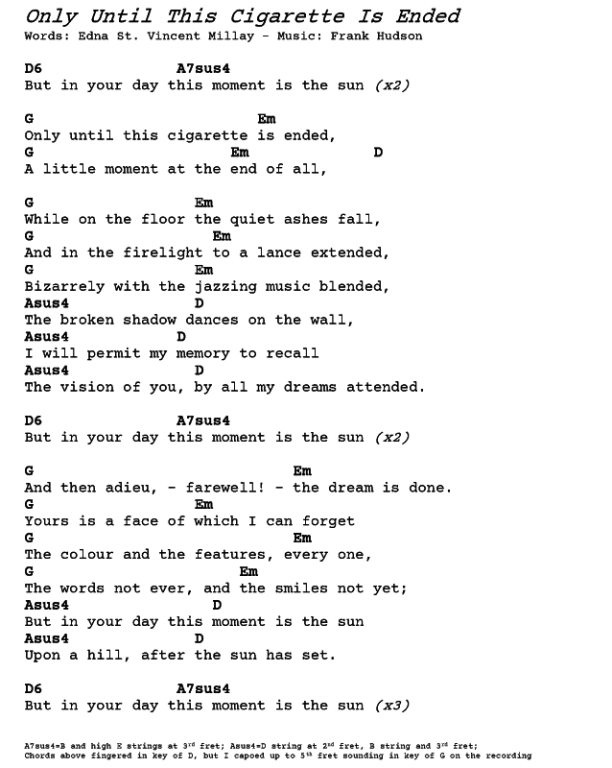
Only Until This Cigarette Is Ended

Did I promise an upcoming, complicated, love poem from Edna St. Vincent Millay last time? Well, let me deliver that.

This poem is one that taunted me to sing it as I read through several dozen Millay poems early this month. Millay chooses rich yet strange images in it, the poem’s erotic mood includes complex uncommon elements within its lyrical account of two consciousnesses which have met and are about to separate, and that makes me think of other songs I admire. Its splendor in an alienated nighttime moment makes me think of “Visions of Johanna,”  while it’s notes of respect beside begone absence makes me think Dylan’s suite of songs within Blood On the Tracks.  And Millay’s choice of images here verge toward the surreal enough to think of Robyn Hitchcock as I worked out the music and performance you can hear below.

Until This Cigarette Is Ended

I chose to leave this chord sheet showing the chord forms I fretted on a standard-tuned guitar, even though the recording sounds in a different key due to my use of a capo. This is an easy song to play on guitar, even strummed rather than using my cross-picked arpeggio playing style, and I wish to encourage others to sing these Parlando Project songs.

.

I choose one lyrical change as I made the poem into a song: I decided to create a refrain out of one of its lines. I’m personally OK with songs that eschew choruses and refrains, and a great many poems taken down word-for-word as song lyrics will not have that element that’s increasingly prominent in popular songwriting. This choice brings forward that two-consciousnesses element. The poem has the poem’s voice (for simplicity, I’ll call that voice Millay’s) speaking what we’d call these days “her truth.” Though the poem is compressed into a lyric moment, that truth is that there’s been a pleasant enough erotic event between two people, but that Millay knew, or has decided, that that’s enough and this will not be an ongoing erotic bond. For a woman to publicly write this over a hundred years ago was striking – this poem’s honesty is precedent to those more contemporary expressions.

But the poem is more than precedent, let me linger on the images, starting with the titular cigarette, that quick and casual tube of tobacco. Rather than fade into Millay’s century ago, this reader (now singer) is drawn back half-that interval to when he, and most in his circle, were smokers. For Millay the cigarette would’ve been a somewhat modern signifier – and one without the more lingering girth of the cigar or the apparatus of pipe smoking – but for me, I was drawn back to what I tried to explain to my wife yesterday was my youthful erotic imprinting on cigarettes. My thoughts were not the trope of the post-prandial smoke after a buffet of lovemaking (something I never chose to do) but on the smell and taste of tobacco about the lover’s body. To younger moderns, disdainful of my evoking that, I’d try to explain that a common sharing of certain oils and ash on our skin and lips was kind of intimate comingled pyre. Millay doesn’t explicitly evoke that – I think the modern briefness and offhand casualness was her intent, but she portrays another image I think here that is specific to cigarettes in my memory” a well-packed, factory made, Modernist for Millay, cigarette can produce a lengthy ash as it’s smoked. I can still recall one college literature professor, one with a very John Berryman beard and manner, who would, while animated with some literary thought he was expressing, continue to puff on his cigarette as the distal ash grew to maybe half the length of the number in his mouth. This drooping ash would jiggle as his lips that held its cigarette continued to expound, and the suspense of its suspension would sometimes disconnect my attention to what he was saying with the other part of his mouth. All our thoughts, all our desires, all of us, will eventually fall to ash might be the image here, and I believe that’s the lance Millay evokes in her poem.*

There’s also fireplace, firelight in this shared post-lovemaking pyre, and Neanderthal meets Plato expressionist shadows make a visual Jazz noise with some off-screen radio or record player. For Millay a palpably Modernist mise-en-scène, but even for more modern moderns, there’s really nothing to turn off, it’s just lovers, so entwined, but these visions…

The final six lines make it so precise and so clear: something, a lasting erotic pairing, is not to be. Millay’s voice here is precise: this person momentarily beside her will not hence imprint with their body, hers – but that other’s words will stick with her? Something they said? Something they wrote? Since there’s no hint of rancor or lack of respect in the boundaries of this lyric poem, it may be the latter, a love of the poetry of the word not the poetry of the physical deed.

And in Millay’s final six lines comes that line I’ve chosen to refrain, a choice that brings her to an in passing but significant notice of that other consciousness inside this short poem’s fleeting embrace further to the fore: “But in your day this moment is the sun.”

What is that saying? That the other takes this as more overt than the covert firelight and briefly burning cigarette? Probably. That could easily be read as more than a bit egotistic, a trope in the more well-worn notched bedpost of the male “Babe, I gotta be moving on” road song. Or it could be, as I tried to make it my musical performance of Millay’s poem, a rueful acknowledgement that there’s a gulf between the two consciousnesses, even inside their closeness in the moment of the poem, now song.

So, complicated – a love song, or a song of something close to love.

That musical performance is available below with an audio player gadget. What? Is that side of the embed empty, the sheets now cold? Ah, the poem-now-song peddler now speaks, there’s jewels and binoculars – no, a link, a link, a highlighted link, that will open a new tab in your browser that will have its own audio player so you can hear it.


.


*Yes, yes, this obligates the sometimes “a cigar is just a cigar,” Freudian mention. That it’s a cigarette here – a genderless tobacco product rather than the male-coded cigar or pipe – is Millay’s choice.

Jazz and reading John Darnielle: Part Two, This Year 365 Songs Annotated

Here’s the final piece of this two-parter, and the place where I take off that hair shirt for a while and present a review of John Darnielle’s new book This Year, 365 Songs Annotated.

I largely owe my appreciation of singer-songwriter John Darnielle to my daughter, who found solace in his earlier recordings as she moved through adolescence. One 2005 song, the one that gives its title to a new book by Darnielle, features a 17-year-old speaker refraining: “I am gonna make it through this year if it kills me.” It resonated more than a decade later with another 17-year-old. What a good thing for a song to do.

I knew Darnielle’s work from a couple of songs recorded under his long-running project name “The Mountain Goats,” most notably the mysterious anthem “Jaipur.”   My daughter gifted me his All Hail West Texas  album one Bandcamp Friday a year or so ago. My immediate thoughts on Darnielle were that he was a good song lyricist. Like the late poet-associate of mine Kevin Fitzpatrick, his work is full of “other people,” and those people are often working class or lost-soul types who make themselves known as if in overheard declarations in his songs. Writing in Boomer classic-rock consumer-guide style “he’s like…” comparisons are misleading in Darnielle’s case. Saying he’s lyrically a mix of Randy Newman, Bruce Springsteen, Ray Davies, and John Prine is a bad assay, because he’s like all of them at once or in sequence, and he is his own man too. Still, the range of characters is an important strength. A lot of poetry, and a lot of indie songwriting too, is a singular solipsistic narrative, and Darnielle’s of the songwriting school that avoids this.

This Year cover

More than a collection of song lyrics (though they’re good lyrics)

.

Yet, This Year  is largely the story inside one person, a memoir in a different form: a book of days where he writes somewhat sequentially, but not by strict intent or always, about how 365 songs came about, what he thinks he was trying to express, and what his life was like as he wrote and recorded them. The entries can be quite short, a couple of hundred words typically, though a few extend for a few pages. The lyrics to each day’s song are included with each entry, which is helpful for any reader who’s not familiar with his work. I’m half-way through reading it straight through, but the book can also be read an entry at a time, as sort of daily thought-starter. I’m somewhere between a hardcore fan and someone that doesn’t know any of Darnielle’s work, and I’ve sought out some of the songs after reading of them in the book.

Things I’ve learned? It was not apparent to me beforehand, but he’s a poet who converted to songwriting, and many of his early songs had preexisted as page poems that he wasn’t planning to sing. Reading his lyrics silent on the page in this book demonstrates a literary poet’s craft in his writing, but my finding this out in memoir is a testimony to their lack of crusty poetese. Poets as well as songwriters would benefit from exposing themselves to Darnielle’s lyrical tactics, and he talks effectively about them in this book. I also learned that he spent formative years in his songwriting’s development living in a small town in Iowa, the kind of place I grew up in, in roughly the same part of the state, though I’m more than a generation older than him.

Another part of his story, which unreels through the day entries each devoted to a single song from his now large catalog of original songs, is that he began recording and making these songs public using meager equipment. He so far mentions almost nothing about the particulars of his instruments which are likely unremarkable and inexpensive, and a considerable part of his early career recordings – including the original versions of some of his best-loved songs – were recorded on a boom-box cassette tape machine at home. I resonated with that, having spent around 20 years using such cassette tape along with low-budget equipment. A late 20th century indie-music and fanzine samizdat network allowed Darnielle a slow-burn career doing that, around the time that my own nerve to share my work had faded. He recounts in the book, that royalties from the tapes sometimes paid part of the $170 a month rent,* but he had a day job in a lower-paid nursing field, again something I rhymed with in my cassette years.

The short entries in the book also tell a story of Darnielle’s religious journey, which began as a Catholic youth and has had elements of return, though I’m midjourney on that arc so far in the book.

These similarities paradoxically bring up the personal gap which makes reading his book so meaningful to me now. From what I’ve read so far, Darnielle apparently retained confidence in his own work through these long-beginnings, low-rent, lo-fi years, and even if there are dark nights of the soul in coming parts of his book, he displays that now as he discusses the work in retrospect. I had, and still have, substantial gaps in being able to carry that in public during my cassette years. Having days of private levels of self-confidence in some of my musical work is not an effective dose to properly present it to others, and my doing so “blind” without that confidence led me to some painful comedy of misreadings of likely interest. Those two things (managing self-doubt, being able to present one’s work effectively to others) interact. Darnielle may have been more personally engaging, or just more persistent in his networking. Elements of luck might have been significant (with me, they were in my “day job.”) Thinking of this difference as I read Darnielle’s book, it’s (too) easy for me to think, “Well, it must have been easier for him, his work was so darn good.” He’s a better vocalist and performer than I am (no-biggie, almost everybody is), and though I’m not sure how far apart we are in “on a good day” guitarist skills, his song lyrics are teaching me new tactics even after decades of my doing this on the page and with guitar.

In the first part of this pair of posts I sincerely worried about my work and hubris when I put it up against the skillset and history of Jazz. Despite those differences in how we’ve used our parable of the talents, I find reading Darnielle’s book heartening so far. You don’t have to be a songwriter, if you are any kind of writer – and likely if you are an artist of any kind – spending time with this book may be helpful.

Here’s an early song of mine, recorded on primitive equipment before the nearing 900 songs of the Parlando Project had started counting off, but consistent with its principles, a setting of John Keats’ “In the Drear Nighted December.”   Audio player gadget should be below, but if not, this highlighted link will open a new tab with its own audio player.


.

*For any younger folks reading this, the $170 a month rent (for a house!) must seem a dormouse fantasy. For younger musicians, the idea that royalties from indie recordings might contribute in any substantial way to making rent must seem equally fantastic.

Adapting Michael Strange: “To Claude Debussy’s La Grotte”

I’ve long wanted to do a Parlando Project piece using the words of early 20th century American poet Michael Strange – but there was this one problem: her poetry wasn’t very good. Or perhaps I should restate that: her poetry doesn’t consistently work in the ways that I appreciate poetry. What about her poetry causes problems for me? It’s not just that it risks being ecstatic to a fault, or that it seems grandiose at times. I’ve forgiven other poets those excesses. It’s certainly not her overall poetic approach, as her verse seems to me to be highly influenced by Imagism, that early 20th century poetic movement that continues to inspire me. She also seems fond of Whitman and Nietzsche, but so were other writers of her era that I’ve presented here. So, if not those things, what? If I’d pick one term for what keeps me from enjoying her poetry it would be “over-writing.”

Here’s an example, an ekphrastic poem about an art song by composer Claude Debussy which used a text by François Tristan L’Hermite. I’m not sure if Strange is portraying L’Hermite’s French lyrics (which are quite good and bring in the myth of Narcissus) but she talks of sound and gives the musical composer the sole place in her title:

To Claude Debussy’s La Grotte

Your song
As the hale of mysterious exotic intention
Drifting in palpitating echoes
O’er the pallid oval
Of night-closed flowers -—

Your song
As the increasing shimmer
Of some exquisite nearness —
Clad in those steel-dark foils
Of sinister fancy —
And once more your song
As the moaning hush of a human soul
Receding — from the Divine Moment

.

The images here constantly suffer from the Donald Trump school of interior decorating. They’re not just curlicue ornamented, they’re coated in gold leaf. The “hale of…intention” image is a fine one, but adding both “mysterious” and “exotic” as modifiers cloaks its originality. Are “echoes” so unclear as a sound description that they need “palpitating” to clear up that they repeat at intervals? Why the somewhat archaic “O’er” when the modern “over” will chime nicely with “oval” and “flowers?” And that’s just the first stanza, first 21 words. This over-egging hurts not just the sharpness of the images, it hurts the word music too. As with Trumps White House confessions of gilde, this can be read as a lack of confidence in her own vision and place in poetry. I must include “poetic” words, I must show the specialness of each facet with modifiers and more modifiers, I must show that I’m writing.

Now I’m not writing this to dunk on Strange. I’ve committed every sin above, and more. What I write has enough faults to repel readership. Strange is not a particularly famous or widely-read poet, but more people have likely read her poem, and maybe even more people would like this poem of hers than any I’ve written. Still, I want a better poem than this one printed more than a century ago if I’m going to perform it. Yet what I did is risky ethically – that Strange is dead and her work fully in the public domain doesn’t erase the issues with what I chose to do this week with her poem. I rewrote it.

Your song,
the hale of exotic intention
drifts in echoes
Over the oval night-closed flowers.

Your song,
the shimmer comes nearer,
some steel-dark foils of sinister fancy —
And once more
your song,
the hush of a human soul
receding from the Divine Moment.

.

I tell my self-accusing self that I did this in service to what I think Strange was portraying in her original poem. Indeed, what I did there is similar to what I do when translating a poem from another language: find the images the poet was portraying and convey them in contemporary English with a word music that works in that destination language – though here I’m able to use more of her original words since she wrote in English. I’m opening myself up to a charge of patriarchal overreach, but in my defense, I’ll say I’ve done this to Robert Frost and Rupert Brooke. So, I may just be an asshole when I do this.

Before I move on to a few notes on the musical performance that prompted me to do this rewrite, let me just give the briefest outline of Strange’s fascinating life, a history that gave me such high expectations as I sought out her verse. Strange was born into a socially prominent East-Coast family, and was married (three times) to socially prominent men. Photographs and contemporary testimony portray her as exceptionally beautiful. Despite her background, she was a feminist, a left-wing social activist, and moved in bohemian circles. During the WWI years she published her first poetry collection and used the masculine pen name Michael Strange for this. Wikipedia’s summary says the name was used to shield her family from the poetry, which was claimed to be erotic and scandalous, and it’s also easy to suppose that she may have made (at least in part) a tactical choice to avoid sexist devaluation of the work. Whatever the initial reasons, she soon came to use the name generally, in subsequent writing, when she appeared on stage as an actress, on radio as a host* and, I gather, “in real life.” I’m not an expert on Strange’s life, but it appears she used feminine pronouns.

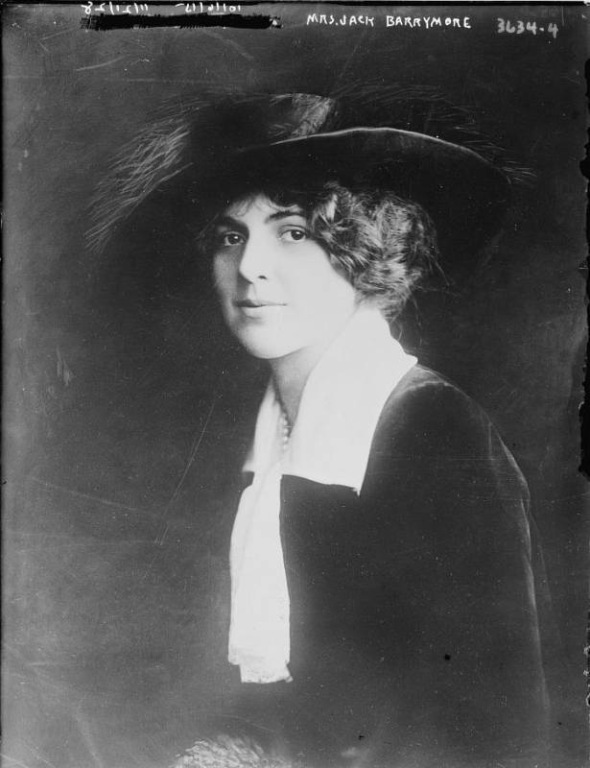
Michael Strange

Pleased to meet you. Hope you guess my name. Born Blanche Oelrichs, became Michael Strange, was a member of the Lucy Stone League dedicated to married women keeping their own name – and this photo is labeled “Mrs, Jack Barrymore” (the name of her second husband, the famous actor).

.

It’s possible I would have run into Strange, on her own, at some time in this Project, since I enjoy examining lesser-known poets from her era here. Instead, I first encountered her because of her relationship with another author who produced popular Modernist work, Margaret Wise Brown. What? Yes, Margaret Wise Goodnight Moon  Brown. Early this century, in my fatherhood role with a then pre-literate child, I was the bard of such stories as Goodnight Moon  or The Color Kittens.  And it may not be only because this overlapped my adult reading that I heard them as part of the same world of early Modernism.** For the last decade of her life Strange lived in a committed relationship with Brown, and so it was in reading about Brown that I first read Strange’s name.

All right, on to this short musical piece using adapted words from Michael Strange. I was working on composing with the intent to use minimal motifs, ones that my minimal keyboard skills could play without using an arpeggiator or other automated extensions. I built the music using a variety of alt-techniques and “prepared” piano sounds. In the middle section there’s an organ part that does use an arpeggiator, and a percussion part that had me playing parts on some struck metal objects over a more conventional drum-set pattern. Not exactly Debussy,*** but perhaps evocative of other 20th century avant-garde musics. You can hear it with the audio player below. No audio player? It’s not gender panic, but some ways of viewing this blog suppress it, and so I offer this highlighted link that will also play the musical performance.

.

*Her radio program was titled Music and Poetry.  Just as with today’s poem – despite my problems with its prosody – Strange’s bio can’t stop being catnip to me.

**Another “could he really be serious” suggestion: if we might well include Robert Louis Stevenson and Lewis Carroll in studies of Victorian lit, should Brown be read next to H.D. and Pound as Imagist texts?

***Musically, while I’ve listened some to the Impressionist musical school of composers, I came to them largely from instrumental guitarists who were directly influenced by them. So, Dadaistically, today’s piece has no guitar whatsoever.

Ode to a 1953 Automobile Ad

I’ve mentioned this Fall that I’m on a project to clean out the accumulations of my long life. There are various battlefronts in this effort, but last month I worked on emptying my stuff from a small storeroom in my house, which was filled with boxes, some of which hadn’t been unpacked since I moved 40 years ago. One box was completely stuffed full of spiral bound notebooks.

I had once saved the notebooks I used in my high school years and then throughout my twenties. This meant a slowly growing cache of them had traveled from a tiny hometown in Iowa, to a dorm in a small college in that state, and then to the locations I lived at in New York for six years, and onward the four places I’ve lived in Minnesota.

I had a typewriter, which I used for some more formal things and finalized school assignments, and then in the ‘80s I got a personal computer,* but for 20 years or so, my creative work began and was recorded with handwriting in these college-ruled notebooks. Early, when there were only a handful of them, I mentally cataloged them by the color of their covers. Even after all these years I recall a couple of the earliest ones as “The Orange Book” and “The Green Book.” Like Emily Dickinson I didn’t always save working drafts, written on whatever was handy, but when I felt I had finished a poem I’d make a good copy in my most legible hand inside one of the notebooks to be saved.

I’ve written briefly at least once about starting to write poems as a teenager, and I won’t go on much more about that today, but I was surprised at the urge – it was not planned. I felt compelled to do this for reasons I couldn’t tell you then, or now. Living in my tiny town I had no idea how many people were writing poems, but I presumed it a small number, as the literature anthologies I had in school made me think the number at any one time was a select few. This misapprehension led to a grandiose feeling that I was writing poetry! – this grand art-form of literary geniuses.

Clearly there was a lot I didn’t know, but in my case this helped me, giving me a sense of accomplishment. Did writing poetry give me an unearned, unrealistic, sense of self-worth? Yes, I think it did – but we all need a minimum deposit in that bank, and that was the source I had. And after all I was a teenager, and few of that age have any substantial achievements.

In that process of pulling aside these old notebooks I came upon “The Green Book” that I recalled when there were only a couple of these, and I set it aside to look through first. In it I saw my good copy of a poem I remember quite well from my early work, one I had thought was one of my better ones then. Looking at it as an old man who’s read much more, written much more, lived much more, I think enough of it to present it here in performance today.

I didn’t have many poetic models to draw on, but this one certainly came from reading John Keats “Ode on a Grecian Urn”  in my high-school literature class. I’ve performed Keats’ poem here, and I think I was already impressed at the ambiguity in the poem’s famous ending back then. My “Ode to a 1953 Automobile Ad”  was on the surface a free-verse parody, burlesquing Keats classical art object – but I was at least partly conscious of wanting to make some solemn points too, though I don’t recall thinking out all the themes the poem includes, so my best recollection is composing the poem without knowing all I was including in the text under my pen.

I think there was a  1953 automobile ad in my memory, though I haven’t found the one described in the poem.** Sometime in my early teenage years, a man in my little town – no doubt doing the same “death cleaning” I am doing in 2025 – gave me several dozen 10-15-year-old Popular Mechanics/Popular Science/Mechanix Illustrated magazines. I devoured them, first because I adored the hyperbolic writing of the self-styled dean of journalistic automobile test drivers Tom MaCahill who wrote for Mechanix Illustrated – but this was a strange genre of magazine. Part reviews of new models of cars and novel ideas in consumer goods, part pre-Whole Earth Catalog handyman tips and project plans, and part more general writing about science and technology including predictions for the future.

1953 Studebaker 800

The soft golden car in front of a Greek colonnade, or a peaceful ride in a Paris that 8 years earlier would have been in the midst of a World War.

.

I enjoyed the time-travel aspect of reading these magazines, visiting as an abstract thinking teenager the world of early childhood. The too fantastic flying car future has since become a meme – but the junior historian in me would think: the Korean Conflict was being fought as some of these old pages went to press (little mentioned in these mags, little remembered now too), the new age of atomic war fear was beginning, and in the sixties as I wrote this poem, Vietnam was echoing the Korea situation. So, as the poem was being written, there was then too the feeling of a glorious and blest domestic United States – yet with a “conflict” acting as a far-off minotaur ready to take sacrificial children.

So, I wrote this in the 1960s linking those times in the 1950s, and sublimation of killing young men is the topic. Inexperienced as I was, I tip my hat to the images the young person that would become me put in there: the camera and/or coffin dark box capturing the bright sunlight of the ad, the rust-holes in the teenaged car as the wound in the son. The use of Whitmanesque (or Sandburg or Ginsberg in their Whitman mode) extra-long lines is not something I do much now, but as I performed them this week, they seemed to work well enough.

This old poem is now published with a musical performance in the lead up to the holiday that was once known as Armistice Day – the very day that World War I ended at a moment when it was just “The Great War” and didn’t need a number, and didn’t expect to gain one – but now our wars don’t get the roman numerals, though fantasy film franchises and Super Bowls do. We didn’t get flying cars. We got armed drones.

You can hear me performing my “Ode to a 1953 Automobile Ad”  with the audio player gadget below. Has the audio player gone with Studebakers and saving old magazines?  This highlighted link is supplied as an alternative which will open a new tab with its own audio player.

.

*My penmanship was erratic and not consistently easy to read, so a typewriter was essential for things of any length destined for others. But I didn’t do creative writing on a typewriter – something about the mechanical nature seemed an authorship firewall: the machine made the letters, keys and levers away from the writer, and one couldn’t easily cross-out and add little marginal changes as one wrote.

One of the things found in the storeroom with the notebooks was a postcard about requirements for receiving a rebate on what would be officially my first personal computer: A Timex-Sinclair bought in 1982 – but that tiny $85 plastic wedge wasn’t able to take over from a pen or typewriter since it had a small membrane keypad that was only useful to learn to write computer programs with. In 1984 I got a Commodore 64 which could do limited word-processing, but I couldn’t afford the software that did that. In 1987 I got an Amiga 500 which came with a copy of Word Perfect – the then leading word-processing software product – and I began a slow and inconstant transition to using computers to do initial drafts over a decade or so.

**The 1953 year of the car in the ad makes me sure it was a Studebaker ad, for a remarkably beautiful new 2-door coupe was introduced for that model year. When I look for examples of the ad campaign, I see many of the Studebakers are depicted in yellow, but never in a family tableau described in the poem in the ones I could find. And there’s the chrome bird hood ornament. Was I thinking of the Packard swan? Looking at pictures of the 1953 Studebaker I see there’s a 3-bladed chrome insignia on the peak of the hood – meant to be a propeller, or bird, or abstract shape? I appeal to Brancusi on the bird.

Searoads: a contemporary poem by Henry Gould

Today’s piece is rare for the Parlando Project: a presentation of a contemporary poem by American poet Henry Gould.

Contemporary? How contemporary? “Searoads” was written only a few days ago. I read it on Halloween when the poet shared it on Blue Sky shortly after it had been written.  Since I follow Gould on Blue Sky, I had read several of his poems before. He’s posted poems and poem drafts written serially as he works on a book-length opus dedicated to a topic. In recent Gould poem-series, historical time seems to take place simultaneously, and wide references to history and literary works weave through stanzas (or even within lines) of individual poems, this weave sometimes worked with the warp of wordplay.

That makes for a challenging density. Since my youth I’ve taken self-pride in being a history buff, and working on this Project has extended the poetry I’ve had contact with to a level that tests the working set of my old-guy memory. When I’ve got the energy to exercise those parts of my personality, digging into one of Gould’s poems can match up with those receptors. Gould’s work is ambitious and deals with earnest subjects, but I suspect it’s also playful. When you can catch, and hopscotch through the pattern of one of his sideways leaps to connection, there’s a pleasure in discovery – and this is so even though honest history and literature contains a great deal of conflict and pain.

I have a term I use for an effect I find in poetry – the polyphony layers of perceptions invoked with images, the melody of tracking from one thing to another like unto it, the intervals of sames separated by time – The Music of Thought. I assume this isn’t a new idea, but while study of the prosody of sound is commonplace, a prosody of the patterns when the images and what they present, composed in that order and layering, seems rarer to me. That I take any pride in writing about this is likely secondary to my ignorance of how thoroughly others have already written about this. I’m the kind of solitary, stubborn cuss that has to discover it myself to be able to integrate it into my enjoyment of poetry.

There can be a problem with the Music of Thought. While tastes in the word-sound-music may vary among readers and listeners to poetry, the effect requires nothing special in terms of shared knowledge. Children can enjoy Dr. Suess before they have much of a corpus of knowledge at all.*   Poems of Yeats, Eliot, Frost, or Emily Dickinson can charm us by their sound even when – if we were tested by some exacting taskmaster to do so – we couldn’t write an internally consistent and plausible essay on what they were on about exactly. Fear of that looming taskmaster kills poetry readership, but the lure of the pleasures of sound draws us back in. The Music of Thought may still be sensuous, but it’s more abstract, it requires more knowledge and attention from a reader.

Assembledge in Powderhorn Lake Halloween 2025 by Heidi Randen

My wife shot this mysterious assemblage in Powderhorn Park at the dawn of All Souls Day 2025

.

When I came upon Gould’s “Searoads”  it was late in the day. I was in the context of the short-attention-span-theater that is a modern social media feed. Tough court for the poem?

The sound caught me first and last, and I also easily fell into this poem’s Music of Thought. In both musics, “Searoads”  drives forward attractively, and I was gathering meaning even on the first time through.**

How does it work? I’m bad at scansion (when creating music I’m habitually playing with offbeats and syncopations, sporting with measures, which probably demonstrates that I don’t understand the basic pattern well enough). Could “Searoads”  be intended pentameter with predominant iambic stresses? I read the stresses as having variation (which good verse should have) but I scanned the lines as having a goodly amount of iambs, while I hear them as predominantly four-feet lines.***

The use of rhyme here is excellent. I heard rhymes the first time through, but not the scheme – so I didn’t know when they were coming. My own ear or taste loves off/near rhyme, and that too helps the sound work without some regular clock-coocoo chime effect. If I take apart the mechanism, it’s ABABCABCA. And there’s a lovely moment in the poem when an extra C rhyme comes strongly in the middle of the last line of the first stanza with “infants.”

The poem has a few unusual words. I knew “sarabande” was a dance form that survives in European classical music, and I even knew that there is some dispute about its origin, including a theory that it includes American musical ideas adapted by Spanish colonialists in the 16th century from native central American music. I didn’t know the word “Argive” (of the Greek city-state of Argos) – but two things referenced in the poem were part of my attraction. On Halloween I was intending to work on a piece for All Saint’s Day (November 1st) or All Souls Day (November 2nd), but despite some effort earlier in the week I hadn’t found a suitable text. As I read Gould’s poem, he may be invoking circular reincarnated or pre-existing souls in the second stanza – so in celebrating all who have died and the unity of that human experience, we may celebrate all unborn as well. What a lovely autumnal thought! And the same stanza even needle-drops a line from one of the All Souls’ texts that I wasn’t progressing on making music for: the “full-fathom five (my father lies)” speech from Shakespeare’s The Tempest.

But one word (well, hyphenated, but…) is most responsible for the piece you can hear today: “Ark-Dove.”**** I suspected the dove sent out from Noah’s Ark to confirm the time afloat in the great flood was ebbing. When I asked Gould, he confirmed to me he was thinking of that too, at least in part, as he wrote his poem. In our troubled times, a great flood of destructions, on a boat stinking of animal effluents, I think we are waiting for the dove to return with a green twig – but I had another specific thing going off in my mind too.

There’s a folk song, collected in 1906 in Texas at a temporary work camp along the Brazos river. A woman there, washing clothes on that riverbank sang this song about being abandoned; but imagining Noah’s dove anyway, singing “If I had wings, like Noah’s dove, I’d fly down the river to the one I love.” Beside the song, the folk-song collector only got the name “Dink” for the singer. He wrote that he tried to find out more later, but when he returned to ask about her, she was gone from the camp and no one knew where. We cannot know if she found wings to carry her above the river or if the river carried her, submerged, down its current.

So, as I returned to the top to read Henry Gould’s poem for a second time on Halloween, I was already humming that folk song, known as “Dink’s Song,”  to myself as I read the words. The next morning, I had no Dink to ask for, but on All Saints Day I decided to work out some music to sing Gould’s poem. I did this with no expectation that anyone besides myself (and probably Gould, who I figured I’d just send it to, unbidden) would hear it.

I’ve been composing a lot in October on acoustic guitar, this meant I had some musical ideas to try with the words. I loosely based my music on the chord cadence from the verse of “Dink’s Song,”  (D G5 D / Bm G5 D) with an even looser variation from the song’s chorus on the last line of each stanza (D G5 D Asus2 D). I’m not a very melodic singer, and unless one knows “Dinks Song”  and reads this, one won’t hear the connection. I recorded this using my usual cross-picking technique on acoustic guitar while singing, and picked the best out of about five passes I quickly recorded that afternoon. I added a low-pitched piano part that emulates the way a tanpura is used in South Asian music and a bass part as I thought the piece needed a little more low-end activity.

Henry Gould received the recording and has graciously allowed me to share this musical performance of his fine poem “Searoads”  here. You can hear it with the audio player below. Has the audio player flown down river? No, it’s just that some ways of reading this blog suppress showing an audio player gadget. This highlighted link will open a new tab with its own audio player so you can hear it.

.

*Adults could enjoy challenging Modernist poetry more if they allowed themselves to initially listen to it (even silently) as a toddler listens to board books. For that matter, I assume Dr. Suess/Theo Geisel had Lewis Carroll and Ogden Nash in his ear when he wrote, but his poetry makes me think he was reading Gertrude Stein or Marianne Moore too.

**I don’t rate myself highly in understanding poems, but a short poem that draws me in usually gets a repeated reading where often my understanding changes. One of the pleasures of doing this Project is that that the poem I start with can change to a poem I understand differently by the time I’m done with the recording.

***Today’s short discussion of prosody demonstrates why I do that sort of thing rarely here. I suspect a combination of being bad at it (not getting the correct answers in my scansion) and distrusting the classic accentual/syllabic theory that may need to be followed more loosely to produce a sophisticated effect.

****”Searoads’”  unusual “Ark-Dove” with hyphen and capitalization made me think Gould must have had something else specific in mind, beyond my folk song and the Bible story. I did a quick search and found that two ships, the Arc and the Dove brought the first English settlers to Maryland – the Arc and the Dove are sort of the Catholic U.S. version of the Pilgrims and the Mayflower. What a rich reference! I asked Gould. Nope, he wasn’t thinking of that. Ah, but the muses Henry – they must have whispered in your ear.

And the poem’s title gave me thoughts too. Isn’t “Searoads” the way medieval English poetry might refer to a ships’ path?

Frost Warnings: an appreciation of the poetry of Phillip Dacey

I mentioned earlier this month that my late wife took creative writing classes with poet Phillip Dacey in the mid-1970s. Later, through her, I met Phil and was able to talk to him a bit about poetry. Phil was generous about this, and I’ve never forgotten that.

It’s always hard to accurately, objectively, analyze where one is in in their writing craft. I knew I was only partway in craft, but I self-judged myself as better than average in the imagination aspect. Looking back at that young man I was then, I’d re-set my judgement now to say I was even less far along in craft than I thought, but I still think my imagination was as good or better than many. Those models that I looked to back then: Blake, Keats, Sandburg, Stevens, and the Surrealists were good enough for starters.

Of course, old men can be wrong when looking at themselves too – presently or retrospectively. I’ve come to consider self-judgment as so unreliable that I treat it as a traveler’s tale: something to listen to, but with a duty of skepticism. If I get time, I might extend this informal series engendered by finding old 1970’s manuscripts packed away in boxes with a few of my youthful poems. If I do, I’ll try to make it worthwhile for you rather than self-indulgence.

This Project takes author’s rights into strong consideration, and you may notice that we almost always perform works in the Public Domain.* As the Parlando Project was starting I learned that Phil Dacey had died. I hadn’t seen him in over a decade at that point, but I contacted his website on hearing the news, and got permission from one of his sons to perform a couple of his poems here. This autumn, while in a dusty boxes clean-out, I came upon a letter from Phil to my late wife dated November 1977, and within the handwritten letter was a typed copy of a poem of his about this time of year.**  I felt I had to perform it for you. Phil’s personal site is no more, and I retain no contact info for the family, but this not just a non-profit – non-revenue – Project would propose that the promotional/educational aspect far outweighs any abrogation of the rights holders. If one wants to seek out and read any of Phillip Dacey’s poetry collections, you’d be following my recommendation. I don’t know if today’s poem made it into a collection (I only have some of Dacey’s many books), but you will find poems like this in them.

This picture of Dacey is from the poetryfoundation.org site. There are some other poems of his linked to a short bio there.

.

The subject matter of Dacey’s poetry when I met him was spread out between memories of his childhood in St. Louis (a city that punches above its weight in modern American poetry), a Roman Catholic upbringing, erotic desire and its complications, and family and marriage. He came into a long-term teaching gig at a rural Minnesota college, and stayed in the state during his retirement; and as a result, the setting for many of his poems is distinctly Midwestern. In my early posts here where I wrote about Phil’s poetry, I stressed the humor in it and the unusually engaging way he presented his work to audiences. Both of those things might endear him to listeners and readers, but I fear they might blind the completely earnest (or the envious) to other strengths in his poetry.***  I don’t know how he taught the craft professorially, but he models for young writers a subtle kind of poetry, and the piece I perform today is an example of that strength.

“Frost Warnings”  begins – and with only casual attention might remain – an occasional poem about the present point in an Upper Midwest autumn. Afternoons remain warm, yet the hours before dawn drop lower and lower until they eventually sink below 0 degrees Centigrade – frost and freezing time for plants. Food gardeners must make their household harvests, flower gardeners, preserve their late bloomers. The poem’s bed sheets with rips and out-worn baby blankets start as reportorial items in a task to stave off frost-burn, but are, if we think again, stealthy deep images of desire and parenthood, the kisses from which we make mankind as Éluard had it our last post.

Then a third of the way in we meet the bedding again, cast as shabby Halloween ghosts. Dacey’s unshowy poetic compression of the worn-life of young parents “too much revelry and worry” is masterful, but might you overlook it on first reading? The modesty of how Dacey uses his craft pleases me – and then he playfully indulges himself by breaking into Wallace-Stevens-voice for the word-a-day-calendar delight of writing down the ridiculous sounding “tatterdemalion.”

On the page it’s also easy to miss the use of rhyme and near-rhyme in this poem: that “revelry” with “worry,” “find” and “vine,” and the comic “jalopy” and “credulity.” Finally, the poem sticks the ending with a rhyme: “Fall” and “mortal.” For at least a while, I think Dacey was associated with “New Formalism” in poetry. “Frost Warnings”  is Formalism unfettered.

I wish I’d spent more time on the music I made for this one. It’s been a busy week or so for me, getting vaccinations, some banking business, attending a large gathering against cruel and capricious authoritarianism, getting my own “garden” of bicycles and composing/recording equipment ready for the upcoming winter. As a result, the music I performed with Phil Dacey’s poem is quite short, and is just a trio. I wanted to add a melody instrument, and strip back or deemphasize the piano part for a guitar, or even a horn or wind instrument part, but that would delay things, and I have a half-a-dozen other pieces in WIP state that also want completion.

Phil was a great performer of his own work. He’d have done a great job presenting this, so I tried to use my memories of him to guide me. I attempted to memorize the poem for the performance (Phil often did poetry readings without “reading”) and I hope I brought out some of the elements in my recording that a quick reader of the page poem might miss. So, it’s done, and you can hear Phillip Dacey’s “Frost Warnings”  with the audio player below. Worried that someone’s taken the audio player away and spread it over last roses in the garden? Don’t wilt, I’ll provide this alternative: a highlighted link that will open a new tab with its own audio player.

.

*Yes, I have bent the rules a few times – and as the Project was beginning, I thought I’d get permission to use more recent poems by sending simple requests, only to find that would too often require prodigious effort and persistence.

**Here my late wife and Dacey were operating like 19th century Emily Dickinson and Thomas Wentworth Higginson well into the 1970s. By the end of the 20th century it’d be emails, and by now, social media or chat software. My dusty boxes and my late wife’s metal box held things for near 50 years, but who knows at what interval current inter-author correspondence-in-effect goes all Library of Alexandria.

***Often humor has a shorter shelf-life and lower canonical trajectory in literature. Using humor, or other approaches which seem to attract a wider audience, can attract a distrust of “mere entertainment.” The argument here, to be fair to detractors, is that such an audience is shallower even if broader, and that “fan-service” audience-pleasers keep an artist from growing and dealing with difficult subjects. My personal belief? Those most difficult subjects are absurd, incongruous, impossible mysteries and dichotomies to solve, and that humor can portray them as well as any other mode.

Phil read a few times with musical backing, as I present him today. One performance I attended was with his sons’ alt-rock band. His “readings,” even if acapella, could have performance elements. He’d weave well-told stories into the poems in such a way that you didn’t always know when the poem had started and explanatory introductory material had ended. He sometimes sang lines when he quoted a song inside a poem. Again, let me concede this sort of thing can be cloying. I’ve heard poetry readers down-rated for an “AmDram (amateur drama) style of presentation, and the “You are hereby sentenced to attend my one-man-show” jokes are easy to make – and that’s sometimes justified. My summary? This can be done badly. Just about all ways of presenting poetry can be done badly.  I thought Phil did it well. Other than talent and attention to his craft (including presentation) one reason it may have worked for Phil was the modest and subtle nature of his poetry that awaited and welcomed being presented more expressively than on the silent page. Still, and unlike some performance-oriented poets, Dacey’s poetry does stand up on the silent page – I just have had the pleasure of seeing it in that other framing.

In Another Language

I mentioned last time that I’m cleaning out things I can no longer reasonably expect to use, and found a box which included poems by my late wife. Perhaps such things are past the use test, but I asked what use can I make of them?

After paging through the papers, I transcribed the handful of poems I found, typing them into documents on my computer, a now ordinary device which would have been a SciFi marvel to her back when she wrote these poems in the 1970s. Could I perform some of them, here, as part of the Parlando Project? Could that seem like special pleading, an enforced overlay of widower husband wants you to shed a tear for his dead wife? Let me try to move you past that. Decades after a death, and when one is old enough to reasonably consider one’s own death to be a nearish interval, shorter than the one from that loss, loss begins to take on a universal and obligatory aura. These aren’t sentimental poems – my late wife, Renée Robbins, was funny and was wearing the full costume of life when she wrote them. Those costumes of life go back into storage, kept for use in later productions. Perhaps her poem “In Another Language”  can be worn by someone still treading the boards?

Yes, these poems are little pieces of someone I loved deeply, written early in her too-short life, and bringing them on to you extends a tiny bit of what she was. Yes, it was particularly nice to feel I was working with and playing this part of her when I performed this poem this month – but yes too, it’s October: everyone’s wearing costumes and pretending they can see ghosts.

I can hear her responding to this situation. How? I’ll explain it with a quote from Woody Allen* that has been reverberating through my mind:

I don’t want to achieve immortality through my work; I want to achieve immortality through not dying. I don’t want to live on in the hearts of my countrymen; I want to live on in my apartment.”

So here you have it, a poem likely written while she was still in college, studying writing under Howard Mohr and Phillip Dacey. I’m fond of the obscure strangeness in the framing image. I can’t be sure what she, the author, was seeing. My best guess is a whole crab or lobster on ice in a seafood display, a mundane piece of unintended Surrealism – and being in a world of frozen water is also an accustomed strangeness to Minnesotans. I like the poem’s leaps, like the dream of the crab escaping to her bathtub, and the totally unexpected leap into the genderless cross-shifting-borders of “Finno-Ugaric.”**

In Another Language

Besides the crab image, I see Noah’s flood in the third stanza. I chose “lift” from the alternatives for that last line because it’s more sensual.

.

I performed Renée’s poem in a style that still hadn’t gone-out-of in the Seventies, as spoken word with an approaching-Jazzy musical backing: drums, bass, and two electric guitars. I believe the music, taken by itself, might shows the subliminal influence of a current band, Khruangbin. It’s subliminal because I don’t use as much reverb.

So, there you go. Looped through with the footnotes, we’ve got Khruangbin, Krasznahorkai, Woody Allen, my late wife Renée Robbins, Phil Dacey, The 1970s, and a fifty-year-old poem by a twenty-something. There’s a lot of intervals and strange harmonies there, but I’ll end with another quote from an artist (actually, from his less famous brother). I read this one in a recent interview answer given by Ken Burns when asked how he makes those famous “Ken Burns Effect” intelligence flights over photos as he edits his work:

It’s all music—my brother, Ric, said that all art forms, when they die and go to heaven, want to be music.”

So, there you go Renée, not immortal from non-dying – but you get music.

As you can see today, we stay narrowly focused on the topic here at the Parlando Project, and we will return with poems by more famous literary poets soon – but to hear Renée’s poem “In Another Language”  as I performed it with music, use the player gadget below. No graphical audio playing gadget? I offer this heavenly highlighted link that will open a new tab with its own music player.

.

*I know a fair number of possible readers of this have strong opinions when they hear his name. I’ve got at least half of those myself. There’s a second, artistic, set of subjects regarding his work that would overwhelm the focus of this piece. To stay on topic, let me just say that my late wife was a comedy fan who could recite from memory the entire 30-minute Firesign Theater Nick Danger radio drama parody, and that Woody Allen movies were a constant date night thread in our relationship. Renée had opinions too, consistently caring ones, but she would have laughed at that quote, and I’m laughing now too, but with a deeper resonance to that laugh.

**My memory of seeing Woody Allen movies with my late wife was intensified by the recent death of Diane Keaton, but there was even more coincidence as I worked on this: the Nobel Prize for Literature went to László Krasznahorkai, who writes in a Finno-Ugaric language. And yes, that language group is non-gendered, even the pronouns – at least from what I find when I checked on Renée’s reference in her poem. And if I may risk one more Woody Allen reference, in my life back then I was (roughly speaking) playing more the Annie Hall role.