It seems like a long way back to the beginning of National Poetry Month this April. One long tradition I’ve followed here for Poetry Month is to perform parts of T. S. Eliot’s “The Waste Land” accompanied by original music I write myself. I started doing this back in 2017, performing just two and a half minutes of the great poem’s “April is the cruelest month…” opening, and this year I’ve been tackling the poem’s longest section: “The Fire Sermon.”
Now April, cruel or not, is nearly over and we’re near the end of that section. “The Fire Sermon” started by the side of a dirty urban river, London’s Thames, and the poet asked the river to flow softly until he’d finished his song. And so today we’re back where “The Fire Sermon” started, with an unnamed narrator viewing the river. Even when “The Waste Land” isn’t shifting voices or shapeshifting who the narrator is, it’s likely to be drawing from it’s great mixtape of references to just about anything, and that’s pretty much what happens in this section. The busy commercial Thames circa 1920 that opens the poem gives way to brief singing by river nymphs,* who we were told had departed when “The Fire Sermon” opened—but they’re in earshot now, at least in the narrator’s imagination. And their singing gives way to—what!—Queen Elizabeth moving down the river on the royal barge.
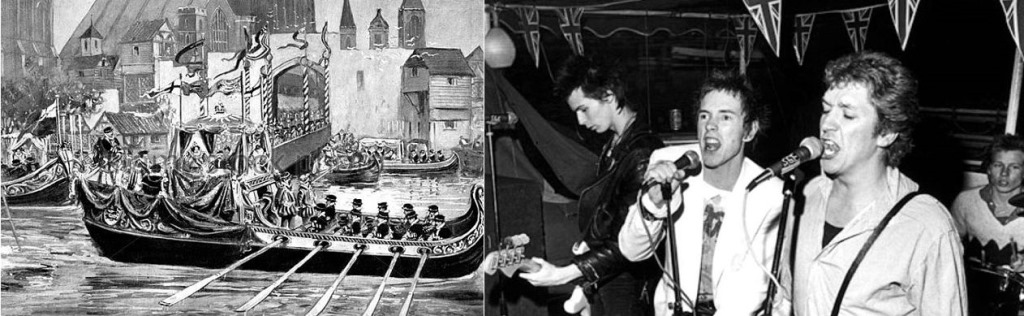
No, not that Queen Elizabeth, the other one, the one before Roman numerals were necessary—but if there’s to be a barge sailing down the Thames connected with some royal jubilee, I was hoping for the Sex Pistols in my small r republican heart.
Either/Oars: the Elizabethan royal barge the first time. The Sex Pistols on their Thames barge trying to drown out Elizabeth “The Deuce’s” Diamond Jubilee with their river nymph song.
Elizabeth is with her most constant suitor on the gilded royal barge, the Earl of Leicester, but historically the “Virgin Queen” never married. Some point to this couple as a continuation of “The Fire Sermon’s” main topic: the corruption and inconstancy of sex and love, but my reading of this barge episode is more at a vision of the passing of glory. Elizabeth and Leicester may not have been a fulfilled relationship, but it’s a great contrast to the man carbuncular and the poor typist from earlier in “The Fire Sermon,” and an Elizabethan gilded barge is a contrast to the commercial barge traffic of Eliot’s time.
When I first looked at this section this spring, for some reason I thought I’d try to do something musically referencing one of my favorite rock bands, Television. That’s not how this turned out. I can still see tiny bits of that idea in the chord sequence and the melodic top line I played on electric guitar. Instead, the arrangement developed as I worked to sonically depict passing glory.
Want to hear how it turned out? The player gadget is below.
*The nymphs’ song is from the Rhinemaidens in Wagner’s Das Rheingold, the start of his epic Ring Cycle, something I’m not very familiar with. Themes of water, fire, and the renunciation of love are present I’m told, and if so, that fits in well with the overall themes of “The Waste Land”.
In the department of coincidence, Wikipedia says the Rhinemaiden’s song melody is Eb, F, Ab, Bb and C, and the cadence in the main part of my music here is Eb, Ab, C, Ab, Db, Eb.
Still, the Dick Wagner I’m more au fait with would be the guy who played guitar on Lou Reed’s Berlin and Rock’n’Roll Animal records.
Today is Arbor Day, a curious holiday, born in the American Midwest, meant to celebrate and cultivate trees. It’s more established than the uncounted more recent designated days, special weeks and “National Months” like Poetry Month, but its observance is spotty.
Wikipedia says this is someone named “Birdsey Northrup” who helped popularize Arbor Day. Since this isn’t April Fools Day should we believe that?
I can’t say I remember and keep it myself, though I’ve always had an attraction to trees. I remember an old tree with exposed root tops outside my earliest remembered childhood schooldays, its roots large and far enough apart that we small school children would sit between them as if it was ground-level-low bench with bark covered armrests. And I remember forgetting where the tree was, like the location of Eden is forgotten, and being unable to locate it even only a decade or so later. That tree is no doubt gone, as many of those school children are gone by place of current location or end of life.
The backyard of the house I grew up in had four large walnut trees, majestic if a bit messy when the nuts fell, littering the ground like a green elfin golf-driving range. I remember that a major branch of one of them had a full long-handled scythe, like the grim reaper’s side-arm, crooked in a joint above anyone’s head or reach, it’s blade now being held in the teeth of the bark which had healed its wound. This I noted as a child, long before I thought to write, or write poetry, and it exists in my memory like a poem that doesn’t need to be written because it just was.
When I was looking for the house I live in now I wanted a yard with trees, which it has. The largest is outside the window as I write this, being old as a tree is and budding like the geriatric Sarah. I note that when Sarah’s husband Abraham met the three angels who told him that he, 100 years old, was to have son with his wife of near the same age, that he met these angels and heard this news under a great oak tree. Abraham, being a patriarch, and therefore by definition part of The Patriarchy, had his wife get busy making a quick meal for the angels, who as divine beings might not need earthly bread and could have said to Sarah, “Oh, don’t bother, we’ve already eaten.”
Anyway, in what is surely the strangest conversation with angels in a book of strange things, Sarah, hard at work on whatever quick-bread recipe that an antediluvian Epicurious might provide is said—right there in the first book of the books of Moses, the Holy Bible, in Genesis 18, in father Abraham’s tent—to have laughed.
Now the angels—who knows here what angels know—might have figured that Sarah’s laugh was the wisest thing they’d ever heard from a mortal, but it doesn’t say that in Genesis. Yes, it’s revered by many as a holy book, so the author may have figured he’d do something subtle here—or maybe it’s a blunder by a non-inspired editor somewhere down the line. Genesis just has Abraham being told they heard that laugh. Do angels joke? Did one of them wink to the others? Do angels wink? And then, to wind up the old geezer Abraham, who knows they’re angels, and is doing all he can to show how well he treats divine messengers who might only appear to be strangers who’ve wandered up to his tent, the angel looks Abraham in the eye and tells him “We heard Sarah’s laugh you know.” The term pregnant pause was invented then I think.
“I dunno, should we threaten to give him a bad Yelp review or something?” Sarah and Abraham with the 3 angels. Oak tree not pictured.
I don’t know what kind of pants folks wore in those days, if they even wore pants at all. If they did, let’s hope Abraham was wearing an old, brown pair. A divine being has just implied that your wife has been impolite, maybe even blasphemous. Genesis has other stories about what happens when you don’t treat angels right.
And 90-something Sarah, who’s just been told she’s about to become pregnant at that age, Sarah who laughed, quickly looses her wisdom—as we mortals who may find wisdom in a moment only to loose it in the next do—and she tells the angels she didn’t laugh. And the angels just said back, like trees do when we laugh beneath them, “Yes, you did laugh.”
No new audio piece today, but I hope to work on the next part of our National Poetry Month serialization of T. S. Eliot’s “The Waste Land” this weekend. Here’s a fairly recent piece that’s in our archives along with over 300 other ones, one that seems right for Arbor Day: Charlotte Mew’s “The Trees are Down.”You can read more about Mew and the poem here, or the full text here. But to hear the LYL Band perform it, use the player below.
What did Emily Dickinson think about the American Civil War, that great national trauma that occurred during her most productive time as a poet? And what did she think about the great national sin that was the cause of that war, slavery?
Emily Dickinson often writes puzzling poems, compressed like a set of speaker’s reminder notes on an index card. Despite occasional antique words and references to obsolete technology, Dickinson’s poems don’t really seem to dwell in a particular time or have any anchors in a time’s signature events. Instead we are left with the multiple capitalized idealized concepts that in the hands of most poets would doom a poem to vapid incorporeality—but the speed and brio of a Dickinson poem seems like the rush of thoughts, and that and they carry us along. All of this lets us see a remarkable mind thinking, but it doesn’t necessarily tell us the conclusions, only the methods by which it tries to reach them.
With many other American poets of her day we can tell what they thought of the Civil War and where they stood on the issues of slavery. Of course, we no longer read most of them, and we continue to read Dickinson. Even though my curiosity about these matters is personal, and in the end it doesn’t significantly change the originality and attraction of Dickinson’s work, I’ve still looked to see what I could find.
Dickinson’s father, Edward, was a politician, a member of the short-lived Whig party, and so there are political stands associated with him. The American Whig party, particularly for northern Whigs, was a “free soil” party. This meant that they did not stand for the abolition of existing slavery but wished to limit any expansion of the practice. Southern slaveholder interests were not content with that as a compromise. In an era when new territories and states were being added to the Union, they feared that they would eventually be too small a minority in a growing United States. In the 19th century before the Civil War, time and again these interests would come into conflict, and it was generally the Whigs who worked out some compromise that put off the Civil War. Edward Dickinson seems to have been an orthodox Whig, he supported those compromises, including voting for one of the last and most fateful of them, the Compromise of 1850 that gave the slave holders a Federal Fugitive Slave Act, giving license for bounty hunters of dubious ethics to haul escaped slaves back to the South (and financial rewards if they over-reached and just grabbed a free black person “by mistake”) and requiring local state authorities to assist in their efforts.
The injustices of the Fugitive Slave Act enraged Afro-Americans and energized abolitionist sentiments. And in the slave states who would secede at the start of the Civil War one of their chief complaints was that the Federal Government wasn’t doing enough to enforce this Fugitive Slave law against individual states that were hampering rather than aiding these “slave catcher” bounty hunters.
The Whig parties balancing act fell off the high wire shortly after that. It essentially split into two parties, the new Republican Party which was more adamant about free soil with no compromises, and eventually became the “party of Lincoln” and slavery’s abolition. The other part was the Constitutional Unionist Party which wanted to continue the Whig-style balancing act. Edward Dickinson seems to have aligned with the Constitutional Unionist faction, which completed the rapidly increasing progression to irrelevance for the Whigs.
On the other hand, both Edward and Emily Dickinson were on friendly terms with those who went the Republican route and even the more radical abolitionist bent. If yesterday’s story of Angeline Palmer might lead you to see a 19th century Massachusetts casting of To Kill a Mockingbird with Edward as Atticus Finch and the young Emily as Scout, the reality of the Dickinsons is much more ambiguous.
I’ve found various critics and commentators who have sought to answer my questions about what Emily Dickinson thought on these things. Some point to Dickinson poems and have suggested readings of them, but these are most often unconvincing to me. She does have poems mentioning warrior courage, duty and loss, but none of them seem to say anything about the causes or necessity of the pressing war in her time. Even more rare are references to slavery or people of color in the poems.
Mysterious and burning. Dickinson’s mind by lamplight
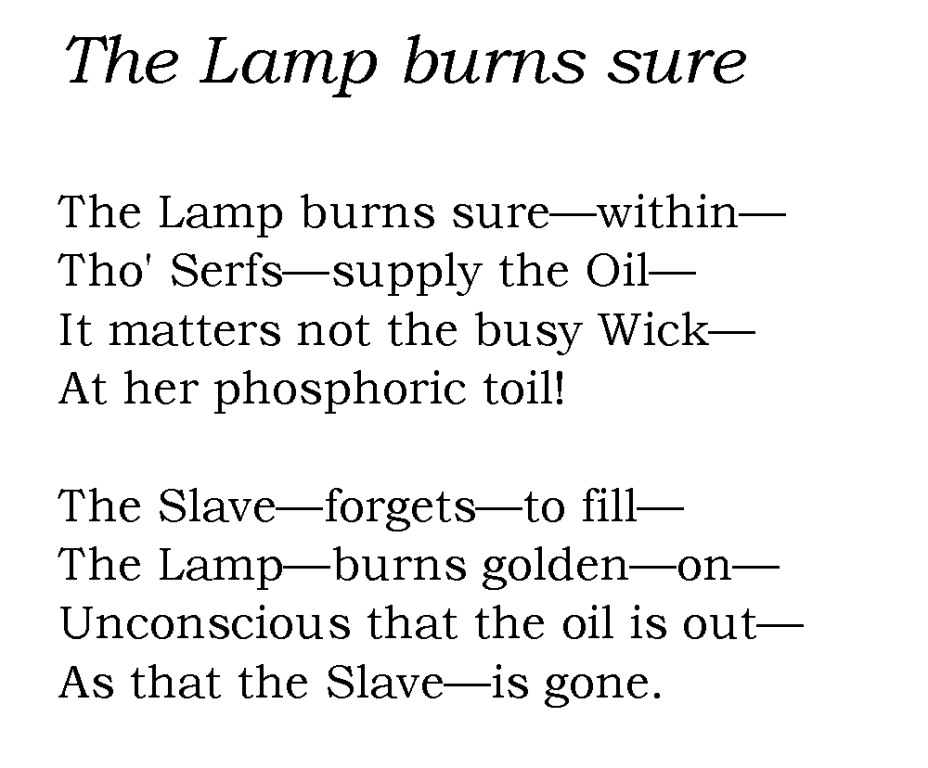
The poem I use for today’s piece is one of those rare ones. “The Lamp burns sure” is Dickinson at her most compressed and ambiguous. The poem’s plot is clear enough, an oil lamp whose oil is supplied by slaves or serfs (the poem says both at first, muddying the waters if it’s talking about slavery) runs out of oil because they have stopped filling the reservoir. The lamp’s wick is so busy burning that it doesn’t notice that it’s out of fuel and would in the normal course of events burn itself out shortly. The poem does not proceed to that end however. It leaves us only with the wick’s obliviousness, and then breaking the tie between the oil bringer’s role as being a serf or a slave, leaves us with the final statement that the busily burning wick is also unaware that the oil is out because “the Slave — is gone.” We don’t get to find out if the lamp is some Hanukkah mystery that will go on burning longer miraculously.
So, what does it mean, if it indeed means one thing? Some read it as a parable of creativity, that we’ll work ourselves past our resources in our passion. A key word there would be “within” indicating some imaginary inner lamp and the slave is just our body and emotional resources.
Some read it as a comment on the base labors that support a civilization that in turn supports arts, science or spiritual pursuits, and in that reading it’s an acknowledgment of the necessity of those labors—take them away, no light! The confusion of serf and slaves is a necessary confusion as it’s talking generally about civilizations.
And then some think, since this is a poem written in 1861 as the Civil War has broken out, and all the slave labor that has supported a large portion of the agricultural economy of the nation is now in question along with that nation itself, that this is not a generalized metaphor. The slave who’s gone, is an American slave, the light is an American light that will burn golden on.
Emily Dickinson’s desk with a whale oil lamp, a little luxury that could extend her writing hours
That last one would make it the closest to an Emily Dickinson statement on slavery and the Civil War. As I burn my own midnight oil tonight and I think of Emily Dickinson who wrote at night by the light of an oil lamp, I lean to the first reading. But some other day I might see something else and read it another way. I’d like to be surprised and to find out that Emily Dickinson’s keen and questioning mind could see what only some in her time could see about people of color and slavery, but that might not be the case. But here’s what I do find when I go to the music of that mind: a mind unafraid to be original and like Frederick Douglass in Robert Hayden’s poem, to believe freedom thought to be as needful as a heartbeat. Even if she didn’t free anyone from slavery like Lewis Frazier and his fellow servants in our last post, or agitate and orate like Douglass, I find there’s liberation there that burns sure.
Here’s my performance of Emily Dickinson’s “The Lamp burns sure.” You can use the player below to hear it if you can see one. No player? Then use this highlighted hyperlink.
Here’s a story. You can decide for yourself if it’s a sad or happy one.
It was a spring day in 1840 in a town in rural Massachusetts named Belchertown. For children you might expect that would be a fine day for play, but that’s not what this story is about, though it is about a child, one with a beautiful name: Angeline Palmer.
Angeline was a poor orphan and ten years old. Playtime was not on her mind. About a year back, the town poorhouse in which she’d lived since she was two years old had bonded her out as a servant to a prominent family in Belchertown. The town’s council ran the poorhouse, and Angeline was their ward legally, but such arrangements reduced the cost of running the almshouse.
I can’t be sure what work a nine or ten-year-old servant performed in those days in that place, but of course there were no appliances, and in rural towns there were not even stores stocked with things we might buy to save a household from having to make them. Households then were very labor intensive, so there must have been work for Angeline.
A servant like Angeline might dream of a better life on a spring day. Some would learn trades in household service that would allow them to start their own businesses. Or they might marry and start households of their own, where even if their lot would be the same sort of household work, they’d be servants of their own.
But Angeline wasn’t dreaming of a better life that day. Instead the future looked ominous. The man who owned the house was now staying in Georgia, looking for new business ventures. He had sent his wife all the way to Massachusetts to check on things at his house in Belchertown, and while she was there, a letter arrived. The letter had instructions for raising some money for his new business: ship Angeline Palmer down to Georgia. The letter figured she’d be worth $600 cash sold as a slave there. That’s about $17,000 today.
You see, Angeline Palmer was Afro-American. She was an orphan, poor, a servant—all things that limited her life, but she was free.
Servants in the house heard this letter being discussed, and quickly sent news of it back to the town where Angeline had been born. She had a half-brother there, Lewis Frazier, barely more than a teenager himself, he arranged a delegation to the town’s council, the men who were by law Angeline’s effective parents. The council wouldn’t take action.
Angeline was allowed to return to Amherst to say goodbye before the trip to Georgia and slavery. Her Grandmother was a servant at the home of the town’s postmaster. She asked him what could be done. Alas, the postmaster was the brother-in-law of the wife who’d been sent the letter. Instead of stopping this, he warned the Belchertown people that someone might be trying to stop the shipment of Angeline.
The postmaster worried someone might try to interrupt Angeline’s trip back to Belchertown by the scheduled stagecoach. Figuring they’d try something on the open road, he hired a liveryman to take her back by special wagon over a different route.
The postmaster was right. Angeline’s half-brother and a friend did flag down that stage, and of course Angeline was not on it. Slowly the pair walked back to town, sure that they’d failed.
But the liveryman had a servant too, and he knew the slower roundabout route the liveryman was taking back to Belchertown with Angeline. The town’s butcher loaned the liveryman’s servant a wagon and the now trio of rescuers sped off to Belchertown.
Despite the liveryman’s slow route, Angeline was already there, back in the house where she’d been a servant and from where she’d soon be shipped off to slavery. There was no time to waste, no one left to appeal to. Leaving the other two in the wagon, Lewis Frazier rushed into the house and found Angeline. Those in the house quickly reacted, and locked Angeline and her would-be rescuer in a room.
The other two men who’d raced from Amherst then left the safety of the buggy, ran up the stairs, pushed aside those trying to stop them, opened the door and took Angeline and her half-brother back down the stairs to their borrowed buggy. A crowd was beginning to form. Angeline and the three men didn’t wait to see what they might do, whipping back out of town as fast as their team could pull.
Angeline was secreted out of Amherst to an underground railroad safe house. Lewis Frazier and his two accomplices were arrested and charged. Though they’d stopped the fraudulent theft of a human being who would have been turned into property, who would have been owned along with her offspring, and bought and sold like livestock, the trio was charged with assault and kidnapping. The evil scheme of the man in Georgia was beyond the local court’s jurisdiction, and besides the three men had prevented that crime.
I don’t know how Belchertown looked upon this matter, but some in Amherst seemed to support the rescuers. Amherst’s most prestigious lawyer defended the trio of Afro-American men at the trial. That lawyer’s name was Edward Dickinson. Dickinson had a red-headed daughter, only a year older than Angeline Palmer, and her name was Emily Dickinson, who later would become known as a poet. Despite Dickinson’s efforts, the trio were convicted. They were given a sentence of 3 months, but it would be stayed if they would reveal where Angeline was hiding.
The dutiful trio didn’t take that deal, but the jailer seemed to be another who sympathized with them. While they slept in the jail at night during their sentence, he granted them liberty each day, and it’s said that townsfolk brought them gifts of extra food. The three men gave up some of their liberty for a short time but prevented a life of slavery.
So, what happened to Angeline Palmer? After a decade had passed, she returned to Amherst and married a relative of one of the men who had rescued her. She died, likely in childbirth, a few years after that. That may sound sad, but that was also the ordinary risk of a free woman living a married life in that time. They’d tried to steal her away and make her a slave, but a network of servants and three African-American men who cared for her risked all to prevent it. So, is that a sad story or a happy one?
In the first two parts I’ve tried as briefly as I can to outline two things surrounding this issue. In part one, I surveyed how poetry moved from an ancient form performed with music to a modern form most typically associated with printed text on a page. In part two I looked at the surprising result of a political decision made in the 1930s that led to a rich cultural mix being encouraged to compose music for non-commercial purposes linked to folk music. 25 years after this decision, a singular singer-songwriter linked that idea with many of the discoveries of Modernist poetry and revolutionized what song lyrics could do.
These two things, the move of poetry away from music and performance in general and the move of song lyrics to utilize all the elements pioneered by the Modernist poets naturally bring this question of “Are these lyrics poetry?” to the fore.
I’m going to try (again as briefly as I can) to deal with the issues brought up by this question. Before I do, I’ll spoil the suspense: I believe song lyrics are poetry, even though I agree to some level with the objections to that idea. On one level, a matter of definition, it ought to be simple to agree: the argument isn’t really that song lyrics aren’t poetry (or that various kinds of performed poetry aren’t poetry) it’s an argument that those things aren’t (or aren’t very often) any good as poetry. As I argued here a couple of years back, “not so great poetry” isn’t worthless, and I doubt the arguments that not so great poetry harms those poems we feel are greater or more accomplished.
What are those objections?
Without music or when printed silently on the page many song lyrics, even effective ones, seem much less effective. It may be 20th century comedian Steve Allen who originated the gag where a pop music lyric is intoned as if it’s a deathless ode. Laughs ensue. Allen liked to remind us that he was a songwriter and the author of serious books, but here, for the bit’s sake he’s showing us his skills as a performer. The unintended air of seriousness is incongruous to the material, he leans hard on the choral repetitions—which are used in poetry, but are used much more often in sung lyrics—and any infelicities in songwriter Gene Vincent’s words that we might ignore in the flow of Vincent’s performance get a raised eyebrow in Allen’s. A performer could do the same to “The Waste Land” or Emily Dickinson and make it ludicrous. And Bullwinkle J. Moose could present the once worthy Longfellow for laughs too.
“Drink in the simple beauty and the profundity of the sentiment…Skitch…”
Context is important in art. “The Waste Land” gained part of its launch velocity because of the trauma of WWI and because the Modernist movement was primed for a weighty masterpiece. But context is even more important in performed work, “Be Bop a-Lula” is designed to be heard sung with music.
Allen was taking a jazz-snob swipe at rock’n’roll. Here he is providing appropriate context for Jack Kerouac. “In Iowa I know by now the children must be crying in the land where they let the children cry.”
That if considered as poetry, using the same criteria a critic would apply to poems, many song lyrics fail to meet those criteria. Well, a great many poems that have never heard a note sounded beside them probably fail those criteria too. There are arguments that complex song lyrics fail because they are performed which I deal with below, but I ask: how sure are you your criteria are universal? When folks argue that Kendrick Lamar or Bob Dylan are bad poetry they are almost never arguing “Well, they just don’t work for me.” Instead they maintain that those who feel they do work have been duped or lack the intelligence and skills to appreciate something they posit as more worthy. How many Modernist, now cannon-resident poems, met the criteria of 19th century poetry? Did the Modernists forget how to be modernists? What part of “Make it new” did we forget?
The more I look at poetry, the more I’m surprised that a great many ways of “making poetry” seem to work. I’m pleased by that discovery, while I suspect the criteria people coming across the same discovery would be somewhere between puzzled and disappointed.
When folks answer this question by pointing out ways that song lyrics (generalized in some way) are different from poetry (generalized as well), I often wonder just how narrow their generalized view of poetry is. Poetry expresses itself in so many different ways even without leaving the page. The differences between how Du Fu’s “Spring View” and Eliot’s “The Waste Land” allow us to feel somewhat similar responses to similar situations are immense, larger than the differences between “The Waste Land” and Dylan’s “Desolation Row.”
Complex poetry cannot be appreciated in performance, much less with the distraction of music. I’ve dealt with this briefly elsewhere in this series, but we also need to ask: is complex, analytic, response always called for? In every other art-form I can think of, we allow for various levels of involvement with the art. Because complex poetry can reward deep examination, must it always be approached in all times and places by all people in that way? Audiences differ in their need to understand immediately. “Be Bop a-Lula” is designed to be absorbed with immediacy as expression and as a series of pleasing sounds. Donald Glover’s “This Is America” isn’t, and indeed it’s designed to make you question your pleasure in a text that works like “Be Bob a-Lula.” What the Bob Dylan revolution proved (regardless of how you rate Dylan) is that audiences will accept complex and unconventional expression in song lyrics. Not every hit song has complex lyrics, but complex lyrics can be a hit song.
If lyrics were good in the way complex poetry is good, that’s immaterial or it may even detract from the music which is the main thing an audience wants from a song. Yes, audiences come to songs for various reasons. Have you never loved a song for evolving reasons? With page-poetry I have certainly been attracted to a poem because of the way it sounded, and that pleasure indicated I might want to stick with it a bit (or re-experience that sound-pleasure) to see what else it might be expressing.
Sure, the ancients performed poetry with music, but that was a primitive solution. Literacy and mass-distributed printed matter is a better medium for poetry. I’m not sure about this. I agree that printed poetry allows for a different experience of the text. Alternate reader here Dave Moore has reminded me that it’s helpful if I provide access to the text of what is performed here. Good point! But the Parlando Project is in part a big experiment to see what works if various kinds of poetry are performed along with various music in various ways. I expect to fail, and I expect to succeed.
Speaking of success and failure, if you’re still here, I appreciate the time and attention you have given to read this. I’m both apologetic for its length and its brevity. Here’s a short audio piece, my translation (with a slight 21st century American adaptation I couldn’t resist) of that four-stanza poem that Du Fu wrote about the trauma of a broken country in springtime, the “Spring View” I mentioned above. Here’s a more literal translation of the text. The player for my performance is below.
Last post I rapidly traced poetry from the era of Homer and Sappho and the Confucian Odes, jumped to English language poetry and finally ended with early 20th century Americans. I traveled fast, and simplified much, but it wouldn’t be out of line to say this is a progression from poetry that was expected to be performed with music to a poetry that wasn’t. Widespread literacy and the printing press, and by the Modernist era, a desire to include complex allusions and layers of ambiguity all helped this progression along.
Today let’s start in the 20th Century in America and follow the songwriter’s side of things. Popular songwriting had become industrialized. Composers and lyricists churned out uncountable numbers—and first by sheet music and then by recordings, film, and broadcasts, these productions could be distributed widely. Barriers to entry were low in this business, but rewards for popular success were high. Lyricists came from a wide range of backgrounds—some were middle class, even college educated, but many were immigrants or descendants of recent immigrants for whom English was a fresh language.
As with any mass art or market, much of what they produced was forgettable, a job of work, their ears may have sometimes bent to the muse, but their hands were looking for a paycheck.
Poets and literary critics occasionally paid a little bit of attention to that work in their time. Lively arts and all, some notice was taken.* With the music inspired by Jazz, the cultural force of the music could not be denied, even if the words that came along with it might be condescended to.
Then, in the mid-1930s, a decision was made, outside of music and poetry—a political decision—that eventually changed the course of popular music lyrics. For political reasons both international and U. S. national, the Soviet Union-dominated international Comintern and the U. S. Communist Party decided to switch tactics from a more purist “only the Communist Party is the solution” stance to a popular front position, where anyone to the left of the then rising Fascist forces were considered valid allies.**
In the U. S. this led to such slogans as “Communism is the Americanism of the 20th Century.” On a political level this meant that the Roosevelt New Deal wouldn’t be portrayed as capitalists pushing insufficient reforms to stave off the inevitable revolution, and that actual “card-carrying Communists” would be mixing more generally with socialists, liberals and centrists. But for our purposes, we need to look at how this played out in the cultural sector.
Popular arts, which could have been perceived as hopelessly compromised tools of the capitalist system, became more acceptable; but a more pure, folk expression that was seen as coming directly from and for the workers and the exploited, a music existing outside of the commercial infrastructure of entertainment, was even more ideal.
So here, twenty years before the “Great Folk Scare” of the 1950s were the roots of the folk revival.*** It’s in this pre-WWII period that Pete Seeger and Woody Guthrie came of age and shaped their songwriting. Seeger was a Harvard drop-out and son of two musicologists.**** Guthrie was none of those things. The Popular Front meant that the likes of those two, and many others with high to low culture backgrounds, would mix it up.
My apologies to my Christian readers for posting this example of extraordinary Popular Front songwriting on Easter when it’s more a Good Friday kind of thing. Billie Holiday sings the harrowing “Strange Fruit.”
As songwriters this could have meant dour issue-of-the-month songs cleared by some central committee. And to be honest, each of them sang and wrote some of those, but both of them had Emersonian Individualist streaks.*****
And they listened too, had big ears. Afro-American music and musicians, isolated southern U. S. musicians who songs and styles were time-capsules of old British Isles tunes. Blues and “Hillbilly” music benefited somewhat from being a source and occasional fellow-traveler with this movement.
The Afro-American Harlem Renaissance is shaped by the gravitational pull of this political decision too. Civil Rights before the ‘30s was often aspirational, and though the folk traditions were honored before, this new emphasis on embracing popular and folk arts increased the interest and respect for them among an emerging new Afro-American cultural consensus.
Now we jump ahead again, it’s that un-named but important straddle decade of the late ‘50s to early 60s. Communist connections are poison. Illness had made Guthrie bedridden. Seeger is persevering outside of any first-tier commercial structure as a road-dog performer. “Folk Music” is now a commercial genre with a still bohemian/left-wing underground. Into this we inject the man who will expand the idea of what song lyrics will be allowed to do: Bob Dylan.
You don’t have to like Bob Dylan as a person, performer or songwriter to accept this truth: there are song lyrics before Dylan’s 1963-66 period and there are song lyrics afterward, but song lyrics are a completely different field after the change he proved was possible. This is why an artist as strong in his own right as Leonard Cohen can say in one of his last public statements: “Giving a Nobel Prize to Bob Dylan is like pinning a medal on Mt. Everest for being the highest mountain.”
But a Bob Dylan has causes, has a context in which he can happen. That choice Communist bureaucrats made for pragmatic political reasons in the mid-1930s led to a folk music scene 20 years later in which Afro-American blues and weird old folk music mixes with poetic Modernism inside the mind of one songwriter, and what comes out is strange and compelling.
Song lyrics don’t have to be a piece of work aiming for an established commercial target. Song lyrics don’t have to make clear front-to-back sense the first or the fifteenth time you hear them, they can mystify you and still have listeners. Songs with narrative elements don’t have to progress in a linear manner. Song lyrics can be about anything, can use any kind of imagery. Love songs can be ambiguous. Political points can be made metaphorically. You can combine different kinds of diction, even sample and reference various existing sources, and it doesn’t have to seem out of place or from the lack of original things to say.
One can point to song lyrics that did one or two of these things before Dylan, but after Dylan used many of them together and repeated that demonstration often, many songwriters wanted to try using any and all of these things, and their attempts caused other songwriters to do the same. A chain-reaction occurred.
Modernist poetry had done all these things already, and often—but Modernist poets didn’t write songs, and for the most part they didn’t read and perform their poetry charismatically. Some Beat poets, that faction of the Modernist movement that had vowed to remain resolutely bohemian, who had read their poems in front of jazz combos, recognized this was a different level of music combined with words. Allen Ginsberg heard a copy of Bob Dylan’s second LP in 1963. As the first side of that record moved inward toward the ouroboros groove in its middle, as “A Hard Rain’s a-Gonna Fall” played, he says he wept. Did he weep, feeling he was now displaced? Did he weep because this not yet 40-year-old poet might be replaced by this just over 20 singer-songwriter? No.
He wept, with an outlook of gratitude, because “There’s a saying among the Buddhists. If the student is not greater than the teacher, then the teacher is a failure.”
A long excerpt from “A Hard Rain Is a-Gonna Fall” with Ginsberg’s statement cut in.
Good story. But this was far from the end of the matter. A great many important poets and critics didn’t feel Ginsberg, or any of his Beat cohort, were very good poets. Therefore, Ginsberg’s say-so didn’t make Dylan a “real poet.”
You can’t say songwriting accepted or didn’t accept Bob Dylan, because acceptance is too meager a word for what happened—he changed how songwriting worked. The question of poetry “accepting” Bob Dylan, or songwriters in general, is still open.
Will I ever answer the question in the title? I beg your patience. This is by far the longest piece ever published here, even though I’m skimming over a lot of things. In Part Three I’ll finally get down to the answer that makes the most sense to me.
For an audio piece today I’ll suggest this one, one of the rare times here that I perform my own writing, a live version of “On First Hearing Blonde on Blonde” by the LYL Band. The audio player is below. Thank you for reading and listening! Part Three, that should be the conclusion, comes soon.
*Decades after this era in 1990 literature professor Phillip Furia published his book The Poets of Tin Pan Alley which helped convince this fan of more “authentic” songwriters that these commercial lyricists were not without considerable art.
**As in the case I’ll make later regarding Dylan, please don’t let any personal feelings or judgements you may have regarding Communism or the Comintern blind you to the historical connections here.
***I can’t not mention one poet and musician who jumped the gun on this, Carl Sandburg, who published his important folk song collection American Songbag in 1927. And for length reasons, I’ve largely left out the 20th century development of Afro-American blues and jazz. Charlie Patton didn’t wait for the Comintern to get in touch with him to forge his new alloy of styles.
****One of his father’s prize students was Modernist composer Henry Cowell. His step-mother, Ruth Crawford Seeger was in some opinions the most significant female American Modernist composer of the first half of the 20th century.
*****We can think of songs like “Where Have All the Flowers Gone,” “Bells of Rhymey,” “Plane Wreck at Los Gatos,” or “This Land is Your Land” as exceeding requirements for that kind of song. Abel Meerpool’s “Strange Fruit” is an excellent example of a lyric, written as a song, that would stand alongside poetry intended for the page.
Today, somewhere, someone probably asked this question for the first time, and yet I’ve been aware of this question for my entire adult life. So, before I try to address the question, let me ask first, how long have we been asking this?
The ancients didn’t ask it. It seems clear that if one goes far enough back in most cultures it was taken for granted that poetry would be sung or accompanied by music. It seemed to make little difference if it was an epic story or a condensed lyric expression, music was assumed as appropriate bordering on required.
Was there a progression away from music being expected with poetry in those times? I wish I could say I was scholar enough to answer that question here. As literacy became widespread, as the collecting of libraries increased, I assume more people may have read Homer or Sappho* on the page than heard their works performed. And similarly, when Confucius and his school collected The Book of Songs they may not have assumed that each student would learn to sing and accompany each of them. Still it would have been absurd then for someone to judge that these works could not be poetry because musical accompaniment and performance had been associated with them.
Let’s see, one of these ought to work….And Sappho holding her plectrum in right hand
If we stay with English language and move on, we know that the Elizabethans recognized some poetry as destined for the printing press’s page, some for performance on the stage, and some for musical settings as songs. Poetry could be associated with music, but it wasn’t the default.
Continuing to sweep forward quickly, a few Romantics like Robert Burns wrote songs and Blake was reported to sing some of his work as well. Some of the prime British Isles romantics wrote literary ballads or the like, works that referred to song forms but without associated music, meant to be seen on the page.
Likewise, there seem to be only a scattered few in the late-Romantic/Victorian era and onto the early English language Modernists who were musical composers and poets or who assumed musical performance for their chief works. Long-time readers here will know that I like to point to Yeats as an exceptional example to this. For a time he pushed for poetry as performance with music and may even have composed or aided in the composition of some of the accompanying tunes. Little of his crusade survives, though it’s possible that one of the tunes to which his poem “The Song of the Wandering Aengus” aka “The Golden Apples of the Sun” is sometimes sung might be his, or personally approved by him.
That Yeats was closely associated with drama and theater may have something to do with this. Newly composed poetic drama is an uncommon form in the modern era, but drama normally presumes performance. Although readings by poets are common in the 20th and 21st century, the nature of the performances vary considerably, and it became common for poets to give dry readings that by the writer/reader’s nature or intent drained dramatic and performance elements from the reading.
Let’s stop for a moment and consider two unlike American poets who emerged in the early 20th century: Vachel Lindsay and T. S. Eliot. Lindsay, who came and went well before the first Beat poet stepped in front of a jazz combo can easily be seen as the original slam performance poet.
He wrote his poetry expecting to perform it. Associated with that expectation, his writing is designed to impact the back row of the auditorium immediately, and if he ever wrote a poem with layers of meaning or intentional ambiguity, I’ve never come upon it.
Eliot on the other hand, read somberly in public, but as much (or more) as Lindsay he seemed to inform his poetry with music. As I return to my serialized performance of his masterwork “The Waste Land” this month I’m reminded of music’s considerable presence in it. He samples music in his great poem just as a modern hip hop composer might, dropping in scurrilous barracks ballads, pop songs, Wagner opera, and birdsong. He didn’t perform it as floridly as he wrote it, and so even if “The Waste Land” bore an original working title of “He Do the Police in Different Voices” Eliot does not do the voices when reading it, nor does he sing the music he’s decidedly referencing. It can be performed however, and while the poem’s detailed layers and references won’t come through in one sitting, a performance like Fiona Shaw’s illuminates the emotional and character range in it better than anyone’s silent first (or probably tenth) reading of it will.
My performance of “The Waste Land,” now about half complete, attempts to bring the abstracted music back to life in the poem, even if I reserve the right to select genres and modes of expression that Eliot might not expect.
When I perform a poem like Vachel Lindsay’s “Abraham Lincoln Walks at Midnight” I expect you’ll get as much, or perhaps even more, from hearing it once as you would reading it on a page.
One of the knocks on poetry with music, or performing poetry in general, has been that it doesn’t help subtle and complex thoughts in poetry come through the way that slow reading on a page where one can look up and down the page at will does. I’ll agree there’s a non-linearity in reading poetry on the page that is difficult to translate into performance. But does musical performance of words prevent “re-reading”?
Music rejoices in repetition. Words used with music often take on refrains and repeated sections. I will sometimes create such refrains even if the original page poem doesn’t include them. Gospel and other ecstatic performance styles have been known to drill down to word or syllable level in repetition, again, somewhat compensating for that weakness of performed poetry vs. its non-linear presence on the page.
Particularly with recordings (although repeated performances have the same virtue) you can re-experience the poetic text for comprehension of different levels or different vectors of observation.
When I’m attending a poetry reading, I’m often worried that I will not be able to keep up the level of attention on the poet’s words as they read them throughout an entire night. This is irrespective of the value or quality of the poetry. A good poet is quite likely to cause my mind to explode with exploration engendered by a line, and I’ll find on my return that I have missed the rest of the poem! And a really good poem can blank out the next several poems.
On the other hand, a simple text like Otis Redding’s song “Respect” as performed by Aretha Franklin and band can bear (for me) hundreds of listens. I will notice new things each time, or given the decades over which I’ve heard it, I may re-notice things I’ve forgotten I’ve noticed before. These revisits will also reach favorite moments where I wait for pleasures to return. A knottier text like Bob Dylan’s “Just Like A Woman” once seemed like a way to vicariously experience a certain kind of demimonde I was only peripherally experienced in. Listening to it over my life tested it against theories that it was about gender fluidity, or that it was a patriarchal endorsement of the male gaze and privilege, and now I usually hear it more as an expression of two addicts negotiating their other relationship besides the one to the chemicals and the situation that obtains them. It may be none of those things, or it may not always be one of those things. It may be something different the next time I listen to it.
Why shouldn’t Emily Dickinson’s “Hope is a thing with feathers” or Wallace Stevens’ “To the Roaring Wind” get the same chance? Of course we can re-read a page poem, or read it and double back to check some connection, but particularly with short poems, might not music encourage repeat play?
In this first part we’ve talked more about poetry and the perception that it has become increasingly separate from music. In the second part we’ll come from the other direction, and talk about song lyrics and that old, but not ageless, question about if they are poetry. I’ll leave you with my performance of Yeats’ “Wandering Aengus.” We don’t know exactly how Yeats would have wanted it performed, but his writing on poetry with music indicates he didn’t want the performer to sing it in an art-song manner. Perhaps I’m complying with his wishes, but then I can’t really pull off full-voiced art song.
*My favorite Sappho legend—as a guitar player that must have the right flat pick to approach the instrument—is that she invented the plectrum.
As we continue to celebrate National Poetry Month here, I ask your indulgence—today’s piece isn’t based on a poem. Earlier this week I did use a Ralph Waldo Emerson poem, mentioning then that his poetry often fails. Well, there are compensations—as an essayist, Emerson often expresses himself poetically.
Today’s piece is part of an Emerson essay published in The Atlantic in April 1862 called “American Civilization.” In it Emerson ranges quite a bit, including some racial and regional stereotyping that may shock some modern readers with its ignorance and prejudice. But rather than concentrate on what Emerson got wrong—after all, I don’t need to go to 150-year-old writing to find that sort of thing, our own age will supply all we’ll ever need—I want to present to you some things that Emerson might have gotten right.
I’ve selected a handful of sections from Emerson’s essay for today, the parts of the essay that strike me as if they were a poem. I call my extracted text “Emerson’s Wagon,” in that one of the phrases it popularized became a pervasive folk-motto: “Hitch your wagon to a star.”
What do you think that means when you hear it today? Most likely you think it means have high ambitions, aim for success not mediocrity, that if you only make it half-way you’ll still get farther than if you’d set your sites lower.*
If so, you may be surprised to hear how Emerson meant that phrase. Indeed, the whole argument Emerson makes in today’s piece is a subtle and surprisingly contemporary one.
Emerson wondering if his essay will go viral—wait—can something go viral on the telegraph?
“Emerson’s Wagon” starts by telling a technology story. While he’s speaking about the telegraph, a recent marvel of his time, the metaphor here could just as easily be applied to the Internet on which you are reading this.** In this metaphor we meet the essay’s first wagon, and it’s, well, stuck and broken down. He points out technology has found a way to get around that.
Then mid-19th century Emerson starts considering renewable energy. A couple years back I was talking to someone about that very subject and he mentioned Massachusetts had fewer resources than some other parts of the U.S. for that, which I found ironic, because Emerson’s 19th century Massachusetts was leading the country in exploiting water and tidal energy for industrial power.
Here is Emerson’s second wagon, the first one he hitches to a star. He’s not talking about personal advancement particularly, he’s talking about harnessing nature’s renewable power, and working with it to improve our civilization.
Now his technological story is getting more interesting. How many times have you heard of nature and technology portrayed as opposites? Enough that you may think that technology inevitably destroys nature, or that technology is replacing nature, and so on?
Emerson’s asking you to think of technology (and also nature, as we’ll soon see) differently. Technology comes from close observation of and analysis of the powers of nature. And in concert, the book of nature can tell us something about how to use and deploy technology, and how we should share the bounty of that.
Finally, Emerson goes somewhere you probably won’t expect. His third wagon*** says that moral principles are natural principles (and vice versa). We moderns may have some doubts about this, but it was part of the Transcendentalist ideals that Emerson and his fellows believed. From that equivalence, he says that for American civilization to succeed, for us to fix those broken and stuck in the mud situations like that first wagon, we must align ourselves (if we wish to make change) with the moral principles of a nature that spreads over all and gives benevolently. To do so makes us more powerful agents of change that cannot be defeated in the long run.
An interesting thought for a time of lies and behavior that isn’t pulled forward by the tides of heroic stars, that instead aims at the lower level of personal enrichment defended with the muddy shield of not-quite-legally-indictable.
*It was a phrase my mother would use, and in this sense too. She raised her large and different family whose members did different things, so maybe it has some value used in this way as well.
***As he once more returns to the line “hitch your wagon to a star” Emerson eventually reels off a list of constellations named after heroes. You might be thrown by the first one on his list “Charles’ Wain.” I’d never heard of it. Turns out it’s another name for the Big Dipper. Wain is a Middle English word for, yes, wagon and together Charles’ Wain sort of morphs into the name of legendary king Charlemagne.
Isn’t it odd that early 20th century Modernists used the locomotive as one of their talismans? After all the railroad train wasn’t particularly new at the time, though like buildings and the airplane it eventually became a fine armature upon which to sculpt the curved Streamline Moderne style—but that was later in the century, and before it arrived the train was already the nightingale of the make-it-new crowd.
“…Shining, just like gold. Don’tcha hear me cryin? Ah Wooo-Hooo,,,”
It probably comes down to speed and power. Much of America in the pre-1920 years was still held between walking and horse-saunter speed, trains were exceeding the magic mile-a-minute rate, a supersonic difference to then. The sight of a long train rolling through the countryside must have been a majestic contrast of speed, noise, and human-constructed momentum.
Even back in the 19th century, the father and the mother of modern American poetry each wrote a train poem. Walt Whitman with his somber “Locomotive in Winter”, and Emily Dickinson* at her most playful with “I like to see it lap the Miles.” The strength of the train ideal is such, that without motion or even presence its gravity is silently impressed onto two classics of early 20th century poetry: “In a Station of the Metro” and “Adlestrop.”
Limited. Shortly before he died, my father told my son and I that he recalled one thing from his childhood visit to the Chicago Worlds Fair in 1933-34, the Zephyr streamlined train. That year we visited it, exhibited in the Chicago Museum of Science and Industry and sent him a picture of us by the train.
But today I want to celebrate Carl Sandburg during America’s National Poetry Month, and to advocate once again for this forgotten Modernist, the son of an immigrant, born in the Middle West of our continent. The poem I use today isn’t particularly difficult or full of samples and beats from everywhere like “The Waste Land,” or subtle in its questions like much of Emily Dickinson. Sandburg gets into it, drops its Imagist payload in a sentence, and then makes its point. As Harriet Monroe said in reviewing Sandburg’s Chicago Poems, in which “Limited” appears: “His book, whether you like it or not, whether you call it poetry or not, is fundamental in the…majestic sense.”
And a poem like “Limited” is fundamental. What it says isn’t novel, but what it says is low enough down beneath our florid lives to be overlooked. We often ask great poetry to tell us something we don’t know, to surprise us, but there may be a place for it also to tell us something to which we can say, dismissively, “Well, yes, I know that!” and for the poem to remain, silent at its ending, saying “If you know that, why haven’t you acted like it’s something you know?”
20th Century musicians loved the train too and its rhythms, that rattling phrasing and doppler marcato. For this performance of “Limited” I tried to touch on that and let some guitar tracks run out. You can hear it with the player gadget below. Not a long text today, but for those who like to see as well as hear the words, click here.
*One of the interesting side-lights I picked up in Genevieve Taggard’s Emily Dickinson biography, one of the first full-length treatments of her life and work, and written early enough that she could talk to people who overlapped Dickinson’s life in Amherst, was that her domineering father, who looks so stern and austere in his photograph was well known in the community for always wanting the fastest team of horses in for his buggy. I see Vin Diesel et al in a prequel Fast and Amherst, but Drift it Slant. Hollywood, call me, I can put the blog aside….
Here’s another post in one of our National Poetry Month series: The Roots of Emily Dickinson. We’ve already touched on Emily Bronte, who’s fierceness inspired the American Emily; and Helen Hunt Jackson, a childhood classmate who encouraged Dickinson to publish her work.* Today we look at a poem from the foremost public intellectual of her region and era, Ralph Waldo Emerson. We’ll see how it connects to Dickinson, and you may be surprised at how current Emerson’s thoughts about water are.
It’s difficult to think of a modern analog to Emerson. It’s not an exact fit, but Oprah Winfrey could be put forward—but that understates the level of Emerson’s pioneering in the mid-19th century when America was still seen as a backwater. Like Winfrey, Emerson’s approval or endorsement could do much to help a new writer come to the fore. Emerson’s opinions, not just on the arts, but on public culture in general, about how best to live and shape one’s own life, were widely distributed and read by a broad readership. But even if similar in fame and broad impact, Winfrey has never pretended to be a philosopher herself, while Emerson was viewed as a central figure in a movement called Transcendentalism. What is Transcendentalism is a book-length subject, but there are, within its core, beliefs in the powers of individual insight over religious authority and the desirability of a close reading of the book of nature.
If it was the middle of the 19th century, the guy on the right might be your Oprah.
When I would read Transcendentalist writings more than a hundred years after they were written, in my 1960s, I would be struck with how often (if one gave some allowances for language changes) they sounded like a hippie critique of 20th century culture,** and in the half-century and more since, if I dip back into them, I find some of their focus surprisingly contemporary.
Was Emily Dickinson a Transcendentalist? I can’t say for sure, but it’s near certain that Transcendentalist ideas, particularly as expressed by Emerson, were familiar to her. His thoughts were in the newspapers and magazines she read in her lifetime. We know she had been given a book of his poems by a friend, and we know she read them, and even copied at least one of them in her own handwriting. It’s possible that she attended one of Emerson’s popular public lectures.
Part of Emerson’s poem “Sacrifice” copied in Emily Dickinson’s own hand.
Emerson’s poetry rarely works well, and Dickinson is a great poet, yet in poems like today’s Emerson selection “Water” I can see similarities between them. Emerson punctuated his poem as one purported sentence, but its syntax is impossible to follow, and so “Water” is as fragmented as one of Dickinson’s heavily dashed poems. Incredible leaps occur from line to line with no attempt to bridge them with explanatory connections in either poet’s work. Emerson begins his poem with a striking phrase, similar to many of Dickinson’s great first lines: “The water understands/Civilization well;” but we soon meet a strange homey image of sticking a toe (or foot) in it, and Dickinson too loved to mix the universal and the mundane. Emerson’s poem develops with water personified as not having or having certain feelings, and then with little preparation we’re warned it can be the destroyer.
I think Emerson is making a very modern point here, one that he expressed also in his essay “Civilization.” When water is respected and harnessed appropriately for its utility *** we are in harmony with nature’s nature. But, if we ill-use nature, we literally go against the tide, and water will be our destroyer.
If Dickinson was influenced by Emerson’s ideas and outlook, and if she picked up his individualist style that dares to be somewhat obscure to stay true to the individual’s perceptions, why is she so often a great poet while Emerson isn’t?
I think Dickinson makes better word choices both for sound and impact. Having “decketh,” “adoreth,” and “doubleth” as three wet dish-rags in a four-word stretch is enough to make Emerson’s poem soggy. And Dickinson has a talent for intriguing mystery that pulls us along even to places we don’t fully understand. She does that partly with her hymn/ballad rhythms which Emerson doesn’t use. Dickinson is usually more immediate too. A few posts back I stated that a poem is not about ideas, but the experience of ideas. In an Emily Dickinson poem, I’m more often able to feel I’m experiencing those ideas as the are perceived, where I feel Emerson is summarizing his thoughts after the fact.
Unafraid, I waded through the -eth words and performed Emerson’s “Water” with my own music, and you can hear it with the player below. And here’s the text of Emerson’s poem if you’d like to follow along on the page.
*With the exception of one poem, which was published anonymously while Dickinson was alive, Jackson failed at that. Still, I think it possible that having some knowledge of her friend selecting poems for publication could have been motivation for Dickinson to create her hand-written booklets of poems which were found after her death.
**This is for good and ill. Idealistic critiques of society are important, but adventurers often take wrong turns. And idealists have a hard time figuring out viable new structures.
***Emerson’s Massachusetts led the nation in using water power for small to large industry in the 19th century. So, when the city of Minneapolis was founded largely due to it’s exploitable water power, a good portion of the city fathers had New England backgrounds. Many Minneapolis streets still bear the name of 19th century New England luminaries, including Emerson. Alas there’s no Dickinson Avenue, as Dickinson’s poems were not published until close to the end of the century.