This is going to be a two-part post to celebrate reaching a milestone in this long-running project. This, the first part, will deal with the Emily Dickinson poem I adapted for this occasion, and the second, to follow, will be more a reflection on the decade or so of this Project along with a hazy look forward.
Let me quickly set out what the Parlando Project does: we take various words, mostly literary poetry not intended for performance, and combine them with original music in differing styles. Sometimes the words are sung, sometimes spoken, sometimes in-between. Mine is the voice you hear most of the time (though I know my voice is a limited thing), I’m the composer of most of the music, and I create recordings so you can hear the performances, playing most of the instruments and scoring the MIDI parts. Over the years, another poet/musician/singer Dave Moore has been the leading alternative voice, musician, and composer in this. Dave and I have performed as the LYL Band since the late 1970s. It was from within the LYL Band that the Parlando Project emerged.
Now onto today’s piece, that 900th one.
My appreciation for Emily Dickinson has grown while doing this Project. I still recall back in the early 1970s an American Literature professor telling me that most of Emily Dickinson’s poems can be sung to “The Yellow Rose of Texas” or any number of other familiar tunes.* That intrigued me, as I was a poet and writer who also wrote songs and was starting to figure out how to play the guitar – but at this time Dickinson was not yet a strong literary influence for me. As the esteemed Professor Hillyer put it in the piece that I quoted from earlier this National Poetry Month, I was still subject to that summation where “coy” moved to the point of “cloy.” I casually allowed that framing, that expectation, and largely lived my life considering other poets.
Doh! Working with her verse here in order to perform it with music expanded that quickly. It turns out she had many modes and moods, she was capable of highly compressed metaphysical poetry (even to a fault), and I sensed the dry but cutting sense of humor of a social satirist in many poems. The younger, ignorant, me had thought her this tragic spinster with needlework homilies, but as I needed to decide what was inside this clearly wider range of her verse I could read her with Frank O’Hara layers of irony and stance, accompanied by a cathedral-organ panoply of emotional stops.
Today’s poem is on the subject of poetry and the poets that create it, so highly appropriate for National Poetry Month.** I strongly marked the word “reckon” that comes in the poem’s first line, this poem starts to present itself as an expression of mathematics. Reckon and reckoning were in the 19th century terms for calculation and by extension with the particular mathematical/geometric skills of navigation. Dickinson had something of a scientific education: classification, dependencies, range, were things she’d studied.*** The poem starts, asking what are the significant integers, the prime factors, that make up the universe.
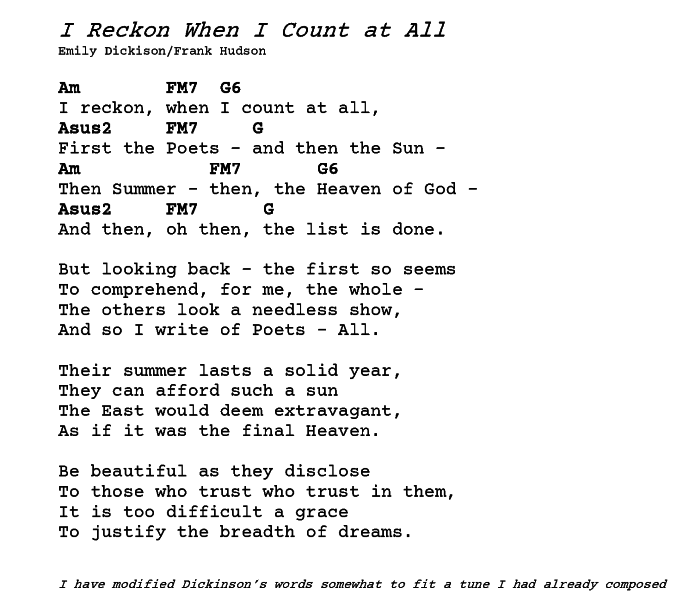
The chord cadence here was an experiment I was doing in close/but not the same symmetry, which is part of the reason I chose to modify Dickinson’s words instead of modifying the music.
.
The list begins with the poets, and then adds the sun (the source directly of nearly all of earth’s energy). Moving on, she oddly next lists the transient summer, but as an avid and knowledgeable northern climate gardener in a household that was across from a farm field, she honored that fecund season. She concludes the list with what seems like piety and a stopping point: “The Heaven of God.” Put a pin in that last item.
She soon corrects herself: the poets already contain all this. The sun? She proclaims poets are as illuminating, warming, and energy producing as the Sun. If summer grows crops, their creativity, poetry’s has no off-season. Poet’s, poetry’s, endlessness makes it as immortal as some heavenly realm. Now of course this is metaphysical math, and after all, the entire poem starts with “when I count at all,” indicating that she might think there are limitations with mathematical counting. The poem’s final stanza (as printed in Untermeyer’s book)**** is somewhat mysterious, but in a good way. There are a number of ways to understand it. There’s one I’d paraphrase as: “So I (as a poet and reader of poets) will continue to appreciate and engender the beauty of a poetry that can present a universe of the known but also that of the surmised and the uncountable. And those who can trust what can’t be quantified or found by earthly navigation: trust in the poets. Could they be wrong? Could their imaginationed maps and internal suns be wrong in the cold light of day? Perhaps, but you can’t count some things, any more than one can survey the time and distance of dreams.” That trust, Dickinson is saying is such as others would put in the “Heaven of God.” The “too difficult a grace” is saying that even grace can’t contain what poetry is. Others read this stanza as saying that the poets are in fact not trustworthy, even if Dickinson admires them all, and is one herself – but she’s sticking with poetry anyway even if she knows that the believers in a heavenly supremacy will not grant her grace, and in that reading the “those who trust” are trusting in the “final Heaven.” When I performed this, I was thinking more the former than the latter, but I really don’t know, I just had to feel someway as I sung it.
As mentioned in the footnote below, the version I used to start my work on today’s piece is not the most accurate representation of the extant poem in Dickinson’s own hand. I furthered that issue. This piece began with music I’d already composed and partly realized, to which I decided to fit Dickinson’s text to. I could have modified the music, but I chose not to, and so added a few words to the shorter lines to fit the more symmetrical structure of the music. I made the most audacious change to the final line, adding “breadth” to make that line symmetrical. I did this because I liked the idea of returning to the sense that the poem started out exploring if the important things could be counted and sized, and one has no control over the length of dreams (or our lives for that matter). I also liked the homophone of it making its sound to a listener like “the breath of dreams,” which pleased the surrealist in me.
Everything I did there is not necessarily the admirable choice. I really wouldn’t know how to defend myself from charges of defacing the work of a great poet. I was guided by trying to make as arresting a song for the listener as I could – and I was thinking too about using this for the 900th Parlando piece – I was “counting” that occasion, and so like the poem I adapted, commenting on the ambiguity of counting poetry and the length of this Project. Did I make it interesting? You can hear my performance of “I reckon, if I count at all” with the audio player below. No player? Well, you can’t count on that, because some ways of viewing this blog won’t show it, but this highlighted link will open a new tab with an audio player.
.
*This is because Dickinson often utilized “hymn meter” aka “ballad meter” used for many Protestant hymns and quite a few popular and very secular ballads from the British Isles, with an alternating 8 and 6 beat stanza. Other “you can sing them to” suggestions: “The Theme to Gilligan’s Island” and “Amazing Grace.” I’m not sure which (or both, hymn and ballad) were what Dickinson had in mind, but some of her poetic influences also wrote literary ballads which were not meant to be sung, but used the meter of the songs.
**And it’s part of my #NPM2026 series, in that this poem appears in Louis Untermeyer’s between-the-wars anthology “Modern American Poetry.” I could have written (and thought about doing) a post on how Untermeyer frames Dickinson from within his era. His evaluation of her was favorable, but he doesn’t bring forward her humor even though he found room for “light verse” in his book. The poems he chooses include some of the Dickinson “Greatest Hits,” but few of her more metaphysical poems – and it omits some of the texts that later became oft favored, explicated, and excerpted.
***To the extent that academic education of women was proper for her time and place, the sciences were considered most appropriate. Men might study theology, law, the higher arts, abstract philosophy that lady brains certainly weren’t suited for, but science was viewed as more of a practical craft and set of knowledge. I suspect math might have been part of the gendered curriculum. I think too of the female “human computers” used in the early days of NASA and illustrated in the Hidden Figures movie, or the Benchley Park code-breakers.
****The version in Untermeyer’s anthology was printed in 1929 as a then yet unpublished Dickinson poem in the Atlantic magazine. This version differs from the handwritten manuscript, and also with other later published versions of the poem. The manuscript is in one of her famous fascicles and includes a number of alternative words that indicate that the poet herself was still in a mind of some variance. See this link for more info on the various versions of “I reckon, if I count at all.”
 Frank Hudson