Louise Bogan is somewhat of a poet’s poet – and that’s sort of a mixed blessing. Earning that title means that other folks who work at the craft of poetry recognize the things she’s able to do even if they may not be noticeable by the general reader. Indeed, when done well, the kinds of skills Bogan had with the music of words or the music of thought may not be noticed because the poet deploys them without creaky prying levers, showy lifting, or grunts of effort.
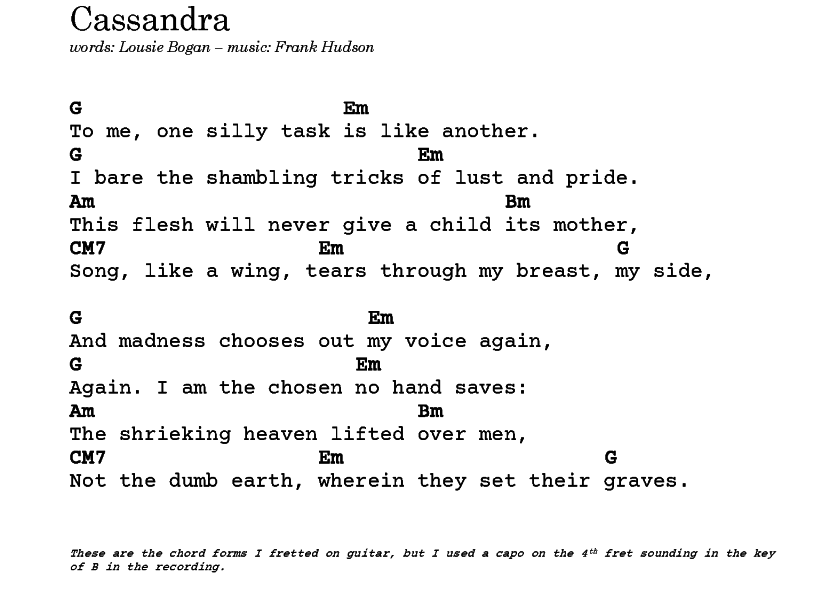
Continuing our celebration here of National Poetry Month, I selected a poem of hers out of Louis Untermeyer’s between-the-world-wars anthology Modern American Poetry. It’s titled “Cassandra.” We may therefore assume it’s in the voice of, or the shared experience of, this figure in classical mythology.* Cassandra had the gift of prophecy, but when she spoke her doomed predictions of the fall of Troy and the fate of those (on both sides) who took part of that conquest, she was more than disbelieved, she was deemed mad. Mixed blessing.
As I mention below, you could have heard this with Mellotron strings, but Cassandra predicted you won’t.
…
Of course, if you have the unerring gift of prophecy you might well know that’s how your messages will be received. Cassandra would also know her own fate (and like many Greek myths, it’s trigger-warning brutal) and she had to bear up under that too.
Louise Bogan took that paradox and put its facets into eight lines of pentameter with perfect rhymes. With a little less skill she might have chosen more space thinking that would demonstrate all the things she could do – and that poem would have been longer.
I love the opening two lines of this poem. Cassandra seems to be calling the gift of prophecy a “silly task,” a “trick” even if the myths say it was a gift from the gods, but she dismisses it as something any wise observer would say are the predictable extractions from the lust and pride of men. What a piece of characterization! The next four lines express knowing the future, and knowing too the foolishness of mankind, only adds pain. The concluding two: an unflinching statement of bearing up under the gift of being the knower-of. Her knowledge of fate gives her a vision of the gods of a “shrieking heaven.”
I tried quite a full arrangement of the music I wrote for this, with two tracks of Mellotron wheezing and some other things, and yet I struggled to come up with a mix that retained listener impact. This afternoon I decided to subtract, taking away track after track until I had just the voice, guitar, and bass – and sure enough there was more there with less. You can hear my performance of Louise Bogan’s “Cassandra” with the audio player below. What, has my prediction failed – there’s no player to be seen? No, I know that would happen since some ways of reading this won’t show the player, and so I offer this highlighted link that will open a new browser tab with its own audio player.
.
*I read a little about Bogan’s life before posting this piece today. Are there reasons she’d empathize with the struggles of Cassandra? One summary of her life that I read is so well done that if you’d like to know more about her, you’d do well to take a few minutes to read this link rather than for me to try to restate it.
I keep thinking that I’d probably like reading more of Bogan’s poetry later this year – and yes, likely present some more of it here too.

