We left “The Waste Land” last time in certainty and doubt. For one of the few times the narrating voice of a part of “The Waste Land” has given its name. Yet despite the male pronoun I used throughout our last post, that narrator, Tiresias, is noted in mythology as having lived as both a man and a woman. Tiresias tells us as he? observes a loveless evening, a coupling between a typist and a clerk in a lower-middle class London apartment that “I Tiresias have foresuffered all enacted on this same divan or bed.” What does Tiresias mean by that line? That he knew the dreary outcome on account of his ability to foretell the future from listening to the sound of birds? Or does Tiresias mean Tiresias has lived as both a man and a woman, experiencing cold and selfish desires from both sides?
There’s a third possibility: Tiresias is both the typist and the clerk, the man and the woman—or at least as far as Tiresias second sight and bi-gendered history offers wider insight, Tiresias may be living and empathetically experiencing this section in a way that is almost that. In today’s section we stay with the woman (or Tiresias as the woman) and reflect on the aftermath of the tryst. That Eliot makes that choice bears noting.
I’m embarrassingly unfamiliar with most of Eliot’s later work after “The Waste Land,” but by reputation and summary I’m unaware that gender fluidity features much in it, just as I’m unaware of any later works featuring a distinctly woman’s outlook. Eliot’s own romantic and inner emotional life has been subject to much conjecture, but at this point in time, influenced perhaps by his marriage and his wartime experiences teaching working-class women, he seems open to making an effort. Of course that doesn’t mean happy and fulfilled women, “The Waste Land” features no creatures of any gender like that.
The title of this section of “The Waste Land,” “The Fire Sermon” references a key lecture of the Buddha where he lists and describes all sensory inputs as burning, by which he means they are contaminated by inconstant and misleading desires. But as Eliot continues in painting his grubby and lifeless London, his portrait is largely passionless—sex and sexual matters are most often at the level of a business exchange. Eliot’s is not a straightaway dramatization of Buddha’s sermon, nor of the state of superseded desire Buddha preached as The Way. It is, however, a portrait of how a depressed individual views the world. Buddhists believe attachments to things desired brings suffering. Depressives may have achieved their state in reverse: suffering, they believe that nothing desired will bring joy.
Only at the end of today’s segment does any beauty sneak in. The narrator recalls being outside a bar, hearing music, and seeing “inexplicable splendor” in the interior of an old church. Where does it go from here? We’ll return to “The Waste Land” later this month and take things up from there.
A moment in the glass, a record on the gramophone.
Musically today, I couldn’t resist a connection between “The Fire Sermon” and its air of unsatisfying sexual barter and one of the earliest successful songs written by Jagger and Richards of the Rolling Stones: “Play with Fire.” I played off that song’s chorus riff somewhat, but my piece is so slowed down that it sounds like a 45 rpm single being played at 33 1/3 rpm. To hear my performance of the section of “The Fire Sermon” I call “The (Play with) Fire Sermon,” use the gadget below. To follow along with the text of the poem, it’s here.
Let me also mention that if the grim details of our exploration of “The Waste Land” isn’t to your taste, we have well over 300 other pieces here where we combine other words with original music in various styles.
Each April, as part of National Poetry Month I’ve been recording a performance of T. S. Eliot’s “The Waste Land” and presenting it here in serial fashion. This year we’re performing the third section of the poem, “The Fire Sermon.”
When we last left “The Fire Sermon” we were by the not-so-sweet Thames river where (as elsewhere in the poem) voices and diction were constantly changing. We don’t know who, or how many “whos,” were speaking in that segment, but the narrator in today’s section identifies himself as Tiresias. As we’ll soon see, Tiresias is as shape-shifting in body as the poem has been in voices.
Tiresias’ has many characteristics in the various mythological tales told of him. He’s able to predict the future, and he does this by studying birds (augury) and in particular by studying birdsong.* He’s blind but is able to perceive things anyway through second sight and acute hearing. He’s said to have been given the gift (or curse) of an extra-long life. He also has the ability to talk to the dead, and in some stories talk to the living after his death. But perhaps the most remarkable part of the Tiresias story is that he was transformed from a man to a woman, and back again.
Tiresias as he is transformed into a woman by Hera because he killed a female snake.
We open not with Tiresias introducing himself, but with his encounter with a merchant, who seeks some kind of meetup with the narrator. There are some who tell us the meetup locations suggested indicate that the narrator is being propositioned for a homosexual tryst. If so, this would be consistent with the closing song in the “Sweet Thames” section, referring to heterosexual prostitutes and that section’s opening in some kind of any-affiliation “after the party” ennui by the river. And so the theme is set: “The Fire Sermon” is going to talk about sex and what passes for love.
Now Tiresias introduces himself, and his sexual fluidity, as he begins to tell what seems at first a straightforward story: a typist has come home to her small apartment. Hers is a low-paid job in the early 20th century business/bureaucracy, one often filled by the new “working woman.” She’s taking care of after-work household necessities, including collecting her drying laundry scattered across the room’s couch (which also serves as her bed), and fixing a meal.
Tiresias tells us he already knows what’s going to happen, and since mythologically he’s told the fortunes of kings and heroes, he’s sort-of over-qualified to tell this story.
And sure enough, Tiresias tells us a young man (carbuncular, i.e. covered with zits) arrives. He’s another wage slave, a clerk, who affects a silk hat that he thinks makes him look like a wealthier man. The typist and the clerk have a meal the typist has cooked and then he, hurriedly, unromantically, and with no real consent, jumps her bones.
And here Tiresias tells us he’s not just seen this all before (in both senses of the phrase, as someone who can predict the future, but also as a demi-immortal for whom this story only changes costumes and scenery as it repeats) but that he’s experienced it as both genders.
And then it gets weirder. That back-story of Tiresias’ own history with sexual exploitation is told in a long compound sentence in parenthesis. Today’s section then ends with an unstated someone who “bestows one final patronizing kiss, and gropes his way, finding the stairs unlit” out of the apartment. Is that the young man carbuncular, or Tiresias, or are they one in the same? And for that matter what of the woman, the typist?
As they used to say in serials, tune in tomorrow, as our story continues. To listen to my performance of this segment of “The Waste Land” use the player below.
*And birdsong acts as a bridge between our first segment of “The Fire Sermon” and this one.
**There are a great many interpretations of “The Waste Land” and its sections. Mine is far from the most learned. I could use footnotes to try to explain every reference and connection in the poem—at least until my learning and research ran out—but I’m choosing to resist cataloging all the connections and references, so that we can appreciate the poem as an impressionistic, imagistic, musical suite of scenes, voices, and songs. If you’d like to read along, here the whole poem.
Let me introduce newcomers to one of this project’s “finds,” the little-known early 20th century English poet Charlotte Mew. Of course, I didn’t really find her, some of her English contemporaries did, and they waged an unsuccessful campaign to bring her work to greater attention. Among those who thought she deserved more attention: Thomas Hardy, Virginia Woolf, Siegfried Sassoon, Walter de la Mare, John Masefield, and even Ezra Pound.
Her poetry touches on some different styles, but what unites it is a skeptical and iconoclastic attitude. She herself seems to have been something of a sui generis outsider, and her poetry reflects that, frequently focusing attention on outsider characters, and her poetry often makes unusual arguments or turns—and I suspect that’s the reason her poetry didn’t catch on. Even her era’s rebels like T. S. Eliot had a ready hook to grab attention: the trauma of WWI and the rise of a modern heterogeneous urban society and industrial economy were enough of a shock to the system that even the most high-brow and arcane poetic examinations had some access to the reading public’s attention. Particularly in America, there were a number of women poets who examined love and relationships* in sophisticated ways that were widely seen then as access to that mysterious creature of the era: “The New Woman.”
Mew didn’t really do the former much, and her take on love didn’t seem to always align with expectations, for she was noticeably androgynous as a person and as a poet.
So, what does today’s piece, Mew’s “Not for that City” deal with instead? Glorious Heaven, and in language and imagery that would make for an ornate hymn about the rewards of same. Except it’s not saying that’s what some “we” really want.
The poem instead says that what “we” want is rest, not a surfeit of glory and splendor.
Yes it’s nice and all, but I could use some alone time.
Who’s the “we?” I’m not completely sure. Mew lived a somewhat weary life with long-running caretaker roles. Is she speaking of the poor and working classes, though she never names them as the “we” as such? Is this simply the testament of a religious skeptic? I can’t say for sure, but it works even if this isn’t determined.
I struggled long on the musical setting of this, completing two different sets of music, and then after choosing the music finally used, trying mightily to realize a full voiced, almost operatic singing line. That failed miserably, I just don’t have the voice or access to anyone else who does. The version you’ll hear with the player below is left with a track of my shabby talk-singing which is simply the best I can do to present this. I still think it’s worth hearing, and you can with the player gadget below. Full text for those who’d like to read along is here.
*We’ve presented some of them here: Edna St. Vincent Millay, Sara Teasdale, Margaret Widdemer, Mina Loy and Elinor Wylie. Being seen as “love poets” probably helped them with general audiences that still existed in the early 20th century for poetry, but then caused them to fall off the literary map later in the century which increasingly admired and required either political and philosophical advocacy, or a devotion to “serious and universal topics”—which for some reason did not include women’s observations of sexual and romantic politics.
We don’t usually associate Emily Dickinson with metapoetry or with the widespread sampling and recontextualizing such as found in T. S. Eliot’s “The Waste Land.” But this poem from Dickinson, one of her best-known, could be engaging in something we could call that.
The poem starts off with a clear indication of reference, by putting its first word in quotes. Based on Emily’s unusual but internally consistent style, I don’t believe that she’s using quotes to indicate hope as concept, as an ideal (she capitalized words to indicate that sort of thing). If it’s a quote, she’s referencing someone else. Who said this “Hope?”
My chief candidate would be the poet and poem from our last post, Emily Bronte and Bronte’s poem “Hope.” If you read and listened to “Hope” in our last post you’ll know that “Hope” isn’t a hopeful poem at all. Dickinson’s poem, on the other hand, is often viewed as praising hope, but if you read/listen to them together, Bronte’s poem sheds a different light on the much better-known “thing with feathers” poem.*
Dickinson seems to start where Bronte ended. Bronte’s hope has feathered wings, and it uses them to soar to heaven to never return. Dickinson starts with “hope” only specifically given the potential for flying away, but Dickinson has “hope” sticking around. Some read the feathered aspect of Dickinson’s image as cute, like a pet songbird, a friendly image, but I don’t think Dickinson does cute much, and I’m not sure she’s doing it here.
What Dickinson says about hope in the rest of the poem has been read as outright praise, but if we take that fly-away-and-feathers link between Bronte and Dickinson, we should be alerted that there may be more shading the situation.
For those who’d like to read along, here’s today’s text and the Bronte poem it may be referencing
.
Dickinson’s hope sings without words, which is a statement of great ambiguity from a poet. Abstract sound that goes beyond meaning is part of poetry’s power, yes, but “without words” may also say that, for good or ill, hope is generalized and not realized by the specifics of the situation. A song without words could be like advice that things will always get better, always turn out fine. A friend or advisor that always tells you that; whose non-specific hope is constant and never relenting can be a “not today please!” thing after all.
The second stanza is an extended metaphor of the hope-birds sweet song in a storm. “Plucky little bird! Good for it!” Is one reading. But there’s an odd line in there that must be weighed too. If the storm is bad enough the bird might be abashed, embarrassed, Dickinson says. Why would that be? Is the hope-bird, shy, timid? Bronte’s hope is said to be in her poem’s first line, and that turns out to be a very severe flaw as Bronte develops it. Could it be even darker? Did the hope-bird say listen to my hope-song in the storm and not fear—oh, how embarrassing—category 5, your town is wiped out by the tornado or hurricane?
Am I being Debbie-downer here? Could be. But how else does one explain the “abash” in that line?**
The last stanza begins still carrying over that metaphor: hey New Englanders (and Minnesotans!) if it’s cold, the frozen center of winter, you can still hear the magical hope-bird. Out way beyond land on the strangest sea? You can hear it. The hope-bird is operational in any and all conditions!
More won’t-shut-up testimony about the hope-bird there. Is this fulsome praise? Recall Dickinson’s famous definition of poetry: “If I read a book and it makes my whole body so cold no fire can warm me I know that is poetry.” And in “Wild Nights Wild Nights” she speaks about adventuring on chartless wild oceans. Not to paint Dickinson as an inner stone-cold Goth here, but cold and strange are not what she seeks to avoid. Dickinson says the hope-bird keeps “so many warm.” She doesn’t say everybody or herself.
What do I make of Dickinson’s concluding couplet? Many readings see it as a comment that hope isn’t self-serving, the crumb being reward for a pet or a tamed or otherwise human-habituated bird. Dickinson (unlike Bronte, whose hope is portrayed as fickle and even cruel) has just made much of hope’s seeming ubiquity. If we take it that she’s commenting ambiguously on someone else’s hope or Bronte’s portrayal of a fickle hope, she could have undercurrents in those last two lines. She may be saying “My hope is wild and unpredictable, maybe not as specifically feral and cruel as Bronte’s, but my hope is not my pet, not at my beck and call.”
Of course, a great deal of this reading depends on thinking that when Dickinson put hope in quotes she meant to refer to the title of Bronte’s poem whose protagonist is highly skeptical about hope. There’s another thing she might be quoting, a special use of the word. When Dickinson entered Mount Holyoke the students there were highly encouraged to make a sincere profession of religious faith. At the end of her single year there, Emily Dickinson was still in a small group that refused to make that profession. The school had a classification for those hard-cases. They were put down as “Without hope.”
Here’s my performance of Dickinson’s “Hope’ is a thing with feathers.” Use the player below to hear it if you see that, or if you don’t, this highlighted hyperlink can play it.
.
*Somewhere in my reading this spring someone tipped me off to consider Bronte’s “Hope” as an influence on this poem of Dickinson’s. I did, and this is what I found following that tip. However, I can’t find any note I made about where I first read that there might be a connection. I owe someone.
**I’m truly hesitant in this regard. I do believe in the intractable nature of the human condition, and I think Dickinson does too, but I don’t want to discount hope or “the peace that passeth all understanding” as a necessary part of dealing with those things.
If Emily Dickinson had no real models for the revolutionary poetry she developed, she did have other poets she could look to. We know from her letters that one of them was Emily Bronte.
English author Emily Bronte and her two sisters Charlotte and Anne all wrote poetry and then novels, but Emily seems to have been the most avid poet of the trio. Starting in childhood Emily Bronte created along with her sister Anne a fantasy world they named Gondal in which they spun tales of adventure. At least some of Emily’s poetry was connected to that world, and so it’s possible that today’s hopeless piece titled “Hope” is part of some fully imagined plot and isn’t autobiographical.
Emily Bronte. Plotting what to do to that useless hope when she’s uncaged?
One of America’s great contributions, an Afro-American contribution in large part, is The Blues. The Blues reaction to misfortune is almost inevitably to battle that misfortune in some way: to mock it, to hip others to it, to talk back to it and tell it that the speaker knows the score and may even settle that score with it some day. Most American Blues aren’t “woe is me, I’ve got it bad, and I’d rather be dead” it’s “I can tell you how much trouble I’ve encountered, but I’m still here.”
Emily Bronte is mocking too, but she’s mocking hope itself, not the unspecified troubles that have figuratively imprisoned the poem’s speaker. Hope is portrayed throughout as an external character, and that character is a pious creep, totally uninterested in easing the pain of the imprisoned speaker.
Still you have to hand it to Emily Bronte here. This is a rather impious poem from a preacher’s kid, even if it’s a character from her imagined world and this is only a momentary lament. Perhaps that’s part of what attracted Emily Dickinson to this fellow Emily. Dickinson is also a great mocker.
As we continue our accelerated exploration of poetry for National Poetry Month, let’s look at another way that poetry, and in particular T. S. Eliot’s “The Waste Land,” manifested itself in popular culture in the black & white TV era.
Yesterday’s post about a Twilight Zone episode shouldn’t be all that shocking. Rod Serling made his bones as a screenwriter first, and many of his TZ episodes were adaptations of short-stories, albeit genre short-stories that might not pass muster in Western Lit classes. Burgess Meredith, who embodied the Prufrockian Harold Bemis had a long career in stage plays that were literary adaptions as well, including directing Ulysses in Nighttown and a touring production titled James Joyce’s Women.
Still, in the unnamed straddle-decade of the late ‘50s and early ‘60s, science fiction and fantasy were rarer than televised literary adaptations. What was extraordinarily common was “Westerns.” A plethora of cowboys, gunfighters, sheriffs, horse-soldiers and ranchers rode the gray sage range. Watching them now I’m struck buy some things. They are often surprisingly violent. The small fuzzy low-contrast home screens wouldn’t have portrayed the later exploding blood-squib aesthetic of Peckinpaugh and Tarantino well then, but the Westerns of this era intensified the meanness, meaninglessness, and sadism to Jacobean revenge play levels.*
The moving pencil moustache writes, and fashion notices. Richard Boone as Paladin and Bob “Marshall” Dylan who’s taken to wearing dark western gear in his later years. Not pictured: Johnny “The Man in Black” Cash.
Taken in general they are also shockingly racially ignorant and ahistorical. The lead roles, the protagonists and antagonists, are nearly always white men, and then if the Western is a way to examine the historic violence of white men that could have its value, but it’s often white man against white man that is the central focus on the small screen. The issue of the conquest, displacement and decimation of First Nations people is rarely dealt with in any searching or complex way, and so that fault has become a commonplace in comments on the 20th century Western. What’s even more obtuse is the lack of any significant ethnicity beyond WASP-white. African-Americans, Asian-Americans, and first generation immigrants in general are all highly under-represented and when present, most always stereotyped.** Latin-American characters exist to a greater degree, given that much of the settings for these dramas would make it impossible to white-out them from history.
So, black & white television Westerns of this era are largely white & white.
I can’t hold it up as an exemplar in these matters, but my favorite of the era was Have Gun Will Travel. It wasn’t consistent in mitigating these massive blind spots, but it had its moments.*** And as a half-hour drama, many episodes present almost poetic compression: striking unusual characters that exist for a scene only, tales told in only a few stanzas, epigrams dropped in as dialog. Watching a good episode is so unlike modern season-arcing prestige TV. You’re left to fill in the life before and after of most any character, and conflict doesn’t brew and simmer over hours, but often is “An intellectual and emotional complex in an instant of time.”
‘50s TV may have bleached the Old West, but that didn’t mean Afro-Americans and others had to go along with that.
So how am I going to stretch things to bring“The Waste Land” into this six-gun waving post before I wind it up? Well, the Have Gun Will Travel “Waste Land” referencing episode “Everyman” is so bold-faced that the writer certainly intended it, though I can’t say if anyone thought many viewers would catch the in-jokes in between the cigarette and laxative commercials.
This attempt to incorporate elements of “The Waste Land” fails to succeed overall, but some things about it are still striking. The mysterious Danceman character (a Summoning of Everyman/Seventh Seal dance of death reference?) could appear in a Bob Dylan song and not be out of place. The strange and sketchy dynamics in the shopkeeper and his daughter might subtly be riffing off “The Waste Land’s” sexual anxiety.
Once more, let me leave you with a Parlando audio piece featuring the LYL Band using the words of Carl Sandburg, this time his “Long Guns” which I mix with a little Howlin’ Wolf. The player is below. The full text of Sandburg’s poem is here. And as to Howlin’ Wolf, well you just need to seek him out, but the man learned at the feet of rural mixed-race early-20th century Modernist Charley Patton.
*Alternate reader and keyboardist here, Dave Moore wrote a chapbook about he and his brother watching these shows as kids and making a game of totaling up the dead. It’s certainly math of higher numbers. Even in the half-hour dramas, one can be fairly certain there will be death along with threats of death—often multiple deaths, often murders, along with executions, duels, and battle deaths.
**Historically, the “Old West” was demographically diverse, just as most frontiers are.
***Two examples: “The Hanging of Aaron Gibbs” featuring singer/guitarist Odetta, and a flawed episode with some strong elements written by Gene Roddenberry “The Yuma Treasure.”
Continuing our exploration of National Poetry Month, let’s open another door. You unlock this door with the key of imagination. Beyond it is another dimension—a dimension of sound, a dimension of sight, a dimension of mind. You’re moving into a land of both shadow and substance, of things and ideas…
Yes, I’m speaking of mid-20th century TV, and specifically The Twilight Zone. Once more there is a revival of this series, helmed this time by the talented Jordon Peele. I think there’s something difficult in his task, one that may not matter in terms of audience or financial success, but one that I notice when I look at the old gray-screen stuff from 60 years ago. It’s two of those qualities I look for in poetry: compressed expression and memorability.
If older people remember some of those shows like poems, it’s because they were much more like poetry than prestigious television is today. For one thing the 30 minute drama was a thing. Isn’t this odd? We talk today about ever-shorter attention spans incessantly, as if we ourselves have forgotten that we’ve already talked about that subject—but the predominant television format today is the video equivalent of the serialized novel. Even the basest form of “reality TV’ shows are season-long arcs of hour-long episodes, and most of the prestige shows intelligent critics like to write about unwind over multi-season plots. That’s a valid concept, but it isn’t the only possible one. Those old 30 minute shows had to express the experience and clash of ideas fast, they weren’t about long-form character dynamics, they were about epiphanies.
Do folks feel they remember 21st century television episodes, in a sense they possess them completely as recollections of sensations and apprehensions; in the way that one possesses a poem, even one not completely memorized, where one may hold and carry a key stanza or final couplet in our mind?
There are several Twilight Zone episodes that seem to have the quality of memorability shared with poetry. For the literary sort, the 1959 first season episode “Time Enough at Last” starring Burgess Meredith as a man who so loves to read books would be one. The gist of the story is so memorable I’m not going to summarize the plot, because you’ll remember it if you saw it. If you haven’t seen it, it’s worth the 25 minutes of your time, and there will be no spoilers here. Only the final (spoilers!) scene is available on YouTube, so don’t go there, but I expect some streaming services will have it.
Instead I’m here to note two small things you may have forgotten, though I have no idea if Twilight Zone’s creator, producer, and screenwriter of this episode Rod Serling intended these details.*
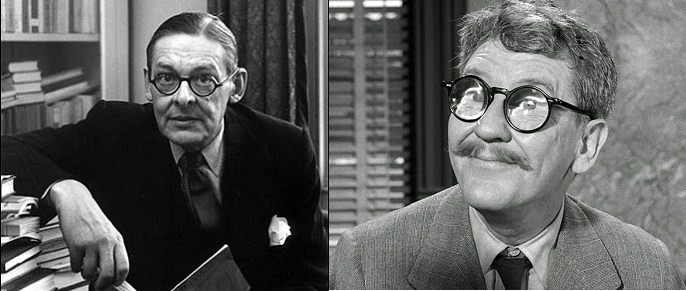
T. S. Eliot and Harold Bemis played by Burgess Meredith. Two bank clerks who’d rather be reading.
First off, Burgess Meredith’s character, Harold Bemis, works in a bank and his marriage is spectacularly dysfunctional. I found it odd that I hadn’t remembered the key scene between the married couple, which is so intentionally cruel and specific as to equal or exceed the empty-hearted offhand cruelty between men and women in “The Waste Land.” Even if the wife’s character is stereotypically shrewish, the ending of their scene is so heartbreaking that I can’t say why it isn’t more remembered. Of course, the whole sexual politics of this echt-’50s trope of the controlling female denying the freedom of the male should be bothersome, but did the TV show intend to reference the scholarly T. S. Eliot circa the writing of “The Waste Land” then working in a bank, famously hamstrung by his own dysfunctional marriage?
Probable? I can’t go that far, but it’s more of an outside possibility than you might think. T. S. Eliot was never Tennyson or Longfellow famous, but in the 1950s he was as well-known as a poet could be then**, and poetry was still considered something of a co-equal branch of literature, a substantial part of culture.
And that was the other detail that stood out watching “Time Enough at Last” again. The couple’s scene revolves around Harold Bemis wanting to sneak a read of a book. A classic novel? A bit of science fiction or fantasy? Hemingway on bullfights and fly fishing? The Second Sex in French? A hard-boiled detective yarn? Philosophy? History? A collection of “Can This Marriage Be Saved” columns?
No, it’s A Book of Modern Poetry. Bemis’ character says of it “This has lovely things in it, really. There’s one or two from T. S Eliot. Edna St. Vincent Millay. Robert Frost. Carl Sandburg.” My ears perked up. That’s the kind of stuff you find here!
Now Harold Bemis is also a stereotype, the nebbish, maybe the idea that the thing his domestic bank clerk life most wants is modern poetry is meant to underline that caricature—that he’s too bookish. It’s not like he wants to anachronistically read The Art of the Deal. Despite the sadness of the scene, it cheered me, it could also mean to say, even a little, that that is what he needs. And in any case, Serling at least thought that an audience in 1960 would know these poets in some way, even superficially. If Jordon Peele or someone would rewrite that scene today and his modern Bemis was to speak of Frank Bidart, Tychimba Jess, Peter Balakian, and Gregory Pardlo*** as the lovely things he most wished to read, would the audience read anything in those names?
Well those four poets could well have as much or more to say to us. Why wouldn’t they? On the other hand, I can perform the older poems I use here freely as I encounter them, and it would be a chore to try to get unencumbered use of current poets for my small project. So, here’s my performance of Carl Sandburg’s “At A Window,” available with the player below, and full text to read along here. All four of the poets he mentions in his scene would have difficult messages that still might console Bemis, all four could write a lovely line, even about harrowing things. But I’d choose this one from Sandburg for him to read aloud.
*Serling’s screenplay was based on a 1953 If magazine short story by Lynn Venable. Venable also has Harold Bemis as henpecked and working in a bank, but her story has Harold’s spouse so dead-set against him reading that it’s said he hasn’t ever been able to finish a book, and the only book author name-checked in the entire story is Spinoza. Her scene between Bemis and his wife is told in a much blander flashback.
**Before there was a national poetry month, on April 30th 1956 T. S. Eliot spoke in the Twin Cities, filling one of the largest capacity basketball arenas in the country (somewhere between 14,000 and 18,000 capacity)—not for a mythic men’s Final Four between Eliot, Robert Frost, Wallace Stevens and Carl Sandburg, but for a solo lecture sure to pack’em in today: “The Frontiers of Criticism.”
***Those are the last four winners of the Pulitzer Prize for poetry. Unfair! Bemis’ book was an anthology of modern poetry, those poets he longs for all had been publishing for 40 years. But just for contrast, here are the poets who won the Pulitzer in the ‘50s, “recent years” to the 1959 TV screenplay: Gwendolyn Brooks, Carl Sandburg, Marianne Moore, Archibald MacLeish, Theodore Roethke, Wallace Stevens, Elizabeth Bishop, Richard Wilbur, Robert Penn Warren, and Stanley Kunitz. Of course, poets in your rear-view mirror may appear larger/greater than they are to contemporaries, and it does look like the Pulitzer committee was more likely to give “lifetime achievement” awards in the ‘50s than they have been in our century.
I once thought that one of the marvels of Emily Dickinson is that she was able to create such revolutionary poetry without any supporting circle of fellow writers. She had poetic heroes: Shakespeare, Emily Bronte, Elizabeth Barrett Browning, but she never met them. Well, it turns out there’s a bit more to her story.
Last year I followed a thread that her sister-in-law, neighbor, and friend Susan Dickinson wrote poetry, and as a result performed one of Susan’s poems “Crushed Before the Moth.” Interestingly, it sounds a bit like an Emily Dickinson poem. This year, I’m reading Genevieve Taggard’s biography of Emily Dickinson, one of the earliest written—researched in the 1920s when people in Amherst who knew Dickinson and her family were still living. And it’s inside that book that I met up with Helen Hunt Jackson.
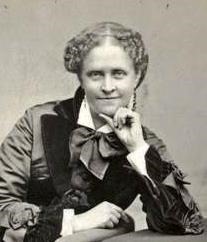
Helen Hunt Jackson: poet, novelist, activist.
Helen was the same age and a childhood classmate of Emily Dickinson, but she married a brilliant military engineer and left town.* Taggard’s biography tells me that she returned to Amherst and visited Dickinson several times. By the 1860s Helen too was writing poetry. Like Emily Dickinson, Helen Hunt Jackson was connected with Thomas Higginson, the editor/abolitionist/feminist who Dickinson famously reached out to and corresponded with, and who helped edit the first collection of Dickinson’s poetry after Emily died.
Helen and Emily exchanged work and discussed writing. Genevieve Taggard even says that Jackson was selecting work for her first collection of poetry while visiting with Dickinson. Unlike Dickinson, Jackson aimed to be published, and did so not only in magazines but eventually in over 20 books.** While Thomas Higginson discouraged Dickinson from publishing, Helen Hunt Jackson adamantly urged her to. Jackson midwifed the publication in an anthology of one of Dickinson’s poems “Success is counted sweetest” the only poem of Dickinson’s published in a book during Dickinson’s lifetime.
Did their writing influence each other? It’s hard to say. Jackson certainly didn’t convince Dickinson to become a publishing professional author, but another woman of the same age and town selecting and publishing books of poetry had to encourage Dickinson at least as much as the far-away Bronte and Browning. On the other hand, it seems that Dickinson had already written a great deal of her now famous work before she renewed her childhood friendship with Helen.
I was intrigued to find out that Jackson wrote a novel in 1876 Mercy Philbrick’s Choice which featured a heroine who was socially reclusive, wore white and wrote poetry that some think might be a novelized tale of Emily Dickinson. I skimmed through it this week. At one point in the novel, a friend of the poet character sends two of her poems to a noted editor who responds favorably, and my heart leapt up, as this sounded like a description of Dickinson’s famous letter to Higginson. There seem to be other tantalizing passages that could be a friend roman à clef’ing Emily Dickinson. But one has to remember that the novel’s author herself, Jackson, is a poet, from the same age and home town. Mercy Philbrick could also contain elements of her own life and character. That certainly seems so of the title character’s poetry quoted in the book—it doesn’t sound at all like Dickinson.
So, here’s today’s piece, a poem written by Helen Hunt Jackson about an Italian wheat field. It’s kind of a revoicing of Wordsworth’s famous “Daffodils” poem, but it has its own charm and details. We celebrate National Poetry Month here the same way we present poetry the rest of the year, a mix of the well-known and the forgotten. To hear my performance of Helen Hunt Jackson’s “Poppies on the Wheat,” use the player below. Want to follow along with the text while listening? Here’s the full text of the poem.
*Emily met Helen’s husband Edward Bissell Hunt when the couple visited Amherst and Emily noted that he was one of the most fascinating men she’d ever met. Edward Hunt was killed at the Brooklyn Navy Yard during the Civil War while leading the testing of a top-secret weapon of his own design, a self-propelled torpedo. Helen remarried after Edward’s death extending her formal name to Helen Hunt Jackson, though she often published using the non-gendered pen name H. H.
**While her poetry is not well known today, Helen Hunt Jackson became a campaigner for Native American rights starting in 1879. In 1881 she published her first book under her own name, a book setting out the reasons for her cause A Century of Dishonor which she sent to every member of congress. Three years later she novelized about Native American issues and wrote a best-seller Ramona which has been characterized as Uncle Tom’s Cabin, only dealing with Native American mistreatment.
Was I being audacious when I compared Eliot’s “The Waste Land” to a modern hip hop/rap production sampling various parts and levels of the world’s culture? I don’t think so (though maybe I should be worried). I’m not going to get into a rap battle between T. S. Eliot vs. Missy Elliot, or a discussion about “Kendrick Lamar, is he a ‘real poet?” like my generation used to discuss Bob Dylan. My aging generational knowledge isn’t deep enough to discuss Lamar or Elliot as intelligently as I should. I’m more comfortable discussing folks who were born long before I was, but someone like Charley Patton is too O. G. to bring up here often. After all, T. S. Eliot and Charley Patton are my grandfather’s generation, born in the 19th century. People like me can be pretty good in figuring out what lessons our grandparent’s completed lives impart, not so good at what lessons our children should learn from us, and terrible at what lessons our children could teach us.
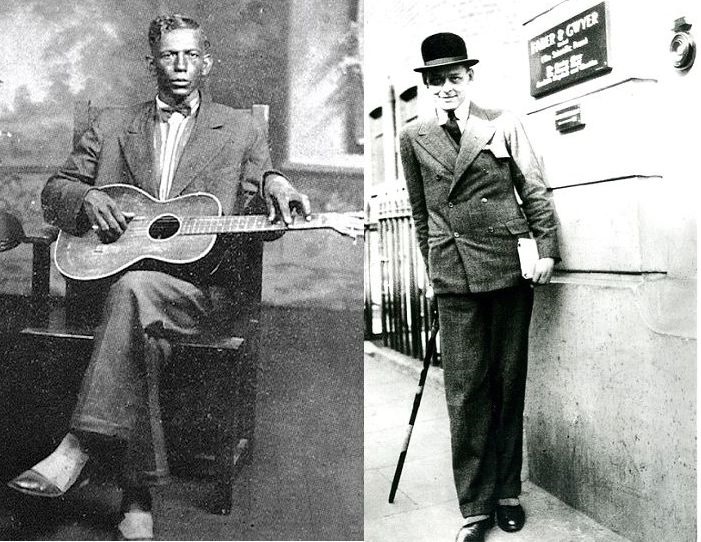
Charlie Patton and T. S. Eliot: two young swells put their best foot forward beside different rivers in the 1920s.
Eliot may have thought he was copying cubist paintings or cinema montage or some French poetry, but he chose this sampling tactic or he would have done something else. Who was Charlie Patton copying? I don’t know exactly. Maybe he made it up. Maybe some griot or indigenous shaman whispered it in his ear.
T. S. Eliot was his own kind of odd guy, odd to his contemporaries, even if he eventually became enormously influential in the Modernist literary movement that had taken over poetry education by the time I was a student. When I first introduced “The Waste Land” here I said there’s two things you need to know to approach it, and they aren’t esoteric at all: first that it’s musical and intended to be, and second that it’s written by a person suffering from depression, a common human malady that colors and filters perception profoundly. Now, following my grappling with it in the past few years, I’ll add two more things, neither of which require reading about Grail legends or From Ritual to Romance either: it’s written by a man writing for a culture coming out of a tremendous wartime trauma and it’s written by a man struggling to come to terms with human sexuality, it’s sins, pleasures, and disappointments.
On the war issues, Eliot is guiltily living, not dead, in a world where many others weren’t so lucky. Estimates vary, but somewhere between 15 and 19 million people were killed in WWI, the majority from the European theater that had become Eliot’s home. Given this level of death, it’s not surprising that Eliot personally knew people killed in the war. Most of his British literary contemporaries served in the war, he didn’t. Indeed, while WWI raged, he tried to disengage from the war, to continue to focus only on scholarly issues and his literary writing.*
Eliot’s an American from St. Louis in a foreign country and he’s gotta figure out how to trans-Atlantic code-switch. He goes in full-force, becoming so completely English that he eventually was able to style himself as an authority on what was appropriately British. After the conclusion of the war, as a literary critic he can write about “objective corelative” and all that, but he can no longer ignore the trauma his adopted country and the rest of Europe has suffered.
Last year’s segment “A Game of Chess” rolled-up into one audio file in our last post, portrays marriage darkly and introduces rape and sexual coercion as one of the underlying themes in “The Waste Land.” Here we know little about Eliot’s own experience, other than his marriage to an English woman was dysfunctional. As we move further into our section for this year, “The Fire Sermon,” sexuality is further brought forward in an unflattering light.
As the section begins in the segment I call “Sweet Thames” we’re back in a ruined landscape, the titular “Waste Land.” The scene seems post a debauched party season, missing even the messy vitality of that. Eliot, a man who grew up near the banks of the southern Mississippi is now on the banks of London’s Thames river.
And then he, or some incarnation of the poem’s speaker, the many voices in Eliot’s head, is fishing. Following the literary and critical references, this is the Fisher King, and we could look to a trail of ancient myths, but I chose to keep it immediate and funky in performance. This is a dirty, river-rat frequented urban river. He wants us to know that he’s fishing next to a gashouse, which I take to be one of those now obsolete processing furnaces that turned coal into coal gas, a smelly and polluting process usually relegated to the worst part of town. The anachronistic pendant in me found this amusing, as a decade after ex-St. Louis boy Eliot wrote “The Waste Land” his home-town Cardinals baseball team used to intimidate their opponents by wearing stinky unwashed uniforms and were given the nickname “The Gashouse Gang” for their smell and general lack of decorum. There’s no known connection for this coincidence, but it’s good that they didn’t wait until later in “The Fire Sermon” and to then become the World Series winners dubbed “The Young Men Carbuncular.”
As the section nears an end point another song-sample break is dropped,** the Mrs. Porter section. Eliot noted that it was an Australian army folk song, and further research indicates that the Mrs. Porter may have been a Cairo brothel keeper known to the ANZAC troops heading for the disastrous Gallipoli campaign, where a dear friend of Eliot, Jean Verdenal was killed in battle. Depending on how salty the soldier-singer may have felt, the body parts being reported as washed varied.
I like to think that Charley Patton, further down the Mississippi river, might have known that tune, but since neither he nor T. S. Eliot are here to sing this, you can hear my performance using the gadget below. If you’d like to look at the text of “The Waste Land” while you listen, the full text is here.
**And for all you carpe diem fans, did you note the sample from Marvell’s “To His Coy Mistress” here, when just before Mrs. Porter soda-washing-song he says “But at my back from time to time I hear…” and instead of a winged chariot, it’s motorcar horns. If given the choice of grave or sex, I think Eliot would have held out for a third choice.
Each April, as part of our celebration of National Poetry Month, the Parlando Project has been presenting in serial form T. S. Eliot’s High Modernist masterpiece “The Waste Land.” This year, we’re up to the third section of the poem “The Fire Sermon,” but before we present new material, I want to give our newer listeners/readers a chance to catch up.
It’s possible to read the entire “Waste Land” aloud as a dramatic monolog in less than 40 minutes total time. Fiona Shaw has done this, and her performances of it cannot be praised or recommended enough. But for me personally (and this goes back to my first readings of the poem) I’ve always been struck by “The Waste Land’s” intense musicality. The collage process of various voices is musical, and “The Waste Land’s” constant changes in tone and insertion of quotes from other poetry eerily predict hip hop mix tapes in a 78 rpm world. Themes emerge and fall back and are then repeated later on, just as they do in long-form musical composition. Eliot even quotes song lyrics multiple times in the poem.
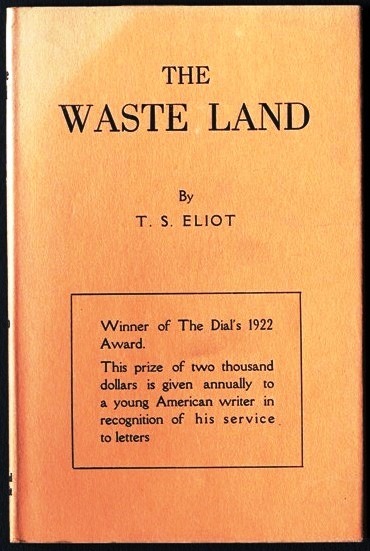
He got $2,000 for service to letters, but our aim is to demonstrate the music in it
So, I’ve long dreamed of performing “The Waste Land” with music—and now, as part of this project I’m realizing that dream on the installment plan. While I think the music can help bring some solace and additional shadings to Eliot’s unstinting look at human failure and limitations, the resulting performance is lengthy. It’s not the kind of thing I can take on creating and performing lightly—and to listen to it, even casually, is not light entertainment either. The Parlando Project normally focuses on shorter poetry, the lyric impulse. Almost all of our pieces are under 5 minutes, and we have hundreds of them available here. So, don’t feel obligated to listen to these longer “Waste Land” pieces. They are not for everybody, and I believe they are consistent with Eliot’s design to write only for those willing to look at dark impulses and feelings, to weigh and consider them within your mind and heart.
Here’s “I. The Burial of the Dead,” the first section that famously opens with “April is the cruellest month, breeding/Lilacs out of the dead land…” which is likely a reason that April is U. S. National Poetry month (and may already be referring to another poem, Walt Whitman’s Lincoln elegy, “When Lilacs Last in the Dooryard Bloom’d.”)
And here’s last year’s contributions, the section “II. A Game of Chess” rolled up into one piece for the first time here. I start out this one by making an ex-post-facto connection of Eliot’s lavish and dissipated opening of “A Game of Chess” with the late-night, dragged out, “Ain’t it just like the night” style of Blonde on Blonde era Bob Dylan, and it ends with an appearance of a guest reader Heidi Randen for the monolog about Lil and Albert and their just-discharged-from-the war marriage.
This month we’ll continue our serial presentation of “The Waste Land” with one of its longest sections, “III. The Fire Sermon.” If you’d like to read along with the text of the poem while listening, the full poem is here. With these musical presentations I maintain that you can listen to them and not feel that you need to understand what the poem means in the essay-question sense, and instead only require the poem’s words to strike you with scattered connotations and impacts. There are a great many resources for those who would like to delve into deeper meanings of “The Waste Land,” all the things that Eliot intended to put there—and also the things he only inherently and accidentally included. For those that enjoy that, there’s much there at that level, but I remind you of the concept I laid down a couple of posts back regarding Emily Dickinson’s much shorter poem: a poem isn’t so much about ideas, it’s about the experience of ideas.