Our most recent post in our April National Poetry month series using poems found in Louis Untermeyer’s between-the-world-wars Modern American Poetry contained some quotes from a long poem, contemporary with the anthology, recounting a conversation between two prize-winning male poets concerning women poets and Untermeyer’s evolving judgement about the poetic canon. There’s another post I might yet write about those choices, but “from A Letter to Robert Frost” also had me thinking of The Sisters, Patricia Wallinga’s one-act opera about the issues female poets face. Since it uses Amy Lowell as its central character, I wondered if I could quickly set a poem of Lowell’s to follow up.
Unlike Emily Dickinson, or several other women poets of Lowell’s era,* Amy Lowell hasn’t been central to my own thinking. I was aware of the “Imagism Wars” where Lowell, a prominent promoter of the new free verse forms that emerged in the 19-teens was accused of hijacking the artistic movement by Ezra Pound, who with Englishman F. S. Flint had originated that name. Pound’s tactics in the battle included declarations that Imagism was now passé anyway, and it was time to move to new strains of Modernism. The stragglers, #Pound said, should now call their movement “Amygism.” And those weren’t the only projectiles in that battle: weighty Amy Lowell got the sniggering nickname “The Hippoetess.” Schoolboy behavior.
Those elements of Ezra Pound’s character (and his eventual abysmal politics) aside, I rather preferred the early poems from the Pound-Flint version of Imagism. And there was another factor, Lowell was from a long-important and financially secure family. Wealthy patrons of the arts have done good things certainly, and Lowell was out there promoting the new American Modernism with more than just banknotes – but even that was part of the problem. Was her place as a consideration-worthy poet more-or-less purchased? She did, in fact, put energy and study into being a poet, but my own background and nature is to suspect things like that, and to hope for better in the arts.
There’s a counterargument. Lowell didn’t choose her family, and no matter what one thinks of rich-kids and nepo-babies, talent and achievement happens where it happens. I’d already looked at Amy Lowell’s segment in Untermeyer’s book. Nothing jumped out at me on the first overview. The striking image, the musically attractive approach to language, the interesting approach to subject matter – I didn’t find it on my first glance. Reputation alone doesn’t make for a Parlando Project piece, as you may have already figured out from some of the “who’s they” selections I’ve already presented this month.
But shouldn’t I look again at the woman who Wallinga chose as her Beatrice guiding her look at women in poetry, the same woman who Hillyer calls out to Frost in his long poem about the state of poetry in the 1930s as “our friend at Sevenells?”
And that’s when on Monday afternoon my eyes fell on Lowell’s “A Decade.” First, it’s a short poem as a text, always a plus for me with my rapid and unpredictable production schedule. And I was, on second thought, attracted to this statement of passion melded into longer partnership.
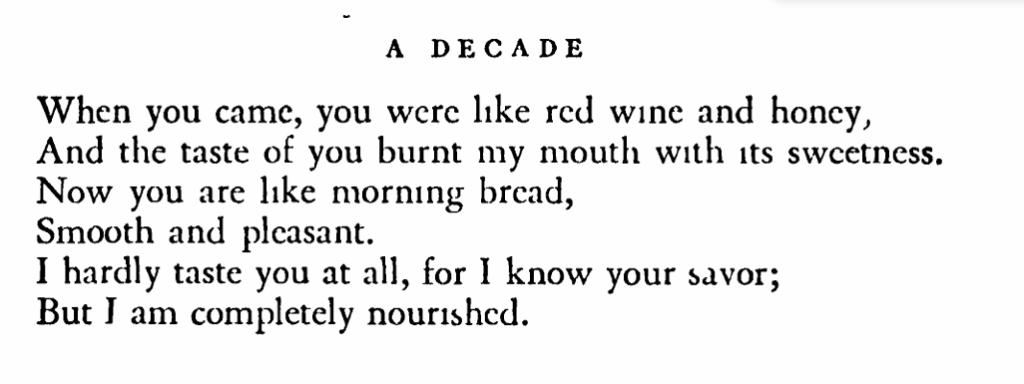
It’s possible to read this poem as not about desire and a personal relationship I’d suppose, but I don’t read it that way. Does the consensus Untermeyer reflects below reflect a blindness, intentional or not, to Lowell’s relationship to Ada Russell Dwyer?
.
The next day was largely spent making the musical piece you can hear below from this poem. The music came together quickly. It’s a piano trio, but the fretless bass doesn’t offer its companionship until the ending, and the rest fell into place when I found for the piano an arpeggiator pattern that expressed a 5/4 beat that I liked. Harmonically, the music is remarkably static, occasional extensions and variations on a G major chord, an idea I felt complementary to the poem’s treatment of the relationship. Indeed, the experience of recording this musical setting changed my experience of Lowell’s poem tremendously. By making the poem audible, I could feel that transit from desire to devotion as I endeavored to make my limited voice an acceptable conveyance for her words.
Silent on the page it’s not the same poem I found by speaking, by performing, by singing the words. I looked back on the consensus reflected in Untermeyer’s introduction to Lowell in his book:
Miss Lowell was not at home among the emotions. She triumphed in the visual world, in the reflection of reflections, in capturing the minute disturbances of light and movement. It has been said that, though a poet, she failed as a humanist, that she never touched deep feelings because she never knew where to look for them.”
I had a recorded performance by Tuesday afternoon, and such a spare arrangement should have led to a quick mix of the tracks and a later Tuesday release. Except…
The recorded sonics were troubling me. First, I usually record my vocals pretty-much “dry” and fix EQ, leveling, and add things like reverb afterward, but in an effort to buck up the confidence of my singing voice I had applied more than a little “vanity reverb” (and delay)** while tracking. That did give me more confidence as I was singing, but in the cold light of the afternoon mixing, it lacked (using one of those vague terms people use to describe sound) “a solid place” in the mix. This issue was complicated in that I record on one computer system and software and mix on another. Removing or lowering the reverb and delay in modern computer software after recording is trivial as long as the musical tracks stay within that piece of software. Once extracted to “printed” tracks (which is what I mix with later) that flexibility is gone.
Furthermore, even in such a simple ensemble, getting the mix between the vocal and the featured piano was critical, and each time I made a mix that sounded right, it didn’t translate when I checked it on common earbuds that I suspect are used by many listeners to these pieces. I produced three “that’ll do it/no it won’t” mixes before settling on a fourth just before going to bed last night. The too airy and diffuse vocal was mitigated by a bit of low-mid EQ boost and the slightest of top end roll off, and now you can hear my performance with the audio player below. No audio player? Ah, that’s likely due to some ways of reading this blog suppressing showing the player – but this highlighted link will open a new browser tab with its own audio player then.
.
*Speaking just of early 20th century American-based women that come to mind this morning : Edna St. Vincent Millay, Anne Spencer, Sara Teasdale, H.D., Elinor Wylie, and Mina Loy have all received musical settings early and often over the decade of this Project.
**”Vanity Reverb” is a common producer tactic to help weak singers perform – it makes the vocal heard in the monitoring headphones sound grander to the shrinking vocalist. Even though I am both the producer and the singer here, the trick still works. Of course, it would have been best if Producer-I had left a dry signal track in there for more flexibility in mixing – but in my haste to get the recording done while I could, I forgot to do that.

