Dunbar

Here’s a piece using an outwardly modest poem by a modest poet, Anne Spencer. It spoke so quietly to me, that at first I overlooked it when I was reading James Weldon Johnson’s seminal “The Book of American Negro Poetry”  anthology, which included it. Just a few weeks later I saw a small story online about her exemplary life as a behind-the-scenes civil-rights activist, which mentioned that she was also a poet.

From it’s title we know she is following one of the Parlando Project mottos: “Other Peoples’ Stories.” When the poem utters its refrain “Chatterton, Shelley, Keats, and I…” that “I” is to be understood as Paul Laurence Dunbar, who was at that time a decade dead at the age of 33, but who was still the most famous Afro-American poet.

Long-time readers here have already met up with Dunbar, and Shelley and Keats require little introduction to those acquainted with English verse. That first name, Chatterton may draw a blank however.

Thomas Chatterton was the most famous failure in 19th Century English literature. A poor boy with pluck he had tricked his way into a modicum of fame by pretending to be the discoverer of a tranche of medieval poetry by a Thomas Rowley. To keep the pot boiling and to engage in the roiling politics of the day, he wrote journalism and opinion pieces under more than one pseudonym, as well as further literary works. The gig economy of his time was not kind to Chatterton. At the height of his career, he would earn about $9 in current dollars for his longer articles. In contrast, writers of our last post’s Burma Shave’s jiggles were paid over $800 in today’s money.

So how does Chatterton make it onto Anne Spencer’s words for Dunbar?

Chatterton was doing all this as a teenager. Fatherless, broke, starving, seemingly at the end of his resources, he took a fatal dose of arsenic and died in his garret. He wasn’t yet 18.

Death of Chatterton by Henry Wallis

Morbid it might be, but “The Death of Chatterton” was a popular and often reproduced 19th Century painting
Given its time, social media was not blamed for his death, but political and class prejudice was.

.

A few decades later, the British Romantics grab on to Chatterton’s case as the perfect example of rejection of the beautiful by the unperceiving. Keats, who was himself tagged as a low-born pretender writing “Cockney poetry” in “uncouth language,” wrote a sonnet to Chatterton. The too-little-appreciated-in-his-short-life Percy Bysshe Shelley, exiled from his culture for radical political and social views, writes “Adonais,”  the now famous ode on the death of Keats at age 25. In it, Chatterton is met on a heavenly throne “Rose pale, his solemn agony had not yet faded from him” as he greets the now dead Keats/Adonais.

Note here the unperceiving in each case has something to do with politics and class prejudice.

And now we return to Anne Spencer. At age 11, the legend has it she was barely literate, six years later she was the valedictorian of her graduating class. Two years later she married and settled in Lynchburg Virginia. Eventually she wrote while raising children and working as a school librarian. In 1918, she helped found the local chapter of the NAACP. Her home became a waystop for numerous notable Afro-Americans traveling in Virginia (“Jim Crow” laws would have segregated public accommodations). James Weldon Johnson (one of the founders of the NAACP) was one of those visitors, and finding that Anne wrote poetry, he helped her work get first published in 1920.

whites only smaller

Two “Whites Only” signs from the Diane and Alan Page collection.
Homes like Spencer’s were important facilitators for Black American travel.

.

Spencer was nearly 40 years old before that first publication. Clearly not the live fast/die young sort. In 1922 when Johnson published the first ever anthology of Afro-American verse, Spencer was included, along with the obvious choice of Dunbar himself. Concluding his introduction to that collection, Johnson said of Spencer’s verse that she was “The most modern and least obvious in her methods.”

“Dunbar”  demonstrates that. Shelley’s “Adonais”  is hundreds of lines. Spencer’s “Dunbar”  is five. Shelley will tell it, repeating and restating his theme in stanza by stanza of glorious English Romantic verse. Spencer’s “Dunbar”  sits quietly, in the midst of this history of poets who died young, whose voices were muffled by prejudice before they were stilled by death. It’s just one chorus. She groups them, tells us Paul Laurence Dunbar found himself with them, a statement of quiet, powerful, assertion.

Perhaps you need to know this history to appreciate the power of that, that “Chatterton, Shelley, Keats, and I” isn’t some arbitrary listing, a line that happens in a small poem talking about a poet—but it’s good to know history, it’s good to have a Black History month, it’s good to know that Keats and Shelley, who now are hallowed in our textbooks, weren’t greeted as worthy poets by their times. It’s good to know that one woman around a hundred years ago in segregated Virginia, quietly but eloquently wrote, and steadfastly worked, to assert a different world.

To hear my performance of Anne Spencer’s “Dunbar,”  use the player below. Don’t see a player? This highlighted hyperlink will also play it.

Shattered Visage

The place of short epigramic poetry in our culture, and just a touch of Percy Bysshe Shelley, combine in today’s piece.

When people seek to stop the expansion of poetry in definition or in practice they will aim and fire at certain targets. If you look closely and slowly, you may see the bullet holes with their worn, rusting lips frozen in mid-kiss.

“Song lyrics? When you see them on the page, you can surely tell they aren’t poetry. And what about advertising jingles then?”

I’ll reply that it’s true that we don’t know if Sappho was a copywriter for hire, or worked independently—and frankly, the advertising jingle has passed into disuse anyway. One benefit of aging is that one can remember lost, golden ages when the rustic bards of old sang along the roads.

I speak of course of that mid-20th Century, Midwestern American Greek Anthology presented by Burma Shave. We know only the fragments of their work that scribes have preserved in illuminated HTML, but did these jingles really harm mid-20th Century poetry much?

I think not.

Here was the scheme: an insurgent company that made shaving cream in Minneapolis Minnesota took to the idea of a series of small signs, enjambed with the broken lines of an epigramic poem, signed-off at the last sign with the company’s logo: its name in white flowing script. Cars sauntered on narrower roads in those days, roads that went farther between cities that had yet to leak out suburbs and housing projects. Car radios were an option not ticked off by every frugal buyer, and the boredom on the two-lane was an advertiser’s opportunity. Huge billboards, the epics of the roadside, might have pressed the budget of the Burma Shave company, but those little signs in series were another matter. Poetry, then as now, is a bargain.

Burma_Shave_Signs_by_highway

Poetry in motion, Burma Shave signs in use, circa 1940.


And to us, the naïve backseat riders with no tablets or Gameboys, we could hope then the horizon might give us that initial red sign and line of verse, followed by their episodic reveal, their enforced caesurae.

Perhaps the poems imagery or significance did not equal Elizabeth Bishop or Wallace Stevens, but the experience—yes!—was exactly what poetry should deliver. It comes on us, with expectation, but unpredictably. It reveals itself, in time marked with intervals that tell us it is indeed time. And in the end, it pleases us in a way that the passage of a mere Pioneer Seed Corn placard or another end-of-lane mailbox cannot.

Its motives may not have been artistically pure, but we didn’t care.

Commercial motives are as fragile as Olympian ones. Around 1960, Burma Shave was sold, and the brand discontinued. The placement of new signs stopped, and only in places where no one cared to groom the roadside did they remain to gradual ruin.

Years later I would move to Minneapolis, and eventually I would fall in with some folks who created a literary magazine that wanted to celebrate the inescapable, unpretentious—yes, sometimes commercial—main drag down Phaeton’s east-west path of the city. They called the magazine “The Lake Street Review.”  Down that street I would often bike or drive past a nondescript building, just before the freight-railroad tracks, just before the shopping-and-buying mall built were Minneapolis-Moline once built tractors. When it was built, this building had been a church, but as the area became industrial in the early 20th Century, the building became, for awhile, the headquarters, the factory, the Parnassus of Burma Shave.

Save the (Burma) Shave

The ex-Burma Shave building on Lake Street as it appeared in the 21st Century


I don’t know if any of us knew that. I only found out as they planned to tear it down, which they did. As the workman did a workman’s job, in the midst of the ditch of lathe and beams, a red sign with cursive white letters was found at the end: “Burma Shave.”

Weckage of Burma Shave Building

“on the pedestal, these words appear…” After the Burma Shave building was torn down.


Musically, the LYL Band performed “Shattered Visage”  a couple of years ago, but I share it now after this week’s presentation of Shelley’s “Ozymandias.”  As I said Monday, I read “Ozymandias”  without bringing out the pathos in the the impermanence of human achievements, choosing instead to emphasize time’s judgement on tyrants, but in “Shattered Visage”  my parody turns to the former. One other link to “Ozymandias:”  remember Horace Smith, the second-place sonneteer who also wrote an “Ozymandias?”  He entered into literary circles with a spoof he authored along with his brother, where they imitated all the most famous poets and orators of their time, including Lord Byron, who supplied an admiring blurb when the collection was published.

To listen to “Shattered Visage,”  use the player below.


Ozymandias

I came upon Percy Bysshe Shelley and this poem like many have, a teenager with a school poetry anthology on my desk. It is a good teaching poem, what with its readily accessible irony—and so, “Ozymandias”  came to me, nestled with poems by Keats and Byron, within the handy “The Romantics” chapter.

Stepping outside the poetry, even briefly, into biography, I found them a glamourous bunch of young men to my teenaged heart. The original “live fast, die young, leave a beautiful corpse” crew. Political and sexual revolutionaries, aesthetes with groupies. Should I study them, or seek to be them? Well the former was on offer, the latter harder to obtain for someone of my looks and stature.

Oxford-University_Shelley_Memorial

One Romantic depiction of Shelley’s drowned corpse, which looks better than some of us do alive.


In the 1960s Byron, Keats and Shelley were the rock stars in my textbooks. To the generation before the coming of the 20th Century Modernists, they seemed that too, even if “rock star” wasn’t yet a metaphor in the shops. So, Tennyson and the Pre-Raphaelites wanted to be Byron, Keats and Shelley too. In America, Edna St. Vincent Millay and Paul Laurence Dunbar showed that you didn’t have to be male or white to feel that urge. Even unique figures like Rabindranath Tagore were touched by their model.

Well, despite the notoriety, the tangled amorous relationships, and the requirement of a tragic early death—yes, in spite of this—in the end the romantic, idealist stance doesn’t remove the poet from the mundane tasks of writing poetry any more than drugs and sex remove from a rock star the need to come up with, well, some music once in a while.

Such is the case here of “Ozymandias.”  Did this poem strike Shelley’s poetic soul in a flash of hashish inspiration while adventuring in the Middle East? Well, no. If we were to continue the musical analogies, it instead came from a silent, slow-motion, written-poetry equivalent of a Battle of the Bands, a Rap Battle, or a songwriter’s Song Pull, a friendly contest undertaken with another poet, Shelley’s contemporary Horace Smith. They both were working off the same short passage from 1st Century BC Greek historian Diodorus, which gives both of them the plot. Here’s Smith’s “Ozymandias:”

Horace Smiths Ozymandias

Horace Smith’s version of “Ozymandias.” Not found in schoolbooks.


After they finished their competing works, I wonder how Smith felt. If one goes to poetry for meaning, these two poems make near the same point. Imagery-wise, Shelley’s choice and portrayal of the broken statue on a barren desert does have better selection of detail. And Smith, trying to make his rhyme, has one particularly awkward line, the one ending “holding the Wolf in chace” (“chace” is an Old-French word that was once used in English to mean hunt). But where Shelley kills it here, is his word-music. If you look at Shelley’s manuscript of “Ozymandias”  you can see some of how he worked on these things, so they wouldn’t be “lifeless things.”

Art is not a competition. Criteria are slippery things, and what works in one poem, fails in another. Even day to day, within our own singular selves, what we seek from, or need from, art differs—but Smith’s “Ozymandias”  was rightfully eclipsed by Shelley’s.

In my music and performance of “Ozymandias”  I went counter to other presentations I’ve heard. The poem’s lyricism and the later 19th Century acceptance of Shelley as a portrayer of ideal beauty has masked the Shelley that was a political radical and iconoclast. As a result, many read it lightly, bringing out its sonic beauty or its pathos. I don’t know how Shelley, the radical, would want it read, but I’ve always felt that the traveler who’s telling this tale knows all too well, in non-historic terms, about living under a hand that mocked them with a sneer of cold command.

Therefore, I emulated the spirit of another English iconoclast, Kevin Coyne, for this piece. I love the probably apocryphal story of Coyne being approached about replacing Jim Morrison in The Doors, that rock star/poet hybrid. In Coyne’s telling, he turned them down because he “didn’t like the leather trousers.”  To hear my sans culottes performance of “Ozymandias,”  with more disgust at tyranny and less pathos at time’s ravages, use the player below.


The Wood-Pile

Robert Frost is every bit the master of word music as Yeats and Millay. What makes Frost stand out is that he was every bit the thoroughgoing early 20th Century modernist as any of his free-verse contemporaries, while retaining an ease with accentual syllabic meter.

Here’s an example of Frost handling a subject just as a free-verse Imagist would. His aims, his presentation, hold to the Imagists’ principles. He deals with the thing directly (as we shall see, two things, but still…), and there are no tacked-on metaphors, no stock comparisons, no extraneous “poetic” language. Context is shown, but not explained. He loosens and varies his meter, so the poem sings and never seems to be a shackled march. At 40 lines, it’s a bit longer than Yeats’ poem considering “The Wild Swans at Coole,”  but Frost’s extra detail is even more specific and concrete than Yeats, though both begin their poem with the poet walking in a rural wetland. Yeats slough is a well-known place to him, conditioned with 19 previous visits. Frost is far enough into his swamp to not know exactly where he is, and so experiences what he sees with a first-time immediacy. Yeats’ slough then contains tradition, Frosts’ the more Modernist “Make it new!” place.

Though presented as one simple rural scene and story, “The Wood-Pile”  is more at two poems, though each part speaks to the other. As Frost’s tale starts, we are in the midst of one of his characteristic journeys, just as we are in other famous Frost poems. There’s a need for decision (“Turn back” or “go on farther”) and his choice, also made in other Frost poems, is to go on regardless of whatever doubts brought the question. If he’s lost in the dark by a wood on a snowy evening, keep going. If you come to a fork in the road, pick one and go on. If you’re walking in a swamp in winter and your foot is sometimes falling through the frozen crust, well, keep going “and we shall see.”

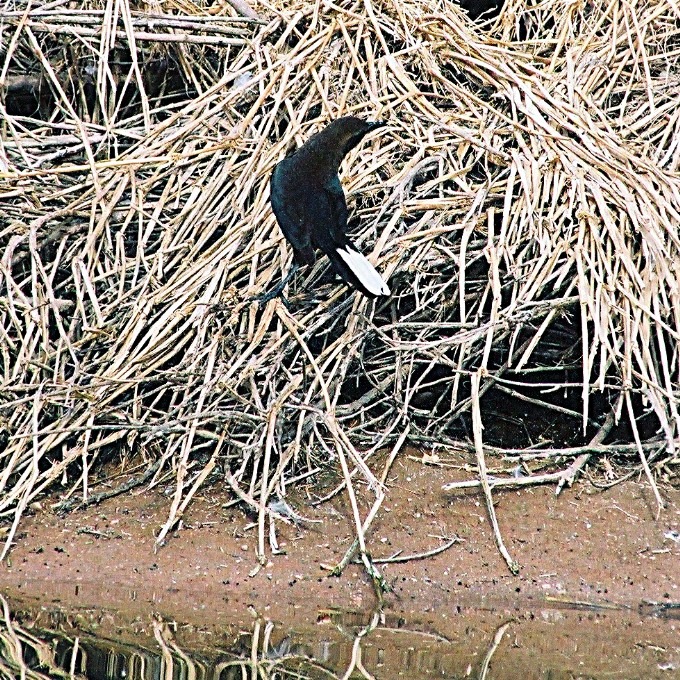
And so, here he sees his bird. No Keatsian nightingale, not Millay’s elusive flying swans with their awkward dangling legs and cries, nor Yeats’ majestic 59 swans, but a small bird. This bird becomes a mirror to the poet. Frost’s bird too must make choices in direction, and the poet, sensibly, thinks the bird’s guided by fear. “Keep something between little me and the big lummox trodding through the winter swamp,” he humansplains. And there’s a bit of humor at human’s expense as the poet muses that the bird, like humans with their self-importance, may think that the only reason for Frost to be out in the swamp is to go after the little bird.

Gackle with white tail feather

“He thought I was after him for a feather—the white one in his tail”


But, we don’t know why Frost is out in the frozen swamp explicitly. The only reason he’s given, or will give, is the Imagist poets’ reason: “and we shall see.”

The bird leads Frost to the second thing the poem wants to present: an abandoned fire-wood cache. Here Frost zooms in close. Every detail of the cut wood and the once neatly stacked and propped wood-pile is stated. Frost turns forensic, like some New England Sherlock Holmes: this pile has been abandoned for years. Mature vines have grown through it.

wood-pile

“The slow smokeless burning of decay”


Here is another context left unsaid. Why would someone abandon a purposeful wood-pile in a swamp? Frost leaves it for us to be detective and to solve the mystery. This isn’t some lot of fire-wood left temporarily to be gathered later in the day, care has been taken to stack and prop it.

The only thing I can think: someone once built a shack (now completely disappeared) on the swamp land. Frost muses, sardonically, that only someone so busy with “fresh tasks” could abandon such effort in cutting and stacking. Does he mean to say, “only a fool would be so industrious to cut and stack this wood and yet not notice he was building his shack on a swamp that would not support a homestead?”

Now, the small bird with his “little fears” and oh-so-human misapprehensions of reality—and now, the steadfast Frost of miles to keep going, even if you may be lost, are set in contrast to this choice. Your fears may lie to you—but so will your optimism.

I once heard an astringent biological statement that the length of our lives can be reduced to a slow-burning chemical reaction. Frost’s last line here is a sad and beautiful analog to that truth.

Turn back or go farther? Go on, and we shall hear my performance of Robert Frost’s “The Wood-Pile”  with my original music. Just use the player below.

The Wild Swans at Coole

Let us for a moment consider length in English language poetry. Despite the customary inclusion of one or two very short poems in most American poetry anthologies (“The Red Wheelbarrow   or “In A Station of the Metro”  typically), one can easily derive from them an accumulated mainstream judgement that poems shorter than a sonnet’s 14 lines are judged slighter expressions of less merit.

Similarly, in music, for all the glories of the mid-20th Century’s two minute and forty second 45 RPM single, serious composed music demonstrates greater regard for pieces of at least middling length, and the 20 to 70-minute symphony is still regarded with reverence. And so on with improvised music practice, which seem to find the five-minute mark as a minimum. Even the later 20th Century movement that got called “Minimalism” worked the idea of fewer motifs considered at greater length.

And so it is when we consider swans, the largest waterfowl, in words. Our last post and audio piece used Edna St. Vincent Millay’s “Wild Swans,”   a fine poem, but if one looks at the accumulated attention gathered in the roughly 100 years since each was written, Millay’s “Wild Swans”  is overshadowed by William Butler Yeats’ “The Wild Swans at Coole.”

Yeats’ poem is worthy of this attention, and he does pack a lot into his mid-length 30-line poem, written by a late middle-aged poet as his colonized country has experienced a failed revolution and his world has seen the shocking mechanized slaughter of the original World War. All that violence is subtext—not once is it mentioned—and as we read or listen to it now, that violence may no longer be apparent, though the background of disappointment remains.

Millay presents the swans as something she cannot comprehend as they fly over her, with her disappointment, her heart at present “a house without air.” Yeats on the other hand presents an almost OCD-level attention with the swimming swans at the beginning of his poem. He has apparently been counting them on each visit for 19 years. He’s going to count them again. And then they fly off in clamor before he can finish his count even though he reports an exact number.

The specificity of those two numbers is curious. Is the 19 years of visits to Coole in Ireland a mere biographical fact? Are the “nine-and-fifty swans” he’s counted an actual census he took regularly? I do not know. Given that Yeats had a long interest in occultism, there may be some occult significance in one or both of those numbers. They are both large numbers for the things they measure: anything one has done for 19 years has a resonance for that long a duration, and given how magnificent the sight of a few swans gliding on the water are, the idea of 59 of them viewed together is an image of overwhelming swan-ishness.

What strikes me most about the two numbers subliminal effect is that both end in 9, and so, seem to be almost at an ending. As the poem develops, Yeats returns to that effect.

These details, written in Yeats typical lyrical fluency, accumulate throughout the poem. The lake and sky repeating each other. 59 swans. The “bell-beat” weight of their wings as they heavily swing them into flight, equally straining, equally coalescing into aerial rings. Their companionable swimming on the cold water “lover by lover”—ah, there’s that 59 again, an odd number—at least one swan has no mate.

But he doesn’t say that. The poem is all its music, the image after image, the beauty after beauty mixed with the undercurrent of impossibility of its permanency. The world will change, the poet or the swans will not return.

19 years of repetition does not mean 19 years of repetition to come. 59 swans is all but too much beauty, but one swan is without a partner.

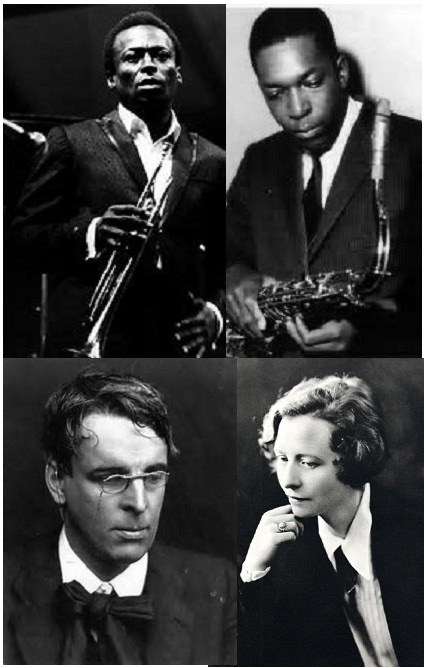
Davis Coltrane Yeats Millay

John Coltrane: “Sometimes when I’m playing there are always new sounds to imagine, new feelings to get at. There’s never any end.”

Miles Davis: “Try taking the f’ing horn out of your mouth”


So, do the 30 lines of Yeats mean it’s a greater poem than the 8 lines of Millay, an objective judgement causing its greater fame?

Why do I have to choose? If Yeats had written 60 or 6,000 lines would “The Wild Swans at Coole”  be better? If Millay had written 80 lines, would her “Wild Swans”  have shown greater skill? We can derive from how anthologists, poetry critics and audiences respond what their preferences are, even those they never articulate explicitly, but in the end it is the longer poems that make the short poems concise and the short poems that make the longer poems seem overwhelming.

How many times have I listened toKind of Blue?”  Does Miles Davis need to play more notes? Does John Coltrane need to play fewer? Looking at these two poems about swans, they illuminate each other.

The gadget below will play my performance of Yeats’ “The Wild Swans at Coole.”


Wild Swans

Let’s return again to Edna St. Vincent Millay as I start a short series of pieces using words by more well-known poets, each of whom considers the book of nature as played out by birds.

Millay’s “Wild Swans”  may be somewhat overshadowed in the Cygnet Committee by William Butler Yeats’ “The Wild Swans at Coole,”  published only a few years earlier than Millay’s poem. The birds of these poems’ central image, the largest waterfowl, are known for white and graceful beauty while at rest or swimming on the water, which contrasts with their somewhat overburdened flight and strangled hinge-in-need-of-oil song.

Other than their pure color and size, it may be the swan in flight that makes them something of the ornithological model for angels, as for such a large bird to have enough strength and wingspan to fly is practically miraculous.

an_angel_playing_a_flageolet-Burne-Jones

No matter how hard you blow on that horn, not enough wingspread to get airborne


In “Wild Swans”  Millay presents that miracle in flight, but by misdirection or misapprehension. The swans are flying as the poem opens, but Millay is instead looking inward—and furthermore, the poet thinks this introspection is bringing no insight.

Swan taking off

Headlong effort transcends grace


But in this short poem’s second part, the images and insights come anyway. In an apostrophe to her heart, Millay addresses it as a “house without air”—an acute metaphor there for despair—and she now asks for the swans to fly over us again, trailing their ungainly legs, crying unselfconsciously their sad and awkward calls.

Wildness, movement, flight beyond bounds, the miraculous after grace, the next day flying over the weeks, then the months and the years.

This is a surprising poem, it’s titular image, those wild swans, are missing, until they are called for in the last five words; not to be beautiful, but straining to be possible.

To hear my performance of Edna St. Vincent Millay’s “Wild Swans”,  use the player below. And remember I rely greatly on readers/listeners helping spread the word about the combination of various words and music here. Tweeting, linking, including in Facebook posts and on other social media, helps this project reach it’s audience. If you don’t do social media, that’s fine too, the amount of work it takes to do this makes that a practical impossibility for me; but if you like this, hitting the Like button for this post helps keep me going.


Tired

I’m going to close out our investigation into the little-known early 20th Century Chicago Modernist poet Fenton Johnson with one of his most emotionally moving poems. James Weldon Johnson first included “Tired”  in his “Book of American Negro Poetry”  in 1922, and it has been anthologized several times since. “Tired”  remains the poem of Fenton Johnson’s that one finds most often shared on the Internet today.

You can see why. Only a few beats in, that powerful line is spoken: “I am tired of building up somebody else’s civilization.” It may take no more than that line alone to have some tag Fenton Johnson as the first radical Afro-American poet.

I cannot categorically disagree there. I know little about Johnson’s political views, and though the two short-lived magazines he founded before 1920 are said to have included political philosophy, I know nothing of the particular stances he took or supported. At least at the time (the first two decades of the 20th Century) “Tired”  along with a few other of Johnson’s poems caused some Black cultural critics to remark that Johnson was too pessimistic, too given over to despair. You might find that strange, but in that moment, there was a feeling that educational and cultural uplift could soon raise the Afro-Americans along with the time’s large and wide immigrant demographics into a new, more accepting America. We know now that didn’t happen, that indeed 20th Century racism and poverty had some mighty blows to land on America and American Blacks with KKK branded racism, Great Depression poverty, and world-wide Fascism—but at the time, that uplift was what many Afro-American elites were pulling for.

However, just by going on what Fenton Johnson poetry I have available to me, I’m not entirely sure Johnson was, at this time, a political radical or a thorough pessimist.

Last Chance Saloon

Somebody give me my gin.” Mike is out back serving warm gin to ladies.

After all, the speaker in “Tired”  is not Johnson himself, no more than the banjo player in our last post’s poem is Johnson, the middle-class raised, college educated man. Even the Last Chance Saloon, where the banjo player played for tips, returns in “Tired”.  Johnson didn’t live in a shanty, he wasn’t married to a laundress.

True, this is a character that Johnson wants us to hear, an important voice that maybe even the Black “Talented Tenth” wasn’t listening to then, much less White America. And though it’s free verse, this is a poem, not an incisive political analysis or program. It’s a dramatic speech with rhythm, repetition, and a rise in despair from gin-houses to the stars.

It’s not hard for me to see in “Tired”  the ancestor of August Wilson’s great play cycle, or the range of characters and voices in Walter Mosely’s detective fiction.

Musically I stepped at least as many decades into the future here, concluding this audio piece with a short burst of the kind of free jazz that allied itself with the Black Arts movement in the later part of the 20th Century. I’ll allow that this music is an acquired taste, but at its core is an ethic of allowing individual voices and modes of expression even in a group context. Free Jazz is not always as raucous as what I played for this, but it does not forbid it either. That’s consistent with what I try to do (within my limits as a musician) with the Parlando Project. When I say we combine words with various music, I mean it.

That does mean that you may not like all the writers’ words I present, or all the kinds of music I write and play to combine with those words, but it means that I’m also not going to stick with one thing and repeat it until we are both tired of it.

I’ve ordered these last four posts here on Fenton Johnson purposely, so to present the man more in full, and because, to be honest, I didn’t feel I could earn any license to speak these words without doing something more than just putting them in my mouth. To listen to Johnson’s “Tired”  as I performed it, you can use the player below where it appears, or this highlighted hyperlink.

The Banjo Player

“So, what are you going to do today?” my teenager asked me.

“Go and be of some use to the world.” I replied.

“How are you going to do that?”

“Write about Fenton Johnson.”

“No really, what are you going to do?”

“Write about Fenton Johnson.”

“Oh. I thought it was a joke or something when you said it.” They were mildly puzzled—but like most of us, most of the time, probably not interested in explanations. Fenton Johnson is not a figure of wide interest, even within the minority interest our culture finds in poetry. Perhaps at some later time they’ll read this, and it’s not an accident that I continue to write here aiming at someone just a bit older than they are.

Of course, I had meant that as something akin to a joke, because our lives and callings are all, taken whole, comic. The sport of fate and circumstance for good or ill should never be mistaken for judgement. Even the tragic is but darkly comic.

James Weldon Johnson on the phone

James Weldon Johnson: poetry anthologist and all-around American polymath, finds he can’t Tweet or post to Instagram  from his phone.

.

In 1922, when James Weldon Johnson (no relation to Fenton) sought to make up the first anthology of Afro-American poetry, he had similar hopes, though more grounded in his greater talent and effort. James Weldon Johnson, like Felton Johnson, was a rare college-educated man in the early 20th Century, and doubly-rare, both were Afro-American college graduates. Both Johnsons held to a responsibility their circumstance pressed upon them: to uplift their race and to heal and resist the ignorance of racial prejudice.

That second part, the resistance part, should feel familiar, as it’s an ongoing struggle many will feel a part of today. Prejudice of many kinds, injustice in so many cases, is still a pressing issue. The uplift part however may feel quaint.

In his preface to The Book of American Negro Poetry  James Weldon Johnson sets out the case that Black American poets should be able to rise to the highest levels of literary achievement, and while he’s not exactly apologetic about the poets his anthology will present, he’s also not a hype-man for what they have accomplished in 1922. Of Fenton Johnson, who he includes in his anthology, he says:

“Fenton Johnson is a young poet of the ultra-modern school who gives promise of greater work than he has yet done.”

Yet, as I look for the work of Fenton Johnson today, almost all the work I find are citations to the same pieces James Weldon Johnson included in 1922. What stunted Fenton’s career? A more extensive biography than may exist would seek to answer that question. The struggle for poetry’s place in national culture was hard enough throughout the 20th Century, add to that the challenges of racism. I do know that Fenton Johnson sought to ambitiously broaden his cultural impact by financing and editing magazines on Black arts and culture, and the failure of these publications to become sustaining was one setback.

James Weldon Johnson, surveying Black Arts in his 1922 preface for his pioneering Negro Poetry collection, speaks not at all of the visual arts (ironically, just as European Modernists were latching onto African art as an influence) and little of Black acting, despite his connections with the New York stage of the time, but he does speak prophetically about the impact of Afro-Americans on American music. Having only the evidence of the spirituals, cakewalk, ragtime, and the imperfect understanding in the cultured North in 1922 of what the newly discovered “Blues” might truly be about, JWJ professes that Afro-American music is already a predominant strain. Nearly a century since, we can only say that he was too modest in his view of the future, however audacious he might have seemed in 1922. American music, seen from outside our country, and in any honest assessment from inside our borders, is Afro-American music. I don’t want to slight the contributions in our country’s music from many cultures when I say that—they are significant—but all of them cannot help but reflect on, and reflect back, the impact of the descendants of those Africans brought here as cargo.

Which brings us to this Fenton Johnson poem included in James Weldon Johnson’s anthology. Here’s a link to the poem’s text. Its overall intent is humorous. You can hear the college man’s mix of condescension with an honest observer’s eye for detail. What makes its poetry an example of the “ultra-modern school?” Our last episode’s Johnson piece, “A Dream,”  was blank verse, even lines, even if the ironic asymmetry of its story is modern. The cadence of Johnson’s God Is in the All Time  is strong and regular. “The Banjo Player”  is free verse, conversational in rhythm. It jumps from the despair of the “Last Chance Saloon” mitigated by music, to the Kris Kringle promise of little children dancing and clapping to the banjo strum, finishing with a joke of the sophisticate.

Like the complex church music and rhetoric of “A Dream”  last time, I had trouble musically portraying the Gus Cannon/Papa Charlie Jackson vibe of the banjo playing bluesman. The banjo is just an instrument that I fight with, and no cheating of one-man-band multi-tracking could save me here I fear. Dom Flemons, Rhiannon Giddens, or someone better attuned to the banjo need to perform this.

I spent an afternoon yesterday depressed at my failure to fulfill the promise of Fenton Johnson’s piece. Could one more mix fix this? Nope.

I moped until I went to sleep.

And then my teenager asked me this question in the morning.

A Dream

Here’s a second poem by Afro-American Modernist poet Fenton Johnson. Like the first piece of Johnson’s that I presented earlier this week, there’s a religious element, but it’s handled this time with a remarkable framing device.

As published in 1921, “A Dream”  is the longer of two pieces which are grouped together as “Two Negro Spirituals.”  What strikes me about them is the extraordinary knife-edge irony held in them between spirituality and reality. If the Language Poets descended from the Modernists will not find in “A Dream”  the novel uses of language and syntax they look for, perhaps the Post-Modernists will appreciate Johnson’s conveying a vivid religious vision framed in a way that causes a reassessment of the foreground material.

That’s more critical theory and bin-labeling that I usually engage in, so let’s move away from that to the piece itself.

Elijah and the angel with a firey chariot

Elijah’s angel-fire chariot. Be sure your seatback is in the upright and locked position.

Is this texturally a “Negro spiritual?” Not really, though Johnson significantly chooses to call it that. The vision he presents, after a brief “Oh, my honey” aside, would not seem out of place in William Blake or any of a number of 18th to 20th Century Christian revivalists. The “spirituals” of the title were largely folk hymns, and the language here is more literary. Johnson wants us to know it’s an Afro-American who’s speaking, yes; but also, a man who could read and know these non-folklore sources. Yet, the recounting of the titular dream is not a scholastic catalog of mystical religious elements, it’s a deeply felt vision of a glorious reward. One does not need to be a Christian to feel the ecstasy of this vision, any more than one needs to fully understand all of Blake’s idiosyncratic religious precepts to sense their “thereness.”

William Blake The Angel

Like Fenton Johnson, William Blake frames an angelic vision

Johnson concludes the poem with a single line of a contrasting vision that recasts all that has come before it. Listen to the piece with the player below to hear it as it occurs.

Musically, this piece caused me all kinds of trouble, and, to be frank, I don’t think I got all the way to what I wanted to achieve. The difficulties of being my own composer, arranger, reader, ensemble of musicians and recording engineer should cause this kind of trouble more often than it does. However, I did so want to continue to present the things that this too-little-known poet Fenton Johnson did, that I have “called time” on this piece, and present it here now for you to listen to. Use the player below to hear it if you see that, or if not, this highlighted hyperlink will also play it.

God Is In the All Time

I’m continually a few days behind in the past month or so, what with Winter holidays and other appointments and responsibilities. Some of the audio pieces have been recorded especially expeditiously, and another part of this project has been neglected: the searches I take to find words (mostly poetry) I combine with original music.

Because publishers do not respond when I ask for permission to use works that may be in copyright, I am constrained to use written work outside of copyright, typically works published before 1923. Although I respond to, and use, poetry written in various eras, my desire to mix in more contemporary voices leads the Parlando Project to use a lot of poetry from the first two decades of the 20th Century. This is not altogether a bad thing. I happen to like a lot of what these pioneering Modernists did, and in some cases, what we find in the mouth of the “Post-Modern” poetry mainstream delta is worthy of reconsideration in the light of the Modernists. Have stagnant currents deposited silt and detritus at our end of Modernism, its own Mannerism that says that poetry must be written in a special poetic language and syntax, because that is the language that serious poems use? If popular poems are to be about recounting internal personal experience and serious poems are to be about hermetic personal language, what is missed?

Maybe we answer these questions by doing, as we answer other questions (even ones we never ask) by living. In my case, the doing may be by continuing this Parlando Project.

So earlier this month, returning to the research that goes on behind the scenes of this blog, I read two old anthologies of poems now in the public domain, looking for some new material. In one I was attracted to yet another piece by Carl Sandburg, a poet I believe should be reassessed in our time, but hardly an unknown, particularly to readers/listeners here. In the second one I came upon the work of Fenton Johnson for the first time. I’m willing to bet most of you haven’t heard of him.

Johnson, like Sandburg, like William Carlos Williams, wrote Modernist verse while remaining in America. Like William Butler Yeats, his career was long enough that he wrote poems that sounded like the 19th Century before transitioning to a 20th Century voice. Here’s a difference: Fenton Johnson was Afro-American.

OK, let me drop a term here: Identity Politics. I was recently reading a thoughtful blog post on Carl Sandburg compared to Post-Modernist poetry, when the author remarked that Sandburg was able to write in a time preceding Identity Politics. I don’t know enough about Left Write & Centaur’s full thought on Identity Politics, but the implication was that Identity Politics, characterized as the idea that we are silos of individual experience based on membership in social and ethnic groups, who then by implication need to be treated and considered primarily by that identity, is a bad thing.

I agree, that’s a bad thing for the most part. I also believe it’s often a real thing.

The first half: the separation, at least to some degree, of individual experience, is so self-evident I don’t feel I need to argue it. Poetry and literature is to a large part a demonstration of the things that we find unique in individual voices—yes, along with things we can find in common in our lived lives—but if our take on experience wasn’t varied, literature would soon become dull and repetitive (at least to me). Even for those things that we find in common as we read or listen, how would we know without literature or other arts letting us share this?

If we feel that separation is a bad thing, then art is where we go to heal that. The arts are simply a name we give to that sharing of experience.

The second part, that this separation can be handled and considered with bins of people labeled with ethnic origin, sexual orientation, gender, age, class, and so forth, this is where it gets real. We cannot wish away with imagination the ways the world labels and files its temporary inhabitants.

Should I care that Fenton Johnson is an Afro-American poet? Should I mention it? Does mentioning it imply some kind of special pleading? As I present a smattering of his development as a poet, will his work become “Well, it’s a Black thing”—a separation surrendered to?

Fenton Johnson

The younger Fenton Johnson. I’m unable to find any later portraits of him.

However we dream our ideal world to come, I know that Fenton Johnson had to deal in the real world of 1918 Chicago, just as he would in 1968 or 2018 Chicago, with his ethnic skin color label on a daily basis. That label doesn’t peel off. No doubt, many he encountered imaginatively filled out that label with a long list of contents, but instead, let’s look from inside Fenton Johnson out at the world.

Will it be the same and different as Frost, Tzara, Sandburg, Rossetti, Tagore, Yeats, and Dickinson? Yes.

Early Fenton Johnson poems often start from a religious theme. This one, “God Is In the All Time”  portrays things from a universalist perspective. To hear my performance, use the player below.