Disillusionment of Ten O’Clock

As we continue our April celebration of National Poetry Month, here’s a poem by Wallace Stevens. Like Keats, Stevens was another poet I liked as a teenager, and like Keats I read him for his language without having a substantial grasp on what exactly he was getting at yet.

“Disillusionment of Ten O’Clock”  is however fairly straightforward, even if it also exhibits several tactics of early 20th century Modernist verse. For example, it’s crazy for color adjectives. The poem has 66 words, and 10 of them are colors. I don’t know how many other readers* of this poetic era notice this like I do, but that sort of thing was widespread. The Imagists who helped initiate English language Modernism often favored visual images, and color is one way to add vividness without resorting to worn-out metaphors. And painters in England and France had already been using a brighter and more colorful palette for some time, probably influencing the poets.

It’s a subtle point I noticed today after working with this poem, but when Stevens launches into his litany of colors that he imagines would make a more exciting gown, he moves like a color wheel. He starts with green and ends with a robe of yellow and blue—pigments that if mixed, would make green again. Is this an inside painter’s joke?

Re-justifying my teenage love of Stevens, I found this poem, though free verse, does have its word-music. Besides that circling riff on gown-colors, there’s the near rhyme of the litany’s end-word “rings” with the concluding “strange” at the end of the list, and the lovely chime of “old sailor” with “here and there.”

It wouldn’t be a Stevens poem without an odd word or two. “Ceintures,” a French based fashion word which I may have mangled a bit in performance** is a beaded belt. “Periwinkles” does at least double-duty besides being an unusual word choice. In the context of the “old sailor” it may be referring to a small sea-snail, but it’s also a violet-hued flower that has given its name to a color.

Wallace Stevens and night-wear

Couture, rings, ceintures, strange. Wallace Stevens waits to slip into something more comfortable. The long gray trousers could conceal lace socks.


The point of Stevens’ poem is the better necessity of imagination and of fancy, set against a fixed early bedtime and bland nightwear. I do think that original color litany is something of a forced march, as if the poems speaker may be trying to break out of that mundane scene in a rote manner, as if reciting colors would bring imaginative dreams as counting sheep might bring slumber. Then we meet up with the drunken sailor who can’t be bothered changing into nightwear: sleeping, dreaming with his boots on of that any-sorts snails and great apes, and chasing, and even more, catching tigers, unafraid.

I wrote this on guitar but decided to play this as a piano trio with drums and bass. The piano is mostly a Fender Rhodes, an early successful electric piano that used amplified tuned-tines rather than strings. It was common back in my youth for these instruments to be run through guitar amplifiers, picking up some grit from an overloaded circuit, and often reverb and tremolo from the amp too. If you listen carefully in the minor chord part of the piece, the pianist is doubling the piano part with another electric piano, which brings in a bit of an amplified string sound to the more bell-like Rhodes. That was my idea to make the major chord and minor chord sections contrast just a bit more.

You can hear my performance of Wallace Stevens’ “Disillusionment of Ten O’Clock”  with the player gadget below. The text of the poem is here if you’d like to read along.


*It was something that the Spectra hoaxers of 1916 picked up on when they sought to parody poetic Modernists, speckling their verse with lots of color adjectives. The name of their hoax movement could even be read as referencing that color fixation.

**I often have trouble with pronunciation of French words, something that I sometimes wonder is similar to those with stuttering or other speech impediments. Well, assuming you don’t know the word, it may be enough for its effect in the poem to just sound exotic!

The Easter Flower

I could have chosen another poem for Easter, but besides this one’s song-setable qualities, “The Easter Flower”  is a poem about a Christian holiday written by a non-believer.

No, let me strike that casual term, “non-believer,” which doesn’t seem to fit McKay. He was a life-long radical, an unwavering believer in workers rights and social justice, always stalwart against colonialism and racism. As a radical, black, gay, immigrant man these beliefs were no simple balm to his soul, and by that I judge his beliefs to be strong and tested. McKay was also a confirmed skeptic, analyzing situations and sometimes changing his views on how these goals may be achieved, but that doesn’t alter those beliefs.

Now some of that may or may not resonate with you. Believers who do not share your beliefs can be rough companions to your reading or listening. Rest easy, this poem isn’t like that.

Here’s a link to the full text of the poem.

First off, like Wordsworth’s famous “Daffodils,”  this is a poem about a past-tense experience, something that exists for the poem’s singer only as a limerent memory as he sings of the flower. McKay who grew up in rural tropical Jamaica spent much of his life in more northern climes. The weather forecast for Minnesota calls for a few inches of wet snow for this Easter, and if non-tropical Minnesotans find this disappointing, all the more so for McKay.

So, the lily in the poem is likely a childhood Caribbean memory, and the plant the Trumpet Lily, the Easter Lily, is not native to these then English colonies. It was introduced there by a missionary who brought it from Japan in the 19th century. I don’t know if McKay knew that, but this flower he remembers at Easter time amidst thoughts of home is a colonial artifact as well as a Christian symbol.

Claude McKay and Easter Lily

Claude McKay and the flower of his complex memory


In the poem’s second stanza McKay modulates the flower memory, displacing the pale flowers in his mind by liking it to a formation of “rime,” the hoar-ice that forms along shapes when foggy water vapor freezes rapidly, uniting the poems present voice in a colder Easter with the warmer past. The end of this stanza and the beginning of the next form a vivid spring rebirth image, as devotional as any Christian mystic could have written.

And then the poem let’s us know that McKay isn’t a Christian. Indeed, at the time the poem was written he was an atheist.*  Therefore, the remembered image of the Easter flower is extraordinarily alienated from the singer. It’s in the past, in the ground of a country he no longer lives in, it’s a religious symbol not of his religion, it’s a non-native plant introduced by colonialists, growing in a climate of soft fragrant April nights, not a sleety cold northern city.

How easily we might skip through this poem, hearing but it’s lovely sounds and involuntarily resonating to the memories of a holiday with flashbacks of chocolate bunnies and jelly beans—or for devout Christians, one might hear only the inspiration of the image of the tomb earth giving way in resurrection. But that’s not this poem. McKay ends saying that he, “a pagan,” is overcome by this none-the-less, worshiping at another religion’s shrine. Why? From what? I think he chooses to make it undetermined. Homesickness even for a colonial homeland he felt he needed to leave is there. A certain ecumenical mystery too. The sensuousness of the flower is an undercurrent, the night smell of the flower has pheromonic power.

To hear my performance of Claude McKay’s “The Easter Flower”  use the player gadget below.


*In the last decade of his life, 20 years after this poem was written, McKay was attracted to the Catholic worker movement. After a period of self-searching he became a member of the Catholic Church.

I Have Loved Hours at Sea

I don’t plan ahead with this project much, which has it’s benefits and costs. Often one piece sort of kicks off the idea for the next one and so on. That was the case with doing my roll up of last year’s section of “The Waste Land”  for National Poetry Month, and then following it up with a very short poem by Sara Teasdale, T. S. Eliot’s contemporary in growing up in St. Louis Missouri.

But I had looked at doing another Sara Teasdale poem other than her “Morning.”   I even went so far as to write a sketch of the music I would use. I liked what I had there, but “Morning’s”  striking compression made it more of a contrast to Eliot.

This project has a lot of inefficiencies like that, poet’s collections I read or skim and then find nothing that inspires me to go further. Ideas for musical combinations that don’t quite bear fruit. Poems that jump out at me as compelling, only to find that they aren’t in the public domain and therefore free to use. Ideas that seem sound but get pushed aside by other ideas that step in front of them.

Given the extraordinary work that I put into this project: selecting my own texts, researching what to say about them, and then composing, playing and recording multiple musical parts, these inefficiencies could trouble me. I certainly don’t want to increase them, but I’m somewhat comfortable in them. Like a meditative walking maze, there’s something in the time and indirectness that lets other thoughts in.

Pink Moon

The Official Moon of Shelter in Place. None of you stand so tall. Pink Moon is going to get you all.


I’m continuing this project in a time of a global pandemic, which doesn’t aid efficiency either. Luckily so far, I haven’t had to deal with any family members or friends suffering from the Covid-19 virus. In their place, there’s the toll of artists who have succumbed to it. It’s been a tough week for that. Bill Withers, who in his too brief time singing through the music industry, produced songs and performances of them that could carry this troubled workman through his clocked-in days. Adam Schlesinger, a songwriter after my own heart who liked to jump and mix genres. Hal Willner, that most underappreciated functionary in the arts, the impresario, who melded other artists into projects many and wide, projects often aimed (as this one does) to celebrate other artists. And then John Prine, the singing mailman from the outskirts of Chicago, who came from nowhere quickly into the Seventies age of the singer-songwriter, and then stayed like a little public park that you knew was always there, visited by yourself, some others, some pigeons, but nothing elaborate and scenic enough to celebrate.

Prine had some interesting things to say about his job. He said that he considered his mail route as “a library with no books.” As it turns out, he didn’t fill it with books—though he returned more than he checked out—but with that portable, walking art: songs. Actor Viola Davis once said that graveyards contain the stuff of her art while urging you to make it part of yours too.

They are the only profession the celebrates what it is to live a life

“Become an artist. They are the only profession that celebrates what it is to live a life.” – Viola Davis


When something, someone, goes away it’s a good time to notice what a sum total of things are. Some people are heroes for one thing they once did. Some have career highlights, a dozen or half-dozen models of importance. Others do things for decades, just doing what they do. Prine’s like that. Here’s a guy that in the decade that got called “The Me Decade” wrote songs that had other people in them.  He kept writing, forging his trademark take on the human condition into song after song. No big thing. That’s what he does. Or did, because now he’s dead and you notice something: there aren’t a lot who did that, and we have songwriters and songwriters still who will do something other than that.

Anyway, these thoughts in a pandemic brought me back to this other Teasdale poem, the one I didn’t use, “I Have Loved Hours at Sea.”

It’s a premature, self-elegy. That’s a hard form to pull off, but I think Teasdale does. It’s bitter-sweet, but that’s what we should expect from Teasdale, poem after poem. It can be read as a poem with a moral, a lesson, that we should live our lives fully so that our container of time is fulfilled—but also as Teasdale often does, there’s a gothic undertone to it all: many the blessing she recounts is qualified or undercut and stated by this young poet in a past tense. Here’s the full text of her poem.

So, as you can see with the player gadget below, I decided to go through with performing this second Teasdale poem in a row. I even decided to write and perform a short piece for strings as an introductory lament. In the delay of inefficiencies and skimpy planning, “I Have Loved Hours at Sea”  now seems to have a reason to be performed, and perhaps for you to listen to.


Teasdale’s Morning

It’s easy to figure T. S. Eliot as an English poet—after all, while his “Waste Land”  spans history and cultures, its landscape is distinctly English and European—but he grew up in St. Louis Missouri, a middle-of-America river town.

I promised you a different poem by a St. Louis poet last time, and so now we return to the compressed lyricism of Sara Teasdale. Just four years older, and with a family that would have crossed paths with Eliot’s in similar social circles, there’s no indication that I’ve seen that these two ever met in childhood.

And oh how different in some ways this poem of Teasdale’s is. “The Waste Land”  is hundreds of lines long. Even it’s third section, which I presented in whole form a couple of days ago, takes over 20 minutes to do it justice. Teasdale concentrated on the concentrated, and her poem “Morning”  first published in 1915, is just 8 lines long, and I assay it in less than 2 minutes.

“The Waste Land”  is a cathedral of High Modernism, and a poem like “Morning”  is what? A little song? A diverting lyric? A small bit of uncomplicated thought or feeling? A mouse in the wainscoting of the sanctuary? A facet light dropped from a stained glass window? In the end we are left with the question of how big is big and how small is small.

One of these songwriter poets is not from St Louis

One of these cats is not from St. Louis.


But here’s one thing the two poets shared. Both of them suffered from some form of depression. Eliot’s poems are generally seen as a search for meaning. Teasdale’s poems are seen as about a search for love. The former seems grander, the later more feminine. But how different are the essences of these two consolations really?

I am an old man. I haven’t answered these questions. You, reader, may well be younger, perhaps you’ll get further in this?

Morning

I went out on an April morning
All alone, for my heart was high.
I was a child of the shining meadow,
I was a sister of the sky.

There in the windy flood of morning
Longing lifted its weight from me,
Lost as a sob in the midst of cheering,
Swept as a sea-bird out to sea.


Before I leave you with my performance of Teasdale’s “Morning,”  let me just talk a bit about how I experienced it. Like “The Waste Land”  it starts in the spring of April, our U. S. National Poetry Month. The second line may trip off the tongue in song, but it’s a strange one: “All alone, for my heart was high.” One could write an essay on that line I think. My first reading was that the poem’s singer is experiencing heightened feelings which bring forth her sense of aloneness. But it also seems to be an image of feeling a oneness with nature, as outlined in the following lines of the stanza, away from humanness. Uncannily, the conclusion of the stanza seems like the John Lennon anguished lines in his song “Yer Blues:”  “My mother was of the sky/My father was of the earth/But I am of the universe/And you know what it’s worth.”

The second stanza tells us in its second line that longing, this aloneness, has been lifted by the flooding experience of this natural morning. The resolution of the final two lines is deeply ambiguous as I read them. The line “Lost as a sob in the midst of cheering”—anyone who has suffered depression, or even a moment of intense sadness, recognizes this image, and I don’t think we can read this as a simple consolation of nature’s largeness. I feel the final line, lovely and sound-rich though it is, is also ambiguous. The sea may be home to a sea bird, but is it home for the poem’s singer?

So only 8 lines, laid sideways, infinity.

You can hear my performance of Teasdale’s “Morning”  with the player gadget that should be below. If you’re reading this post on an iPhone or iPad with the WordPress reader you’ll be wondering what I’m talking about, but if you use the box-with-arrow share/action gadget in the iOS WordPress Reader app you’ll see a choice to Open in Safari, and the player gadget and your ability to hear the audio performances will be visible in the full browser.


Thanks for reading and listening. This project doesn’t ask for funds, but if you’d like to help it consider helping spread the word about it, particularly on social media during this National Poetry Month.

Wordsworth’s March

Let’s launch the Parlando Project’s celebration of National Poetry Month with one more poem about march, about spring, and about joy. And oh, could I use some joy in this uncertain pandemic plagued spring! You too?

I’ve chosen to use this poem, “Written In March,”  by British poet William Wordsworth today. National Poetry Month is a U.S. thing—but that’s OK, because I’m going to make him an American for the day by combining his original English rural scene with some American music: the blues.

NPM_2020_poster

Lots of folks will think of ways to celebrate poetry this April. The Parlando Project has been doing our odd part for several years now.


This is not so wild a thought as you might think. While Wordsworth is not the kind of early 20th century Modernist that I often feature here, a century before them he helped make a statement for plainer speaking and broader subject matter in his landmark Preface to the Lyrical Ballads  in 1801. He famously stated there that poetry is simply “Emotion recollected in tranquility.” Among the things that he and his fellow English Romantic movement poets looked to for influences were folk music and ballads.

American blues was created by the uncrowned Afro-American Modernists of the early 20th century. Since there was very little authentically American “serious music” in 1900, and what there was they weren’t exactly welcomed in it, they created a Modernist form of their own device. We could call it a folk music, but then Louis Armstrong was fairly sure “All music is folk music. I ain’t never heard a horse sing a song.” Musically it used all kinds of things, some of it was from African nations their forebears had been abducted from, some of it was from native American soil, some of it was from other immigrants, some too may have been from indigenous Americans, and some of it had to have been the creation of their own minds, needs, and creativity. Musically it has many descendants, and its core is the greater part of what makes something musical distinctly recognized as American around the world.

That this form could be called “The Blues” was a problematic branding, because the term then and now can be confused with a long-existing synonym for sadness or depression. While there are sad and pitiful blues songs, the typical stance of a blues to trouble is to say that it’s wise to the situation, that even if the singer is beaten down by something, that they’re still here. And many Blues songs are also perfectly happy to be joyous, and that’s the mode I went for today.

So, I maintain that this is a reasonably natural combination. Wordsworth wants to tell us a rural tale of winter’s end arriving, of fields and livestock thriving, of an outdoors that welcomes us again with open arms. In this year’s troubled spring we may not have a full measure of spring’s blessings, but we are still given a portion. Let’s devour the portion we’re given all the more joyously even if the serving may be smaller this year.

I played acoustic slide guitar for this one, using a favorite guitar variety used by early American blues musicians: the resonator guitar invented by Slovakian immigrant John Dopyera. It’s essentially a big pie-plate-sized metal speaker cone driven by the strings of an otherwise more-or-less conventional guitar that houses it. The guitar is retuned to a non-standard tuning that many blues players called “Spanish” and some think may have been learned from Mexican laborers that crossed paths with the Afro-Americans in the southern U.S. I wear a ceramic tube on a finger of my fretting hand to stop the notes, and this sliding tube on top of the strings gives legato note transitions and microtones. Many players can use this slide guitar technique fluidly, giving the guitar a smooth legato note envelope as the only artifact of using the slide, but I also enjoy letting other possible artifacts stand out more, putting a mic near to the fretboard so I can hear the heavy slide strike against the strings or even slap the fretboard wood at times.

The player gadget to hear William Wordsworth’s “Written In March”  played as a slide guitar blues is below. To read the full text of Wordsworth’s original poem, it’s here.

Join us over April’s National Poetry Month to see what else we can come up with to surprise you with. If you want to sample the range of different things we do immediately, our archives here have over 400 other examples of words (mostly poetry) combined with original music.


A light exists in spring

Given the times we live in and the current virus-crisis, can I be excused for being a little bit late with an audio piece for World Poetry Day?

It occurs to me that if World Poetry Day was some kind of Olympian-Olympics or the World Cup in Verse, and the United States had to look over its relatively short history on the literary scene and pick it’s most powerful and representative champion, Dickinson could be our choice, even though she spent her writing career not really having one.

Indeed, when I was introduced to Emily Dickinson as a teenager back in the middle of the last century, that was the inevitable, subtitled fact about her: a recluse, a nun of poetry in effect—self-isolated in her room, scribbling odd little poems which are now seen to have at least some middling value because, well, they’re so unusual and such.*

For a century and a bit more, past-through that time when I first read her, and over our new century line by a couple of decades, readers, critics, and listeners still discover that there’s as much there in her little poems as we seek to look, and look again, for.

Take today’s spring poem of hers “A light exists in spring.”  It’s as simple and complicated as a William Blake song of experience. It’s as metaphysical as a poem by Donne. Yet it doesn’t push me, or (I think) many other readers away. It draws me in to this mystery of what it is describing. Dickinson confides in us: we are likely to feel/see this too.

I compared her to Blake with consideration, because poems like this strike me as describing some kind of mystical or limerent moment. Dickinson has a strange effect often, she can be a cold romantic, a skeptical seer, as I read her.

Something in spring almost  speaks to her, and that “almost” in her poem seems powerful—a present absence. I question my musical setting once again today. I’m not sure if I have mistaken a playfulness in this poem as a meditation upon a mystery.

Perhaps it’s my time, and much of the other world’s, this World Poetry Day that leads me there. Many of us are taking Emily’s vows this March, this spring: sheltering in place, practicing social distancing, pondering perhaps a mysterious illness’ distance short or near—and whatever our usual disposition, we may be now far from even lonely crowds in our homes and rooms. This spring is visible as a distance as far as we can see.

My Fathers House 1850  Emily Dickinson

Shelter in place: Emily’s room was on the 2nd floor behind the trees in the front-left of this picture.


The player to hear my performance of Emily Dickinson’s “A light exists in spring”  is below. Thanks for listening, reading, and sharing the existence of this project.


*Scholarship has shown this blurb-level summary of Dickinson’s life was misleading. For a woman of her time and location, she was above the average line in experience (Some college! Visited other cities. Privileged and connected family in a college town located in the region of America’s greatest intellectual ferment at the time). But by her middle age the burden of a woman’s domestic role and a much speculated-on illness tied her down to the homestead, and only then, in her later years, did she become the recluse of legend.

Winter 2020 Parlando Top Ten, numbers 7-5

Back now to our recounting of the pieces that you, our readers and listeners, most liked and listened to this past winter. Let’s jump back in as we count them down.

7. “We Wear the Mask”  by Paul Laurence Dunbar.  This one is remarkable in that it was released on February 24th, very late in the winter season, yet it still racked up a lot of listens to go with the number of likes here on the blog, outstripping the other well-known Dunbar poem I performed and released three days earlier: “Sympathy (I Know Why the Caged Bird Sings.)”

These two poems are the best known works of this early 20th century Afro-American poet directly addressing racial issues, and given the seriousness of racism and the quality of “We Wear the Mask”  as word-music, it’s well earned its current position as a much anthologized poem.

Why did it edge out “Sympathy?”  Who can really say? I liked both performances I did of the Dunbar poems myself. “Sympathy”  has the more complex arrangement, but simplicity that works has its appeal. Or was it something random—did Dunbar’s title put it in search queues connected to world-wide Covid-19 concerns?


6. “Do the Dead Know What Time It Is”  by Kenneth Patchen.  I was completely enraptured by this poem of Patchen’s because of its complicated paralleled half-conversations. In the previous Top Ten post this week I remarked about how Marianne Moore’s poetic expression seemed to echo the actual syntactic twists of transcribed common speech, even at the cost of being harder to follow on the silent page. In Patchen’s poem, we have the more common “naturalistic dialog” where syntax is complete, where sentence structure is plausible, not the fractured and disagreeing actuality of literal transcribed speech. But Patchen has two speakers totally focused on non-answering halves of a conversation: the old guy at the bar who wants to tell the poem’s persona of a second-hand encounter with the God-head, and the poem’s persona, a quasi-homeless swain in conversation with an unheard and somewhat mysterious woman* at the same bar.

The chemical reaction of these two side-by-side half-conversations builds until one phrase appears to link the two—two loves linked somewhere between desperation and desire.

Patchen All at Once is What Enternity Is

And all our count-downs are happening over and over. Patchen as painter.


5. “The Little Ghost”  by Edna St. Vincent Millay.  So, a comforting God-head appears off-stage in Patchen’s poem. Hugo Ball’s ghost in our last Top Ten post seemed of the malevolent poltergeist type. Now here Millay’s is a much more benign spirit who seems to signify being there after being there.

Regarding the music for this one: like a number of my generation, I encountered Ravi Shankar LP records and performances in the Sixties. For a moment some borrowed sense of South Asian music permeated the culture of popular music groups and their audience. Why did that happen? Has anyone asked, much less answered, that question? Yes, I assume the drug and social stress induced search for mysticism was a factor. Maybe George Harrison and his access to the culture through The Beatles alone was enough. But I can speak for myself: some musical qualities easily discerned in this music grabbed me then as they still do now. The musical structures related to steps in various orders away from and returning to a home drone pitch. The opulence of microtones beyond the conventional 12 notes. The singing rhythms.

In the Seventies, that decade that everyone forgets, I spent nights working in a busy Emergency Room, often with an Indian-born surgeon, who as the evening would wear us on, would suture while hum-singing tunes of his homeland. Every so often, even these decades later, I sometimes find myself singing unremembered vaguely South-Asian melodies when working late on some task.

Evidence of some ghost? I doubt it myself. Not reincarnation—resonance.


We’re more than halfway down the countdown. The next three coming up here soon.


*Is she a down-and-outer like the poem’s persona just looking for some kind of human connection? A prostitute seeking money? An analog to the God-head, or is the poem’s persona that? By not clearly defining this, the poem gains mysterious power I think.

Winter 2020 Parlando Top Ten, numbers 10-8

For those that have been following our look at English poet Frances Cornford, we’ll have at least one more example coming of her stuff soon. But now is the time when we count-down the ten most liked and listened to pieces from this past winter.

It’s been a slightly difficult season for this project for me personally. It’s frankly been hard to keep up the level of posting, research, composition, recording, and playing that goes into it. What has been encouraging is the increase in listenership for the audio pieces and your continued readership here on the blog. December set a new record for monthly listens with increases coming significantly from those who hear only the audio pieces from the places where you might get podcasts (Apple Podcasts, Spotify, Stitcher, PlayerFM etc.)* During February the number of listens passed the milepost of 50,000 all-time downloads. This is small by the scale of Internet sensations (typically measured in millions) but to me that’s satisfying in the larger, but sparser crowd of those interested in poetic expression.

Readers here on the Parlando Project blog know that besides the same audio pieces the podcast listeners get, you get more information here about the writers and my reaction to what they’re doing. You might think of the blog as a kind of an “insiders ring” in that way. Blog traffic took off last fall, which made my heart leap up, and it’s continued at a similar level over the winter.

Given that I mostly keep with the older pre-1924 Public Domain stuff that is unrestricted in reuse, and because I wander about various musical genres in a way that’d tempt many old car radio listeners to “push the button” and current playlist streamers to tap play next, I especially appreciate those who stick with this project and it’s eclectic tastes!

Hugo Ball in metal 1080

“Metal man has won his wings!” I worked this winter to make Hugo Ball The King of the Dada Blues Singers


Let’s go to the countdown. Today we’ll cover numbers 10 through 8 as calculated from listens on all platforms and likes here on the blog. The title of each piece will be hyperlinked to the original post, so you can click and check on what I said about it then.

10. Rimbaud’s “Eternity.”  This winter I decided to make things more difficult for me by doing more translations of non-English poetry, adding translation to the whole compose/record the music, play most of the musical parts, research the context of the text, and then write about those tasks. And Rimbaud may have caused me more trouble in translation that anyone other than maybe Mallarmé. I labored to some kind of reasonable draft on two or three Rimbaud poems, but the results just didn’t grab me in English. Knowing that some other poets who I admire think highly of his work, I couldn’t figure out if I was picking the wrong poems, or what.

Arthur Rimbaud - the most famous photo

“Go Rimbaud, Go Rimbaud….” The most famous photo of the teenaged poet.


Then with his “Eternity”  I realized—this poem’s impact in French comes from its invocatory power.  This is why someone as unafraid of going over the top as the young Patti Smith could be drawn to his writing. Free verse can reach that level, but loosening my translation so that I could (uncharacteristically) render it as a rhyming verse made this one more compelling.


9. “The Labors of Hercules”  by Marianne Moore.  Marianne Moore writes in English, but her expression is so unusual that I feel like I need to translate her to get to the heart of her poems. Unlike Moore’s contemporary Gertrude Stein, whose verse is even harder to draw denotative meaning from, the task of performing Moore to music is challenged by her conversational rhythms which sound like someone talking.**  Not only does this make it harder to fit in regularized music (I didn’t) it tends to lure the listener into thinking that they should be able to comprehend what Moore is getting at. With Stein you’re quickly aware that words are being used in a musical way, so you can just enjoy them for sound value. With Moore you sometimes think that the speaker herself or you the listener are in early days as English as a second language.

Young Marianne Moore

A lesser-known photo of Marianne Moore. Like Frost and William Carlos Williams, I always visualize her as if she was born at that advanced age that she was at when I started to encounter poetry, not as this young woman


I’m doing the back-patting here, but I think I helped Moore’s gist come across a bit better by my performance than the poem left sitting mute on the page.


8. “Ghost Blues”  by Hugo Ball.  Another case where I decided to go with a looser translation in order to vivify the original work for the modern English language user. The original post shows some of the intermediate steps I went through in translating this Dadaist poem from German. One thing that I think I’ve figured out after the original post is that a word that I couldn’t find in any of my accessible German dictionaries, “Gängelschwemme,” is probably a place name. My performance uses “spillway” for it, and still I have no way to know for sure (if it is a place name) if it references something along those lines.

I decided to make this a Dada Blues as it might be loosely rendered by electric players in the blues revival of the Sixties. Unlike a lot of pieces here, this one isn’t really composed. I had setup a loop to see if my translated text might fit to a groove like that. As I sung, I felt moved to plug in an electric guitar as I tried the lyrics.

“Hey, this works pretty good” I thought. I hit record. And one take later this is what you get.


If you’re new here you may notice that all of these are electric guitar pieces in a rock’n’roll context (though “The Labors of Hercules”  is more irregular and somewhere in-between post-rock and free-jazz in my mind). Long time listeners here know that’s not what we consistently do. Stick around, the next three of the Winter 2020 Top Ten is coming up soon.


*Just to clarify expectations: the Parlando – Where Music and Words Meet podcast is only the audio pieces themselves, unadorned. While I suppose I could chat about the poems and my music in the discursive and wandering way most audio podcasts do, I don’t do that.

**Back in the 1960s when I first got a little plastic cassette recorder, I took to recording people having casual conversations and then transcribing the words literally. Here’s what shocked me in this practice: the words on the page made little grammatical or syntactical sense. The transcriptions didn’t even match “natural, realistic” dialog in fiction. Our daily conversation is often more avant-garde than we realize; and we are comprehensible to each other orally in ways that we would not be if our speech was turned into page text, through things like timbre, expression, non-regularized conjunctions and connections.

I suspect Stein and Moore were both more exacting mental transcribers of what we actually say aloud than conventional literature expected, and as two women aware of the modernist movement in general (not just literature, but music and visual art) they combined this objective phenomenon with their own aesthetic techniques.

Missing

Frances Cornford is a 20th century poet that is close to unknown in the United States, despite achieving some degree of success in Britain. She’s sometimes classed there as a “Georgian poet,”* a grouping that like the Imagists produced several contemporary anthologies in that century’s teens and twenties.

It’s not a term used much in America, even in literary circles, as the 20th century Modernist revolution and American hegemony in general brought so many American voices to the first rank of English language writing. The closest to an American “Georgian Poet” might be Robert Frost, whose first book length collection was published while he was living in England and building a close connection with British writer Edward Thomas who was labeled a Georgian poet.

Georgian poets are often set in opposition to the Imagists and the Modernist movement in general, even though they shared the same times, events, and places with each other, and even though occasional friendships and other affinities might cross between the groups. As Modernism “won” the war after WWI and the crises of the Thirties and Forties, Georgian poets were often seen as too tied to old poetic formalism and nostalgia—and even more damningly, to not fully appreciate the absurdities and dangerous forces of the modern world.

Labels are after all just sticky paper, but in reading poets like Frost and Thomas, I don’t see a pure division. Thomas and Frost’s outlook is just as Modernist as any, just as bleak and unsure of any easy consolation.** What they don’t share with many Modernists is a conviction that seemingly random assemblages of images with obscure rational connections are a useful and powerful tactic in expressing a reality.

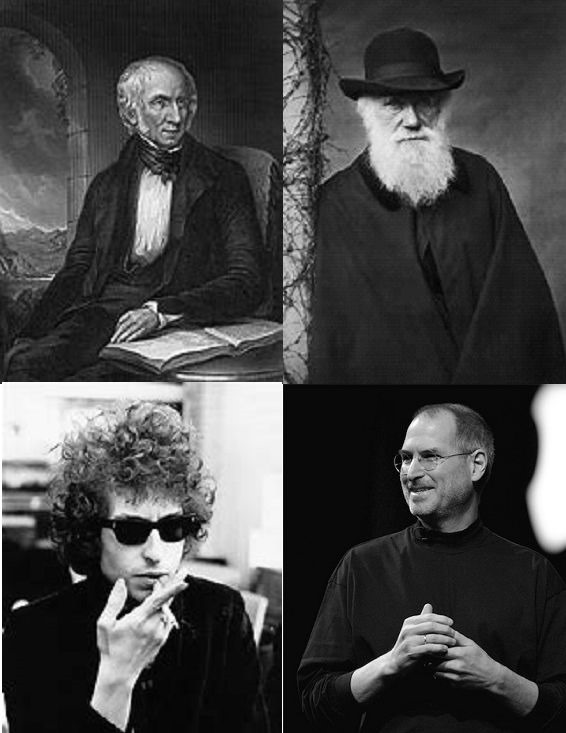
Frances Cornford has a singularly interesting back story, one that (so far) I only know the outlines of. On her father’s side she’s the granddaughter of Charles Darwin, one of the founders of modern science. On her mother’s side, she’s descended from William Wordsworth, a great reformer of verse in English at the turn of the 19th century. She seems to be whip smart, but her poetry may have a deceptive surface. Just to glance at it on the page or rattle it off the tongue, some of it looks and sounds like light verse, the kind of thing that might speak of little foibles and humorous misapprehensions. But then there comes a line that seems out of place, almost a mistake. When I first presented her earlier this month, the “sticks out” line in that poem was “O fat white woman who nobody loves.” Even if we may read that line differently than she intended, I think this smart writer intended for us to be surprised and arrested by it.

Wordsworth-Darwin-Dylan-Jobs

Frock coats to black turtlenecks. Frances Cornford: roughly like being a descendent of Dylan and Steve Jobs today.


Today’s Cornford piece, “Missing,”  is even shorter. Two lines in (but ¼ of the way in this very compressed poem!) we might think we are about to get a piece of humorous verse musing about “just where did I put that.”

Wham! “Dead soldiers or unposted letters…”

If this was a Dada or Surrealist collage we might be forewarned by stylistic expectations, not just that a war casualty is about to drop into our short poem, but that it would be joined with something as mundane and as overlooked as an unsent letter. Like Cornford’s “Fat white woman” line it risks seeming like bad poetry or an example of egregious insensitivity.

But of course, this was a woman who lived through both World Wars. She named one of her sons after Rupert Brooke, the doomed Georgian poet whom she knew, and who would die in WWI. And that son then was killed fighting on the side of the republic in the Spanish Civil War.

Taken inside, as small, strange poems can be, Cornford’s “Missing”  may make you see differently, think differently. Also, these poems have made me think again about the value of risking “bad poetry.”

To hear my performance of “Missing,”  use the player below. I liked the simplicity of the music today, just strumming guitar and voice, as I worked on a more complicated piece that you might soon hear. Maybe you’ll like it too.


*In 1910 the British king Edward died and King George V was crowned. He lived until 1936, so his reign was a handy shorthand for a group of British poets whose careers emerged just before WWI.

**The group of American women poets, sometimes given the label “Songbird Poets” (Teasdale, Millay, Wylie, and to some degree Taggard and Bogan) who are favorites here have some of the same position and problems with “High Modernism”.

Murmuration

It should have been just a throw-away line in Modernist novelist Ernest Hemingway’s first novel. A character describes how he went bankrupt: “Two ways. Gradually and then suddenly.”

That line, or the concept of it: gradually, then all at once, has persisted because it encapsulates something that occurs more broadly than the accumulation of debt obligations. Economics, politics, artistic movements all work socially in ways that may be tied to some very deep concepts, deeper than mere humanity.

Earlier this winter I presented William Butler Yeats “The Stare’s Nest at my Window.”  It’s Yeats musing on his country, which had so recently achieved colonial independence and yet had then fallen so soon into sectarian civil war. The “stare” is an archaic word for the common starling, and despite its presence in the title, this bird doesn’t really appear in the poem. Instead, Yeats’ poem is asking for honeybees, rather than starlings, to build in the nesting cracks in the deteriorating masonry of his home.

In talking about how I experienced the poem, I felt that Yeats may have been speaking to an understanding of starlings as a harmful, invasive species. European starlings are obnoxious, capable of displacing other birds, and they are artless, bereft of any sort of lovely birdsong or plumage. Their large flocks can damage crops, eating grain, fruit, young plants, and even the very seeds before the crops have become anything. Honeybees, as I read Yeats’ wish, are some better, more directly constructive creatures.

When a country is in turmoil, acting against its own as well as humanity’s best interests, doesn’t it seem as if such is evidence of base and selfish forces that are natural and therefore incapable of change? Evil, greed, and self-dealing seem ingrained, the result of some gradual deteriorating evolution toward greater and greater failures of heart and mind.

As it turns out, starlings, those deplorable birds, do have something marvelous that they can do. In flight, flying near to each other so as to seem to be grains in a sand painting or facets in a mosaic, by the hundreds and by the thousands, they can shift and change direction in such an amazing way—gradually, then suddenly.

Though this video has some cutesy elements, it’s one I could find that both shows the murmuration behavior and a theory of its mechanism.


These birds, certainly those individual birds in the flock, cannot know that this is beautiful, yet they do it anyway. Human observers may think they have seen a miracle, a sign of the divine, or at least some unprecedented event—but what they have really seen is just as ingrained in nature: a physics of change and of glorious new shapes.

In a comment on “The Stare’s Nest at My Window,”  alternative voice here at the Parlando Project Dave Moore remembered that he too had done a starling piece, so we’re overdue to present it to you today. His song is called “Murmuration,”  and it’s about this startling flight behavior of starlings. You can hear it performed by the LYL Band with the player below.