February Twilight

The cosmos says we need to get a leap year, and extra day, and yet we put it in February. It was a dozen degrees Fahrenheit this morning, and my bike ride back from breakfast was into an insistent north wind that explains to me that we’re in Minnesota and we’ll probably have a snowstorm or two yet before we can see spring—a spring that sometimes seems too short to form memories.

So, before we leave this month and season, I thought it a good time for a short poem referencing a short month from American poet Sara Teasdale. Teasdale is like Edna St. Vincent Millay, a poet that 100 years ago was thought a leading voice in this country’s verse, after which we spent the rest of the century more or less forgetting or down-grading their place.

When such re-evaluations happen, it’s common to assign them to the refined judgement of posterity, the further assay that separates momentarily sparkly stuff from the for-all-time classics. How does that happen?

One could assign this downward path to Teasdale (like Millay) writing metrical and rhyming verse in their prize-winning years early in the 20th century. The evil Modernist free-verse hordes in this view laid waste to all who dare to rhyme or march to a one-shoe-off beat.

There’s a factor there, sure, but this story doesn’t account for two giants whose statues were not toppled: Frost and Yeats. Nor the monuments on many campuses to canon sitters like Auden and Wilbur et al who were not primarily free-verse poets.

No, I think there are more important factors in this determination, one that is currently under revision in our new century. First, both were essentially lyric poets. “Lyric” in this sense doesn’t mean that they wrote song lyrics. Though of course this project finds them sing-able and otherwise suited to presentation with music, “Lyric” in the literary sense means that their poems tend to be set in the impressions and immediacy of a moment, and their final and considered judgement of that moment is not necessarily explicit. Lyric poems don’t usually have great themes developed with long arguments in verse. Nor do they have narratives the way a novel or story does, were we turn the page to find out what happens next. What happens in a lyric poem—happens! Right then. Right now.

The pioneering Modernists in the years before the end of WWI, those that were or wrote like Imagists, were fine with that. Indeed, this was the point of Imagism. Teasdale wasn’t called an Imagist, but she could write like one, albeit with rhyme and meter. The Imagists didn’t call for the end of rhyme and meter, they called for an end of poems that existed to fill out those forms without the vividness of the lyric.

But post Eliot and the Pound of the Cantos, post the sheltering of poetry inside the academic monasteries which could too easily fall into a rout of poems to be taught rather than poems to be experienced, these poems could seem slight. The Imagists were a fine exercise to break from the past, but they were not, in this outlook, the way to write great poetry.

And here’s the other reason. Gender. The academics were overwhelmingly men and were steeped in the things men were thinking about. And the world of the middle of the 20th century had a lot of concerns that made the concerns of Teasdale and other women poets of the early part of the 20th century seem like the line in Casablanca  uttered by Humphrey Bogart “The problems of three little people don’t amount to a hill of beans in this crazy world.”

For the first part of our double feature: 90 seconds of cinema that was an emotional touchstone to many. Also, mansplaining.


It took the culture until nearly the end of the 20th century to see that part of the world’s craziness was because men were still explaining how it worked to women.*

All that may be too much of a burden to bear for this short poem by Teasdale. But if “February Twilight”  was signed Frost or Yeats, I suspect more attention might be paid to her poem. It doesn’t read much like Yeats, but it could pass for the shorter, lyric Frost.

The lyric impulse in poetry survived the mid-20th century when colored with Dada and Surrealism. “See, it’s not me! I’m a serious poet, but I just chanced into this charged moment.”


What does Teasdale experience in the charged moment of her lyric? That it seems like she’s the only one that views this star, a manifest untruth we could explain to her, but which I think she knows as the final line presents. She doesn’t explain this to us, but we can stand in the cold, snowy February and experience it with her.

I’m choosing tambura and acoustic guitar again for my performance today, this time with an organ keyboard part. Click on that player gadget below to hear it.  “If you don’t, you’ll regret it. Maybe not today, and maybe not tomorrow, but soon, and for the rest of your life.”


*Which I’m doing here. Ha Ha! Here’s where one of the principles of the Parlando Project comes in: “Other People’s Stories.” I’m not claiming the exclusive right to mansplain mansplaining, but men speaking up about it has its place and value.

Oh, and explaining has value too. And I happen to like Casablanca  as a movie. And defeating fascism might have a value greater than the optimum choice for a snuggle-bunny. And I had huevos rancheros for breakfast. A hill of beans would be meaningful and sustaining to me!

Sadie and Stephen Hawkings

It’s leap year, and the last time there was one of those, Dave Moore wrote this song about the mysterious cosmologies and quantum physics of love.

We’ve already met Stephen Hawking here, though in a roundabout way, as the universe may be. When Hawking died a couple of years ago, at his public memorial an astronaut read a passage about the cosmos from a Percy Bysshe Shelley poem to eulogize the great cosmologist. Coincidence? Well I looked, and I was surprised to learn that Shelley, that early 19th century romantic poet, could write on the physics of light and calculate the speed of a light-year. Not quite quantum theory, but a better performance than many poets today might do. Romantic wonder and physics may be objects that are closer than they appear.

I suspect Sadie Hawkins is a more obscure star in our firmament these days than Stephen Hawking. Dave would know Sadie first-hand because he’s much more knowledgeable than I am about what once were comics and are now whatever they are fancied as an art form. Back when they were funny papers Sadie was created by cartoonist and satirist Al Capp.

The Montgomery Story comic book

Al Capp ran a comic book company too. In 1957 he published a comic book about the Montgomery Bus Boycott, which helped bring to the fore Martin Luther King. The story in Dave Moore’s family is that his mother typed MLK’s thesis in Boston. Like I said, objects are closer than they appear.


I can’t quite fathom how to condense Capp into a short blog post. I proudly thought I could come up with two or three sentences to sum up Capp’s career—but that’s impossible. His Wikipedia article covers the high points I guess. I will say that by the time I was reading comic strips the Al Capp mythos was probably past its prime and unappealing to me. But that didn’t mean that I didn’t know Sadie Hawkins. Schools still had annual “Sadie Hawkins dances” where young women were licensed to ask men to a date or dance, and all this (along with some legends about Irish Saint Brigid) got melded into a tradition that women could propose to men on Leap Year day.

That’s enough to get you into Dave’s song. As long as you’re willing to entertain a song about a once highly popular cartoon strip and theoretical physics, you’re the audience for this one. I don’t know if that’s enough to fill a Sadie Hawkins Dance floor, but the wallflowers are more interesting there I’d think.

How do quantum forces work? I doubt I know more than Percy Bysshe Shelley. I planned to present this piece for leap year day sometime back, but what did I think two years ago when I heard Shelley’s poem? That he had written of a mazzy  heaven, and that flavorable word brought me to think then of Mazzy Star, an indie rock group that can trace its way back to Minnesota about the time Dave and I started to make music together. Now as I write this post this week, I read that the person whose particle path made that traverse, Mazzy Star principal David Roback, has just died.

The player gadget to hear the LYL Band perform Dave Moore’s “Sadie and Stephen Hawkings”  is below.


Sympathy (I Know Why the Caged Bird Sings)

The last two times I presented poems by Paul Laurence Dunbar here I went out on a limb on subtexts that might be present in those poems. “October”  is on the surface a harvest “Happy Autumn” poem, but there’s an element in it of the personified rich harvest’s carefree possession of wealth. Just a handy poetic metaphor? Perhaps. And then there was his valentine of a poem “Kidnapped”  which could plausibly be connected to the Cupid and Psyche myth, but specifically deals with the narrator being captured and taken from its home. Just another recasting of a widely utilized myth? Could be.

But you see Paul Laurence Dunbar is the first successful Afro-American poet. A man whose parents had both been slaves, whose ancestors would have been very non-metaphorically kidnapped, and a man whose race in his 19th century were the harvesters who retained none of the wealth that accrued to the owners.

Today’s piece by Dunbar carries its subtext clearly—it’s hardly subtext at all! One cannot read or hear it and not see it as a statement about freedom denied. Partly because it can be applied so directly to Afro-American history, it’s become one of Dunbar’s best-known poems.

Dunbar Live!

Dunbar with violinist. Seems like an idea….


I don’t need to add to Dunbar’s words today. But since my ego claims I should say something, I’ll note this: Dunbar chose to write his poem as a universalized statement. There’s no lack of Afro-American experiences of freedom limited, other-defined, and outright denied—but the poem he wrote speaks universally of that issue.*  The specifics of racism and economic deprivation would be self-evident to his Afro-American readers anyway.

Was writing about denied freedom in metaphor a commercial choice, in accordance to the poetic style of his time, or an example of a largeness of his soul? Well, now his poem exists, and it speaks to freedom denied to anyone who encounters it.

Levys Ad and Malcom X

I started thinking of wry captions for this. Nope, the picture doesn’t need’em.


Another setting from me using violin, cello, and acoustic guitar today. I went out last night after working much of the day on this audio piece and saw songwriters playing acoustic guitar at a local venue. I enjoyed the concert, but also in the background I was thinking: alas, I can’t really play guitar or write songs like they do. I watched them changing chords rapidly compared to what I could do earlier in the day. That’s so useful I thought, recalling that I had had trouble rendering my leisurely cadence earlier.

I’m not sure why I thought that. I’ve been doing both of those “I can’t” things for over 40 years, despite limitations on my part that change over time. When I returned to the piece today my guitar part didn’t sound as wanting as I remembered, and the uncommon “i, III, VI, v, i” hopscotch chord progression of my composition seemed worthwhile to the morning’s ear. My violin line (played on guitar via MIDI) seemed better than I remembered too. I still wish I was a better singer, but I can express my own way with melody on an instrument even if my singing limits me. The piece seemed valid to me again.

What lesson to draw from that? Comparing your art to others can be fraught. Sometimes when you need to improve, observing others can show you the way. Sometimes when you’re different, it’s still good, and not a falling away.

To hear Dunbar’s “Sympathy”  as I performed it, use the player below. The full text of the poem is here if you’d like to follow along.


*A good argument could be made that there is a specific to the Afro-American experience in Dunbar’s metaphor though: the caged bird’s song. American music, that stuff that we (and a great deal of the rest of the world) have come to hear as the strongest part of our American culture is disproportionally Afro-American music.

We Want to Believe That There Will Come a Moment When Everything Changes

Here’s another in our series presenting poems that address what a struggle for social change feels like. A couple of differences this time, but then this project likes differences.

First difference: the words I adapted for today’s piece weren’t intended as a poem. How’d I come upon them? I saw this post over on the Afro Punk blog which had a linked short video with long-time radical activist and thinker Angela Davis. Davis’ younger interviewer starts off with a philosophic observation about the nature of time and changes, and ends by asking Davis to “get us to a different place.”*

Davis’ reply did that: it included an insightful statement that may be useful across generations. Listening to it in her exact and measured speaking cadence I began to see a structure already implied in it that could be expressed poetically. My contribution to the text was simply to cut out and arrange some of her words in order to further compress and focus on an element that I heard and resonated with and that I’d like to emphasize. Though that’s audacious on my part, my intent was to respect and re-amplify this part of her message. Did I succeed or fail by changing the context of some of her words in this way? Listeners will judge.

You may not agree with every one of Davis’ ideas, but my point is that through poetry we can better understand the experience and soul that fires those ideas


Here a second difference. When I presented Yeats’ poem about his country’s civil war, I said most living Americans will likely have no knowledge of which sides and positions were involved in that struggle that Yeats wrote about in 1923, much less a position on them or their consequences. I certainly didn’t. Time and distance can do that. What might a civil war feel like so soon after Ireland had gotten its independence? We can still feel that element in Yeats’ poem regardless.

Similarly, the complex theological structure of William Blake’s 18th century “prophetic books” require footnotes for many of us, but his stance for human freedom and possibility despite our fallen nature may still come through.

Davis though is still a person of controversy. That’s a radical’s job after all, and she’s been at that for more than 50 years. Furthermore, actual questions of life and death of people—people that other still-living people know or knew—are connected to those positions and tactics over the decades. Arguments of necessity and priority are complex. As it is, no passage of time has made racism, sexism and homophobia mooted points, and no country I know is a safe refuge from these things. These are too important questions for me to be glib about them.

But what about what Davis said during this Black History Month about us who want social change? There is some wisdom to take in. You can listen to my performance of a few statements from this February 2020 talk by Angela Davis with the player gadget below, and you can see Davis herself make her points herself. Musically I believe I was thinking of Gil Scott-Heron when I tried to do my best playing a couple of electric pianos. Gil Scott-Heron is another one of those influences that helped form this project.


*For Black History Month, Afro Punk has taken a theme “How long ‘til Black future month?”

The Wild Roses

When I started thinking and planning this project, I thought I’d be producing audio pieces around five to eight minutes in length. That was the most common length of the preliminary combinations of various words with music I had experimented with before the Parlando Project was launched.

I made a course correction once the project took off. If you’ve been here recently you’ve seen that the typical audio piece is now between two and four minutes, roughly the length of the classic 45 RPM single record of my youth. How’d this happen?

I found that I am really drawn to the condensation and immediacy of lyric poetry, the kind of thing that lands its impact in 30 lines or less. Like those three-minute singles of my youth, those texts can often cram quite a bit of expressiveness into a similar length of time.

Then part of this is also counterprograming. About half of the listeners here consume these audio pieces as podcasts on Stitcher, Spotify, Apple Podcasts, Player.FM etc.  A great deal of podcasting on offer clusters around longer-form, loosely organized talkfests. I have no long commute, take few long trips, and much of my life is reading, writing, composing or recording and none of that opens opportunity for someone remotely talking at length (however engagingly) about something.*  My thought is that even if someone enjoys that, then mixing in a short dose of poetry or other condensed writing with music from this Project will be a pleasant contrast.

And there’s a more intimate reason. I’m a weak singer who cannot execute complex sung melodies or make simpler ones thrilling over a longer duration. Listeners will note that I don’t sing most pieces here, using instead variations of chant, talk-singing, or declaimed spoken word instead. This leads me to want to make my statement in a shorter format.

What’s all this leading up to? I told my wife that I’m hoping I’ve earned the right to potentially bore my audience today, because I’m going to present an eleven-and-a-half minute, 20-verse ballad. What’s more, I’m the author, so I can’t even cut the thing for length as the writer will complain.

“The Wild Roses”  has an odd inspiration: a TV episode that aired almost exactly sixty years ago on Feb. 6th 1960 as part of the western TV series Have Gun-Will Travel  titled “The Night the Town Died.”  Have Gun-Will Travel  strived to differentiate itself from other TV westerns of its era. It liked the odd-ball script a lot more than most, and the series’ star Richard Boone (who also directed that episode) seemed to favor bold acting performances. And though he rode a horse in the 19th century American west, Boone’s gun-for-hire character Paladin acted more like a noir private detective.

I’ve written here that the then common 25-minute stand-alone story format for dramatic TV shows developed poetic effects. Our modern, linked-episode, multiple-hour seasons develop characters over time in a way that emulates novels on the page. The much shorter format of the ‘50s  and early ‘60s had characters life stories sometimes told in a scene or two.

I’ve often wondered if the teenaged Bob Dylan watched these shows. There are elements of his story-telling in song that sometimes remind me of them. Dylan’s narratives are much more abstract, and Modernist language and tactics are deployed more often than the TV writers were allowed to do, but the sense of quickly sketched and absurd situations could be linked.

Gunfighter’s squint or age-related myopia? Richard Boone as Paladin, Robert Zimmerman as Bob Dylan.


The HG-WT episode “The Night the Town Died”  has some strong moments, but overall it leaves more an impression of its oddness and slightly over-done seriousness than coherence. I took very little from its script:** a single character name, a line of dialog—but largely I relied on a funhouse mirror reflection of its overall plot arc: a man comes to a town to revenge the lynching of his brother,*** but he wants to first determine, Hamlet-like, who his just target is.

I chose to tell my story using a young female Ophelia-like character as the narrator, and I gave the revengeful Hamlet-ish protagonist only a few lines. The former appears in “The Night the Town Died”  to speak about wild roses, the later bears the name I instead gave to the murdered brother. There’s no Deus Ex Machina Paladin gunfighter to serve as judge or referee as in the TV show. In my ballad, the narrator and the revenging traveler characters meet four other characters. If you think some of these encountered characters carry modern or out-of-time undercurrents, yes, that was my intent. And coming in right after a Yeats’ poem last time, I chose the town’s name in my ballad with intent too.

These choices were performance challenges. The writer (me) didn’t give the performer (me) much choice but to try to “play” the characters in voice to line out who was speaking in the immediacy of performance. If someone else was to perform this, having a number of vocalists to play the characters would be better I think. I sing the woman/narrator role, but then speak the lines from the men she meets in hope it helps set them apart. Likewise, my song might gain value from having a woman singing it.

The Wild Roses

There are still a few lines that I don’t think are as good as they need to be in this version. Maybe today’s performance is a bootleg/demo?


Performing this kind of narrative song takes special talents, and I have no more than a small amount of what should be deployed in that task. And as a writer my narrative for this ballad is also unusual. It’s intentions are more like Bobby Gentry’s “Ode to Billy Joe”  or Bob Dylan’s “Isis****”  than the straightforward narratives of “Matty Groves,”  “The Dowie Dens of Yarrow,” or Marty Robbins “El Paso.”*****   Does “The Wild Roses”  succeed or fail? The player is below.


*My wife, whose routine and preferences are different than mine, enjoys conventional podcasts, and audio books as well. I grow more and more impatient with age it seems. I can read and absorb more denotative information in the available time with my eyes than with my ears.

**There are two screenwriters credited. One (also credited with the story) had what seems an unremarkable career: Calvin Clements Sr. The other,  Frank Pierson, had a longer. more successful career.

***Yes, another post-WWII western based on a white-on-white lynching, which consciously or unconsciously may have been a way to deal with the horrors of terrorism directed at Afro-Americans and the responsibilities of citizenship and moral choices.

****More obscurely and perversely, some of the most laconic and least well-remembered Dylan songs like “The Ballad of Frankie Lee and Judas Priest”  and “Clothes Line Saga”  were also an influence here.

*****This Western gunfighter ballad was topping the charts at the same time “The Night the Town Died”  episode aired 60 years ago. Around the same time, Bobby Zimmerman started using the name Bob Dillon (Marshall Matt Dillon was another leading TV western character of the era, though there is a Dillon road in Dylan’s hometown of Hibbing, and there was a successful ‘50s football player that had the name of Bob Dillon)

Rimbaud’s Eternity

I started out this January trying to translate Rimbaud, and it’s only as the month is ending that I’ve finally got something to present. Why was this such a struggle?

Well, some of it’s me. I’m having a harder time this winter keeping up this project, and by focusing recently on translation I’ve only made it harder on myself. Why do I do these translations on top of composing, recording, and playing most of the instruments in the pieces? That’s more than a rhetorical question, I’ve sincerely asked myself that this month. I’m not a speaker of any of the native languages of the poets I’ve translated, so I work with the highly welcome online dictionaries and computer translators available—but I’m not a literary scholar or expert on any of these poets, and I’ve never lived as part of their culture. I worry about getting it wrong, doubly so in that I present them publicly.

I think I have three reasons. First is that it expands what I can present here. As I’ve mentioned before, it’s difficult to get permission to do what I do for work that’s not in the public domain, and I don’t want to use other people’s translations that are in copyright without permission. Second, I think this is a great practice to improve one’s own poetry. Do any creative writing programs these days require or assign translation of poetry?*  I don’t know, but if not, I’d encourage that. The struggle to find the best English word, to not harm the strength of an image, and to shape the poem so that its word-music works are directly transferable to writing one’s own poems. And here’s the last reason: I think performing a poem illuminates it for the reader/performer, it makes it part of your breath. Translating it imbeds it even more so in one’s mind.

So why was Rimbaud a tougher task?

Unlike other poets, I’ve never been a Rimbaud fan, even though Modernist French poetry was an enthusiasm of my twenties. I think I bought a translation of Rimbaud’s A Season in Hell  at the same Savarns book store on the Minneapolis West Bank where I picked up poetry chap books by Patti Smith and collections of French language Surrealists. And Smith and Surrealists liked Rimbaud a lot.  Smith has spoken reverently about how her copy of Rimbaud helped her through her own early twenties, but Rimbaud didn’t perform that service for me.**

Arthur Rimbaud
Sentinel soul. Teenage poet Arthur Rimbaud

But even just as myth, Rimbaud has an inescapable pull. There’s no story like it: a bright teenager drops out of secondary school, flees to the Paris of the Paris Commune in 1871, takes up with celebrated poet Paul Verlaine. Disasters ensue, including taking the most famous non-fatal intra-author bullet from a disordered Verlaine. In the midst of this, he writes furious poetry, poetry capable of impressing the most avant garde writers of the 20th century to follow.

Bang Bang My Baby Shot Me Down

“Situations have ended sad/Relationships have all been bad…” Plaque marks were Verlaine shot Rimbaud.

All this as a teenager. As his teen years end, he stops writing and moves to Africa to work as a commercial trader, never returning to the writing life and by accounts actively distaining it. He dies of cancer at the age of 37.

As we’ve seen recently here, there are other teenaged poets who’ve produced work we still read today. But very few of them produced their greatest work at that age—and arguably none of their youthful work was as influential as Arthur Rimbaud’s.

I’ve dealt with the trouble that hard-to-grasp, obscure, and Surrealist poets present to translations. Rimbaud was as tough as Mallarmé in that regard. In one Rimbaud poem I finished a complete translation draft, but was left with an “is that all there is” feeling that the result wasn’t all that compelling. I started another and then another, but again the early results didn’t seem like I’d grasped them or that they’d work here.

Then it hit me, at least with his poem “Eternity,”  part of its power is incantatory, it’s in the metrical and rhyming effects in the original French! This shouldn’t have surprised me. While there are other ways to achieve similar effects: parallelism, repetition, old-English alliteration, even a certain kind of intellectual rhyme in imagery itself, rhyme is still used in most songs and hip-hop rap flows, not because there’s some kind of rule about it, but because the expectation of return to the rhyme gives a certain fatalistic drive to the verse. And “Eternity’s”  meter is also unusual, it’s a very short line, just five beats.

Do you remember me saying that I almost never try to bring over the sound of the original verse into my translations, that I’d rather focus on making the images vivid and for the poem to have whatever good word-music in English? That’s still a practical rule, which may go double when translating from a language like French which has the benefit of so many more rhyming words; but in this short poem I decided to move over to respecting the syllable count of the original line and to a ABCB rhyming scheme.

Eternity

For good or ill, this did cause me to play more fast-and-loose with some of the more difficult images and phrases in Rimbaud’s poem, ones where other translators had other readings. If it sounded good, if it kept to the scheme, if it seemed to advance some overall flow to the poem’s meaning from image to image, I judged it “close enough for rock’n’roll.”

In the end, my main diversion from other translations of “Eternity”  I’ve seen is that many other translations make this poem more of a brag that Rimbaud has absorbed the infinity of the titular eternity and is now it’s master. My version has a more elusive eternity and a sense that others are seeking to apprehend it, much like a search for an underground partisan. Because the other translators may be Rimbaud scholars with a greater mastery of French, there’s a good chance they’re more correct—but if there’s a possibility that the “I is another” in Rimbaud’s poem, there may be an element I’m bringing out that was always there. Here’s a link to the poem in the original French for those who’d like to check.

Musically, this is rock in the ragged sense that rock’n’roll is a loose and inclusive form. There’s no tight backbeat, the bass is a bowed contrabass with some filtering, and the guitar won’t really play the blues—but the overall guitar timbres are from the rock palette. For the chord cadence I made a nod to some of those who did help me get through my 20s. The line in Rimbaud’s poem that ended up being translated (loosely in this instance) as “I see no escape” brought to mind “All Along the Watchtower”  sideways to me, and the chord cadence I use is also somewhat similar to Patti Smith/Bruce Springsteen’s “Because the Night.”  The lines in my translation “Murmur our desire/Night that is nothing/A day that’s on fire” could well fit into that sort of expression. Some of you know the drill to hear it: the player gadget’s below, but what if you don’t see a player? Here’s an alternative, this highlighted hyperlink will also play my performance.

*I know in the past students were assigned translations from classical Greek and Latin poets as part of general studies. While this came from the idea that classical grammar and vocabulary were the basis for mastery of English (a suspect notion) I think it must have helped many a budding poet.

**It was poet/musicians did that for me: Leonard Cohen, Bob Dylan, Jimi Hendrix and Smith herself. All of these are controversial figures in purely literary circles. I can tell you that none of them helped my standing in those 1970s years when I should have been establishing the peripatetic poetry career that I didn’t have. It would have been better for me, influences-wise, if I could have said Rimbaud instead.

Poem 20 from Twenty Love Poems

This should be embarrassing to admit, but I’m not that familiar with Pablo Neruda’s poetry. This project is a great motivator to fill in such gaps. English translations from Chilean Neruda’s Spanish exist, but there may be no better way to become truly familiar with a poet than to translate them yourself.

As 2020 began, I saw a list of some works that came into public domain status on January 1st. Neruda’s Veinte poemas de amor y una canción desesperada (Twenty Love Poems and a Song of Despair)  was one of those 1924 books that are now free to perform and use.

Published when Neruda was 19, it has reached a large audience for a poetry collection: the Wikipedia article says it’s the “Best selling poetry book in the Spanish language ever” and gives overall sales as 20 million copies. These are poems of erotic love and desire, and that subject no doubt helps its popularity. I think it’s safe to assume that some of the sales would be love-token gifts.

Veinte Poemas Title Page

“If you see her, say hello. She might be in Tangier…” Pablo Neruda’s 1924 “Blood on the Tracks”


I’ve only translated one poem in the series completely: the final love poem. But on a cursory examination this collection of poems is an example of a genre that if presented as a sung recording would be called “a break-up album.” That is, it’s an expression of the author’s experience of a romantic relationship that has come to an end. It’s a common enough trope that many singer-songwriters have one in their catalog, and most of the rest could support a playlist to create one in effect.

A problematic element in the break-up album, sung or printed, is that the hard-end of a relationship tends to leave the writer who gets to document it a number of not always elevated states: self-pity, anger, hopelessness, revenge, grief, confusion, sorrow. By definition, the singer is “working through this.”

The former beloved likely appears, but they often don’t get a very well-rounded portrayal—the author’s pain is the side that gets sung. Sometimes you get Blood on the Tracks, and other times you get “Ballad in Plain D”  from Another Side of Bob Dylan. Where’s Neruda, who was a few months younger than the Dylan of Another Side when Twenty Love Poems was written, in this continuum? The poet’s beloved here is referred to mostly in the sense of her absence in this final poem. Not much is said about who did who wrong and in what ways, and by this it’s a universal poem.

Universal can risk banality. Against this danger Neruda arrays considerable musicality in his poem. It’s not a strict form like a villanelle, but repeating lines and phrases work like that form and remind us of the stuck-ness and the self-mantras at the end of a relationship. From my start at a couple of other poems in the series, the whole collection seems to be full of sensual imagery, but this last poem, so full of loss and lack, challenges this tactic.

Neruda wrestles with that right from the start, saying in one of the refrains that the dissolution has caused him to be able to write “the saddest lines” and he then immediately launches into some of the most elaborate images in this poem:

‘…The night is full of stars
And the dark stars on the horizon are shivering’
The night wind swirls the sky, singing.”


Yet the rest of the poem is not consistently in this voice. Alternating with the more striking images are lines you, I, or the next person might say at the end of a relationship. This may make the poem more inviting to those not ready for a full-on array of Surrealist images.

This also made it easier for me as a translator. I feel my task as a translator of surreal images is to make them vivid for speakers of contemporary English, and that leads me to feel I should understand even the most hermetic image to render it as well as I can. I’ll often spend a long time on just one phrase, one image. What is the poet’s mind, however disassociated from convention, sensing, seeing, in this?

As a performer, my other task was to invest this poem about the end of a passionate state with appropriate emotion. How much to understate? How much to state with extra conviction or extra doubt? What I lack in skills there I can try to shore up with music. The composition’s core is an acoustic guitar part that while it isn’t exactly based on a drone tone, doesn’t have the kind of progression that takes the listener on an irresistible linear route. I let my strings sing with the bass guitar part, an instrument that can portray a heart-sob better than most. Standing in for the stars, the night winds pushing clouds, the distant singer, and the lost beloved is a high melody part off in the right-channel distance.

The player gadget to hear this performance in English is below. If you’d like to hear the poem read in the original Spanish, you can find that here. Normally I’d provide the full text of the poem—in this case, my fresh English translation—but this one is rather long on the page. I’ll post it separately if I get some requests for it.


Thanks as always for reading and listening.

The Times Are Nightfall

There’s a musical theme in today’s audio piece: things that pretend to be another instrument, and while they don’t quite get there, are still something else.

That low bowed-string sound that opens today’s piece? It should be no surprise to long time followers here that it’s a Mellotron,* the primitive magnetic tape ancestor to today’s computer-based virtual instruments. It doesn’t really sound like a cello as it lacks any variation of articulation, but it does have a sound of its own.

There’s no bass guitar (the cello part is solidly in the bass register anyway), but to add a little punch I added an emulation of the Fender Rhodes Piano Bass most famously used by The Doors. Used as The Doors did, it can do a fair job of sounding like the plunk of an electric string bass, but I filtered it here so that it sounds less like a real bass. And yes, there’s an old-style electric piano in there too, an instrument that doesn’t really sound like a piano, having more of a bell-like timbre. I love the sound of a real piano, but there’s something else in the electric piano that I like too.

And finally, there’s the instrument I wrote the song on: electric guitar. I don’t know that we still think of the electric guitar as a “not quite” approximation of a “real” acoustic guitar, but one can define it so. There was more than the usual unamplified leakage of the electric guitar’s strings into the vocal microphone when I recorded the live take of the guitar and vocals for this. Normally I’d consider that a fault and record a clean pass of the vocal without that extraneous noise, but I kind of liked the accident and decided to keep it.

A little past half-way a pair of “real” violins doubling a new melody line come in, but since I don’t play real violin once more it’s a virtual instrument played on my MIDI guitar. Even in this simple section you can probably hear the difference in articulation from a modern VI instead of the Mellotron.**

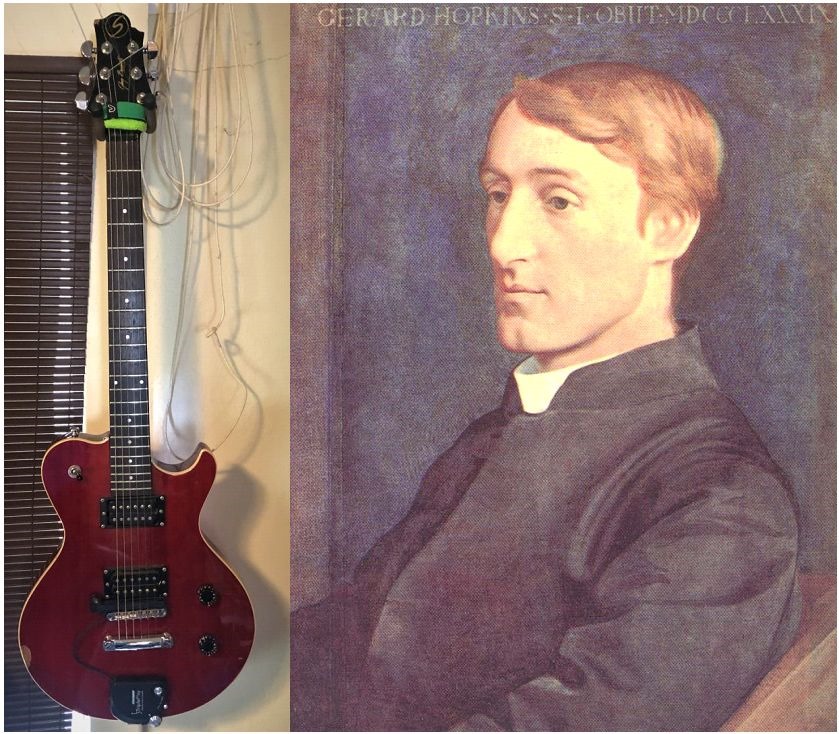
My Red MIDI Guitar and G M Hopkins

“I see only the basic material I may use…you may ask me why do I fail” I put a MIDI pickup on a cheap battered guitar that found in a used shop. David Sylvian lacks Hopkins fierce collision of images, but shares a sensibility with Hopkins in his song.


Well, all this is backward from the usual post here, were we talk about the encounter with the text used*** and then have only a line or two about the musical process, but the Parlando Project isn’t about consistency—it’s more about its opposite. Which is part of why you, the listeners and readers here are different. If you were someone who likes but one kind of music or one kind of poetry, we could disappoint you here. Our way is not the way to do it for maximum audience size, but if you’re a writer or musician—and even if wise council may be to find your style and consistently present it—an experience of alternatives can enrich that.

And then too, think of all those failed, not-quite instruments that don’t actually sound like the real thing. They sound like the exact and different failures they are.

To hear the performance of Hopkins’ poem, use the player gadget below. The full text of “The Times are Nightfall”  is here if you want to read along.


*It’s not actually a Mellotron: a rare, complicated and maintenance-requiring electro-mechanical instrument. The technology that greatly extended that concept, the modern “virtual instrument,” can more than handily represent it. Unlike the Mellotron’s single tape strips for each note, a virtual instrument can (all in software) represent different articulations and the various electrical subtleties of how the Mellotron was amplified and recorded back in the day. Even the peculiarity of the Mellotron’s notes being stored on strips of tape (not loops) that meant that after a few seconds the note would just end abruptly can be emulated or bypassed.

Music geek section: The Mellotron “VI” I used today is the M-Tron, who pioneered the idea of a software Mellotron. So far, I’m not quite grasping all its options, and I think I still prefer the Mellotron that’s part of MOTU’s Electric Keys collection.

**If you listen to “Endless Circle”  from late last month here you’ll hear how today’s piece might sound with more realistic instruments: cello, violin, piano, acoustic guitar, and vibraphone. It’s very much the same palette as today’s piece. My frank opinion today? I prefer the musical accompaniment of “Endless Circle”  and could never get a mix I was entirely happy with of “The Times are Nightfall.”  But I much prefer the vocal performance on “The Times are Nightfall”  and was unhappy with the vocals on “Endless Circle.”  In each case, I settled for the best I could do that week so that Genevieve Taggard and Hopkins’ poems could get presented.

***Hopkins’ most famous series of poems are called The Terrible Sonnets  not because they’re failed works, but because they are saturated with terror at failure and imperfection in human life. This poem has that too, but in its final section it seems to draft, in a New Year’s Resolution sort of way, a hope that personal discipline can lead one out of that state. The poem ends with ellipses, and I believe the poem may have been left unfinished by its author. My dictionary tells me that “ellipses” comes from the Greek for “falling short.” Even if unintentional, those things add meaning to the poem for me.

Though human discipline can do mighty things, it will  fall short. Whether divine or personal, some grace, some mercy, some beauty in imperfection is necessary. Thus that blessing I give: “All Artists Fail.”

Ghost Blues

The story this time is failure, diversion, randomness, and Dada. Some of it’s mine.

After the largely pleasant interruptions of the holidays, I’ve been finding it hard to concentrate extensively on new pieces. This hurts the more intricate musical compositions, research on the context of their original creation and reception, and my fresh translations of poetry not originally in English.

I’m fairly good at limiting one scourge of the modern artist: social media. I get behind on responding to comments here (bad form!), I usually put off reading the blogs I follow to once every week or so. I’ve never dived into Twitter much and have entirely avoided Facebook and the rest. Other artists have other types of engagement with these things, I wouldn’t call myself a model in that regard. Indeed, I’m sure I’ve done this project no favors with my avoidance of these things. I ascribe a great deal of the growth of this audience to random searches and the intentional work some of you have done spreading the word about the Parlando Project. Thank you. Thank you. Thank you.

So, I’ve carved out the precious time for this. And then, I get to work, a blessing many never get. And sometimes, it just doesn’t happen.

I’ve started and broken off three or four translations this month. I’m often drawn to the more hermetic poets with translation: the ones with wilder syntax, unusual metaphor, elusive meanings. I think what draws me is the same that causes one to open the most mysterious wrapped gift first. What could it be? Sure, it could turn out to be the wrong size or color, or a complete misreading of your interests, but that desire to jump into mysteries is undeniable.

But this predilection does lead to issues with my translations. My goal as a translator is to make vivid to a contemporary audience the images in the original poem. I will not usually make any attempt at carrying over the sound-music to English, but I do like to honor the thinking-music of it, the order and cadence of the original poet experiencing the matter of the poem. This intellectual melody is a great deal of the pleasure I get out of a poem that works for me: that the poet would think and express this first, then this, and finish with that. If each of those is a surprise that I can share, art has happened.

But when taking on a Surrealist or Dada poem, or a poem that claims to be based on disordered sensations,* how can I be sure enough that I grasp the metaphor, divided as always by time, language, culture, but in addition with an aesthetic that seeks to confuse or confound the reader, at least at first.

That sort of thing takes a lot of attention, more than most close readings, even before the task of finding the new English words comes in. And this month, I get only partway in and then feel lost or discouraged—and something interrupts, or my energy flags, and the house of cards doesn’t necessarily fall down, it just remains a bunch of playing cards with no architectural reason to exist.

The closest I got to completing a new translation was this poem by Hugo Ball, one of the original Dadaists. It was the fifth in his series 7 Schizophrene Sonette.

Here’s the original:

Das Gespenst

Gewöhnlich kommt es, wenn die Lichter brennen.
Es poltert mit den Tellern und den Tassen.
Auf roten Schuhen schlurrt es in den nassen
Geschwenkten Nächten und man hört sein Flennen.

Von Zeit zu Zeit scheint es umherzurennen
Mit Trumpf, Atout und ausgespielten Assen.
Auf Seil und Räder scheint es aufzupassen
Und ist an seinem Lärmen zu erkennen.

Es ist beschäftigt in der Gängelschwemme
Und hochweis weht dann seine erzene Haube,
Auf seinen Fingern zittern Hahnenkämme,

Mit schrillen Glocken kugelt es im Staube.
Dann reißen plötzlich alle wehen Dämme
Und aus der Kuckucksuhr tritt eine Taube.

At the point I set aside the translation, here’s what I had tentatively and incompletely rendered in English:

The Ghost

It usually happens when the lights are on.
It rattles the plates and the cups.
On red shoes it slides in the damp
Swaying nights, and you hear its flames.

It seems to run around from time to time
With trumps, likely to play the ace.
It’s careful with the ropes and pulleys
And is recognizable by its noise.

It is busy in the Gängelschwemme
And then its white crown wavers in the wind,
Its tines tremble like cockscombs

With shrill bells it spins in the dust.
Sudden exploding dams are torn apart
And a dove emerges from the cuckoo clock.

Almost done, but I couldn’t figure out that word “Gängelschwemme.” Any reader here have a good solution for that?**  It seems a compound word, the start having some sense of walk or lane I’m thinking and the last part may have some water connection, but as it became hard to continue my focus, the meaning seemed to tumble further away.

And so there I was, days have past, and there’s no new audio piece to post here. It was then that it was like someone spread butter on all the fine points of the stars, and things started to slip.

The image of that exploding dam. I thought of Kansas Joe McCoy and Memphis Minnie’s “When the Levee Breaks,”  a song about impending disaster. The Blues have their own Dadaist streak,*** but this song is one of those that has a fairly easy to follow plot: a singer who tells us that no matter what he (and others do) to hold back an impending flood, when it comes he will be driven from his home, child, and spouse. There’s an undercurrent to that story if you look at it a second time. He says he has a “happy home.” And surely this great flood (the song is likely a reference to a significant and damaging 1927 American flood) will be destructive. But why is he not taking his spouse and child and fleeing with them at the point when there is nothing else that can be done to stop the flood? Because he can’t? Is he an imprisoned worker forced to work on the last defenses against the flood, or is he racially or economically constrained to leave the area? Is it because even if he knows there’s little chance that his labor on the levees will keep the flood in check, he must try to his upmost anyway? Could it even be possible that he has absorbed the impending disaster in his soul and he’s ready to leave that all behind as the flood has “intended.” Maybe his happiness isn’t as certain as the awesome disaster is.

One could write a novel or short story from that song. In one’s imagination one might link that specific situation to other things. But let’s stay with the lyric impulse, the exultation of the moment.

My new diversion was to turn Ball’s sonnet into a blues. This freed me up to make some more audacious adaptations as I merged the feeling of the lyric of “When the Levee Breaks”  into another re-visioning of Ball’s poem. Doing this in a week of loud yet underexplained**** international explosions creeped into the resulting lyric too. Ball was writing his poem in 1924, but this week it seemed that a “a dove emerged from the cuckoo clock.”

Here’s the blues interpretation inspired by Ball’s sonnet:

Ghost Blues

The lights is on people, but it happens just the same.
The lights is on, happens just the same.
In the swaying nights, you can hear the flames.

Seems to run around, sometimes you see its face.
You see it time to time, see it face to face.
But when it’s got its trumps, likely to play the ace.

It’s careful with the ropes and pulleys, I can tell you boys.
It’s careful with those ropes and pulleys, I can tell you boys.
But no matter how careful, you can recognize it by its noise.

It’s busy at the spillway, white crown wavers in the wind.
Peaks are trembling like a rooster’s comb when it begins.

I heard those shrill bells, there was spinning in the dust.
When I heard those shrill bells, there was spinning in the dust.
When the levee breaks, the dams is torn apart.

When the levee breaks, the ghosts begin to walk.
When the levee breaks, and the ghosts begin to walk,
I dreamed a dove emerged from the cuckoo clock.

You can hear me take it on with a quick musical interpretation using the player gadget below. If you don’t see a player gadget (some readers don’t) you can use this highlighted hyperlink instead. In another week, it might be better performed, but it felt good to get it out during this one.

.

*Yes, some of my translation failures this month have been with Rimbaud.

**Even though my draft had a tentative idea for “erzene Haube,” I really couldn’t figure that one out either, even if I had put something down in English that I could develop as a comprehensible image. But what comprehensibility did Dadaist Ball intend?

***Part of Bob Dylan’s genius was to not only borrow from Modernist page-poetry but from the Modernist Afro-Americans and some strange folk-songs to create his revolution in song lyrics. Don Van Vliet (Captain Beefheart) also did this extensively.

If one wonders where are the Afro-Americans doing what Pound, Eliot, W. C. Williams, Sandburg, H. D. etc. were doing in the first part of the 20th century—well, the bards of Blues and the creators of Jazz were making their own revolution we are still incorporating and absorbing.

In terms of page-poetry, much of the Harlem Renaissance is still to come into public domain availability, but this insight was one I share and partially derive from them. Also, see literary figures like Fenton Johnson.

****Could it have been a poltergeist that Ball’s poem seems to be referencing?

Song from Love’s Labour’s Lost

When I select which texts to present here it’s most often an informal, beneath the consciousness, process. This week I thought I’d follow on from my last post and continue on the theme of a poet’s experience of age, but instead the events and times we live in overcame me.

Earlier I was beginning to translate a French poet, but I couldn’t concentrate on that task. Thrashing about, I eventually found myself working on this song from a Shakespeare play. After all, songs in his plays are usually diversions: a little light variety to help entertain the audience or something to help bridge a scene change. So OK, a diversion—but when I check for the context of this song in the play that uses it, Love’s Labour’s Lost, I find that it comes at the very end of the play.  Could it be a diversion then, or is it an unusual summation?

On one hand it’s a very simple song isn’t it? A short nostalgic seasonal scene, though in Tudor-England times perhaps not so old-fashioned. Winter. Log hearth fires. Warm milk from the cow freezes in the pail. Icicles. The way-paths all fouled-up with snow and ruts.

But to throw it in at the very end of a play—a comedy yes, but one that I’m told is full of reference to all kinds of political events of Tudor times—that makes me ask if more attention is required.

One thing I notice is that although written centuries before the early 20th century Imagists, it operates just like an Imagist poem: it’s short, nothing is an elaborate metaphor developed over many lines. If it’s about winter and the cold, it never says “I’m sick of this lousy winter” or “It’s so cold!” Though a sense of palpable cold and wintertime stress pervades the poem, it’s only through physical images that this is portrayed.

A few minor language tweaks and it could have been written in 1915 not 1595 or so. Robert Frost could have hauled those logs. Ted Hughes could have witnessed the herdsman blow on his hands for warmth. The song could’ve appeared in Thornton Wilder’s The Skin of Our Teeth.

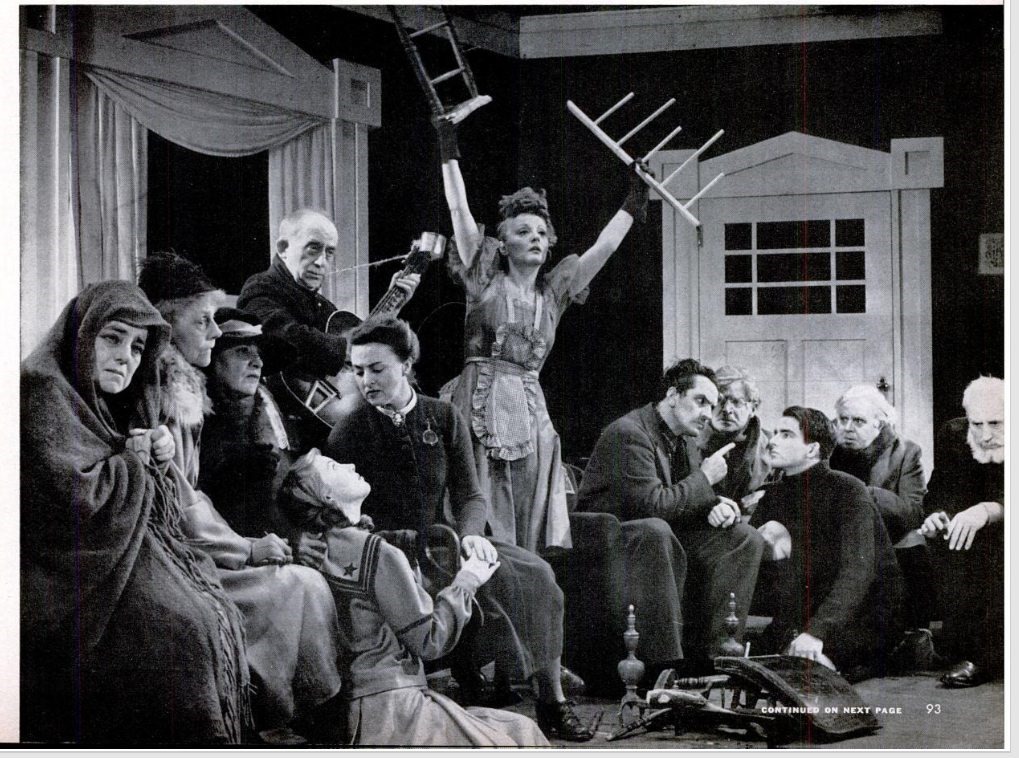
Scene from The Skin of Our Teeth2

“The ice age is coming, the sun’s zooming in.” A scene from the first act of Wilder’s  1942 “The Skin of Our Teeth.” That’s Tallulah Bankhead who’s broken up the chair for kindling.


Shakespeare’s winter song here is immediately preceded by another song in his play (the first song invoked spring.) Each song of the pair features a symbolic bird, and for this winter song we’re given an owl in its refrain,* a bird omen of unseen dread whose song, breaking with the Imagist show/don’t tell rule, is described as “a merry note.”

Merry? A little dark humor there I think. But even if that bird’s a bad omen, the fact that it’s singing means that it’s enduring. And the poem’s second and final stanza continues that theme of endurance. Everyone in church is sick and you can’t hear the sermon for the coughing (but coughing means you’re breathing, and who can tell how useful the sermon’s lesson might be anyway). The visible birds are hunkered down in feathers. There’s some crabs** sizzling in a bowl. There’s a fire. Tom’s brought more wood. There’s someone there to see greasy Joan cooking.

That refrain repeats and the song ends. Shakespeare’s play’s characters are kings, courtiers, and princesses and the plot their fancies. His actual world was full of war and deadly factions, brutal executions; a world of connivers, fools and tyrants, and even those who could combine all three. Yet, here he ends his comedy not with a wedding but with a song about modest endurance.

I think I lucked into this one this week. If one pays attention to this little song, it says something about those of us who are not kings or principal ministers.

Those who’ve endured my singing may be glad to hear this one is spoken word. The music is drums with a mix of four wintery synths played with my little plastic keyboard and MIDI guitar. The player to hear it is below. The full text of this short Shakespeare poem is here. I wish you the sustaining fires that are warm and illuminating, instead of the flames of fools.


*The refrain also features one of the more obscure words in the piece: greasy Joan is “keeling” the pot. I thought “stirring,” and there is some sense of that, though it may be particularly skimming fat off some stew.

**I thought of steamed crabs hissing, but if Shakespeare is remembering his rural Warwickshire it might not be seafood, but crabapples. Hot ale punch with floating crabapples was apparently a thing.