The Birmingham Vulcan (for MLK)

The Holiday

Monday is Martin Luther King Day in the United States, which I take as an occasion to honor the man but also to honor the American promise that changes for the better can be achieved, albeit via earnest efforts and personal costs.

At my age King and the mid-century struggle for what was then called “Civil Rights” were not history — they were current events. I can tell you that despite the somewhat anodyne holiday we celebrate this year, these things were in King’s time as fractious and deadly as any issues today. Some of the immediate issues in the struggle were things we might now assume are self-evident, equivalent civic rights for Black Americans: the rights to vote, to travel, to sit in a restaurant, to speak for change. I assure you these things were controversial, and that it was easy to find short and long arguments as to why they were impossible or contraindicated by the inherent and/or empirical nature of Black or white America. Those things, or so it was widely said, were impossible, impractical, ill advised, a poor use of resources, against human nature.

Are any of my readers thinking that the consideration of history including so many instances of injustices is depressing? Or what of the fears that this will cause inordinate shame? Let me then point out on this holiday: societies can advance, costs borne in the struggle for those advances will be honored. On July 4th we celebrate the improbable founding of our country as “A republic if we can keep it.” On Memorial Day we celebrate great losses to preserve that country. On your choice of Labor’s Day we say our nation takes broad-based work. On Martin Luther King Day we can see all those things too. while being reminded that King was not a President or General, but a man who represented and gained his power from us, American citizens, asking adamant with the effectiveness of soul-force, for our country to stop doing what harms us, to start doing better. Isn’t that a fine thing to celebrate?

The Birmingham Vulcan Illustration

The 56-foot-tall Birmingham Vulcan exhibited before installation overlooking the city. How the iron man looked around the time MLK was in Birmingham. How it looks today atop it’s base and observation tower. African ancestor: Ptah. The MLK memorial statue.

.

The Song

Are any readers still reading who feel what I wrote above is jejune? If you’re still here, thank you for your patience, but I’m about to try your patience some more. “The Birmingham Vulcan (for MLK)”  has never found an audience, and there are times when I can see why. I have an unreasonable love for unusual connections — things that in my mind connect but to most seem trivial. You’d think poetry might allow some license in such things, but that’s not so. When I showed this to my former group of poets when we were all alive together a few years ago, this piece was to them confusing and without a shred of emotional connection. My takeaway? I had portrayed nothing of the wide-ranging connections to them then. It’s gone through a couple of revisions since, likely improving things, but the core problem is that this piece requires a somewhat unique combination of knowledge to make sense.

So, let me take the usually foolish step of providing a brief decoder ring to the mythological story “The Birmingham Vulcan”  tells. Poets and songwriters: you should know this is a bad idea. “The Waste Land”  and “American Pie*”  aside, few readers like the impression that the poem knows something they don’t.

My poet group first-readers stopped right off at the second word. “Who’s this Solon?” Short answer, he’s a big macher for classical Greek Athens and it’s system of government. “What’s he doing in Africa?” Plato told a story in one of his Symposiums that Solon went to Egypt, and the learned priests there told him that he had no idea about the history of his region. Now this is an interesting story choice in that the Greeks were famous for thinking they were exceptional, and here are these foreign Africans telling them they knew more about history than they did.

“OK, so who’s this iron man?” He’s Hephaestus to the Greeks, but to the Egyptians he was Ptah,** and to the Romans he was Vulcan. All three of these ancient gods were makers and metalworkers. Hephaestus has some additional particulars: he was segregated from the other Olympians, was described as deformed or ugly, and in a connection that will come up later, he was also the patron of weavers.

Birmingham arrives in the second stanza. When I said this was connected to MLK’s “Letter from Birmingham Jail”  that rang a bell, but what’s lesser known is the reason the southern American city that jail was in was called Birmingham. They wanted to be an industrial city dealing with iron, steel, and metalwork, like unto Birmingham England. And yes, they actually erected a giant statue of Hephaestus/Vulcan at his forge to overlook their town early in the 20th century.

Did the statue’s maker make him clearly Afro-American? Nope, I don’t think the city fathers*** would have paid for any such depiction of Vulcan. But sometime between the World Wars they painted this iron statue brown, either to hide the corrosion or to make the connection to iron more plain.

Third stanza: segregation and regulation to lower paid jobs. One of the “Well, you don’t understand, it just works better that way” situations that King went to Birmingham to oppose.

Fourth stanza: King arrives. King’s “Letter from Birmingham Jail”  is as wide-ranging as an Emerson essay in terms of references, but I loved this little noted connection: King was in a city of foundries and chose as an example of soul-force civil disobedience the men from the biblical book of Daniel thrown into a fiery furnace for disobeying the ruler.

Fifth stanza: “Letter from Birmingham Jail”  is not written to dispute overt racists or the segregationists. Rather it was addressed to ostensible supporters who raised objections to getting on with stopping what was hurting the country and offending justice. The non-segregationist position was to object on a wide range of fronts to that civil rights movement — some with practical, strategic or logistical concerns, some seeking to assuage those whose “culture” and “traditions” might be offended. And of course, many too were silent on those issues out of fear, ignorance, or distaste for struggle. King spoke to those too in his letter.

The original version of this piece was called “The Cord of Life,”  a phrase mysteriously used in King’s letter, and one I loved for its connection to Hephaestus, and so it remains in this stanza.

I trimmed some stanzas as the poem went through revision that directly referred to the infamous Birmingham Sunday terrorist bombing of a church during the civil rights struggle in Birmingham. A great many poems and songs have already sung of this and of the four schoolchildren killed going to Sunday School, so I hope it’s still remembered. That act was so offensive that the terrible sacrifice helped move public opinion. The sixth stanza is all that remains of that matter, and I still feel the song is a bit long, but I left this one in so that there’s some motivation for the Vulcan statue to magically speak in the concluding stanza.

The last stanza as the silent statue finally speaks has been worked over several times. I still hope it has some power on this day. You can hear my sung version of “The Birmingham Vulcan (for MLK)”  with the player below, or for those who don’t see the player, with this highlighted link.

.

*I admire the former and am generally uninterested in the latter. So even for the exceptions this doesn’t always work.

**Ptah, venerated particularly in Memphis. As in the delightful Talking Heads lyric “Cities”  got away with it: “Memphis, home of Elvis and the Ancient Greeks.” That song, like mine, is briefly referring to the “African origin” theory/myth that assuming that Western culture started with the Greeks ignores that African cultures may have informed the Greeks.

***The writer’s group, poets of good taste, disliked my play on words “foundering men.”

The Absent Poetry of World War II

It’s been sometime since I’ve posted here. Having fewer blocks of uninterrupted time to compose and record the audio pieces for this Project, I’ve spent time instead with that proudly designed to be a time-waster Twitter in the past week or so. Twitter* has its own news stories this week — but that’s not my subject today.

I have a tiny number of followers there, and what I tend to talk about on Twitter is poetry, and then less-popular types of music. Really, not unlike what I do here on this blog, but more cut-up and off-the-cuff — and with more typos from typing on a small tablet screen and screen-keyboard. While working with poetry and music might cross-train you to fit things into constrained spaces, the Twitter short post-length limits challenge even this fan of compressed verse and sub-1000-word essays.

I came upon this Tweet this morning though that brought to mind something I’ve not revisited here on the blog for a while. One of the regular Twitter poetry-posters put up the devastating Wilfred Owen poem “Dulce et Decorum Est,”  and I once more thought of how powerfully the soldier-poets of World War I wrote about their war from the front lines — how to this day England recalls what they said combined with their presence as example casualties from that war, and in the sum, the tragedy all that entails. Long-time readers of this blog will know how thoroughly I’ve extracted poetry from WWI for presentation here.

War Poets in Poets Corner Westminster Abbey

Here’s a picture of a specific memorial to WWI poets in the Poet’s Corner of Britain’s Westminster Abbey

.

Perhaps it’s the Public Domain limitations of what can be freely reused in a Project like this, which puts my attention on pre-1927 work — but I was caused again to wonder, why don’t we have dozens of effective poems about WWII, many of which will be commonly anthologized and recalled by the general audience poetry retains? If called to find examples I might start (as would many others) with Auden’s “September 1, 1939” — but this isn’t a first-person “report from the front lines” poem like Owen, Sassoon, or T. E. Hulme presented back then. It’s not even as close to harms way as the incisive poems of Edward Thomas who wrote about his approach to volunteering for the British Army that led to his death in the conflict, or Apollinaire’s equivalent to Auden’s poem about the outbreak of WWI, “The Little Car.”  It’s not that poets or writers didn’t serve, and a great many novelists who served had a war book in them it seems.**  So, we can easily think of the novels about WWII written from frontline experience. But poems?

Was WWI poetic and WWII novelistic? I can’t make that case. Maybe you can. Is it down to the changes in the literary marketplace? Plausible, though within poetry’s more limited audience in the second half of the 20th century you think there’d be room for poetry as vivid as those of the WWI soldier-poets. Here’s a short list of a few of the notable American poets who did serve in WWII: James Dickey (Air Corps airborne navigator, though some reports say fighter pilot), Richard Wilbur (Army Signal Corps in Europe), Frank O’Hara (sailor on a destroyer in the Pacific), Richard Eberhart (gunnery trainer), Lawrence Ferlinghetti (Captain of a submarine chaser), Karl Shapiro (medical corps clerk in the Pacific theater), Kenneth Koch (infantryman in the Philippines), Randall Jarrell (“Celestial navigation tower operator,” which he claimed was the most poetic job in the Air Force).***

Of that list only Shapiro and Jarrell wrote what might be called “from the front” poems. Jarrell’s “Death of a Ball Turret Gunner”  may be the  example of an anthologized WWII poem, and Shapiro had his first book about his overseas, but not exactly in front line combat, V-Letter,  published as the war was still ongoing.

What happened? Why didn’t more of these poets write more about the details and moments of their service? My general observation is that instead they wrote consciously and unconsciously about how the war changed their outlook on the world. David Haven Blake wrote a short journal article on Wilbur’s World War II poetry, but instead makes the case more for this theory. He quotes Wilbur as saying “The war challenged me to organize a disordered sense of things, and so prepared me to write a poetry of maximum awareness and acknowledgement.” I’ve seen another quote from Wilbur circling the same thought “One does not use poetry for its major purposes, as a means to organize oneself and the world, until one’s world somehow gets out of hand.”

This non-scholar will now generalize wildly, but the WWI war poets used poetry, often structured metrical/rhyming poetry, to demonstrate the world out of joint, a genteel form container for barbarity and chaos. The WWII poets muted all that as unspeakable (or even over-spoken?) and sought to portray in poetry (that wasn’t always as formal) the values and observations of a peacetime more precious, however ambivalent and imperfect, from the militarized brutality of combat.

Let me dedicate this little essay to Robert Tallant Laudon. Laudon sought out the Lake Street Writers Group early this century as an 80-something veteran who had served in a logistical role in England during WWII. Though he became a music professor after the war, he seemed not completely sure of his skills as a poet, but he wanted to use poetry to portray something of his experiences during the war. By the time he was 86 he published a small chapbook “Among the Displaced — World War II”  with the resulting poems. I now view the younger me who heard him workshopping drafts of these poems as a much younger man than I thought I was then. Such is the progression of age! His poetry, like much good poetry, was written in an immediate present while depicting the 1940s, and I’ll always treasure that experience.

I mentioned at the start no new music, but here’s a piece, a “found poem” I created out of a recorded interview with another music professor, Weston Noble, who had served in WWII and which I set to my own music early in this Project. The voice you’ll hear in this must-listen-to piece is Noble’s. He commanded a tank in Europe during that war. In other parts of that interview, he recalled that when under fire, another member of his crew would ask him to sing. Inside that steel turtle shell the war outside existed mostly audibly, and the fate of those vibrating inside was unsure. The voice of Noble somehow calmed his crew. And this person now, here, who writes this? I’m still afraid to sing, worried that the unpleasant sounds that I too-often utter will embarrass me and displease any listeners. When I hear this man, now far in age from the war he fought in, decades from the interior of that tank, speak to the recorder of “The Garden of Trust”  claiming that it can be found in music, I invariably start to mist up.

Listen to this two-minute audio piece with the player below — or if you don’t see it, with this highlighted link provided as a backup.

.

*A new sole-proprietor owner has led many — who have through long activity and posting on this online service built up it’s usefulness for themselves and others — to worry about its continued existence.

**Kurt Vonnegut did two WWII novels . One, Slaughterhouse Five,  is one of the last first-person-experience-informed WWII novels, and another, Mother Night,  is a personal favorite, and includes this WWII poem that this Project performed.

***I was able to start this list from an article on the Poetry Foundation’s web site linked here.

Avebury Song #2

Is it even possible to mention Stonehenge without risking the unbidden memories of the feet-to-inches comic debacle from Spinal Tap? Well, that’s one reason I’m a little hesitant to introduce today’s piece in our Halloween Series this year.

But still, I’ve been talking and singing about ghosts, ancestors, spirits, and their home fires a good deal, and I remembered this performance by the LYL Band of this song I wrote after visiting an altogether homier set of Neolithic English standing stones at Avebury several years back. I understand Stonehenge is fenced off, and that enforced distance probably does little to staunch the tales of quasi-Medieval druids with magical rites floating stones in the air. Avebury’s large henge basically had a country hamlet grow up inside it, there’s even a pub in the midst of the circle. You can walk right up to the stones, feel these cool earth-aerials, measure them against one’s own height and age. A walk around the Avebury henge is a good walk, and one may also look over the equally amazing earthen ditch-works that are part of the site. As you stroll a flock of official government sheep wander the grassy meadow keeping overgrowth at bay without internal combustion clatter. So at Avebury, as I was walking around all this, I did not think of druids. I thought of men and women who dug and moved that earth, dug and moved those stones, erected them watching over each other.

Avebury collage

There are several rings in the henge at Avebury, and the stones are individual in shape and size, furthering the thoughts I had while visiting the site.

.

Did they have some chieftain or matriarch who planned and ordered its construction? Perhaps. What belief was being expressed in large rocks? Some likely, at least to the level that metaphor asks of us. But as I said, I thought of who did the work — the sweaty, hard-breathing, hand-callousing work. They worked stones with stones, dug with pickaxes made of antlers. At night in what huts did they sleep, on dried grass beds perhaps? And in that night they no doubt slept hard after their day of work, dreamt dreams harder than those of old poets who need only to move words around. If the energy of the earth and sky was transmitted up and down those big stone antennas, so too must the energy of their dreams be drawn in there. And I was there where they must have slept, dreaming under night breaths, their aches soothed by the rest. Dreaming of what? Children, parents, lovers, siblings, colleagues, whole days of rest, the mighty thing they would construct, a story, a prayer, a melody, the little joys of a meal or exactly good weather?

Not druid magic in my thoughts at Avebury, but I felt those dreams might be — no must be — harder than the dulling mutes of time. They sparked around in their heads, and when their heads became skulls and then dust, where is that spark, and can we read it still, tune it in? A belief, at least to the level of metaphor, felt we could. That’s the song.

Avebury Song 2

Here’s the songsheet. If you ask for scenery to back your performance of this, get the measurements right.

The player many will see below will play “Avebury Song #2,”  and if you don’t see it, you can use this alternative highlighted link. I hope to complete at least one more new Halloween piece to present here yet this month, though the moving pieces of my life doesn’t make that sure.

.

Song of Shadows, and the Poet’s Diaspora

English poet Walter de la Mare does a very particular kind of fantasy or horror poem. If one is looking for body horror or jump-scare monsters, de la Mare is not your guy. His spooks and slitherers are usually off-camera — instead, he describes discretely the atmosphere and effect of a haunting, visitation, or some binding spell. As our Halloween series continues, I have a performance today of a de la Mare poem called “Song of Shadows.”   It starts out commanding a musician, so it’s a natural for the Parlando Project, but besides the ghost story, I think it invokes something else I considered this week.

Here’s a link to the poem as de la Mare wrote it. I made a slight change to the concluding line of each stanza as I like how that change works in performance.

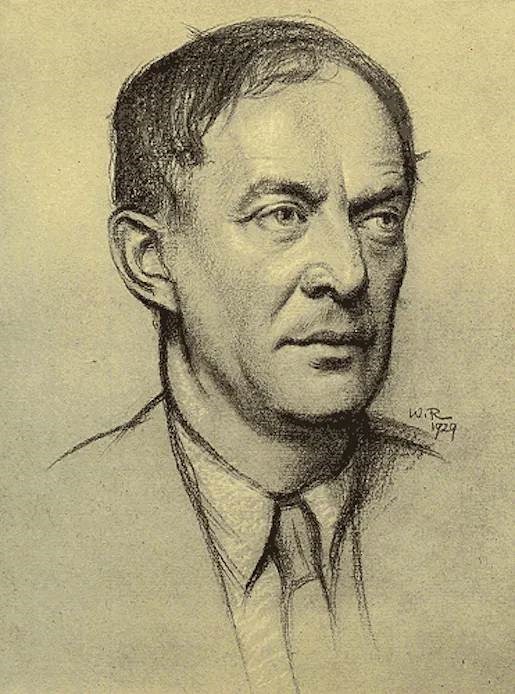
Walter de la Mare

I learned a weird fact about de la Mare this month: as a writer he struggled for income, but for reasons I don’t yet know he was given a bequest in golden-boy and WWI casualty Rupert Brooke’s will that provided for his career.

.

“Song of Shadows”  is not definitely set, though some elements of the scene indicate it might be somewhere antique. Fires and tapered candles wouldn’t be totally obsolete to a 19th century-born man like de la Mare, but the opening command to a musician sounds like a court or titled lord of the manor kind of thing to me. And the poems report of an extant — not necessarily metaphorical — hourglass with sinking sands really sets this outside of the early 20th century when it was written.

One could stretch and draw a class-conscious reading between the commander of the poem, the musician, and the eventual appearance of some ghosts or spirits. Who are the ghosts to the commander? To the musician? De la Mare leaves that open, but the different roles of those three characters offer an opportunity for speculation. To the commander: old friends, old enemies, subjects, servants, or serfs rebellious? And within the range of feelings the spirits may carry, we may note the poem’s commander asks to risk summoning them.

But I mentioned the poem set off another line of thought beyond its subtle fantasy intent. The poem concludes the shadows have been summoned by the musician’s song, “Dreaming, home once more.” So rather than thinking of the commander or the ghosts, I thought of the musician. While I operate musical instruments to realize the Parlando compositions, I’m likely more competent as a poet than as a musician, but singer is often an honorary title for any poet. For those who read this who are poets: is this not a part of our job?

The thought intensified when I read a string of Twitter posts by Lao poet Brian Thao Worra this week. Thao Worra was taking stock of his career in that post, and throughout it he seemed charged with a mission toward the Laotian diaspora as a Laotian-born poet and artist living in America. I’m no expert on Laos (nor anything else really, but less so on Laos), but it struck me that so many poets I read and resonate with are part of, and speak of, large diasporas: Irish poets, Afro-American poets, Jewish poets. Even the echt classical Chinese poets Du Fu and Li Bai were banished to far provinces of China. Why do I resonate to these poetries? It then occurred to me: many, perhaps most, poets are in some kind of diaspora, be it geographic or otherwise. We have emigrated from the country of Poetry, or we have been exiled or taken away from there. And there we are, like the musician who sweeps faint strings in de la Mare’s poem — singing, waiting for countrymen* to hear our song. Will they hear, and if so, will it be in the plane of dreaming, in the plane of ghosts and spirits — and so then will it be that we are all, home, once more?

I didn’t sweep the strings of an old, cheap 12-string guitar very faintly for this performance of Walter de la Mare’s “Song of Shadows.”   And I kind of hollered the vocals. Ghosts, make of that what you want. You can hear it with an audio player gadget below, but if you don’t see that player, this highlighted link is an alternative that will open a player gadget.

.

*I can’t think of a gender-neutral word that has the same flavor and power to me as that word “countrymen.” Why that is must be complex, or just some failure on my part, but I just wanted to say I used it because I couldn’t do better.

Sam and the Ghosts

Our Halloween series continues with the voice, music, and words of Dave Moore today as I present his piece “Sam and the Ghosts.”  And as bonus autumn content, this one takes place in a garden just past harvest time.

I haven’t kept a garden in decades, but Dave and long-time friend of this blog Paul Deaton do. They remind me that at about this latitude north, October is the time to have removed the final products and to prepare the bed for the interval until spring planting time returns.

I may not have done this for decades, but this process goes back — way back. Folks were planting crops in the Midwest long before colonization. The mound builders here, like the earthworks and standing-stone raisers in the British Isles, fed themselves on the invention of agriculture. So in that way, every garden — that small geographical gesture — is a memorial. William Blake said the rebellious angels of art must need to drive their plows over the bones of the dead. I don’t think he was speaking of colonization or commerce when making that point, but his maxim is true reportage anyway. Whether we are speaking of poetry or music or tomatoes, were we plant has likely been tilled before by dead people. Isn’t it proper then that we should honor them before we make our gestures in the soil?

Sam and the Ghosts

The song sheet Dave handed me the day we recorded this song a few years back.

.

In Dave’s poem which he made song, Sam* has forgotten this. Some ghosts remind him. In his poem they are ghosts of settlers. Outside of the poem, they are people created by Bob Dylan.**  Those definite levels in history are not the beginning, not the end. Who knows who ran the land from where the settlers’ family left to come to America? Then we do know who lived the land, and were so harshly displaced before the settlers’ opportunity. Who knows, maybe Hollis Brown’s farm is no longer farmland now after some other money has changed hands. How many songwriters are tilling Bob Dylan’s land?

Every seed you plant came from somewhere before you plant it. Every land has ancestors. Every garden is, or should be, a memorial. Winter will bury our gardens, turn our blank pages to blank pages again, and we wait and expect for spring.

The ancestors expect for spring too. We are that spring. The gaps of expecting are where the ghosts live.

To hear the LYL Band perform with Dave Moore singing his song “Sam and the Ghosts”  you can use the graphical player below if you see it. No player? This highlighted link is your alternative.

.

*Neither Dave nor I can resist a pun. For extra Halloween-relevance points, Dave has named his gardener “Sam Hane.”

**”The Ballad of Hollis Brown”  is an exceptionally stark early Bob Dylan song set in an indeterminate time in rural South Dakota. In Dylan’s song, the seven-member Hollis farm family are starving. Here’s how it sounded when the first recording of it was released in 1964.

All Souls’ Night

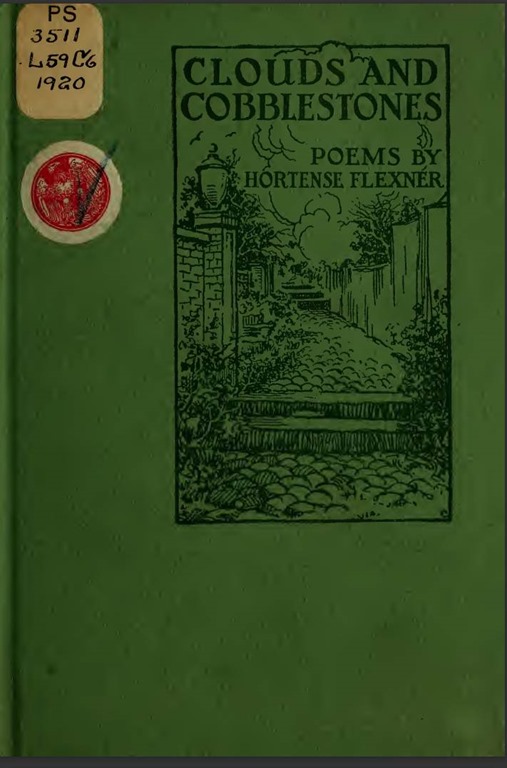
Today’s words are from a poet who’s been forgotten, but this one poem seems to have outlived all her other work largely because it’s a fine short ghost poem with a definite shiver from an ambiguous ending. The poem was called “All Souls’ Night, 1917,”  and it was first published in 1920 in the author Hortense Flexner’s first collection Clouds and Cobblestones.  That book’s acknowledgements indicate “All Souls’ Night”  was never accepted by any of the many publications Flexner had published in toward the beginning of her career, and a selected poems published shortly after Flexner’s death in 1972 does not include it. So it was never her most famous or noteworthy poem while she lived.

Why did I hear of it, why is it out there on the Internet in 2022 to be read? Because of its eerie qualities “All Souls’ Night”  has made a number of contemporary lists of Halloween poems.*  To read or hear it once is likely to impress you of its value as such, and you can read it here with this link, or listen to my brief musical performance below. Our discussion has spoilers, so read or listen first. My performance is only 2 minutes.

clouds and cobblestones cover

I’ve looked at clouds and cobblestones from both sides now, and still somehow…

.

Now that you’ve experienced “All Souls’ Night,”  let’s suppose you’re interested in at least a few questions that the poem might bring to mind after you read its 12-lines with their unambiguous chill. Yes, there’s a window here — just as there was in Sara Teasdale’s nursery last time — but either side of this window’s glass has questions.

Outside the window, there’s a date 1917 ending the original title. The poem internally mentions nothing about World War I which was ongoing that year and would still be a universal memory when the poem was published. Several other poems Flexner wrote and published around this time deal with the war, and one short play of hers, Voices,  that was produced on Broadway in 1916, is about the despairs of war.**

Given that WWI is no longer in most any living soul’s memory, I’ve chosen to drop the 1917 in today’s title, as have some of the re-publishers of fantasy or Halloween poems that are featuring it. Outside this poem’s window we only know there are “hosts of lovers, young in death.” Maybe it’s me, but when I first read the poem, I thought the many lovers would be pairs, many of the lovers throughout time who are now dead and stayed in their passionate youth, and the poem does not directly disabuse that notion. But in the 1917 WWI context, one presumes the dead were soldiers, freshly dead. Whatever Flexner’s intent, I think the former has, potentially, greater impact today, even with our current European war. Can we simultaneously allow how Flexner might have intended her ending to be read, and allow how you or I as a modern audience can see the two groups or characters in this poem?

In the poem’s ending, the poem’s speaker, in a warm room next to a fireplace on the other side of the window asks that their warming fire should be allowed to die down, to eliminate the warmth and light on their side of the glass. It’s implied the poem’s speaker is there with others, a party perhaps, as the fire has been set for cheer in the poem’s opening line. With the onrushing crowd of ghosts outside, the insiders are now told at the end: hush, dim the light, turn the room cold so that the ghosts are unaware of them. This is an ambiguous statement if you think about it.

It can be read three ways I think. One, this is simply self-preservation, the ghosts might be vengeful toward the living. In the WWI context the dead might blame them for starting or not stopping the war. Or the folks inside may be smug, and the ghost lovers are their opposite. The insiders may be saying those outside lovers are the not-the-elect living, and that they would steal the warmth, which the insider speaker concludes they will not be able to use, being they are creatures who didn’t stay living and warm. Or lastly the poem’s statement may be one of pity: we shouldn’t be happy, we shouldn’t flaunt our warmth and light to those dead who now can have none of those things.

If, in the WWI context, Flexner has the ghost lovers to be likely the partners of the not dead inside, then the last reading is the most likely. But the reality of any  of those readings is that the cheer, the warmth, and the joy inside the glass must cease. At least for the night, the light and temperature must equalize to death-like on either side of the window. That is the poems genius: it’s chilling on both sides.

At the time of the performance, I went more with the middle reading in my internal approach. I was tempted by that contrast, even if my reading isn’t correct, perhaps because I see so much in our current culture where the other is cast as undeserving. Their desires are a distorted, improper grabbing for joys, things they haven’t earned as members of “the elect.”

This touches on religious beliefs, so one more factor: the poem references All Souls’ Day, a Christian religious holiday. I’m not sure if Flexner wishes to put a religious overlay on her poem, other than an occasion for ghosts. The Flexner family were 19th century German Jewish immigrants to America, and beside Hortense, there are several notable members. The foremost Flexner was her uncle, Abraham Flexner who I see credited with (among other things) the founding of the Institute for Advanced Study at Princeton, the eventual American home of Albert Einstein. Abraham was raised Orthodox, but became an agnostic. I have no info on what religious customs Hortense Flexner may have been knowledgeable about.***  All Souls Day as a traditional Roman Catholic holiday was devoted to praying for those dead not in heaven, in purgatory, and was separate from All Saints Day, which was reserved for the saints who got right into heaven. Protestant Christianity dispensed with those twin holiday distinctions and more or less considered it one holiday.

OK, here’s the part about my short musical performance of “All Souls’ Night.”  I got out the virtual orchestral instruments again and started writing orchestral string parts to go with acoustic guitar. To help with the ghostly air there are two non-acoustic instrument tracks that are mixed at an almost subliminal level: a somewhat overdriven electric piano and a suitably unreal synth patch. You can hear it with the graphic player were it’s seen, or with this backup highlighted link.  I still have other pieces planned for our Halloween series this year, so check back or click Follow to experience them.

.

*Poets.org, a long-time online poetry repository, has “All Soul’s Night, 1917”  as it’s only Hortense Flexner poem, and references it under themes where a search might find it, but I may never know what the Ur-source is for this poem’s revival.

**Don’t think big time. There were more theaters then, and the Broadway theater where it was produced was The Princess, which sat only 299, and we don’t know how long the run was. I have watched a low budget amateur performance of Voices. It’s an earnest to a fault two-hander with a young French WWI-experiencing girl and another mysterious character who turns out to be Jeanne D’Arc.

***I went down a happy rabbit hole reading about the Flexners. Hortense was a feminist and a suffrage activist, college educated and eventually a literature professor at two of the “Seven Sisters” women’s Ivy League schools. She’s also some kind of relative to Kenneth Flexner Fearing, a lefty poet who became a pulp-noir novelist around mid-century.

Yeats’ Coat

Let me briefly slip, Wordsworth-like, into reverie, and note that “Oft, when on my couch I lie in vacant or in pensive mood…” I turn to the vast daffodilian array of scanned material available from a brief Internet search. I’d been thinking about Irish poets after reading this exchange between poets Ann Grá and Sean Thomas Dougherty.  Grá asked “What’s the best way to improve one’s active writing vocabulary?” Dougherty’s answer? “Read Irish poets. Everything will improve. Including life.” Irish poets mentioned — and William Butler Yeats enters the chat. You may have noticed that I led-off last time by remembering a Yeats poem about a friend whose work has come to nothing. This all entered into seeking another Yeats poem to perform this week. I came upon this one. Poetry workshop devotees, note that I read it even though it has just about the most generic title imaginable: “A Coat.”

But here’s the neat thing: I was able to read it in its first American publication, situated exactly with added meaning and context in a scanned copy of a 1914 number of Harriet Monroe’s Chicago-based Poetry  magazine. Poetry,  the magazine, was fairly new. Yeats reputation was well-established — so publishing a tranche of new Yeats poems was likely “a get” for Monroe rather than a breakthrough for an emerging poet. With rhyming coincidence, the selection of 11 Yeats’ poems begins with that one from last time “To a Friend Whose Work Has Come to Nothing,”  and ends with today’s: “A Coat.”   These poems are followed by a short editor’s note from Monroe who writes of the resistance from cultured readers to the Modernist verse her less than two-year-old magazine had received, singling out the objections to Carl Sandburg’s Chicago poems* she’d published. Then as I read the scanned magazine, and without even a page-break, the indispensable English-language Imagist Mephistopheles, Ezra Pound, pops up from the hellmouth trap-door with a review of Yeats new verse.

Then, as often now, what sits on the page as if it’s an objective bit of selected poetic criticism is really an insider comment from those who already know each other in some way.** Pound reviews “A Coat”  specifically in his piece, just a few pages past the poem’s American unveiling. “Is Mr. Yeats an Imagiste?” Pound is rhetorically asked. “No,” Pound answers himself, “but he has written des Images as have many good poets before him.” In writing here about Yeats then current poetry Pound praises the directness of style and unfussy language and syntax the Irish poet is now using. He mentions that Yeats’ earlier poetry with a more 19th century music and setting has attracted followers and imitators in their now 20th century, but perhaps the imitators miss some of its vitality — so much so that Pound wonders if the reader would “Rather read Yeats in the original” than these bad copies. Pound’s conclusion? “I’ve not a word against the glamour as it appears in Yeats’ early poems, but we have had so many other pseudo-glamours and glamourlets and mists and fogs since the nineties that one is about ready for a hard light.”

So, why do Irish writers have something to teach us other English speakers about using our language. First off, as a colonized and exploited country, they may look at the language from a critical parallax. If it’s the language of your colonizer, your oppressor, you may want to ask what English words should  do, and you have reasons to be warry of what they can  do.***  And I have a second idea, less fully-formed, that the whole mists and fogs of Celtic folklore, to which Yeats added his own caldrons of turn-of-the-20th-century magic and occult stuff, offer a conscientious poetic distiller a chance to speak the shades of the ineffable vividly in their poetry because their folkloric traditions and magikal folderol have already saturated their personal needs for glamorous elaboration. Other poets embroidered robes, either traditional or ceremonial, will get caught in such, but if one can escape, you have the contrast of a new clarity. This clarity is different — you have the experience of having worn the long robe, and now the new Eden.

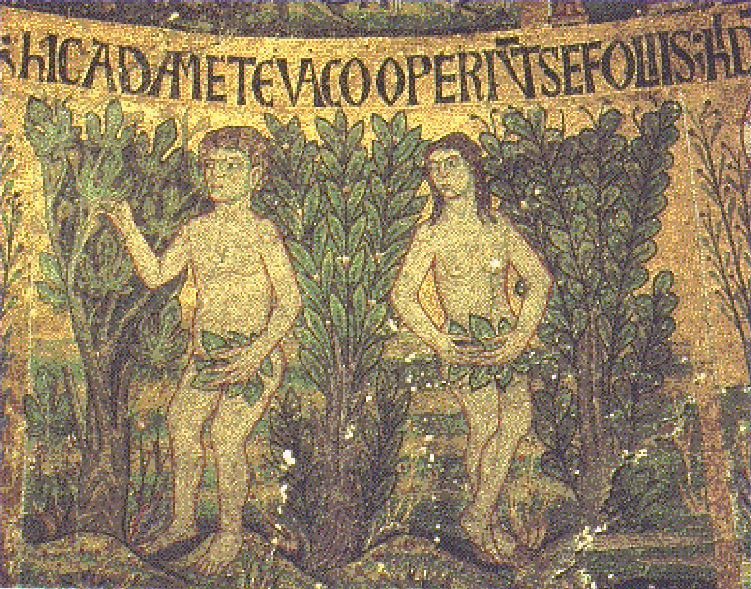
Adam-Eve

Eve ate from the tree of knowledge, then Adam explained plant-based couture  Eve wonders why she suddenly knows the Latin genus Toxicodendron.

.

Today’s performance of Yeats’ “A Coat”  has music for solo acoustic guitar, something that I’ve fallen back to often this past summer. The final guitar performance turned out to be an exercise in the various timbres I could pull from the guitar. The tuning and chord voicings used had several two and even three-string unisons which resonate and sustain, and then some contrasting pizzicato muted notes. You can hear it with a player gadget below — or if you don’t see that, with this backup highlighted link.

.

*Reading Monroe’s 1914 account reminds me of just how alien Sandburg’s poetry must have seemed to an early 20th century ear. To my 21st century ear and mind, I can more easily find the music in it, and I treasure now his Imagist “direct treatment of the thing” being applied to ordinary life, workers, immigrants, and the cultural powers that obfuscated that with elaborate English language.

**The American Pound and the Irish Yeats were both in London at this time. It’s likely that Pound himself was the conduit by which the new Yeats poems found their way into Monroe’s magazine. London then was the locus of the new Imagist ideals which stressed simplicity. Poets who wrote primarily in metrical and rhymed forms then, such as Yeats, Frost, Hardy, and Edward Thomas absorbed or resonated with this new, fresh, directness as a poetic effect.

***Though for various reasons this project has limitations on using modern English-language poetry, it strikes me that contemporary American poetry benefits from similar parallaxes. I was going to supply a catalog of those groups who know English as having been used as the language of an oppression, but it occurs that anyone who’d go with this thought can already supply their own catalog.

Write Me Down

Some things others wrote this week brought to my mind an early post on this blog that has had thousands of web visits over the years: my presentation of William Butler Yeats’ “To A Friend Whose Work Has Come to Nothing.”   Back in 2017 when I performed that Yeats’ poem I couldn’t help but wonder: who was the friend, what was the work that had come to nothing? I probably spent several hours researching that over a couple of days* and came up with the name of the man, the nature of his project, and the final fate of each. The man came to an abrupt end soon after Yeats wrote his poem, yet the project that was his aim eventually became partially successful. You can read that early Parlando Project post via this link.

When I looked back at that post, I found that I had spent the first half of it honestly dealing with the problematic nature of poetry as a method of communication. One can draw an auditable bottom line from those issues: most poets have few readers, many have nearly none. Furthermore, thoughtful, intelligent, deep engagement from those poetry readers would be from a subset of those small groups. That being so, the question of why do poets persist occurs, and that has no simple answer — but one element of that is that the act of writing has an ineffable magic. The very act of saying and recording, even what will rarely and barely be understood, has a power.**

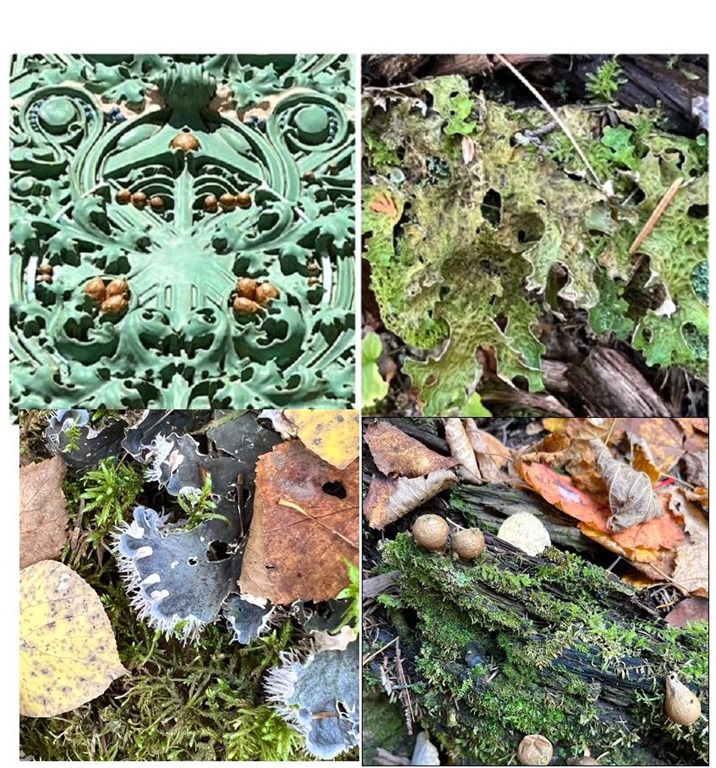
Fall Collage 4B

Art & Nature: a Louis Sullivan building ornament with various fall fungi and lichens. Photos by Heidi Randen.

.

Around the time I performed Yeats’ poem and wrote about my encounter with it here, I wrote a poem of my own which was not successful in performance to the level that I could present publicly. Since the Parlando Project is primarily about presenting other people’s words not my own, it was easy to set this one aside. This past summer I found that old poem as I cleaned up the song-sheets in my studio space, and I considered a new performance of it. Given the way life is postponing my efforts still, finding out what a new performance would sound like took over a week, but I completed a version today. That poem, now song, “Write Me Down,”  is about the challenges, duties, connections, and consolations of life. I fear “Write Me Down”  is a confusing multi-faceted catalog of those things. The handful who read it years ago when new found it uncompelling and impenetrable, but I haven’t had heart or mind to revise it since. But here’s today’s point again: as the title might indicate, it says something too about the motivations to write things down, even poetry, to manifest them for an uncertain audience. We poets have great imagination! We can imagine an honest and merciful judge will read us, and we can do so even where our imagination retains other limits: where and while we don’t know how long we will work with our life, and we don’t know how close to nothing it will come to. We can only know the love in the work.

You can hear my performance of “Write Me Down”  with a graphical player below if you see that, or with this backup highlighted link. Thanks, as always, for reading and listening.

.

*I was only able to find the significant details that Yeats left out of his poem to make it a more universal and general statement after work with Google’s index of published and not yet public domain books that was part of an ill-fated project that I understand was stopped due to copyright issues. I wish I had noted the book or books where I found that info, but the kind of in-between-life research that I found time to do, and my own general sloppiness, kept me from recording that. I regret that, and have tried later to make a point of linking others’ research that I’m grateful to have found.

**The direct inspiration for this piece’s words as I recall is a blessing associated with Rosh Hashanah new year’s celebration: “Shana Tova Tikateivu,” which means “May you be inscribed in the book of life for a good year.”

The most popular Parlando Project piece, summer of 2022

They tell us: yesterday was the last hot day of the year, with temps peaking above 90 F. The summer night ended, like a fair or exhibition with fireworks lightning and booming thunder, and the coolness of fall seems to have arrived today. The urban trees here have just a touch of autumn colors on the edges of avant-garde branches. A city’s pretense is that it is artificial, a human-made place, but the trees are here to remind us.

Late September Days cartoon

The above cartoon presented without further comment.

.

I’ve said that when I look at what pieces were the most liked and listened to each quarter that the results often surprise me. The Parlando Project takes words (mostly poetry) and combines them with various original music. For practical reasons,* the poetry we use is largely in the public domain, poets whose reputation has usually settled to a stable level. We’ve done many pieces from such poets that retain readership into our century: Dickinson, Frost, Yeats, Stevens, William Carlos Williams, Eliot, Millay. I also enjoy reviving work by poets that once had considerable readership, but who have fallen out of favor or esteem: Longfellow, Teasdale, Sandburg for example. And there are poets that have higher profiles in the UK than here in the US: Edward Thomas and Thomas Hardy. And there’s my translations or adaptations of work outside of English: Du Fu, Li Bai, Rimbaud, Rilke.** That’s a big world of material, and my attempts good, bad, and indifferent are up in the archives for all to hear. But then there are the wildcards, the poets that only indefinitely reached and failed to retain much regard.

Apparently, Robert Gould Fletcher is one of those. He was identified early on as an Imagist, a form of early English language poetic Modernism that I think has values worth revisiting. Curious, I dipped into a couple of his many books from the first half of the 20th century and found a short nature poem that intrigued me. As I worked to set it to music my city had a summer storm whose aftermath was a striking yellow/green/brown sky tint. In the heat of that evening I started to recast Fletcher’s poem, producing a result that’s a “after a poem by” or “inspired by” work — but it wouldn’t exist without Fletcher.

Despite Fletcher’s non-existent current literary standing and my own low profile as a poet, “Yellow Air”  was the most listened too and liked during our past warm summer. I wouldn’t have predicted that, which is a pleasure.

You can see Fletcher’s original text and the full text of my subsequent version along with guitar chords which you might use if you want to sing it yourself by clicking on this link to the original post. Or you can hear it straightaway with the player below.

.

*Submitting writers may know how slow and inconsistently editors will respond. Well, I found the response asking for permission to present poems here was even worse. If an unsought grant was ever to fall from the sky for this Project, I’d ask first for someone to bug and cajole rights holders for the rights to present more recent poems here.

**How much have we done this? Over 600 times! And all of the results are still available here via the archives. If you just want to sample the music more rapidly without my comments on the encounters with the text, the most recent 100 or so are available as podcasts on Apple podcasts or most other places that offer podcasts. Note that the Parlando Project podcasts are just that: the typically less than five-minute audio piece. From time to time I’ve considered a more conventional talking-about-stuff podcast, but I’m unconvinced the interest would replay the work on top of the research, composing, and recording effort that goes into this Project.

Abbreviated Summer 2022 Parlando Top Ten

There were fewer audio pieces presented this past summer, so I’m going to abbreviate our traditional Top Ten review of the past season to reflect that — but I still kind of like this part of the Project, as I get to see what pieces got the most response. Like the Parlando Project in general, the most popular pieces tend to be quite various, and it’s often the pieces I’d least expect that bubble to the top. As a proper Top Ten, we’ll look at them as a countdown, starting with the 10th most liked and listened to one and ending with the most. The bold headings are links to the original posts in case you’re new here and would like to read what we said then.

Very briefly here are the pieces that make up numbers 10 through 6.

10. Arthur Hoehn by Frank Hudson. In the summer doldrums I felt free to include more of my own words. This is a short elegy for a classical music DJ who worked the overnight hours. I’m quite proud of the final lines of this one.

.

9. Staying the Night at a Mountain Temple by Li Bai. Another of my loose translations of a Tang Dynasty classical Chinese poem. I based my translation on my understanding of Li Bai’s (his name is also rendered as Li Po) general outlook. An example here of how I work with orchestral instruments.

.

8. Stratocaster by Frank Hudson. Really, this project is usually concerned with other people’s words, but this sideways ode to an ingenious radio repairman whose swoopy electric guitar design was enshrined in the Museum of Modern Art got a good amount of response.

.

7. The Dick and the Dame by Dave Moore. Alternate voice and keyboard player here Dave Moore says some of this is adapted from Robert Coover, but this really holds together as a poetic liturgy for pulp noir. Also I got to wail on guitar.

.

6. Let us be Midwives by Sadako Kurihara (translated by Richard Minear). This was my piece for past August’s Hiroshima Day, a short tale of the huddled human aftermath of the first atomic bombing. Is there a word for sad/hopeful? If so, that’s this poem.

.

don't underestimate 800

Getting ready to lock up my bike late this summer, and my attention is drawn to a message on top of the post.

.

Now let’s move on to the top 5 and say just a bit more about each of them.

5. From Cocoon forth a Butterfly by Emily Dickinson. We’ve done lots of Dickinson poems here over the years. Though we did this one in summer, it talks about harvest time. While poetically condensed, Dickinson observes harvest workers and the proverbially productive bee and contrasts them with a no doubt lovely, but also somewhat unoccupied butterfly. Is Dickinson, the poet, the butterfly? I’m not so sure. My understanding is that Dickinson’s domestic duties in her mid-19th century household, while less than those of poorer families, were also not insignificant. Is the butterfly then poetry, or the poem she’s written, or a fancied life of a full-time artist which she wasn’t? Dickinson ends with this point: at the end of it all, however joyful or laborious, is the Sundown, which is Extinguished. Like the Preacher in Ecclesiastes, I’m thinking she sees vanity in the whole scene.

.

4. To Whom It May Concern (Carry Them Away) by Kevin FitzPatrick. Dave and I both admired Kevin’s poetry and outlook, even if neither of us wrote like him — but then as I said elsewhere here this summer, too few poets write like Kevin. Here’s a short poem written entirely in another’s voice, whose words Kevin the poet recognizes deserve repeating, deserve attention, deserve concern. If I don’t write like Kevin, that essence, that principle, is part of what I do here with the Parlando Project.

.

3. Palingenesis by Henry Wadsworth Longfellow. Poets today read Dickinson (should) and Whitman (must), but few literary poets will admit to reading Longfellow now. Dickinson and Whitman are great rebels, geniuses of make it new. Longfellow worked in traditions, replanting them in America. If you want to rebel with your attention and consider Longfellow, I’d suggest the shorter lyrics. Was this lyric referencing Longfellow’s wife who died too young in his arms? I can’t say for sure, but I used it to reference my late wife who also died too young more than 20 years ago.

.

2. Generations by Frank Hudson. This is a tiny poem in a tidy setting. I’ve been noting recently the lack of perspective in many older persons’ views of the young. Old people are supposed to supply that perspective, to know from intimately observing things over longer time that stuff thought new is just a variation or a carrying forward of the flow of society. Instead, I see all too many who want to proclaim some past got it right and the present is a decadent signal of end times. So, in this short piece I cast myself as the sage of advice to the young, but with a twist.

.

What was the most popular piece this summer? Come back tomorrow for the answer.