I’ve got a gorgeous song for you today, despite a difficult week for new work. I’ll try to get to it shortly, with only a little throat-clearing first.
It was 18 degrees F below zero* this morning. Oh, there was probably some wind chill too, but let’s not put too fine a point on temps like that — Minnesota January winter certainly doesn’t.
Our winter, to speak broadly, isn’t just cold. There’s also ice, snow, and winter cancellations and rescheduling. If that sounds grim, well, somedays it is — but then there’s a little something else about this sort of winter when you run across others out in it. Early this morning I saw another bicyclist with full face mask and goggles sawing their bike over the packed snow pavement. Before that, a woman walking her dog, each of them concentrating on getting such business done. In other duties, some school kids were walking to school. Every one of those fellow citizens are dealing with this shared winter too, and despite not being able to see much of their faces, you can likely feel something of a common cause.
But winter can also be experienced without even such scattered crowds. I used to commute around midnight on a bicycle, and the urban streets on rough winter nights would be the same as some new nowhere, like unto a SciFi paperback cover of the astronaut gazing through alien ruins. My wife sometimes runs just before dawn to a park that has no others but her and the existential animals.
Today’s piece is a winter poem by American poet Elinor Wylie, who wrote absolutely lovely short lyrical poems around 100 years ago. Hers is a slightly different winter. First, she’s walking with someone else. She doesn’t mention the temperature, but I doubt it quite as bitter-brittle as my morning. Hers is explicitly windless, but there is snow, the kind of loose powder that tends to fall when it’s colder than the soggy wet flakes.
Wylie’s reputation dropped fairly rapidly after her premature death in 1928. One knock against her pretty poems was that they were that and nothing else but attractive pictures drawn in word music. Well of course music itself doesn’t task itself with more than to be attractive, and visual art doesn’t need to support a philosophical argument or insight explicitly.
Sure it’s a pretty line: “I shall go shod in silk,” but damn it, open the door, it’s seriously winter out here!
.
I rather like this poem’s picture, because it’s something of a white-space void with just scant details coming out of the snow, like a Whistler painting. But it’s not even visual clues for the most part — the details are textures, feel images: veils, silk, wool and fleece, feathers and down, and then the velvet of the title. There is testimony that there is no noise, much less talk. Indeed, her partner in the walk is near-totally obscured, and this choice —conscious or unconscious — seems striking to me. Is she alienated from them, or so close that there’s no novelty in mentioning? The sensuality of the imagery may give undercurrents of erotic love, but the obscuring of the partner makes that reading stranger.
I seem to be specializing recently in taking leaps at alternate readings that even I don’t think likely, though not impossible either, like my wild-ass guess that Truth’s body moldering in the grave next to Emily Dickinson’s Died for Beauty could plausibly be John Brown. Don’t bet your grade on that one, students! But I thought of the woman walking her dog this cold and snow-covered morning. No reason to talk there, nor was the dog taking time out for a barking address. Wasn’t that dog wearing a wool sweater? Less romantic a poem, but not impossible.
Though it’s freshly done, I’m fond of the music I came up with for Wylie’s poem. Maybe you’ll like the little song they make together when I performed it this morning. The player gadget is below for some of you, and if you don’t have that, you have this highlighted hyperlink that will also play it.
Happy Birthday poet, performer and rock band leader Patti Smith! We’ll get to her, girls basketball, Arthur Rimbaud, and studying French in Iowa before we’re through today’s post.
There’s a lot of things that go into this Parlando Project existing. One thread of that origin begins: I came to admire poetry as a teenager and a couple of years later I started to write it. I did those things sensuously, without deep understanding of connotation or denotation. I loved poetry and I wrote poetry as music: organized sounds that attracted and pleased me.
Let’s follow that thread, barely woven. I took French in high school in my little Iowa town. The teacher was an interesting man, full of iconoclastic thoughts and some experience in France itself that I don’t recall the particulars of. He seemed rather bold in my little farm town mostly settled by Swedish immigrants some 80 years before, and I suspected then he felt immune to criticism because he was a fairly successful girls basketball coach.* French was the only foreign language offered in my small high school, but I was both aware of Iowa’s history as a French colony** and with bilingual French and English labels and signs from fishing trips deep into Ontario Canada. I was not even a middling student in the class. I did fine with vocabulary, reasonably well with the language rules and syntax, but I was bad at conversational French, both being slow to pick up the knack for spontaneous expression using the words and grammar, and abysmal in pronunciation. I was entirely incapable of making the mouth sounds required. I suspect this is neurological, I have a general problem with mimesis in music or speaking. People are often shocked at how bad I am at that kind of thing.
I did even more poorly in my freshman French class in my attempt at college. This was so even though by then I had an additional motivation: I had learned that French poetry was an important influence on Modernist English poetry. And then, after the Bob Dylan revolution in popular songwriting, French poetry was often cited as an influence on Dylan, and so then by one remove from Dylan, a reflected influence on others who sought to write unusual lyrics using expanded forms of expression.
Let’s skip forward to the fall of 1975. I’m living in a trailer in the middle of Newburgh New York, a small descending city beset with racism and mid-70s industrial ennui, working in the busy E.R. that served as the last resort of the uninsured sick and wounded of the area. I eagerly snag the first LP by a poet who has formed a rock band, and who has been performing 68.2 miles away down the Hudson river in Manhattan. A bootstrap magazine down there would put a label for her band and the bands that were performing around the same time and place: “Punk.***” Like most genre labels, that’s too reductionist, but there you are.
The album “Horses” by the Patti Smith Group presented something important to me, then, and from the uncoiled, frayed thread that unravels from there to now. It’s highly audacious and retains a considerable level of originality even today. I’ll allow that audacious may be the friendly way to say pretentious — the difference may be how much the results work for a listener. I can somewhat understand those that down-rate or even dislike the record, for even though some reject it for ignorant or stupid prejudices, others have valid reasons from their experience and ways of looking and doing. This is the nature of art, and it is almost required of art that breaks new ground. One must go on one’s nerve to be different — and nerve is another way to say that you fully risk pretending to validity and worth.
Horses is halfway a rock song record, and the other half is something else. Yes, Smith sings on the record, but often words are chanted, spoken, prayed, reduced to sound collages halfway between puns and scat singing. If one was to compare it to the singer-songwriter records of it’s day or to a hip hop record closer to now, it’s closer to the later but still its own thing. In the context of then and now, Horses is less likely than records of either the 1975 or 2021 poles to represent itself as a first-person narration of the singer. For much of the record’s running time Smith speaks as fuzzily defined protagonists that however lacking in biographic detail don’t seem to be herself. Rappers may like to put on exaggerated and boasting personas, and lately gender fluidity has found its way into hip hop, but Smith is male or of indeterminate gender for almost the entirety of her first record. Sexualized violence and unilateral lust occurs in a state between fantasy and reality. Visionary states of consciousness are entered into extravagantly, yet this never seems much like a psychedelic record of a few years before. Is it more gothic than many of those? Perhaps — but too Horses seems more consequential, and less a novel pipe dream.
Around this time, following my own thread, I began reading in translation and slowly translating to English a handful of French poems. I still “understood” little of that poetry, and didn’t even like all of it. I gravitated to the Surrealists mostly, but I had paperback volumes of Arthur Rimbaud’s Illuminations and A Season in Hell, and I knew that the Surrealists thought him a Surrealist before their time. Yet to this day, I’ve not really come to grips with Rimbaud. Translation is one way to deeply understand, and that’s a route I’ve taken in the past couple of years with him.
From left to right: the most well-known photo of Rimbaud while he was still writing poetry, Patti Smith’s iconic Horses cover photo taken by Robert Mapplethorpe and a photo from the time of the Paris Commune in 1871 that has been identified as likely of Rimbaud.
.
Even superficially one can see the linkage between Smith and Rimbaud in the most hermetic piece on Smith’s record, “Land.” A protagonist character that may persist throughout this more than nine-and-a-half-minute piece, Johnny, seems to be a melding of one of William Burroughs’s Wild Boys**** and Chuck Berry’s persona of Afro-American guitar-playing crossover success, Johnny B. Goode. In place of Berry’s refrain of “Go go, go Johnny, go go” Smith substitutes “Go Rimbaud, go Rimbaud.” But Smith’s Rimbaud influence seems to be even deeper, merging somewhat too with her partnership with the young Robert Mapplethorpe. If decades of exposure to Rimbaud hasn’t greatly increased my understanding and/or appreciation for Rimbaud, I’ve oddly been able to appreciate Patti Smith from the first words I read of hers on the page, and from the first words on Horses.***** It was famously said about the first Velvet Underground record that few bought it, but everyone who did started a band. Horses sold a bit better, despite its originality and outsider stance. A lot of Horses’ listeners started bands too, and more than a few of us found it more than a demonstration of how to express unusual things within the context of an irregular rock band — we remember it helped us survive and find meaning in that survival. Does that sound sappy to say? Sound like late-adolescent hero worship? Examining myself I don’t think it’s as much of that as it sounds like. Maybe I’m wrong? I’m beyond caring this late in my life what that was, or why — I’m more at grateful I survived and can do this Project now.
Those who know Rimbaud’s biography or work from its appearances here or elsewhere will know how unique and audacious he was too. The most famous single fact about him is that he stopped writing poetry as a teenager, so his entire collected works are the works of a minor. Some of it conforms formally and shows a careful versifier, and some of it out-Whitmans Whitman in free expression of physicality and sexuality.
I awoke at 3 AM this morning, deciding I had to do something today for Patti Smith’s 75th birthday. My sleepless mind half-dreamed and solved that it needed to be something by Rimbaud. Despite reduced higher brain functions, I downloaded a collected works and began searching. Life situations will not allow me to complete any piece started as late as today by end of the day. So, this is Part One, all I can complete. Below there’s an audio piece containing my translation of one of Rimbaud’s best short, rhymed lyrics performed with a little Patti Smith Group feel to the music. The piece is Rimbaud’s “Eternity,” and it’s been one of the most popular ones the Parlando Project has presented. If you’d like to read my translation of the lyric or my original thoughts on the process of creating it, you can find that here. To hear it, you can use the player below, or this highlighted hyperlink will also play it.
.
*Girls basketball was a big thing in Iowa outside of its largest cities who were uninterested in girls sports at that time. In those days it was played with special rules using 3 on 3 teams separated in each half of the court. This meant that girls that didn’t have shooting talent could play only defense and rebound, and girls whose talent was shooting could be very effective and dominate without having to be quite the all-around athletes that modern women basketball players are asked to be. This allowed good coaching and gritty players from small towns to beat many larger schools in the single-class annual state championship tournament which was broadcast live and covered extensively in the newspapers.
**Like snooty Parisians, even rural un-degreed Iowans of my time would know to discretely sneer “out-lander!” at anyone who pronounced our state capitol with un-French final “s” sounds. Beside that historical French connection, my aunt and associated pair of cousins had been posted with her husband in France with the Army, and those cousins were bilingual as they learned speech. She herself spoke French with a decided American southern accent, a little like American Creole. I loved that aunt so much, this might have also been a factor.
***I keep reminding my contemporary teenager that “punk” at its American inception didn’t mean a single style. It was more at the “irregulars” —those whose lives had not necessarily been as musicians — being pressed into service as the more exclusively musical Sixties predecessors died, became depleted from drugs (cocaine in particular gave too many a “best consumed by” date), or just became regimented in a new record industry that understood how to constrain musical artists into commercial money-makers. Speaking in the context of Rimbaud, I could note that “punk” originated as slang for a less successful/powerful criminals and by extension into less-powerful young men in homosexual relations.
****I’ve read and enjoyed a lot of those labeled “Beats,” but for some reason I’ve never really wanted to read Burroughs. I have no idea if that’s my loss. All I know about him is what others have said, but Smith has spoken of Burroughs’ influence, so I don’t need to draw the connection myself. “Land” itself was the hardest song on Horses for me to appreciate and enjoy. I’d been through some incidents of sexualized violence in my teen years and Smith’s use of that motif, while not exactly “triggering” in the modern parlance, wasn’t easy to appreciate.
*****I do own a copy of the indie single that preceded the LP, but I bought it after the LP came out. I first ran across Patti Smith on the page as a writer, before Horses. One early example I recall was a prose-poemish piece of hers called “Dylan’s Dog.” And I knew from notices that she and Lenny Kaye (another person I knew as a “rock critic” before I heard a note of his music) had been mixing electric guitar with poetry. By 1974-75 in Newburgh I was far enough away and far enough poor that I was disconnected from New York City, and so I missed out on the NYC CBGB’s scene.
I ran long the last time, let me be short today. Last week after Ethna McKiernan died, Dave Moore and I talked briefly, and I said that I was going to try to write something for Winter Solstice.
“Make it a happy one” Dave requested. I’ve written at length about the losses Dave and I have had with poetic colleagues in recent posts, so for those who want more details, I’ll refer you to the last couple of posts here instead.
How far did I get to that “happy?” Not all the way. The piece I wrote and you can hear my performance of today is more at bittersweet. I’ve talked to Dave about how I’m hearing Kevin FitzPatrick’s and Ethna’s voices, very distinctly at times when I’m quiet. And since I knew them largely as poets, I’m hearing them reading their poetry. I tell you honestly I don’t find this eerie at all. I find it comforting. I expect that those voices will fade with time, but right now to hear them keeps them with me.
I suspect grieving people have heard similar departed voices since we first began to speak, and that those voices would be more sure to come on a long dark winter night. But here’s my modern variation: due to the pandemic the last few meetings of the Lake Street Writer’s group happened over Zoom Internet videoconferencing. I became accustomed to seeing Ethna’s face after she began her cancer treatment on the same home screen I’m typing this on, and so now when I’m on a Zoom conference I sometimes expect to see her face again as one of the squares on my grid — and I will allow myself to visualize my expectation. You can read all 2916 lines of “In Memoriam,” and you won’t find Alfred Tennyson having that exact image to deal with.
Here’s my own text I performed from. Due to short recording opportunities, I worked out the drums and percussion, and then rapidly laid down a bass, piano, and then an arpeggiated 12-string guitar part to further establish a harmonic flavor. I had time to quickly improvise three passes of a lead electric 12-string part, and this was the best of them.
.
Then the last time I saw Ethna McKiernan, it was her book launch reading at Celtic Junction on August 6th. I recall she wore a brightly colored headwrap on those last Zoom conferences, and for the public reading she was all in bright red. I melded those two visual memories with our seasonal gift-wrapped packages in the poem.
So those are some of the consolations the poem’s title refers to. And too, one of the fine things in winter and on winter solstice is to be inside, in our lights, at home with our partners, family, house-pets, and welcome ghosts.
Here’s what I speak of in the final line: our lakes and ponds and the still parts of rivers have ice surfaces now. Whichever side of the ice you are on: under it and in the underwaters, or over precarious ice not thick enough to securely separate yourself from those cold underwaters — laugh with more than happiness, laugh with that knowledge that that ice is a fragile and temporary division.
I fear this is going to be one of those bad elegies, one where the writer goes on too much about themselves and not about the person who has died. I’ve already mentioned that I find myself unacceptable and self-absorbed when I talk about myself, and saying that again only digs the self-dug hole I’m going to speak from today deeper.
In the mid-1970s when I moved to Minnesota from New York I connected back up with Dave Moore who I knew from a year in my aborted attempt at college. Through Dave I fell in with a literary group that varied in size and was herd-of-cats led by Kevin FitzPatrick. The group had just started a little magazine they called the Lake Street Review, Lake Street being a long commercial and industrial street that ran east/west through the center of Minneapolis: bars, gendered barber and beauty shops, warehouses, grocery stores, used car lots, a high-towered Sears linked to a rail-freight line and distribution center behind it, neighborhood movie theaters and former such theaters now grinding porn, the recording studio where “Surfin’ Bird” was recorded, a small attempt at a non-suburban shopping mall built on the tract where tractors and tanks were once factory-built, a “hardly a foot we can’t fit” shoe store whose upstairs apartments housed Robert Pirsig when he wrote Zen and the Art of Motorcycle Maintenance. Literary magazines generally preferred foreign words, or landscape landmarks like rivers, lakes, or mountains for their names. Yes, there were lakes at the west end of Lake Street, a self-improvement plan for nature dredged out from what had been swampy wetlands as part of a series of landscaped urban parks that circled Minneapolis — but let me be clear to those who aren’t from around here: calling an artistic enterprise The Lake Street Review was something of a provocation. This was a group of working-class writers with a non-academic outlook toward poetry.
The groups earliest meetings were held at a bar, and Dave noted to me that a large portion of the informal membership was made up of bartenders. Let me also set one other demographic fact: this was a group of men moving from their 20s to their 30s. Eventually the membership thinned out, and the remainder continued meeting in rotation in the members homes and apartments.
As the clan leader, Kevin was generally gentle and accepting. A high-school graduate, working in an urban ER, the again’er in me was attracted to the outsider stance, but Kevin also wanted the magazine’s public work to be acceptable to the parents and grandparents of us young men. The 1970s had still extended the “generation gap” of the 60s, so the “Seven Dirty Words You Can’t Say on Television” you also couldn’t say on the pages of the Lake Street Review. Feminism was mysterious, like women generally were to these young men, but those women were talking about it which made the mystery unsettling. Anything gender-queer was probably beyond the pale.
I liked those folks, but some of this rankled me. Kevin’s desire to speak across the generation gap as a poet was more noble than I appreciated at the time, but I wanted to go much more radically into discussions of sexuality and sexual roles than Kevin did, and what work I shared with the group privately I thought was underappreciated and misunderstood. I skipped off to two other groups sometime in the 80s, only to return to the Lake Street Writers Group after more than a decade away.
By this time the group had become smaller and more fixed in membership and was no longer concerned with the discontinued magazine. Four or five others, interesting writers and persons in their own right, were regulars, and then not; until by the last few years it became a quartet that would meet every month to share and discuss work in progress.
So when that group ended, it was Kevin FitzPatrick, Dave Moore, Ethna McKiernan, and myself. I’m not sure exactly when Ethna became one of the group as it was likely during my sojourn away from it. At one point she was one of two women generally attending, but as we contracted into the quartet, she was the only woman. As we aged it’s possible that this was less of a filter or division, even if it didn’t disappear. Another thing that happened as we condensed: the group had become predominantly Irish-American. Ethna’s father had been a force in the Irish cultural renaissance, something I was almost entirely ignorant of,* and Ethna’s speaking voice retained a distinct Irish pronunciation undertone. Kevin and Ethna took it upon themselves to establish an annual Twin Cities St. Patrick’s Day poetry reading, a reminder that non-descript leprechauns, green plastic hats, sham-shamrocks, and ever-filled and spilled red cups and flushed faces were not the sum total of Irishness.
Will I ever get to Ethna in this post? To my shame, I will speak more in silhouette, about myself. In many ways I felt the junior member of this group. Kevin and Ethna has several collections published. Ethna got arts grants, had an MFA. Kevin and Dave had degrees from fine private colleges, I was a High School graduate. I gave up trying to publish shortly after my temporary leaving of the group, and it would have been understandable if it irked Kevin and Ethna sometimes that here was this opinionated yet apparently non-professionally serious person taking up their time. I retained a close friendship and collaboration with Dave outside of the group throughout the decades, and grew to understand and appreciate Kevin’s artistic goals, but no such closening happened with Ethna. I knew much less about the details of her life, and what bits I picked up second hand, sometimes from the poetry itself and not from her own conversation, indicated a life with more than it’s share of staggering life events. I also got a not-unexpected sense that men had been part of some of those staggerings, something that she didn’t express much directly in our group of three men and herself. Here’s a statement: I know more about the life-details of Emily Dickinson than I know about the life of a poet, my own contemporary, who I shared a few hours with every month.**
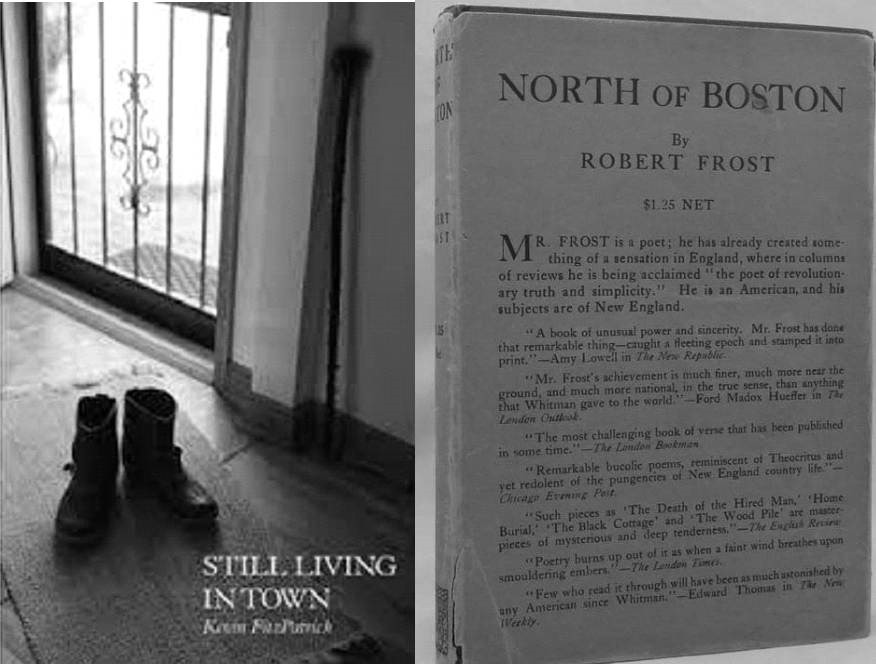
Kevin’s mature poetry never seemed to aim at beauty as such. It is a beautiful thing to find beauty were it isn’t. Ethna indeed aimed for beauty, sometimes comforting and sometimes fierce, and as the saying goes, if you don’t know where you’re going, you’ll never get there. Ethna got there some of the time, which is all we artists can do. Looking through her recently published Light Rolling Slowly Backwards, New and Selected Poems it is easy to find that she was the most skilled poet in our little group, which sounds like fish-in-small-pond praise — but if you (who don’t know us) were to read her, I think you might find similar achievement to whatever other poets you read. When I read Kevin and Ethna’s last books during my yurt retreat early this fall I observed that while I had heard almost every one of Kevin’s published pieces in Still Living in Town in early draft form, I hadn’t heard many of Ethna’s. I know she attended more than one group sharing works in progress, but the amount of work new to me was surprising. I do plan to share one of her striking poems with you soon, but let’s wrap this long introduction up and get to the final part of my countdown of the most listened to and liked Parlando pieces from this past fall.
Three Irish poets: Yeats, McKiernan, and Campbell.
.
2. The Folly of Being Comforted by William Butler Yeats. Ethna never simply said something like “Read Yeats!” but before I encountered her I didn’t think much about him one way or the other. Now over the five plus years of this project you’ll have heard the fruits of that influence from her in my many well-liked presentations of Yeats. As I said when I presented it, Yeats was making a very specific point in his poem relating to his own life. I chose in my performance to stubbornly ignore what Yeats intended his poem to be about, and to instead sing it remotely to her on her hospice bed with my own intent. If I snub Ethna in this eulogy, I’ll ignore Yeats too. No respect.
It’s a challenge for me to work out my approximations of Jazz when I’m playing all the parts one pass at a time while being far from a master of any instrument. When it succeeds, as some thought here, I try to combine my simplicities (unimpressive I’m sure to a skilled musician) into something that still pleases when heard together. The highlighted title above will link to my original post on this where I discuss Yeats’ intended meaning, but you can hear my performance dedicated to Ethna with a graphical player (if you see that) or this highlighted hyperlink.
.
1. Reynardine by Joseph Campbell. Before the depths of their illnesses, I asked Kevin and Ethna if they’d heard of this early 20th century Irish poet, and they both drew a blank, which I’ve now found is generally true about this overlooked and worthy of more study poet. If Ireland is thought known for exuberant and willing to risk excessiveness expression, Campbell is never more masterful than when he’s compressing things to a handful of words.
Reynardine is a supernatural story in three short verses. From what I’ve been able to determine (see the original post on this) the supernatural element may have been introduced by Campbell, who took an existing long-winded run-of-the-outlaw ballad, and boiled it down with a shapeshifter element. After he’d done that, the resulting folk revival song, one sung by many of the best revival singers of the British Isles, always includes at least hints of that element. My presentation uses Campbell’s original lyrics, which I think are superior to those usually sung.
As far as it’s popularity here this fall, this is an odd one. The blog post presenting it wasn’t read much at all, and the likes for my explanation there of how Campbell transformed the Reynardine story were low in number. But the listens to the song (as with all the audio pieces here, available via Apple Podcasts or most other podcast directories) were easily higher than any other recent piece. To hear it now you can use the player gadget if your blog reader shows it, or this highlighted hyperlink.
.
*I once joked, confessing my cultural ignorance there, that my idea of an Irish writer was Frank O’Hara. Joke or not, someone somewhere must have addressed what connections O’Hara’s poetry had with Irishness, but I haven’t found it.
** It was only a year or two ago, after my interest in Dickinson intensified that I found out that Ethna too had a deep appreciation for that genius. Of course, I have my portion of blame for this, just as with this inappropriate eulogy, but suspect she believed that I wouldn’t understand or have any sense of her experience or sensibility. I’d estimate she was wrong, but saying that only adds to my inappropriateness here today.
Today we continue to move up the countdown to the most popular and liked piece from this autumn. I mentioned earlier in the countdown and elsewhere that during this year two poets that Dave Moore and I had grouped ourselves with over the years fell seriously ill, and this autumn they both died. Dave himself has been through a health swerve since 2020, but given that he’s alive and could tell his own story, I’ll leave that to him. I’ll just summarize that these three people were a large part of my direct and living connection to poetry, and my circumferential part of the ripples from two of them dying has been to sharply feel that human poetic-creation connection become past-tense.
Two of the pieces left in this countdown are remainder connections to those two poets.
4. Timepiece by Kevin FitzPatrick. This is one of my favorite pieces that I heard Kevin read even before it reached its final draft for publication. I believe Dave liked it too, and shortly after we heard it, the LYL Band performed it and that’s the recording you can hear below.
Kevin, like our other departed poet, Ethna McKiernan, was a consistent reviser of his work. Poets in groups like ours sometimes present work soon after it reaches a completed draft, but Kevin’s early drafts nearly always seemed close to “ready to publish.” Despite his reliance until far into this century on a typewriter and carbon paper, his drafts’ punctuation and spelling was always correct and the suggested and taken revision ideas often revolved around clarifying narrative elements that would be in the forefront of his poems.* Kevin also paid attention to meter, and when we’d see later revisions that would be another area he’d have changed.** As a group we could sometimes be brutal with each other’s work, but it was rare that Kevin would present a stick-out sore-thumb.
“Time Piece” (the title may have been a single word in the draft I performed it from) had one issue that I recall: there was discussion of the “incorrigibles” that the poem concluded hadn’t stolen the dead father’s wristwatch. At least one of us didn’t like it, perhaps thinking it an archaic, obscure or somehow too formal a word. Kevin nodded and said little as was his usual response to suggested revisions. I think I may have argued for incorrigibles, and since it was there in the draft we performed from long before the poem’s publication in Kevin’s 2017 collection Still Living In Town, that was still the word in my performance.
Well, damn it, Kevin’s dead, and it’s his poem, and he was good at writing poetry, but “incorrigibles” is the right word, and his revision for publication: “those slick boys” doesn’t have enough flavor. That Dick Tracy word-aroma is just what’s called for! “Greatest Generation” father, and a wristwatch after all! He also made one other revision on the published version: from “That he wasn’t scheduled for a boxing match at six” to “That he wasn’t scheduled to box at six.” I suspect Kevin’s ear thought the later better meter-wise. However as boxing has become a more obscure sport the shorter “box” may miss some readers.*** “Did he work in an Amazon warehouse?” some moderns may think.
“Timepiece” or “Time Piece” is a poem well worth reading or listening to. The LYL performance of the earlier draft is what the graphical player below will play, and if you don’t see the player, slug this highlighted hyperlink.
.
FitzPatrick’s publisher, Midwest Villages & Voices, doesn’t distribute online, but this link contains an ISBN and other info that may help you obtain a copy from your local book store or library. Then this other guy, Frost, has books available too.
.
3. After Apple Picking by Robert Frost. Unlike our other Frost poem in this autumn’s Top Ten, the metaphysical “Bond and Free,” you can feel this one. Particularly as Kevin began to spend his weekends working at his life-partner’s rural farm, I could see kinship between FitzPatrick and Frost. Both were drier than a Minnesota winter’s static humidity, both liked to observe human outlooks critically, and both of them could give you some of the tang of work tied to nature. I’m not sure if lifetime farmers are likely to write a poem like this, but someone coming to that work from something else, as Frost and FitzPatrick did, has the outsiders’ advantage of fresh observation.
When I presented this poem last month I thought about dedicating it straight out to Paul Deaton, who’s blog I’ve read for the past few years, in part to catch up on his accounts of small-format food farming, sometimes mentioning apple trees and orchards. But I wasn’t certain how well it fits anything Paul experiences. The apple trees of my youth were tall enough that ladders would be required, but the orchards I saw biking around Bayfield this fall have quite short trees, the kind where an adult would stand flat-footed to pick the fruit.
But maybe I should have gone ahead. Even though this poem has specifics, even to what aches after work, it’s about finishing a task. When another blogger I read: professor, editor, and author Lesley Wheeler wrote of getting to the final stage of a book-length manuscript, I thought of how I felt after finishing a manuscript decades ago. That same “Well, I probably missed a few, but I’m done with apple picking now.”
This post has gone long, though with things I wanted to say. Our next post will break from our usual Top Ten countdown, as it will deal with both the most popular piece, and the runner up, and I’ll talk more about poet Ethna McKiernan.
.
*More than once I’d say to Kevin “If I had had the idea to write something from this same material that you used, I’d have written a short story.” I remember once Ethna took me sharply to task for saying that, admonishing me that Kevin was writing a narrative poem. She misunderstood me, for I knew and admired that. Mixing into a short poem, with its almost unavoidable lyric immediacy and compression, with narrative elements sometimes even including a Joycean epiphany, is not easy. Once or twice, so taken with the story in one of Kevin’s poems I attempted to craft a short story from the same material, to demonstrate my point — and yet I could never complete one of those attempts. Kevin’s poetry may look unshowy, but it’s not easy to duplicate.
**Several years ago, Kevin and Minneapolis folk/blues revival pioneer Dave Ray of Koerner Ray and Glover engaged in a little side-bar about meter in Blues lyrics, with Kevin scanning their iambics. Kevin played a little blues harp, and Ray and Kevin’s dad were both in the insurance business.
***Kevin also boxed, and not in a warehouse way. He once wrote a poem which had as significant line “The boxer slugs!” Dave Moore’s punishing wit, after dealing with a lengthy group discussion about if that line would be misunderstood, was spurred to write an entire song about a garden beset by invasive…wait for it…”boxer slugs.”
Let’s continue our Top Ten countdown of those pieces that you liked and listened to the most this autumn. Regular readers here may not be surprised that death features in some way in each of today’s three poems, as illnesses, infirmities — and yes, folks I’ve known a long time dying — have been part of the year for me.
Everyone that dies or is limited by infirmities is a lesson, one you listen to more richly and intently as you get older. It’s a lesson that makes me press immediately against what limits age has put on me, gives me a sense to use what I have presently before it’s gone. Oh, I am sad that I’ll not hear Kevin or Ethna’s voices again, except in memory or recordings — thin mirrors those. Dave reminds me that it reminds him when I post older LYL Band recordings where he was able to pound and roll the keys. Our family continues to deal with my wife’s mother descending, as politely as she can carry it, into dementia. But those that go before us are meant to teach us. Don’t skip the lessons.
Why Now, Vocalissimus by Frank Hudson. When I posted this audio piece, shortly after I wrote it, I said right out I wasn’t sure what I meant by it. That state may be unnerving for a writer. After all, aren’t you supposed to know? If you don’t know, how can you present anything vividly to the reader or listener?
Well, there’s a theoretical structure, a mythological structure, that seeks to explain that. It says that we are conduits for muses, external things. We don’t have to be outstandingly worthy, exceptionally preceptive, or precisely eloquent, since we are in this scheme conduits of something outside us. Frankly, this can lead to a lot of bad poetry: inchoate self-expression bearing the costume of inspiration. But then everything leads to bad poetry — all artists fail as I remind readers here often. But what of us readers, us listeners? We fail too, grasping partially what much art conveys.
My understanding of what I wrote back in September has grown as I live with this set of words. Part of our job as living, breathing artists is to carry forward the work of those who’ve left off working. We are not just creators, but also carriers. So, if you write poetry, bring words down onto the page or speak your own words, know that I’m charging you to also preserve and enliven those others who have no voices left to carry the spark. And that’s what I try to do here with the Parlando Project.
My performance of “Why Now, Vocalissimus” is available below with a graphical player. Don’t see it? Then his highlighted hyperlink.
.
Heidi Randen’s picture of a milkweed husk spoke to me this autumn.
.
6. The Shadow on the Stone by Thomas Hardy. A complicated ghost story, a complicated haunting. As I wrote when posting this, English poet Thomas Hardy had a dysfunctional marriage — and yet, like many folks forced by fact into the separation of death and mourning, he still felt the returning presence of the intimate dead.
I rather liked the music I composed and played for this one. It has a weird loping groove that I find attractive. To hear the performance, some will see the player, and the others can use this highlighted hyperlink.
.
5. God Made Mud by Kurt Vonnegut. I decided to present several short excerpts from Vonnegut novels that work as poetry this fall on the occasion of the 99th anniversary of his birth. The LYL Band had recorded them well over a decade ago, on the week Vonnegut died. Why didn’t I wait for the nice, round 100-year birthday? See the start of this post for why.
In Vonnegut’s novel Cat’s Cradle the text I used here is the last rights of an imagined religion. Like the theoretical/mythological structure of muses directing us to write poetry, Vonnegut proposes a useful if compressed Genesis story that asks us to recognize that the nagging mystery of death is no harder to explain than the overlooked mystery of living at all.
I’m nearly over the bout of upper-respiratory crud that has laid me low this month, so I felt it time to see if I could test the dulcet tones of my voice again with a new audio piece. Today’s is one by Emily Dickinson: “I died for Beauty — but was scarce.”
This poem is characteristically short, and “I died for Beauty” has long been one of Dickinson’s “better known” poems. Let’s do what I often like to do with one of Poetry’s Greatest Hits here and see what we may have missed, and why I might archly put that “better known” in quotes. Here’s a link to a blog post that starts with the full text of the poem in case you’d like to refer to that as I discuss it.
Let me get this out first: to certain sensibilities this is a poem that’s easy to find infused with a kind of corny gothic pretension. It’s got all the counters, common already in Dickinson’s mid-19th century, only more so now: graves, decomposing tragic corpses, sad death, and the world’s disinterest in earnest souls. And on top of this: it’s got capital letter Truth and Beauty. Even a school child who’s read and adored some Keats* will see Dickinson as dropping a shout-out to the doomed garageman’s son.
What can we infer about what Dickinson intended here? I’m no Dickinson scholar, but what I’ve gleaned from reading some of her letters as well as her poems is that while she had those gothic urges, she fiercely wielded a skeptical eye and a satirist’s pen. My guess is that she believed in capital letter Truth and Beauty, and Poetry for that matter, but she also knew the comic limits of humans dealing with them. I could be wrong, or projecting, but that’s the Dickinson I “read.”
The poem’s opening line, with its concluding start of a broken phrase “I died for Beauty — but was scarce” lets one suspect that the tomb is not exactly overflowing with heavenly beauty. So, our dead-in-the-tomb “died for beauty” narrator here finds death (like life) is asking for our narrator to become “adjusted.”
But wait there’s another voice! One equally devoted to capital letters! One who died for Truth! In case one thinks those capital letters are shouty, his voice is soft, somewhat defeated, and is asking about failure. Note that the died for Truth voice is male —we’ll have more to say regarding gendering in the poem soon.
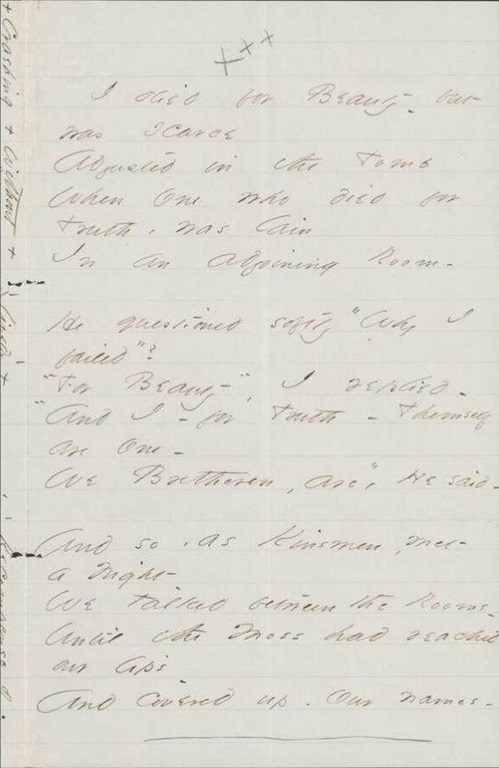
Here’s how Dickinson wrote down this poem of hers in one of her sewn-up fascicles.
.
Dickinson either makes an odd choice or is just awkward in the Truth guy’s opening question.** She writes it as he’s asking “Why I failed?” in quotes. In ordinary writing this would indicate that the voice is asking: “Why did I, the Truth Guy, fail.”*** However in the context of the poem the Beauty voice, our narrator, answers back as if they were asked why they died. It’s hard to convey in a single-voice performance, but if Dickinson intended this awkwardness, it’d be a demonstration of Beauty being consumed by their own state and so thinking the question was to them.
The conclusion of the 2nd stanza, Truth Guy’s reply to our Beauty narrator is stilted, even by mid-19th century formal speech standards. I don’t know if this is intended or simply a failure in Dickinson’s prosody. If intended, Truth Guy’s speech is demonstrably meaningful (truthful) while not being beautiful. I think of my thought about Dickinson growing up in a household consumed with lawyering and contracts and being genetically related to lawyers.
I’m indebted to Oliver Tearle in pointing out something else in Truth’s little speech: he calls our narrator “Brethren” which is continued in the summary of the next and final stanza as “Kinsmen.” Now if we are to assume that our narrator is Emily Dickinson, a woman, then she’s just changed gender or has been miss-gendered by Truth Guy. Now of course even though the poem begins with “I” we can’t be sure that Dickinson — even if consumed by the beauty of poetry and multiple times in her poems apt to cast herself as writing of herself after death — intends that I who died for Beauty to be herself.
This may be leading to the final two lines, where truthfully and beautifully the omnivorous (even consuming mineral!) moss consumes their bodies and eventually their grave’s marker stones, leaving nothing gendered, nothing specific, only their essences returning to our shared essence: the truth and beauty available to us all if we seek it, to borrow and use it, to find comfort with, and to comfort by.
I’ll pause here to note that poet Ethna McKiernan died this past Sunday. I worked on this Sunday and Monday before I heard the news.
A Player gadget is below for many of you to hear my performance of Emily Dickinson’s “I died for Beauty — but was scarce.” And if you don’t see that, this highlighted hyperlink will also play it.
I’ll offer my own tentative and inconclusive possible inspiration: It’s thought this poem was composed in 1862, and while we don’t know the particulars of Dickinson’s intent, there’d be this possible even more contemporary influence: the folk hymn adaption “John Brown’s body (lies a moldering in his grave/but his soul is marching on)” which was transmuted into a more grand literary composition with the chorus of “His truth is marching on.” As “The Battle Hymn of the Republic” Julia Ward Howe’s poem was published in the February 1862 number of the Atlantic Monthly where Dickinson surely would have seen it. Literally, the antecedent to “His” in Howe’s poem is the godhead, but folk-music-process wise, the antecedent is John Brown.
Posthumous editor and sought-out living “preceptor” (in her words) of Dickinson, Thomas Wentworth Higginson, was a backer of John Brown’s raid.
**Original Dickinson editors Mabel Loomis Todd and Thomas Wentworth Higginson removed the quotes Dickinson put around Truth Guy’s question, making it clearly a question to our died for Beauty narrator in their version. So “He questioned softly ‘Why I failed’?” in Dickinson’s hand then became “He questioned softly why I failed?” on first printing.
***”Failed” here is meant also to have a double meaning as in dying, but the fail in failed is too prominent. As this voice was first introduced, “One who died for Truth” is more noble sounding, as in martyrdom, than failed in truth.
Here’s one of my favorite pieces from the five-plus years of the Parlando Project, and given that winter has fully started off in Minnesota, it’s an apt one for what I see out my window. As I post this, I remind you that the archives here going back to 2016 have nearly 600 audio pieces, covering a considerable variety of words (mostly poetry) and music.
I’d planned several new pieces to start off December here, and I even had a few recorded tracks and sketched out compositions as the month began. Then stuff happens.
First off, the teenager got sick, which meant recording in my studio space was out for a week. Then just as they were getting better, I got sick — sick enough that sitting up in a chair was a goal and thinking, reading, and writing —much less playing instruments and singing — was a stretch. I’m still operating at less than 50%.
So instead of a new piece today, this piece created from a poem by D. H. Lawrence. Lawrence was perhaps better known as a novelist and literary critic, but his poetry took interesting approaches in the Modernist era of the early 20th century.
His “A Winter’s Tale” is as mysterious as any exotic Surrealist poem, and though metrical and all rhymed up, largely observant of the Imagist rules that broke English language poetry from off-the-shelf metaphors and the lot of tell-not-show imagery. Here’s a link to the text of Lawrence’s poem. It’s a lovely text, the words are a pleasure to put in one’s mouth or ear; and I’m also fond of the musical setting I created for this one. I’m often telling myself when arranging my music to give the compositions more patience and space — and then I go on and add one more thing and another, defeating that thought. Here I listened to myself.
When I first presented Lawrence’s “A Winter’s Tale,” I said I wasn’t quite sure what it means. More than two years later, I don’t know much more. Many readers sense some kind of “end of a romantic relationship” situation here, and taken that way the poem works. Strangely works, but works. Other possibilities occur to me as I’ve revisited “A Winter’s Tale” since I performed it. Some sort of animal hunting* seems implied here as much as human romance. Is that hunting subject, or the metaphor? Sometimes poems refuse to choose on that question.
Battle of the poets. Smokey Robinson brings it with this opening “Everyday brings change, and the world puts on a new face. Sudden things rearrange, and this whole world seems like a new place. Secretly I’ve been tailing you like a fox that prays on a rabbit.” Now, go to the bottom of this post to see what I can do to try to meet Motown’s popmusic-craft with my own thing.
.
Is it possible that what the poem speaks of and searches for is winter itself? At first this may seem a strained reading, after all the poem spends a good deal of its brief text describing winter scenery, so how can it be something the poet is seeking when it’s in front of them? Some of that description though is of winter’s haunting and elusive qualities: obscuring mists melding with snow, far off winds that sound like sobs or sighs. The winter in this poem does seem to be winter’s arrival, perhaps even earlier than normal arrivals, with grass blades at first not even covered by the early snow. In such a reading is what the poet has to tell this promptly arriving winter is that spring will follow it?
*One of my favorite early English sonnets, Thomas Wyatt’s “They Flee from Me” makes use of deer hunting as symbol for love’s vulnerability, long before Smokey Robinson’s song first presented by The Marvelettes “The Hunter Gets Captured by the Game” did likewise.
Long time readers here will know that one of this Project’s ideas is “Other People’s Stories.” I’ve chosen to make that one of its principles for a couple of reasons. First, the Internet is full of folks telling their own stories, and this is fine (after all, to me those would all be “Other People’s Stories”). I wanted to do something different, to focus on how you and I experience a variety of words from a variety of writers with a variety of outlooks. The second is that I’m rather uncomfortable with promoting myself. That one’s complex.* Like most writers or composers or artists I think my own work has value at some percentage over half the time. Which then, mathematically, allows that I doubt its value, or my handling of its value, or the costs of declaiming its value to the universe a bunch of the time too.
No one creates without the first thought. It would be impossible. And no one who cares about what they create, about their audiences, or about how much craft and care can be devoted to any art; without seeing the faults, the missed communication, the needs for just one more revision or tomorrow for any work.
Many of us create instinctively, because we have to — but sharing that work is a choice. I’m nearing 600 Parlando Project audio pieces presented here. I could have presented at least half or two-thirds of that easily with things Dave or I wrote, but I made a different choice. It’s less conflicted for me to publicly look at, to be honestly surprised and delighted at Emily Dickinson, William Butler Yeats, Carl Sandburg, Langston Hughes, Sara Teasdale, or Du Fu; and then to share that with you.
But there’s a problem with “Other People’s Stories.” I’m likely not understanding everything those authors intended.** And they’re their stories, their visions. I’ve talked recently here about how when I translate a poet who wrote in another language how I want to honor their work and transfer accurately their particular powers, and yet then become tempted to break off into something their work makes me see through my own eyes.
A long prolog to presenting today’s piece, one I wrote and titled “Ethna’s Dream.” Ethna is Ethna McKiernan, a poet who I used to meet and talk about work with once a month or so, along with two to four others. Ethna cared and crafted her work over decades, and in her life did other useful work: running an Irish heritage book and art shop, working with the homeless. She’s currently in hospice, comforted by family, and the reports are that she’s now mostly in an out of what appears as sleep.
I couldn’t call Ethna a close friend. I always sensed a distance there. I think often of her none the less these days, and of every rudeness, awkwardness, or self-dealing on my part around her; and those or any number of things could have caused that. The very fact of writing a poem about her death, her dying, that mostest personal thing, seems problematic.
So, when you listen to my piece “Ethna’s Dream” you now know all that. This is not a poem about those things I’ve discussed in prolog, or at least I hope so. Instead, my intent is that it’s a poem about what we should treasure of that sharing of the unconscious that we have with artists (including those whose main art is just living). What I present in “Ethna’s Dream” is not a romantic, imaginary, sentimental metaphor in my own mind — though it may attract or repel you if you see it as such — it’s more at the essences of what we do, share, and take with art.
There’s references to Bottom’s speech in Shakespeare’s A Midsummer Night’s Dream. Am I prettifying myself up with pretentiousness, or comparing myself to the foolish play character? I wrote it, and yet I can’t tell.
*One problem, leading to one fear, is that when offered the chance to promote myself I see myself as overdoing it, and coming off as a self-absorbed narcissist that runs on too long about the arts I work in, prattling about the obvious and the obscure in equally embarrassing ways. If you’re still reading at the footnote stage, you may have forgiven me for that.
**Beside just plain embarrassment of ignorance, we now more often talk about cultural appropriation in regards to this. The travesties of cultural appropriation are real, but my belief is that they should, must, be risked.
Life events are conspiring again to keep me out of my studio space to record new pieces — but it just so happens that I have this rocking Blues recorded back in 2007 with the LYL Band that’ll contrast with our pensive Frost meditation on work from last time. Today’s audio piece was made from Frost’s short poem titled “Fragmentary Blue,” now recast as “Fragmentary Blues.”
Unlike Carl Sandburg or Langston Hughes, I have no idea if the 1914 vintage Robert Frost had any experience or appreciation of this Afro-American musical form. A quick search found nothing, even though Frost’s lifetime overrode The Jazz Age, The Swing Era, and even early rock’n’roll.
But as poet Langston Hughes soon discovered, the lyrical expression of the Blues was a vital format worth picking up. A first draft of this post included a long aside about the importance of this Afro-American Modernist form, but on second thought I’m going to take less of our time today so that we can focus on how Frost’s poem can be expressed through that form.
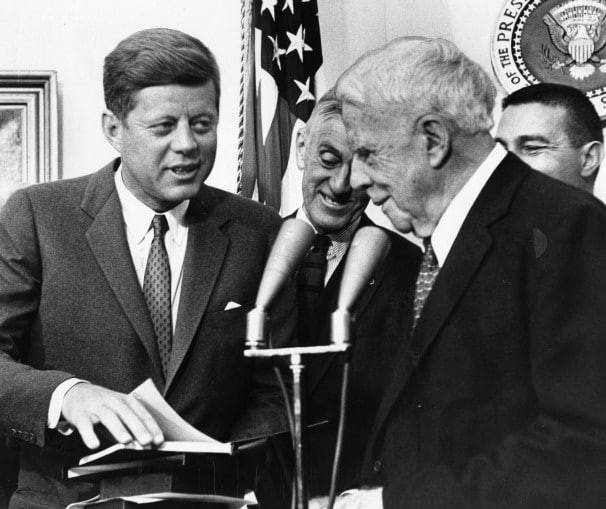
JFK: When you wrote “Come on mama, to the edge of town/I know where there’s a bird nest, built down on the ground” were you talking about what I think you were talking about? (wink wink). Frost: No, you’ve got me confused with another bucolic poet, that’s Charlie Patton — but I believe that’s a philosophic statement about how erotic desire is both natural and elusive. Patton was tuned in open Spanish for that one.”
Blues lyrics often used a stanza format of three lines: one a statement, the second a restatement that may be the same, nearly the same, or subtly varied while still gathering intensity via repetition; and then a third line which can go in any direction the writer/poet/singer wants to take it, though it usually rhymes with the ending of the first two lines. It’s a variation of that ancient and simple poetic scheme the rhyming couplet, but with that repetition allowing for something extra in the balance. And there’s often an element of call and response in the lines: that choral rock, and roll back that Sophocles, Skip James, and Pops Staples could share.
So, let’s go back to our 1914 Robert Frost poem “Fragmentary Blue.”
Why make so much of fragmentary blue
In here and there a bird, or butterfly,
Or flower, or wearing-stone, or open eye,
When heaven presents in sheets the solid hue?
Since earth is earth, perhaps, not heaven (as yet) —
Though some savants make earth include the sky;
And blue so far above us comes so high,
It only gives our wish for blue a whet.
Not in Blues stanza form. Instead, ABBA, and I don’t mean the Swedish pop group.* But Frost has made the center two lines in each stanza a sort of parenthetical, so that lines one and four are natural couplets and the middle two lines are already couplets that can stand by themselves. This means it was easy to turn “Fragmentary Blue” into “Fragmentary Blues.”
Why make so much of those fragmentary blues?
Why make so much of those fragmentary blues —
When heaven presents us sheets of a solid hue.
Here and there a bird, or a butterfly.
Here and there’s a bird, or a butterfly,
Or a flower, or a wearing stone, or an open eye.
There’s some savants say the earth includes the sky.
Some say, some say, that the earth includes the sky —
And the blues so far above us, it comes on so high.
Since earth is earth, it isn’t heaven yet.
Earth is earth. It ain’t heaven yet.
It only gives a wish for blues a whet.
So there you go, via show not tell, we rock up Robert Frost in the Blues form. If you read the two sets of words closely, you’ll see something has changed. Frost’s “blue” on first reading seems a stand-in for beauty, while the Blues treats its namesake emotional dissatisfaction as something less than beauty. But, consider again. Frost’s poem says we miss the immensity of natural beauty in our all too earthward human act of trying to possess its emulations. That difference, that dissatisfaction — that’s the Blues. My adaptation only brings out that subtext more overtly. You can hear the LYL Band express Frost most blues-wailingly with the player gadget below, or with this highlighted hyperlink that will play the performance. Most of the better guitar notes here were played by Andy Schultz who played with the LYL Band for a few times, and Dave Moore will once more hear himself back when he could pound and roll on the (plastic) ivories.
.
*Is it too late in their career to suggest that they produce a trans-Atlantic Carl Sandburg tribute record? I’m available, and you need my audience of dozens to hundreds of listeners.




 Frank Hudson