Blackberries

Here’s a performance of a poem in time for St. Patrick’s Day to start Dave and my celebration of the poetry of Kevin FitzPatrick. Longtime readers here may remember me speaking of Kevin late last year when he became seriously ill and then died. I even published a post then that discussed some things that FitzPatrick’s poetry did that my own poetry, or much other contemporary poetry, didn’t make enough use off. Despite that earlier post, I’m going to say a few more words about the value of his poetry you may not hear at first — even though most of his poems are clear, plain spoken, and easy enough to understand for most readers.

Right there is a first potential problem. Some readers have an “Is that all there is?” response to many of Kevin’s poems. To the degree that I knew Kevin’s internal processes I don’t think he was troubled with that “problem.” He wanted his poetry to communicate to audiences not inured to modern poetry which might communicate in a non-linear way or with great reliance on esoteric imagery. But just because FitzPatrick doesn’t “come in hot” with arresting first lines, occult mysteries, and outlandish similes or settings, doesn’t mean it can’t have some other values. In the series this post initiates, I hope to show some of those strengths.

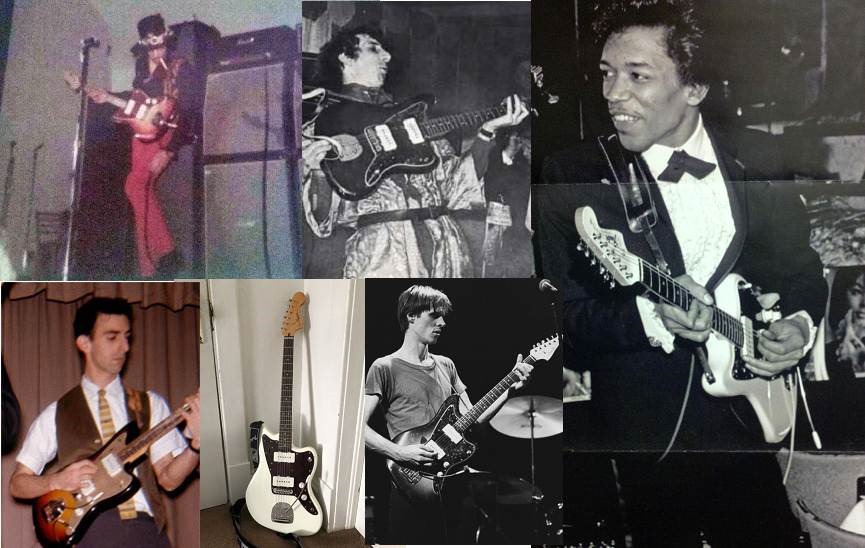
This is the picture that seems most “Like Kevin” to me.

.

Today’s piece uses the poem that led off FitzPatrick’s final collection, Still Living In Town.  And for St. Patrick’s Day? Besides Kevin’s own Irish heritage, this one is about taking a fresh look at Ireland’s Nobel Prize winning poet Seamus Heaney. Like Heaney, FitzPatrick liked to take a sly look at his subjects.

There’s a player below to hear The LYL Band’s performance of this poem by our friend and fellow poet. In our celebration of Kevin earlier this month we performed all the pieces live, one after the other, without rehearsals or preliminary run-throughs. This leaves some rough spots, sure, but perhaps we can take them as evidence of life for us left to sing against the taking from us?

There’s a fairly long intro before the words begin today, which documents how our recording session began: with Dave coming from the stairs into the studio as I am already commencing my musical part. He then needs to start almost without thought.

Oh, what if you don’t see the graphical player below?  This highlighted hyperlink is another way to hear that same performance.

.

The Taking and the Singing Back

I started this inconstant month calling it “Unrequited March”  — and I had this desire: to pay a more complete tribute to a recently departed poet I knew: Kevin FitzPatrick. In that task I wanted to see if I could rejoin with another voice and poet you’ve heard here: my friend Dave Moore.

Dave’s had some reduction in his ability to play keyboards, and he wasn’t sure how well his voice would hold up, but he was able to join me late last week as we took our usual “live in the studio” approach to doing some new pieces together, including a number of ones using FitzPatrick’s words. This requitement was doubly appropriate because Dave knew Kevin even longer than I did. Dave and I managed fine, and had a good time.

In the normal course of things those pieces would get worked on in the following week, but life has interrupted our singing back at death.

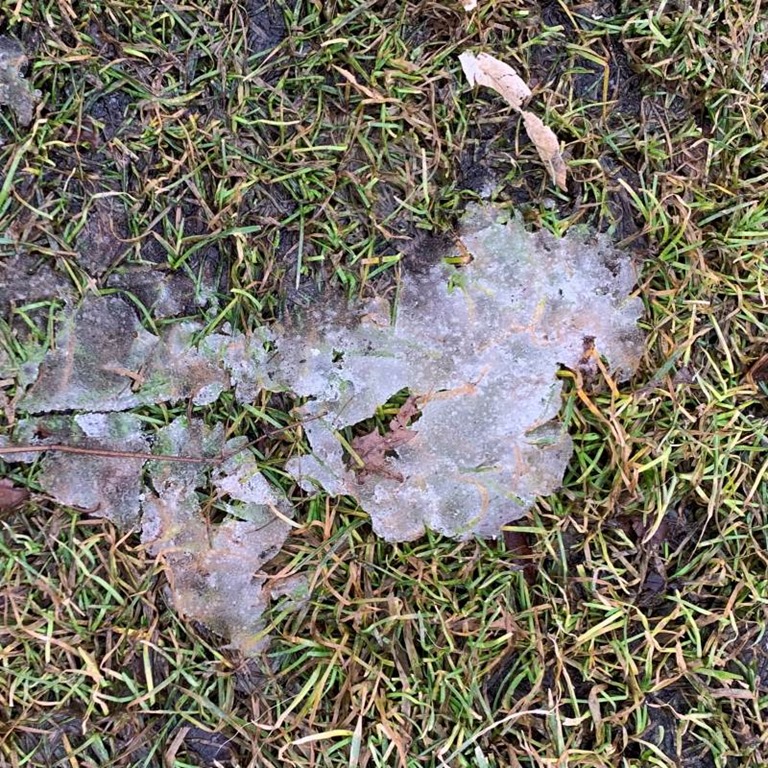
Ice Toad - monocrhome

We are all racing forward and melting.

.

How? Even if one of this Project’s mottos is “Other People’s Stories,” I have qualms about telling other living persons’ events, so I don’t feel right discussing more details here today, but there have been hospitals involved, and some pretty long hours in the last two days in those places.

The outlook, best as I can predict it now, is that beyond my concerns with these other matters, my ability to work on audio pieces will be restricted for a while. If time allows, you might still hear some of the Kevin FitzPatrick related stuff yet this week.

Does it seem odd to work on art and our experience of it, even when other things must take precedence? That occurred to me too. Well, when I visited our newly hospitalized patient, they had two needs: music and Jacques Derrida. Go figure.

Unrequited March

Here’s a sonnet of my own about the oncoming spring. I live in Minnesota, and here that season’s arrival is something of a lottery ticket. Oh, it’s likely that by sometime in February a Minnesotan is tired of winter, and we know that somewhere around May Day we’ll not have snow or cold to deal with for a few months, but when today’s high got to 40 F, we know no more than that. When I moved here, I was told that on days like today we might see folks wearing T-shirts outside — and yes that’s so. We are so in a hurry for spring that what would be a 5-degree Celsius winter day in more temperate regions seems time to ditch the jacket. Yet we are still likely to have more cold, and even more likely to get substantial snowfall, particularly in March.

So it is, from late February to late April is a two-month season of “what d’ya got” in our state. That’s what my poem performed today deals with.

Things are still snow-covered around here, but it’s not fluffy, Christmas-card snow— more at rugged crusts. I still ride a bicycle nearly every day year-round, and so winter means that I pay special attention to the surface conditions of the side-streets that I most often ride. You know the old factoid that Inuit peoples have a multitude of words for snow in their vocabulary? A day or two after a snow what’s often found is compressed and polished snow with some patches of white glaze where tires’ friction has buffed a gloss.*  A few days later there will be areas where that surface further abrades and patches of dull-brown porridge-like snow aggregates are scattered on the roadway. I call the later “brown-sugar,” and the earlier hard white surface looks to me like the smooth inside of a shell.

Spring-time bike rides in Minnesota aren’t necessarily what you think.

.

Low-pressure studded bike tires work pretty well on the hard shiny stuff, and large knobby treads are the thing for the loose brown sugar. My deep-winter bike’s tires are a pair of Venn diagram hoops circling both.

That’s a poet’s bike ride for you: metaphors per hour.

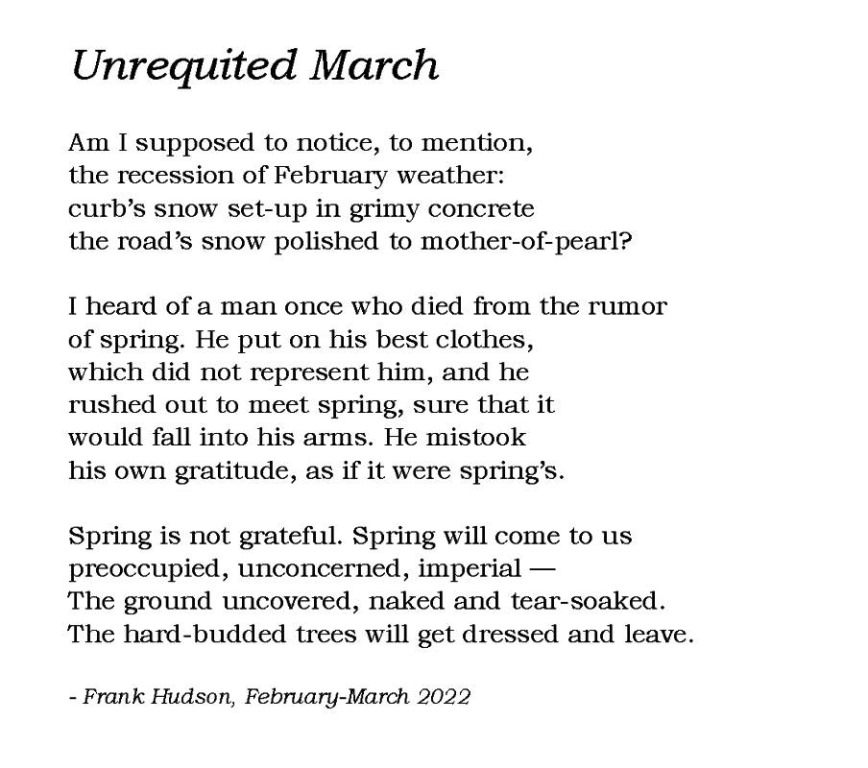
Unrequited March

The meter’s a bit loose, yet not loose enough to cry “Kings X — Free Verse!” either.

.

Does any of this help “translate” my poem for those without my climate? That’s my hope anyway. Though the title of my poem is “Unrequited March,”  my wish for you, curious or stalwart reader/listener, is that spring will love you back this year. The player gadget to hear about the uncertainty of that is below for many readers, and for those whose way of reading this blog won’t show that graphical player, this highlighted hyperlink will open a new tab to play the performance just as well.

.

*The large, knobby, low-pressure tires are also capable of riding on fresh snow before cars get to it. Un-rutted light and granular cold-weather snow is kind of fun to ride in. The wetter and clumpy snow that will likely come in any heavy storms for the rest of the season is much less joyful. That stuff is like riding in deep mud. The tires’ knobs will get traction — it’s not the tires, it’s an old out-of-shape guy like myself who’ll get tired quick riding through that.

Langston Hughes’ Poem

Today’s piece, “Poem”  from Langston Hughes 1926 poetry collection, The Weary Blues, is one of the shortest poems in that book. Here’s a link to the text, all of it, if you’d like to read along. Those who’ve followed this Project as it has looked at early English language Modernist verse may recall that very short poems, even poems that seem bereft of obvious metaphor, were something that many of those early Modernists liked to present. Such tiny poems are pointed darts at the pomposity and long-windedness of the poetry they were seeking to replace.

The sense I get from today’s example is that by using the generic if exalted name of “Poem”  as the title, when what follows is so spare and simply stated, is meant to draw attention to the provocation that this is worth consideration as a complete lyric.

It may be me and my current situation, but when I read “Poem”  I immediately thought it was a memorial poem, a five-line-with-one-refrained-line statement of the essence of loss intended to put itself up against something like the book-length “In Memoriam A.H.H.”  by Alfred Tennyson. I still find nothing in the text that forbids that reading.

But death isn’t the only loss in life. Some, particularly those looking for obscured clues to Langston Hughes’ erotic orientation see this a coded statement of a romantic or erotic breakup with a “He.” Like Shakespeare’s sonnet sequence and Tennyson’s long poem, the poem has a dedication to a set of initials: “F. S.” in “Poem’s”  case. Some articles one can find in a web search identify this dedicatee as Ferdinand Smith, who was in the merchant marine — as was young Hughes before he published The Weary Blues.  Hughes did know Smith, but I haven’t seen a full explanation of how this putative identification was made. Oddly, if this poem of complete separation was written about Smith, Hughes and Smith kept in touch until Smith’s death in 1961. In Real Life there was no utter break between the two — but that’s biographical information, nothing in the text forbids the abandoned love reading either.

Frederick Smith

Frederick Smith, who’s been identified by some as the  mysterious F.S.

.

And then too the poet Hughes of The Weary Blues  and elsewhere is very broad in his use of the pronoun I. Not only does Hughes not identify F. S. and what exactly was the nature of the love relationship, Hughes is fully capable of using “I” as a collective or representational singular. Think of Hughes most famous early poem The Negro Speaks of Rivers”  — its litany of I’s is not a Quantum Leap  confession that this certain 20th century poet worked on the Pyramids or rafted the Mississippi with Abe Lincoln.

But “Poem”  does feel like a personal expression, even if Hughes may frustrate us if we prefer poems as memoir filled with explicit self-expression. Yet maybe this is of little importance to the essence the poem wants to express. Grief from loss of a lover who leaves and lives, or loss of a friend who has died — does the heart assay any difference?

Musically today I demonstrated fidelity of a different kind, playing a cheap 40-year-old 12-string guitar that I bought shortly after coming to Minnesota, and a bass that once belonged to Dean Seal, who played in the LYL Band in the early 80s. I have newer better* instruments, but it seemed like a good way to reset and get back to making some new Parlando Project musical pieces after February presented other matters that needed to be done.

You can hear my performance of Langston Hughes’ “Poem”  with the player gadget below — or if you don’t see that, with this highlighted link.

.

*My newer guitars are better in that they don’t have parts that won’t exactly work anymore or intonation issues I need to work around, but besides old-times-sake I think there’s some character remaining in these funky instruments sound.

Song to the Dark Virgin

I’ll promise you a love song at the end of this, but let’s look briefly at some other stuff that surrounds that song.

As I look in the Langston Hughes poetry collection I’m featuring this Black History Month for a Valentine’s Day piece, there is less to pick from than one might imagine. Even though his The Weary Blues  is a first book by a young man, and it includes some of the Afro-American poet’s best-known poems — poems of love or passionate desire are conspicuous in their absence.

Even for 1926, the year The Weary Blues  was published, this is somewhat unusual. You might think roughly a century ago the down and dirty lunge of love might be automatically missing, and to some degrees of physical explicitness you’d be correct, but poems on the emotional variety of love and desire were if anything the very fashion for the last decade called The Twenties. Popular and esteemed poets of that era Edna St. Vincent Millay, Sara Teasdale, and others were quite ready to talk frankly about desire. Nor were Afro-Americans silent on this subject. Jean Toomer wrote what I think is flat-out one of the best surrealist love poems of all time. Claude McKay wrote beautiful and passionate love sonnets, and the Blues singers performing and recording then were quite willing to serve in the lust and fond department of art.*

We’ve already said that Hughes was a pioneer in valuing those very Blues and Jazz singers. Early this month we performed Hughes’ “To Midnight Nan at Leroy’s,”   a Blues poem presenting just such a singer and a condensed late-night view of a hook up. Was the man in this poem Hughes himself? Possible, but I think the preponderance of the evidence says not. I think he’s an observer of the tryst, and even given the value he puts on short poems in his collection, he somewhat stints on the details.

No, Langston Hughes, for all his night-life settings and ash-can-school observations in The Weary Blues is almost prudish about sex and love. If he feels desire himself, he’s loath to talk about it — while all around him poets and singers were talking and talking about that.

I’m not a scholar, just a person who actively seeks out poetry encounters and then gathers some information that helps me grasp what the poem may be on about. Hughes was guarded about his sexuality. I gather this was true for his entire life. Some believe he was gay or bi, but then other poets of his time were and that didn’t stop them from writing about desire even if their readers didn’t necessarily understand the gender object of their affections.**   I read at least one piece that concluded Hughes was asexual. Frankly no one seems to know, and if you’re looking to date Langston Hughes, he’s dead, so it may not matter.

Today’s piece uses Hughes’ “Song to the Dark Virgin.”   It does show passion, and if not as Surrealist as Toomer’s great poem, it dips into almost a Robert Herrick style 17th century set of conceits***  Hughes’ use of the archaic pronoun “Thou” and a few other less current words in common speech show him code-switching to something a bit like the Bible’s “Song of Songs”  in the King James translation.

And speaking of “Song of Songs,”  it’s not even clear if this love poem is to some anonymous person or if in some sense it’s to Black people in general, just as “Song of Songs”  melds what seem like individual lovers into Judaism. If you read this poem as Black is Beautiful breaking out 40 years before it’s more publicized instances, you could make a good case.**** The Weary Blues  includes poems set in the various ports Hughes landed at around the world during his stint as a merchant sailor before assembling the book, and his father was living in Mexico. From this I wondered if the ”Dark Virgin” is a reference to the Black Madonna paintings and figures he might have encountered overseas. A possible clue to this not just being a young person’s love poem is that it’s titled “to the  Dark Virgin” not “to a.”

Mother of God of Andronicus

A Greek Orthodox icon, one of the examples of the Black Madonna found in Eurasia and Latin America.

.

But Valentines Day is here, so let’s perform this as a romantic love song. In Robert Herrick style, just calling out a love object as a virgin isn’t unusual. In such a reading or performance this is how the poem may be described: the poem opens with the idea of being a scattered and shattered love offering to the beloved in Part I. Part II gets a little more intimate: the speaker wants to be the layer of clothes next to the beloved skin. Kinky, but Herrick and for that matter “If I Was Your Girlfriend”  Prince would approve. Part III gets closer to consummation of desire as in the trope of consummation as consumed by fire. Yes, it’s a little bit of archaic dress up, but who knows, maybe a love whisper of “I want to annihilate your body” is still a working bedroom line?

Song to the Dark Virgin

The above are guitar chords as I fingered them, but the recording uses a capo on the 3rd fret, so it’s heard in the key of Bb today. Interesting progression, there’s no V chord in it!

.

If you follow the progress of the imagery Part I starts out with shining light, then the more obscured light inside folds of clothing, and finally in Part III it’s out in blazes of leaping flame.

I ardently performed this one today with guitar, chorused fretless bass, and a warped low string section. I let those bowed strings play what an electric bass would play so that the actual electric bass could do other things. Many of you can hear it with a graphical player below, but those whose way of reading this won’t show the player can use this highlighted link to play it.

.

*She’s not Black, but Genevieve Taggart wrote one of the most pointed and poignant of love poems about love on the poor side of town during the last Twenties too.

**Today’s poem never uses a gendered pronoun or name.

***No, not meaning he’s vain — it’s a poetic term for a metaphor that’s not afraid to be elaborately weird or fanciful.

****Back to “Song of Songs,”  get to the 5th verse and you get “I am black, but comely” in the KJV. Or as “Ecclesiastics”  had it: “Nothing new under the sun.”

More from Langston Hughes’ “The Weary Blues”

This month I’ve been doing a series of pieces based on poems from Langston Hughes’ first book-length collection The Weary Blues of 1926 — but maybe it’s time to mention that I have already presented two early pieces that were included in that book.

Here’s Hughes “Dream Variation”  which also offered its title to a section of the 1926 book.  “Dream Variation”  is an example of Hughes offering a quickly understandable surface message with a plausible deeper intent beneath that surface. The surface reading will connect easily with anyone stuck in a February northern location winter: “To fling my arms wide / In some place of the sun” is something most of us in Minnesota would be ready for, but are only dreaming of right now. Many here like to talk about our enjoyment of the outdoors even in our cold climate, and yes there was some sun when I rode out at 16 degrees F this morning on my bike. I was happy to get the exercise and to watch the crows big as black chickens and the binary oblivious to flurious* squirrels — but I’m tired by now of pulling on leggings and making sure my hands have enough covering to keep my fingers from the cold stiff numbness.

I talked about my encounter with the poem and it’s sometimes discussed deeper connotations here. You can hear the audio piece with guitar and piano clustering around a three-months-into-winter drone with either a graphic audio player that some of you will see, or this highlighted link.

.

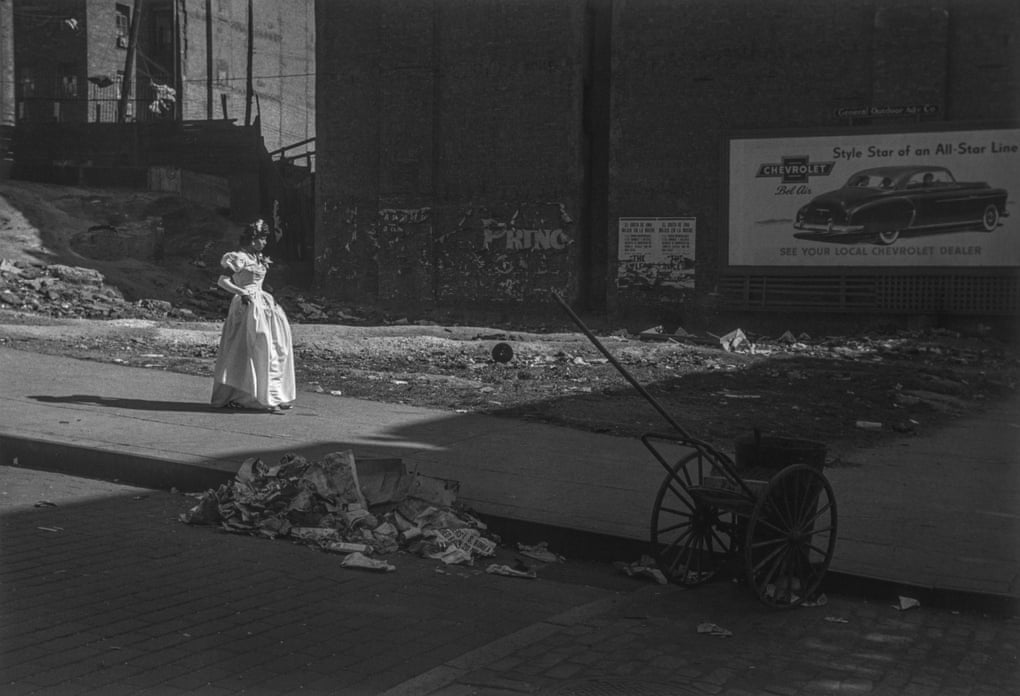
I was quite taken by this photo of Roy DeCarava’s “Graduation 1949” when I saw it this winter.

.

The Weary Blues  has another section that takes its title from one of Hughes’ best known poems “The Negro Speaks of Rivers.”   I was talking about this poem this morning to a fellow I sometimes meet in a café I ride to. I was saying this is a remarkable poem written by a 17 year old, one who literally crossed and looked at America’s Mississippi River on his way to New York City in furtherance of a compromise with his father on college education.**   Maybe this won’t seem remarkable to you, if you’re here already reading this far down about a poet who died in the last century, who wrote it generations back.

Hughes might have written about the exact details of his current life. He could have written about how he felt, what with the bargain he’d been forced to strike with his father. He was 17, and forming his own autonomous self is the task of any young person. His father probably didn’t know what the rest of the 20th century would be like for Langston, much less what we’d think of things now in the 21st. What would young Mr. Hughes have known? More, or less?

I was recently reading some jokes observing what are considered the perennial follies of youth. One of the zingers was “It’s best to hire young graduates while they still know everything.”  Queue the laugh track.

I don’t know if 17-year-old Langston Hughes thought he knew everything. I didn’t think so at that age myself. But as we consider why we might want to read or listen to poetry by long-dead poets, we might want to consider what Hughes’ poem asks us to consider: that we are the accumulations and results of our ancestors and neighbor’s ancestors. That doesn’t mean we are them, we are the sum on one side of the equals sign from a lot of figures to the left of it; and so the possible extensions, solutions, fulfillment and remediations of them.

That’s what’s remarkable about the young Mr. Hughes’ poem, its approachable impersonality and insistence on the distances yet salience of the past. It’s not “A Negro…” even, but “The Negro….”  In it, the current of the past is longer than any history of oppression, injustice, or any stories of conquest. Endurance yes, but beauty too. So, despite age-related-stereotypes, at 17 Mr. Hughes may not, and doesn’t have to, know everything — but it helps to know some things that came before you. Rivers flow. Rivers move. Langston Hughes wrote this moving to New York City — the place where he eventually lived most of his life, but not before changing what he did on the banks of another river.

That’s why we have Black History Month,*** and why I’m talking here to what I suspect is substantially a white audience about Hughes and that observance. Some of you may be nodding off by now, whatever color — “We know all this.” you may be muttering. Facts are not the soul, but poetry and music can speak of that.

I’ve always rather liked my electric guitar performance on my setting of “The Negro Speaks of Rivers”  that you can hear with the player gadget where seen below, or with this highlighted link.

.

*Yes, there wasn’t a word “flurious” until now. You are present at the creation!

**My original post on this poem has a longer summary of Langston Hughes’ family situation at the time he wrote this poem. In short, his father was adamant that instead of literature that Langston study engineering. Langston agreed, but then after trying to go along with his father’s wishes, he dropped out, shipped out to sea on merchant ships, and on return to the U. S. worked various lower-end jobs. I think of John Keats’ decision a hundred years before Langston Hughes’. Engineering and medical field students: I’m not suggesting poetry instead. Really, I’m not. Perhaps rather an and instead of or is best.

***It may not be coincidental, but one of the jobs Langston Hughes eventually had was a stint working with Carter Woodson, who first suggested an annual observance of Black history. So, all the more reason to focus on his work this February.

To Midnight Nan at Leroy’s

It’s Black History Month, and I’m planning on presenting a series focusing on Langston Hughes’ first poetry collection: The Weary Blues — but before we get to today’s new Hughes’ piece, let me briefly set down a few reasons for why Langston Hughes.

This project presents early Modernist poets most often. From the American predecessors of Modernism (Whitman, Dickinson) we often jump to those of the 1905-1926 era who sought in various ways to “make it new.” While I continue to read and have interest in post-1926 work, less of that can be reused freely for this project. This reduces the Afro-American sources free to use, as the beginnings of the Harlem Renaissance have moved into Public Domain slowly, year by year, since this project began in 2016. My earlier Hughes’ pieces, even if they were eventually included in The Weary Blues,  were published earlier and so had already moved into PD. It’s only on January 2022 that the whole book’s contents moved to public domain.

The Weary Blues cover 1024

Our February focus: Langston Hughes’ first book.

.

A second reason: look at the title of Hughes’ first book, it includes “Blues.”  As we celebrate Afro-American contributions and experience this month there’s an important parallel here. Americans, some of whom set up shop in England and France before WWI, are hugely important in establishing the Modernist break with the shopworn 19th century writing styles. At the same time, Afro-Americans were crucial in doing the same job for music. As I tried to briefly explain last Black History Month, a great deal of the American Black intelligentsia was caught flat-footed by this musical revolution happening around and by them.*

Let’s cut them some slack on that: cultural change is hard to understand while it’s happening, and the quick white adaptation of Afro-American musical ideas in The Jazz Age of the previous Twenties reflected back to the Black community some rough or even derogatory approximations of what was really going on.

Hughes was a young man when he wrote today’s poem. He’d crossed paths with Black intellectuals by then, but he wasn’t fully one of them. His father had cut a bargain for him to go to Columbia to become a professional. Langston skipped out, worked as a cook and at other restaurant jobs; and took to sea working on merchant ships. Hughes came quickly to an understanding of this new music, it’s complexities and its reflections.

Lastly, here’s one of the things I’ve come to understand about the beginning of Modernist poetry in English: there were substantial elements there that sought to strip back poetry, to simplify it to its essence, to make it immediate to an open heart and mind without pre-requisites. This mode was eventually superseded by a more academic and allusive poetry to the degree that some of the best of this early poetic Modernism was set aside or down-rated as simplistic and insufficient.

Over the years you’ve heard me sing the praises of Carl Sandburg, who seems to have been eventually excused away as cornball. But Sandburg was still vital to the young Langston Hughes in the 1920s, and Hughes took Sandburg’s Midwestern American Modernism and applied it to his own heritage and experience. The mainstream of Afro-American poetry retained more of the vitality and working-class connection that Sandburg expressed. Thank you, Afro-Americans.

Let’s move onto the poem I used as today’s text for the performance you’ll be able to hear below. “To Midnight Nan at Leroy’s”  is not one of Hughes’ best-known works, though it deserves more attention. Here’s a link to the text. You could skim through it on the page and see the Blues connection, even if it’s not a Blues stanza as printed — though it could be refitted as one — but more importantly, it’s got a Blues sensibility. My reading of the poem says there may be a little playing going on, a little con and double consciousness which the whole of the work will show up. This will let the hip listener say on hearing it “Yeah, you and I know what that’s like.” That’s Blues sensibility.

I think the poem is a dialog. Nan of the title is performing at a club, and she’s expressing some eroticism in her performance. I think the poem’s other voice is hitting on Nan. The opening stanza is that other voice, the un-named man, who’s starts out teasingly acknowledging that he’s getting what she’s putting down.

The second stanza could be either voice. I performed it neutral, even as if it might be a narrator, a third voice. Note the loaded word “jungle” in it, one of the “primitive” adjectives used to describe this new Afro-American art. Primitive isn’t totally a derogatory or diminutive to the Modernists, who remember wanted to remove the cruft of a worn-out culture and get back to an essence; but in the context of a white-supremacist-soaked society it could surely slide over to being that. Black artists with intact self-respect did use labels such as “Jungle” in the 1920s, so it’s not simply an external white appellation, but it sure sounds like they’re partially reflecting with the white culture when they do. Pause at the last line: I hear Hughes’ “And the moon was white” with intent.

The third stanza is the man cheering on the singer/performer Nan, and I think also he’s suggesting that if “lovin’” is her object, he’s ready.

Fourth? Yes, the two get together. I perform this as Nan’s voice. Note Nan’s use of the diminutive “boy” for the man in this part of our dialog. He may have been acting the player in his earlier stanzas, but I think this is an intentional reveal that the male character is less than a fully actualized man. The white moon image returns, and their moments of Black joy contrast against it. One could write a moving essay on this poems white moon image, but I’ve already gone long.**  You write it.

The poem concludes by refraining the entire first stanza. I perform in the man’s voice, now sour-grapes-ing the couples’ night. Who put one over on the other in this one-night? Maybe some of both, and maybe external social forces are part of the fate-mix too. Hughes chose to dedicate the poem to Nan, so I suspect his sympathies lie more with her. Another question: is Langston Hughes the unnamed male voice? Hughes’ sexuality is mysterious, and while that’s possible, my estimate is that he’s observing, not writing a poem as memoir here.

I performed “To Midnight Nan at Leroy’s”  with my own one-man-band providing the trio accompaniment, and I hope your speakers can handle the bass part. Some of you will see a graphical player gadget below, but other ways of reading this blog won’t show it, so here too is a highlighted hyperlink  to play it.

.

*Last years Black History Month book was 1925’s The New Negro , which included an essay worrying about the dilution of Black uplift and culture from the diversion of frivolous Jazz. Read my post on that essay here.

**As with Sandburg’s short poems, with Langston Hughes here it may help to imagine that you are translating this from Tang dynasty Chinese. The plain English words here could mislead us to think this a mere rote moon/June thing and that Hughes had nothing complex to say.

Letting Go the Wolves: I praise Ethna’s wolves

I’ve promised one more piece using texts taken from Irish-American poet Ethna McKiernan, and here it is. There are a couple of reasons why I left this one to the end of this series memorializing her work. The first reason: the poem’s persona seems to speak of her approaching death. The second reason: I don’t know if McKiernan actually liked or rated it as highly as I do. Let me make this plain at the start: I think this is a great poem, and I’ll go into why in just a bit.

I believe I encountered “Wolves”  at the same writer’s group where I heard other work Ethna was working on in draft form.*  These things make my performance today particularly fraught with issues. I only take this step of releasing this performance today because of my admiration for the poem, and my feeling that some out there in the rare and appreciated audience for this Project will welcome it. “Wolves”  has what poetry often hopes for: it is beautiful and yet harrowing, and its experience is vivid while not guarded inside defined borders.

I hear the snow crust crack
into spider-fine antenna lines
with every thudded footbeat. It is so still
that their light scratch of nails on ice
rasps the air like flakes of metal filings.

Let’s grab this text as it grabbed me, even on first hearing, with the opening statement: “I hear the snow crust crack / into spider-fine antenna lines…” The meter has a lope of accents that appeals, the internal rhyme of “fine” and “lines” separated by the chime of the assonant “antenna.” The three strong accents together in “snow crust crack” which allow “crust” to not get the full stress it would normally get appeals and announces. “…with every thudded footbeat. It is so still / that their light scratch of nails on ice / rasps the air like flakes of metal filings.” follows — and if you’re not captured yet by this poem’s story, I can’t think of what language can do to do that.

This opening almost registers as synesthesia, as the sense invoking words rush in. “Snow-crust crack” is visual and auditory together — and for a winter clime resident, you feel that texture in your own feet too. Besides the word-music the visual of “spider-fine antenna lines” has the sense of the spreading broadcast of the wolves’ approach. The ordinary snow-surface footfall of a “thudded footbeat” made by the furry pads of the wolf would be only present in an unnatural silence — and then the quiet but more plausibly audible sound of talons on ice. The shivers of it, nails on blackboard-like, invokes the winter.

ice pond

Listen carefully for those claws on the ice.

.

I could go on, but I think any listener who is pulled in by this opening will sense equally strong lines and images as McKiernan’s poem proceeds. The creative writers in my audience may benefit from analyzing for themselves why they work their attraction on us. There’s an overall effect of intimacy with nature in the midst of this poem: not a passive, uncomplicated, and easily beautiful nature, but one close enough to be (prematurely) incorporated with the poem’s speaker.

The cave mentioned in the poem means that this is almost certainly a persona poem. The voice we hear telling this story is not the literal biography of a modern Irish-American woman who normally lived in cities, yet the astonishingly vivid images lets us doubt this just enough to not judge that outright. Even the most personal and revealing poetry can benefit from real and fantastical lies.

I’ll not explicate the ending outright, for I want you to experience it in the course of the poem’s story. I’ll only say that it could possibly be why McKiernan did not select this poem for wider distribution while she lived. “Twist endings” can cloy or leave a reader/listener feeling tricked, but my judgement says this one only enriches what’s sensed as the description of the poem’s scene has unfolded. Like many a good ending of a great short poem, it may make us want to read/listen to it again immediately.

Before I direct you to my performance of Ethna McKIernan’s masterful “Wolves,”  I’ll leave you with one thought the context of this poem leaves with me beyond the poem’s own effects: what might your art do that you don’t necessarily realize that it can do? For it’s a mystery to me why this wasn’t in a final selected poems. The poem seems to me to be fearless and exact, but the self-editor may have been frightened or dissatisfied.**

A player gadget to play this performance appears below in some ways this blog is read. Others will need to use this highlighted hyperlink to hear it.

.

*Just before I published this post I thought to do a final string-search for the opening lines of this poem — and found that it had indeed been published in The Poetry Ireland Review  of January 1984! This published version uses exactly the text used for this performance, and you can find that text via this online link. That publication date is much earlier than I would have expected it to be. Did I somehow run across it — not as a draft as I recalled inside the Lake Street Writer’s Group — but in a publication that might have been shared with the group?

On publication it was titled “Letting Go the Wolves.”   I had recorded the performance you can hear above  a decade ago thinking the title was only “Wolves.”

Did McKiernan feel it was too immature a work when making final judgements for her final “New &Selected” collection Light Rolling Slowly Backwards  compiled a few months before her death? I don’t judge it so.

**Another, if unlikely, possibility: Ethna may not have secured rights to secondary publication, though the grant of such is traditional within small-press poetry. As much as the wolves in the poem, I may be clambering on top of thin ice in presenting this poem, even though I only want to point out its value. If I haven’t made it clear recently: The Parlando Project is not even a non-profit organization — it’s a no-profit organization.

Stones

I’m going to write here a bit, but if you’re in a hurry, I urge you to do two things. The first is to simply listen to today’s audio piece. I think that will reward you. You’ll find a way to play that near the bottom of this post along with my second suggestion.

To a large extent this project adapts other people’s poetry in the process of combining it with music I write and record. Occasionally when I mention this, or when the more general topic of a difference between poetry and song lyrics comes up, there will be objections or distinctions brought forward: those two things (poetry found on the page and words designed to be combined with music) aren’t the same, they’re different.

I’ve written about this here in the past. My conclusions in summary: the thing we call poetry includes a great deal of unlike expressions,*  and many are comfortable with that. Why chop off “song lyrics” as an appendix of non-poetry or not-quite-good-enough poetry? Well, if we do that are we forgetting that poetry across multiple cultures began as an oral presentation almost certainly combined with music? Why would that precedent not mean that literary poetry, however prized and skilled, has failed to sing or express its music explicitly?

So, if I move past those differences between poetry meant for the page and poetry meant for performance with music, and seek to test literary poetry in that context, what do I find? Well, a number of things that seem like problems with musical performance of Modernist page poetry are often less difficult than they seem. Poem doesn’t rhyme? That doesn’t help one memorize for unaided performance, but it’s not really a big deal. Uneven meter or line lengths? Modern musical expression has long slipped the bonds of straight beats or fixed length of melodic lines. One can even up shorter lines with musical elements too.

What is challenging? There are auditory challenges. Texts designed for performance often take into account pronunciation obstacles and allow space for breath. At least for myself there is a general difference in attention between words heard and words read in terms of attention. If a word or image requires one to pause for consideration on the silent page, there is an automatic “pause button” in our consciousness, and this is not so in the ear. The richest literary poetry may overwhelm us when listened to, though performance itself may also illuminate things we would never hear on the page, even after multiple readings.

In the context of today’s piece, let me speak of another issue. Work for performance, such a song lyrics, thrives on repetition, or refrains. Rhyme itself is one of those matters of repetition, even if it’s not required. Refrain draws our attention as it combines with the rest of the performed text, allows us to more fully absorb one part of what is expressed, and combines naturally with musical motifs that also repeat.

When I look through a poetry collection looking for Parlando candidates, the poems that use repetition will often be the ones that seem most suitable for performance — but that said, many pieces I’ve performed here have no refrain, no repeating chorus. Particularly with shorter texts this can still work, but piece after piece of poetry performed without repeating elements seems too much of avoiding that useful thing.

More than 50 years ago, a pioneering rock critic Richard Goldstein, published a book, The Poetry of Rock,  examining the possibility that rock lyrics of that era could be considered as poetry. Despite the title, the book did not wholesale advocate for the conclusion that they were simply poetry. Instead Goldstein noted, as I’ll admit, that these two ways of encountering words lend themselves to different experiences.** One tactic Goldstein decided on when dealing with song refrains in his printed examples to be experienced as literary poetry was to not completely transcribe the refrains in his versions of the lyrics. Instead he might just put them once at the end of the set of words. Making them the final statement on the page gave them emphasis, as repetition in a chorus would, without overwhelming the expression of the verses.

Working the other way, as I will do today, one can reverse this tactic. One can simply repeat a stanza, perhaps the first one, as a chorus, or at the end. Or one can take a line and make it a refrain, as I did with Sheng-Yu’s “Lament”  this fall.

Celtic Ouroboros

The Poetry of Rock? A Celtic representation of the ouroboros. This is a mystical symbol beloved by Jung and alchemists that is often used in graveyards. What does it mean? Thoughts differ, so may I offer one: Death can go kiss its own ass.

.

Did you skip to here? That’s fine.

OK, let’s get to the good stuff: this poem “Stones”  appears in the new poems section of Ethna McKiernan’s Light Rolling Slowly Backwards.  It’s a fine poem on the page, and I highly encourage you to experience more of McKiernan’s work there by buying her book or seeking it out via a library. Here’s the publisher’s link.  That’s the other “ask” I have for you today. But “Stones”  is also a poem of lyric experiences, it calls out to be performed with the context of its implied emotions shared in your ear.

And this I did. Besides presuming unilaterally to do that, I made one other adaptation in the piece for performance’s sake: I took a line in the final stanza and made it a refrain. Because that line is repeated now six extra times, I’m bringing it forward for you to make sure you notice it and its possible meanings.***  I could throw in some more paragraphs about what I considered those possible meanings to be as I performed this beautiful poem, but I’ll not do that today. May your ear link to your heart, and listen with the player gadget below —if your way of viewing this blog shows that — or this highlighted hyperlink otherwise.

.

*”Paradise Lost,” “Tyger,” “We grow accustomed to the dark,”  and “The Red Wheelbarrow”  are all worthy poems we might agree. Are they less different from each other than some random literary poem is from some song lyric?

**I may be repeating myself to say this here in a footnote — but that’s part of why I do the Parlando Project: because I expect you’ll experience the texts differently when you hear them performed with music.

***Did Ethna intend that line, now a refrain, to reflect itself in those meanings? I can’t say, but perhaps not. I, who performed it, intend for those extra meanings to come forward. I completely subverted William Butler Yeats intended meaning in one of his poems this fall. Judge me as you will.

Velvet Shoes

I’ve got a gorgeous song for you today, despite a difficult week for new work. I’ll try to get to it shortly, with only a little throat-clearing first.

It was 18 degrees F below zero* this morning. Oh, there was probably some wind chill too, but let’s not put too fine a point on temps like that — Minnesota January winter certainly doesn’t.

Our winter, to speak broadly, isn’t just cold. There’s also ice, snow, and winter cancellations and rescheduling. If that sounds grim, well, somedays it is — but then there’s a little something else about this sort of winter when you run across others out in it. Early this morning I saw another bicyclist with full face mask and goggles sawing their bike over the packed snow pavement. Before that, a woman walking her dog, each of them concentrating on getting such business done. In other duties, some school kids were walking to school. Every one of those fellow citizens are dealing with this shared winter too, and despite not being able to see much of their faces, you can likely feel something of a common cause.

But winter can also be experienced without even such scattered crowds. I used to commute around midnight on a bicycle, and the urban streets on rough winter nights would be the same as some new nowhere, like unto a SciFi paperback cover of the astronaut gazing through alien ruins. My wife sometimes runs just before dawn to a park that has no others but her and the existential animals.

Today’s piece is a winter poem by American poet Elinor Wylie, who wrote absolutely lovely short lyrical poems around 100 years ago. Hers is a slightly different winter. First, she’s walking with someone else. She doesn’t mention the temperature, but I doubt it quite as bitter-brittle as my morning. Hers is explicitly windless, but there is snow, the kind of loose powder that tends to fall when it’s colder than the soggy wet flakes.

Here’s a link to the text of Wylie’s Velvet Shoes,  in case you’d like to follow along.

Wylie’s reputation dropped fairly rapidly after her premature death in 1928. One knock against her pretty poems was that they were that and nothing else but attractive pictures drawn in word music. Well of course music itself doesn’t task itself with more than to be attractive, and visual art doesn’t need to support a philosophical argument or insight explicitly.

Elinor Wylie at the door

Sure it’s a pretty line: “I shall go shod in silk,” but damn it, open the door, it’s seriously winter out here!

.

I rather like this poem’s picture, because it’s something of a white-space void with just scant details coming out of the snow, like a Whistler painting. But it’s not even visual clues for the most part — the details are textures, feel images: veils, silk, wool and fleece, feathers and down, and then the velvet of the title. There is testimony that there is no noise, much less talk. Indeed, her partner in the walk is near-totally obscured, and this choice —conscious or unconscious — seems striking to me. Is she alienated from them, or so close that there’s no novelty in mentioning? The sensuality of the imagery may give undercurrents of erotic love, but the obscuring of the partner makes that reading stranger.

I seem to be specializing recently in taking leaps at alternate readings that even I don’t think likely, though not impossible either, like my wild-ass guess that Truth’s body moldering in the grave next to Emily Dickinson’s Died for Beauty could plausibly be John Brown. Don’t bet your grade on that one, students! But I thought of the woman walking her dog this cold and snow-covered morning. No reason to talk there, nor was the dog taking time out for a barking address. Wasn’t that dog wearing a wool sweater? Less romantic a poem, but not impossible.

Though it’s freshly done, I’m fond of the music I came up with for Wylie’s poem. Maybe you’ll like the little song they make together when I performed it this morning. The player gadget is below for some of you, and if you don’t have that, you have this highlighted hyperlink that will also play it.

.

*That’s minus 28 C. Minus.