Last Thoughts on Robert Bly

The poet and writer Robert Bly was unavoidable here in Minnesota, and to some degree that may be true elsewhere. Today would be the day this week I would have to record something new, but I’m going to write this instead on the week of his death.

I moved to Minnesota from New York in the mid-1970s, and Robert Bly was unavoidable even then, at least within poetry circles. Minnesota is used to single degrees, and it soon became clear to me that one didn’t need to reach a balmy high of 6 degrees of separation to connect a lot of the poets here to Bly.

Now as a younger man I was a big again’er, and so I was often moved to do by what I was in opposition to. Bly was this too, and he retained this spirit well into his middle age. I recall the first time I saw him read and then speak on more general cultural topics at a writers event. The reading was intriguing. I recall he spoke his poems in a Yeatsian* sing-song chant and I believe he may have strummed a mountain dulcimer haphazardly while intoning his poems. That sort of thing is not universally attractive, then or now, but I admired the attempt. The poetry held my attention while not bowling me over. I’m not entirely sure (memories of other Bly readings blur into my memory of my first) but he may have spent time in his reading speaking about the matters the following poem would be a distillation of. In effect a Bly reading sometimes seemed to be roughly in haibun form, prose talk containing associations and context, to be followed by a shorter lyric poem. In the mid-20th century this reading style was an again’er move, for the predominate public literary reading was flatter, trusting the words alone, or the persistence of memory from studying them on the page before or after, to bring forth the impact. The Beat poetry** with jazz thing still existed then, but this wasn’t quite that, and the Beats were still assayed plausibly as a faded popularizing fad with inferior poetry by many. Over the years my fondness/acceptance of Bly’s reading style continued, though I never wanted to sound like Bly reading.

Part of what might seem too much at a Bly reading, perhaps part of why he chose to explain the human connections not always overt in the poetry which followed, was that he really seemed to want us to treasure the words. That could seem vain or self-important — but of course he, or any of us poets, are only borrowing the words.

The video looks like it may be Bly reading around the same time I first heard him.

.

Later in the event series where I had heard him read, I heard him talk about culture. I recall the core of his talk that day was about how young people (he may have been restricting his subject to young men, even though this was years before Iron John)  had this narcissistic irresponsibility and lack of order. He called those suffering from this syndrome “Boy Gods” and he said these two words so close together that I wondered if this was a new word I hadn’t heard before: “buoygaadz.” Anyway, I wasn’t having this. Yes, nearly all writers, and more nearly all poets, have a sliver of un-endorsed self-regard for their thoughts and work.*** And we don’t generally know what to do with what skills we have, but at a young age drawing on our own lives isn’t just narcissistic, it’s also largely what we have any grasp on so far in our short years.

So, my again’er back was up. Maybe it wasn’t me he was talking about? Didn’t occur to me. I’d been working full time since I was 20 first in nursing homes taking care of folks Bly’s parents’ age, then in urban Emergency Rooms where people had no where else or no choice but to come. I didn’t need some writer with writing prizes giving me tough love, it was my day job to provide some pretty tough love to some needy people.

That’s often what happens when two again’ers meet. How much did I misunderstand? How much was Bly wrong? As an old man I’m not sure. That again’er part of me still arises, even in old age; but now I’m prone to doubt that there’s one way and one understanding — which was always part of my being against stuff that claims there was. Similarly, I was never attracted to Bly’s denomination of a men’s movement, though some others who seem a decent sort of person in my estimate were. I have no understanding of that part of Bly’s lifework, and so look elsewhere if that’s what you’re looking for. Also missing in my accounting today will be that there was, even more so in the older Bly, a sense of general good humor about our less than murderous follies.

Skip forward some decades and into a new century. Partly from examining closely the early Modernists (who wrote differently than most Modernism that followed) and partly from a renewed interest in how the classical Chinese poets expressed poetry, my poetry became more like Bly’s without any direct intent on my part to write like him (remember, my first impressions of Bly’s poetry were: nice enough, but not impressive or something I needed to copy.) If you’ve listened to some of the hundreds of examples of various performance styles I’ve used here combining poetry and music, I don’t think you’ll find me sounding much like Bly reading — but he is one of several whose courage in trying different ways to make verse work aloud inspired me.

And then, as readers here will know, I started to do more translations. I did this to expand what I presented here, and also because I think it’s a great way to get inside other ways poetry can express itself for my own writerly benefit. In the course of doing that, I would run across works that Bly had translated. My first thoughts? “He put stuff in there that wasn’t in the poem. And he makes them all sound like Bly poems.” Well, there’s my again’er again! I told myself that I want to honor the poet I’m translating — and sure, I can’t move the exact word-music over, but it should remain their poem, not mine. Oh, I still think I’m trying to do that, but I’m failing into doing what I see in Bly’s translations more and more. I’m not sure how I’ll eventually feel about this failure on my part. I’ll say only this (in example) if you think you’re reading Rumi by reading Bly, you’re not. You’re looking over the shoulder or between the ears of Robert Bly reading Rumi. That may be a fine location, just don’t hang the wrong sign on it. Ah, but as with the poetry we write, we’re only borrowing the words.

Have I been too dismissive or hard on the man who has just died, and who earned his honors and esteem and perhaps deserved even more? And who am I to cast this as if Bly and I are peers in any estimation! I worry that I might give some readers those impressions, but no, my intent is to say this in gratitude to Bly; and then to say this to you: if you, even partially, progress by opposition know that opposition may be like a pair of powerful magnets with poles repelling — they may snap around in your intending hands, together.

For an audio piece today, here’s an autumn poem by Rilke that Bly and I both translated. Here is a link to a page with Rilke’s own German beside Bly’s English version, and here’s mine.

Since this version from 2019, I’ve changed the 8th line to a less awkward one: “If you don’t have a house, you won’t build one now.”

.

You can hear me perform my translation combined with my own music either with the following player gadget (where shown) or with this highlighted hyperlink.

.

*I didn’t know back then, but William Butler Yeats had designs to do just such a thing early in the 20th century, perhaps more pitched than what Bly did, but by Yeats own instruction also not “art song” with elaborate melodic singing.

**While in New York I’d heard Ginsberg sing poetry; and though his pitch sense had issues, he was singing in full voice. Though I left New York before the hip-hop explosion, Gil Scott-Heron was a thing, and again, the cool, sly Beat infused (in both senses of the word) Scott-Heron thing wasn’t what Bly was doing. Bly then was always slowing the flow down, sometimes elongating the words almost like a stage hypnotist.  The Last Poets sounded more like drill sergeant chants compared to Bly. Ken Nordine’s “Word Jazz” had moments of that slow, hypno-suggestion groove, but it also had rhythmic variety. Later Bly chopped with a raised hand while reading, chopping also the words off at their feet with more variety in tempo.

***Often fighting with a stubborn bit of self-destruction or outright self-hate. Many artists think they know what they’re doing maybe 51% of the time, and then “I don’t have any idea about how to do it” fills the remainder 49%. The former pride lets us work, maybe even impress the results on others, the later portion calls us self-deluded. Some self-medicate trying to dampen down one portion or the other, but the drugs, drink, etc are not accurate enough.

Hello Babies

Today I’m going to start a short series here celebrating Kurt Vonnegut, a writer generally filed under “novelist” on bookshelves.

Most of the words this project uses started out as poetry, and poetry is a form of literature. So, one might assume that I’ve read a lot of novels. I haven’t. I’ve set no ban against the form, and I’ll read one or two a year, but the ones I read aren’t usually considered great literature. Essays, poetry, poetry collections, biographies (and less commonly memoirs), non-fiction accounts long and short, historical and current — my reading dance-card is full, and at my age I’m not sure I’ll ever rebalance my reading investments.

As he aged, Vonnegut apparently fell out with the conventional ideal of the novel too. Even some of his earlier novels had elements in opposition to long fiction either literary or popular as generally considered, and so his reputation as a “great writer” or as a “best seller” were both constrained.

Luckily for this project, which likes to combine words with music in various ways, and prefers short, condensed forms of expression for that, Vonnegut is very quotable. Fictional characters who are quote collections and makers of short speeches are not the stuff of literary esteem, but then the results have other uses. Today’s piece is an infant-baptismal litany that a character in one of Vonnegut’s earlier novels* proposes to give, and it’s become one of Vonnegut’s most remembered and requoted passages.

For all his literary eccentricities and opinions, Vonnegut and his novel does remain in print.

.

The performance here, and probably the rest in the series to follow, was performed live in one-take by the LYL Band on April 15th 2007, the week that Vonnegut died, and these presentations are taking place in the week of the 99th anniversary of his birth. All these performances are imperfect in one way or another, but at least for me I still hear the emotions in-between the notes as Dave Moore and I made note of a departed writer’s spirit. Today’s piece was the first one we preformed that day.

A player gadget for “Hello Babies”  is below for some of you, but not everyone reads this blog in ways that display that, so I offer this highlighted hyperlink which will also play this short performance.

.

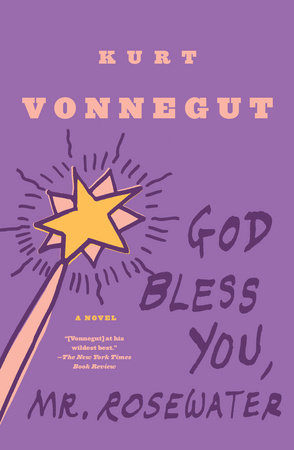
*The Vonnegut novel this passage appears in is God Bless You, Mr. Rosewater,  which I must confess I haven’t read. I say that just as a matter of honesty, not as a review or recommendation which I’m obviously not qualified to give. I suspect I’d like it when and if I get around to it. For counterpoint, here’s a review, contemporary with the novel’s publication, from the New York Times were the reviewer proves a maxim that I often repeat here: “All artists fail.”

The Shadow on the Stone

Because they usually deal with brief moments in time, we sometimes think of lyric poetry as making do with simple thoughts, singular emotions felt distinctly. Today’s piece, English poet Thomas Hardy’s “The Shadow on the Stone”  shows us it can be otherwise.

I suppose one can say it’s a poem about grief, or you could say it’s another ghost story. If it’s a ghost story, it’s poised entirely between belief and disbelief in such afterlife visitations. If it’s a grief poem, and it is that I think, it points out that grief doesn’t mean simple, singular, feelings.

Let me summarize a few things that are biographically behind this poem, even though I think some of its ambiguity can be sensed, felt, and to a degree understood without them.

The poem’s author, Hardy, was married in his thirties* to another woman of the same age. There was something of a romance in their courtship story. She was beautiful, looked younger than her suitor, and loved to ride around the English countryside on horseback. She was a doted-on daughter from a well-borne family that had had some financial setbacks. Hardy was from a tradesman’s family and was not established successfully in a trade or as the controversial author of novels he would become. Not long into the marriage, the wife began to think of this as what would have been called then “a misalliance.” He was beneath her standing after all — and Hardy’s eventual emergence as a novelist of note if anything made her more estranged. She considered herself a writer, while others dismissed her work as all the while Hardy’s began to succeed.

Eventually she moved to the attic of their house, and their emotional separation was an open secret among their acquaintances. In 1912, after more than 35 years of marriage, most spent in estrangement from her husband, she died.**  In going through her attic quarters they was found a manuscript she had been writing. Some accounts give its name as Why I Hate My Husband  and others What I Think of My Husband.***

Emma and Thomas Hardy

For Emma, Forever Ago. Thomas Hardy and pre-ghost-wife wife Emma back in the 19th Century.

.

So, what happens in the moment of this poem, after her death, and after that life-history? Here’s a link to the poem’s text if you’d like to follow along. The poem’s speaker (I’ll just say “Hardy,” as Thomas Hardy was forthright about the subject of his grief poems) is working during the autumn in his garden and sees cast across a “Druid stone”**** a shadow shape which he says in his imagination brings to mind the shadow of his dead spouse when she would garden there. While he says this was “imagining” he’s not completely sure. Those aware of Hardy’s marriage history will hear a particular salience in the statement that the ghost of his dead wife is one “I long had learned to lack.” But this phenomenon, of intimates appearing in the imagination of the grieving is commonplace, and I can say in the experience of myself and my dead spouse, it’s not a simple wistful visitation. If one’s world has been turned upside down, you may not want it to spin some more, even backwards.

In the second stanza this “Is she really here, or my imagining” state is interrogated. Hardy speaks to whatever is behind him casting shadows, and says (perhaps just in case it’s a real, and maybe even a vengeful, ghost) “I’m sure you are standing behind me.” As if he’s conjured up a spirit and he’s letting them know he knows who/what they are, knows their name, and can query it.

The spirit doesn’t respond. I love the ambiguous skeptic’s final two lines here: “I would not turn my head to discover/That there was nothing in my belief.” Hardy wants to not face it  if the spirit is real, not an imagining, and we don’t even know if from fear or love.

Continuing in ambivalence, Hardy says next that he wanted to look  and disprove, a statement that he in action doesn’t do.*****   Instead he leaves the garden without seeking to disprove or confront the spirit or imagining he believes is representing his dead wife. Best as I can tell, the idiomatic expression “throwing shade” is of Afro-American origin. This Merriam Webster note says it was popularized on Ru Paul’s Drag Race  circa 2010, though I’m pretty sure I heard and used it before then. In my performance, I speak it in that meaning, even if Hardy didn’t mean it that way in his time. As in life, Hardy seems to say he must endure and miss his spouse, and so this ambivalence with a possible ghost resonates with his grief.

I mentioned performance above. I started composing here thinking about the Afro-American musical influences on the Velvet Underground, both in rhythm guitar figures and in Moe Tucker’s spare drum kit and approach. If I would have written the drums in this as a jazz-influenced piece, the high-hat would have marked the beat, but there’s no high-hat in this piece’s drum kit, though the tambourine playing does stand in for it somewhat. This didn’t turn out to be a Moe Tucker style drum part after all, but that’s where I started.

My original take had things ending on Hardy’s poem’s final word: “fade” — but overnight I decided it needed a reprise after that hung resolution, and while playing that I decided to riff on some other famous lyrical uses of the word “fade” as a trope of death and persistence. A player gadget is below for some to hear my performance, but if not, this highlighted hyperlink is another way to hear it.

.

*This is fairly late for a first marriage in the mid-19th century.

**She and Hardy were 72 in 1912. This is not one of those stories of the stricken young bride who died long before her time.

***We may wonder just what the real deal was with their relationship, who was meaner or more dismissive to who — and well, the patriarchy and all that may have colored within the lines, as most accounts by men and women seem to paint Thomas Hardy as the aggrieved party in the marriage. Interesting matters — but for the purposes of presenting this poem, beside the point. Flip a few gendered words in the poem, and imagine it being written by a widow who thinks of her abusive or belittling husband after his death.

****I wondered about this peculiar detail. Was this a characteristic English garden decoration, like a birdbath or garden gnome statue? No. A large flattened top stone was found during construction which Hardy thought was an actual Druid stone, perhaps used as an ancient altar. More evidence that while Hardy was a skeptic, the realness of a supernatural “apparition” is meant to be in question — and this may also allude to some metaphoric bone and ash sacrifices the marriage brought to their lives.

*****In a short essay on this poem, Jeremy Axelrod sees an allusion to the story of Eurydice and Orpheus in the underworld. Hardy doesn’t usually use classical Greek allusions in the poems I’ve read, but even if unintended, well, “death of the author” and “archetypes.”

They’re All Dead Now

In the last two posts I’ve mentioned how early 20th century Irish poet Joseph Campbell used the concision of Imagist poetry to present eerie folkloric material. However, today’s piece, written some 70 years later by Dave Moore, shows how the reiterative storytelling methods used in many traditional ballads can still work. Because of the way it tells its story, it’s somewhat longer than usual pieces here, but well worth 8 minutes of your time.

I quite vividly remember the first time I heard this song. I’d known Dave for over a decade then, but there was something new: he told me that he had written some songs and I offered to record them. I setup a cassette recorder in his living room where a patinaed old upright piano sat against a wall next to a set of framed pocket doors that he and I had spent some time stripping a few years before. I had a pair of Radio Shack microphones to hook up to record him. I think one of my mic stands was a second-hand-store gooseneck floor lamp that had given up its socket for a mic clip.

I don’t recall most of what Dave played and I recorded that day. Maybe four or five songs, but the last one was the piece I’ll perform for you today. Dave was a powerful, pounding piano player in those days, and the old upright was ringing out pretty good as he gave forth the lyrics of “They’re All Dead Now”  loudly over the top of that. By the end of its 11 verses, his voice was getting ragged — but the story he was singing was powerful enough that it probably should wear one out. He finished, and his voice was too.

The tape I made is now long lost, though “They’re All Dead Now”  remained recorded in my memory. Also to my recollection, that day was the day that the idea of the LYL Band that you’ve sometimes heard here as part of this Project took hold.

I think we may have tried to play or record it once or twice since, but it’s a difficult piece to bring off. Effective singing of long ballads in this kind of traditional form and length is extraordinarily difficult. While trained singers have built up stamina and technique to do that, this untrained singer will testify that it is as wearing as singing a set of hardcore punk — and since traditional ballad singing often uses sparse accompaniment, you have nowhere to hide and nothing else to bring the fury or shock to the audience other than the song’s story and one’s voice. Which is why, even in folk clubs among aficionados, long ballads are an iffy thing. The emotion too often invoked is boredom. Polite audiences will not throw things at the ballad singer, but they will fall into talk among themselves, and some will drop their eyes to half-mast and tune out to thoughts of more exciting music or leaf raking.

But of course, these songs can work. To build up to doing this performance I listened all morning to June Tabor recordings. Tabor (and Anne Briggs) are two of the best I know at performing this kind of material, and Tabor often uses instrumental backing (Briggs more often sang unaccompanied). I wasn’t ready to expose just my bare voice for this piece.

The piano part you hear is actually two piano tracks. Here I was thinking of the simple repeated motifs that John Cale,* with his association with what was called Minimalist composed music, would sometimes play. I added a synth part, which is more faithful to what Tabor would sometimes use, where the easy to transport and amplify electronic instrument serves almost as some droney acoustic folk instruments might at a traditional ballad sing.

I sang my vocal at my most energized part of the day and managed about four takes, and what you’ll hear is the best of that. I wouldn’t say my vocal timbre is pretty, but then maybe this song can survive that.

Yes, Dave’s song. I still think it’s a great song, same as the first time I heard it. The story it tells is historical,** it happened on the West Coast of Scotland just as the lyric says in 1618. Though it’s heavily refrained and has those 11 verses, it still doesn’t waste much time, dropping you in media res and progressing in presenting a horror that should be more frightening than witches.

Illustrating your 17th century Scottish Facebook feed: political instability, patriarchy, and religious fervor (or excuses).

.

I used to dream of hearing a great singer sing this song, but folk music’s principles say that a song needs singerrather than necessarily waiting for that. June Tabor is my age,*** I’m not sure she still performs. Rhiannon Giddens, the ball is in your court. Contact me.

But the rest of you can hear my best at transforming Dave’s song right now. There’s a player gadget some will see below, and otherwise this highlighted hyperlink will also play it.

.

*Yes, I’m still on a Velvet Underground jag this month.

**You might think 1618 is fairly late in the ugly history of witch prosecutions, but if you go to this account from the town of Irvine in Scotland I link here, you’ll read that “In 1650, a total of 17 women were also executed for witchcraft – 12 in March and 5 in June. Other burnings similarly took place in the town in 1662 and 1682.” So, there was enough of this that the story of Margaret Barclay, John Stewart, and Isobel Crawford is sometimes not included in round ups of the atrocities. Walter Scott did his own investigation in the 19th century, and the Irvine hyperlink above includes some of Scott’s account.

***October –  besides being the occasion for this week’s Halloween series – is also Dave’s birthday month. Happy Birthday Dave! Age has taken some ounces off of Dave’s keyboard pounding, but I still hope to present more of his voice here as part of the Parlando Project.

our Halloween Series starts with: The Good People

In the past month I’ve presented poetry by Robert Frost and Emily Dickinson, two of the most famous and best-loved American poets, and William Butler Yeats, the great Irish poet — but I also like to go beyond Poetry’s Greatest Hits and hunt for overlooked writers to combine with our original music. That’s how I found the work of Joseph Campbell who also wrote under the Gaelic version of his name as Seosamh MacCathmhaoil.

Ireland takes great pride in their poets, rightfully so, but Campbell seems to have slipped out of memory for the most part. I’m not yet sure why. Something about his personality? Political scores? The wealth of other poets to read? The lack of some widely acknowledged great poem that anthologies can’t ignore? It may just be that his limited level of fame and esteem in his most-active years before WWI didn’t reach a high enough point for his glide path to carry him into the 21st century.

When I found Campbell’s work, two things immediately attracted me: it’s lyrical and easily fits into the Parlando Project, and that he is likely the first Irish national to write in the Modernist short free-verse form that became known as Imagism. I don’t know how he came to write excellent examples in this style, but as the 20th century progressed that highly compressed and unpresupposing poetry was compartmentalized into a “you’ve proved your point” passing corrective to 19th century verse, and so Campbell’s fine examples in this style that were not widely anthologized and commented on when fresh carried little weight later.

But there’s another reason that his work fits with our “The Place Where Words and Music Meet” motto. Campbell seems to have collected and worked with traditional British Isles folk music. A few years back, author Greil Marcus came up with a fine phrase for America’s mashed-up folk musics and their contexts: “The Old Weird America” — but the British Isles traditions love ghosts, mysteries, and general strangeness too. In Campbell’s early 20th century books, right next to the free-verse Irish landscape Imagism, we may find poems that look a lot like folk song and which contain elements from traditional sources; but Campbell also shows a talent for vivid condensation (no 30 verse slowly iterating ballads for him) and luckily for our Halloween Series, he retains an emphasis on spooky and occult motifs.

So, let’s kick off a short Halloween series here with one of those poems which I’ve set to music: “The Good People.”

The Good People

What good’s a folk song if folks can’t sing and play it? Here are the accompaniment chords to my setting of “The Good People.”

.

The poem’s opening four lines set the scene, a mill path near a stream at night. Mist is rising off the mill stream, and it’s clear though dark. I was puzzled a bit by the black “lock,” but best as I can figure it may be a waterway-controlling lock. I don’t think it’s a spelling variant of the Scotch Gaelic “loch,” but it’s easy to think so just hearing it sung.

Ducks on a misty pond 1024

One misty morning early… Heidi Randen’s picture of autumn pond mist

.

In this quick-to-the mystery telling, the poem’s narrator lets us know there’s another group in this nighttime in the next quatrain. There’s a somber procession “along the grass.” I visualized small creatures, at least tall-grass short. One of them is apparently a queen of the creatures, and by now we should sense we’re in a fairy story. Two things, one obvious to any reader, and the other obscure to me until I read the poem are disclosed before this stanza ends: the queen is Aoibheall who is a prominent Irish supernatural creature. Besides noble prominence, she’s known for having a magic harp, and any human who hears this harp will soon die. Knowing that detail will set one up for the final two stanza’s concluding lines: the first of those lines we encounter tells us the little people are conveying a corpse.

This is not a victory march, the supernatural creatures are apparently The Good People in the title and they are sad and solemn. As the poem finishes, our narrator brings us to the final stanza-ending line, telling us that the corpse is possibly human.

Many, probably most, versions of traditional folk songs do not work like this, despite the rich folkloric flavor. Instead, British Isles folk songs often work like soap operas or podcast serials with a slow accretion of detail separated by many repeating refrains. At 12 lines and 72 words, Campbell’s lyric is very condensed.

To some who read or hear this, at least an air of strangeness should be conveyed efficiently. It’s also plausible, knowing the tales of Aoibheall and her harp, that a short sharp bolt of terror could occur to the narrator standing in this scene for us to imagine ourselves. The narrator surmises the corpse the fairies are bearing may be human. They (and now you) may know about Aiodheall’s harp. Did Aiodheall’s harp’s music kill the human they’re carrying? Will their dirge, already in progress, come to a harp part?

So, listen to today’s audio piece, if you dare. The player gadget will materialize below for some, but other ways to read this blog are under a powerful spell which forbids displaying it. Therefore, I’ve cast a highlighted hyperlink here to give you another chance to risk your life.

.

Bond and Free

Looking for texts to feature here this month, I came upon this odd Robert Frost poem “Bond and Free”  and I could easily see how I could perform it Parlando style. Performance unavoidably involves choices, even if it can precede fuller understanding. Let me talk some about those choices I made and what understanding I’ve come to have about this poem. If you want to have the full text available while I discuss it, it can be found here.

What seemed odd about this poem? Well, I associate Frost with specific and palpable imagery. If one has any sense of the rural landscape of the 20th century, as I do, I can often place myself directly on the stage with the speaker in a Frost poem and examine the set decoration. Critical overviews of Frost’s era will sometimes want to clearly distinguish his work from the Modernists, mistaking the devices of rhyme and meter as the essentials of his work. This ignores that he’s so often working in his early short poems with the same direct observation, avoidance of worn-out tropes, and fresh, lyrically present moments as the Imagists.

This poem with it’s capitalized “Thought” and “Love” is not like that. In some ways it’s like Emily Dickinson in her more philosophical or legalistic abstract mode. To the degree that this poem has a landscape, a stage set, the one on which this poem plays is cosmic.

Frost’s poem begins “Love has earth to which she clings.” Any accustomed Frost reader would expect that garden or farming matters will follow. We first read Love here as implying a plant’s roots, but what follows has a topography viewed from aerial heights. From there the valleys of a hilly country are, as they can practically be in Frost’s time, wall after wall that separates people and their towns from each other. That third word “earth” as the poem progressed could well be capitalized too, for it’ll turn out to be more at the planet Earth, not mere soil. The first stanza ends by introducing Love’s contrasting principle in this poem — Thought, as in Free Thought. Right away we see Thought is flying above it all, in the mode of Icarus or Daedalus.

The poem’s speaker (I’ll call them Frost, for as there’s no sense that Frost is setting up some special other voice from his own) follows Thought as the second stanza views Earth’s earth from above as a landscape with marks of human effort on the ground visible as a printed page. “Nice enough” it seems to have Free Thought thinking, but “Thought has shaken his ankles free.”

It’s now a good time to take note of the poem’s title: “Bond and Free.”   Frost is writing this about 50 years after African-American emancipation. Like Emily Dickinson (who wrote most of her poetry during the Civil War) Frost almost never mentions slavery, the issues of racism, or the widespread theories of racial differences or superiorities in his poetry.*  Leg shackles could be applied to prisoners of course, but like the broken shackles that are hard to view at the feet of the Statue of Liberty, in the American context I think slavery is an intended connotation here. Essays on cultural appropriation could be written from this. Not here, but it’s possible. I could suppose someone could see a BSDM reading. While I know a blog post titled “Robert Frost and Sexual Kink” would be surefire clickbait, I’ll resist. It’s also plausible that he was connecting “bond” in the sense of “marriage bond.” More on this below.

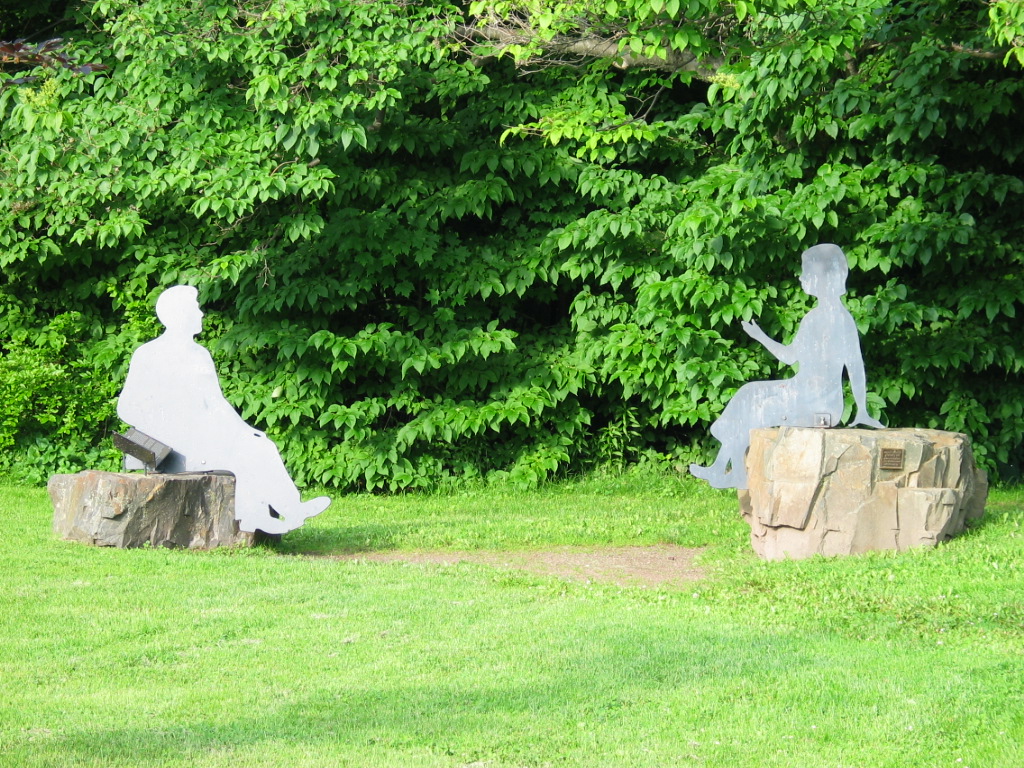
“You read your Emily Dickinson. And I my Robert Frost…” The two great American poets lived in Amherst in different centuries, and this set of statues there commemorates that.

.

In the third stanza we outdo Bezos, Musk, and Branson as Frost notes with inexpensive poetic efficiency that Free Thought is not bound-in by earthly hills but is capable of interstellar flight. This stanza’s final lines, an Icarian or Luciferian plummet, find that at the end of the limits of the dreams of a night Thought invariably returns to an “earthly room.” As my footnote below notes, Frost is fairly sure of the fallen nature of humanity.

The final stanza is, to my reading, an ambiguous judgement. If humanity is fallen, Frost too is unable to judge the competition and contrast of Love and Free Thought. Thought’s freedom and range, even if temporary, even if illusionary, has a pull and value. And “some” (Frost externalized this opinion and doesn’t say they are right or wrong) say Love (even if it’s bondage and constrains one) can have a fuller possession by nature of its grounded stasis.

The poem’s final couplet retains this duality, Free Thought has partial experiences of multitudinous beauties in a wonderous universe, but these beauties are “fused” to other stars. To choose other than temporary dreams, just replaces New Hampshire with Sirius.

I said at the start performance means choices. I made an audacious choice. In Frost’s poem he consistently gendered Love as female and Thought as male. Furthermore, I’ve read second-hand references that in an earlier draft he chose to make both Love and Thought female, an unusual choice that he abandoned. I made my choice for my own reasons, to help the performer, myself. I think that choice makes it a stronger piece for myself and for my audience.

The reports of Frost’s abandoned choice would make for a different poem. English writing in Frost’s time usually used male pronouns for universals and abstracts, so that original choice of female pronouns must have been intentional. His choice for skyward Free Thought as male, and earthy and fecund Love as female is archetypal, and I in turn made a conscious decision to reject that. I did this because I feared that too many listeners might grasp this poem as a conflict of male sexual freedom vs. the clingy women. Intentionally or subconsciously, this may have been in Frost’s mind, and even so then this is Frost’s version of the complicated love poem that the female “songbird poets” were developing in his time, even if it’s more abstract in describing the bond and free of desire.**  I just preferred the duality of the poem ungendered, and I think modern audiences are ready to receive that version.

The player to hear my performance will appear below for many of you. However, some ways of reading this blog won’t show it, and so here’s a highlighted hyperlink to play it. You will notice that besides the pronouns there are a few other textural differences, some accidental, some chosen to make the language more colloquial***  and easier for a modern listener to grasp on hearing. I don’t know if these changes are for the better, but they were this performer’s choice.  As promised earlier in this month of noisier musics, acoustic 12-string guitar and piano featured this time, but just enough sarod and tambura in the background to add a non-New England air.

.

*Frost did write one searing poem on racial hatred and violence: “The Vanishing Red,”  which I presented here. A brief search today didn’t return much. I would expect that he held stereotypical views and used ugly racial epithets casually. Like Dickinson, Frost’s silence on this central American issue should be more often considered as a loud silence. In her defense, Dickinson’s stance on human freedom, often expressed in her poetry, can easily be viewed as inspirational by all. Frost is surer of a fallen humanity, but that too can be appreciated by those weighed down by life or oppression.

**That reading would say that Frost was more guarded and indirect in dealing with desire than Millay, Teasdale, and the “songbird poets.”  Thus, the uncharacteristic abstraction of this poem

***One of Frost’s Modernist strengths was to largely remove from his metered and rhyming verse the sense of stilted and too formal poetic diction. My judgement was that this skill deserted Frost several times in this poem. Perhaps abandoning his usual distinct and grounded settings for this more abstract poem also blunted his naturalness of speech.

Timepiece

Here’s another elegy, but this time by modern American poet Kevin FitzPatrick. Dave and I are keeping Kevin in our memory, which is one place to store someone one knew who has died. Writers like Kevin get another keeping location, one that can be accessed by those that didn’t run into Kevin while he was alive, and that’s in their work.

I won’t sugar-coat this, even in this grief time. I’ve talked here before about what I call “Donald Hall’s Law.” It’s a cold assertion, made by poet Hall in one of his late-life essays, that the majority of poets who receive prizes, notice and ample publication in their time, will be unread 20 years after their death. Is this judgement of time clarifying and correct?

Well, we mere readers of poetry too will generally be forgotten. Forgotten is time’s henchman. Perhaps having only a few “immortals” allows us to focus on those whose work remains in front of us — the heroes who survive the cannonades to become included in the canon. Utility is one part of the argument here. How many poets can one teach in one survey course? How many pages of poets can an anthology’s binding hold? How many names can we contain in our own personal “poetry contacts” memory storage as we pause at a bookshelf? It may seem cruel that this is a rough process taken so casually by time.

So, let me pause here and ask myself, a person who knew the poet Kevin FitzPatrick to some degree, what did Kevin think of this process, this fate?

I never asked him. He never spoke of this matter in my presence. I did get to observe how he carried himself in life, the way he honored poetry and the people in it when he had the direct, living way to do so. That was perhaps his primary concern more than the matters to be observed by a ghost. And there is  a scholarship fund to express some concern for legacy, a fine idea. Here’s a link to that. And here’s a link to Kevin’s obituary in our local newspaper published today.

Kevin FitzPatrick and book

A more recent photo of Kevin FitzPatrick. All grief connects, so I’ll use Kevin’s elegy for his father today to elegize Kevin.

.

But then I recalled that Dave and I had another performance of one of Kevin’s poems stored away somewhere. I found and listened again to this elegy written by Kevin about his father. “Timepiece”  is about something Kevin felt about the work of a parent and the work of time’s henchman, but now too I think it says something about Kevin’s work.

It’s a good poem to remember of Kevin’s. You can help me remember it by listening to the LYL Band performing it over a decade ago with this highlighted hyperlink, or if your way of reading this blog displays it, with a player gadget below.

.

Here’s a link to a site where you can purchase Kevin’s poetry collections.

.

I think I was enchanted

Earlier in the history of this blog I did a series called “The Roots of Emily Dickinson” talking about some influences that helped shape her poetic originality, but in that series I missed running into this ecstatic poem known by its first line “I think I was enchanted.”   Scholars are fairly certain it’s the American poet’s elegy for British poet Elizabeth Barrett Browning.

Actually, it’s one of three Elizabeth Barrett Browning elegies Dickinson wrote, evidence that she truly wanted to record her appreciation for this poet. In my casting about for interesting material to perform and present here I came upon today’s piece only after finding another of the three, “I went to thank Her.”   I had gone so far as to start writing music for the Parlando presentation of that poem, when, in looking for information, I came upon this other one via Susan Kornfeld’s fine blog on experiencing Dickinson’s poetry. You can use this link to read that post and today’s poem as she presented it.  Kornfeld says “I went to thank Her”  pales in comparison to “I think I was enchanted.”   It’s certainly more intense — intense to the point I began to question my initial readings of the poem, as I often do with Dickinson.

One of the challenges with Dickinson’s poetry is that I have little sense of exactly what the author intended. We have no readings of her performing her own poetry written in the 1860s of course, and despite some saved correspondence, those letters seem to me to show a person who presents different personas in what for others would be casual prose.

I said this poem is often considered as an elegy, a poem of praise written after the death of the subject, but while “I went to thank Her”   speaks of EBB’s grave, there’s no direct mention of her death in this one. Furthermore, “I think I was enchanted”   has moments I read as humor, even satire, mixed with what could be read/heard as outlandish but sincerely intended Blakean visionary experiences.

Dickinson opens her poem with a distancing frame: she tells us this is how she responded to EBB’s poetry as a “somber girl” — and in one of her alternative notes in manuscript she considered “little girl.” Here’s she’s recounting how the younger goth-girl Dickinson encountered EBB, and I love Dickinson’s concise entry into that gothic outlook: “The Dark — felt beautiful.”

What follows is the Blakean part, an outright visionary state: time has no meaning, logic and proportion have fallen sloppy dead*, butterflies have become as large as swans. Dickinson has other poems that portray such states, and in some of them here I’ve mused that she had either/and visual disturbances like migraine/epileptic auras or full-fledged mystical transport where ordinary reality dropped away. But then observe how this vision recounted from childhood trails away. In our somber young girl’s vision, the older Dickinson says the sounds of bees and butterfly wings are audible but that they were little tunes “Nature murmured to herself to keep herself in Cheer — I took for Giants — practicing Titanic Opera.” I think the older Dickinson (she probably wrote this poem in her mid-30s) is allowing she was a little over the top in her feelings then. That she calls the sounds in her vision “opera**” is easily read as being over-dramatic in feeling by moderns, but I’m not certain how Dickinson would have viewed opera from her mid-19th century seat.


Emily Dickinson performs her tribute to Elizabeth Barrett Browning — wait that can’t be right! Well, it’s analogous, or psychedelic, or something.

.

The second half of the poem becomes more abstract, though opening with the metaphoric claim that ordinary days, even the “Homeliest” of them, are now transformed after reading EBB into a fancy-dress “Jubilee.” Another unusual word choice there, not prompted by rhyme. Did Dickinson mean something exact with “Jubilee?” Would she have been familiar with the Hebrew tradition*** from which the word derives? Possibly from Old-Testament sources.

The poem’s 6th stanza seems satiric to me. One of the most well-known examples of Emily Dickinson’s stubborn individualist character was her steadfast refusal to declare herself as “saved” by being reborn in the Protestant religious revival tradition of her time and place. That issue was part of what ended her formal education, and it set her apart from friends and family members. This stanza says, in my reading, that “What happened to my mind back then, I can’t really define and explain — but it’s not some simple declaration or decision, you have to live/experience it.” Thus sticking it once again to the just publicly accept Christ’s grace and be saved crowd. She continues the satire in the following stanza, in effect saying “You think I was out there, what with my butterfly bees beating opera tunes — well, your sanity without that luscious visionary intensity is dangerous to me! And if I ever get poisoned by that, well I have the antidote…” and she launches into a final stanza.

That stanza says EBB’s books of poems are “Tomes of Solid Witchcraft” — a phrase which slots right into a pagan-feminist bookshelf doesn’t it! And then a lovely fade to end: “Magicians are asleep” (the only possible reference to EBB’s death in this putative elegy) but she will remember the magic of that “somber girls” experience of EBB’s poetry, and the possibility of its creation by a woman, like as the religiously faithful remember the godhead/universe-creator.

In that reading I’ve outlined, I enjoyed this poem’s passionate mix of possible reflected youthful visions and the more mature satiric comparisons to a certain kind of religiosity. I did find it somewhat difficult to perform, as the syntactical jumps are hard to fit to breath and natural expression.

One thing still leaves me puzzled: Yes, I understand that Dickinson could easily feel that EBB was groundbreaking in her expression of woman’s ability to write and think and desire — and while that’s no settled notion even in our current age, it must have been even more striking in 1860. But even allowing for the framing device that Dickinson uses, the visionary experience engendered by encountering the poems as a young girl, I never have received that kind of jolt of new perception from reading any Elizabeth Barrett Browning. Maybe I haven’t come across the right poem? Maybe I can’t quite read them as Dickinson did from her situation?

Which is another reason to be grateful for Emily Dickinson, because in poems like this and others, this mid-20th century guy living in the 21st century can  get that jolt from Dickinson.

To hear my performance of “I think I was enchanted”  you can use a player gadget below if you see it, and this highlighted hyperlink if you don’t. Today’s music resulted from me specifically wanting to combine a variety of non-obtrusive percussion sounds (percussion being those pure “you hit it and sound comes out” instruments) with swelling synthesizer sounds that have no struck attack in them at all.

.

*Grace Slick riffed on a number of authors, not just Lewis Carroll, but I can’t think of an instance when she quoted Dickinson. Maybe she (like I) grew up in a time when Dickinson’s poems were thought and taught as simpler homely oddities. Grace, if you’re reading this blog, let me know what Dickinson meant to you.

**Like Dickinson I’m attracted to close, near, and slant rhymes, and when reading and performing this piece I was surprised that she missed the near-rhyme that “Titanic Overtures” would be in place of “Titanic Opera” with “To keep herself in Cheer.” “Opera” is a more strained rhyme, so maybe that exact word was important to her intent?

***Every 7 times 7 years farmland was to lay fallow and slaves were to be set free. This relationship to slavery led the term to be adopted by Afro-Americans in connection with the ending of slavery, a process that began in the United States around the time this poem was written. I have not solved to myself the mystery of Emily Dickinson’s opinions on American chattel slavery and Afro-Americans. Her father’s known political opinions on slavery (a huge issue when Dickinson was writing her poems) was as a “moderate.” But her Massachusetts had significant and militant abolitionists (including the Dickinson associate Thomas W. Higginson). Abolitionist positions are not synonymous with belief in the full and equal humanity of Black Americans; and it would not surprise me if Emily Dickinson, like Whitman, could hold racist opinions about Blacks while intellectually being whole-heartedly committed to freedom.

It’s also possible that Dickinson may have known of Roman Catholic Jubilee years; and in the context of a poem about a poet who lived in Italy and was connected with the turmoil there (which cancelled the 1850 Catholic Jubilee Year) this term could have been brought to mind.

Four Things I Learned from the Poetry of Kevin FitzPatrick

It’s taken me a few days to write this post after learning of the death of Minnesota poet Kevin FitzPatrick. After someone dies, someone you know at some level, there’s an emptiness. While it’s impossible to feel emptiness, it may be the first obligation of grief to hold that sense for a little while. Was for me.

I didn’t know Kevin well. We were different sorts, and I myself am quite bad at friendship. But I knew him somewhat, and over time quite a bit as a poet. With some interruptions on my part for over 40 years I’d see him every month in a meeting that sometimes had as many as ten or so writers and sometimes was just Kevin, alternative Parlando voice Dave Moore, and myself. We’d meet in one of our places and those present would break out new work for comment and feedback.

I said we were different sorts. Back in the 1970s I was chiefly influenced by some hermetic and oppositional poetries: French Surrealists and para-Surrealists and those Americans who had read or influenced them. These poets tended to be ecstatic in mood and unafraid to puzzle or offend. Kevin had a different vision — he wanted his poetry to be comprehended and welcomed by ordinary folks, including working people of our parent’s generation. Is that the first or fifth thing I learned from Kevin? No, I’m still learning that one.

Let me speak ill of the dead. In our common youth I thought Kevin was prissy and way too afraid to offend. But we were young men then, and by now my younger self has passed from life to a degree near to what Kevin’s entire non-written life did this week. The way I see it now is that we were both half-right — but his half produced better poetry more often. So, I doubt he learned much from me, but I learned several things from him. You might want to learn some of these things now or later, so I’ll offer four things I learned from Kevin FitzPatrick’s writing today.

Kevin Obit Photo

“You can’t tell a book by looking at it’s cover.” Kevin FitzPatrick edited the urban working-class Lake Street Review, but today’s piece has some farm boots in it.

.

Characters

Here’s the first and primary one, a lesson that I often told Kevin I would try to remember. Around the time of his first collection, Midwestern writer Meridel Le Sueur said that Kevin’s poems were poems with other people in them. Given Le Sueur’s life twining activism with writing, this was a fitting observation for her to make about Kevin’s writing. But stop and think for a moment of the poems you write, or even the poems you read or rate highly. How many of them have actual, flesh and blood characters in them? A great many poems, and to wildly generalize, many poems by male poets, have nothing but the poet’s own consciousness reflecting on itself. If something external intrudes on this, it may be nature or incorporeal spirits — or if human, they may appear as masses or classes in sociological case-folders. Kevin’s poems had a range of characters: friends and antagonists, folks that are richly neither, and people who you just run into in life. Kevin himself appeared in his poems, yes, but in many examples the poem was as much about Kevin as the novel The Great Gatsby is about Nick Carraway.

You may think that poetry, with its freedom of language and musical force can dispense with characters, that poetry may be particularly suited to delve into an individual’s own consciousness so otherwise unrepresented in human life. Good poems have been written from that conviction. But is that all  it can be? What a lonely art making itself lonelier would result.

Dialog

Kevin’s use of dialog goes along with the characters. If you’re going to allow them to appear in your poetry and have autonomy, then they need to seem to speak independently. Kevin’s characters were not kept silent, and a good many of his poems had the texture of a compressed short-story, including the effective use of dialog.

Again, I’d argue that we are too exclusive when we talk about the poet’s voice and poetry as self-expression to the exclusion of all else. Yes, the world may be enriched by 100 poets writing in their own voice, saying out-loud or on the page their own individual experience. But if some of those poets would allow other voices to speak in their verse, to join in the choral and antiphonal song that is human experience, we might have at least 200 voices, if not 500, speaking in our poetry. How we speak, how we express ourselves is important. How we listen, what we hear, that too is important. The poet’s ear shouldn’t be cocked for just iambs and trochees.

Work and Workers

Why shouldn’t the world of work appear in poetry? I mentioned that earlier this month in dedicating my performance of a poem by Carl Sandburg to Kevin that Sandburg didn’t shy from talking about folks working, how that felt, what they encountered. FitzPatrick extended that in his poetry with a good degree of specificity. In his poems about encountering agricultural work in his fine final collection Still Living In Town, the specifics and groundedness of farm chores were taken into his poetry.

Yes, let us concede a dialectic. Many readers (and poets) go to poetry to escape that everyday grind, to celebrate the exceptions of romantic love, cosmic visions, rare events worthy of celebration. Fine. But why can’t poetry inform and illuminate what we are doing for a third or so of our lives?

Rural-Urban

Between the rural-urban divide is a great place for a poet to sit and write. I spoke of Kevin’s final collection from 2017, Still Living in Town  above. In America, there’s an increasing division in outlook between those living in cities and those living in rural areas and small towns. Kevin’s poems in that collection, including characters, dialog, and those work-a-day issues, also allow us to see different locations and outlooks as he travels between his urban house, his capitol city office job, and a small farm.

How few travel between those worlds with open eyes, ears, and hearts and write verse about it! Kevin FitzPatrick did that in his final book. As I said above, I learned things by how Kevin approached his poetry and characters, but it’s important to also make clear that he’s not just a  “poet’s poet,” but also a rewarding and entertaining writer to read. Books from the publisher of Still Living in Town  are not available from the large, easily linkable mail-order booksellers — which depending on how you feel about such things may be a feature not a bug. Here’s a link to the WorldCat listing for FitzPatrick’s 2017 book which includes library availability and the ISBN number that might aid in ordering from your favorite indie bookstore.

OK, should there be my customary Parlando audio piece at the end of this post? With some trepidation I’ll offer this one, my performance based on an early version of a poem destined for Still Living in Town.  It’s an old recording from 2013. Shortly after I recorded it, Kevin heard it and thought I misinterpreted the song. As I said, we were different sorts, though over the years I like to think we grew closer from our shared love of what poetry could do. Kevin said I missed the poem’s point; it was about the difference between the urban and rural cultures he was observing and writing about. He’s right, I undersold that element, seeking instead to stress how a customer service interaction went sideways from mistrust and was eventually resolved. I think he also might have reacted to my edgy, angsty delivery and music. Kevin was a calm, dry speaker in performance, and the speaker in this performance isn’t. It’s also important to know that “Returns”  is just a piece of a greater work that took him several years to write. This isn’t the most singularly impactful poem Kevin ever wrote, just one in his series that I happened to perform one day because I liked the vignette, and that I had handy to put here today.

A few bits of scene-setting before you click on this performance: Kaplans* was a clothing store specializing in utilitarian work clothes and outerwear that was located then on Minneapolis’ famous working-class-to-under-class Lake Street. Wheeler Wisconsin where the scene shifts to in the conclusion is a town of 300. Tina, the deus ex machina of the poem’s story was Kevin’s partner who decided to buy an 80 acre farm which Kevin commuted to every weekend during the time of the book.

Player gadget to hear it below for some, and if you don’t see that, this highlighted hyperlink is another way to play it.

.

* The first winter I spent in Minneapolis, it was at Kaplans that I bought my first pair of Sorel boots, that genius Canadian design that has a waterproof leather and rubber outer boot with an inner insulating liner made of compressed wool. If you ever have to stand in -20 F cold and wait on a bus that might not run on-time, the un-frostbitten scansion of my poetic feet recommend them.

Summer 2021 Parlando Project Top Ten, numbers 4-2

Continuing our countdown of the most listened to and liked pieces here this past summer we move today to the numbers 4 through 2 on our list. I’ve mentioned that blog traffic and listens have dropped off a bit this summer, which from looking at past years stats follows a yearly trend. Things are picking up this month, which is encouraging — and even before autumn has begun, we’ve already rolled up our most page views and visitors for a year ever. Most of the blog visits come from those using search engines stumbling onto a particular page, and there are some perennially popular Parlando blog posts that draw visitors month after month and year after year. Maybe sometime this fall I’ll talk about those, but when it comes to listens to the audio pieces this summer, the list is all recent work, so let’s move on to them.

4. I, Too by Langston Hughes  I did a double post for American Independence Day, using texts from Walt Whitman (“I Hear America Singing”)  and this answer piece by Langston Hughes. Hughes’ piece easily outdrew the Whitman in listens, perhaps because it’s fresher to some listeners (Whitman’s piece has already had at least one widely-sung setting). Then too, the music I wrote for “I, Too”  was a catchy little cycle of chords that I played in full strums on acoustic guitar. To my ears, and apparently many of yours, it was simply effective.

Hughes wrote his poem as an individual Afro-American’s story, one paralleling his own biography, but it’s easy to see he intends it as a fully-earned addition to Whitman’s catalog of Unum’s in the E Pluribus. I decided to add onto Mr. Hughes’ lyric one short phrase at the ending, “If not us, who else,” in part to double-down the Independence Day point being made. Questions of cultural appropriation may prick us, their needling will establish these concerns have small if sharp and painful points, but the overall issue of who tells, who sings is long past decision. Story tellers will tell. Singers will sing. Poets can do both at the same time.

If you haven’t heard this one, or want to hear it again, there may be a player gadget below, and if not, this highlighted hyperlink can also play the piece.

.

3. Sappho’s Old Age by Sappho  Speaking of cultural appropriation, yesterday in this Top Ten countdown we had a piece written by pioneering Canadian poet Bliss Carman presenting himself as if a reincarnated Sappho. Is that ridiculous? I guess it can’t help but be, but I honestly enjoyed his poem and performing it. However, this piece in today’s part of the countdown was somewhat more popular this summer and was actually largely written by Sappho.

Now it’s my turn to respectfully appropriate her work and twist it my way. Ancient Greek being — oh what’s a saying for this? Oh yes: “It’s Greek to me.” — I worked from literal glosses of the text and tried to turn it into singable modern English idiom. Then I got to the poem’s conclusion, and enchanted by the parallels with a poem by 19th century French poet Arthur Rimbaud that I presented here this spring, I decided to replace Sappho’s metaphor with one drawn from Rimbaud and his life.

Bliss, I guess you and I are in the same boat, probably on one of the lakes between my state and yours.

To hear the performance in my old age of Sappho’s song of her old age a lot of ages ago, you can use the gadget below or this highlighted hyperlink which will open a new tab window and play it.

.

Bee Busy Hearts

Bee busy! Hearts! Summer photos by Heidi Randen.

.

2. The Poem ‘The Wild Iris’ by Heidi Randen   Heidi wrote the text I used here at the end of a post at her blog this summer, though I added the music and additional repetitions and pauses of my device to the piece you’ll hear. In turn Heidi was resonating with something she had read in a poem by Louise Glück. So, in the end, I appropriated her work appropriating Glück’s. This process by which I appropriated the text as well as the musical repetition give it a rondeau effect if not that exact form.

Oddly, all this repetition was to present a thought about transitions, which Heidi and I are both going through this summer. Things cycle, things repeat, and then they don’t. Every day for months a parent picks up an infant and carries it somewhere. Then the toddler asks, and the parent lifts their toddling body to hip or shoulder and carries them bidden. One day they no longer ask, the parent no longer lifts, and never lifts again. And then sometimes, with time and age, the parent, will be carried by the child.

That and more. We can be so nearsighted with doorways, they sometime appear only when we are on the threshold.

You may see a player gadget below to play this highly popular piece from this summer, but some ways of reading the blog won’t show that. This highlighted hyperlink is another way to hear it.