Fall 2021 Parlando Project Top Ten, numbers 4-3

Today we continue to move up the countdown to the most popular and liked piece from this autumn. I mentioned earlier in the countdown and elsewhere that during this year two poets that Dave Moore and I had grouped ourselves with over the years fell seriously ill, and this autumn they both died. Dave himself has been through a health swerve since 2020, but given that he’s alive and could tell his own story, I’ll leave that to him. I’ll just summarize that these three people were a large part of my direct and living connection to poetry, and my circumferential part of the ripples from two of them dying has been to sharply feel that human poetic-creation connection become past-tense.

Two of the pieces left in this countdown are remainder connections to those two poets.

4. Timepiece by Kevin FitzPatrick.  This is one of my favorite pieces that I heard Kevin read even before it reached its final draft for publication. I believe Dave liked it too, and shortly after we heard it, the LYL Band performed it and that’s the recording you can hear below.

Kevin, like our other departed poet, Ethna McKiernan, was a consistent reviser of his work. Poets in groups like ours sometimes present work soon after it reaches a completed draft, but Kevin’s early drafts nearly always seemed close to “ready to publish.” Despite his reliance until far into this century on a typewriter and carbon paper, his drafts’ punctuation and spelling was always correct and the suggested and taken revision ideas often revolved around clarifying narrative elements that would be in the forefront of his poems.*  Kevin also paid attention to meter, and when we’d see later revisions that would be another area he’d have changed.**  As a group we could sometimes be brutal with each other’s work, but it was rare that Kevin would present a stick-out sore-thumb.

“Time Piece”  (the title may have been a single word in the draft I performed it from) had one issue that I recall: there was discussion of the “incorrigibles” that the poem concluded hadn’t stolen the dead father’s wristwatch. At least one of us didn’t like it, perhaps thinking it an archaic, obscure or somehow too formal a word. Kevin nodded and said little as was his usual response to suggested revisions. I think I may have argued for incorrigibles, and since it was there in the draft we performed from long before the poem’s publication in Kevin’s 2017 collection Still Living In Town,  that was still the word in my performance.

Well, damn it, Kevin’s dead, and it’s his poem, and he was good at writing poetry, but “incorrigibles” is the right word, and his revision for publication: “those slick boys” doesn’t have enough flavor. That Dick Tracy word-aroma is just what’s called for! “Greatest Generation” father, and a wristwatch after all! He also made one other revision on the published version: from “That he wasn’t scheduled for a boxing match at six” to “That he wasn’t scheduled to box at six.” I suspect Kevin’s ear thought the later better meter-wise. However as boxing has become a more obscure sport the shorter “box” may miss some readers.***   “Did he work in an Amazon warehouse?” some moderns may think.

“Timepiece”  or “Time Piece”  is a poem well worth reading or listening to. The LYL performance of the earlier draft is what the graphical player below will play, and if you don’t see the player, slug this highlighted hyperlink.

.

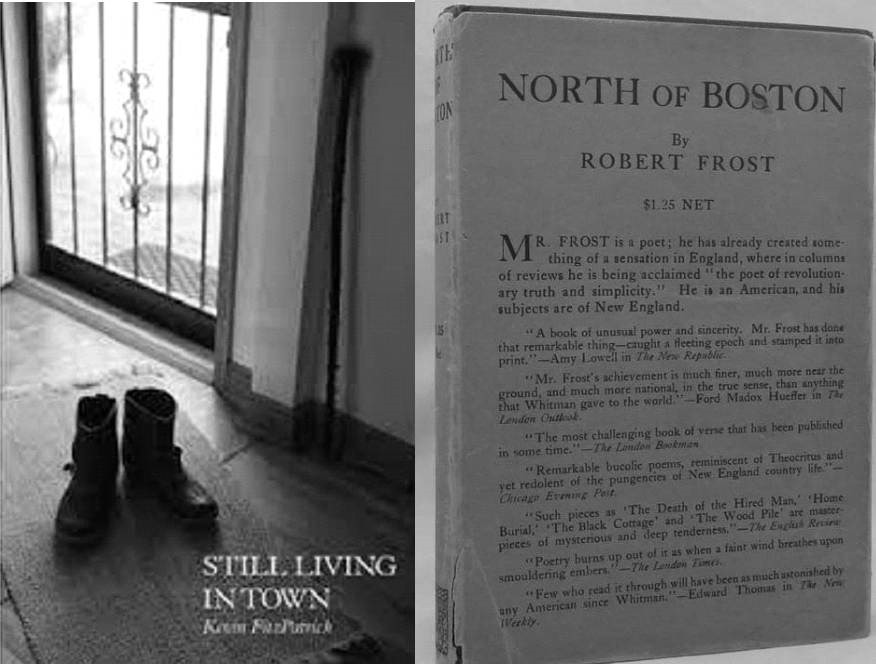
Still Living In Town and North of Boston

FitzPatrick’s publisher, Midwest Villages & Voices, doesn’t distribute online, but this link contains an ISBN and other info that may help you obtain a copy from your local book store or library. Then this other guy, Frost, has books available  too.

.

3. After Apple Picking by Robert Frost.  Unlike our other Frost poem in this autumn’s Top Ten, the metaphysical “Bond and Free,”  you can feel this one. Particularly as Kevin began to spend his weekends working at his life-partner’s rural farm, I could see kinship between FitzPatrick and Frost. Both were drier than a Minnesota winter’s static humidity, both liked to observe human outlooks critically, and both of them could give you some of the tang of work tied to nature. I’m not sure if lifetime farmers are likely to write a poem like this, but someone coming to that work from something else, as Frost and FitzPatrick did, has the outsiders’ advantage of fresh observation.

When I presented this poem last month I thought about dedicating it straight out to Paul Deaton, who’s blog I’ve read for the past few years, in part to catch up on his accounts of small-format food farming, sometimes mentioning apple trees and orchards. But I wasn’t certain how well it fits anything Paul experiences. The apple trees of my youth were tall enough that ladders would be required, but the orchards I saw biking around Bayfield this fall have quite short trees, the kind where an adult would stand flat-footed to pick the fruit.

But maybe I should have gone ahead. Even though this poem has specifics, even to what aches after work, it’s about finishing a task. When another blogger I read: professor, editor, and author Lesley Wheeler wrote of getting to the final stage of a book-length manuscript, I thought of how I felt after finishing a manuscript decades ago. That same “Well, I probably missed a few, but I’m done  with apple picking now.”

Player gadget below for some, this highlighted hyperlink for the rest of you to hear my performance of Robert Frost’s “After Apple Picking.”

.

This post has gone long, though with things I wanted to say. Our next post will break from our usual Top Ten countdown, as it will deal with both the most popular piece, and the runner up, and I’ll talk more about poet Ethna McKiernan.

.

*More than once I’d say to Kevin “If I had had the idea to write something from this same material that you used, I’d have written a short story.”  I remember once Ethna took me sharply to task for saying that, admonishing me that Kevin was writing a narrative poem. She misunderstood me, for I knew and admired that. Mixing into a short poem, with its almost unavoidable lyric immediacy and compression, with narrative elements sometimes even including a Joycean epiphany, is not easy. Once or twice, so taken with the story in one of Kevin’s poems I attempted to craft a short story from the same material, to demonstrate my point — and yet I could never complete one of those attempts. Kevin’s poetry may look unshowy, but it’s not easy to duplicate.

**Several years ago, Kevin and Minneapolis folk/blues revival pioneer Dave Ray of Koerner Ray and Glover engaged in a little side-bar about meter in Blues lyrics, with Kevin scanning their iambics. Kevin played a little blues harp, and Ray and Kevin’s dad were both in the insurance business.

***Kevin also boxed, and not in a warehouse way. He once wrote a poem which had as significant line “The boxer slugs!” Dave Moore’s punishing wit, after dealing with a lengthy group discussion about if that line would be misunderstood, was spurred to write an entire song about a garden beset by invasive…wait for it…”boxer slugs.”

Fall 2021 Parlando Project Top Ten, numbers 7-5

Let’s continue our Top Ten countdown of those pieces that you liked and listened to the most this autumn. Regular readers here may not be surprised that death features in some way in each of today’s three poems, as illnesses, infirmities — and yes, folks I’ve known a long time dying — have been part of the year for me.

Everyone that dies or is limited by infirmities is a lesson, one you listen to more richly and intently as you get older. It’s a lesson that makes me press immediately against what limits age has put on me, gives me a sense to use what I have presently before it’s gone. Oh, I am sad that I’ll not hear Kevin or Ethna’s voices again, except in memory or recordings — thin mirrors those. Dave reminds me that it reminds him when I post older LYL Band recordings where he was able to pound and roll the keys. Our family continues to deal with my wife’s mother descending, as politely as she can carry it, into dementia. But those that go before us are meant to teach us. Don’t skip the lessons.

Why Now, Vocalissimus  by Frank Hudson. When I posted this audio piece, shortly after I wrote it, I said right out I wasn’t sure what I meant by it. That state may be unnerving for a writer. After all, aren’t you supposed to know? If you don’t know, how can you present anything vividly to the reader or listener?

Well, there’s a theoretical structure, a mythological structure, that seeks to explain that. It says that we are conduits for muses, external things. We don’t have to be outstandingly worthy, exceptionally preceptive, or precisely eloquent, since we are in this scheme conduits of something outside us. Frankly, this can lead to a lot of bad poetry: inchoate self-expression bearing the costume of inspiration. But then everything leads to bad poetry — all artists fail as I remind readers here often. But what of us readers, us listeners? We fail too, grasping partially what much art conveys.

My understanding of what I wrote back in September has grown as I live with this set of words. Part of our job as living, breathing artists is to carry forward the work of those who’ve left off working. We are not just creators, but also carriers. So, if you write poetry, bring words down onto the page or speak your own words, know that I’m charging you to also preserve and enliven those others who have no voices left to carry the spark. And that’s what I try to do here with the Parlando Project.

My performance of “Why Now, Vocalissimus”  is available below with a graphical player. Don’t see it? Then his highlighted hyperlink.

.

Heidi Randen’s picture of a milkweed husk spoke to me this autumn.

.

6. The Shadow on the Stone by Thomas Hardy.  A complicated ghost story, a complicated haunting. As I wrote when posting this, English poet Thomas Hardy had a dysfunctional marriage — and yet, like many folks forced by fact into the separation of death and mourning, he still felt the returning presence of the intimate dead.

I rather liked the music I composed and played for this one. It has a weird loping groove that I find attractive. To hear the performance, some will see the player, and the others can use this highlighted hyperlink.

.

5. God Made Mud by Kurt Vonnegut.  I decided to present several short excerpts from Vonnegut novels that work as poetry this fall on the occasion of the 99th anniversary of his birth. The LYL Band had recorded them well over a decade ago, on the week Vonnegut died. Why didn’t I wait for the nice, round 100-year birthday? See the start of this post for why.

In Vonnegut’s novel Cat’s Cradle  the text I used here is the last rights of an imagined religion. Like the theoretical/mythological structure of muses directing us to write poetry, Vonnegut proposes a useful if compressed Genesis story that asks us to recognize that the nagging mystery of death is no harder to explain than the overlooked mystery of living at all.

Yes, player gadget below for some, and this highlighted hyperlink for others to hear it too.

.

Halfway through this fall’s Top Ten. The rest will be posted here soon.

Reynardine

Are you familiar with the song “Reynardine?”  You might be. It’s been performed by many of the best performers in the modern folk revival: Anne Briggs, Fairport Convention, John Renbourn, June Tabor, Bert Jansch and others.*  Today as I extend our Halloween series, I’m going to introduce you to a version of the song you haven’t heard, a version that I’ll maintain uses more efficient and effective methods to convey an air of mystery. There’s supposition that this version may have been an indirect catalyst in the way the song you may know was presented, but this little-known version’s lyrics are so good that singers should consider using them in contemporary performances.

Where did I find this new version of “Reynardine?”   In the 1909 book of collected poetry by Irish poet Seosamh MacCathmhaoil (AKA Joseph Campbell) titled The Mountainy Singer.

I’ve spent a day or so in hurried research on this, even though long-time readers (or readers of our last post for that matter) will know that Joseph Campbell** has been of interest to me for a couple of years now. Here’s the shortest version of what I know that I can make.

Songs related to “Reynardine”  go back to the early 19th century in the British Isles and the U.S. Wikipedia gives us a representative early (1814) example, and this helpful page gives us a catalog of later 20th century versions. The older versions sometimes vary the name of the title character and contain no supernatural elements. The typical plot is a broadside ballad variation of what is still a staple romance-story trope: a woman meets an erotic stranger who she thinks may be disreputable and possibly stranger/dangerous — but who also may be wealthy or noble (Reynardine claims to have a castle in most versions.)  Over several verses there may be Victorian code-words like “kisses” and “fainting,” and the title man may leave the lady wondering where he’s run off to.

Skip forward to the early 20th century: in 1909 (the same year that Campbell as MacCathmhaoil publishes “The Mountainy Singer”)  a musicologist Herbert Hughes publishes the first volume in a series of successful song collections titled Irish Country Songs.  A great many songs that will be featured in Celtic and general folk-revival recordings, performances, and song anthologies are included in Hughes series of books.*** Hughes’ printed version of “Reynardine”  is shorter than most extant versions, a verse and a once-repeated refrain, and it’s even called a “Fragment of Ulster Ballad.” In a footnote at the bottom there is this note, unsupported by any of this song’s lyrics:

In the locality where I obtained this fragment Reynardine is known as the name of a faery that changes into the shape of a fox. -Ed.”

A century-old song, with many collected versions, and this is the first time that “Reynardine”  is said to have supernatural elements. Where did Hughes get this? I don’t have a direct link, but there is our version of “Reynardine,”  published in the same year by the Ulster-native Campbell who is not credited on Hughes’ score, though Campbell/ MacCathmhaoil is  credited in at least two other songs in Hughes’ Irish Country Songs.  The supposition is that Campbell is either “the locality” — or that Hughes and Campbell shared a traditional source which has left no extant song version that indicated to both of them that Reynardine is a supernatural creature.

Hughes' Irish Country Songs version of Reynardine

Footnotes! Pretty scary boys and girls! Herbert Hughes’ songbook presentation of Reynardine that likely changed how the song was viewed.

.

Did some of the later 20th century folk revival singers know of this footnote? Possibly. One highly influential revivalist A. L. Lloyd sang a version that included at times a remark that Reynardine had notable teeth which shined. In pre-dental-care England this detail may have been enough supernatural evidence. Furthermore, he wrote of the were-fox context in liner notes more than once 50-70 years ago which led other performers to explain the song that way, either as their own subtext or to audiences.

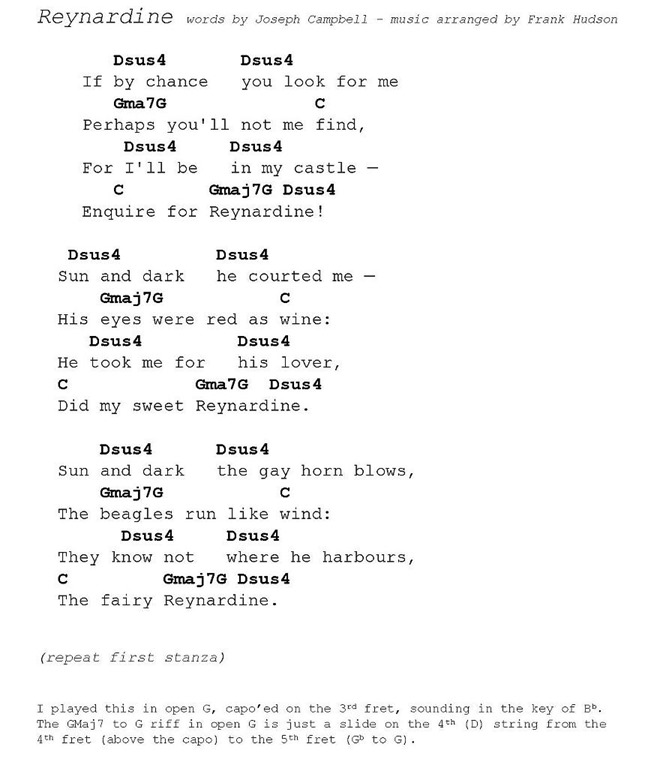
But here’s another mystery — and I’m saying, a useful one — why isn’t Campbell’s version of “Reynardine”  known and sung? Let’s look at it. The chords here are the ones I fingered, though I used Open G tuning and I formed the chords while capoing at the 3rd fret, so it sounds in the key of Bb. But the music “Reynardine” is sung to isn’t harmonically complicated (you could simplify the chords), and a better singer than I could better line out the attractive tune used by myself and most performers. ****

Reynardine Song

I made one change to Campbell’s masterfully compressed 1909 lyric. I use the more instantly recognizable, less antique word “lover” where Campbell had the easy to mishear “leman.”

.

Poets and lyricists: this is a marvel. No need of footnotes or spoken “this song is about…” intros. The supernatural element is subtly but clearly introduced. The refrained first stanza was as published by Hughes, and is commonly sung in modern versions. The second makes the bold move of changing a folk-song readymade where some damsel’s lips are found to be “red as wine” with an animalistic short-sharp-shock of Reynardine’s “eyes were red as wine.” The third stanza lets us know he can be a fox in form, subject to fox hunters with the brief but specific statements of the horn and hounds. Another subtle thing: Campbell repeats the “sun and dark” all-day-and-all-of-the-night lyrical motif to tell us this isn’t an ordinary fox hunt scheduled for seasonable days befitting rich people’s leisure, but a 24-hour emergency. The hunters know this fox isn’t normal. The refrained first verse reminds us that the lover may know that the were-fox can also take a human form, and make use of human defenses, such as castles, which the assiduous hunters do not.

As a page poem this has the vivid compression that Imagism preached. Compare the efficiency of this story-telling to “La Belle Dame sans Merci”  which has its sensuous pleasures, yes, but takes it’s time getting to the point. The two poems convey essentially the same tale, but Campbell can leave us with an equally mysterious effect using so few and aptly chosen words.

There’s a player below for some of you to hear my example of a performance of Joseph Campbell/ Seosamh MacCathmhaoil’s “Reynardine.”   Those who don’t see it can use this highlighted hyperlink instead.

Hopefully, I haven’t put any of you off with my own footnotes about this song’s unusual history and transformation. If you skipped to the end, here once more is my message today:

If you perform this sort of material, consider using Campbell’s lyrics instead of those you may have heard from other singers. They’re that good.”

.

*And more recently in a softly lovely version by Isobel Campbell, formerly of Belle and Sebastian.

**Obligatory statement: no, not the Power of Myth  guy. I suppose it could be worse, Campbell could have been named James Joyce or Sinead O’Connor, and confused us too.

***Besides “Reynardine,”  Vol. 1 includes another popular folk-revival song, erroneously considered to have wholly traditional lyrics: “She Moved Through the Fair”  which Hughes’ correctly credits lyrically to Irish poet Padraic Colum.

****I was somewhat working from a very rough memory of Bert Jansch’s version on his Rosemary Lane  LP. It’s a good thing I was rushing this and didn’t stop to listen to Jansch — his version is an acoustic guitar tour de force. If you’d like one performance to demonstrate why I, and many acoustic guitarists, revere his playing, that would be a good choice.

Until Memory is Only Forgotten

Just last month I was writing here about how alternate Parlando voice Dave Moore and I used to perform pieces live and unrehearsed. Infirmities, personal matters, and a little thing called the Covid-19 epidemic meant we haven’t been able to do that for 18 months — but today we did that again.

Rusty? Yes. We’ve always been rough and ready, which means we persevered today because we love our common attempts at spontaneous performance, even though your ears will be spared most of them. Personally, I’m overjoyed to hear Dave’s keyboards mixing in with my guitars again. Perfect or imperfect is another, subsidiary, matter.

Here’s the very first piece we performed today, using for a text one of the sonnets I’ve written this year about infirmities. My sonnet, “Until Memory is Only Forgotten,”  tells about an older woman with Alzheimer’s disease which has removed, and is removing, many of the layers of her memory, and who is traveling from the Memory Care Unit where she is presently living to visit siblings back in the farming community where she grew up.

Jerseys!

Pictures of the Gone World. The young woman who raised blue ribbon dairy cows.

.

Long time readers here will know this Project normally features us presenting and performing texts by other authors, but since summer tends to bring in a smaller audience, I may be using more of our own texts when I can find time to present work here this season.

I chose to tell this woman’s story without following a time-line, because as with memory (even a degraded one) the scenes aren’t linear. Dave and I repeat some motifs in our playing, just as the subject of the poem sees different crops in the fields and can only see corn and speak again to her daughter-driver of that crop; yet in unmarred memory she recalls her Jersey dairy cows like the other Memory Care Unit resident who can still tout his Holsteins. Structurally this is a free-verse sonnet, though I think the old patterns of iambic pentameter remain rustling distantly in the fields.

Until Memory 800

Here’s the sonnet used as the text for today’s audio piece.

.

The player gadget to hear The LYL Band performance of “Until Memory is Only Forgotten”  will appear below for some of you. If you don’t see it, you haven’t forgotten, you’re just reading this in a mode or reader that won’t show such things. That’s OK, this highlighted hyperlink will also play the performance.

I’m not a scholar, but I play one on the Internet

Let me write a post about something that I experienced recently, just like a real blog would do.

Early this month I attended a virtual symposium Sonnets from the American  organized by Dora Malech and Laura T. Smith.*  I’ve heard “Zoom Fatigue” is a thing now, but I found it energizing. I’m still integrating things from this experience, but here are a few preliminary things this three-day program brought forward.

There’s still a lot to be discovered out there for me.  Even when I saw the listing of sessions, I came upon the subject of Fredrick Tuckerman’s poetry, a name that I’d never heard, and someone who was certainly not part of the American Lit canon in my mid-century day. I can see why he’s a fascinating subject, and the simplest thing I can say about his biography is one could quick-take him as “a male Emily Dickinson.” Similar locations, times, and period of social isolation. I’ve read a few of his sonnets, and so far they aren’t grabbing me, but then that may be me. I’ve been quite distracted as this difficult year has progressed.

Americans don’t mind messing with the sonnet form.  I started writing sonnets around age 20 or so. It was the first poetry form I cottoned to, and the only one that I’ve ever practiced much. There’s something about the length of 14 lines, long enough for a contrasting pair of lyric statements, but not so long as to ask the reader to maintain the mind-meld intensity lyric poetry asks for past endurance. The venerated Petrarchan and English/Shakespearean forms have mechanisms that have been established to work, and I wrote close to the form to start. I recall writing a crown of English sonnets as a 20 year old in a barracks on a fair grounds, but mostly since then I’ve wanted to see how many variations I can create inside the 14 line form, while at the same time worrying that I was cheating by not being faithful enough to it.

In session after session I learned from scholars that Americans not only brought a different sensibility to the matter of their sonnets, but that they didn’t mind morphing the form too. And why not, after all the Elizabethans didn’t just clone the Italian form.

I’m pretty sure I’m not up to snuff as a scholar, but I like running into scholarship.  Compared to any scholar (and many avid readers) I’m under-read. I’ve perhaps read more poetry than a few, but I’ve read many fewer novels than almost any serious literature person, and I’ve got lots of holes in contemporary poetry that this project doesn’t help me in remediating. And at my age, there’s also the “I read it fifty-years ago” factor. The younger scholars at the event had a reasonable retention of what they had read, perhaps more than I have read in my longer time. Is there a minimum amount of poetry one has to have read to have a significant interaction with it? I’m unsure. But what the scholars presenting at the event brought to this is new outlooks, new connections. In my modest, under-read way, this is what I try to do here.

To non-scholars who read this, if you think (perhaps put off by scholarly terminology or personal educational experiences) that scholars have dissected poetry only from corpses, the Sonnets from the American  event let me see the real enthusiasms that are out there.

Just this month I’ve noticed that the Royal Holloway, University of London seems to have linked to some thing or things I’ve written here. The referrers link lets me know that folks are coming here via that institution, but the referring links are behind a staff/student login, so I don’t know what. I’m not sure if that’s a blessing. I might be embarrassed by what I wrote!

There are more light-skinned people writing about Afro-American poetry.  I’m a hybrid music and poetry guy, this shouldn’t have surprised me. While this is a complex and delicate subject which cannot help but interact with wider social forces and existential injustices that this post cannot even begin to cover, in my 20th century Afro-Americans tended to write (where they had the opportunity) about current or recent generations of Afro-American music, and white writers, performers, and impresarios did a lot of the noticed work in reviving interest and applying attention to older Afro-American musical artists and forms. This is changing in the 21st century.**

Again, there can’t help but be an overlay of the American racial caste system here, but my observation, blinkered as it may be, is that this factor still exists in music scholarship and non-institutional enthusiasm.

Now this project is enjoined by practicalities and by copyright law to concentrate on pre-1925 texts, which means that my interests in Afro-American poetry must make do with a shorter list of authors, but the Sonnets from the American event had plenty to interest me there. I could fill my dance card with presenters who’d have something to say about Paul Laurence Dunbar, Claude McKay, and Jean Toomer. One of my favorite pieces I’ve presented here, Toomer’s remarkable Modernist love poem “Her Lips are Copper Wire,”  a 12-liner that works like a sonnet, got mentioned in several sessions I attended. Another personal favorite of mine, Fenton Johnson, got a shout out in question time at another.

I don’t want to give a misleading impression here. There were people of color presenting at this event and presenting important insights, but in the current isolation of my project I could think I was the only white guy whose interests in “Other Peoples Stories” included Black Americans as well as Elizabethans, Tang Dynasty Chinese, South Asians, various early Modernists, some French-speaking guys, and sundry 19th century library stack dwellers.

Negro sharecropper and two wagehands shucking corn for the landlord, a white woman. On road to Cedar Grove, west of highway No. 14, Orange County, North Carolina, Sept 1939

Different tunes, same words:  “Happy Harvest” or “Maggies Farm

Since I’ve written this instead of working on new audio pieces, I’ll leave you with a piece I did last autumn, Paul Laurence Dunbar’s poem “October.”  Dunbar, the first successful Afro-American poet, emerging late in the 19th century, wrote in several styles: dialect poetry that I find hard to read and impossible to present, competent variations of late 19th century literary poetry and subjects, and a handful of poems speaking about the experience of an American Black man in an era when the promise of freedom was decaying steadily into a new era’s variation of denial of humanity. It’s those last poems, small as the number may be in his work, that he is most remembered for now. But what about this one? On the face of it, this is a harvest poem, a “happy autumn” number taking joy in the last bounty of fall.

It works entirely on that level. I’m not enough of a scholar to tell you if Dunbar ever expressed any other intent in writing it.

Now, listen to or read the poem again. Published in 1913, when large numbers of Afro-Americans were trapped in a feudal agricultural share-cropping system, where harvest’s bounty went to the white landowner and their family. I can’t unread the subtext here.  My performance of Dunbar’s “October”  can be heard with the player gadget you should find below.

.

*I found out about this symposium via writer/editor/professor Lesley Wheeler. A big thanks to her for that! Wheeler’s own presentation at the event was on sonnets with radically short lines, a variation that I hadn’t thought of or tried.

**And wait a few years, and any fresh Afro-American musical innovation will get adopted by white musicians. I’m an American musician—most of the notes are Black. This blog started out largely focusing on the early 20th century Modernist poetry revolution, part of a multi-art-form change. Fenton Johnson’s poetry and Toomer’s Cain  are public domain examples of Afro-American Modernist poetic work from this era that I’ve run into so far, though maybe there are others yet for me to find. But, but, but, if one asks the question: “Where are the pre-1925 Afro-American Modernists?” all you have to do is look to poetry’s sister art music and the blind will see.

Fall 2019 Parlando Top Ten, numbers 10-8

It’s time to look back on the past season and to look once more at the most listened to and liked pieces over that time. We do this in the classic count-down method, moving from the 10th most popular to the most popular piece.

This time I’m going to link to the original post each time so that you can read the longer discussion of my encounter with the text, but if you’d just like to hear the recordings of the performance of the poems, the player gadget following each listing will do that.

10. October by Paul Laurence Dunbar.  When something makes these count-down lists it’s often hard to know if it’s the inherent interest in the author, the things I wrote in the post introducing the poem, or the qualities of the musical piece and its performance that account for that. In this case I think it could be a bit of all three. I wrote in my post about what I thought was an undertone in this seemingly happy autumn poem. Was that a misreading? I’m not sure, but it informed my solemn musical performance which may work even if you don’t share my sense of this supple poem.


9. Saint (Cecilia) by Stéphane Mallarmé.  I do generally get a good response to my translations from languages other than English, which encourages me to continue them here. This one was a real bear to wrestle with, and my post on it went into detail with the kind of problems I encountered in that process.

I highly recommend translation as an exercise for poets. Not only do you need to achieve a Vulcan “mind meld” with another artist when translating them, but the mental muscles activated to find the best English word in sense and sound are great ones to develop for one’s own writing.


Rilke Mallarme and Dunbar

Three poets awaiting the invention of the MacBook and the modern coffee shop with WiFi: Rilke, Mallarmé., and Dunbar.


8. Autumn Day by Rainer Maria Rilke.  Another translation that received good response this fall. Here I ascribe a substantial portion of that response to those looking for and appreciating Rilke poems, and finding some here. Of course, there may be many reasons for that desire to seek out Rilke, but I’m under the casual impression that he’s treasured for what seem to be life lessons to his readers. I noted in my post on this poem that it’s been a particularly popular target for translators, but you still may want to look at mine, or hear the way I performed it.

This poem of his is also an example of a theme: gardens and small agriculture, that I returned to again and again this fall. Perhaps it’s my own position in life’s passage that caused that, but there are a good number of autumn poems that are both about the experience of “cultivating one’s garden” and the valence of the ending of a growing season. Such is Rilke’s.


One day there is of the series: Emily Dickinson’s Thanksgiving, sort of

Did you know that Emily Dickinson wrote a Thanksgiving poem? It’s not one of her “Greatest Hits” or anything, but it does represent a couple of Dickinsonian traits: skeptical humor and puzzling philosophical concision. You can read the text of it here as I discuss my encounter with it.

Dickinson didn’t use titles, and the first line, our entry into the poem, starts off with a strange tentativeness. What’s the series? All the days of our lives, of history? Or a series of holidays? I suspect the last, in that the next line throws up the American holiday inside quotes. It’s hard not to read “Thanksgiving Day” in Dickinson’s text without intonating the words with “air quotes,” that at least slightly dismissive way of saying “Well, you can call it that  if you want.”

I’m not a Dickinson scholar but I get the impression that Dickinson uses quotes literally—that is, when she’s quoting someone*—but there is a sense here of our modern manner in the poems first half. And as the poem continues, its opening comments could be written this week by someone musing on the holiday. Yup, Thanksgiving is a strange mix: part a big meal, a gluttonous celebration; and part memories of worshiping dissenter pilgrims and family. And Dickinson, in her thirties as she wrote her poem, notes she’s not sitting at the kids table nor is she some honored elder closer to the pilgrims than the present. So, outsider in a middle place, she says she’ll post a review, from her “Hooded thinking.”

Maybe you’re visualizing The Handmaids Tale  when you read “Hooded.” I think Dickinson is taking a bit of a religious acolyte’s stance in her review, even if playfully. Her two-word review: “Reflex Holiday.” You’re just going through the motions she seems to be saying.

Emily Dickinson family portrait

One won’t get a turkey drumstick: Emily Dickinson on the left with her siblings.


The poem could end there, but Dickinson takes off in the second half in gnomic concision. This is often beautiful as word music, but it’s hard to follow her mind.

What’s the sharp subtraction for the early sum? A falling away from religious immediacy? Mankind’s fall from grace? Forgetting the history or piety of the holiday? The next two lines are even more weird. What the heck does “Not an acre or a Caption/Where was once a Room” mean? This is Dickinson the hermetic riddler. I’ve rolled that couplet around in my head for a week and it always slips from my grasp.

The tossed pebble wrinkling the sea lines have a Blakean tone. Here the mystic Dickinson is plain as any mystic can be in words: our lives, our actions, are small against creation—just visible, just for so long. Her final couplet seems to say that our thanks, our Reflex Holiday, is insufficient to the gift. This realization combined with the reflex action is, in a way, a more sublime and awe-some thanks.

What an odd poem! It starts out witty and lightly skeptical and (as best as I can figure it) closes on a humble mysticism.

Musically, I tried to hew to the mystery, if a strange resonant piano and wavery synth can portray that. The player is below. Thanks for reading and listening!


*If she is quoting a person, it may well be Sarah Hale, a New England journalist who campaigned for the importance of a Thanksgiving holiday during Dickinson’s day.

Elizabeth at Woodstock

I like to mix things up with this project, presenting Poetry’s Greatest Hits but also less-known poems and poets too. One oddity is that two of the most popular pieces here over the past four years have been by unknown poets known rather as heads of state: a teenage love poem by George Washington and a lament from Abraham Lincoln.

History is unavoidably entangled with literature, so I’m often pleased to present poems that are personal witnesses to history. Today’s piece uses three texts written by Queen Elizabeth I of England, or rather by a young princess who wasn’t queen at the time of their writing, but was instead a political prisoner.

As someone who grew up in the U.S. I didn’t have a good grasp of British history for most of my life. Over the years I’ve picked up bits and pieces, but one element that I discovered was the degree to which that the era surrounding the vigorous birth of English literature was a dangerous, violent, unstable political situation. And the woman who would give her name to that era, was not protected from those horrors.

The story is complex, here’s the best brief summary I can come up with. Europe had been in the throes of religious-affiliated warfare between Catholics and the Protestant wings of Christianity mixed in with the usual imperial cross-conflicts for some time. Elizabeth’s father, Henry VIII had moved England into the Protestant camp largely so that he could divorce his wife and marry the woman who would be Elizabeth’s mother. That new Queen eventually was executed as Henry VIII moved on through his infamous marital history. At Henry’s death, his young male child and heir Edward became king in name, but with an adult Protector running the country, but that protector’s brother sought to marry the teenage Elizabeth and take over. That plot failed, and the Protector’s brother was beheaded.

On the sickly Edward’s death at age 15, Elizabeth’s older half-sister Mary (daughter of Henry VIII’s first, divorced, queen) became ruler of England, and she switched the country back to the Catholic side. Every time the state religion changed, suppression of the other religion occurred, and plots from the outs faction against the new establishment were rife.

Elizabeth was, on paper, next in the line of succession at this point, but aligned with the Protestants. This barely protected her and made her a target at the same time. And in 1554 a Protestant plot that aimed to unseat Mary and put Elizabeth in her place was discovered. Elizabeth was now 21, some suspected her being a participant, not just a pawn being moved surreptitiously to the queen’s row on the chessboard, and once more executions will be going forward for the discovered plotters.

Elizabeth was taken to the Tower of London. Her imprisonment began, interrogation was in store, even torture and execution were possible.

After several months in the Tower, a compromise was reached between those who wished to rid Queen Mary of the plausible rival and those that thought it better to not martyr Elizabeth. She was shipped off to a disused old castle, Woodstock, away from the court and other plotters. It could be said she was now at a royal palace, not the Tower where traitors were imprisoned and executed. In reality, she was still imprisoned, kept in the half-ruined castle’s gatehouse under guard.

The story goes that today’s poem was written in charcoal on the interior wall of that gatehouse by the imprisoned princess. As a poem it’s also a political statement, a rather clever one at that. On its face it’s not addressed to those who’ve imprisoned her, rather it’s addressed to impersonal fortune, fate. Like a candidate sticking to the message, she’s not charging her Queen and half-sister with being behind this, but she is calling out injustice. She’s not issuing a call to overthrow the government, but only slyly praying in conclusion that a just God may send “to my foes all that they have thought.”

In today’s performance I’ve framed that poem written on a prison wall with two other shorter texts: a couplet titled “In Defiance of Fortune”  and an ending: three lines scratched into the glass of a window pane in the gatehouse by a diamond, an even starker statement by a political prisoner.

Musically, I’ve been thinking of The Byrds, and so it was time to break out the electric 12-string. I even thought of punning off the title of the half-ruined castle that Elizabeth was imprisoned at by referring to Joni Mitchell’s “Woodstock”  musically—but in the end there is only an echo of that song’s chord progression left in my music.

There are more stories in the swerving era of revolution and counter revolution, secret police and royal executions. Elizabeth’s eventual reign doesn’t end the religiously affiliated plots. After her death and a new Protestant king, one of the last serious Catholic-affiliated plots against the government ends when Guy Fawkes is found watching over some great store of gunpowder in a crypt under the parliament building. An English holiday is born, celebrated on November 5th: a burlesque of treason or revolution, suitable for children. Effigies are burned, there are taffy apples, and fireworks smell in loud colors.

Guy_Fawkes_arrested

Arrest, torture, head on a pike, then centuries as the but of holiday villainy. Only Alan Moore can save him now!


Of course it was deadly serious for Fawkes, ready to kill in defense of his oppressed religion, and deadly serious for the government, ready to execute him for such a plan. Someone—do we call them Fortuna or God—had a joke to tell us. As Fawkes was led up the execution platform, he tripped, fell off the platform, and broke his neck. History, like literature, has so many sad stories, some uplifting ones, and then again some jokes.

To hear Elizabeth’s prison poem performed, use the player below. Want to read the texts and a few other poems attributed to Elizabeth, they are available here.*


*I found out about these most directly Elizabethan poems over at the Interesting Literature blog. Highly recommended.

Blue Undershirts

Long time readers/listeners here know I like to look for the Modernist outliers and less-remembered poets, and today we have one of those: Orrick Johns. But as a bonus, today’s piece by Johns likely influenced one of the most famous American short modernist poems. So, we’re only one remove from “poetry’s greatest hits” with “Blue Undershirts.”

Orrick Johns has a Wikipedia page, but the project classifies it as “stub class,” and the article’s lead sentence claiming that Johns was part of “the literary group that included T. S. Eliot, F. Scott Fitzgerald, and Ernest Hemingway*” seems misleading to me from what little I know so far. If what the author of that meant was that Johns is a Modernist of the first generation, that would be correct, though he was not a novelist of note, nor a Lost Generation exile in Europe or (as far as I know) a close friend and artistic confidant of that trio.

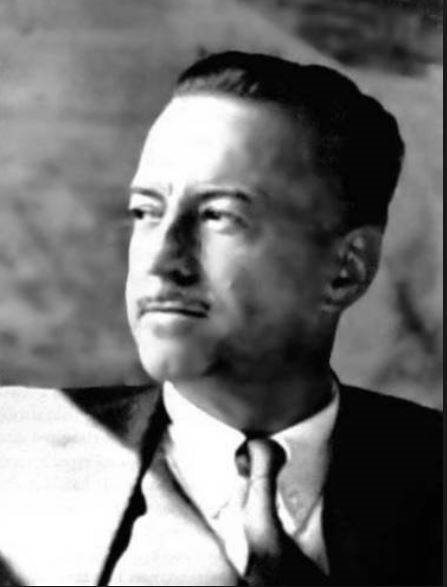
Orrick_Johns

The only picture I can find of Orrick Jones


Like Eliot, Johns was born in St. Louis, but I haven’t found any direct connection between them in my brief research. He did know St. Louis’ other most noteworthy poet of Eliot’s generation, Sara Teasdale though. If for no other reason that he was present in Greenwich Village in New York City during the early part of the 20th Century, he does turn and touch many other American Modernists. He eventually became a member of the American Communist Party later in the century, which no doubt connected him with others of that time who thought that a remedy for the crisis of capitalism, fascism and racism.

But for today, let’s look at how he and his little-known poem connects with William Carlos Williams. In 1915 Williams and Alfred Kreymborg were involved with Others: A Magazine of the New Verse,  a New Jersey headquartered, NYC-area journal that published many of the East Coast modernists. In its first year one of those published was Orrick Johns and a series of short poems in the then Modernist/Imagist style he called “Olives.”  Imagists were somewhat fond of small, mundane one-word objects as labels for poem series. Kreymborg called his own 1916 collection “Mushrooms,”  and so we know what the two of them would have ordered if they stopped off for pizza.**

There’s an element of provocation in “Olives,”  and though I don’t know John’s writing and outlook well, I can’t help but read a sense of humor in them. Some read as if they could be parodies of Imagist poems, even though Others,  being thoroughly Modernist, was in favor of Imagism.

Here’s the third poem in the “Olives”  sequence:

Oh, beautiful mind,

I lost it

In a lot of frying pans

And calendars and carpets

And beer bottles…

Oh, my beautiful mind!

That could be as serious as a modern Instagram poem, or it could be Don Marquis’ laughingstock fictional free-verse poet Fothergil Finch or Ficke, Seiffert and Bynner’s invented Spectrist characters’ work from 1916-17. Was there a meta/double-ness intended? In 1917 Others  published a “special issue” devoted to Ficke, Seiffert and Bynner’s Spectrist hoax “new poetic movement” poems. When the hoax was revealed, many Modernists like the Others group took the stance that these old-school poets had freed their minds when they wrote as invented authors with intent to mock the new styles.

Despite the caricatures of Modernist detractors, many early Modernists liked to make fun of themselves and recognized the outrageousness of what they were experimenting with. Was “Olives”  a Dada statement: “Look, this ephemera is as worthwhile as some long-winded, pro-forma imitation of Keats or Tennyson. At least it’s clearly of today, and doesn’t ask you to pretend to be some knight or medieval Latin scholar?” Or was Johns writing as best he could in the Imagist style, which valued stripping away fripperies and outdated metaphors, and presenting objects in a charged moment of time?

My best guess is both. And I could be wrong, even wrong twice.***

Here’s the piece I used today from “Olives,”  titled there “Blue Undershirts:”

Blue undershirts,

Upon a line,

It is not necessary to say to you

Anything about it—

What they do,

What they might do…blue undershirts

Does this sound like a famous William Carlos Williams poem?**** Did Amazon mess up your order for t-shirts, color: blue, sending you a red wheelbarrow instead—and what—there are white chickens in the box? I guess that’s what the air holes were for, even if they let some rain in when it was sitting on your doorstep.

Williams and Johns were both part of the Others circle, and there is the mysterious appearance of the first four lines of “Blue Undershirts”  quoted in Williams’ 1920 prologue to Kora in Hell  in the context of Williams claiming that Others  founder Alfred Kreymborg is superior to T. S. Eliot, because Williams observes that Eliot is too much recapitulating the past where Kreymborg and Williams believe:

“Nothing is good save the new. If a thing have novelty it stands intrinsically beside every other work of artistic excellence. If it have not that, no loveliness or heroic proportion or grand manner will save it. It will not be saved above all by an attenuated intellectuality.”

While writing this prologue, did Williams think that “Blue Undershirts”  was a Kreymborg poem? I can’t say, but that he prefers those lines of Johns to “Prufrock”  and Eliot says something by way of example.

So, in 1923 did William Carlos Williams have “Blue Undershirts”  in mind as he wrote “The Red Wheelbarrow?”  Again, I can’t say. Williams was already well versed in compressed Imagist writing and speaking in a plain American idiom, and the Others  circle was close enough that I’m sure all kinds of informal interchange occurred. From an abstract of his paper, it appears that Mark Hanna sees “Red Wheelbarrow”  as consciously seeking to be a version 2.0 improvement on Johns’ less graceful and vivid poem. That sounds plausible to me and detracts not at all from Williams’ achievement. Art isn’t a contest, and no amount of “Top 10 lists,” prizes, or “greatest” evaluations can make it so, but “The Red Wheelbarrow”  does give me subjectively more rewards than “Blue Undershirts.” Still, that doesn’t reduce the audacity of Orrick Johns doing “Blue Undershirts”  first.

When I performed “The Red Wheelbarrow”  I composed music using a 12-tone row based on one Modernist musical structure. In my performance of Orrick Johns’ “Blue Undershirts” I worked superficially with George Russell’s Lydian Chromatic Concept of Tonal Organization. Please know that you should stress the “superficially” in that sentence. Russell’s theory is substantial, and while I once had dreams of trying to study it, at my age I know What it does/What it might do…is, well, blue undershirts. The player is below.


*And I’m part of the musical cluster that included Prince, Bob Dylan, Garrison Keillor, Husker Du, Sharon Isbin and the Replacements. Technically true, but misleading as a claim of significance on my part.

**Ezra Pound published Canzoni  in 1911. He was paying tribute to medieval songs back then, but a careless listener could mistake that for Ezra’s own order at the pizza joint.

***Johns remained fond of the “Olives”  series, republishing a selection from the 1915 “Olives”  as “Tunings”  in his 1920 book Black Branches.

****The connection between the two poems was first pointed out by Mark Hanna in a scholarly paper in 2010. Alas, that paper doesn’t seem to be accessible to me, but Hanna has this poetry explorer’s admiration for making this connection. I can imagine him doing a Cortez in Darien leap when he found it.

The Parlando Winter 2018-19 Top Ten part 3

Should I stop for a moment in our count-down of the most liked and listened to pieces this past winter to describe briefly what the Parlando Project is? After all, there are always new people coming upon this stuff.

What we do is take various people’s words, mostly poetry, and we combine them in various ways with original music. The music too is not one style. Sometimes we sing the words, but not always, or even usually. Sometimes we read them or chant them or talk-sing them. Singing gives a particular effect to the words, and though I admire many examples of art-song, including some examples that use the same texts that I’ve used, I think there are other facets of the poetry that can be shown with other performance styles.

I wish we had more modern or semi-modern poetry here, but very soon in this project I determined that the effort to obtain the rights to creatively engage with work still in copyright protection would reduce the amount of encounters we could produce.

Limits and restrictions often engender creativity though. I’ve found that being largely restricted to the pre-1923 public domain world still allows me centuries of material to pour over, and there seem to be a great many under-appreciated and forgotten writers to discover. A lot of what I end up using is work from the first part of the 20th century, the Modernists that established the world of literature we are still continuing and reacting to. It’s been fascinating to experience this early formative time of Modernism by adapting and performing their words.

Now let’s return to our countdown with numbers 4, 3, and 2 in popularity this winter. Yes, they’re all early-20th century Modernists. And one poet takes two slots in the countdown today.

4. A Winter’s Tale.  D. H. Lawrence is another novelist who was also a poet. In my youth he was probably better known for his novels, and their spicy rep in the mid-century world no doubt helped his youthful readership. I recall reading some Lawrence poems in the sixties and I remember liking them then, but I have to say that my interest in them didn’t continue. Now in this project, in this century, I’ve run into him again. The Imagists who kicked off British literary Modernism considered him one of them.

I liked this poem of his, even though I still can’t say for sure what’s going on in it, but we often can forgive that in the context of music and words. My musical setting for an early 20th century poem kind of took some small inspiration from the late 20th century music of Mark Hollis (of Talk Talk) who died last month.


D H Lawrence in Mexico 1923

D. H. Lawrence asks “Is that a Mexican poncho, or is that a Sears poncho?”


3. Gacela of the Dark Death.  Here’s another work that I translated into English myself for presentation here, a poem of passion and wit from Spanish poet Federico Garcia Lorca. I actually first heard this poem as part of a project that attempted to do something like what the Parlando Project does: Joan Baez and Peter Schickele’s 1968 LP Baptism.  Baez read Stephen Spender’s translation of Lorca’s poem earnestly there, and the poem’s title would lead one to read it as sorrowful. As I translated Lorca’s Spanish I sensed a more playful and mocking attitude in some of the images, and my performance tries to bring that out from my translation. As part of conveying the emotional range of the piece, I sang the opening and closing sections while speaking the middle of the poem—an example of how singing and speaking words changes the experience of them.


Baptism back cover

Baez and Schickele do Parlando 51 years ago


2. Self-Pity. D. H. Lawrence again, but a different kind of poem from “A Winter’s Tale.”  Shorter, and superficially an Imagist poem, it so clearly makes its “no whining” point that it was once used in a film by a drill sergeant. Poetry that makes straightforward self-improvement/empowerment points was not that common in early Modernism, and it’s not the usual way to literary cred these days either. I’m not sure why that would have to be. There’s an audience that likes it, and the 19th Century revered some poets who plied lessons like this poem does, although usually with many more words and stanzas. My best guess is that artists, particularly now in an era when literary poetry is something of an outsider art, like novelty and rebelliousness too much to settle for earnest self-improvement.

Well, this poem isn’t one of my favorites, but you know something: I need its message some days as much as anyone. I may have worked extra hard on the music I wrote and performed for it to compensate for that.


So what will be the most popular piece from last winter? I’ll be back soon to reveal that.