That Summer Feeling

I could, maybe should, write about a number of things this weekend. The end of May brings Memorial Day, one of the United States’ two holidays celebrating those who served in the armed forces, the spring version being more focused on those who died in wartime duty. It also brings to mind the anniversary of the drawn-out, agonizing death of George Floyd a few blocks from where I’m writing this. I think of that little group of South Minneapolis people, ordinary citizens of my neighborhood, who witnessed it, who pleaded with the police officers to cease their officiousness. I think of the new policemen in that squad, earnestly following the lead of their trainer who’d arrived, the man with his knee on Floyd’s neck. Duty.

Duty is a small word, but one that we have two holidays to honor. We generally respect it, and in small and large ways we carry duties through our days. My wife does in her workdays what I did for a couple of decades, taking on the duty of helping the sick. In between workdays she takes on the obligations to her mother suffering from increasing Alzheimer’s in a care home.

I’ve written about all those things here. I could write at length about them here tonight. In doing so I could say I am following my obligations to humanity, to those who suffer, to those who’ve lost. We use poetry often to decorate those tasks, more often perhaps than we use the more capricious song to do so. Thus I could write, and you might view it as your duty to read that.

Instead, I’ve been filled this month with the realization that this is my teenager’s last summer as a teenager. They’ve concluded an indifferent year of post-secondary education, and now have taken their first job. As to next Fall plans: they are thinking of stopping with school, saving money from the job, and moving out. Studying seems like a duty — their work-a-day job does too, but maybe it’s a more novel duty, or at least one that has a biweekly award of a paycheck.

Music is a key to memory, particularly emotional memory to me. During these feelings this May, I came upon a performance of a song by Jonathan Richman. Richman has an utterly strange career. He’s one of those you might see called a cult artist, which means those who “get” him sometimes puzzle those who don’t, but also it means that many who read this won’t know his work at all. As a teenager Richman became something of a Velvet Underground* superfan, and his early work shows direct influence of Lou Reed’s songwriting. In the early 70s he and his band The Modern Lovers recorded more than a dozen tunes that prefigured a lot of what was to come in Punk and Indie rock a few years later, but the recordings were not issued when they were made. Then in 1976, when the first stirrings of Punk were drawing attention, they came out along with newer recordings.

Here’s complexity to that odd: the old, early 70s songs and recordings were unvarnished, and they followed Reed’s model of being emotionally honest, but their timbres and approach would be in tune with some of the vanguard of what was called Punk at that time. The newer songs were even more childlike, though no longer being written by a teenager or recent teenage time-emigrant, and the sonics were quieter, even more stripped back. As his career continued, Richman generally proceeded down that path, writing ever more childlike songs focused on everyday wonderment. If his early singing called on some of Lou Reed’s snarl and assertion, the later work took on elements of 50s Do-Wop teenage innocent sweetness.**  Richman in a sense started out before his time, had a recording career launch when his early work seemed of the moment, and then continued until the present day as a singer-songwriter presenting the impression of coming from a place that was younger and younger.

The song I heard while thinking of my teenager at the borderline, “That Summer Feeling,”  was sung by a 40 something Richman a couple of decades into that career. On Richman’s record the Do-Wop influence is apparent, backing harmonies and call and response from additional voices. Compared to the version you can hear below, there are more verses, more detail of youthful specifics. Blind to the career history I’ve summed up above, you might easily think someone about 19 or 20 recorded it, fresh with passing through that borderland.

Here’s the intuitive choice I made when I decided to quickly work up a cover of “That Summer Feeling:”  to record it more in the style of the early 70s The Modern Lovers recordings than the “mature” Jonathan Richman. If I had more time, I would have overdubbed a garage rock guitar solo at the end or maybe some combo rock’n’roll organ as those records sometimes had. Following my taste, I preferred the songs less specific but most summer-set verses.***  This musical change and the way I sang the lyrics also brings out more of the undercurrent in this song, a complexity that a casual listen to a more smoothly produced recording might let one overlook. The singer isn’t just doing a let’s remember our youth story here. He warns in slightly mutating refrains that that youth will haunt you, and then he pleads with the (presumably teenage) listener to not wait until they’re older to, what — it’s not entirely clear — somehow integrate that duty-free time’s outlook fully into oneself or it won’t just haunt you, it’ll taunt  you, and finally it will hurt  you “the rest of your life.”

Would any kid ever listen to that message? Doubtful. My fatherhood duty knows limits, even counterproductive effects, of advice. Still, I wanted to sing it anyway.

After the jumps of this Memorial Day post, I won’t make the proforma Memorial Day holiday wishes. Some will be decorating graves. Some will be thinking of how life was disregarded. Some are caring for the sick and infirm. Some will be having cookouts or taking a little vacation trip away from work. Black joy, worker’s rest, flopping down in the grass without any duty, playing or listening to music. We honor duty. Let us also honor some respite from it.


Here’s my performance of Richman’s song.

.

*As many writers do, I must reiterate the Eno quote about how only a few thousand bought the first Velvet Underground record — but that everyone who did went out and started a band. Historians have determined that the record actually had decent sales, but Richman is one of the early examples of direct VU influence. The early Modern Lovers band included folks who would go on to being in The Talking Heads and The Cars.

**The small vocal ensemble 1950 style of urban teenage music that got called Do-Wop was often written by teenagers or near teenagers — and like the Punk, Rap or Indie music that followed later, it was inexpensive and approachable to create for the kids who made it. Arch cultural critics and satirists-in-song Lou Reed and Frank Zappa both appreciated it, thought it honest in its innocence. Punk founders Patti Smith and Lenny Kaye met because Smith loved an appreciation of Do-Wop that Kaye had published. I on the other hand have vocal limitations that keep me from indulging in the style.

***I am struck by the specific the song takes in one verse where it goes from singing swimming ponds and cool lawns to a traffic stop. I don’t think Richman meant to make that an existential moment, even if our modern gun-soaked life might make it seem so now.
Happy May Day to the workers in song

It was quite the April for me, and I’m resting up today before getting on with a bunch of tasks I’ve put off while working on the accelerated posting schedule for National Poetry Month. Readership was up substantially, busiest month ever for visitors at this blog, and page views blew past the old record by over a thousand. I should be better at replying to your comments and encouragement, but besides being focused on the work I have a mental Catch 22 where I often can’t decide the best way to respond, and in that indecision put off responding.

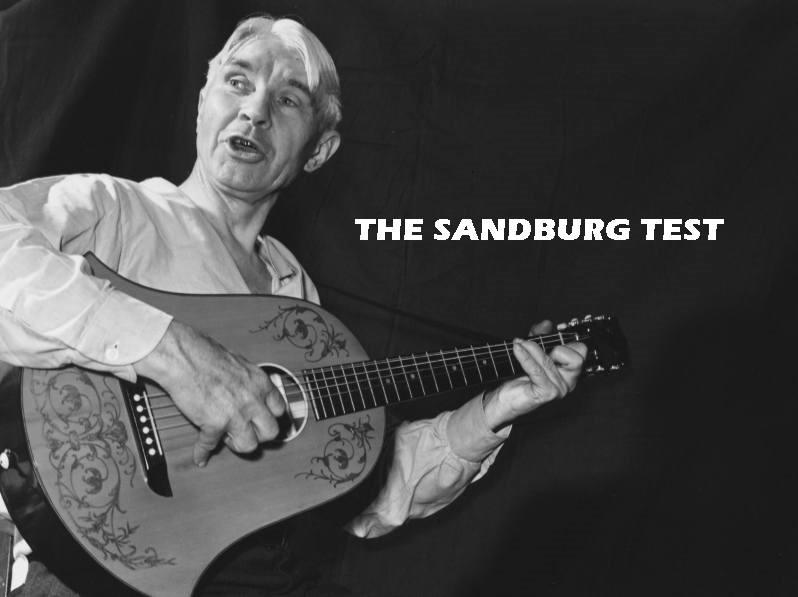
Car Sandburg - The Sandburg Test

.

I didn’t put anything new for International Workers Day today, but I’ll repost this piece with Carl Sandburg’s words from his longer poem “The Windy City”  that I created for last autumn’s U. S. Labor Day. In posting it last year I suggested something I had bounced off my old compatriots in The Lake Street Writer’s Group, something I call “The Sandburg Test.”

Let me suggest a rough analog of the Bechtel Test.  Let me call it The Sandburg Test. To be clear, it’s not my suggestion that every poem has to be about work, about the things we do for our daily bread. But, if we are viewing an anthology or substantial poetry collection from a poet, to pass The Sandburg Test it has to have poems that deal with work in some substantial way. How does the speaker or characters in the poem relate to work? What are they doing that work for? What is it in presenting them that portrays something about life? What are the mysteries, sensations, and systems of that work?

Here’s that musical performance of Sandburg’s words from “The Windy City” accessible with the graphical audio player you should see below. No player to been seen?  This highlighted link is an alternative.

.

Singing at Dusk

A three-part post today — let’s see how short I can keep it, though we’re going to go far. Read on and we’ll leap from an important artistic movement whose poetry is forgotten, to the case of the odd filtering out of a woman artist from that movement, to some notes about translation and musical composition — and in the end to a remarkable trick, an April Fools’ joke of a sort I played on myself unconsciously.

Canons

It’s weird sometimes trying to figure out whose work gets remembered. It’s too much to ask for there to be some fair-minded, objective, and well-informed process of experts weighing the canon as our caissons go rolling along. Instead, quality and salience is supposed to just emerge. Emerge from what? Taken, via circular reasoning, from that memory. This sort of works, though how we know how well it’s working is hard to explain, as it may not consider those we aren’t as a culture considering. Canons have always changed — it’s ahistorical to say they haven’t, and when did we agree that history stops?

Dada poets are under-considered — or if they are, it’s as a conceptual statement more than a considered poetry. Visual arts will always include a Dada piece when discussing Modernism, literary arts are much less certain to. Dada’s evolution into Surrealism makes it almost easier to leave out Dada poetry. Dada poetry can be seen as the rough demonstration, the provocation that initiates a disruption.

My idea of presenting a Dada piece today comes out of an idea as question I had:  “What can I do for April Fools’ Day?” Dada can be seen as an April Fools’ Joke. How so? Let me invent a manifesto of Dada that no Dadaist is likely to earnestly write as it violates the concept of Dada:

Much of what we’ve been given as meaningful can be seen in the human predicament as useless, maybe even harmful. Yet, we’re constantly being fooled with the trappings of power and precedent. Arbitrary examples of meaning, truth, and rules, dressed in the right costumes, framed in the expected way, keep us susceptible. So let us show how the trick is played and laugh at its absurdity.

Art Movement — and also the structure of an April Fools’ Joke.

Therefore, Dada presented poetry — a literary form we believe must be meaningful because it’s beautiful — that was random, perverse, taking the forms and frames of meaning while eschewing that meaning. Surrealism later posited meaning — or perhaps more exactly, the experience of art including poetry — as being above and beyond logical, conventional rationalizations, but the way was cleared by Dada’s withering can(n)on-fire that made merciless sport of the idea of hierarchical poetic meaning.

Still, we’re more comfortable with the idea of looking at the urinal/fountain or bicycle handlebars above a bike seat and seeing a worthwhile experience than we are looking at a series of chaotic words uttered incongruously as poetry. The first is a gentle poke in the ribs, it can easily elicit a pleasurable “See that?” The second worries us more, how should we take this? And the connection of denotative meaning (even an elusive one) that we rely on to carry us through an assemblage of words, is it indispensable? Is reader/listener boredom a legitimate artistic response, or one we’ll long endure?

The questions in some Dada poetry are valuable. The answers, not always so.

Emmy Hennings, forgotten because she was a Dadaist and because she wasn’t a Dadaist

Earlier this week I set myself a task to look at some Dada poetry to see what I could present here. I came upon a handful of poems by a name I believed I’d never seen: Emmy Hennings. I’ve retrospectively rechecked a couple of books I’ve read on Dada/Surrealism and I found my memory faulty. Hennings’ name was  mentioned, but the context of those mentions didn’t make her seem anything like a key player. She was the partner and wife of Hugo Ball, a big macher in Dada, and consigned as a peripheral helper/muse/hanger-on. She did perform (from the very first Cabaret Voltaire performance!) but she was often characterized as a “music hall performer,” the kind of conventional entertainment that wasn’t what Dada was about. The supposition was put forward by the avant-garde that she was an interloper tempting Ball and the Cabaret away from real Dada into some kind of bourgeois, conventional performance career.

On further examination, there’s a case that she’s been underestimated.

Emma Hennings 1913

Just kids. 1913, three years before the Cabaret Voltaire, but Emmy looks to me here like this could have been taken in 1975.

.

Looking over her poetry in a handful of human translations and quickie machine translations from her native German, I was immediately drawn in. It showed that essential Dada tactic as stated many years later by American Dada composer Frank Zappa: “Anything Anytime Anyplace For No Reason At All.” It also contained German Expressionist poverty-stricken darkness — and yes too, an element of erotic romanticism, though in the context that element was being set in place against the rest, implying criticism of it. Downrating her including music hall and folk song in her Cabaret Voltaire performances would seem to leave-out the case for Hennings consciously creating a Dada collage. If you put disparate things together as part of Zappa’s AAAFNRAA, those elements will talk to each other when viewed as one thing.

Here’s a secret factor most artists remain loath to admit: the random, or even the most carefully constructed miss-matches, can generate meaningful perception in the human mind. Yet Hennings didn’t write unalloyed gibberish, though outlandish collisions were allowed. She sometimes writes in a manner I recognize from later Surrealism — although from a woman’s mind and experience, a vantage point the Surrealists were loath to admit into their boy’s clubhouse.

Reading more about Hennings, I could see a rich collage of biographic and aesthetic components to her art.* I tried to sum that up to my wife by describing my emerging conception of Hennings as “A WWI sort-of Nick Cave: dark outlook, opiate addiction but hard working, catholic mysticism encrusted, mixed with elements of power-observing romantic eroticism.”

Want to know more? A very informative summary evaluation of Emmy Hemmings I found in my reading is linked here.

Making today’s musical piece, a Dada experience

I already had a rough performance mix of the musical composition used for today’s piece before any of these Dada and April Fools’ ideas. I composed it using four new “virtual instruments”**  that were newly available to me: a viola da gamba, a hardanger fiddle, a singing voice, and something that called itself a dulcimer.

I love bowed strings, and the somewhat rare and archaic viola da gamba is one that has long interested me, an interest that was sustained by once having a co-worker who played the instrument. The VI is a bit harsher sounding than hers (she used period correct gut strings and a softer bowing attack) but I used it to play the low-end lines in today’s piece.

The hardanger fiddle is a Norwegian folk-variation that uses sympathetic drone strings to add persistent, powerful overtones to the those actually fingered on the fretboard. A musical hero of mine, guitarist Steve Tibbetts once recorded an entire album featuring the instrument. My honest summary: I love drone, I love Tibbetts, my wife would testify I must love Norwegian-Americans, but I found it hard to take the sound of the hardanger for the length of an album — my reaction is similar to how some people experience bagpipe music. I also like sour tunings and harmony, but still that was my reaction. Dada being my goal, I went against sweetness however, and there’s a brief hardanger section in the middle of the piece.

By far the predominant sound in today’s music is from the VI that calls itself a dulcimer. I play the American mountain dulcimer a little bit. It’s a gentle diatonic scale instrument associated with American British Isles immigrants who settled in rural Appalachia,  usually played by women as a quiet solo accompaniment for singing. This VI’s sound is nothing like anything I’ve played on mountain dulcimer. A demonstrator for the company that sells the VI says it sounds more like a lute. I’d expand that to say any of the oud variations or maybe even a mandolin family instrument. I treated its sound with a lot of reverb, so it’s more Coleridge’s opium dream Abyssinian maid dulcimer than some rustic American in a lone cabin.

The last thing I added to what was an otherwise vocal-less piece at this point: a high, keening VI voice. The human singing voice is something that VIs don’t yet allow easy access to. Perhaps eventually the ability for an easily available VI to sing all the components in human sung language will emerge, but for now what they do quickest is singing vowel-rich syllables. This VI went beyond the usual Oohs and Aahs with what sounded like nonsense words in no certain language. I hadn’t made the connection yet, but nonsense words are another part of Dada.***

So, on completion of the realized composition I surprised myself — I had what I then saw as a Dada piece without starting out with any such intent. That led me to seek out Dada poetry, and then to find and translate Emmy Hennings’ poetry to meld with my music.

“Singing at Dusk”  is one of the few Hennings poems that has English translations I could find, but I made my own fresh translation. I followed a priority that guides my translations: determine what the images are in the original language and construct a contemporary English language way to convey those images. Since that is my primary goal, I will take liberties with the original’s sentence structure and wording. At times (and this happens here in this translation) I’ll even change the matter of the image in search of vividness. This latter choice is a historical fault, and I feel conflicted about it, but as I continue to translate, I catch other more renowned translators, resorting to it. Because I wanted a compelling sound to match up with the rather insistent music it was to mesh with, I also (uncharacteristically for my translations) decided to impose a rhyme scheme along with some other sound elements for this translation, which further caused me to depart from Hennings’ original. That kind of mutation to serve a form or rhyme scheme is another thing I catch other translators doing. Due to these choices, the result is partway between an earnest attempt a poetic translation and an “after a poem by” variation.

Singing at Dusk

This version is a looser translation aimed for the needs of today’s performance

.

If it’s Dada, how much of this matters? It could, maybe should, be nonsense syllables, a random whatever. However, I didn’t find Hennings’ poem in the original German to be nonsense. Dedicated to her husband, Hugo Ball, it strikes me in German — and perhaps even more so in my looser translation — as a critical look at romance and marriage/partnership from a woman’s standpoint. Another element I bring out in my translation is the immigrant/exile experience. The originating Dadaists were from various countries, holed up in Switzerland, with a World War raging around them. They were writing work in German and French and a smattering of other languages, when those languages were being spoken in opposing trenches. National rootlessness was endemic in Dadaism, both as a choice and a fate.

Here’s the promised final observation: those keening nonsense words I generated from a VI played on my little plastic keyboard resolve at the end to something that I suddenly realized sounded very much like a woman singing “Jawohl.” What! They were just vocalese syllables, abstract sounds when I chose them — and they remained so for the dozens of times I’d listened to those passages, played even before I chose a German language poet to translate. Was that a trick of the ear? Here it was, the night-time, I was going to bed after a long day working on this piece. I was listening to this singing at dusk, and inside my earbuds I hear this voice loudly singing the German word for the certain and absolute “Yes.”

Will you have my experience with this musical piece? I can’t say, but you can hear it with the audio player below. No player?  This highlighted link will open a new tab with its own audio player.

.

*Like some other Dadaists, she was a hyphenate: she wrote poetry, prose, sang, danced, made and performed with puppets, painted.

**A virtual instrument (VI) is a playable instrument made up of multiple samples (most often taken from a microphone in a recording studio placed on the “real thing”) of the various notes, ranges, and articulations of an actual instrument. One plays the VI by using a controller (a keyboard or perhaps a guitar with a MIDI pickup) that controls the notes played, or by scoring the music and selecting how that score should be played. This is a much more atomized use of sampling than the other kind of sampling that uses recorded snippets (often several bars long) of already recorded music afterward triggered to create musical beds and motifs in modern hip hop/rap music. The latter is another use of collage: thank Dada again.

Obviously, the tactile experience and idiosyncratic techniques of the real instrument cannot be brought over, but the results are increasingly convincing, at least to casual listeners. For composers without grant patronage or large exploitable friend networks, it’s a godsend. Even when the exact sound of a musician and acoustic instrument in the room isn’t produced, a musical something can be.

***The most famous Dada poem in any form known to modern English speakers is the Talking Heads song “I Zimbra.”  When he presented it during his American Utopia  theater piece, composer David Byrne explained that he adapted the vaguely foreign-sounding lyrics from a Dada nonsense-word poem by Hugo Ball, the partner of today’s poet Hennings.

Cool Tombs

It’s been too long since I’ve presented a poem by Carl Sandburg here, and awhile since I had the time to make one of my “punk orchestral” pieces accompanying one of the poems.

Carl first.  Unlike Frost (birthday boy today, happy birthday Robert!) I appreciated Carl Sandburg as a young person. A poem like today’s “Cool Tombs”  doesn’t appear to truck with irony or express its perceptions subtly. It appears to say what it means to say. Those schoolchildren sure that poets and their literature teacher accomplices are seeking to make fools of us dense and under-lived students can rest easy with what this poem seems to be. Here’s a link to the full text of the poem, if you’d like to follow along.

I’ve made my point elsewhere in this Project that Sandburg, likely with intent, had other poetic modes. Like Frost (which Sandburg was once considered a peer to in literary merit) he’s always plain enough speaking that one can be fooled into thinking his thoughts are always straightforward. Read quickly enough, seeing only the plain-talking, “Cool Tombs”  has just one thing to establish: that our selves lose and are left-loose from our deaths. Great accomplishments, great enemies, great failures — eventually, nothing.

Where’s the ambiguity? Where’s the deep reading that great poems reward?

My answer, my reading of Sandburg here, is that is to be found in American history — that history a denser poem full of every Empsonian ambiguity — and Sandburg clearly is roping in American history here.   Are his choices incidental/accidental? Well, they do include things that disappear, even if like love they remain inescapable, returning things.

Other than American historians, few readers today will understand what a “copperhead” is referring to when Sandburg speaks of Lincoln, other than perhaps knowing it as a species of poisonous snake. That it was, and is — but in the American Civil War those in the North opposed to fighting the secessionist slave-holding rebels took to using an incised liberty head carved out of the mid-19th century American penny coin as an emblem of their sentiments. If you reach into your pocket now and note who’s on the current copper penny, you’ll see the head of Lincoln.*  Did history write some irony there?

Civil War hero and post-war President Grant suffered from corruption among businessmen in and surrounding his administration, details now lesser-known outside of historians today. The Sandburg that wrote this poem, ex-political operative and then still daily newspaperman, knew that government corruption hadn’t disappeared conceptually. Perhaps he also knew that Grant intended to — to some degree did — try to set up a fairer settlement to those newly emancipated from slavery. In the cool tombs of history, perhaps we remember Lincoln and Grant for those efforts, even if imperfect and eventually abandoned, they were.

Pocahontas’ story, as much as can be deduced from records and oral histories, is complex, and subject from the beginning to substantial romanticization by English settlers.**  An indigenous American, she married an early English-American settler, and legends of this marriage and other friendliness of Pocahontas to the English settlers are the prime reason she became a historical character to the eventual conquerors. From the First Nations standpoint, one can easily see this story rests on a vibrating matrix of love, coercion, or treason. As her story leads into Sandburg’s voice claiming for the lovers in the concluding section, perhaps Sandburg holds primarily for the first of that trio — but he and I were not there, we cannot really tell. I also don’t know Sandburg’s intent, but the previous two situations are suffused with crimes and evil: slavery, murder, corruption, and greed. Is Pocahontas’ story contrast or continuance? The poem’s text allows either reading. Perhaps the fairest reading, the one that was in my sense as I read it, is that Pocahontas’ love was tragic given how the conquest continued with so much killing and subjugation. Note too that Sandburg says a hail-the-conquering-hero parade (perhaps to the tomb?) should be examined as a vainglorious exercise.

Lincoln, Grant, Pocahontas cool tombs

Lincoln’s tomb in Illinois, Grant’s tomb in New York, and Pocahontas’ burial site in England.

.

Is all this external exegesis based on unintended things that I’m artificially assigning to a simple or at least single-minded poem? Most modern academic readers of Frost understand him to be a poet comfortable with intentionally invoking subtext. Certainly, if this were a set of incidents in a T. S. Eliot poem with reference to metaphysical poetry, with passages in Latin and Greek referencing classical history and legend, we’d know he wanted us to consider those connections.***

But Sandburg? I’d caricaturize my sense of how Sandburg’s viewed today like this: he’s written off as a superficial popularizer of unremarkable intellect and talents. He fooled some folks earlier in the 20th century into thinking there was something there, but now we have a better vantage point.

I obviously don’t see it that way. I could be mistaken — in which case it’ll be forgotten in the cool tombs.

Carl Sandburg's grave

Carl Sandburg’s grave in Illinois. Not so grand, but it also asks us to add history to the grave. There’s a little plaque on the footing bearing the legend “For it could be a place to come and remember.”

.

Alas, now again I spent more time spent writing on the words, leaving less time for the music. I recently had enough energy and assured time to try to do something with a larger group of orchestral instruments. Let me be brief. I wrote this originally as a non-harmonized melody, but transformed it into a harmonized piano part via some software that extracts harmonic ideas from a monophonic line, choosing the one that interested me the most, and tweaking it from there. The piano part then became the orchestration by another translational process of placing the piano’s range of notes with various other instruments.

If I had the focused energy or assured time, this could be a movement of a larger piece with other themes, variations, contrasts in color — but that doesn’t fit my life. I’ve come to call these short pieces, often expressing a simple musical idea by whatever means I can bring to hand “punk orchestral.” You can hear the recording of my performance of Sandburg’s words with this orchestral music using the audio player gadget you see below. No player?  This highlighted link will open a new tab with its own audio player.

..

*That liberty head cent had been replaced with a new design just as Lincoln was elected, though still in circulation. The new 1859 design replaced the classical liberty head profile with what? An American Indian in native feathered headdress. The current Lincoln profile penny was adopted in 1909, less than a decade before Sandburg wrote his poem.

**A couple of obscure horticultural details occur in the Pocahontas section. “red haw” is a tree that produces a crab-apple in Autumn. So too is the pawpaw, a fruit widely raised and eaten by native Americans. Sandburg oddly refers to the “pawpaw in May” which would not be a sweet, edible fruiting time for the plant in North America. Is there intentional metaphor there, or a mistake?

***I don’t know if Sandburg had this poem by Thomas Campion, which in turn was a loose translation of Catullus — but the lovers getting as much as they can while tomb-wise element was brought to mind as I newly considered Sandburg’s tomb poem.

Two Aunties: Fenton Johnson’s transition to Modernist free verse

There’s a great deal that remains unknown about the poet I’ve been featuring here this month: Fenton Johnson — but then again, there are some things that I’ve been able to learn about him since I first began performing his poetry as part of this Parlando Project in 2018. Today’s piece, though late in my month-long series on this pioneer American Black poet, comes around to where I first encountered Johnson: as a Modernist, free-verse poet.

The previous posts this month are from two book-length collections Johnson published in 1913 and 1915. While it’s only speculation, it’s not uncommon for poets to collect work done over a few years, particularly for a first book. Accounts I’ve read say Johnson wrote poetry (and at least one locally produced play) while a student, so it’s plausible that some of the poems included in his poetry books could have been written even earlier in the century. English-language Modernist poetry started to be published around 1909. Within the next decade we see new forms begin to spread out based on concision, fresh imagery, unusual or prismatic scene-focus, and freer and non-regular rhyme and meter. Americans are conspicuous in this new movement. In 1912 Ezra Pound published his famous ultra-short poem “In a Station of the Metro.”   Living overseas, Pound starts promoting the new style as the foreign editor for the new Poetry  magazine, and he submits to them short poems by Hilda Doolittle (freshly renamed as H. D.)  In 1913 Pound and F. S. Flint compile “A Few Don’ts by an Imagiste”  which was published as a manifesto of the new style in Poetry. The next year Midwesterners Carl Sandburg started publishing the new free-verse style in Chicago and Edgar Lee Masters placed his initial Spoon River epitaph poems in Reedy’s Mirror out of St. Louis. In 1915, T. S. Eliot, another American ex-pat, publishes Prufock, and in New York a young poet Alfred Kreymborg gathers his friends to start a small literary magazine explicitly dedicated to the new forms. He titles it, in honor of the insurgent outsiders, “Others.” These others included William Carlos Williams, Wallace Stevens, Marianne Moore, Man Ray, Mina Loy, Orrick Johns, and Lola Ridge, all of whom were U.S. East Coast based. Also in Others:  Pound, Sandburg, and Eliot — and eventually, our Black man from Chicago, Fenton Johnson.

If Fenton Johnson is lesser-known, it’s possible he’d be on an even greater level of historical obscurity if he hadn’t been published in Others.  Sitting here in 2024, I can retroactively maintain that some poems from Johnson’s books of 1913 and 1915 are proto-Modernist through using Afro-American oral and musical forms, even though the bulk of his books are like the poems I shared early this month: poems in 19th century forms.* From what I can see, Johnson’s work came to the attention of New York based Afro-American focused cultural critics and anthologists not because of those two book collections, but because of how strikingly different this 1919 free-verse little-magazine published poetry was, and the visibility of the cutting-edge Others  to NYC-based critics. When James Weldon Johnson created his first-of-its-kind collection The Book Of American Negro Poetry  in 1922 he included several poems by Fenton Johnson — but instead of the paragraph or two praising their strengths offered for many of the poets in his introduction, he says only this: “Fenton Johnson is a young poet of the ultra-modern school who gives promise of greater work than he has yet done.**” I read that hands-off briefness as meaning “Well, he’s doing something different, some are noting that, so I include him.” Despite that lack of enthusiasm by this early Black anthologist, one of the included poems, “Tired,”  has become Fenton Johnson’s most anthologized poem — the one that to this day is included in many Afro-American poetry anthologies. Besides being an early Afro-American to write in free verse, “Tired’s” prominence and Johnson’s mysteriousness has also given Johnson the air of a fierce political radical. In the next post in this series, I’ll tell you what I’ve found out about that.

Since it’s such a striking poem, and because “Tired’s”  free verse has become the predominant literary poetic style as the century progressed, that mode of Johnson’s poetry remains fixed in cultural memory to represent him. You can view a “lyric video” of my musical performance of “Tired”  at this link.  All of Johnson’s 1919 Others  poems (eight in total) are also in free verse, and today I’ll present two of them combined in one performance: short poetic portraits of a pair of older Black women that would be invisible to the society and the culture. “Others” indeed.

Fenton Johnson Two Aunties

Here’s how the two poems appeared in the February 1919 issue of Others

.

This time my accompanying ensemble is a rock quintet. You can hear it with the audio player gadget likely available below. No player? This highlighted link is a backup, and if you click it, it will open a new tab with its own audio player.

.

*Other Afro-American poets retained traditional metrical-syllabic and rhyming prosody used by Johnson’s original model Paul Laurence Dunbar. Jamaican Claude McKay who moved to the US after WWI published excellent formal verse, as did the younger poet Countee Cullen. Other less-remembered Black poets of this WWI through the 1920’s era worked largely in the older, established prosody. Just as Fenton Johnson was early in adapting Afro-American preaching and musical styles into his poetry, his early use of free verse predates the Harlem Renaissance.

**In a later 1931 edition there are apparently more extensive remarks by Johnson on Johnson, but I have yet to find anything other than excerpted quotes — but from those excerpts it seems James Weldon Johnson was troubled by what he saw as radicalism and despair in Fenton Johnson’s poetry.

Two Houses on the Blue Ridge Mountains

While visiting western North Carolina this month I toured two houses built in the 19th century, each high on hilltops overlooking the mountains surrounding them. My mind likes to link things, I couldn’t help but look at them as a pair.

The first house was named Connemara by an owner that lived there in between the man who had it built and the man whose shade I’d come to visit. The man who had it built was Christopher Memminger who had enslaved workers to build it. Memminger eventually became the Confederacy’s Secretary of the Treasury, so he must have known something about money and the slavery that helped accumulate it.* The later owner was a poet and writer who somehow found his own words remunerative enough to afford it, Carl Sandburg. Sandburg was said to have found the place a bit baronial for a socialist poet, at least on first sight — but his beloved wife wanted temperate pastureland for her dairy goat herd, and this place had that. She’d helped and stood by Carl through his unlikely rise from hoboing between short-lived work, to being an aide to a mayor of Milwaukee, to daily journalism in Chicago, to becoming a prize-winning poet and multi-volume biographer of Lincoln.

The second house is Biltmore, built for George Vanderbilt II. If you know your Gilded Age, the Vanderbilts were likely the first great fortune family of enormous wealth in 19th century America. Brief accounts I’ve read of him don’t make him sound like someone all that interested in business or growing wealth. He was bookish, a bit shy — but also very rich and looking to use that wealth to put his mark on things, to enclose his life in the best as he saw it. If one wonders at the two socialist second-generation immigrants living in the large farmhouse of Connemara, Vanderbilt’s house makes that place look like an outbuilding. Biltmore’s not just bigger, it’s thought to be the biggest residence ever built in the United States, with around 4 acres of floor space beneath huge high-vaulted common rooms. The estate surrounding it was over 100,000 acres, and Vanderbilt had it landscaped by Frederick Law Olmsted, the man who had worked on a much smaller canvas with the 800 acres of New York City’s Central Park.

The mix of manicured and wild seeming landscape is beautiful in the Olmsted manner. We biked along a trail through 8 miles of it, past lagoons and along the banks of the French Broad river —and as we rolled over a wood-rimed rise down past a pasture I was delighted to see three hawks at tree-top level swooping over us, so low that the shadows of one passed over me rolling beneath them.

The two houses have similarities, if not in scale. Both Carl and George were packrats, though at the wealth level of a Vanderbilt, it’s called being an art collector. The Sandburg house was donated to the US government just after Carl’s death. His wife and two live-in adult children packed up as if going on vacation and left the house for residence in Asheville. The Park Service has maintained it ever since in Marie Celeste ghost-ship-shape. One of Carl’s cigar butts sits in an ashtray on the set-for-a-meal dinner table. Piles of books and magazines cover many surfaces as if they were just set down this week. Sandburg has thousands of books in bookcases everywhere around the house, and there are busts of Carl and his long-term subject Lincoln, art photographs by his wife’s brother Edward Steichen, and scattered knickknacks. Vanderbilt had even more thousands of books, all stored in a large floor-to-two-story-high ceiling library room, all arranged with leather and gilt bindings a-plenty. Life-size John Singer Sargent portraits abound and above giant elaborately surrounded fireplaces. Hallways are hung their entire length with framed etchings. Large Flemish tapestries showing Biblical virtues completely cover walls of a big room. Servants kept it all clean and ordered then, and that’s how it’s displayed now.

libraries

Sandburg Clutter

Vanderbilt Biltmore Library and a Sandburg bookshelf. Some Sandburg clutter.

.

The mood of the two places, as I sensed it, was very different however. Biltmore seemed dark, and though some of that was likely due to preservation of valued pieces from bright lights, both my wife and I had simultaneous Citizen Kane thoughts by the large tables and giant fireplaces. She nudged me and asked if I’d like to put together a jigsaw puzzle. In contrast, the Sandburg house seemed domestic in a familiar way to me. The metal handles on the hand-touch-patinaed Sandburg kitchen cabinets — chrome ones fluted like a Pontiac’s hood — were the same that were in my childhood’s kitchen. The clutter there, like my clutter.

kitchen_600

The Sandburg house kitchen

.

In the lengthy tour of the Vanderbilt house, the highlight was when we detoured outside onto a long stone veranda with splendid views of the Blue Ridge Mountains. We sat on deck chairs, as we might sit on our own home’s rickety screen-porch, and gazed not at a multicultural Midwestern neighborhood, but on the far hazy peaks as swallows darted to and fro just over the railing as they likely did when the Cherokee could not dream of steamboat millionaires or multi-volume biographies.

There’s a wicker chair out on a large flat granite rock, yards from the Sandburg house. It too offers a view of the tree-covered mountains, but with no roof over one’s head or seats for others. Carl Sandburg would go to that chair and sit to write first drafts. That unkempt shock of white hair of his would blow like leaves in the breeze, and the sun would remind him how blank the new page was.

Sandburg lived at his hilltop house bought with the proceeds from his own literary labors for two decades. Though George Vanderbilt was rich the day he was born, he had only about the same number of years to enjoy the extraordinary elaborate one he had built to his desires. Some of us still read Sandburg’s work in our homes — only tourists will now see Vanderbilt’s commissioned magnum opus.

I told you I like to connect things — and these two houses around Asheville are a natural pair — but I also look for the more tenuous connections. Last time I said that Sandburg’s most lasting influence, obscured by time and the others influenced by him, was being an original “roots” or “Americana” popularizer, the man with poems, a guitar, and songs from all corners and sub-cultures of America. What is perhaps the greatest lasting fruit of the extended Vanderbilt family tree? Not steamboats. Not gilded age mansions. Not art collections. Maybe not even philanthropic donations to long-lasting institutions. In 1910, Emily Vanderbilt Sloane, descended matrilineally from the Vanderbilts, gave birth to John H. Hammond. There’s no room to tell you all John Hammond gave us, so here his Wikipedia entry is linked. Why would you want to click that link? Here are names you’ll see linked to John Hammond there: Bob Dylan, Bruce Springsteen, Benny Goodman, Robert Johnson, Harry James, Charlie Christian, Billie Holiday, Count Basie, Teddy Wilson, Big Joe Turner, Pete Seeger, Babatunde Olatunji, Aretha Franklin, George Benson, Freddie Green, Leonard Cohen, Arthur Russell, Jim Copp, Asha Puthli, Stevie Ray Vaughan, Mike Bloomfield, and John H. Hammond’s own son John P. Hammond.

Today’s post is dedicated to my life partner of two decades today, Heidi. For a musical piece here’s one of Sandburg’s chief influences whose birthday also happens to fall today, Walt Whitman’s “I Hear America Singing.”   In his song Whitman reminds us of our labors, and as the son of a house carpenter, he knew directly who built the houses. Graphical audio player below for some, backup link here if you don’t see it.

..

*Carl Sandburg, Lincoln biographer, was not a Confederate, and was a proud “Civil Rights” supporter. When the tour guide noted the incongruence of this, I put on my village explainer hat and told the tour group that poet Longfellow, he of patriot poems like “The Ride of Paul Revere,”  lived in a house built by a Tory who fled the American Revolution.

Jazzonia: May Music Find a Way on International Jazz Day

The end of U. S. National Poetry Month is approaching and there are things I meant to get done (and didn’t) this year, but the last day of April is also International Jazz Day, and I can’t let that go by without a piece to celebrate. Poetry Month and Jazz Day — shouldn’t that be a piece of Jazz Poetry read in front of a Jazz combo?

I looked around the house and didn’t find one. Not the Jazz poem, it was easy for me to think of Langston Hughes, one of the originators of the form, and find a poem of his, “Jazzonia”  that I didn’t perform when I celebrated his book The Weary Blues  a couple of years ago.

No, it’s the Jazz combo that’s missing. Not in the garage, not in my studio space, not under the table in my office amidst that messy pile of stuff. Not in my phone’s contacts list. None marching down the street in my city too northern and cold for Mardi Gras.*  Oh sure, there are a couple of Jazz clubs in town, and local musicians who can play Jazz, but I don’t know them. I’ve handed out Parlando demos to a couple over the past few years, and heard nothing, which may indicate politeness around my audacious use of my limited skill-set — and that would be right. I can sort-of hang with a Jazz feel on a good day with guitar as long as I’m under control of the context,** but Jazz isn’t about tightly controlling the context. It’s about surprise, about flexible chops that fit with a multitude of things.

So, I went about doing my best with what I had at home. I have a little device I use to practice instead of a metronome. It lets one play-in a set of chords in rhythm, and then generating from the form you play a drum and bass track following the harmonic material in tempo you’ve given it. It’s a fine quick practice tool, but I’ve only used it a couple of times here for public Parlando Project pieces.

I prefer to put in work on the digital drum tracks, adding hand percussion, even playing a real ride cymbal I collected from a neighbor a few years ago, editing the hits and beats on drum patterns — but I let that go this time. The machine had supplied a serviceable walking bass part, I let that stand as well. I played the guitar part in a single pass after warming up. I had to duck out a couple of egregious clams, but it represents one of my good guitar days.

Jazzonia 2

In the whirling cabaret, guided robots and human jazzers play for Poetry Month and Jazz’s Day.

.

Looking at Hughes’ poem (full text here)  I see that he specifies there’s six Jazz players in his poem’s combo. If I count my reading at the mic as a player, that got me up to four, including the two robots on bass and drums. So, I next checked out my naïve piano skills. I was pleased with a couple of little motifs I came up with. My repetition with under-elaboration of those motifs marks this piece as more of the simplified “Soul Jazz” emanation*** than a hardcore blowing session. That’s OK with me, I liked those records. For the sixth and final musician, I played some vibraphone over MIDI from my little plastic keyboard.

The above account may have convinced too many readers to not listen to the result, but for a one-day-wonder I think it came out pretty well. It’s a little longer than most pieces I present, but that lets its relaxed celebration grow on you if you’re receptive. The audio player gadget to hear it is below for many, and this backup highlighted link is for those that don’t see that.

.

*One thing my town once had, and I now miss, was the May Day parade that happened each year in my neighborhood. Elaborate giant puppets, kids on decorated bicycles, dancing troops, folks on stilts or riding on fantastic creations, and usually more than one amateur shambling marching band with a touch of second -line New Orleans flavor. Alas, lack of funds and what seems to be a case of sectarian infighting has stopped this annual event. I did some videos of this while it was still a going thing. You can see some here, here, and here.

**Jazz guitar is much about chord chops, something I’m embarrassingly bad at. Similarly, advanced Jazz harmony will confuse me quickly if I try to understand it in real time. Luckily, with this Project I usually get to be the composer and bandleader, so I work with myself the player to do what I can accomplish.

***You’re still here reading the footnotes? Good, this probably should have been the main thing in this post. Langston Hughes’ long life and immediate and lasting appreciation for Jazz meant that he could write about and be influenced by early Jazz when Dixieland was fresh, and then he continued to dig it, incorporate it, and perform his poetry with Jazz musicians in the post-WWII years. So even though Hughes wrote “Jazzonia” about 1920’s Jazz, he lived long enough that he could have performed it more in the mid-century bag I experienced then and sought to manifest today.

What’s extra cool about how Hughes presented the still emerging Jazz of the 1920s in “Jazzonia”  is that he sees it already as part of a continuum from the African Garden of Eden, and then via Cleopatra, and through Harlem Renaissance — so it’s no surprise his Jazz, and Jazz itself, can keep on reformatting itself into new ways of expression. The honesty I shared regarding this audio piece above? It’s part of living the Musician’s and Composer’s Prayer: “May music find a way.”

Beneath the Poplars, César Vallejo’s Easter Locus Solus

As National Poetry Month continues, let me take a brief break from the personal history of Parlando inspirations to again do in the present what this Project does: explore a poem as I combine it with new music. A few weeks ago I found an early poetry collection by the Peruvian poet César Vallejo. Before looking into this collection Vallejo was just a name to me, a poet who is best known as being a favorite of other poets whose work I had read.

If I had time to write more tonight I could go into his troubled life, but I do not. Suffice to say he grew up poor in rural Peru, and by paths he traveled to Lima and studied some in Peruvian universities, but poverty and trouble with the authorities seems to have always followed him. He fled to Europe and had down-and-out adventures there, but eventually died there 85 years ago this April. In a brief interchange with another poet on Twitter this spring we agreed that from what we know Vallejo seemed to always be an expatriate, an exile — and unhappy from that. If so, unhappiness for a man, but poetry deals with diaspora often and well — perhaps because even when we are dealing with our native language, the dialect we spoke from childhood, we are seeking in poetry to find its real home. So often poets stand in the midst of other native speakers of their language and find this so.

My adventure with a poem in a foreign language forces by nature a greater travel. Even if I have another English translation, I try to find it in the original and start again with the awkward literalness of a machine translation of that. Other translators likely have smoothed over the troubles of a literal with their chosen solutions, and out of some pride and a desire to not appropriate the work of other living writers, I then try to make a vivid poem in English out of it. Besides recreating the poem’s images and music of thought* in English, I often drill down into individual words by looking at foreign language dictionaries and examples of usage to see what plausible other English words might convey the author’s intentions. Though I feel conflicted about this, the process of collaborating with a dead author engages me as if I am writing my own poem, and from that arises a danger that I may be tempted to extend the poem or add variations on the original’s theme. In this Vallejo poem, my translation has a couple of gray areas, which I’ll note for accuracy’s sake.

Here’s my translation of “Bajo Los Alamos”  into “Beneath the Poplars:”

Beneath the Poplars

Jose Garrido was another young Peruvian writer that Vallejo knew before exile.

.

A few notes on my translation. In the first line “bardos” might well be translated into poets or bards. I made an eccentric choice, “scriptores,” trying to make the image more clear and mysterious at the same time. I thought of the poplars branches swayed over in the pasture wind would be like monks hunched and copying manuscripts, and that would be consistent with a poem that I feel is about labor and respite. I believe poets labor, but as a word poet doesn’t suggest it directly enough.

The 11th line was difficult for me, and I can’t right now recall all the struggles I went through to arrive at the line in my version. Given that the poem is about an old shepherd falling asleep in autumn, a clear image of the falling leaves being like sheared wool may have attracted me more strongly than a literal line translation.

I think the 12th line describes a sunset — and while Vallejo didn’t say sky, I decided to clarify the sense of “azul” here as the blue sky, as we mean it when we say “out of the blue.”

Lastly, did you notice that this poem mentions Easter, but is set in autumn? Peru is south of the equator and April is autumn there. All those easy connections we northerners feel about Easter and spring as a resurrection metaphor fall apart in the global south.

A gorgeous poem of work and rest, and I hope my rustic music helps set the mood for it. Given Vallejo’s life it seems he’s writing here of his locus solus, his essential place that he’s exiled from. Here’s how you can hear my performance of it: there’s an audio player displayed below for many of you. No player? This highlighted link will open a new tab with an alternate audio player.

.

*I give priority to transmitting what I think are the poet’s images to our eyes through our words. The word-music, such as rhymes and meter where present, I generally take as what is unfortunately lost in translation, though I like the resulting poem to have an attractive sound in English. The “music of thought” is my own term for the order and manner of repetitions in the presentation of the poem’s substance by its images and statements. This has its own musical structure and can more easily be transferred into a different language.

Now Winter Nights Enlarge

Still not able to find time or the skills and concentration to produce as many new pieces, but I thought it was time to finally realize a Parlando version of Thomas Campion’s Winter Solstice poem “Now Winter Nights Enlarge.”   I’d first thought about doing it back in 2017 when this Project was a little more than a year old, but for some reason I never wrote music for it, so it was time to set that one right.

Using an unplugged electric guitar so as not to disturb my household, I composed a good tune with an attractive set of chords that were more at a chord-melody approach, with moving notes inside the chord forms than is my usual style. Unplugged, with me mumbling the words to myself, it sounded quite promising.

Earlier this week I had a couple of hours in which to try to record it. I grabbed an electric guitar to play the music I’d conceived, plugged it in, and…

I couldn’t play the more complex chord voicings and keep any sort of appealing groove and vocal performance. I’ve never been a good, or even part-way good, comping or rhythm guitarist, so this shouldn’t have surprised me — but it disappointed me. I tried just laying down the chords with the idea that concentrating on that and leaving the vocal to a secondary, overdubbed, take might fix things. No, it didn’t. A little better, but still not nearly good enough. I thought of all the not-extraordinary guitarists in the world who could have done a passable job of playing what I’d written with some verve, but none of them were in the room with me.

So, I appealed to the composer — who being me, myself, listened with concern and quickly rewrote the tune with a simpler chord progression while the microphone waited. I put the electric guitar back on its rack and figured that Campion (who wrote music for his poems) had probably composed his music on the lute. I grabbed a small bodied acoustic guitar strung with some European silk and steel wrapped strings.*  In short order I figured out a cross-picked part for the new music, but my time was getting short. I quickly ripped off three or four takes of the new tune with the acoustic guitar, and I thought the last one just might be worth sharing.

lute-player-accompanying-an-old-man-holding-a-musical-score-jacques-des-rousseaux

Too many chords old man. What do you think this is, Jazz?

.

Overnight last night I stayed up recording the piano and cello parts you can hear below. As is common for me, I played the piano left-hand and right-hand parts in separate passes on my little plastic keyboard. I wanted to play a viola part for the bowed-string track, but I don’t have a good solo viola virtual instrument, and so I used a cello VI I did have. This morning I mixed the results, and there it is.

Campion’s words do well to try to convince one of the cheer of long nights and cold temps, and this December we’re to have our fill of both of them this week along with wind and blizzard snows predicted. Is that the message play the Minnesota Theater of the Seasons is putting on? That our lives and loves may be but toys, but playing with the unwrapped toys in dark December** is never an elderly joy, but something always new and discoverable.

Want to read Campion’s words silently in the enlarged night? Here’s a link to them. The player gadget to play my compromise Solstice song is below for many of you. Nothing that looks like a graphical player below your tree?  This highlighted link will open its own player so you can hear it.

.

*The strings are the Plectrum set from Thomastik-Infeld. They are extraordinarily low tension and smooth, but must be played with a very light touch. Rather than the bright zingy tone that the common steel-string acoustic guitar produces, the resulting timbre is somewhat like gut or nylon strings.

**If your top falls and doesn’t always give you גאַנץ, may it at least fall on האַלב.

Four Things I Learned from the Poetry of Kevin FitzPatrick

I’ll be attending a memorial for Kevin this afternoon. Thinking of him, and I thought it right to reblog this.

Frank Hudson's avatarFrank Hudson

It’s taken me a few days to write this post after learning of the death of Minnesota poet Kevin FitzPatrick. After someone dies, someone you know at some level, there’s an emptiness. While it’s impossible to feel emptiness, it may be the first obligation of grief to hold that sense for a little while. Was for me.

I didn’t know Kevin well. We were different sorts, and I myself am quite bad at friendship. But I knew him somewhat, and over time quite a bit as a poet. With some interruptions on my part for over 40 years I’d see him every month in a meeting that sometimes had as many as ten or so writers and sometimes was just Kevin, alternative Parlando voice Dave Moore, and myself. We’d meet in one of our places and those present would break out new work for comment and feedback.

I said we…

View original post 1,415 more words