Song from Love’s Labour’s Lost

When I select which texts to present here it’s most often an informal, beneath the consciousness, process. This week I thought I’d follow on from my last post and continue on the theme of a poet’s experience of age, but instead the events and times we live in overcame me.

Earlier I was beginning to translate a French poet, but I couldn’t concentrate on that task. Thrashing about, I eventually found myself working on this song from a Shakespeare play. After all, songs in his plays are usually diversions: a little light variety to help entertain the audience or something to help bridge a scene change. So OK, a diversion—but when I check for the context of this song in the play that uses it, Love’s Labour’s Lost, I find that it comes at the very end of the play.  Could it be a diversion then, or is it an unusual summation?

On one hand it’s a very simple song isn’t it? A short nostalgic seasonal scene, though in Tudor-England times perhaps not so old-fashioned. Winter. Log hearth fires. Warm milk from the cow freezes in the pail. Icicles. The way-paths all fouled-up with snow and ruts.

But to throw it in at the very end of a play—a comedy yes, but one that I’m told is full of reference to all kinds of political events of Tudor times—that makes me ask if more attention is required.

One thing I notice is that although written centuries before the early 20th century Imagists, it operates just like an Imagist poem: it’s short, nothing is an elaborate metaphor developed over many lines. If it’s about winter and the cold, it never says “I’m sick of this lousy winter” or “It’s so cold!” Though a sense of palpable cold and wintertime stress pervades the poem, it’s only through physical images that this is portrayed.

A few minor language tweaks and it could have been written in 1915 not 1595 or so. Robert Frost could have hauled those logs. Ted Hughes could have witnessed the herdsman blow on his hands for warmth. The song could’ve appeared in Thornton Wilder’s The Skin of Our Teeth.
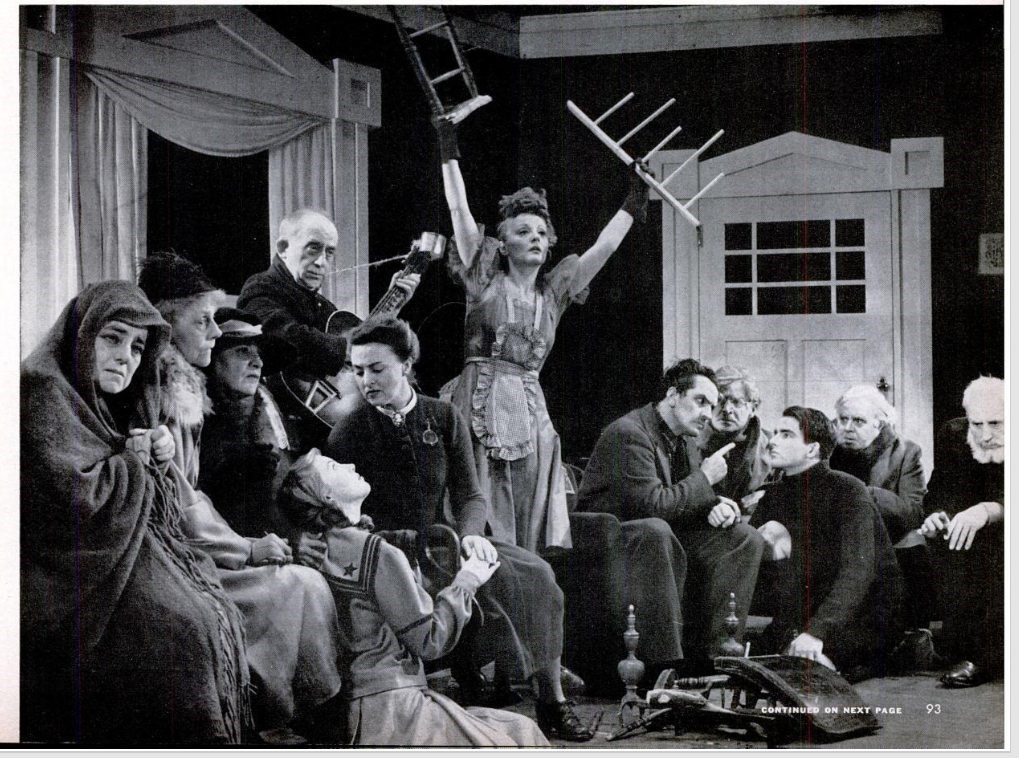
Scene from The Skin of Our Teeth2

“The ice age is coming, the sun’s zooming in.” A scene from the first act of Wilder’s  1942 “The Skin of Our Teeth.” That’s Tallulah Bankhead who’s broken up the chair for kindling.


Shakespeare’s winter song here is immediately preceded by another song in his play (the first song invoked spring.) Each song of the pair features a symbolic bird, and for this winter song we’re given an owl in its refrain,* a bird omen of unseen dread whose song, breaking with the Imagist show/don’t tell rule, is described as “a merry note.”

Merry? A little dark humor there I think. But even if that bird’s a bad omen, the fact that it’s singing means that it’s enduring. And the poem’s second and final stanza continues that theme of endurance. Everyone in church is sick and you can’t hear the sermon for the coughing (but coughing means you’re breathing, and who can tell how useful the sermon’s lesson might be anyway). The visible birds are hunkered down in feathers. There’s some crabs** sizzling in a bowl. There’s a fire. Tom’s brought more wood. There’s someone there to see greasy Joan cooking.

That refrain repeats and the song ends. Shakespeare’s play’s characters are kings, courtiers, and princesses and the plot their fancies. His actual world was full of war and deadly factions, brutal executions; a world of connivers, fools and tyrants, and even those who could combine all three. Yet, here he ends his comedy not with a wedding but with a song about modest endurance.

I think I lucked into this one this week. If one pays attention to this little song, it says something about those of us who are not kings or principal ministers.

Those who’ve endured my singing may be glad to hear this one is spoken word. The music is drums with a mix of four wintery synths played with my little plastic keyboard and MIDI guitar. The player to hear it is below. The full text of this short Shakespeare poem is here. I wish you the sustaining fires that are warm and illuminating, instead of the flames of fools.


*The refrain also features one of the more obscure words in the piece: greasy Joan is “keeling” the pot. I thought “stirring,” and there is some sense of that, though it may be particularly skimming fat off some stew.

**I thought of steamed crabs hissing, but if Shakespeare is remembering his rural Warwickshire it might not be seafood, but crabapples. Hot ale punch with floating crabapples was apparently a thing.

Winter Sleep

What age are we when we write poetry? What age should we be?

Poet Donald Hall while writing memoir in essay form after age 80 said that part of why he turned to prose was that after a certain age he no longer felt he had the urge to, or could, write poetry. I’m not that old yet, but after so many decades of writing poems I’m more likely to ask myself why this poem needs to exist.

This never occurred to me as a younger writer. It was enough that the urge was there, that the work of shaping it was rewarding, that the existence of some new set of words in some novel order representing a moment of experience had occurred. There are times when we may suppose this always is—at least approximately. We’re all our own first reader. For some of us, some of the time, our only readers. Even if we believe we’re writing a poem for someone else, that first audience is still inevitably connected with the poem’s creator.

I don’t know that there’s any pattern in that first audience disliking its own poem at times. Does one get better at crafting poems or observing experience with time? Does one get better at staying out of the way of the poem when that’s necessary? Does one get more preceptive at the ways the poem fails to meet, or cannot meet, some more perfect state? Does one just realize that some days you eat the bear, and other days the bear eats you?

A couple of years back I had some fun looking at a compiled list of the 20 most anthologized American poems of the modern era. Now of course such a list reflects any number of factors, some of which are extra-literary, such as prejudices, impact, and probably even some ivy-tower log-rolling. But still, these poems can safely be considered as successful with an experienced audience early in our century.

One thing surprised me. About half of these poems, the ones that are presumed to reflect the author’s masterpieces, were written in the author’s 40s. Six more were written in the author’s 30s. Just one was written by a writer past 50 (Elizabeth Bishop’s “One Art” published when the writer was 65). Only two were written by writer’s in their 20s (the list’s youngster was T. S. Eliot’s “Prufrock”,  completed when the author was 27.)

But how old were these poets in their souls of experience, the place from where they wrote these poems? It’s not unusual for younger poets to take on the air of more experienced people in their poems. This past fall we presented a couple of well-known and liked poems considered to be about old age: Rilke’s “Autumn Day”  and Shakespeare’s Sonnet 73 “Bare Ruined Choirs.”  Rilke wrote his autumn of one’s years poem in his 20s, Shakespeare’s was penned in his 30s.

Yet neither sounds false to this older reader.

Similarly, there are times when I’m writing that I feel younger than my years. It’s a commonplace that there’s a sense of play in the arts, something that past a certain age is increasingly rare to find in off-hand physical activity.

So perhaps you, like I, may feel unstuck in time when writing. Our writing may not be objectively timeless, but our mental flight seems so.

While thinking about these things this winter, I came upon this poem* that seemed to me to be a fine expression of the experience of old age experiencing the unsettledness of sense of age.

Edith M Thomas engraving

Edith Matilda Thomas. One thing I’ve found out: Emily Dickinson classmate Helen Hunt Jackson helped launch Thomas’ writing career.


There’s not much here today about the author, American Edith M. Thomas, who published “Winter Sleep”  in 1896, when she was just in her 40s. I don’t know that much about her yet. It’s strictly metrical and all rhymed up, but once or twice it seems to strain natural speech to make its rhyme and meter.

What’s impressive about it is that it strikingly presents not just old age, but the approach of death as an unstable state, the dream of life. This isn’t an “autumn of my years” poem—it’s a “winter of my years poem.” I immediately sought to set it to music for performance. To hear what I came up with, use the player gadget below.


*”Winter Sleep”  is another poem and poet I was introduced to by Poem-A-Day from the Academy of American Poets. Here’s a link to the text of the poem and you can sign up for Poem-A-Day there too.

Emerson’s Requiem

In the last hour of 2019 I was sitting on the couch with my son as we exchanged video clips we thought each other should see. I mentioned that Neil Innes had just died, that he was part of the Monty Python circle, and that before Python he had founded a musical group that helped inspire the Pythons called the Bonzo Dog Do-Dah Band.

“I think I’ve heard of the Bonzo Dog Do-Dah Band.”

“Search for ‘Canyons of Your Mind’”  I suggested. Sure enough, the magic of Internet searching brought up a video. “This is the most Sixties song ever” I promised.

Here’s the clip we watched.

Farcical fascicles found  “In the wardrobe of my soul, in the section labeled shirts.”

.

I wasn’t sure if I needed to provide context for it. As the performance shows they’re sending up every bit of performative anguish over absent love as well as the worship of musicians offering it. And the lyrics? They should have mortally wounded a certain kind of Sixties metaphor that was supposed to transcend our mundane world. In the middle of it Neil Innes plays a guitar solo that was likewise a pig cupid’s dart to the heart of every guitar hero moment. Anyone got the tab for that?

Son was not impressed. He had just shown me a Franz Ferdinand video chock-full of early 20th century Dada and Constructivist art moves: Max Ernst, Kurt Schwitters, Alexander Rodchenko visual riffs. In contrast, the Bonzo’s Dada lacked the same danceable drive and sleek black stage dress of the smart and sharp 21st century Glaswegian rock band.

Oh well. I hadn’t seen the Franz Ferdinand videos he showed me and I was glad I saw them. They made me think how we are still working out the Modernist revolution as we enter another decade that will be called “The Twenties.”

Early in the last week, I watched an episode of Apple TV+ Dickinson with my wife. In it Emily was crushing on Benjamin Newton over their mutual admiration for Ralph Waldo Emerson’s poem “Dirge,”  “The one where he’s on a plain with all those ghosts” as TV’s Emily has it.

That made we want to go back and check out Emerson’s “Dirge.”  What might Dickinson have seen in it?

It is 19th century Goth, right full of death and lonely love for the dead. Emerson had suffered at least as much as his early 19th century peers in terms of early deaths in his circle, and his poem is quite similar to a poem Abraham Lincoln wrote around the same time that we’ve featured here. One of Emerson’s charms as an essayist was that his mind might take him anywhere while writing one, and the reader is afterward taken along for the ride. This one-thing-after-another move can also work in poetry, but when Emerson the poet does it, it generally doesn’t work for me. “Dirge”  suffers for that.

Here’s the text of “Dirge”  as Emerson published it. The TV show’s Dickinson latched right onto that arresting image, a rural plain full of ghosts, but Emerson buries the lede, putting another stanza before it. That stanza isn’t entirely bad, indeed its abandoned field with scanty corn could have conceivably informed Dickinson’s “Summer’s empty room” in her later poem we featured this December. I tried performing the poem in its entirety, but it was running nearly 8 minutes (longer than I like to use here) and so I then decided to cut to length by removing those stanzas that were Emersonian digressions. I’m not sure that’s the right way to go, though I think the listener might prefer my more single-threaded version. In some of the excised stanzas, Emerson made the poem’s setting distinctly his Concord hometown; and the mourned, missing folks: his siblings who died young. Specificity also works in poetry, but I’m not sure it strengthens this  poem.

One more thing before I offer you a chance to hear my resulting performance. An 1850s Emily Dickinson would have been reading this kind of gothic romanticism in its moment. The element, performative or not, of contemporary personal emotion in poems was part of the change of 19th century Romanticism. Her models: Emerson, Emily Bronte, Elizabeth Barrett Browning, and others used that mode. Even Whitman made common use of it. Here’s something I find striking: Dickinson generally didn’t. Her poems make little use of sentimentality. She will use emotional words in her poems rather than images meant to invoke feelings in the 20th century Imagist manner, but those emotional terms often seem examined, observed, set to the side.

I asked my son if what put him off the Bonzos was that they were desecrating his musical religion. *

“No, you could have just picked a better one.”

Acoustic guitar and a mix of synthesizer sounds for today’s musical performance of Emerson’s “Dirge.”  The player gadget to hear it is below. Don’t see it? Then this highlighted hyperlink will also play it.

.

*Pedantically one could draw a fairly direct line from the Bonzos to early Roxy Music to “Anarchy in the UK.”  But no more footnotes today! If I’m going to excise Emerson’s digressions, why should I give myself license?

Endless Circle

Here’s another poem by the lesser-known American poet Genevieve Taggard. Taggard was sometimes classed with a group of woman poets of the first part of the 20th century, all of whom suffered from the rise in the 1920s of “High Modernism” that held that longer poems with elevated metaphors referencing prior literature and art were the mark of seriousness in poetry.

Robert Frost* was able to hold out against this to some degree, but most female poets had a harder time of it. Three poets I’ve presented here multiple times: Edna St. Vincent Millay, Sara Teasdale, and Elinor Wylie all suffered from this change in the culture. Before this change in our last century’s Twenties, they were all prize-winning American poets, and all had achieved a reasonable degree of readership and fame. Somewhere nearing 100 years ago, all of these figures started to be classed as writers of unserious work: merely pretty verse. By the second half of the century when I went to school none were taught in my classes. Not part of the canon.

The poet, professor, and blogger I’ve referenced here earlier this year, Lesley Wheeler, recalls the term “The Songbird Poets,” which exclusive of it’s dismissiveness seems apt to me. The whole idea of poetry as song rather than an impressive castle of elaborate and complex images was in retreat—but all of them could write the kind of short poem that sings off the silent page. I can’t resist turning up the volume on them for this project.

Was their gender part of the downward reassessment? No need to make too fine a point about it: yes. To the degree that the critics and canon formers had an objective criteria, it was to see an excess of emotional content in their work, and they wished for a poetry where rote sentimentality was reduced or eliminated entirely and where overt emotional language was replaced by states revealed in those complex and often academic images.

But one can’t take emotional content out of art, whose whole Unique Selling Proposition is to transfer the experience of experience between one mind and another.  Those who’ve followed our yearly April dive into that High Modernist checkpoint T. S. Eliot’s “The Waste Land”  know that it has a harrowing emotional core, so harrowing that Eliot himself seemed embarrassed by it later in his career. By the time I was introduced to it in the second half of the 20th century this aspect of that medley of lyric poems was absent in the syllabus.

I maintain that song, the word-music of a poem, its structure, order, and how it rhymes its observations, can (just as much as some cool classical image formulating an objective correlative) powerfully contain and convey emotion. “The Songbird poets” were vastly underappreciated for the complexity of their examination of emotion and the human condition. Let us judge these means again as we look at Taggard’s poem. We may be able to look at these works and see what the previous generations couldn’t appreciate: The form her verse takes here is integral to the impact of this poem.

Endless Circle Text


This is a poem that holds itself in a mysterious balance, a Mobius loop of a story fulfilling its title. My reading of it is that it’s a love and death poem that portrays neither as final by its spare and graceful text. As I understand it, it opens with lovers under a tree, who by the second stanza have aged and edged into a death, a transition they mark “laughing and leaping” as if rebirth into youth.

The first verse is then repeated, and I’m feeling it ambiguously. Are they a new generation of young lovers under a tree, fated to love and weep, or has the poem’s singer moved on to a new love, a new desire fated to end in weeping—or are our lovers buried under the tree now, their spirits recalling life?

I don’t always know where the musical accompaniment ideas come from for this project. Sometimes I realize after the fact that I’ve been channeling some musical idea subconsciously. After I finished the mix on my performance of Genevieve Taggard’s “Endless Circle”  I suddenly realized that I may be musically recalling The Incredible String Band, a Scottish group from the weirder fringes of “The Sixties.” I admired their asymmetrical and unafraid to wander song structures and their wide-ranging combinations of various instruments, but I’m always hesitant to recommend them to others because their vocals are (like mine often are) more than a little pitchy.

If that part of my music here bothers you, today’s piece will then. This piece called out to be sung, even if mine is the only voice I have available to sing it today. The player to hear “Endless Circle”  is below.


*William Carlos Williams also fought against this, but he seemed to have felt this academic turn hurt his work’s standing. Marianne Moore is a conspicuous example of a woman who was able to buck the trend by writing every bit as cool and hermetic as any of the Modernist men. Frost himself seemed to write fewer of the short lyrics that his early books featured and turned to longer blank-verse narratives. And another Parlando Project favorite, Carl Sandburg, mixed in longer, more Whitmanesque epics, and turned to his Lincoln biography.

Over in the British Isles I don’t think things worked out quite the same. Why this might be is too long a subject for this post, much less a footnote.

**If you want to read a long impression of what it’s like to listen to an Incredible String Band Sixties album with an open mind and an ambiguous conclusion you could click here: “Makes Syd Barrett sound like Neil f’ing Diamond” it says. Or if you’re too young for that writer’s simile to hit home, think of the weirdest chronic-infused hip-hop mix tape you could imagine, only it’s played by two white guys and their girlfriends on a shed-load of acoustic instruments instead of samples and loops, and autotune clearly hasn’t been invented yet. Or if you’re brave, you could take the adventure and listen to one of their records yourself. Yes, an excess of “canyons of your mind” hippie naivete in the lyrics too, something that Taggard’s form and concision here contrasts with, but there may still be some charm in their work since there’s little danger of it taking over the world these days.

Love Came Down

One of the particulars of childhood is that one can experience extraordinary things as usual. In the years of my childhood, protestant Christian church services always included the singing of several hymns by the congregation at large. I suspect this may be less common today. I believe larger churches now often feature talented musicians and singers performing more of the musical parts of the service, which makes the worship more like conventional entertainment. In many of the rural churches of my youth, even organizing a church choir for a single number might strain the resources of the smaller congregations. So instead, we held the hymns in our own breaths and wavering pitches.

The singing of such hymns, many from the 19th century, was part of my musical initiation. The melodies were various, some taken from traditional airs, others adapted from famous classical composers. The words? There was that ordinary/strange part. Hymn writers were often the philosophical sort, and their lyrics would drop esoteric theological terms and judgements as austere as their hopes were sure. It wasn’t just the children that would be asked to fill their lungs and sing these arcane terms, they were also not the common language of the farmers and tradesmen who filled the pews.

Often the minister leading the congregation would skip the more difficult verses, but I, enamored of words, would read them anyway and wonder at their celestial descriptions. This experience may have primed me for a later-life appreciation for Emily Dickinson, who sometimes used the common hymn meter for her own original and less than orthodox hymnal.

Well, that’s a long digression before bringing forth the author of the text I use today: Christina Rossetti. Rosetti often wrote short devotional poems, and while I don’t know if she intended them from the start as hymn lyrics, some were straightaway used for same. Her poem “Love Came Down at Christmas”  is one example. It’s sung to several melodies, one of which is a traditional Irish tune which I used as a basis for my setting.

Rossetti as a poet is not often drawn to extravagant verse (unlike many of her Victorian contemporaries), and the text of her poem is quite short: 12 lines, 63 words. While not in an exact form like a triolet, rondel or the like, it makes significant use of repetition: 11 of those words are uses of the word “love,” and its relative “lovely” could make that count 12. The poem has only one rhyme, which sometimes just repeats its word rather than true rhyme: divine, sign, mine.

So, a simple structure, the kind of thing that is ideal for singing. None the less, it’s been altered in most performances I’ve sampled. The line “Love to God and all men” has sometimes been changed to inclusive language (“all of us”). The other common alteration is to drop the second verse. That’s odd, it’s not like this is a 48-verse ballad or something. I suspect that dropped verse is excluded because it uses those dodgey theological words.

Here’s Rossetti’s original second verse:

Worship we the Godhead,
Love Incarnate, Love Divine,
Worship we our Jesus,
But wherewith for sacred sign?

Many would be in the philosophic weeds there. The belief that sweet baby Jesus is an incarnation of the divine Godhead is orthodox Christianity, but it comes off kind of Hindu expressed so. And the last line is a bit awkward in sing-ability and sense.

Edward_Burne-Jones_Star_of_Bethlehem

The gifts are nice, but the Airbnb review Joseph’s writing will still be scathing.


Still, dropping it obscures the point Rossetti chose to make: that the incarnate Godhead is not something that we can invariably grasp. Use of three-kings astrology and wandering stars is not reliable after all. As the second verse makes way for the third, she chooses and old standby from folk-ballads for her compressed song: the love-token. In songs like “John Riley”  long-separated lovers know each other by some special device they have exchanged, and in this case, love itself is the token. We will know the Godhead, and not some counterfeit, is present by love’s presence.

I took the liberty of revising Rossetti’s second verse rather than dropping it. Here’s how I rendered it:

If we seek the Godhead
Love incarnate, love divine;
Where to find our Jesus,
What would be his sacred sign?

I also took liberties with the music. All the repetition with the words often resolving down to the same made me think of musics based on similar relationships to departing and returning rather than a harmonic progression that goes onward. That and the second verse called for me to pull out the tambura and sitar,* and to play guitar and organ in a manner that would match them. The piece would benefit if a better singer in that tradition sang it than myself—but then, there may be a benefit to singing the hymns even if one isn’t the best singer in the congregation.

Choices like this as I pursue this project to introduce different words and music to each other is my adult way to make the extraordinary usual. The player to hear my performance of Christina Rossetti’s poem is below.


*Though I once played a copy of the Coral “Electric Sitar,” I no longer use that approximation of the real sitar. Instead I use my MIDI guitar to play sitar and tambura “virtual instruments” where the guitar (or keyboard) can trigger the sound of each note in the instrument’s range as one plays, using a variety of realistic timbres from the real thing.

Lights (There Is No Darkness)

We’ve come to the winter solstice, the longest night of the year in the northern hemisphere, much more night than day where we live. But it’s also the season of lights: extra holiday lights decorate homes, Christmas markets, and some streets. Some are the lure of commerce, some the lure of religious worship. Some lights say that the desecrated temple can shine again. Some are an abstract decoration set against the dark and grey.

NASA photos of night-time Earth from space

Dave sings below: “Seen from space the earth is glowing…luminescent as a cinder…”


This has probably gone on at some level since we discovered fire. It could be illusion or illumination, but the lights are our human communication with the dark. We know the dark is larger, we know the dark will return—but we still want to speak our piece.

A few years back Dave Moore and I recorded a performance of a song he wrote: “Lights (There Is No Darkness).”  I improvised two longer guitar solos in the performance, neither of which are in any hurry, but I’ve come to rather like them along with Dave’s loping, chiming keyboard part. There’s a longer night to decorate, so why not share it here today I think.

The player gadget for “Lights (There Is No Darkness)”  is below.


Do the Dead Know What Time It Is?

Here’s a poem by 20th Century American poet and artist Kenneth Patchen performed with music which manually realizes some ideas often produced by machinery.

Patchen is one of the original poetry accompanied by jazz guys, an idea that is one of the tributaries to the Parlando Project, but the poem of his I use today isn’t one that sings off the page when you first look at it. The speech in it seems casual, as if one is overhearing someone talking.

“Do the Dead Know What Time It Is?”  has a very unusual structure. It’s one part a Robert-Browning-like dramatic monolog and another part seeming snippets of a bar-room conversation. But Patchen doesn’t separate these out into differentiated sections of a multipart poem, rather the two modes seem to be occurring at once, the louder monolog spoken by “the old guy” to the younger man and then the often whispered and interrupted conversation between the younger man and a woman who is trying to pick him up.

Here’s Patchen reading this poem with a jazz combo. I also just discovered that The Blue Aeroplanes did a version of it with a rock band decades ago.


I first thought: oh, what a great thing for a recording! I’ll put one in one stereo channel and the other on the other side—but then I thought better. The claustrophobic nature of these two conversations is part of the effect Patchen has designed.

As barroom stories go, the old guy’s story is a good one, even if the younger man is only half-listening—but the second, whispered one, is all about what isn’t exactly said. I could go on at length about how the two stories connect, what they say to each other in the structure of the poem Patchen made, even though the two conversations in the bar never actually join each other. I found the poem quite moving, but I’ll leave it to you to connect them.

Instead, let me dance about the architecture of the music today. I’ve been on a loud electric guitar kick lately, which may frustrate those of you that prefer the acoustic music, which will return in good time. Music structured like this piece is often constructed by loops stored and manipulated by computer software or by small solid-state devices that can capture a phrase and repeat it. Similarly, the original rappers’ DJs used turntable manipulation to repeat a section of a grooved record, a task that can now also be emulated digitally at the press of a button. There’s nothing wrong with these methods or machines.

Still, I most often try to play the repetitive parts you hear here. It’s not something I’m naturally good at, and I allow some imperfections to occur. Perhaps I do this because I became enamored of the hand-played repetitions that made up the composed music emerging in New York near the time I left for the Midwest—but it’s not Steve Reich or Phillip Glass* that today’s piece sounds most like. The proximal influence is a record album that came out in the early 1970’s called “No Pussyfooting”  by Eno and Robert Fripp. That record’s guitar textures were produced by mechanical means too, two tape recorders set several feet apart from each other so that the “looping” was really a long loop of tape between them that allowed measures played by the guitar to repeat and get gradually added to in approximately real time. This seemed magical then, but a tidy little box that sits on the floor and costs about $100 can do all that these days.

No Pussyfooting

It was hard to find a barber shop with a fresh tarot deck in the ‘70s


There are two guitars in my music here, but the one that sounds throughout most of the piece I’m playing with loud sustaining notes that I (unconsciously) made sound as if they are a repeating loop with variations even though it’s real-time, straight through playing emulating Robert Fripp’s sound on that record which made such an impression on me at the time. One never knows what ghosts will visit when I plug in a guitar.

You can hear that music combined with Patchen’s words with the player below. The full text of “Do the Dead Know What Time It Is?”  is available here.


*Reich did use tape loops as well as live through-played instruments. Seeing the small ensemble Phillip Glass toured with in the ‘70s: electric combo organs that sounded like “96 Tears”  and “Light My Fire”  along with a handful of wind instruments was amazing in a small space.

Emily Dickinson’s Snow

I woke up this morning to learn that it’s Emily Dickinson’s birthday—and I didn’t get her anything.  Well, we do know how to do something here at the Parlando Project and that’s create musical presentations quickly, and it’s not like we’ve run out of Dickinson poems to use.

So today’s piece is a Dickinson poem about snowscapes. Having had the opportunity to visit the Dickinson family house in Amherst and hearing there that the area across the highway road was in Dickinson’s time a farm field helps me visualize Emily writing this. I can clearly sense her looking out the window from her bedroom writing table on that road and field that are this poem’s landscape.

This is Dickinson in her playful mode, but that doesn’t stop her mind from creating some exact and fanciful descriptions for the snowscape, starting right out with the snow fall being sifted like flour (do cooks still sift flour?) *

The least playful image in my mind is also the most striking in the poem, it’s a description of that farm field as “summer’s empty room”, not yet filled with snow (the furrows are still visible) and some now deserted plant stalks are jutting through picking up windy veils of snow. This is likely a poem written about an early winter, December, snow fall

In other work Dickinson can be harrowing or she might present us with some concise mysticism or philosophic equation, but that’s as close here to a darker note as we’ll get in this one. She seems content in her vision of a stilled winter and a smoothed and sparkling world—as I was today watching the white outdoors and below-zero temps just the other side of my glass as I wrangled a dense percussion track for this piece. It was afternoon before I moved on to a few keyboards. Then the final musical task was to add the 12-string electric guitar parts.

DeArmond S72-12

My electric 12-string, “recordless, but for them”


Long time readers here will know that the Twin Cities is something of a center for the 12-string guitar, an instrument I’ve used since shortly after I arrived here, but the electric 12-string remains a rare instrument here as it is elsewhere. Acoustic or electric, for each of the guitar’s conventional six strings the 12-string adds a paired string right next to it. Most of those additional paired-strings are conventionally tuned** an octave higher than the regular guitar strings, and the two strings when struck never quite vibrate in unison, adding a slight wobble that’s either charming or sea-sick depending on one’s taste and ear. I added to that with a whole load of echo, delay and reverb today, and all this called for the parts to be played sparsely and slowly. Even with an echo effect glitch*** that ruined the first couple of takes, I was able to lay down the parts quickly enough that you can hear it tonight with the player below. If you’d like to follow along with today’s poem (sometimes cataloged under its first line “It sifts from Leaden Sieves”)  the full text is here.


*Emily would have sifted as the household’s baker. The flour in her time was less refined—and sifting also removes things like bugs or foreign matter that might be mixed in with the flour. And sifted flour is more suited for blending with other ingredients. Sifting seems metaphorical matter for creating art, doesn’t it?

**Conventionally the high B and high E strings are tuned in unison and the bottom 4 in octaves, but some players tune additional strings in unison rather than octaves (Steve Tibbetts and Huddie Ledbetter/Leadbelly for two unlike examples).

***User error on the part of the producer, engineer and musician, which is easier when they are all me. I also make the tea, so there’s no one else to blame.

Night, and I Traveling

When I started this project a few years ago I didn’t realize that I’d have to largely work with poetry which is in the public domain. This can still disappoint me, but there’s been a welcome side-effect.

This limitation caused me to look deeply into the first couple decades of the 20th century for texts to use. I knew a little about the pioneers of Modernist poetry in English, or thought I did—but as things often go, the more you find out, the more you find out you don’t know.

I had carried the impression in my younger years that Modernist English poetry started out with “Prufrock”  and “Hugh Selwyn Mauberley” and that it soon moved on to “The Waste Land”  and Wallace Stevens with his multi-section poems set off by roman numerals. All stuff with moments of beauty and extravagant language, but also a bit heavy-lifting if one wanted to take it all in, much less wonder what the poet was on about.

But when you look for the actual beginnings, you find Imagism in the time before WWI—and the poems are much more modest: often short, sub-sonnet length, and they aren’t out to wow you with the elaborateness of their imagery, which is concrete and immediate.

Are these slight poems, ones lacking the impact that the weight of a few hundred lines and some quotes from Latin or Tudor poetry could bring? You can read them that way. Absorb them like a short paragraph in a novel that you are rushing through to get to a waypoint of a plot, and then they may seem so.

But the men and women that wrote these poems didn’t intend these poems to be slight. They intended revolution or rejuvenation of the poetry of their language. Compression. Concision. The leaving out all express sentiment to be replaced by a call for their readers to be involved, to see the certain things the poem described and to feel them as fresh experience, not as an allusion to ideas about the experience.

Well here’s a poet and poem I didn’t know about before this project, and one that isn’t classed as one of the pre-WWI Imagists as far as I know, even though this poem is—intentionally or not—exactly an Imagist poem. The poet’s got more names than Du Fu, for he didn’t always write or name himself in English: the Irish poet Joseph Campbell, AKA Seosamh Mac Cathmhaoil, and Joseph McCahill.

Joseph Campbell

No, not the “Power of Myth” guy, the other Joseph Campbell


Like many Irish poets of the turn of the 20th century he was involved in trying to end the colonial status of Ireland. He lived in Ireland the colony and the free state, England and the United States. He wrote lyrics to traditional Irish melodies, plays and other stuff (including a memoir of his imprisonment during the struggle for Irish Independence).

But here’s one of his poems, first published in 1909, and as Imagist as anything by Pound, H.D., Flint, T. E. Hulme, William Carlos Williams, or Sandburg were writing around then:

Night, and I travelling.

An open door by the wayside,

Throwing out a shaft of warm yellow light.

A whiff of peat-smoke;

A gleam of delf on the dresser within;

A woman’s voice crooning, as if to a child.

I pass on into the darkness.


Like Frost’s “Stopping by Woods on a Snowy Evening,”  Campbell’s “Night, and I Traveling”  takes place in the old, unlit, rural night. And instead of a dark copse of trees, it’s a country house, perhaps more a hut, that the traveler pauses beside. What does Campbell see?

Light from a hearth burning peat, that not-quite-coal that served the country people of his time. There’s a dresser and some small array of porcelain dishes displayed on it. There’s an ambiguous line: he hears inside the hut “A woman’s voice crooning, as if to a child.”

Why did Campbell choose “as if” for two of his 46 words? Well, practically he might not have seen the woman, much less the child. It may be meant to suggest that the child is being lullabied to sleep and this may be the reason the traveler doesn’t even consider helloing to the home’s inhabitants. Or it could mean that the child is no longer home, grown and left for elsewhere, or even dead.

I don’t think I’m imagining that later implication, though it’s not explicit.

The last line is rich in ambiguity too, though it seems to suggest it’s resolving that spare line that preceded it. Is our traveler passing on into the darkness like the child who has left home or has left life? Or is he a traveler who has “miles to go before he sleeps” who cannot stop and rest or talk to those who live in the hut? Or is the traveler perhaps a person who knows or suspects he’ll never even have such a meagre but real home like the one he’s passing? I know too little of Campbell’s life as of this point to weigh that last possibility against his own biographical facts.

You’re free to hear the poem as saying any one, or all, of these things. It’s still a charged moment even without it being defined exactly—perhaps even more so for that. I’m not Irish, but it seems to me to be a concise emblem of Ireland at his centuries’ turn.

Musically, I used a 12-string acoustic guitar with tambura and sitar drone accompaniment today. I can’t say it’s authentic Irish music, but then Celtic music in the 20th century picked up a lot of things like alternative guitar tunings brought by a Scottish-Guyanese man traveling from Morocco and bouzoukis from Greece. To hear my music and performance for this poem, use the player below.


The Night Is Freezing Fast

One peculiarity in the process of producing these pieces is that I plan sometimes based on odd intuitions. So, as I was looking forward to another session with LYL Band keyboard player Dave Moore late this fall I made a snap decision.

I had earlier noted this turn-of-December poem by A. E. Housman and made a note that it would be a good way to transition from the autumn to winter season here. That’s planning.

Then intuition stopped by.

Is intuition the Manic Pixie Dream Girl or Disreputable Boy Friend of an artist’s mind? I don’t know, but intuition was suggesting that for music I could combine Housman’s words with Motörhead. Somehow it’s hard for me to visualize the graceful classical muses dancing about me with their lyres and lutes suggesting this sort of thing.

Minerva and the Nine Muses by Hendrick van Balen

Yes Dave, I’ve been working with cellos, violins and acoustic guitars a lot this fall. But the muses are suggesting: Lemmy!


I had less than a day to add more “plan” to this intuition. I listened to some Motörhead to refresh myself on them, and quickly settled on their name-sake song “Motorhead”  as a rough template for what I’d try to do with Dave the next day. Taking the Housman poem text, I added some refrains* to bring out more song-like qualities, and to closer match the text of Lemmy’s “Motorhead”  song.

Motörhead performs “Motorhead” for a group of people who seem to be waiting for the 12-step group meeting to start


Dave arrived and we did a quick pass through with the original lyrics to get the sense of the musical donor for this dodgy operation. I dropped a chord or two of this already simple song form, and then we were on to attempting “The Night is Freezing Fast.”

This week I listened to what we put down that day.

Dave acquitted himself admirably, as he often does, with this spontaneity. And the take you’ll hear below also has my original guitar playing from the session. But there was one substantial fault to it: all the tempo I could push myself to that day was still too slow for Motorhead.

Honoring intuition with plan, I none-the-less pressed on completing “The Night is Freezing Fast.”  I added bass guitar to the track, guitar under the guitar solo (it wasn’t manic enough to stand without a second guitar) and recorded a final vocal.

What you can hear with the player below is an imperfect mixture of plan and intuition. Considering it now I think the intuition was even better than I hoped. The overall plot of Housman’s poem is a little gem: the onset of cold winter recalls to the poem’s speaker the otherwise un-explained Dick who hated the cold—and then a mere one additional verse comes which by sideways description tells us that Dick is dead and buried.

I’m not familiar with English idiom of Housman’s time and place, but one line in his text “prompt hand, and headpiece clever” is colorfully awkward to me, but in the context of the poem I read a stalwart and resourceful friend or workman being described.

Lemmy’s lyrics had a strong fatalistic tendency that meshes well here. The lines I added that were meant to echo “Motorhead’s”  structure added an extra element to Housman’s spare poem, bringing out an undercurrent that’s there but easily missed. Housman says the dead friend has become the “turning globe:” he’s now part of the eternal seasons. The sea change (or ice change) that’s occurred implies that he’s become December, the always returning season of fresh death. In the run out after the verses I started interjecting some cries in the manner of John Lee Hooker.**  Melding Lemmy and Housman was intuition’s idea, and a good one.

My planning and execution were, I think, less successful. On the other hand, it’s the best Housman/Lemmy mashup you’ll likely hear today (or most other days). Housman’s original text is here. Lemmy’s lyrics to “Motorhead”  are here, suitable for your next book club or 12-step meeting. The player to hear the LYL Band performance of “The Night Is Freezing Fast”  is below.


*Refrains, choruses, hooks—these sorts of things tend to make page-words more song-like. In this project I’m helped by having a liking for songs and other musical expressions with words that don’t use those structures, but in this case I thought they’d also help intensify some elements in Housman’s poem, and in this setting, intensity is a requirement.

**Specifically, I was recalling Hooker’s “I’m Goin’ Upstairs,”  which ends with a magnificent and mysterious verse and an upper register ululation that chills me every time I hear it. Here are Hooker’s lyrics and the most-well-known recording.