Have you changed out your summer flamingos for autumn yard turkeys yet?
“The Parlando Project,” my 2015 dream to present over a hundred audio pieces combining various words (mostly poetry) with various music, has now reached 155 officially published pieces. For those who’ve taken some of your attention and spent it listening to me present my take on the words of others, primary thanks is due to you. Despite the amount and variety of material I present here, I respect that your attention is precious. Thank you!
Thanks even to the unintended. The strange movements of technology and trade have allowed highly flexible musical instruments to become available at low prices. Most of what I use to make this did not exist one hundred years ago, and in the past few decades, the cost of these instruments, software and recording technology has declined into broad affordability.
Similarly, the Internet, so easy to dismiss for its mundane temptations, has made the availability of artistic materials “ubiquitous everywhere” that tautologies are sold.
Both of these things, the music technology and the Internet, are so enabling of creative work that it seems almost sinful to me to not apply my human imagination to them. But, as with many things, avoiding one sin leads to the commission of others. So, thanks also to my family for the forbearance that has allowed this project to get the amount of time and attention it asks for.
Thanks to Dave Moore, who lets me take a break from presenting my voice uninterrupted , and whose words are presented in some of the most listened-to pieces presented here.
Thanks to the Modernists of 100 to 150 years ago, who showed us fresh ways to use language, and shared their complicated hearts, heart’s beats, and apprehending eyes. Thanks also to their foresight to publish their work before 1924, so that we’re free to demonstrate to the still living what they did. Alas, the leading sadness in this project for me has been the large number of works by no longer living writers whose work you and I cannot speak publicly, because our copyright laws forbid it.
No new audio piece today, instead, here’s one of the first officially released pieces of the Parlando Project, words adapted from Dave Moore. I view it as being about the people left even farther behind than the signed artists of famous paintings. It’s called “Netherlands.”
I’ll let it be a reminder that there is a whole lot of material available here now, so using the Search… box or just click-wandering through the Archives months on the right will allow you to listen to more of the variety that Dave and I do.
Subscribing to the blog either through the “Follow” button near the top, or on the WordPress Reader, will let you know about new posts as they occur, or if you just want an easy way to get the new audio pieces for listening to them off-line, you can do that by subscribing to the “Parlando – Where Music and Words Meet” podcast on iTunes, Google Play Music, Player.FM, Stitcher, or wherever you get podcasts. The “Parlando – Where Music and Words Meet” podcast is free of course. [note: I’d previously mentioned using the little orange RSS buttons to subscribe to the blog, and for those who have an RSS-aware app they will still work, but the Follow button I’ve just added today makes this easier for most.]
Here’s a list of poets and poems, along with the year they were written:
OK, you probably already read the title of the post, so you know what they are.
This list comes from an article I bookmarked this summer that intrigued me, and today I returned to it because I’m thinking a bit about “The Canon”—those poems and poets that are judged by some generalized panel of experts as being worthy.
The whole The Canon thing is full of controversy, with complaints that it doesn’t include enough of what some favor in terms of poetic expression, or that it’s too-much a dead white man’s club; but part of what makes that discussion worthwhile is that The Canon is how almost all of us got introduced to poetry as an adult practice. Somewhere in our school years, we will be asked to open a textbook, and there on the pages will be some “great poems” that we will be asked to grapple with. Some of us will be puzzled that we can’t figure out how to do the sums of what these poems mean; and some of us will want to emulate them, to steal a little of their vision of existence, and some will hope to someday gain for ourselves something like that esteem in the eyes of others, to be, in our words, on a page in an anthology.
Sure, we may have already encountered nursery rhymes, Dr. Seuss, and perhaps some song lyrics, but these poems are the adults, writing the adult things. Poetry sections of literature classes can be as fraught with adolescent frisson as sex ed.
The article I was intrigued by was written by Emily Temple and posted on Lithub. It’s a painstakingly counted-up list, collated from twenty anthologies of poetry. The selection of anthologies has some problematic focus: half of them were specifically focused on American poetry, and nearly half (eight) were anthologies of modern or contemporary poetry. Still, the work to make this list must have been considerable, and I don’t know any similar, but better, efforts to use instead. For this post, I’ve decided to take even more shortcuts, over and above relying on Temple’s work, so bear that in mind.
I’m going to focus on the “Top 20,” the poems that appear in nine or more of the twenty anthologies. While this doesn’t eliminate the anthology-weighting to modern Americans, I think it means that these 20 poems and their authors are safely in “The Canon” as constituted in our current century. Here are a few scattered, short, observations about these most of the most anthologized modern American poems.
I had read and/or remembered reading all but three of the poems. (“Musee des Beau Arts,” “Skunk Hour,” and “Love Calls us to the Things of This World”). I suspect anyone who’s been interested in American poetry for a few decades would come in around that.
I sometimes worry that I’ve concentrated here too much on works from the first quarter of the 20th Century, and particularly those connected to the “Imagist” revolution in the center of that time. From this list, I shouldn’t. Nearly half the list (nine) is from this period, and if one was to play the “Kevin Bacon game” with Ezra Pound concerning these, your number is always zero to one, or you’re Wallace Stevens. I use so much from this era because I have trouble even finding the time to seek the rights to present a piece still in copyright, but also because I happen to find that era fascinating—and it turns out as far as modern American poetry is concerned, it’s still the core of The Canon.
However, even though the Parlando Project is closing in on 140 pieces, we’ve only done two of these top twenty poems (“The River Merchant’s Wife,” and a small portion of “The Waste Land.”)
What era other than the Teens and Twenties of the 20th Century was over-represented? The Fifties, four selections, and you could consider Gwendolyn Brooks’ 1960 “We Real Cool” sneaking in as a fifth.
Dead White Man’s Club? Not as bad as it was when I was in school. Not Dead White Males: 7 out of 15 authors if I count William Carlos Williams’ second-generation Puerto Rican heritage and don’t count that Richard Wilbur, though white and male, and still alive. The Canon is always historical, always trailing the contemporary. It’s not 7 out of 20 because five authors had two works in the Top 20. If someone does this article in 2117, or even 2067, I wager the pale dead males will be less than 50%. This is an easy bet (I won’t be around to collect from after all) but also because if we take the short-term acclaim of literary awards for new work in the past few years, I informally believe we’re already at that level. I know some will object to even mentioning these distinctions for various reasons. That’s a big topic, another time. If one wants to make an argument for tokenism from either side of that debate, that only the white males got double selections in the Top 20 would be your data point.
UPDATE: not to belabor the White Males count, but as I pointed out when we presented “The River Merchant’s Wife” back in July, the authorship of that poem in a complex subject. It is a translation of classical Chinese poet Li Bai. Pound’s Chinese translations are acknowledged to be of the looser variety however. If we split that one 50/50 we’re halfsies on White Males.
Here’s one that was interesting to me as I think about another issue: how old were the authors when the wrote their “Top 20 poem?” Go ahead, guess….
You didn’t look ahead, did you?
I guessed low. I was of the impression that poetry was a young person’s game, and many of the poems I’ve used here were written by authors below the age of 30. Turns out the average was a fraction over 40 years old, with Elizabeth Bishop at 65 and Wallace Stevens for his second selection at 75 making appearances for the Medicare set. The youngsters? Eliot at 27, Pound at 28 and 30, Auden and Moore at 32, Dickinson and Plath at 33. One oddity? Despite the average of a bit over 40, no one wrote a Top 20 poem in their 50s. If you’re under 30, don’t despair, as I did, thinking “John Keats died at 25, and what have I accomplished.” If you’re a poet in your 50s, consider a career in the insurance industry and plan on being Wallace Stevens.
This is another of the posts here that I’m tagging “About” that are not occasioned by a new Parlando Project audio piece. For those who can’t wait for the next piece mixing various words (mostly poetry) with original music, here’s that “included in 10 out of 20 anthologies” hit “The River Merchant’s Wife: A Letter” done up Parlando Project style. Use the player below to hear it.
As I promised last month, there’s going to be a few more posts here without new audio pieces, discussing some side issues and ideas I’ve run into during the last year or so of the Parlando Project. Some of these are going to be lengthier, and they may not be as interesting to those who come here just hear surprising combinations of music and words. I’m using the tag “About” on this sort of post, so that you can easily filter the audio containing posts (Podcasts) from these.
Today’s post is about what I found as I looked at Tristan Tzara’s poem “Vegetable Swallow.”
Why was I looking at Tzara poetry? I have a long-standing interest in the Surrealists, a movement that followed Dada, and with whom Tzara sometimes made common cause. And my first translation of Tzara for use in an audio piece, his elegy to proto-Surrealist Apollinaire, was unexpectedly popular here, the third most listened-to piece of last summer. So, time to look into some more Tzara I thought.
I own books that I could have searched, but they are poorly stored and arranged, and so I relied on our modern vade mecum, The Internet, to see what else might be out there to compose music with. A familiar search engine found 122,000 results for Tzara poems, but of course all is relative. One of my favorite French Surrealist poets, Paul Éluard, still obscure to many English speakers, had 222,000 results, and Carl Sandburg turned up 448,000. Emily Dickinson? 23,000,000! So Tzara’s poetry is not as widely available as some. I did not look at all 122,000 results, but of the poems I found translated into English, a handful seemed to repeat, and looking through them, I eventually thought one titled “Vegetable Swallow” had the most potential for use along with music. Here is how it appeared on several web sites, in an unattributed English translation.
two smiles meet towards
the child-wheel of my zeal
the bloody baggage of creatures
made flesh in physical legends-lives
the nimble stags storms cloud over
rain falls under the scissors of
the dark hairdresser-furiously
swimming under the clashing arpeggios
in the machine’s sap grass
grows around with sharp eyes
here the share of our caresses
dead and departed with the waves
gives itself up to the judgment of time
parted by the meridian of hairs
non strikes in our hands
the spices of human pleasures
Why did I select “Vegetable Swallow?” It was a good, short length. It seemed to have some musical qualities. I liked how it concluded. Some of it was incomprehensible at first take—but it’s Dada isn’t it. This is, after all, a poet who taunted the art-world with the idea that randomly arranged words could be compared to the value of recognized literary art.
I found I had preferred my own translation of Tzara’s “The Death of Apollinaire,” and so I aimed to do my own translation of “Vegetable Swallow” too.
As I started work on “Vegetable Swallow,” I first had to find it in the original French. After some searching, I found an edition of Tzara’s “Poésies Complètes” to work from. Right from the top, at the title, I started to dissent from the English translation used elsewhere. Perhaps you read “Vegetable Swallow” as Dada: two unrelated words jammed together for the effect of absurdity, but one could also read it in English as a compression of the phrase “Eat your vegetables,” which can be a parent’s command, or a commonplace for feeling obligated to do the unpleasant but necessary thing. But in French, swallow as a verb is not the same word as swallow the bird. Tzara used: “Hirondelle,” and as Minnesota’s own Dada bards The Trashmen once proclaimed: “The Bird is the Word.” I would have chosen “Vegetable Martin” or “Vegetable Bird” as the title, because I clearly think I’m conveying Tzara’s presentation more accurately there—even though, in this case, I’m making the title more hermetic.
The next major puzzle I have is with the second line “l’enfant—une roue de ma ferveur.” In the online text the em dash has changed to a hypen, and we are pressed to visualize a compound noun “child-wheel,” rather than to break the thought after child/l’enfant. I made a more speculative translation of roue/wheel, when I saw that the same French word is used for the gymnastic “cartwheel”. Cartwheel is a very specific, vivid image. It’s also an inside joke relating to the story that Paul Éluard met his wife when she literally cartwheeled down the street. It does the job of making a hyphenated “child-wheel” comprehensible, even if child-wheel’s presence in the Internet version may be a typographical misunderstanding.
In summary, the first stanza is two lovers together, embracing (or at least realizing/admitting) their carnal physicality.
The second stanza to me describes a rain storm above our two lovers. I can’t tell if stags are the storm clouds, or creatures caught in the storm. I chose caught in the storm. Next up I probably make my own mistake, which I’m catching only now. I translated “coiffeur” as simply hair because one of my computer translators had it as hair and I didn’t double-check that, when it now looks like “barber” or “hairdresser,” as in the Internet version, is more likely correct. I love the image of the rain falling down like hair cut by the barber’s scissors. Maybe the image works better if the focus is on the dark hair as heavy rain instead of the immaterial hairdresser, but still, I’m likely wrong on what Tzara wrote.
I make the syntax of the third stanza more English, and I make the most substantial and speculative change in the last line there. I understand “mordues” to not mean dead, as the Internet version has it. It can mean bitten as a verb or a fan/fanatic as a noun from what I find. I chose to go with the fanatic choice. And “parties” can mean part, but it can also be used for a political or other faction. From my choice of “fanatic” I could have then gone with “faction” for the French “parties,” but instead I chose the image of the swirling waves as a convention of fans or fanatics. I liked that image in as a presentation of two ardent lovers sharing caresses within the stanza, but now I’m thinking maybe I should have gone with the ideas of bitten and apart, as it would foreshadow the final stanza to a degree.
In the final stanza, I change around some syntax a bit too, but, in the next to last line, I confront a typo, repeated over and over as the other translation is duplicated on the Internet: “non strikes in our hands.” This is surely Dada! Is this a crossword-puzzle clue for baseball fans with a naughty testicular subtext (but what does Tzara know of baseball?) Or is it a cry against our complicity in the suppression of organized labor’s rights? A clumsy bowler approaching the lane, about to roll another gutter-ball? Such rich poetry!
No. It’s a missing “o.”
Here again, accessing the original French helps, though I should have distrusted one of my machine translators more in other matters after it insisted on translating “midi”, the common French term for noon, as MIDI. Perhaps it knew that I would be using MIDI to play synthesizers from my guitar and little plastic keyboard?
Fixing the typo allows the poem to close strongly. The last stanza’s first line works in either the Internet translations more active voice (though I would have chosen the stronger “surrenders” to “gives up” if I went that way). My choice is more passive: “The hours’ judgement is offered.” I think the third stanza is something of a time-lagged aubade, were the lovers have reached a time (noon instead of the traditional dawn) when they must part. The Internet version of the next-to-last line, with the typo fixed: “noon strikes in our hands” is fine. My version, “gone noon in our hands” means to clarify what I feel is the image here, the reclining lovers atop each other, hands clasped together above their heads, like the hands of clock at noon, knowing they must part as the day reaches the border of PM (Post-Meridian); but typo fixed, the Internet version may be more accurate to what Tzara wrote. I’m afraid that by this point, I had been letting my poet half overtake my translator half, and I wanted the poem to end as well as it could by my lights, even if I was recasting what Tzara wrote to a sense of what I think he was getting at.
In the end, the Tristan Tzara poem “Vegetable Swallow” I found on the Internet in English is less of a Dada exercise in scourging language, and more of a sensuous love poem, albeit one with fresh images. And even if you are not an expert in the foreign language being translated, checking English translations against the original is revealing. Furthermore, just as in performing the work does, doing one’s own translations helps one see deeper into the choices the poet made.
So yesterday, proud of my work, I was disparaging the unknown translator of the “Internet Version” of “Vegetable Swallow.” Reviewing and double-checking my work after the deadlines of performance and recording were finished, his work comes off better upon further review. In the second and fourth stanzas, his work is more accurate than mine, and arguably better than mine (even if I’m doing the scoring). And with the hilarious “non strikes” typo, he’s blameless.
And from further research last night, I think I can identify the translator of the Internet version: it’s Lee Harwood. I was even able to find an audio link on the web where he reads “Vegetable Swallow.” Even just hearing the modesty in his voice at midnight, him reading “Vegetable Swallow” across the network as I stayed up too late tracking this down, I wished I could sit down with him and ask him more about his own work and that of Tristan Tzara. Alas, he died two years ago this summer.
Several Internet sites use Lee Harwood’s translations of Tzara, yet do not credit him.
For easy reference, here are links to the players of my translations and performances of Tristan Tzara’s “Vegetable Swallow” and “The Death of Apollinaire.”
A slight apology for the slight drop off in posts so far this month. While I could say I’ve been struggling a bit with some frailties, there’s also been an element of needing to prod myself to get going again after reaching and exceeding the original goals of the Parlando Project. Don’t forget, we’ve been going on for over year now, and there’s over a hundred audio pieces available here of different kinds of words (mostly poetry) mixed with music that varies as much as my talents allow. If you’re checking in, and wondering where’s the new audio piece, remember there’s probably another piece you haven’t heard yet waiting to delight or confound you in the archives listed on the right.
This week, I had the good fortune to see Kevin FitzPatrick and some other younger poets read at the funkiest reading space in town as part of the Midstream Reading series. Kevin is starting his short reading tour to promote his excellent new book “Still Living in Town,” which is not yet available through Internet book merchants. He’ll next be reading on September 21st at the Har Mar center Barnes and Noble in St. Paul Minnesota at 7 PM and then on November 14th, also at 7 PM at Magers and Quinn in Uptown in Minneapolis.
Husker Du fell back into the last century, but Grant Hart kept writing great songs.
I’ve been noting also this week the death of Grant Hart, songwriter, singer, musician, artist and founding member of Husker Du, one of the greatest of the “get in the van” indie bands of the 1980s. Despite moving in some circles that overlapped, I never knew him, but we apparently shared one personality trait: we never figured out, or cared to figure out, how to promote the art we make to bring it to attention of others. Others who did know him, and who have a higher professional profile than he or I have, have written eloquently about him this week, but one thing I didn’t see noted in any pieces I read—his short name, said aloud, two syllables long, is a complete prayer: “Grant H(e)art.”
This summer I completed the goals I set out for the Parlando Project, which I originally envisioned as a one-year project to combine performances of various words with various music which I could present to the public here on this blog, or as podcast that could be automatically downloaded if desired. My original goals was to try to present 100 to 120 pieces during that year, and I hoped, despite (dare I hope, because of?) the variety that I would achieve a few thousand downloads for the entire series of pieces.
What a year it has been! The 100 pieces goal looked ambitious to me, and indeed the amount of time to write most of the music, produce and record the performances, and the research into their presentation—most of which remains unseen to the readers and listeners—was considerable. As of this week, there have been 128 Parlando Project pieces since our official launch. Hundreds of hours have gone into this year, and as with all such intense pursuits, the artist’s family gets to wonder why someone would spend that much time staring at the thing the artist is making instead of the very real people who surround them. That’s a very good question that no artist really has an answer for, save for most artists’ recognition that they seem to have no choice in the matter once they feel what the thing they are making could be. So I thank them. And Dave Moore, who’s not only written several of the most popular pieces here, he has been key to this. He’s allowed me to use his voice so you don’t have to always hear mine, as well as playing most of the keyboard parts on the Parlando Project music pieces. The Parlando Project wouldn’t be what it has been without Dave.
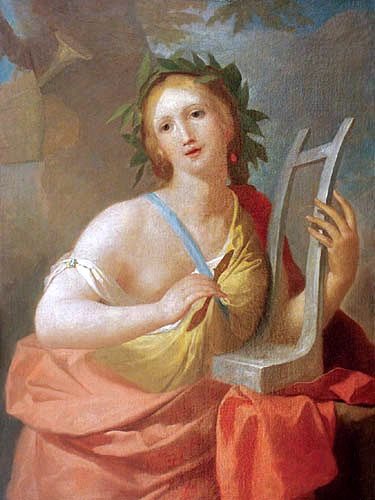
I suppose I should thank the muses too, but she thinks it’s a lyre,
even though it has no strings. Is it just part of an old chair?
Audience growth has been beyond my expectations over the year. Streaming web stats, at least as I get them and understand them, are less definitive than I would have hoped, but by this summer thousands of streams or downloads a month had become the norm. Blog readership here is more in line with my initial expectations, and lower than the podcast stream numbers, but the blog readership is still it’s growing steadily from what I can tell. This only concerns me in that the show notes with the podcast are a poor substitute for the richer presentation of the material about the piece in this blog, and through iTunes the show notes are about to get much briefer and simpler. Maybe this is a sign I should stop talking and simply Kick Out the Jams? If so, I’m going to be a bit dense and put even more emphasis on the blog in the next few months.
But I can’t leave this discussion on audience without thanking each of you who read this, and to thank several times over those of you who’ve linked to Parlando Project pieces on social media or other blogs, or who have taken the time to click the “like” star on a post here. I’m fine on focusing in close on creating what I hope are interesting pieces, but I’m not good at promoting them. You are the ones who’ve done much of that. I’m not always sure who’s done this linking, I only see the result when a piece starts getting more attention. If you’ve one of the readers/listeners who’s done so, and don’t mind saying so, please let me know in the comments.
Going forward I’m intending to keep the audio pieces coming. If I have the time, I even hope to spend a little more time looking for permissions to include works still under copyright. It’s distressing to me that there are authors whose work I’d love to present here, some of whom are long dead and whose work still speaks to us, but I feel constrained by law from doing so, and feeling lost as to the methods to get around this issue.
It’s this connection with authors who can no longer speak for themselves that has been a surprising, but most moving part this project. Reading and translating Du Fu, coming across writers I knew only as names like HD or T. E. Hulme. Finding out more about Yeats or Carl Sandburg, their poetry and politics. Finding out that Bob Dylan was the second or third songwriter to win the Nobel Prize for literature, and that the first Nobel songwriter, Rabindranath Tagore, was such a mammoth figure standing outside my view until I looked. Or that Christina Rossetti spoke to me more clearly as a poet than the other Pre-Raphaelites. Without this project I’d never have learned that I had this unscheduled train layover in the English village of Kingham one hot summer day just down the track from where Edward Thomas was still listening to all the birds in Oxfordshire and Gloucestershire. That the teenage love poem of George Washington still could have a listenership. That the simpler Emily Dickinson speaks, the more sharp the ambiguity, all needle and no embroidery. Hearing and relaying the words of Viola Davis about art being the “Only profession that celebrates what it is to live a life.”
I know I’m supposed to be inspiring and all,
but isn’t this blog post getting a little long?
So I’m going to continue here with the Parlando Project to “Tell Other People’s Stories,” but here, with this blog, I’m also going to spend some time talking about art, particularly about the intersection of music and words. These blog posts are going to be longer, perhaps more theoretical, but don’t fear too much theory. I’m still going to be elbow deep in making more Parlando project musical pieces, and work rounds off the sharp edges of theory.



 Frank Hudson