Today I’m going to wrap up my late summer series of fresh English translations of the early poems of French Surrealist Paul Éluard. Frankly, these poems are having trouble finding an audience – and in my suppositions, this is understandable. Earlier in the series I wrote (generalizing) that modern audiences have expectations of poetry – pre-requisites for our attention and valuation – and these early Éluard poems refuse to meet those expectations.* That’s a large part of what I like about them: their laughter at their refusal.
This abrupt ending means that I won’t get a chance this month to write more about what I know of Éluard’s life and how it might inform that refusal. I probably should know more about the details before writing such an account anyway, but the shortest summary would say: WWI vet therefore likely suffering its endemic PTSD, a leftist in a world where communist and fascist regimes are the current weather fronts, and an unruly, committed lover bilaterally lucky and unlucky in love. He would eventually write some grander poems, poems more full of the stuff that might please more readers and listeners, but this summer’s set of early refusenik poems are one way to confront the way of the world.
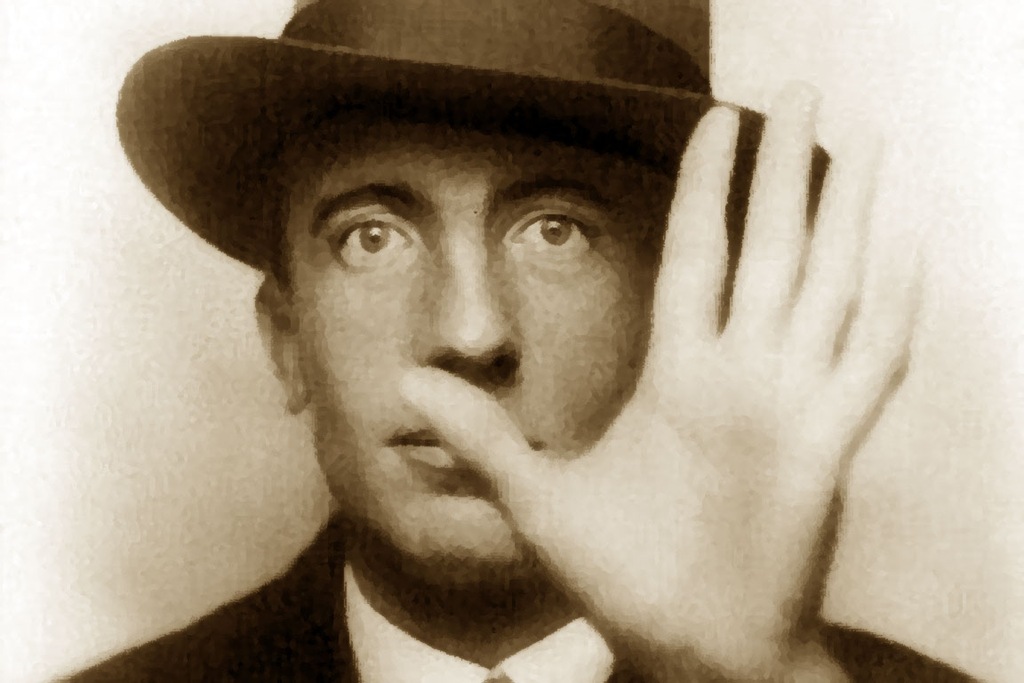
Paul Éluard, not a window-shutter hand.
.
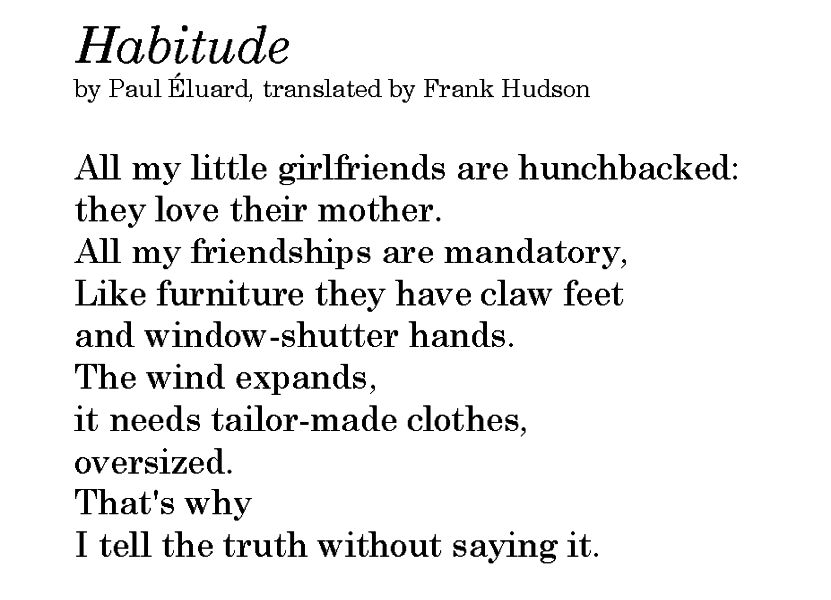
As performed, Éluard’s “Habitude” is so short that it’s one of the shortest pieces in the history of this Project. It says, I think, a few things about the rules of desire and constraints of propriety. Written when Éluard was helping found Surrealism, it shows how influential the absurdity of Dada was in that movement’s birth. The poem is just long enough to have a contrasting middle section, and I try to highlight that contrast by switching from speaking to singing in performance. The truth, that Éluard proclaims “without saying it” here is that he wants an open window and an ever-expanding wind rushing in.
Even with this foreshortened series, my translations here have likely increased the number of easily online-available English translations of Éluard’s early poetry by 50% or so.
.
I’m not sure what the next piece will be (I have several in various stages of completion), but your presenter values variety highly, so it’ll likely be different. This Project is “oversized” and off-the-rack clothes can’t contain it.
To hear my translation and performance of “Habitude” you can weigh the audio player that should be below – but Internet viewing doesn’t make that gadget mandatory, so I offer this highlighted link which will open a new browser tab with its own audio player.
.
*It’s also possible that my musical settings and performances might have been less worthwhile, or my being unable to refrain from connecting Éluard’s poems with present political and civic concerns in my recent posts was tiring or awkward to readers. I almost released another musical version of “Habitude” late last week, but I decided my singing on it – though my singing is always roughshod – wasn’t up to the impeccable standards of exquisite vocalizations you’ve come to expect here.
Returning now to my series presenting the early poems of French Surrealist Paul Éluard, you may recall that I was talking about the small contemporary presence early Surrealist poets like Éluard have in America compared to their contemporaries in Surrealism who were painters and visual artists. I wrote then about few reasons you may not have heard of, much less considered, Éluard’s poetry. Here’s another reason: we generally expect poetry to deliver a message to us, if not an explicit moral, memoir bit, or assayable philosophical, spiritual, or political point, then something that conveys a comprehensible, palpable, report of the experience of these things. Sure, poetry might be condensed and shorn of elaborate contextual frameworks – just as a text we might receive on our phones would seem vague to those not party to the conversation and the ongoing relationship of its writer and reader – but we fill in those things most of the time when we consider a poem worthwhile, while visual art is allowed a great deal more freedom. No one is required to hold forth on what water lilies or sunflowers mean in a painting, and melting clocks or obscuring apples may sport with our expectations, but still intrigue us.
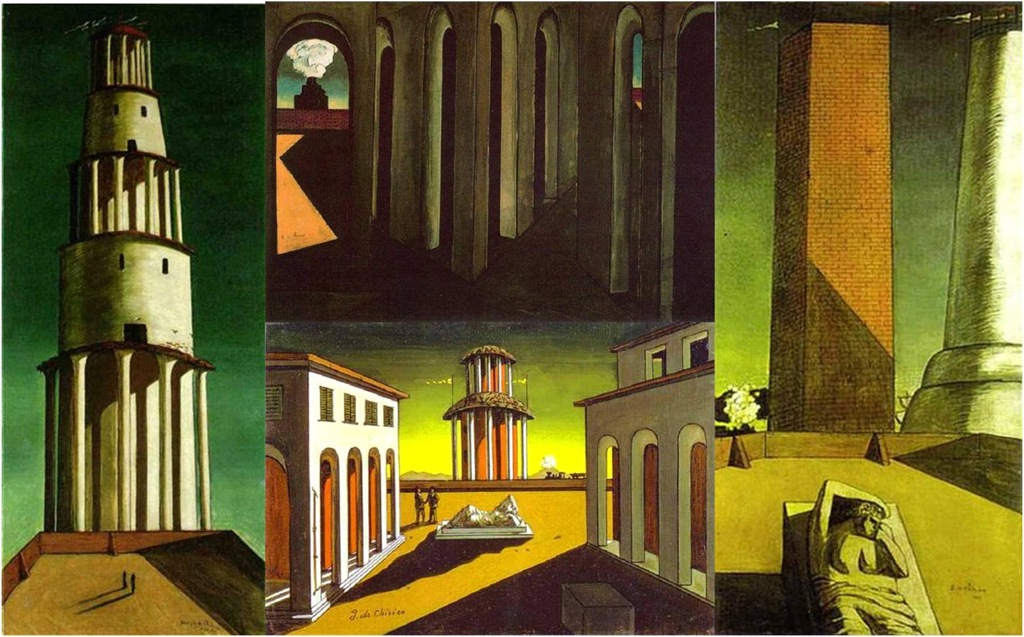
So today’s Éluard poem is an appeal to readers to cut him some slack by presenting an ekphrastic poem, a poem implying a case that you could consider its set of words beyond finding its message, but to just enjoy it as a not-fully-decodable object in itself. If we don’t know what a Surrealist painting means, we might still have an experience with it, and one such experience is what Éluard’s “Giorgio De Chirico” means to convey.
One side-effect of that open field we allow visual art is that we may have varied and dynamic experiences – derive entirely new and novel “frames” in our experience of it. As I wrote recently in my run-down of the most popular posts over the decade of this Project: the most popular post here was about how the Statue of Liberty, which is most often seen as a clear expression of freedom and welcome, has another context, partly intended by its creator, but unseen from our usual perspective, the metal giant’s feet have broken free from shackles and chains, and the small island its pedestal rests on once had a jail. Or let’s take the ubiquitous image of the Mona Lisa. What did Da Vinci intend? We don’t know, and we even like to think the enigmatic smile depicted intends for us to wonder. To its patron, the painting they commissioned might mean something about patriarchal ownership. Some surmise that the woman is pregnant and is musing on the child that is to be born. Others, pregnant themselves, could take that same framing and wonder if that face is attempting to misdirect its body from a bout of morning-sickness nausea.
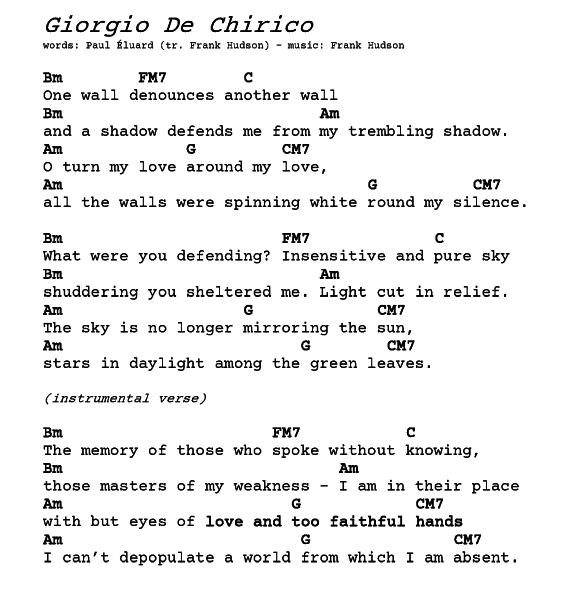
So, as I translated “Giorgio De Chirico” I could see things about De Chirico’s paintings that Éluard was experiencing and reporting on. I enjoyed finding singing English words to convey that from his French. I performed it, tracking just voice and solo acoustic guitar this time, during the same sessions where I was working on the other Éluard poems that I presented in August.
Here are four representative De Chirico paintings. The sharp lines of shadows and bright light, the tiny people dwarfed by structures, all were motifs he commonly used.
.
Then yesterday, instead of buckling down and preparing a final mastered mix of the song I’d made, I watched a documentary about 9/11. The one I watched focused on the part not usually considered: the experience in the Pentagon, that giant military office building in Washington D. C. that also suffered a deadly hit by a hijacked airliner that day.
In it, one survivor told her tale of that day. She was a light colonel, working in an administrative desk job, in a building that (other than its massive size) is like a great many other office buildings many work at during any workday, and furthermore she was about to give a presentation on some matter in that common workday misery, a morning meeting in a small conference room there.
And then the speeding fuel-laden airliner slammed into the wall of her facet of the five-sided Pentagon. In darkness, thick smoke, and heat she led a small group trying to find an exit. She grabbed a damp sweater that she found by touch to try to stifle the smoke. She didn’t know the dampness was from jet fuel, not water. The building segment was already aflame, parts not yet immediately destroyed were collapsing in the heat. No one could see much of anything, they had to hold hands to stay together. Her small group made it to a window, a bit of light in the dark chaos. Like many modern office windows, it was not designed to be opened – more than that, it had recently been upgraded to be “blast proof” as protection from something like an outside truck-bomb attack. It was made so that it couldn’t even be broken! Someone in her party picked up that trouble-spot of many an office day, a heavy laser printer, and hurled it at the window. It bounced right back off the glass. Somehow in the dark and smoke, they found the printer again, and threw it again – and that time the blow started to uncase the window’s frame. They pried it out and leapt outside.
Now that’s more excitement than many poetry blogs will offer you most days. Watching this account, everything was intensified by the story’s setting, for I’ve worked in modern office buildings like this, I’ve had the boredom or anxiety of meetings, I’ve carried heavy laser printers and made them work again the second time – frames that make it easy to share that experience.
The documentary also had an account from a man standing outside who saw them pounding ineffectively on that window and who went into the burning building to try to see if he could lead them out, only to find the destruction and conditions inside made it impossible to find any way to them from that exit. It wasn’t until a decade later he found out those pounding at the window had escaped, but for ten years he thought he was the last one to see them alive.
And then, I expanded in my empathy as I watched these accounts, including those who didn’t escape. It called to mind that folks elsewhere in buildings or working boats struck, perhaps nowadays with un-maned mechanisms that don’t need suicidal fanatics inside them, but have up-the-chain commandants upwards to the Commander in Chief who’ve loosed them thinking they have good and sufficient reason to do so.
Now, I’ve ruined a perfectly good essay on art and poetry – and your expectations if you came here for that – but as I revisited this performance this morning to make a final mix you can hear below, those sudden and shuddering skies, the words I translated in August from French: denounced and spinning walls, daylight through leaves, and those who speak without knowing. Mysterious, enigmatic poems and songs can act like objects (as painting or sculpture) engender new feelings, new meanings.* Perhaps it takes a Surrealist, with a willingness to combine outlandish things without favoritism to sensible intent to portray some realities.
A chord sheet of the song I made from my translation of Éluard’s poem.
.
If you want to hear my performance of my own translation of Éluard’s “Giorgio De Chirico,” there’s the audio player below. If it’s not there, don’t throw a printer, there’s this highlighted link that will open a new browser tab with its own audio player.
After our Anniversary Month celebrations, I’m returning to performances of some more poems by principal Surrealist poet Paul Éluard. It’s struck me that Éluard is less well-known to English speakers than he should be. I have only half-formed ideas why that may be so. Let me briefly list them.
Was it his politics? He was a self-avowed Communist – which as we know from the wisdom of our peerless American leader is correctly the name for anyone with a smidgen of concern for how the government might organize it’s efforts beyond the interests of the wealthy – but back in the midcentury when I was growing up, it meant support for corrupt one-man-rule authoritarians who erected bulwarks against free elections, sent spies and armed thugs against their opponents, and gloated in jails, prisons, and the power to exile. Despite his full-throated poetic odes to liberty and acknowledged heroism in the resistance to fascists during WWII and the run-up to that war, Éluard didn’t forthrightly oppose Communism when those things were mistakenly taken to be the bad things about Communism – before we knew better.
Was it Surrealism, or specifically being a Surrealist poet? Defined broadly, at least in my youth, Surrealism as a force in the visual arts was important and popular. How popular? Magritte, Dali, and Escher were inescapable as LP record-covers, posters, or reproductions on the wall. But Surrealist poetry? Not so much. Oddly, Surrealist poetry’s 19th century inspirations as well as its post-WWII descendants were popular enough. Baudelaire to Rimbaud to Bob Dylan to New York and Black Mountain School poets have substantial presence in our culture, but in the middle parts between the World Wars where we have Surrealists like Éluard, their Dada and Surrealist poetry falls into a memory hole.
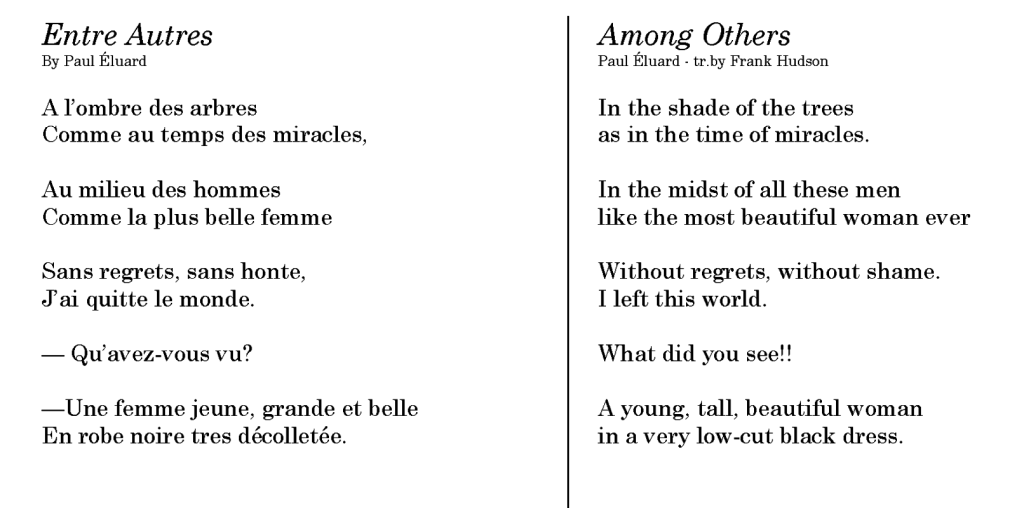
Is it something as simple as the tastes of translators?* The masses of monolingual readers in English-speaking countries rely on them to embody poets like Éluard. They are an underappreciated and (even within the realm of poetry) underpaid lot – but they, for a large part, get to pick who we pay attention to. Maybe they just didn’t encounter or take a liking to Éluard? Particularly in his early poetry, which supplies the examples I’ve used so far, Éluard doesn’t have as much esoteric imagery as some other Modernists. It may sometimes be hard to explicate exactly what he’s saying in his poetry, but he often writes, at this point in his career, in what I read as plain-spoken colloquial speech that doesn’t dazzle with its decoration while remaining elusive in intent. I’m not immune to being caught by surprising language myself. Afterall, the first Éluard poem I ever translated (and likely his best-known in English) begins “She is standing on my eyelids…” – and once you translate that, you want to continue and complete a translation of the entire poem. Today’s poem, “Among Others,” doesn’t go that hard.
None of the above have stopped Spanish language poet Pablo Neruda from having a footprint in English-speaking culture that I casually measure as being a bit larger than Éluard’s. Go Figure.
This can’t be so: if I complete everything I’ve planned in this Éluard series, will this blog will be the site of nearly half of all the English translations of his French poems on the Internet?
.
So, now let’s get to another of Éluard’s early poems, “Among Others.” My usual mode of translation is to try to convey the poem’s images. As a side effect, that allows me to land a beachhead without having forward intelligence as to what the poem means to say as if it was ordinary prose. Best as I can tell (I’m not a French linguist by any means) the language here is as plain as that in “The Red Wheelbarrow,” “Fog,” or “In a Station of the Metro” – poems from American Modernists in the demotic yet diffuse-meaning mode. There’s a single clue simile that something in Éluard’s short poem may call for extraordinary attention: “as in the time of miracles.” Could this be an ordinary bit of French idiom, or is it a tip that something miraculous is to occur?**
What is Éluard getting at in this poem? I’d say the betting odds are that he’s portraying some men talking about whatever they think is important and compelling, but the poet’s voice says that while he is among those men, his attention is on other, more carnal or incarnated thoughts, a vision of a desirable woman.***
Yet, as I worked with the poem, and as I finally performed it, I decided to place my bet on the longshot: that it’s not that the poem’s speaker’s thoughts are just like a woman, but that the poem’s speaker is, at least for that moment “in the midst of all these men,” seeing themselves as that vision of a young, tall, beautiful woman – in other words, in his image he gender changes.
Now, I am sporting with authorial intent there – but even in the first, best odds, version there could be an element in the male poet’s imagination seeing union with that woman.
Anyway, here’s my performance which is taking the long odds, including side-bets that my voice can put this song, from this point of view, over. There’s a good chance there’s a player gadget below. If not, don’t tear up your betting slip, there’s a highlighted link too – and if you click that, it’ll open a new browser tab with its own audio player.
.
*I base my estimate of Éluard’s popularity by casual searches for English-language translations of his poems on the Internet. I haven’t done any strict count, but my impression is maybe 10-20 poems are extant there. “L’Amoureuse” and “Liberté” have a footprint in English online, but the air gets thin quickly past those two poems.
**If an American football fan was to write about a “hail Mary play” we know not to call to imagination the venerated Blessed Virgin being hurled tens of yards through the air by desperate athletes. Some naïve translator-from-English making that image clear and literal would likely mistake the authorial intent.
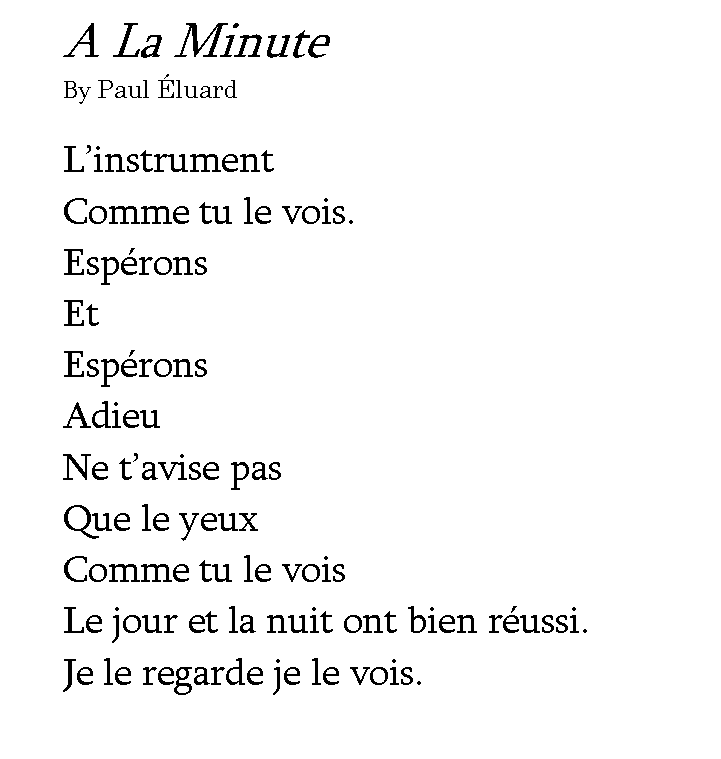
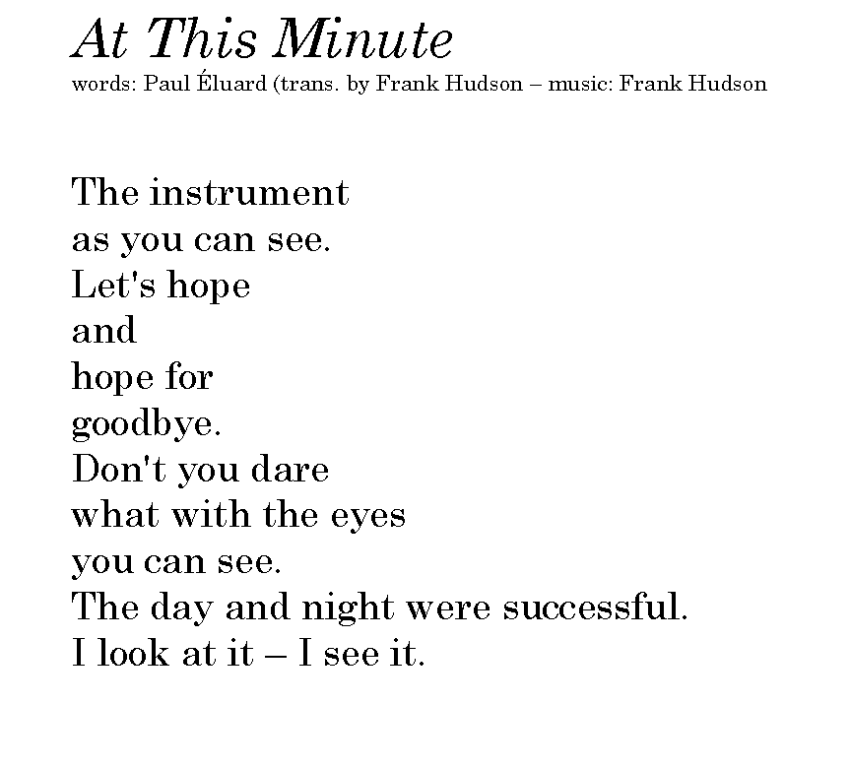
Here’s another new translation of a poem by pioneering French Surrealist Paul Éluard that I made in order to perform it with music. This one, “A La Minute,” which I’ve rendered as “At This Minute,” also lacks the extravagant imagery that one might expect in a poem associated with Surrealism. I hear its language as informal speech, though this could be a mistake – remember I’m far from a fluent French speaker, nor am I an expert on early 20th century France. The only solid objects referred to in the poem are the eye and a more vague “instrument.*” There’s also the pronoun “it” present, and from the poem’s title and inference that may refer to the abstract concept of time.
Éluard’s original French, and my translation to English. That translation may still be a WIP. This morning I was thinking I should revisit the penultimate line.
.
What the poem is talking about is elusive. Like the Éluard poem last time, the greater context and situation are left out of the poem, leaving a set of statements about it. At the time I performed the poem – as with “The Naked Truth” – I had decided that my performer’s subjectivity was going to use my dissatisfaction with my country’s current regime to animate the words. On deeper reflection afterward I’ve begun to think that both of these poems are complicated love poems. Perhaps if this series continues, I’ll write more about Éluard’s complicated love life, but even in the absence of that biographic information I remembered that Éluard is famous in his native France as a great love poet.
Those two frames can become congruent in poetic expression. If one loves one’s country and residents, one can have a complex relationship with its civic actions and outlook. Similarly, the intimate relationships between erotic partners cannot escape political and power questions. If early 20th century, or modern French readers, are expecting a poem about the affairs of love from this poet, they will likely hear it as such. As to the political reading? One thing I often see myself here in America: those women who carry experience with incompetence, reflexive lying, and lack of responsibility from intimate partners see immense resonance in my country’s current leadership. That is not a happy feeling, but it’s a clarifying one.
Éluard had a lifelong political side, and so consciously or unconsciously he may have intended this ambiguity. The poem seems to me to be addressed in hopes that a relationship will change, perhaps with the ending of it. What a speaker in the poem is declaiming then is that they are aware, can clearly see, what is wrong there. It may be a “who do you believe, me or your lying eyes?” situation.
Since I’m accustoming you to link two seemingly disparate worlds when hearing this poem, let me jump now to the music I made for performance. There’s a producer/musician and music theory teacher, Rick Beato, who has a very popular YouTube channel. One of his regular segments is to listen to the top 10 contemporary pop music streaming songs. This sort of thing is red meat for older listeners who eagerly click on those episodes wanting to hear Beato’s declarations of the lack of merit in modern pop music which will include objective reasons for that lack of achievement.** In one recent episode he noticed that many of the streaming hits didn’t “go anywhere” – meaning that they didn’t modulate to new keys, change tempo or time signature, or even change chords very much. Since there is a universe of sophisticated things that a composer or performer can do with all that, there’s value in pointing out the potential of using those musical tactics. But what he doesn’t stop to ask himself (or his audience) is: why might acts make that choice, and are then rewarded with large contemporary audiences for doing so?
Two putative answers that quickly come to mind: we are seeking something that seems stable and comforting – and conversely, we may be quite frustrated by the lack of positive change in our world and want to express that.
There’s a great, complicated, love song made famous by Aretha Franklin, written by Don Convay: “Chain of Fools.” Lyrically, that song may be a cousin to Éluard’s poem, and the song’s harmony is an interlocking one-chord riff, broken only for a few bars where all the instruments fall away and only voices and handclaps carry on in the same key. Whenever I hear someone make a statement that assumes that harmonic complexity is the key to effective music, I will call Aretha Franklin to testify.
Now I’m not Aretha Franklin – as far as I can determine, no one is – but my music for “At This Minute” is based on one chord (Em) with the tiniest movement in how it’s voiced. I built this composition starting with the rhythm, a pair of related and repeated broken chord piano arpeggios expressing that chord, underlaid with a simple bass part I played on my U-Bass.*** To drive home the statis, I plucked my kalimba (thumb piano) right up next to the microphone so that it sounded almost like musical hammer blows.
Rather than performing my translation from Éluard’s French straightforwardly, I decided to improvise repetitions of phrases in it. While it doesn’t sound like ecstatic Afro-American gospel a la Franklin, conceptionally, it’s akin. You can hear that performance with the audio player gadget below. No audio player? It hasn’t said goodbye, but I hope and hope you’ll see this alternative:a highlighted link that will open a new browser tab with its own audio player.
.
*What is that “instrument?” A clock or watch face perhaps? Or since the poem wants to riff on the eye and seeing – the spider face of Éluard’s poetry is as full of eyes as Emily Dickinson’s is of bees – the instrument could be the instrument of vision, the eye. If one was to create a Surrealist painting to illustrate this poem, both of those instruments should be melded together.
**To Beato’s credit: while he savvily promotes these run-downs (both senses of the word) as disparagement of modern pop music, he’s got a wide enough musical taste to offer praise for things he hears and likes in these top-tens. His grasp of music theory and enthusiasm for how it can be deployed is infectious, and that’s a good thing. As to how good or bad modern pop music is compared to the golden era that (just coincidently) happened when the oh, so, objective evaluator was a young person, I’ll call to the stand Mr. Theodore Sturgeon with his law that “90% of everything is crap.”
***The U-Bass is the size and construction of an ukelele, but with very thick nylon strings meant to be tuned to the same notes and register as a bass guitar (EADG). I love the upright bass, but I can’t afford, store, or play one well-enough – but I have three or four ways to make something like that instrument’s sound, such as today’s U-Bass.
Last time I had a chance to record a new piece using guitar, I rattled the bones of a Jazzmaster amid synth keyboards played with the same guitar. Monday I had another chance. My studio space was quiet, I could have made it loud – or I could open a sensitive microphone. Organic, wooden music? I uncased an acoustic guitar. I do like the directness of that instrument. I have microphones setup for recording in my studio space, so it’s as simple as opening a preset template on my computer recording software, arming the tracks, and clicking the red screen button.
The contrast that resulted could have been even greater. I tend to attack the strings on an acoustic guitar pretty hard. I use a flat pick, but I’m most often not strumming the way other plectrum players do. Instead, I skip from string to string, not striking them consecutively or with a “boom chuck” alternative strum either. I use that single flat pick’s point to do in succession what a “finger picking” guitarist does.* Many years ago when I tried to learn how to finger-pick, I noticed that many patterns didn’t strictly require that you strike two or more strings simultaneously, and I just spontaneously started to move the single point of a flat pick around to play what I would have done using thumb and fingers.
I had a new song to record – really new. Over the weekend I decided to crack open my old paperback of Paul Éluard’s Capitale de la douleur, Mourir de na pas mourir , Éditions Gallimard, 1966. The book’s entirely in French, and I can’t remember what bookstore I found it at in Iowa. As I’ve mentioned occasionally here, I had the impression that French poetry was an important influence on English Modernist verse, and living in a state (Iowa) that retained some French place names and seeing French on signs and labels when I visited Canada for fishing trips as a kid made me feel that French was a logical second language for me.**
Somewhat like finger-picking, I was a washout studying French in school. I had a terrible time pronouncing the words anywhere near correctly, and the introductory classes I took in high school and in my foreshortened college years had nothing to do with the French poetry I wanted to get ahold of.
So, kind of like guitar playing, I just went self-taught. Back in the 20th century I brute-forced my way through a handful of poems with a French-English dictionary and vague memories of basic French syntax and grammar from my school-room failure. Eventually, it was just easier to get the poetry already translated, where and when available.
It was only once the Parlando Project got underway in the twenty-teens that I returned to translation. Nearly all the English translations I had read are not in the public domain and free to reuse. And furthermore, I found that not every poet’s work I was interested in had even been translated extensively into English. This was true for many of the Dadaists, and I was also somewhat surprised that it was true of Éluard.
Éluard, as best as I can tell, is a big deal in Modernist French poetry. Present at the creation of Surrealism. Not just an important avant-gardist, admired for his love poetry too. Patriotically valorized for being a stalwart member of the anti-fascist Resistance during WWII. But none of that makes him all that important in America.
I wanted to go through the early poems collected in my book that would be in the public domain. Many of them do not have English translations I can find propagated on the Internet. I used my limited French vocabulary to scan them for what looked like interesting lines, and concentrated on the shorter ones that fit this Project’s needs.
I took the ones I picked out and put them through machine (computer) translation. Machine translation has gotten much better in the past few years,*** but it still doesn’t produce poetry. What it does produce seems, to my inexpert eyes, to be mostly accurate glosses of the literal poem. My job is to take those words, discern what they are trying to represent, and to make that into a poem that will seem vivid to a modern American reader.
In that process I would find even a pristine word-for-word translation inadequate. I want to translate the sequence of images as much as the words, and I want the result to have some musical or incantatory power (even if I don’t usually go so far as to try to duplicate a meter or rhyme scheme).
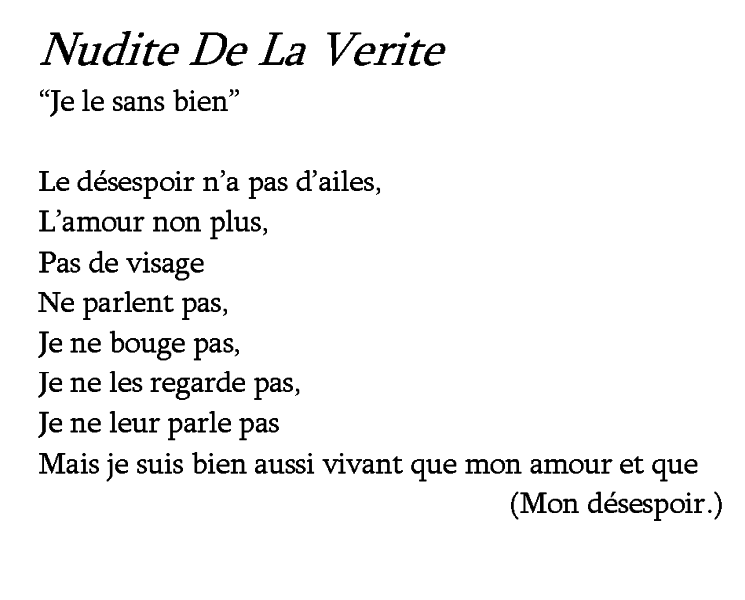
The poem, “Nudite De La Verite,” in its original French
.
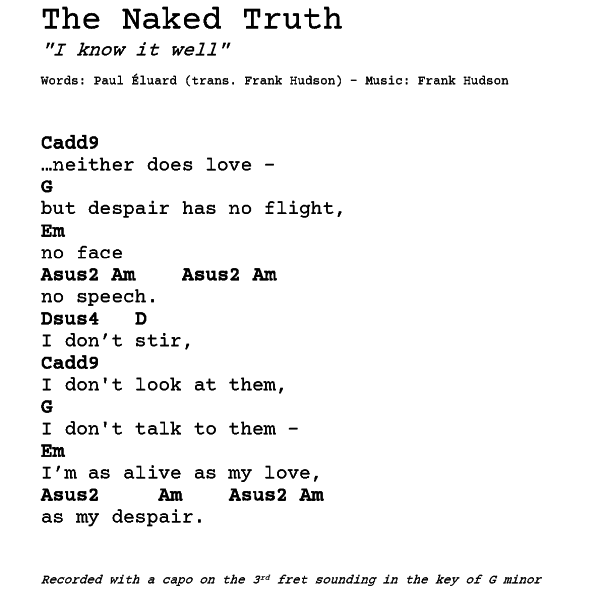
Éluard’s “The Naked Truth” was not hard to work with. There’s not much wild imagery to it. There is the image of the incorporeal state of despair that has no wings in the literal translation. I decided to sharpen that to “no flight,” both to link it with the rest of the short catalog of always-present no-action and so that the sound of “no flight “ can better flow into the “no face” that follows.
I really wanted that negative flow about resistance to despair, and for that I made the most significant choice to change the sentence structure of Éluard’s text, which has the line stating despair at the start followed by the line about love. I reversed the order, putting the line about love first, almost as an interrupted side-thought that prefaces the statement about despair that we will momentarily think is what all the adamant stubbornness is about – until we get to the payoff at the poem’s end.
Perhaps this isn’t the best choice? It’s not the order Éluard wrote down in French, and I want you to know that I changed that order. I may have been influenced by the way I, and many others feel – particularly in my town – with the current regime and its performative cruelty and callousness. Goddammit, we might see this through this little poem: a hope that our level of our despair at those things must be equal to a level of love.
My version in English, presented as a chord sheet for those that want to sing it themselves.
.
You can hear my musical performance of my translation/adaptation of Paul Éluard’s “The Naked Truth” with the audio player below. What? Has any such audio player taken wing the way your despair or love hasn’t? Well, I offer this consolation: a highlighted link that will open a new tab with its own audio player.
.
*For the added volume and sharp attack, some guitar finger-pickers use picks too, but different ones than a flat pick – typically a plastic thumb-pick that fits ring-like, but over the distal part of the thumb, and metal or plastic picks somewhat like half-spoon thimbles on one to three fingers. Others use some combination of fingernails and flesh. I have terrible nails and my skin can only allow me to play a limited amount of time with my thumb or fingers on bass. I tried to use fingerpicks as a guitarist, but found them finicky to manage.
**If I was a kid in my present residence, it would be natural to have gravitated toward Spanish. While my town has a significant number of Francophone African-Americans, Latin American Spanish is often in the air around here, and whenever I delve into Latin American poetry I find great riches.
***I suppose these computer-translations could be called Artificial Intelligence of a kind. The AI label gets thrown on a wide range of things these days both for promotion and disapproval. In my defense I’ll point out that computer translations aren’t “generative AI,” the thing that (deservedly) gets the most heat. When I type Éluard’s French into a machine translation entry box I’m not asking it to generate some reheated reprocessed slop of other, uncredited, artists’ work in order to present the pretense of originality. I’m asking it to do what I did when thumbing through my French-to-English dictionary, along with making some effort at producing an understandable syntax order for the resulting words. As for other AI issues: I casually assume my request to render a 35-word poem has a modest carbon footprint.
I still end up working with French-to-English dictionaries to check significant words, to see examples of the words or phrases in use, and to make at least an effort at understanding possible idiomatic usage. Would it be better if the poetry was translated by a bilingual poet with extensive knowledge about early 20th century France? Yes, but I’m not sure that Éluard’s fate has given us that – and so I make my efforts.
I’m starting on one of my New Year’s Resolutions early: to spend more time presenting fresh translations here. I expect a sizeable portion of them will be from French. Today’s piece, from the poet Paul Éluard, will be one example. Since there will be others, I’m going to start today with an aside about the translator’s tasks and my tactics and credentials for doing them, before we get to today’s combination of poetry and music.
I am not a native French speaker, nor do I have great facility with that language. Growing up in a little Iowa town, I had the luck to be able to take French at our small community high school, and later attempted to study it in college. French was Hobson’s choice for any foreign language classes at my small high school, but I welcomed that particular chance. In at least one previous post I’ve mentioned some of my accidental connections to the French language, but let me summarize them for newcomers. I first encountered French during my father and his brother Bill’s fishing trips to Ontario Canada, where I, a grade-school aged kid, was amazed to find the labels on many boxes and cans were bilingual, French and English. Around the same time my beloved Auntie Red, found herself and her young family stationed in France when her military husband was restationed there. Back stateside, she would amaze me by reeling off French phrases still retaining elements of her Southern US accent. That there was such a thing, an entire other language to describe the world, presumably as rich as English, seemed marvelous.
My academic career with French was none-the-less fraught – both in high school and college. Much of the work was based on getting conversational mastery, and I was terrible at it. I have something (I’ve always suspected neurological) that frustrates me with vocal mimesis. It’s likely part of the reason I struggle with singing. Helpful correction of the “no, it’s pronounced like this” kind only made me seem stupid or uncooperative, because my second and further attempts would still be way off in trying to make the right mouth sounds. Though my academic career was eventually stunted anyway, I sometimes wonder what might have happened if I had lucked into a class based on silently reading and appreciating literature in another language.
But that wasn’t on offer, or affordable, to me. So, in my 20s, largely out of school, I started to translate French poetry. This was a laborious process. I would page through a French to English dictionary for all but the most common words. I still retained a smattering of knowledge of French syntactical and grammar practices back then, and putting the two together I was able to produce a handful of translations. One that survived from this work was my translation of Paul Éluard’s “L’Amoureuse” which was presented here some years back.
My activity then, and my activity now, might occasion questions, ones I don’t know that I have a good answer for. Should I be doing this? Wouldn’t it be better if someone fluent in both English and French did any such literary translation? Isn’t the answer the that last question obvious?
My answers (then and now) would be: some of these poems don’t seem to have English translations I have access too, and even if translations exist, isn’t an attempt to do my own translation just another variant of doing one’s own “deep reading” of a poem? If for example, Helen Vendler has written an essay on what she found in a poem, does that mean I shouldn’t look at the poem myself and ask what all is in there – not because I think of myself as more learned or insightful than Vendler, but more at because I’m another human consciousness engaging with the consciousness of the poet.
What gave me such audacity, with so small a mastery of French, to do this? Well, I wanted to – enough for a stubborn young man. Now as an older man, still translating without mastery in the source language, I also tell myself that I did (and do) self-consider myself a poet, a chooser of words, focuser of images, composer of word-music. Part of the task of translation is to do the primary work of literal translation, but to produce the full pleasure to the reader of poetry, the poetic work is at least as important. Decades ago, I read that Ezra Pound used only someone else’s English glosses of Li Bai to create his landmark Cathay collection. Eventually I became aware that Pound’s Chinese translations were not very accurate depictions of Li Bai – and since learning that as a young man I’ve sometimes “checked” translations of poems to see how varied the translator’s version may be from some literal word for word, or from other translators’ versions. I was too uncertain of my own translations to think I was doing better work, but what I read as taking liberties bothered the younger me. Are translators like Pound “cheating” by not serving the original poet faithfully? These resulting English poems (I would say of Pound’s Li Bai) were as much or more the translator’s poem as the source author’s.
But what if I publish my translations? There are what I call “guild concerns” there. In the same way that I worry that my naïve musical compositions and make-do musical skills are, in their small way, part of a flood in the musical culture that reduces the shrinking opportunities for “real musicians” and trained composers, am I doing the same for translators with better knowledge and cultural grounding? Back to Pound: his work out-shadowed other translators who knew Chinese, and I’ve featured here a contemporary of Pound, Shigeyoshi Obata, whose Li Bai translations are largely unknown.
As a guild concern for people who depend, or wish to depend, on income from their art, this can be considered an existential issue, and I wish them no harm. Yet they may think: no matter, you are harming us. And now there’s another monster in the forest that they might view me as riding in on: computer-based artificial intelligence.
Since my early thumb-worn French-English dictionary forays, computer translations have become quite facile. An instant’s click will produce a literal gloss on one’s screen of a poem such as today’s selection. Let me stipulate to all, and to those that fear and dislike AI, these instant computer glosses are not good poetry.* I will click for them, but I will still spend time with dictionaries. What are the various contexts of a word? Which choice in English brings the most to the poem?**
Herein lies one problem. I’m trying to read the source author’s mind, and that will bring in my own mind, experiences, and knowledge to filter that process. This part of translation is unavoidable for causing both errors and accuracy! As I’ve grown older, I now often understand those “cheaters” as other blind ones assessing the elephant of the poem. If, as Frost had it, poetry is what is lost in translation, then a translator’s job is to reclothe the poem’s bones in English poetry, using modern English poetic expression. Doing this has limits, dangers: readers may like their foreign poetry to sound, well, foreign, with an exotic awkwardness – and having ancient poets sound like your contemporaries at a local poetry reading risks unintentional humor.
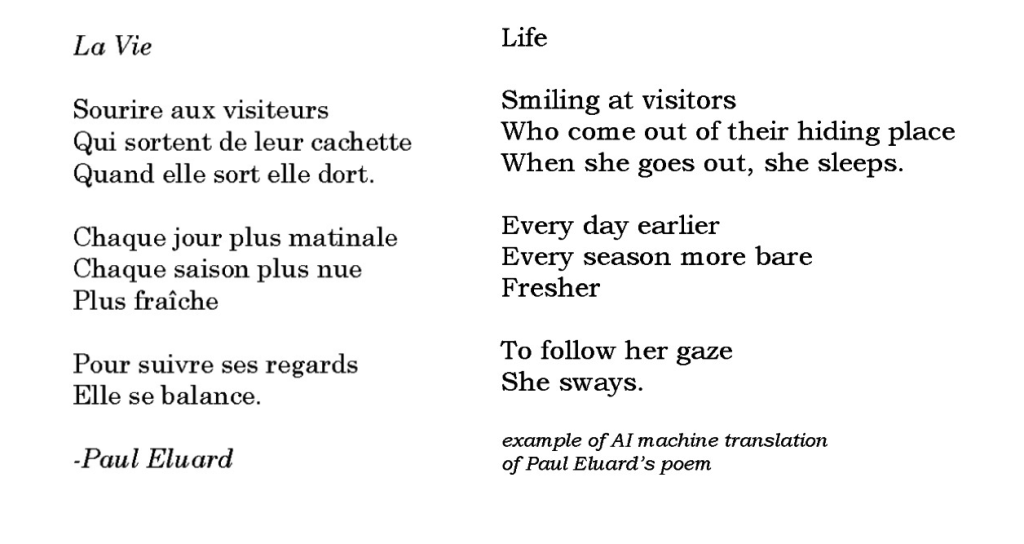
So, here we go: an early poem by French Surrealist Paul Éluard, “La Vie.” I start with a machine translation.
The 1926 poem in its original French, and a computer translation
.
The syntax comes out somewhat scrambled or hard to follow. As a prime Surrealist, one that knew and went through the Dada predecessors to Surrealism, this is likely there in Éluard’s original French I think. My first questions are what are the images: what does the author want me to see, or otherwise sensually appreciate? This can be hard with Surrealist poetry or the like: they often seek strangeness or even nonsense in images. All good imagery works with some degree of mystery or novelty, anything less risks cliché. Even one of those images that you read and think “I’ve never seen it like that before, but once I’ve read this, I’ll always think of this comparison” has to surprise you, cause you to take the leap of likeness. Surrealism says you need to outright react that’s impossible or outrageous to fully free and implement the imagination. So, my primary task is difficult with Surrealist poetry – they may want to be impossible or impenetrable, yet I still try to make the images clear, and this may be subject to mistakes. It’s also possible that in psychoanalyzing the poem that I may be putting things in there that the conscious intent of the original poet didn’t intend. ***
Examining the gloss, I think Éluard is describing a woman whose consciousness is either in a dream state mimicking waking life or living her waking day informed by, or as if, in a dream state. I think the image wants that ambiguity, to have it both ways. Either way, the people and things she meets are like strangers who have been hiding and she has found them for the first time.
My translation, used in today’s short musical performance
.
I take the liberty while translating this image in giving double meanings to some words, using more than one English word to stand for a single French word. I’m doing what “rescaling” a lower resolution digital image does, I intersperse additional pixels/words to bring the image out. “Neu” is rendered “naked” and “new;” “fraiche” becomes both “cool” and “fresh.” This is a judgement call, and my choice may be wrong. In making those word choices, using a French dictionary with multiple meanings and usage examples of the word used in context remains useful. Another thought, that AI will miss, but bears considering: the author may have intended a pun or other wordplay .
The final two lines gave me a word-music chance to put a rhyme in to tie things up, what with “gaze” and “sways.” I was so pleased how that worked out that I overlooked one word, a mere possessive pronoun, “ses.” I’m enough of an idiot regarding French usage that I can’t be sure if it’s a male pronoun such as “his” or a general pronoun, a “he/her/it” equivalent. Who’s gaze is it? The woman in the poem? The poet, the male Éluard? Something else, life or imagination?
In my ignorance, and as an admitted failure of craft, I just put down “her,” because at the time I finalized my translation my focus had moved from the word-for-word elements to what is the vivid image; and I thought, this woman that Éluard is admiring in the poem, living the Surrealist outlook, is confident in her own gaze as she sways in either the intoxication of fresh experience or the artistic refinement of dancing her day forward, and so I wrote in my translation “her.” I thought the poem is about the woman – even should be about the woman in the conclusion if I was writing it – but Éluard might have chosen to end it with his gaze evaluating the woman’s experience: I’m the artist, they’re just “life.”
So unintentionally a feminist recasting of the poem? Surrealism does have a problem there: open to women as muses, yet not as open as it should have been in allowing them to be concrete artists themselves. Shades of Éluard and Breton, may I call my ignorant choice a “Freudian slip?”
Today’s music? This was a little exercise on my part using a depiction of a couple of chord progressions from a Joe Pass performance as the basis for the music. Pass was a great Jazz guitarist – but for external practicalities, once more there’s no guitar in this version at all! Dada composition! You can hear my musical performance of Paul Éluard’s “The Life” with the audio player gadget below. No player visible? Not a mistake or slip, it’s just that some ways of reading this blog won’t translate into showing the player. If so, here’s a highlighted link that will open a new tab with an audio player.
.
*They don’t generate good literary prose either – producing as they do some estimate of the most probable word to be used, not the one chosen by another human’s consciousness that may not be the most common one-for-one. Moreover, with poetry the word-music issue is ignored by the AI translations, and poetry is musical speech. I generally don’t do rhyming accentual-syllabic translations, the cause of many an “inaccurate” translation, but I want the resulting translated poem to sound like poetry in modern English.
**These choices are a reason I highly recommend translation as training for poets. I don’t believe I undervalue topic, message, or prose-level-meaning in poetry, but many poets are stuck in finding the best combination of what they want to say with how it’s said. While I acknowledge the real issues with AI, for a monolingual, working with a literal/prose gloss of another poet lets one develop those selection-skills of the right word, right order, right connection, while one-step-away from their own experience and desired message.
***This may be proper since Andre Breton, another founding Surrealist, thought Sigmund Freud was on to something crucial with his recent theories and psychoanalysis. That Breton may be wrong about Freud or that Freud may be wrong about how the layers of consciousness and personality work only reinforces my stipulation that this outside consideration of the poet’s fellow consciousness is necessary for accuracy and errors.
This poem by the French Surrealist poet Paul Éluard wandered into my view earlier this month, and it seems like it, and my work translating it into English, slots right in between my late wife’s poem I performed last time and this Saturday’s planned #NoKings protests planned around America.
I’ve mentioned earlier this year that in my youth I became interested in the French Modernists because I had gotten the impression that they were a key force in English-language Modernism. Later, from my work for the Parlando Project, I came to learn that this is only partially so. I wasn’t far into the Project when I realized that there was in London before WWI (at that time still the center of English-language literature) a “reverse British Invasion” going on as crucial as the 1960’s British Invasion that helped revitalized rock’n’roll music. Americans: Pound, Eliot, H.D., Frost, and even the important British Imagist theorist T. E. Hulme who had spent some expanded-sky time in Canada, were all there shaping up a make-it-new freshness. Now it’s also true that Eliot and Pound were fond of some French poets,* but as I later traced those French poets with the greater resources I could obtain this century, I found that some of those French writers were taken with Whitman and Poe.
Still, the French Symbolists, and the more internationally-sourced but eventually Paris-centered Dada and Surrealist poets were important. Having only High School French it was hard for me to absorb a great deal of French Modernist poetry, but what I was able to find in translation, or painstakingly translate myself in the 1970s was an important influence on me.
It was soon enough that I came upon Paul Éluard then, who as far as the French were concerned, was a big deal, often rated as the greatest Surrealist poet. Well, ratings are silly – ought to remain so – but his poetry had striking imagery and was often concerned with some combination of erotic love and anti-fascist politics. In the 1970s, the first attracted me primarily, while the latter seemed a noble history lesson.
Ha ha! History, it seems, has jumped out of the past, and the anti-fascist Éluard is due for a revival – and so I welcomed seeing his poem “Bonne Justice” appear on BlueSky in its original French. I could make out enough of it (my French is even more scant than it was in my 20s) to want to do a translation and possible performance.
I don’t know why his handwritten manuscript uses a circular format. Éluard may be trying to convey the eternal in natural law. Cynics might read “circling the drain.” Young moderns seeing this would need to start with the translation task of reading cursive.
.
Translation moved quickly. Vocabulary issues are easily handled by computer these days, and online sources help to drill down on a word’s flavors.** Éluard’s language here is not fancy, there are no obscure or archaic words, and he seems to me to be speaking to a general audience, not artistic theorists or avant-garde cadres. I proceeded as I normally do when translating from a literal gloss: first finding the images and what word choices will most clearly illuminate them, while giving care in preserving the “music of thought” in how the poem introduces the images and sets them off in the context of each other – though then I will take a hand at using a modern English word order and sentence structure that has some new music of sound in its new language. I rarely try to make rhyming translations. This poem’s word-music retains Éluard’s original repetitions, which I think are sufficient.
A chord sheet presented so that others can sing this fresh song created in English from Éluard’s poem.
.
So, my “Beautiful Justice” keeps all of Éluard’s parallels, though I made one set of considered changes, both for the benefit of myself as the performer of the result, and from my reading of Éluard’s intent. This poem seems to be speaking of qualities and situations of mankind as a whole, but he uses “hommes” (men) for this, and in another case a masculine noun for brothers (“frères”) which I rendered as “family.” I decided these gendered words were outdated conventions that would benefit from translation. Yes, I was thinking too of my late wife’s poem, “In Another Language,” performed here last time, who in those same 1970’s was dreaming a genderless language.
It’s just a single acoustic guitar and my rough-hewn voice for this performance. If one wanted to remember this poem, now song, when marching on October 18th, it could be portable that way, though I don’t think my own performance is a stirring march – it’s more a reminiscent prayer. Prayer is focused speech. Song adds intensity of breath and music to speech. Marching and standing together, as simple as that is, adds action from our bodies (even this old man’s body). There may be more going forward that we will be called to do – who can tell with accuracy – but I think it’s not a bad start to be praying in song for those laws old/yet new, those always perfecting laws that protect us, the laws that aren’t capricious decrees to persecute and sever us.
You can hear my song in English made from Paul Éluard’s French poem with the graphical audio player below. No player? This law says you’re permitted to click on the highlighted link and it will open a new tab that will have its own audio player.
.
*Core Imagist F. S. Flint, working-class-born, but a native Londoner, worked hard to promote modern French poetry in this pre-WWI era for one.
**Though an online French dictionary I use for that had a service outage while I was working, and I began to dismay that I’d given away to charity my large old French-English dictionary volume.
As I promised last month, there’s going to be a few more posts here without new audio pieces, discussing some side issues and ideas I’ve run into during the last year or so of the Parlando Project. Some of these are going to be lengthier, and they may not be as interesting to those who come here just hear surprising combinations of music and words. I’m using the tag “About” on this sort of post, so that you can easily filter the audio containing posts (Podcasts) from these.
Today’s post is about what I found as I looked at Tristan Tzara’s poem “Vegetable Swallow.”
Why was I looking at Tzara poetry? I have a long-standing interest in the Surrealists, a movement that followed Dada, and with whom Tzara sometimes made common cause. And my first translation of Tzara for use in an audio piece, his elegy to proto-Surrealist Apollinaire, was unexpectedly popular here, the third most listened-to piece of last summer. So, time to look into some more Tzara I thought.
I own books that I could have searched, but they are poorly stored and arranged, and so I relied on our modern vade mecum, The Internet, to see what else might be out there to compose music with. A familiar search engine found 122,000 results for Tzara poems, but of course all is relative. One of my favorite French Surrealist poets, Paul Éluard, still obscure to many English speakers, had 222,000 results, and Carl Sandburg turned up 448,000. Emily Dickinson? 23,000,000! So Tzara’s poetry is not as widely available as some. I did not look at all 122,000 results, but of the poems I found translated into English, a handful seemed to repeat, and looking through them, I eventually thought one titled “Vegetable Swallow” had the most potential for use along with music. Here is how it appeared on several web sites, in an unattributed English translation.
two smiles meet towards
the child-wheel of my zeal
the bloody baggage of creatures
made flesh in physical legends-lives
the nimble stags storms cloud over
rain falls under the scissors of
the dark hairdresser-furiously
swimming under the clashing arpeggios
in the machine’s sap grass
grows around with sharp eyes
here the share of our caresses
dead and departed with the waves
gives itself up to the judgment of time
parted by the meridian of hairs
non strikes in our hands
the spices of human pleasures
Why did I select “Vegetable Swallow?” It was a good, short length. It seemed to have some musical qualities. I liked how it concluded. Some of it was incomprehensible at first take—but it’s Dada isn’t it. This is, after all, a poet who taunted the art-world with the idea that randomly arranged words could be compared to the value of recognized literary art.
I found I had preferred my own translation of Tzara’s “The Death of Apollinaire,” and so I aimed to do my own translation of “Vegetable Swallow” too.
As I started work on “Vegetable Swallow,” I first had to find it in the original French. After some searching, I found an edition of Tzara’s “Poésies Complètes” to work from. Right from the top, at the title, I started to dissent from the English translation used elsewhere. Perhaps you read “Vegetable Swallow” as Dada: two unrelated words jammed together for the effect of absurdity, but one could also read it in English as a compression of the phrase “Eat your vegetables,” which can be a parent’s command, or a commonplace for feeling obligated to do the unpleasant but necessary thing. But in French, swallow as a verb is not the same word as swallow the bird. Tzara used: “Hirondelle,” and as Minnesota’s own Dada bards The Trashmen once proclaimed: “The Bird is the Word.” I would have chosen “Vegetable Martin” or “Vegetable Bird” as the title, because I clearly think I’m conveying Tzara’s presentation more accurately there—even though, in this case, I’m making the title more hermetic.
The next major puzzle I have is with the second line “l’enfant—une roue de ma ferveur.” In the online text the em dash has changed to a hypen, and we are pressed to visualize a compound noun “child-wheel,” rather than to break the thought after child/l’enfant. I made a more speculative translation of roue/wheel, when I saw that the same French word is used for the gymnastic “cartwheel”. Cartwheel is a very specific, vivid image. It’s also an inside joke relating to the story that Paul Éluard met his wife when she literally cartwheeled down the street. It does the job of making a hyphenated “child-wheel” comprehensible, even if child-wheel’s presence in the Internet version may be a typographical misunderstanding.
In summary, the first stanza is two lovers together, embracing (or at least realizing/admitting) their carnal physicality.
The second stanza to me describes a rain storm above our two lovers. I can’t tell if stags are the storm clouds, or creatures caught in the storm. I chose caught in the storm. Next up I probably make my own mistake, which I’m catching only now. I translated “coiffeur” as simply hair because one of my computer translators had it as hair and I didn’t double-check that, when it now looks like “barber” or “hairdresser,” as in the Internet version, is more likely correct. I love the image of the rain falling down like hair cut by the barber’s scissors. Maybe the image works better if the focus is on the dark hair as heavy rain instead of the immaterial hairdresser, but still, I’m likely wrong on what Tzara wrote.
I make the syntax of the third stanza more English, and I make the most substantial and speculative change in the last line there. I understand “mordues” to not mean dead, as the Internet version has it. It can mean bitten as a verb or a fan/fanatic as a noun from what I find. I chose to go with the fanatic choice. And “parties” can mean part, but it can also be used for a political or other faction. From my choice of “fanatic” I could have then gone with “faction” for the French “parties,” but instead I chose the image of the swirling waves as a convention of fans or fanatics. I liked that image in as a presentation of two ardent lovers sharing caresses within the stanza, but now I’m thinking maybe I should have gone with the ideas of bitten and apart, as it would foreshadow the final stanza to a degree.
In the final stanza, I change around some syntax a bit too, but, in the next to last line, I confront a typo, repeated over and over as the other translation is duplicated on the Internet: “non strikes in our hands.” This is surely Dada! Is this a crossword-puzzle clue for baseball fans with a naughty testicular subtext (but what does Tzara know of baseball?) Or is it a cry against our complicity in the suppression of organized labor’s rights? A clumsy bowler approaching the lane, about to roll another gutter-ball? Such rich poetry!
No. It’s a missing “o.”
Here again, accessing the original French helps, though I should have distrusted one of my machine translators more in other matters after it insisted on translating “midi”, the common French term for noon, as MIDI. Perhaps it knew that I would be using MIDI to play synthesizers from my guitar and little plastic keyboard?
Fixing the typo allows the poem to close strongly. The last stanza’s first line works in either the Internet translations more active voice (though I would have chosen the stronger “surrenders” to “gives up” if I went that way). My choice is more passive: “The hours’ judgement is offered.” I think the third stanza is something of a time-lagged aubade, were the lovers have reached a time (noon instead of the traditional dawn) when they must part. The Internet version of the next-to-last line, with the typo fixed: “noon strikes in our hands” is fine. My version, “gone noon in our hands” means to clarify what I feel is the image here, the reclining lovers atop each other, hands clasped together above their heads, like the hands of clock at noon, knowing they must part as the day reaches the border of PM (Post-Meridian); but typo fixed, the Internet version may be more accurate to what Tzara wrote. I’m afraid that by this point, I had been letting my poet half overtake my translator half, and I wanted the poem to end as well as it could by my lights, even if I was recasting what Tzara wrote to a sense of what I think he was getting at.
In the end, the Tristan Tzara poem “Vegetable Swallow” I found on the Internet in English is less of a Dada exercise in scourging language, and more of a sensuous love poem, albeit one with fresh images. And even if you are not an expert in the foreign language being translated, checking English translations against the original is revealing. Furthermore, just as in performing the work does, doing one’s own translations helps one see deeper into the choices the poet made.
So yesterday, proud of my work, I was disparaging the unknown translator of the “Internet Version” of “Vegetable Swallow.” Reviewing and double-checking my work after the deadlines of performance and recording were finished, his work comes off better upon further review. In the second and fourth stanzas, his work is more accurate than mine, and arguably better than mine (even if I’m doing the scoring). And with the hilarious “non strikes” typo, he’s blameless.
And from further research last night, I think I can identify the translator of the Internet version: it’s Lee Harwood. I was even able to find an audio link on the web where he reads “Vegetable Swallow.” Even just hearing the modesty in his voice at midnight, him reading “Vegetable Swallow” across the network as I stayed up too late tracking this down, I wished I could sit down with him and ask him more about his own work and that of Tristan Tzara. Alas, he died two years ago this summer.
Several Internet sites use Lee Harwood’s translations of Tzara, yet do not credit him.
For easy reference, here are links to the players of my translations and performances of Tristan Tzara’s “Vegetable Swallow” and “The Death of Apollinaire.”
I promise you, we will end up today very close to the love song of the last episode, though we will travel a ways before we get there.
I’ve not featured any French writers yet with the Parlando Project, but as this summer has used the words of many 20th Century English poets, we may be overdue for that, as the start of that century found some of them looking to the French for some new ways to write.
French poets started to go “modern” before the British poets, around the same time that Emily Dickinson and Walt Whitman were making their own breaks with past practice in America, so they had a head start, and their avant-garde was way past the supply lines of conventional narrative and sentiment by the time the 20th Century really got rolling. The absurd casualties of WWI, largely fought in France and its neighboring countries, and so deadly to some of the generation of men doomed to fight in it, only accelerated the modernist direction away from the kind of meaning you might find in a political speech or battle plans.
This summer, 50 years ago, the Polish-French writer Guillaume Apollinaire coined a new word to describe a new way to approach the world in words: “Surrealism.” A few years later, his term was taken up by a group of artists who went about trying to practice a new idea, presented in 1924 as if it was a political manifesto, to write and create from:
“…The actual functioning of thought. Dictated by thought, in the absence of any control exercised by reason, exempt from any aesthetic or moral concern.”
The Surrealists went on from there, going in various directions, becoming less an idea and more of a brand—but stop and think for a moment, that original idea, isn’t it powerful? The idea that there is a reality that we agree not to apprehend, not to speak of, that we constantly reframe our thoughts to, isn’t that idea political as well as aesthetic?
You take the idea of Surrealism, add music to it, and later that century you get Bob Dylan. You take the idea of Surrealism, apply it to the current reality, and you are woke, not from the dream, but to the dream that should not be denied.
Today’s piece uses the words of one of the French Surrealists, Paul Éluard. Éluard, like many of the British poets of this era, was another veteran of WWI. One story of his war service was that, since he was a writer, his military superiors assigned him to the office tasked with writing the official letters to the relatives of the casualties, and such was the efficiency of modern war that he sometimes needed to write 150 of them a day. After a year of this, he asked to be sent to the frontline trenches.
Jean-Luc Godard’s film “Alphaville.” “I love you” could be the ending.
I have exposed you several times this month to pieces about the horrors of war and slavery, but I also told you we must travel a ways to get to today’s piece. After the war, as a founding Surrealist, Éluard produced verse with strange images and seemingly arbitrary combinations—Surrealist tactics to break the conventions—but his great subject, against the night, pain, and suffering, was love. Perhaps after those 150-letters-a-day forced march, he too wanted to look to war’s opposite.
Paul Éluard and the beloved, Gala. Eyelids not visible in this picture.
“L’Amoureuse” (The Beloved) is one of Éluard’s most famous early works, and uses my English translation of his words. The LYL Band performance of it was recorded live several years ago. To hear it, use the player below.