An exchange from the Prologue to Kora In Hell

William Carlos Williams Kora in Hell  is an unusual book. Its subtitle: Improvisations  promised me more than it delivered. Improvised or semi-improvised poetry, that true Jazz poetry where the author composes on the spot from themes or from spontaneous inspiration is something I admired and—to a degree—practiced in my youth. The improvisations of Williams’ book are usually classed as prose poems, but I don’t find much music in them nor a sense of surprise or discovery. They do reflect the influence of Dada and Cubism, and if I could hold my attention on them longer, they might still bring some pleasure and illumination to me—but so far I haven’t been able to do that. But nearly half the book as published is prologue and that was more rewarding to read.

One can get a real sense in the prologue to Kora in Hell  of where Williams found himself a century ago when it was written. There’s a lot of self-assertion, a lot of names dropped, a lot of debates on poetry and art where Williams as the author of the piece gets to be not just a debate participant, but the moderator, editor, and director of the debate. Poets Ezra Pound, Mina Loy, Wallace Stevens, Marianne Moore, T. S. Eliot, H. D. and Alfred Kreymborg make their appearance. In visual arts Duchamp, Man Ray, and Charles Demuth are referenced. Earlier this year I also noted that a forgotten Modernist poet and editor Orrick Johns has one of his poems quoted in the prologue without attribution.*

The point Williams seems to be making over and over again in the prologue is that he is just as important, connected, valid and artistically insightful as any of these. One can easily view this assertion in a multi-valent way. Williams could easily have felt isolated and left out, now resident in New Jersey and earning his living with a bourgeois job** as a physician. And however genteelly it’s couched, most artists must engage in self-promotion—it’s unlikely that any ego-less man or woman ever set out to write a poem or paint a picture. And the point he’s making, that he, Williams, has something worth considering has  since been validated by the canon-setters.

In the case of two poets, Pound and H.D., Williams has a personal history, having known them in his college years. And it’s an exchange of letters with H.D. excerpted by Williams in the prologue to Kora in Hell  that I used for today’s audio piece. In her letter H.D. is offering gentle advice regarding something Williams has written. She’s noticed some stuff that seems derivative and that she feels doesn’t represent Williams’ individual inspiration. She sets that observation in the context of a writer’s calling and the sacredness (in her view) of the artistic enterprise.

HD and WCW

Two initial American Modernist poets: H.D. and W.C.W.


Williams, the home team here, gets to respond in the bottom of the inning and he shrugs briefly before thundering. He doesn’t really address the substance of H. D.’s feedback so much as he jumps on the “sacred” sentiment it’s couched in. Sacred in Williams’ mind is associated with singular artistic criteria, the kind of thing that Eliot and the New Critics of High Modernism are starting to create in a revised standard version—and he’s again’ it. When Williams says “There is nothing sacred about literature, it is damned from one end to the other” it sounds as a ringing iconoclastic statement, but what does he mean? Is he saying “There’s so much crap around that folks think is great art, so who should care what little mistakes us Modernist innovators make.” Or is it something else? Is he perhaps saying something akin to a maxim I repeat here often, that “All artists fail.” Is Williams claiming that to attempt some impossible sacredness, forgetting that the artist will fail, will harm the work from that intention?

There is nothing sacred about literature, it is damned from one end to the other.

He then closes, in a sentence as musical as anything in the prose poems that follow, with a Dada litany. A half a century later, another Dada-influenced artist who influenced me, Frank Zappa, would phrase the same principles when he said his artistic rule was AAAFNRA, “Anything, anytime, anywhere for no reason at all.”

I’ll have more to say on this in a follow-up post, but this is long enough for one sitting and it’ll give me a little space to talk about the music in today’s piece. I got to use two new components in composing this. The opening section features a fine pipe organ virtual instrument from Garritan. In a vary real sense, the pipe organ was the first, wholly mechanical, embodiment of the synthesizer, and I personally can’t play or compose for it without thinking of Michael Barone and his long-running radio show “Pipe Dreams” featuring that instrument. The orchestra sounds are from Sonuscore’s The Orchestra which is a novel approach to orchestral virtual instruments. My initial encounter with using The Orchestra mirrors most other reviewers: it makes adding orchestra colors simpler than most while giving indications that it can be used deeply if one gets under the hood of the default ensembles.

This may be a good time to explain how I use virtual instruments here, and particularly orchestral instruments. I’m thinking that many of our casual listeners when they hear Dave or myself chanting or singing away with everything from a string trio to larger ensembles that I’m just dropping in some loops or samples from a recording. There’s a good deal of that done on the Internet with poetry and I won’t knock it.*** After all, I subscribe to the maxim of Duke Ellington’s that Peter Schickele sustained “If it sounds good, it is good.” However, because I consider myself, despite my limitations, a quasi-musician and an intentional composer, I choose not to do that. Those string and orchestra parts are played,  on little plastic keyboards or with a guitar MIDI interface. Sophisticated musicians probably already know that because even while using orchestral instruments my harmonic framework is either based on rock’n’roll/blues and their common “three-chord trick” or on older drone/modal folk music traditions.

So the opening H.D. section of today’s piece is a three-chord trick, something that any garage band or punk musician would understand. And the William Carlos Williams part that follows is simpler yet harmonically, based on just C to D major chords, though the color notes of the electric guitar solo extend that slightly. When someone asks what kind of music I write I’m at a loss for useful words. I’ve said extended folk music and I’ve said punk orchestral.

To hear me present the epistolary dialog between H. D. and W.C.W, use the player below.


*As I said when presenting John’s “Blue Undershirts,” it’s possible that Williams, who praised the lines he quoted and used a similar though extended expression in his anthology staple “The Red Wheelbarrow,” might have thought that Kreymborg wrote them, since he quotes them while praising Kreymborg.

**I have no idea of Williams’ intent in that “day job” choice—or even how good or bad he was as a physician—but given the latency and indirectness of writers and artists impact on their fellow human beings, such work may be a useful adjunct to the writing life. I myself spent nearly 20 years of my working life in the lower levels of nursing. As I told my wife recently in a moment of clarity, I figured that if I couldn’t help myself at least I could be some help to others. Young artists: consider this.

***I must also mention modern hip-hop production which has developed a class of composers who are very adept in using samples, bits of recordings, and timbral eclecticism in a way that if someone had described it in the mid-20th century it would have seemed the very essence of an elite and esoteric avant garde, and thanks to a blessed (as in The Beatitudes) audience, and a good dose of the ever-popular folk music elements: intoxicants, sex and violence, they’ve made widely-heard popular music with it. This strikes me, along with Bob Dylan completing the Modernist revolution in poetry, as the most significant and surprising artistic events of my cultural lifetime.

Summer 2018 Parlando Top Ten, Part Two

Continuing on with our countdown of the most liked and listened to audio pieces during this past summer here at the Parlando Project, today we’ll look at the pieces that came in 7 through 5 as we move up the list to the most popular piece.

7. The Hunter. Maybe, with Internet audiences, it’s the cats? I’ve playfully included pictures of William Carlos Williams with said cats in a few posts, and Williams, who sometimes thought he was overlooked as an American Modernist while he was alive, seems to be holding an audience, even though his poetry doesn’t present itself with open, easily accessible sentiments. His even more difficult “St. Francis Einstein of the Daffodils  almost gave Williams two appearances here this summer, falling just a couple of places back from the top ten. Or maybe it’s the informal American language that he uses? Other American Modernist contemporaries of Williams: T. S. Eliot, Ezra Pound, or Wallace Stevens often liked to drop leaves from a Word of the Day calendar into their poems, while the New Jersey doctor generally didn’t. Maybe there’s something here with Williams like the cats: familiar and domestic, intriguing, but not seeking to please? After all he once said: “I didn’t ask you to understand anything, only to listen.”


6. The Apotheosis of Harlan Ellison. I’ve warned readers already that this summer’s top ten has too many pieces where I wrote the words, and that’s not representative of what this project is about—and so, here we have the second of three pieces in this summer’s top ten where I wrote the words I perform. Well, at least this one is about someone else, the long-time critic, writer and SciFi anthologist Harlan Ellison.


James the imagined  author vs Jimi the reader of SF

I talked about how Ellison helped encourage Octavia Butler, but what if avid SF reader Jimi Hendrix had decided to go the literary route?


5. Beloved. My words again, although as I tried to explain in the original post here including it, I was inspired by a statement Bobby McFerrin once made about music, how it touches you inside on that sensitive flap of skin named the eardrum. Given that news this past week has included stories about unwelcome touches, that metaphor goes both ways.


WCW with a baby

Excuse me, while I kiss this baby. If cats and William Carlos Williams brings in readers, how about W.C.W. and babies?


Back soon with numbers 4 through 2 in our look back at Summer 2018’s most liked and listened to combinations of words and music.

To W.C.W. M.D.

It’s now 1916—well not really—but allow me immediate mode for the time being. Some early 20th Century Modernist characters we’ve already met are about to collaborate in New York City with a largely forgotten figure whose words we’ll meet today.

The Provincetown Playhouse, that CBGB’s of Modernist American theater, has moved its organization from the remote Cape Cod artist’s colony to New York’s Greenwich village, and they’re still looking for new types of plays by new playwrights. How about drama using Modernist poetry?

Verse drama, despite continuing productions of Shakespeare, is a thing that often generates rumors of revival while never really reviving. In 1916, the Provincetown group was open to trying this. Which poets can come up with something?

Alfred Kreymborg could. Kreymborg was a leading networker or influencer in the New York area for Modernist poetry. Ezra Pound, and then Amy Lowell, would publish anthology books of Imagist Poets. Harriet Monroe out of Chicago was also gathering new Modernist work for Poetry  magazine. In 1916 Kreymborg would do the same in New York, with a magazine and anthology book series called “Others.”  Kreymborg had also been writing poetry, short poems mostly, all of them free verse. Now a play.

Others group

The “Others” group: L to R in back: Jean Crotti, Marcel Duchamp, Walter Arensberg, Man Ray, R. A. Sanborn, Maxwell Bodenheim. In front: Alison Hartpence, Alfred Kreymborg (bowtie daddie), William Carlos Williams (w/ Internet click-bait cat) and Skip Cannell


The play he wrote is an odd thing to describe. Titled “Lima Beans,”  it’s a two-character play about a couple. The husband loves lima beans, the wife decides he might also like string beans and surprises him with the new beans—but no, he loves lima beans. He stalks off, angry. She scrambles and gets some lima beans. He realizes he loves his wife, returns and she’s got lima beans for him. Kiss. Curtain.

I guess this could be a Seinfeld  episode plot decades later, but that’s not how Kreymborg uses it. He writes his play with litanies of repeated words, hocketing between the two voices. After reading the play this month, I’m guessing a performance might sound like a cross between Dr. Suess’ Green Eggs and Ham  and a late 20th Century Minimalist musical work by someone like Phillip Glass or Meredith Monk. Or as Preston Sturges’ Sullivan would have it, Waiting for Godot  plus vegetables—but with a little sex in it. That musical comparison is particularly apt, because even though the play did not use musical accompaniment, Kreymborg saw it as a musical structure.

So here in 1916 we have the Provincetown group, putting on a play that pioneered a performance aesthetic that still seems audacious 50 or 60 years later. Who are you going to get as actors to realize this—words and a presentation of thought conveyed musically, without actual music?

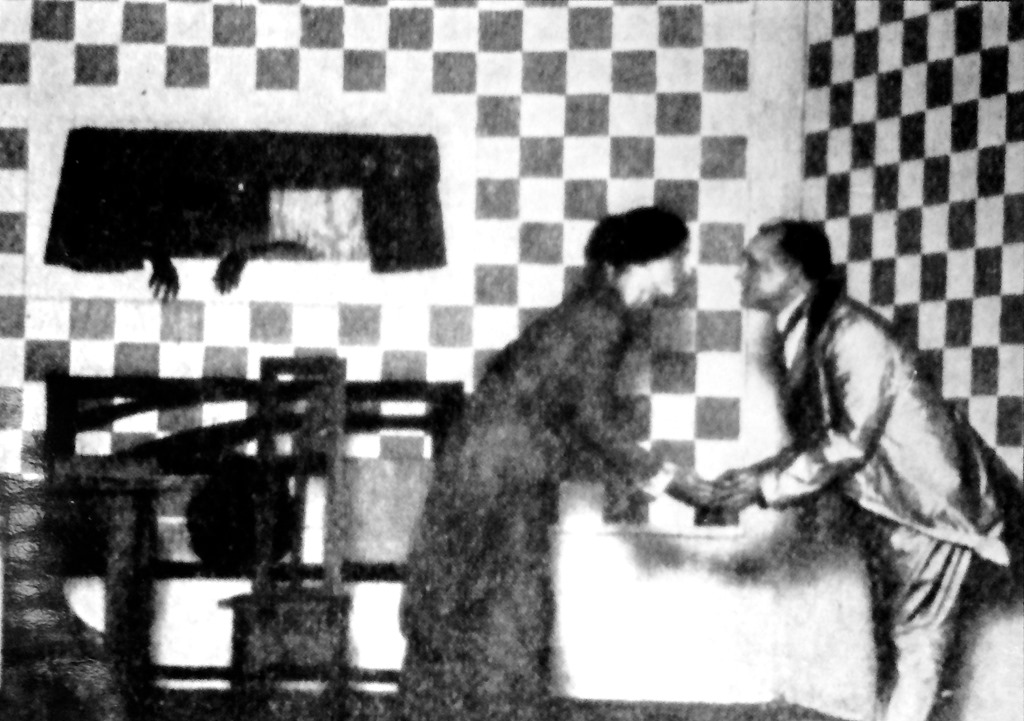
Poets.  In the role of the husband, William Carlos Williams. In the role of the wife, Mina Loy, who had just arrived in New York after getting away from those Italian Futurists. Neither poet had acted before, but Kreymborg rehearsed the two poets until they could present his free-verse vision.

Loy and Williams in Lima Beans

Mina Loy and William Carlos Williams in Lima Beans. The set for the proudly independent Provincetown Playhouse production cost $2.50, and its set designer, William Zorach,  also played the 3rd character whose hands are hanging, Soupy Sales-like, out the window.


I toyed with the idea of trying to realize Lima Beans  here, although with music this time. But it really needs two voices, and I wasn’t sure that a short section could do justice to the structure of the piece.

In it’s place, I looked for a short poem of Kreymborg’s to use instead. This proved more difficult than I thought it would be. I read his two poetry collections from this era, but no poem grabbed my attention. As in the play, he’s looking for a new poetic language in these poems, but it’s hard to grab the emotional center of many of them for performance.

In the end I chose today’s piece: “To W.C.W. M.D.”  It’s dedicated to William Carlos Williams. This might be more of Kreymborg’s log-rolling networking skills on display, but its subject also answered a desire I have to do a piece remembering my late wife Renee Robbins in some way today. As best as I can penetrate the emotional core of this poem, it speaks of the need to separate and not separate from those that have died.

Musically, the piece is based on one stacked chord, E minor7/11, but the notes are spread out between the instruments. Besides drums there are two bass guitars, piano, two viola parts, a violin part, and a clarinet in this. To hear it, use the player below.


St. Francis Einstein of the Daffodils

Metaphor, that stuff that helps make the music of thought in poetry, is the linking or liking of things. This is like that. This stands for that. The sensation of this is like the sensation of that. This reminds us of something else. The way I say this recalls the way one says that. Metaphor recombines the stuff of our world even though it’s a combination that only exists in the imagination.

Metaphor can make something clearer to an audience. It’s so useful in that way that one can barely explain anything challenging to an audience, even in the most prosaic day-to-day business world, without falling into metaphor. In poetry however, the bounds of increased clarity can be stretched, broken, and abandoned. Depending on one’s mood as a reader, this can be frustrating or a pleasing play of the mind. With the Parlando Project we perform the poems with music. One hope from this is that you can relax and let the beauty or strangeness of the words carry you over gaps in meaning. Sometimes you can enjoy a poem before you understand it.

William Carlos Williams who wrote the words in today’s piece, gives us Spring weather with Spring flowers and fruit blossoms, gardens and orchards, and all under a title that combines a famous saint with his era’s most famous scientist. He gives us almost no help in combining that title with the poem, other than yoking them together. The linkage of metaphor is much strained here, even when he further explains his title by adding a sub-title: “On the first visit of Professor Einstein to the United States in the spring of 1921.”

How are we to make the connection that will construct the metaphor?

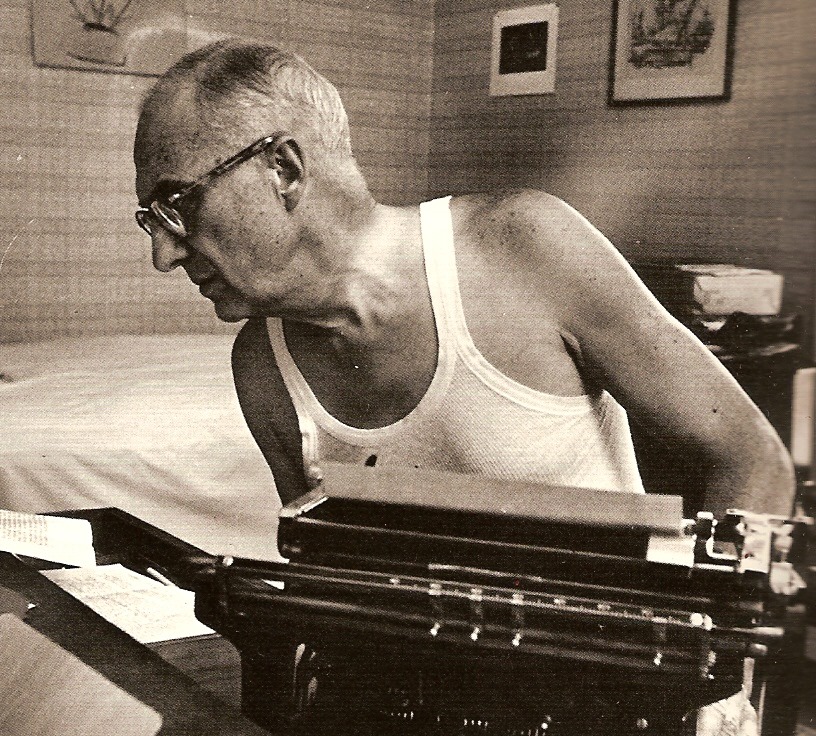
William Carlos Williams with typewriter

Just another hipster with his typewriter. William Carlos Williams throws off his covers.


My best understanding so far is that the connection is wonder and change. Recall our last post, where in his “Queen Mab”  Percy Bysshe Shelley, the Romantic early-19th Century poet, gave us a vision of the wonder of an immense cosmos, which Shelley’s own notes tell us he could also sense through the poetic/mathematical meter of the speed of light. The theoretical scientist and the visionary poet each seek to grasp some new metaphor of the world. Einstein was changing physics in the time that Williams and his fellow Modernists were seeking to change the apparatus of art. Williams elaborates on this theme mostly by vivid descriptions of the change of Spring. In the only mention of Einstein in the body of the poem, Einstein is “tall as a violet.” He is the Spring’s new growth.

There are a couple of obscure literary references in one section, the sort of thing T. S. Eliot or his imitators would have used. Who is “Samos, dead and buried?” I’m not sure, but my guess is that it’s Pythagoras of Samos, the famous classical Greek philosopher for whom science and the arts were one. And Lesbia? Catullus’ Roman poetic beloved, who we’ve met here in Elizabethan guise. It may be enough that they have ancient sounding names, and of such ancient classical modes, Williams, who is in some ways the Anti-T. S. Eliot, says “Sing of it no longer.” He moves right back into a present day of Spring. Pythagoras is dead, Catullus’ Lesbia is dead, and so is a black cat buried in a newly planted garden. Awhile later in the poem we may get one more connection to that cat part of this buried trio. A chicken-raising man who puts out poisoned fish-heads to keep the cats from his chickens. That man becomes like the Modernists, needing to kill the ancients to protect the new flock he’s raising.

As a side note, this poem’s chicken farmer, the white-haired negro, was quite likely the man whose rain-glistened red wheelbarrow sat next to the white chickens in William’s famous poem of admiration.

The poem closes with a sensuous image of Spring change, a night that grows warm as an orchard owner opens his windows and throws off the covers that were needed in the cold. In an earlier version of the poem, Williams had woven Einstein by name in and out of those Spring images explicitly, including this last one where Einstein was named as that man with the blossoming orchard, another grower of renewed things. In this later version, all these stated links to Einstein are removed (save for that one Einstein as a violet).

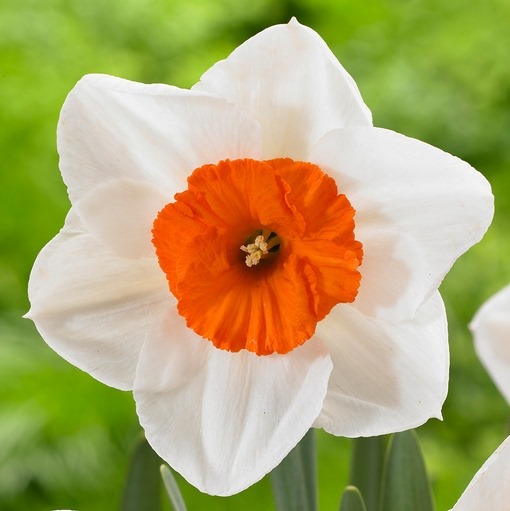
Professor Einstein Narcissus

Not a violet, but the “Professor Einstein Narcissus.” Has “great curb appeal” and “deer won’t eat” says this garden center.


Was that a right choice? The resulting poem is shorter and more mysterious, but it also doesn’t make it easy to see what Williams is getting at. He’s using metaphor, but he’s removed all the connections. I decided to perform the later version. I think it performs slightly better, and perhaps the music makes the obscurities less taunting.

A simple musical arrangement this time, just acoustic guitar and subdued electric bass. To hear my performance of William Carlos Williams’ “St. Francis Einstein of the Daffodils,”  use the player below.


The Hunter

A couple of mornings ago, I awoke after a night’s sleep, and as I took my bicycle out to the alley to ride off for breakfast, I was surprised to see the road dusted in torn blossoms and several small tree branches cast about on the wet ground.

While I had been still and sleeping, a storm must have come up.

That contrast, the stillness and the broken change is at the heart of today’s poem by William Carlos Williams, “The Hunter.”   Williams opens his poem with an allusive image. “In the flashes and black shadows of July.” Is this the lightning of a summer storm? I thought so at first. But it might be just what one sees lying on summer grass and looking up through the boughs of a tree. The whims of a breeze or the caprices of squirrels and birds on the thin branches will flutter the leaves’ fan of shade revealing the sun in a flash.

Yet, summer “seems still.” The animals of summer appear “at ease.” But what if there is danger in the world, as in the unmet character in the poem’s title, the hunter?

William Carlos Williams with Kittens2

In a last-ditch attempt to increase readership of his poetry, William Carlos Williams decided to try that Internet staple: cute kittens.


In Williams’ poem, the hunter does not appear, ready to shoot the game. The hunter is invisible, as the hunter is time, the hunter is change.

For today’s music I combined an orchestral ensemble and electric guitar with an appearance of a harpsichord.  The player gadget to hear my performance of “The Hunter”  is at the bottom of this post.

I’ve noted that there has been a steady listenership for the other William Carlos Williams poems posted in the archives lately, and that helped inspire me to look for more of his work to present. As we move into summer, I remind visitors that there are over 220 pieces available here. Use the search box or just wander through the monthly links on the right.


The Parlando Project Winter 2017 Top 10 Part 1

I’m going to do the top 10 list a little differently for the past fall,  doing it in parts, so as to not overwhelm visitors here in one post with more audio pieces than you might have time to listen to. I’m also a bit pressed for time right now, and this fits with my schedule as well.

In traditional fashion, we’ll start with the 10th most popular audio piece from the past three months, and work our way up the list in popularity judged by your streams of the audio and likes on the blog.

Number 10, we have my looser translation of Rainier Maria Rilke’s “The Dark Interval,”  which is one of five pieces that are returning from our last Top 10 from September.  I translated this a few years back, making choices at the time (as translators must) as to what the author was getting at in the original German, and what English could most effectively reflect that. Knowing just a little bit more about Rilke, I think I’d make some different, better informed choices now, but the choices I made then do make for a particularly apt Winter poem with it’s opening skiing metaphor that was my most audacious choice. Rilke’s lines “I can speak in many voices/but this voice shuts up quick.” remain personally meaningful.

Musically, this is one of the short and pretty ones, so go ahead and listen.


Number 9 finds the piece that remains a perennial on the Top 10 lists, a little angsty ditty written by a love-lorn teenager infatuated with a neighbor girl. Although he didn’t actually complete the piece, with it’s acrostic scheme that was to spell out the young woman’s entire name left abandoned partway through the last name, and even though he apparently didn’t get the girl, you have to admit it’s an ambitious move by a young poet or suitor.

I titled it with the love object’s first name “Frances.”  The guy went on to military and political success, capping it off eventually with popular success as a wordsmith here. You may have heard of him: George Washington


Rose3

“When the last rose of summer pricks my finger…” photo by Renee Robbins


Well, is it all going to be repeats from last time? No. At number 8 we have a newer piece, making it’s first appearance on a Top 10 here, William Carlos Williams’ “It Is a Small Plant.”

My late wife often found pleasure in looking at things closely. How intent and intense could her focus become, and what would that reveal? If she found out, she could never tell me exactly, only that she was drawn to do that. Many years ago, after her death, I took to digitizing the photographic slide prints that she took, some of which were as close to buds and flowers as her lens could focus, and the feeling of being behind her eyes, looking with her intent, fell over me.

Williams does something like that in his poem, which also cannot tell you straightforwardly what it apprehends, while the power of the seeing is overwhelming. I like the music I played for this one quite a bit, particularly the fretless bass part, an instrument that I took up this year, and have felt greatly rewarded by.


That’s all for today, but three more of the Top 10 will be posted here soon. And remember, we now have over 160 pieces posted, so if you’d like to see what else we’ve performed and interpreted, the Archives (to the right on the web page) will let you listen to other pieces.

Arrival

Today’s words are from William Carlos Williams. Unlike our last post, I wouldn’t call this a love poem. Oh, I believe there’s an assignation between two people in the opening section of this poem, but affection seems missing and the desire, if present, seems to be questioned—no, that’s not quite right—the questioning of desire is silent, present in its absence.

William Carlos Williams 1

Poet and physician William Carlos Williams casts a cold, clinical eye on desire

This is another poem I came across at the Interesting Literature blog, where it was included in a round-up of seduction poems. We’ve visited a few of that type of poem here as well, with shepherds, nymphs, a merchant’s wife, and Williams’ fellow physician-poet Thomas Campion making invitations—but this isn’t really a proposition, any more than it’s a love poem.

Williams’ poem is not titled something like “Come Live with Me and Be My Love”,  it’s titled “Arrival.”  So yes, an assignation, but one with a schedule like a train or airplane flight, or as we’ll soon see, like a season. Is there desire in the unhooking of the dress? In modernist, Imagist style, that emotion is not stated, but the passive voice and sparsest of descriptions argues that it’s there and is not there.

After the poem finds itself, as many of us have or will find ourselves one day, in a “strange bedroom,” a sea change occurs. The woman in the dress has disappeared. In her place: an autumn tree, disrobing its leaves because the season is felt arriving. Again, desire is not mentioned—it wouldn’t be mentioned, this is an Imagist “show not tell” poem—but this image is also passive and rote.

I’ll let you feel and figure out the image of the final few lines yourself. The now naked woman as bare winter tree? Or is her presumably male companion’s body being synecdoched?

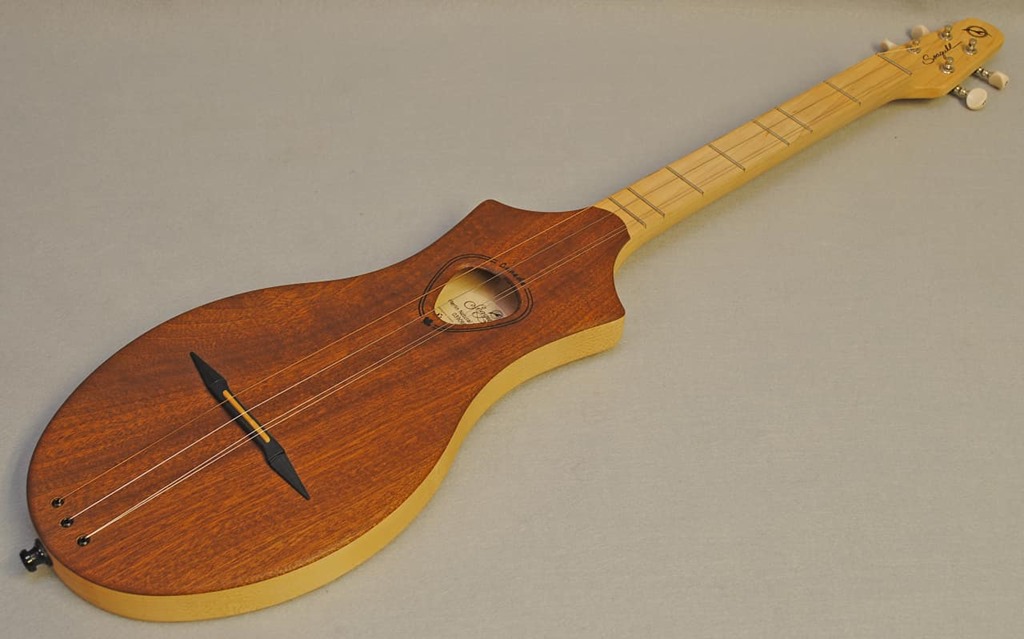
Merlin Dulcimer

“A dulcimer in a vision once I saw” The Seagull Merlin dulcimer I played on this.

What of the music today? The instrument that sounds something like a mandolin is an Appalachian dulcimer, a simple American instrument; but one, like the sitar used in the last post’s audio piece, that has drone strings. The music is modal too, based around D Dorian. On the percussion side I remain attracted lately to little instruments, so there are shakers, maracas, a cabasa, congas, a chime tree, even some finger snaps in this. I could say that this is a connection to William Carlos Williams’ Puerto Rican heritage, but really, it’s something that is pleasing me musically this month.

Here’s the piece, use the player gadget below to hear it. No gadget to be seen?  This highlighted hyperlink will also play it.

Did you like it? Want to help spread the word about this ongoing project to mix various words (mostly poetry) with various music? Hitting the like button here helps, but what does the most to bring this to the attention of new readers and listeners is to mention and share this blog on your own blog or on social media.

Want the audio pieces to listen to later? You can subscribe to the Parlando Project podcast on Itunes, Google Play Music, Stitcher, or wherever you get your podcasts.

Oread

How did you spend your extra hour given to us by the Daylight Savings Time changeover? Some spent it snuggled with a loved one, or others for splendid dreams given time for extra chapters. I spent my night and hour wrestling with another poet’s poem and creating and performing music for it.

A few posts back we presented William Carlos Williams “The Red Wheelbarrow,” a widely anthologized and very short Imagist poem. My current feeling, shared in that post, was that Williams really was talking about a red wheelbarrow, a simple tool used for important tasks. Of course, he was also aware that the rain-glazed red paint of the wheelbarrow and the white chickens around it was a bold visual image, consistent with the modernist art he appreciated, and that he didn’t mind the provocation of calling attention to this without elaborate justification, any more than a classical painter or poet would think they would have been required to tell us why we should give a fig about Artemis.

Here’s another short Imagist poem, this time by Hilda Doolittle, who wrote as H. D.   H. D. knew William Carlos Williams from when Williams was a college student, but then H. D. knew or crossed paths with many of the principals of Modernism over her lifetime. Modernist poetry admitted more women creators than painting or music, or most other arts at the start of the 20th Century, but that’s a low bar to clear. H. D. cleared it however, and she continued to run her own race on her own course from the start of her career.

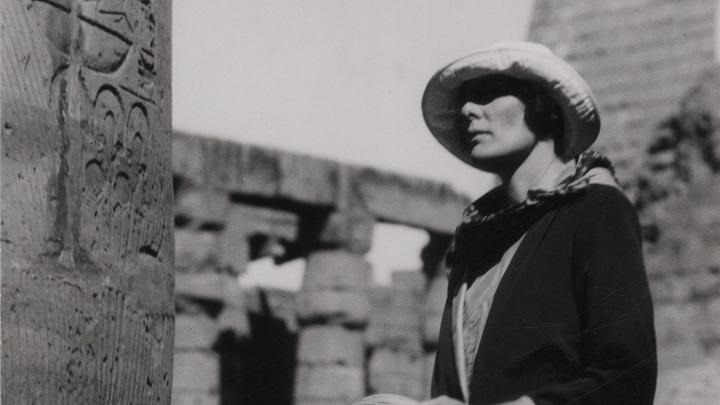
HD in Egypt

Another episode from HD’s remarkable life: she was present when King Tut’s tomb was opened in 1923


H. D.’s 26 word poem is much different from Williams’ 16 word one. It’s much stranger, and the internal state the external images present is more complex than even many longer poems reflect.

In some ways, the title “Oread”,  the effective 27th word, helps us. For those not up on Greek mythology, we can look it up, it’s a mountain nymph or spirit. Like many Greek nature spirits, an Oread is female.

So, from the title of the poem, we can say that it’s an Oread that’s speaking—but even if we grant that, this ain’t Tinkerbell. The supposed nymph is commanding nature, as a full-fledge god or goddess or a magician would. And the Oread is not asking it for protection, or forbearance, or even for it to put the hex on someone else, it’s asking it to do it’s best to overcome her. “Whirl” “pointed” “splash”, and “hurl” are some of those 26 words.

Another huge difference between Williams “Wheelbarrow”  and H. D.’s “Oread:”  the former is intensely visual, the later, just as intensely, tactile.

And who’s the Oread talking too? Three words in, it seems to make that clear: “sea.” Except the sea is described largely as a forest—a forest that can splash and form pools, but a forest at least as much as a sea. The sharpest readings of this is that the Oread is speaking of the sea with the images of the forested mountain (waves are like trees, water drops are like the needles of pines), but by saying it so, she is saying that the overcoming she commands is a merging of two like things.

I’m left with a conclusion that this is a spell of desire. Whether it is sensual, spiritual, or artistic desire makes no difference in the frenzied merger that is being called into being.

So, what did I do in writing music and performing “Oread?”  I repeat most of the lines at least twice, to emphasize the incantational aspect. Despite my recently expressed desire to re-explore artificial drum machine sounds, the percussion has lots of little instruments for a ceremonial air: shakers, maracas, cymbals, tambourine, even a chiming triangle. The main musical motif is a four-note synthesizer phrase that seems to be looping, but once again isn’t, as permutations occur throughout. The bass part rarely plays the same note as the synth motif, a musical effect that can be likened to “rubbing,” an apt metaphor for this sensuous poem.

To hear it, use the player below.


The Red Wheelbarrow

Obscurity in modernist poetry is a funny issue. What makes some writing hard to grasp, difficult to understand? Esoteric and little-known words like Wallace Stevens loved? Far-flung allusions to works in several languages like T. S. Eliot was prone to? Exploding normal written syntax and logical flow as Gertrude Stein did? Taking images into realms where direct one-to-one symbolic meaning is not only impossible, but more than likely, not the aim, as Tristan Tzara or Paul Éluard demonstrate? Presenting things “slant” in iconoclastic riddles as Emily Dickinson could? Writing works of epic length that few if any human minds can comprehend in their whole, like the Cantos of Ezra Pound?

And then there’s this poem, the basis of today’s piece, William Carlos Williams’ “The Red Wheelbarrow.”

The Red Wheelbarrow

The whole of it: 16 words, no punctuation, all lower-case

From empirical evidence you could say that it’s the very peak of the canon of modern American poetry. Remember that compiled count of the poems that appeared most often in poetry anthologies, most of which were explicitly focused on modern American poetry? “The Red Wheelbarrow”  is alone at the top of that list, included in over half of the anthologies counted.

Does that make it a “best loved poem”? Does it even assure that critics consider it great, much less the greatest? No, it does not. I think I first ran into it as a teenage student, in one of those anthologies used in some English literature class. Did my young teacher point it out as a poem of special merit? Did I view it as such? No. If I can trust my memory, if it was discussed at all, it was as if it was some kind of stunt, an intended provocation that so short and mundane a piece could be considered artful. “Now class, let’s get back to T. S. Eliot and Wallace Stevens.”

And how about critics? They largely part like the Red Sea on “The Red Wheelbarrow”.  If we look to one side, in among the mollusks and manta rays now behind the water curtain of the divided sea, we find those who care little for it. There’s nothing there demanding to be written about. No virtuosity is demonstrated to be noted and admired. And what important point is it making, other than, well, no point at all?

So, we turn to the other side, those swimming with bemused dolphins who wonder if they could leap across the band of Israelites walking on damp seabed, those critics hoping to demonstrate their microscopic perception of the hidden art in this terribly short and compressed poem. Carol Rumens is concise and representative of this when she says of Williams’ poem “This is his manifesto, surely–a poem quietly declaring how modern poetry works.” And she also warns “A naïve reading could take it as a comment about the great usefulness of wheelbarrows on small-holdings where chickens are kept.”

And then, here I am, now. No longer the teenage student who was sure someone had figured these things out, and I need only to find them. I can’t see far enough ahead where Moses and Aaron are, nor can I see far enough back how close Pharaoh and those charioteers are getting. I’ve got my hasty bread and a few grabbed things in my little cart, pushing it across the mud. I think I must be naïve. Yes, Williams is a modernist, as committed to the new way of writing as clearly as possible, a proclaimer of “No ideas except in things,” which means in retrograde, the things must be the ideas. If he had wanted to write a manifesto, he could, and did in the other poem that stated that dictum.

The obscurity in this poem is that there is no obscurity other than what we bring to it externally. There is no allusive, secret meaning, other than the secrets we’ve kept from ourselves, of our tools and our companion responsibilities.

Yes, there is art in these 16 words: the line breaks that ask us to hold our gaze, even in the middle of words, the “so much depends” warning that bids us look. The choice to look at just these simple common things, is a choice, is an idea. I think the dolphin side of the parted sea has smarter companions than the mollusks’ side; but I am looking down at my wheelbarrow, and Williams’ wheelbarrow, and saying naively, that it matters, even if I’m in the middle of the band, unable to see Pharaoh or Moses.

I’ve spent too long on the words again, but I feel I need to say a bit about the music I composed for my performance of “The Red Wheelbarrow.” I chose to use a twelve-tone row, a modernist musical idea from the same time as when Williams was writing the poem. It would be pretentious for me to say I got this from deep study of Schoenberg or Webern, though I’ve listened to a good deal of modernist music. However, “serialism” never stuck with me until I heard the prologue part of “This Town Is a Sealed Tuna Fish Sandwich” written by Frank Zappa. I’ve loved that piece from the first time I heard it.

Twelve-tone music subverts expectations of a tonal center or “important” scalar notes, so it can sound a little woozy or random, but, of course it has its pattern, by definition, which the mind’s ear can hear if you stop thinking in expectation of familiar patterns, which is the simple and profound thing it is asking you to do.

For those who’s blog readers can display it, you can click on the player to hear my performance of “The Red Wheelbarrow.”  No player visible? This highlighted hyperlink is another way to play it.

Millay’s Sonnet 43

Edna St. Vincent Millay was another poet who offered little to the “New Criticism” critics who largely set the canon for the 20th Century, even though her career, which covered the first half of the 20th Century, ran almost exactly through the same time as Eliot, Frost, Pound, William Carlos Williams, and Wallace Stevens, and even though she achieved significant readership and a level of awards and accolades while living.

What was their problem with Edna St. Vincent Millay? Well her popularity would be a negative in some lights. In this regard, critics are often no different than the record store clerks of my own day, whose estimation of any indie band would inevitably drop as soon as they achieved a widely-played record. And there’s the “her” and “she” problem. The level of disbelief of the idea of a woman artist probably varied among these critics, but literature was still a very male world at that time and unconscious prejudices are a given. But even if we skip those two, frankly illegitimate, factors, there is the issue of Millay’s plainspokenness.

St Vincent

Annie Clark performs as “St. Vincent,” Edna St. Vincent Millay is on the right. Google carefully!
Clark has said the stage name came from a NYC hospital, but if that’s so, it’s a remarkable coincidence.

Odd isn’t that? This value that you might rate highly in friend was held as low regard by the New Critics, who likely thought it common and unremarkable. A Millay poem typically says exactly what it means, right out. There may be images, but they might not pass Imagist muster. They aren’t stark omens whose meaning is felt and then deciphered, they may be more like the illustrative images the Imagists wanted to leave behind. Millay’s all tell and too little show for them.

And Millay’s language often seems stuck in the 19th Century too. Some lyrical poets like Yeats and Frost adopted Modernist tropes and were able to make their rhymed and metrical poems sound more like contemporary speech. Millay sometimes seemed to be reading from a somewhat musty library book when composing her poems.

The most extended image in “Sonnet 43”  is a bare winter tree, which could be a borrowed image, or a homage, and I choose to manifest the later in this performance.

Can our modern (post-modern) age free up some respect for Edna St. Vincent Millay? I think so. With contemporary poets, we now sometimes value plainspokenness. And the cluster of things that Millay spoke plainly and honestly about include love, sex, and desire.

This sonnet was published in 1920, it’s nearing a century old. If we slide over some of the 19th Century “poetic diction” (something I found easy enough to do when performing this) it’s as honest and as nuanced report on the state of a heart as anything written then or now.

And if one must have ambiguities for art’s sake, honesty can contain that too. Some read this poem as bitter, or a lonely-hearts club statement, or as regret for a life that Millay’s time would’ve called promiscuous. That’s not how I understood it to perform it. I think the speaker is recalling an active love life they rather enjoyed. They reveal themselves (honestly) as something of a sensualist. As the Petrarchan sonnet wraps up its octet, the speaker allows a touch of regret about those lovers who turned to the speaker at midnight “with a cry.” What did the speaker offer them? I think the closing lines say some “summer,” a summer that “sang in me”—that is, that summer is not something the speaker intentionally gave or offered, and the speaker doubts that the muses of that summer offering will still speak through her. William Carlos Williams—unlike Millay, following all the Imagist rules—touches also on the caprices of summer and fulfilled desires in It Is a Small Plant,”  but some are more accustomed to a male author speaking ambiguously about the honest incursions and boundaries of desire.

Perhaps this poem benefits with some listeners in being heard performed in a male voice? I can’t say for sure on that.

Among the 20th Century admirers of Millay’s verse were my father (who grew up on the 19th Century Longfellow and the like, so Millay’s 19th Century diction was no bar) and a distant cousinoid of mine, the modern American theater pioneer Susan Glaspell.

I rather like the musical accompaniment for this one. I worked quite a bit on the drum part trying to bring out different colors, and for the bass I was able to supplement the electric bass with some bowed contra-bass, which is one one of my favorite sounds in the world. Ironically, Millay started out wanting to be a concert pianist, and the top line here is one of my naïve piano parts. To hear me perform Edna St. Vincent Millay’s “Sonnet 43”  aka “What lips my lips have kissed…”  use the player below.