Parlando Summer 2020 Top Ten, numbers 7-5

Maybe it’d be a good time to remind new readers what the Parlando Project does. We take various words, mostly poetry, and combine them with original music. Because seeking allowance for performance of words still under copyright is difficult,* we tend to use words in the public domain.

One common response to this capsule description is, “You mean songs?” And yes, sometimes there is singing of words. When I say I compose music for this, particularly when I use orchestral instruments, there’s an expectation of the general field of art song. And when I say a particular performance is me speaking the words in front of a, sometimes live, band, there are generational expectations from the beatnik to the hip hop.

The Parlando Project is not solely any of those things, and in the midst of the various combinations it comes up with, I’d say I’m still seeking, even now after hundreds of pieces and more than four years, for new ways to combine music and words. Song, art song, and the wide range of spoken word with music all seek this too. I just try to do it allowing for exploration of all three.

So, let’s get on to the continued countdown from 10 to 1 for the most liked and listened to Parlando Project pieces last summer.

7. Inversnaid by Gerard Manley Hopkins. Just like with music-music, word-music is a subjective thing. One person’s sublime poetry for sound and flow may not please another at all, and one person’s favorite recording or performance might be torture or boredom to the next listener.

I can sometimes be both persons above, one day liking the complex, the next the simple, in one mood seeking sweet consonance and another day a rich bitterness, or bursts of enormous energy sometimes and then expository slowness other times. It is a good thing that I have access to a range of musics.

But even if for sound alone, the poetry of Gerard Manley Hopkins tends to please me. It may help that it’s not an overexposed sound. Most modern poetry has an easy conversational feel with underlying iambs, while Hopkins feel for stresses with varying valleys and rills between loosens the lockstep yet retains a home footfall.

A great many of you listened to and liked my performance of Hopkins’ “Inversnaid”  this past summer. As I mentioned in the original post, this is not a poem that is easy to understand through and through for meaning, but the sound of it can carry one over the spillway of it’s wilderness waters.

.
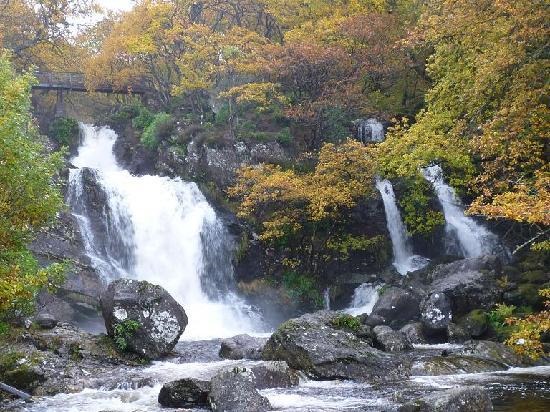
Falls at Inversnaid

A falls at Inversnaid. There’s a hotel right next door to these. Hopkins’ nature was to well, use nature to represent things. Sandburg often chose to use human-made things to explain humans.

.

6. Good Night by Carl Sandburg.  I remain immensely comforted by the range of Sandburg’s poetry. His concern for the commonality of people echoes one of this project’s goals: “Other people’s stories.” His eye for injustice is clear. Modernism has a reputation for solitary individuality, but in his best short poems he harnesses the continued freshness of Imagism with these concerns.

In times like these I can find in Sandburg the things I need, the necessary skepticism, the necessary hope, the indispensable love that allows endurance and asks for change.

One thing I’ve encouraged during this project’s presentation of Sandburg is to assume that he, no less than other Imagists, deserves deep reading. Obviously, many current aesthetic theories say this is true of anything, but I think for whatever it’s worth that it’s likely part of Sandburg’s intent in his best early work too. If he wrote in a garret in Paris. If Sandburg never achieved any of the general renown he accumulated (renown the times and mores eventually spent down during the 20th century) scattered scholars might look for that.

Is there something below the surface of his “Goodnight?”  I think he, the artist, chose  the trains and steamboats as the leaving things of sleep and its longer analog rather than conventional poetic things from a palette of sur-human nature. Now technological progress has added a nostalgic note to his specifically steam-powered leaving. That may be an accident the author didn’t intend, giving this poem an extended feeling, extending out down the track, down the river, over the horizon.

.

5. The Workman’s Dream by Edgar Guest. Does deep reading of poetry tire you? It does me sometimes. Does the chance that you’re missing the “real” meaning of some piece embarrass you once, and once is enough? Are you brave enough to laugh at Dorothy Parker’s smart-set summation** of the coolness-factor of “The Workman’s Dream’s”  author and still listen to him today?

Like Sandburg, Guest was a working journalist. Unlike the entire Sandburg, Guest’s poetry retains a certain work for hire desire to please over the coffee. Can we allow poetry to do that (sometimes) and not harm it? Well for Father’s Day I performed this one. The bold-face heading to each top ten listing will open in an new browser tab the original post I wrote, where in this case you can get the chords I used if you’d like to sing this one yourself.

.

*My estimation: mostly because the poetry rights holders don’t care to seek this—and even when asked. This indifference is also mixed with some concern that it could reduce their control over how the material is presented and any (improbable) revenue.

**”I rather flunk my Wasserman test then read a poem by Edgar Guest” said Parker.

Parlando Summer 2020 Top Ten, numbers 10-8

It’s time to look back over the summer and see which pieces you liked and listened to the most during this season. As always, I’m going to count up to the most popular in a series of posts here over the next few days. Each bold-face listing is a link to the original post, in case you’d like to read what I said when I first presented it.

10. Before Summer Rain by Rainer Maria Rilke.  Long time readers here will know that I like to take a crack at original translations, and I even wrote a post this summer about how I, a person with only a little French in high school over 50 years ago, goes about this—and why you might want to try this too. Regardless of your level of language mastery and your obligations to the original writer, a public translator must also take up an obligation to produce an impactful, living poem. It may be unavoidable that you bring your own gifts as a poet to this task—or even up your game to be able to do that while using another poet’s inspiration as your matter.

Rilke currently has a reputation as a poet of spiritual uplift, a man whose lines get Pinterested over photos, quoted in journal entries, and immortalized on refrigerator magnets. In short: the self-help poet of spiritual self-improvement. I’m not going to knock that. There’s a hell of a lot of lesser things that a work of art can do than to make someone feel better, less lonely in their thoughts, or to help them think that they can better themselves. Sure aesthetes, that’s not all poetry can do, and while I’m no Rilke scholar, I think that isn’t all Rilke can do either.

My translation focused on Rilke’s images in his poem, trying my best to make them understandable or at least striking, and to give the poem a working English word-music.

.

9. Huazi Ridge after a poem by Wang Wei. More translation. The cultural and linguistic audacity to translate classical Chinese poetry has to be a few orders of magnitude greater than translating 20th century German (a language I don’t speak, but I had grandparents who did).

I decided to term what I derived from the sparse literal translation I had of this poem “after Wang Wei,” which is likely more accurate than calling it a translation. But if you are going to use what is more frankly your impression of a poem, the charge remains the same: give us something vivid and give it some word-music that works in English.

The music music here includes my simple approach to the Chinese lute, the pipa. While guitarists might think they have some grounding with this not unrelated string instrument, the pipa, like the western lute, has almost no sustain compared to the modern guitar. Great players can wring a wide range of sophisticated effects from the pipa, but a naïve player like myself just hopes to add a little bit of a different timbre that reflects the culture that produced such distinctive and highly compressed lyric poetry.

.

If you like to hear what the pipa is capable of, Gao Hong demonstrates it’s range while performing her composition “Flying Dragon” in this video.


8. Government by Carl Sandburg. Carl, whose parents spoke Swedish, makes things easy for me by already writing his poem in informal modern English. Sandburg worked for the Socialist* mayor of Milwaukee before he started his career as a poet in Chicago and published his first collection, Chicago Poems, where this one appears. His day job in Chicago was working as a newspaper journalist in the era made famous by the play and movie The Front Page. These things mean that when Sandburg writes this poem and says repeatedly “I saw…” it’s not just some poetic trope.

His final stanza is a fairly sophisticated analysis of politics. Interestingly it’s not—in this poem—a ringing call for change. The statement here that government is made up of humans, and that it therefore inherits human characteristics, is on the face of it an explanation of the political failures this poem testifies to. But nested in this also is the idea the government can change as people change (and change it). No, it won’t be perfect, but it can be better.

.

*Midwestern Socialists of Sandburg’s time reached the highest level of Government administrative responsibility in US history.

The Most Popular Parlando Piece, Spring 2020

Are there people today still falling in love, or not falling in love together, or remembering love and almost love? Seems like a silly or rhetorical question doesn’t it.

So, yes, I suspect there are, as there have been before.

People fall in love on marches, at the barricades. Policemen fall in love. People fall in love in the time of plagues. Old people fall in love. Young people remember love or almost love. Oppressed people fall in love. People fall in love, but their partner doesn’t, and sometimes that partner is the wiser of the two.

So, is this the time for a poem of romantic love to be the most popular piece this past season? This is a time of new dangers and old evils. This is a time that predicts greater uncertainties and promises change if we act, and despair if we don’t. Can poetry put its “Queer shoulder to the wheel” as Ginsberg wrote? Should it?

Dada for Juneteenth

You have nothing to buy but your chains! For today’s Juneteenth, some Dada in advertising algorithms.


I’ll be honest, I think about that a lot this spring. It’s a large part of why it’s hard for me to get around to creating new work here as this spring unfurled. Honestly I have little right to present short pieces here on Emily Dickinson, Du Fu or Arthur Rimbaud, but I may have even less authority to write briefly on politics, economics, sociology, or epidemiology—much less American racial dichotomy and all it’s injuries.

My observation that many who do  write of these things have no more authority than I do is not helpful. Another observation is that all us artists have is that: our observation. We must strive to be careful seers and more exact sayers of what we see, though we tend to be flat seers. Heaven and wildflowers: that’s leveling. Romantic love, that often-brief thing; and disaster, that sometimes-brief thing that harms long and painfully, we see them both, we write about them as if they’re equal.

As this turns out today, I will have slighted Mr. William Butler Yeats. I’ve talked not at all about his poem, the one that you listeners liked and listened to most this spring, though it’s hardly a perhaps to believe Yeats thought some of these thoughts and questions that I’ve filled this post with instead. You can read my original reaction to the poem, linked here, in place of something new today.

The player gadget to hear Yeats’ “When You Are Old,”  this love poem written by a 20-something about old age, is below. Thank you very much for reading and listening, and an extra thank you to those who’ve helped spread the word about the Parlando Project. There’s a lot of stuff here from the four years of this project to listen to, and I’ll still attempt to have new pieces here soon.


Spring 2020 Parlando Top Ten, numbers 4-2

Continuing on with our countdown of the most popular pieces here this past spring, I find a few things that break the usual patterns. So let’s get on with it and see what we find that were the most liked and listened to since March 1st. The bold-face titles are links to the original post presenting the poem, so you can easily visit those to read more about it and what I said back then.

4. To a Fat Lady Seen from a Train by Frances Cornford. This short poem in the tricky triolet form is as catchy as a nursery rhyme and is fairly well known in Cornford’s native Great Britain. Besides that earworm quality, the poem is weird in it’s shocking and concise frankness of observation, even more so when one considers it was published in 1910, pre-“Prufrock”  and “Hugh Selwyn Mauberley.”  It seems to have raised a little ruckus in its time too, as A. E. Housman and G. K. Chesterton both wrote parodies of it, and so by way of equal time I performed Chesterton’s parody as well in my presentation of Cornford’s poem.

Cornford is another of those worthy-of-greater-attention poets that I’ve enjoyed finding in this project. This spring I presented a poem of my own about the bourgeois and un-artistic lineages of some of our greatest poets. Cornford would be a countervailing case. She descended from William Wordsworth, the great reformer of English poetic language and Charles Darwin, the revolutionary evolutionary theorist. I may be something of a Leveler myself, but I won’t hold it against her.

Pattern breaking? This is a second poem by the same poet to appear in this Spring Top Ten, and it’s quite different from the charming Walter de la Mare-like narrative of “The Old Nurse.”


3. We Wear the Mask by Paul Laurence Dunbar. Pattern breaking? This isn’t a piece that was presented this spring, but back in February. Most of our pieces get a third or more of their listens in the first week, and in this one’s example, those listens were counted last winter—but listens continued this spring at a high enough level that here it is at number 3.

Dunbar is America’s first successful Afro-American poet, and this poem is often read as an eloquent statement of the burdens of bearing up under racial oppression. And that it is, and so it retains a still unavoidable relevance. If you follow the bolded link, the original post includes the guitar chords for my conversion of Dunbar’s poem into a broadside to sing.

Here’s the wisest thing I know about protest songs. Does singing a protest song change the world? Not necessarily. But for the moment you sing the song, perhaps together with others, it likely changes you, for as long as the song continues. Therefore, it’s good that we continue to remember Dunbar’s poem in voice and song.

Not to trivialize the immensity of the struggle against the evil of racial oppression, but as I write this in June 2020, I’m struck by the marchers and mourners here and elsewhere during our Covid-19 pandemic wearing their masks, a gesture to help protect others from the spreading of that virus. “We Wear the Mask”  indeed.


“We wear the mask” photo from Minnesota protests on the killing of George Floyd. photo by Derek Montgomery for MPR News.


2. The Stare’s Nest at My Window by William Butler Yeats. Odd how this poem snuck up on me. I noted a Yeats book it was in had moved into the public domain, and I read the entire poetic series it was part of with an initial shrug. The esoteric mysticism of Yeats is not what attracts me to him, and these poems seemed overdependent on that aspect.

So, what about Yeats attracts me? Well, the beauty of his language certainly, but also his quests to see poetry as something again suitable for performance and to revivify the cultural heritage of his nation which had been much damaged by colonialism.

Somehow I wanted to know the context of the poems, and to find that this poem was written in the midst of a civil war made it more pointed, more charged. Then, later this spring I sat in my room, flames and smoke within my own tower’s view. “A man is killed” and “We had fed the heart on fantasies” are phrases in a poem. Nice words, they scan well, just phrases in a poem?


I’ll be completing the countdown soon with the most listened to and liked piece from last spring. Hit follow or check back to find out what piece that’ll be.

Spring 2020 Parlando Top Ten, numbers 7-5

Today we continue on with our look at the most listened to and liked pieces last spring. It’s a mixed bag, because that’s what this project has done: one 19th century poem recast, one Modernist classic, and a song by Parlando Project alternate voice Dave Moore. Music? A keyboard heavy arrangement, an LYL Band performance with Dave on keys and my guitar accompanying, and a bit of power-chord rock. Birds, nightgowns, and multitudes. Just as before, the bold-face titles are links to the original post if you’d like to see what I said back then.

7. Disillusionment of Ten O’Clock by Wallace Stevens. This disrupted spring has brought a lot of odd dreams, sleepless and activist nights. Stevens’ poem is a dream of order and routine vs. imagination and dissipation. He, like I, may be a little bit of both. Stevens: an insurance company lawyer vs. a poet with a weakness for alcohol. I: a ragged musician, poet, and presenter of no particular style vs. the kind of guy who still got up at dawn and worked on the pieces you have seen here 2 or 3 times a week over the past four years.

I’m still not sure what’s up with Stevens’ negligee kink, but it’s a lovely poem isn’t it, and I hope I’ve done it justice.


6. Murmuration by Dave Moore. It might seem odd given that I write nearly all of these posts, the great majority of the music, and perform and record most of the musical parts myself, but I didn’t design this project to be all about me. In fact I once pitched an idea similar to this project where I’d play none of the music, but the musicians, like this project, would by necessity confront a variety of words and produce pieces on short notice reacting to them. I’d still like to hear how that would work.

“Murmuration”  is more of a continuation of the LYL Band, a group that Dave Moore and I have been the core of for 40 some years. Dave’s a braver poet than I am and a fine songwriter. “Murmuration”  is a meditation in song about the flock behavior of starlings which present a magical beauty. I, the stubborn reality-is-strange-enough guy, wanted to explain the mechanics of that beauty in my original post.

Later, as I monitored the non-congruous mix of crowds on the second night of street reaction to the George Floyd killing in my neighborhood, I once more fell back on murmuration as a metaphor in a later post here. On that night there seemed no discernable wisdom in crowds—yet by the next night, there was some wisdom, and much heart and soul force on the streets. Humans, we create our beauty too.


“A swallow will tell you without using misleading, heartrending, words: when we are inhuman, we’re one with the birds” Will Oldham and Eighth Blackbird do what I try to do, only better.


5. I Contain Multitudes from Song of Myself by Walt Whitman. I haven’t heard all of the Bob Dylan record due out this Friday, but if I wasn’t so modest for good reasons, I’d say Bob was trying to follow some of this project’s musical forms. The talk-singing. The cello lines. The spare keyboards and guitar. The eclectic references. Maybe to throw Bob off my tail, to celebrate Walt Whitman this spring I went the other way. Not a string quartet, but a rock band. And not a fancy one with sophisticated licks—my guiding light for this was “Walt Whitman as done by Iggy and the Stooges.”

I didn’t get all the way to my goal, but it was fun to try. A whole lot of fun. The last time we referenced Iggy Pop musically was when performing my translation of Apollinaire’s account of the outbreak of WWI last summer. If this project continues I may commit that sort of thing again—and string quartets too.


We’ll be back soon as the countdown to the most popular piece here this spring continues. Next time has some surprises.

Spring 2020 Parlando Top Ten, numbers 10-8

Each quarter I like to look at the pieces here that have received the most listens and likes. It’s time to look back at this year’s spring, and so I’ll be doing that this week. However, I once more need to report that it’s become increasingly hard for me to desire to create new pieces for this project. I say that partly as an apology to those who do enjoy the weird mix of the known and unknown writers whose work I present here, and partly as a statement of the cold facts of our time and how it impacts this artist. Perhaps I’ll write a post about this at greater length soon, but I don’t want to stand in the way of those of you who enjoy what the Parlando Project does. I appreciate you too much.

And too, part of these Top Tens is not just to point out what you liked, but also to help new readers and listeners understand this project beyond the one piece they find here from a web search or something you found linked-to on your social media feed or another blog. We have 460 audio pieces posted here in a range of musical styles and authors.

So on to our countdown, starting today with the 10th through 8th most liked and listened to piece. The bold title is also a link to the original post where the piece was first presented if you missed that earlier.

10. The Old Nurse by Frances Cornford.  One of the constraints of this project is that so much of it requires my own voice, which has its limits of which I’m aware. From the beginning Dave Moore has been a great boon as an alternate contributor here, but age and Covid-19 is making that difficult. This spring my wife Heidi Randen has been good enough to take time to contribute her voice a couple of times, and this piece received enough response to just make it onto the Spring Top 10.

“The Old Nurse”  is by little-known British poet Frances Cornford. I’ll write more about her soon, but this ghost story requires no introduction or framing to be effective I think.


9. Morning by Sara Teasdale.  This project loves the subject of poets whose work needs to be better known (or known in a different way.) Teasdale’s a good example of this. She’s a contemporary of T. S. Eliot (and grew up in the same town and neighborhood, though there’s no record they ever met that I’ve found) and for a time, just as Modernism was arising as a poetic movement in English around the years of WWI, she was recognized as a substantial writer.

And then she fell off the barrel of the canon while others got launched into the circus catch-net of remembered poetic artists. Was this because she was a woman, or that she wrote rhymed metrical verse? The former reason is important, the later not completely unimportant, but I’ve come to think a large part of this is that she wrote short, lyric poems. “Lyric” in this sense does not mean she wrote words to be set to music (though her poetry is extraordinarily amendable to that.)  Lyric means that her poems tend to be short and present “an intellectual and emotional complex in an instant of time.” That phrase, one of the definitions of pioneering Modernism in English, soon became honored more in the breach than the observance. Big subjects, tackled by big poems, often anchored once more in allusions to substantial cultural markers beyond our eternal instant became the ideal in the 20th century. Teasdale didn’t do that, it wasn’t in her range.

Our complex instants in time became a forgotten subject.

So, this project asks you to pay attention to the complexity of Teasdale’s spring moment.


Carl Sandburg guitar kids goats

Carl Sandburg and coven with a satanic familiar at his shoulder strike a chord for lyric poetry. Let’s sing along: “See the U.S.A. with your Chèvre, hey….” And guitarists: an interesting voicing for C minor 6 with a 9th in the bass if you sound the open D string.


8. Monotone by Carl Sandburg.  Sandburg isn’t exactly a case like Teasdale, though like her, he also is less honored now than during his lifetime. He was able to write long poems on big subjects, eventually becoming known for a multivolume biography of Abraham Lincoln that retained portions of his long-form poetic style. Where he became less rated as an important poet, it was due to his apartness from a later high-culture and academic-oriented school of poetry that viewed his work as insufficiently formed and shaped, as too unsophisticatedly straightforward in expression. The prose-poem looseness of his free verse became just as out of style as Teasdale’s verse.

All of which obscured the Imagist Sandburg, just as dedicated to the “intellectual and emotional complex in an instant of time” as Teasdale. Like Teasdale, I feel that these now less-remembered shorter poems of Sandburg deserve more attention and consideration of their complexity.


The Most Popular Parlando Project Piece for Winter 2020

December seems so long ago doesn’t it? More so this spring in our current crisis. Back on the 10th of December I awoke, took my bike ride to breakfast in a pleasantly crowded café, where I read that it was Emily Dickinson’s birthday. While eating breakfast I decided I should try to make a Dickinson piece before the day was done.

This morning in March, I rode to that same café. Normally there are 20 or 30 folks there drinking coffee, eating breakfast, talking, reading or fiddling with notebooks or notebook computers during the morning on a weekday—more on weekends. Today they are to close their dining area for the duration at noon, and the two couples eating breakfast several empty tables apart (along with some not-present more) will need to do what I did and pickup takeout fare to keep this place a going concern.

Last morning to dine in at Turtle Bread

Cold but sunny morning, and taking their last chance for awhile to have breakfast together.


When Emily Dickinson was a child, her family grew up not in the grander family house her grandfather had built and lost due to debts and business ineptitude, but in another house across the road from a cemetery. Some biographers think this molded the young mind of our great poet, but then the literature of that time had a decidedly gothic tinge to it anyway. And that’s not the place she lived as the poet we know.

Her father worked assiduously to repair the family wealth and regained the homestead. Emily’s room is in the front of the house. Out to her left would be the garden and orchard that she became the master of with the illness and eventual death of her mother. Below her, the kitchen where she and the family’s immigrant Irish servant fixed the family meals and baked. That garden and orchard is now gone as the world of her family and town moved on from its former rural self-sufficiency. Also gone is the 11-acre Dickinson meadow that would have been more or less straight-on in view for Emily at her writing table on one of her December birthdays.*

The famously sequestered Dickinson of her later adult years would have been living our current Covid-19 life of “social distancing” and stay-at-home self-isolation. You might think her poetry would be more solipsistic for that, but she really was a mind forever voyaging. The winterscape she portrays in this short poem is quite likely that Dickinson meadow or her bare garden.

Though the creation of the music and recorded performance of it was rapid even by this project’s quick pace, I don’t think it suffers from that at all as I listen to it again today. The post I wrote about it in December was not one of the most liked or read this winter, but the audio piece was listened to more than any other one during the past three months,** and by enough to score the top spot anyway.

As I consider my sequestered music making today—something I can create even in these times, by myself, playing each part in turn—I feel for those other musicians whose art and the revenue to support it requires a live venue, a paying crowd coming through the door. Of course, cooks, wait staff, musicians—small businesspeople for the most part and only a portion of our world—are not the only ones who will suffer through the duration of our current crisis, but they were in my thoughts as I write this.

Is Dickinson’s poem lighthearted and playful or more gothic in mood? My current reading of Dickinson is that it’s both. She is amazed at the shapes and filigrees of the barren landscape, yes—but it is a place of stilled and departed artisans as she portrays it. She sees an absence, that resonate line: “Summer’s empty room.”

My performance of Emily Dickinson’s “Snow” also known as  “It sifts from leaden sieves” is available with the player gadget below.


*Here’s a highly detailed blog post about the vantage point of Emily’s room in the Dickinson homestead. It even goes so far to suggest that the irregularities of mid-19th century glass may have been the genesis of some of the impressionistic or even visionary imagery in Dickinson’s poetry.

**The second most listened to piece was #6 on the list “Do the Dead Know What Time It Is.”

Winter 2020 Parlando Top Ten, numbers 4-2

As we continue our countdown toward the most popular piece of this ending winter, we come to a section coincidentally that’s all poets known by three names. You can’t plan something like that, but your listens and likes counted up that way.

4. “The Stare’s Nest at My Window”  by William Butler Yeats. This poem grew on me after I selected it from a short collection of poems Yeats wrote on the Irish Civil War that followed Irish independence. Just after I read the series for the first time this winter, I mentioned to my wife that Yeats seemed to be too far into his mystical side for me to find something I could attach to in them. “The Stare’s Nest”  seemed only the least bad for my use after that first reading, largely because I could grasp its word-music as promising.

I often work on the music and performance before I work on the research about the text and its background. I did so here, though one may think it perverse to do that—my setting and performance will then come from me working without a context, and without the best information about an author’s intent. Still, the setting I came up with accumulated considerable power for me, and even though it’s me playing all the parts I composed and reading Yeats’ words, my impression of “The Stare’s Nest”  was transformed as I experienced what came from that combination. Though I made these components, the whole presented something I was unaware of.

What did I become aware of in the process of creating the piece? This poem I feel is perched somewhere between a prayer and a magical spell for his country.


3. “The Times are Nightfall”  by Gerard Manley Hopkins. Speaking of word-music that pulls me into places I might not otherwise choose to go, Hopkins is an example. He seems to be a full-on Christian mystic with more than a touch of hair-shirt depressive in his soul that he doesn’t fight so much a seek to feel more fully.

But his metrical conception, his use of repeated sounds, I’ve liked from the first time I read him. He believed his ideas there (borrowed from the more Saxon ancestral branches of English poetry) worked better than the musical structures adopted from the Romance languages or from poetry in Latin.

One can test his theories by seeing how his hymn to dark winter works with music as I do here.

Yeat and Hopkins

Yeats the great Irish poet and nationalist spent a good deal of time in England. Hopkins, the English poet with a distinctly English prosody was a priest unhappily sent to a post in the still colonized Ireland. Despite our world-wide virus crisis, St. Patrick’s Day will be celebrated by an Irish diaspora here in the United States this week.


2. from “Dirge”  by Ralph Waldo Emerson. Emerson is better known as an inspirational force via his essays and influence on Transcendentalism than as a poet, but his influence was felt by poets and in poetry. The distinctly American poetry that emerged in the 19th century is almost completely made up of poets touched by him.

When I have dipped into Emerson’s own poetry it’s produced some of the most popular pieces during the run of this project, but I wasn’t looking to find another Emerson poem this winter. “Dirge”  came forward in a round-about way from watching the Apple TV+ Dickinson,  a streaming series presenting a youthful, passionate Emily Dickinson. That series fully intends to use our present culture as a lens and overlay to espie into Dickinson’s times, something that I think worked for its released first season, though it works most completely if one looks also with a more sober eye at this genius. The creators seem to have done their homework. Lot’s of little details and obscure Dickinson trivia are referred to. And speaking of Transcendentalists, they manage to have some wicked fun with those other three-names Henry David Thoreau and Louisa May Alcott—who are both skewered with lesser-known biographic facts that aren’t full pictures of those two by far, but make for some good scenes.

In one scene, Dickinson and a young man Dickinson is crushing on bond over their mutual love of Emerson’s “Dirge”  for its gothic lines about a field of ghosts. I had to check out the poem. I worried that is might be a too long and how well the 19th century sentimentalism in the text would work for modern audiences, but trimmed a bit for length, the listeners here sure liked it this winter.


So, what’ll be the most popular piece here from the past few months? Will the author go by three names? Obscure author or well-known? American? British Isles? Translation from another language? Stay tuned.

Winter 2020 Parlando Top Ten, numbers 7-5

Back now to our recounting of the pieces that you, our readers and listeners, most liked and listened to this past winter. Let’s jump back in as we count them down.

7. “We Wear the Mask”  by Paul Laurence Dunbar.  This one is remarkable in that it was released on February 24th, very late in the winter season, yet it still racked up a lot of listens to go with the number of likes here on the blog, outstripping the other well-known Dunbar poem I performed and released three days earlier: “Sympathy (I Know Why the Caged Bird Sings.)”

These two poems are the best known works of this early 20th century Afro-American poet directly addressing racial issues, and given the seriousness of racism and the quality of “We Wear the Mask”  as word-music, it’s well earned its current position as a much anthologized poem.

Why did it edge out “Sympathy?”  Who can really say? I liked both performances I did of the Dunbar poems myself. “Sympathy”  has the more complex arrangement, but simplicity that works has its appeal. Or was it something random—did Dunbar’s title put it in search queues connected to world-wide Covid-19 concerns?


6. “Do the Dead Know What Time It Is”  by Kenneth Patchen.  I was completely enraptured by this poem of Patchen’s because of its complicated paralleled half-conversations. In the previous Top Ten post this week I remarked about how Marianne Moore’s poetic expression seemed to echo the actual syntactic twists of transcribed common speech, even at the cost of being harder to follow on the silent page. In Patchen’s poem, we have the more common “naturalistic dialog” where syntax is complete, where sentence structure is plausible, not the fractured and disagreeing actuality of literal transcribed speech. But Patchen has two speakers totally focused on non-answering halves of a conversation: the old guy at the bar who wants to tell the poem’s persona of a second-hand encounter with the God-head, and the poem’s persona, a quasi-homeless swain in conversation with an unheard and somewhat mysterious woman* at the same bar.

The chemical reaction of these two side-by-side half-conversations builds until one phrase appears to link the two—two loves linked somewhere between desperation and desire.

Patchen All at Once is What Enternity Is

And all our count-downs are happening over and over. Patchen as painter.


5. “The Little Ghost”  by Edna St. Vincent Millay.  So, a comforting God-head appears off-stage in Patchen’s poem. Hugo Ball’s ghost in our last Top Ten post seemed of the malevolent poltergeist type. Now here Millay’s is a much more benign spirit who seems to signify being there after being there.

Regarding the music for this one: like a number of my generation, I encountered Ravi Shankar LP records and performances in the Sixties. For a moment some borrowed sense of South Asian music permeated the culture of popular music groups and their audience. Why did that happen? Has anyone asked, much less answered, that question? Yes, I assume the drug and social stress induced search for mysticism was a factor. Maybe George Harrison and his access to the culture through The Beatles alone was enough. But I can speak for myself: some musical qualities easily discerned in this music grabbed me then as they still do now. The musical structures related to steps in various orders away from and returning to a home drone pitch. The opulence of microtones beyond the conventional 12 notes. The singing rhythms.

In the Seventies, that decade that everyone forgets, I spent nights working in a busy Emergency Room, often with an Indian-born surgeon, who as the evening would wear us on, would suture while hum-singing tunes of his homeland. Every so often, even these decades later, I sometimes find myself singing unremembered vaguely South-Asian melodies when working late on some task.

Evidence of some ghost? I doubt it myself. Not reincarnation—resonance.


We’re more than halfway down the countdown. The next three coming up here soon.


*Is she a down-and-outer like the poem’s persona just looking for some kind of human connection? A prostitute seeking money? An analog to the God-head, or is the poem’s persona that? By not clearly defining this, the poem gains mysterious power I think.

Winter 2020 Parlando Top Ten, numbers 10-8

For those that have been following our look at English poet Frances Cornford, we’ll have at least one more example coming of her stuff soon. But now is the time when we count-down the ten most liked and listened to pieces from this past winter.

It’s been a slightly difficult season for this project for me personally. It’s frankly been hard to keep up the level of posting, research, composition, recording, and playing that goes into it. What has been encouraging is the increase in listenership for the audio pieces and your continued readership here on the blog. December set a new record for monthly listens with increases coming significantly from those who hear only the audio pieces from the places where you might get podcasts (Apple Podcasts, Spotify, Stitcher, PlayerFM etc.)* During February the number of listens passed the milepost of 50,000 all-time downloads. This is small by the scale of Internet sensations (typically measured in millions) but to me that’s satisfying in the larger, but sparser crowd of those interested in poetic expression.

Readers here on the Parlando Project blog know that besides the same audio pieces the podcast listeners get, you get more information here about the writers and my reaction to what they’re doing. You might think of the blog as a kind of an “insiders ring” in that way. Blog traffic took off last fall, which made my heart leap up, and it’s continued at a similar level over the winter.

Given that I mostly keep with the older pre-1924 Public Domain stuff that is unrestricted in reuse, and because I wander about various musical genres in a way that’d tempt many old car radio listeners to “push the button” and current playlist streamers to tap play next, I especially appreciate those who stick with this project and it’s eclectic tastes!

Hugo Ball in metal 1080

“Metal man has won his wings!” I worked this winter to make Hugo Ball The King of the Dada Blues Singers


Let’s go to the countdown. Today we’ll cover numbers 10 through 8 as calculated from listens on all platforms and likes here on the blog. The title of each piece will be hyperlinked to the original post, so you can click and check on what I said about it then.

10. Rimbaud’s “Eternity.”  This winter I decided to make things more difficult for me by doing more translations of non-English poetry, adding translation to the whole compose/record the music, play most of the musical parts, research the context of the text, and then write about those tasks. And Rimbaud may have caused me more trouble in translation that anyone other than maybe Mallarmé. I labored to some kind of reasonable draft on two or three Rimbaud poems, but the results just didn’t grab me in English. Knowing that some other poets who I admire think highly of his work, I couldn’t figure out if I was picking the wrong poems, or what.

Arthur Rimbaud - the most famous photo

“Go Rimbaud, Go Rimbaud….” The most famous photo of the teenaged poet.


Then with his “Eternity”  I realized—this poem’s impact in French comes from its invocatory power.  This is why someone as unafraid of going over the top as the young Patti Smith could be drawn to his writing. Free verse can reach that level, but loosening my translation so that I could (uncharacteristically) render it as a rhyming verse made this one more compelling.


9. “The Labors of Hercules”  by Marianne Moore.  Marianne Moore writes in English, but her expression is so unusual that I feel like I need to translate her to get to the heart of her poems. Unlike Moore’s contemporary Gertrude Stein, whose verse is even harder to draw denotative meaning from, the task of performing Moore to music is challenged by her conversational rhythms which sound like someone talking.**  Not only does this make it harder to fit in regularized music (I didn’t) it tends to lure the listener into thinking that they should be able to comprehend what Moore is getting at. With Stein you’re quickly aware that words are being used in a musical way, so you can just enjoy them for sound value. With Moore you sometimes think that the speaker herself or you the listener are in early days as English as a second language.

Young Marianne Moore

A lesser-known photo of Marianne Moore. Like Frost and William Carlos Williams, I always visualize her as if she was born at that advanced age that she was at when I started to encounter poetry, not as this young woman


I’m doing the back-patting here, but I think I helped Moore’s gist come across a bit better by my performance than the poem left sitting mute on the page.


8. “Ghost Blues”  by Hugo Ball.  Another case where I decided to go with a looser translation in order to vivify the original work for the modern English language user. The original post shows some of the intermediate steps I went through in translating this Dadaist poem from German. One thing that I think I’ve figured out after the original post is that a word that I couldn’t find in any of my accessible German dictionaries, “Gängelschwemme,” is probably a place name. My performance uses “spillway” for it, and still I have no way to know for sure (if it is a place name) if it references something along those lines.

I decided to make this a Dada Blues as it might be loosely rendered by electric players in the blues revival of the Sixties. Unlike a lot of pieces here, this one isn’t really composed. I had setup a loop to see if my translated text might fit to a groove like that. As I sung, I felt moved to plug in an electric guitar as I tried the lyrics.

“Hey, this works pretty good” I thought. I hit record. And one take later this is what you get.


If you’re new here you may notice that all of these are electric guitar pieces in a rock’n’roll context (though “The Labors of Hercules”  is more irregular and somewhere in-between post-rock and free-jazz in my mind). Long time listeners here know that’s not what we consistently do. Stick around, the next three of the Winter 2020 Top Ten is coming up soon.


*Just to clarify expectations: the Parlando – Where Music and Words Meet podcast is only the audio pieces themselves, unadorned. While I suppose I could chat about the poems and my music in the discursive and wandering way most audio podcasts do, I don’t do that.

**Back in the 1960s when I first got a little plastic cassette recorder, I took to recording people having casual conversations and then transcribing the words literally. Here’s what shocked me in this practice: the words on the page made little grammatical or syntactical sense. The transcriptions didn’t even match “natural, realistic” dialog in fiction. Our daily conversation is often more avant-garde than we realize; and we are comprehensible to each other orally in ways that we would not be if our speech was turned into page text, through things like timbre, expression, non-regularized conjunctions and connections.

I suspect Stein and Moore were both more exacting mental transcribers of what we actually say aloud than conventional literature expected, and as two women aware of the modernist movement in general (not just literature, but music and visual art) they combined this objective phenomenon with their own aesthetic techniques.