1 A High-Toned Old Christian Woman and First Fig by Wallace Stevens and Edna St. Vincent Millay It seemed like an odd pairing. So much so that I wondered why I thought it might work. Wallace Stevens, who looked like what he was, an insurance executive; and Edna St. Vincent Millay, the beautiful bohemian New Woman of the 1920s. Stevens’ poem “A High-Toned Old Christian Woman” was awash in his characteristic play with esoteric words, luxuriating in its educated Modernism. Millay’s “First Fig” is epigramically brief and simply said. They were only about a dozen years apart in age a hundred years ago when these poems were written, but Stevens seemed older than his years, and Millay was famous as a distinctly young poet and as a poet who spoke for the new youth.
The subconscious forces that had me perform them together is still somewhat inexplicable. The rational connection I can see is that both of them are giving their Modernist defense against an older propriety, each in their own voices. Both are defiant in their ways, but they also somewhat reassure the older generation with an undercurrent in their poems. “A High-Toned Old Christian Woman” is telling the titular old Christian (which may be based on Stevens’ mother) that he too is a devout believer, but his belief is in pagan art. Millay’s “Fig” self-admits the likely unsustainability of her devotion to an artistic life, yet her short poem has enough room to say that she’s aware of that. Both poets accept that their stubborn individual Modernism may make widows wince.
Adding Modernist poets to your electric guitar pedalboard.
The unusual music in this spring’s most popular audio piece may have attracted some. Earlier this year I was able to find a used example of a guitar effects pedal that I’ve looked at for some time: the Electro-Harmonix Attack Decay pedal. Its prime trick is to make an electric guitar’s notes burn at both ends. Most other similar effects work only with single notes, but with proper settings and playing, the Attack Decay can latch on to and do the reverse delay thing on overlapping notes, letting the featured guitar in this piece sound like a hurdy-gurdy.
This is the piece that you, our flexible Parlando audience, listened to and liked the most last season, and you can hear or re-hear it with the player gadget below, or through this highlighted hyperlink which will play it in a new tab window.
There’s another repeat author in this segment of our spring 2021 countdown of the most listened to and liked pieces here over the past three months. More than that, the number 4 and 3 positions are held by two installments drawn from the same poem, parts of my long serial performance of “The Waste Land” that wound up this year. It makes sense then to deal with them together.
4 What the Thunder Said Part 1 and What the Thunder Said Part 2 by T. S. Eliot As much as I enjoyed the challenge of taking on the range of Eliot’s poem and making explicit its implicit musicality, “The Waste Land” is not what many of us go to for poetry comfort food. The last section of the great poem was by all accounts written while Eliot was hospitalized with what is now considered depression. Most of his poem is a horror story, still and all twice-baked crafted, written by a man whose meticulousness had him working in a bank — and then revised by Ezra Pound, as merciless an editor as ever existed. That part of the poem can seem a cold-case puzzle to be solved, the likely source material for a volume by Dan Brown. It’s not.
It’s a series of songs made up of the overheard and the remembered bits caught inside Eliot’s educated mind, half in Parnassus and half in a Hogarthian vision of early 20th century London — and then we get to the last part of the poem, “What the Thunder Said,” which is more Eliot’s own song, a long somewhat improvised song that was written, he later confessed to Virginia Woolf, in something of a trance, without even bothering to understand what he was writing. Up until then the poem, however despairing or dark, has been crowded: voices, characters, changes of scene. This last part is Eliot alone with himself. The waste land, the desert title-place that we only meet in this last section, isn’t the condition of post-WWI England or Europe, the waste land is Eliot alone with himself in only lightly-disguised self-pity, which eventually leads to a final expiation in its concluding portion.* The accelerating four sections of “What the Thunder Said” that I presented this past April are the journey of that mind.
You can hear the performances of Part 1 of “What the Thunder Said” here with this highlighted hyperlink, or if you see it, with the player gadget below.
So, what’s the next poem in our countdown after all that sturm und drang?
.
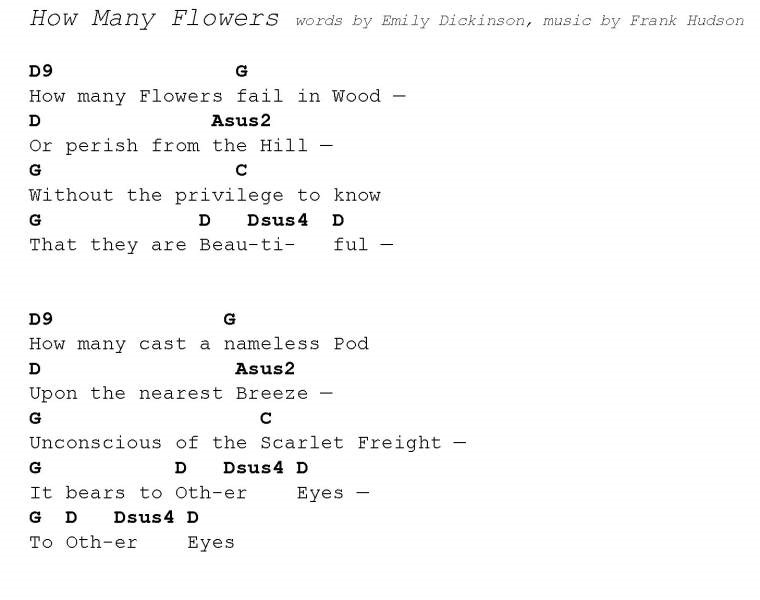
Seriously, singing poetry can be an even deeper inhalation of a poem. Here’ are my chords if you’d like to sing this poem of Dickinson’s.
.
2 How Many Flowers by Emily Dickinson Just Emily: gardener, avid botanist, Transcendentalist meditator, a legal mind filing a concise argument in the case of the universe, folding her words up. It takes me a minute and a half to sing it.
I had some fun in my original post on this imagining how close she came in her poetic diction to writing an early 20th century Imagist poem, but we may have little trouble translating on the fly from her 19th century-isms to the vivid moment she observes: the observed or unobserved flower, the present and presence — and the future, their scarlet freight. Like much great poetry, maybe like all great poetry it doesn’t need me to prattle on about it, it just needs you to sing it, to carry that scarlet freight.
The player gadget that many of you will see is below for “How Many Flowers” by Emily Dickinson. Can’t see the player in your reader or browser view? Here’s the alternate highlighted hyperlink.
*Unlike the other 3 parts, the 4th part of “What the Thunder Said” didn’t get the listens and likes to make this top 10, possibly because of its length or general disinterest or dismay from the audience in its rough, less-exactly recorded nature. Still the electric guitar playing that builds from about 3 minutes in and finally becomes the brief solo that starts at 4:45 is as pure a piece of musical-emotional expression as I’ve ever played.
It’s time for our every-quarter look back at what pieces you, my valued and appreciated listeners and readers listened to and liked most during the past Spring. This one turned out to be a tight bunch over the past three months, with only a little over a dozen listens and likes between the 1st and 10th position. Given the range of musics I’ll use and the variety of poetry presented, that means that there are a lot of different “yous” out there in this project’s audience, or that some of you don’t mind my jumping around a bit.
We’ll progress in the countdown format, starting with number 10 and over the next few days getting to the most listened to and liked one from this past springtime. If you missed what I wrote about each piece when it was first presented, the bold-faced titles are also hyperlinks to the original post where you can read more about my encounter with it.
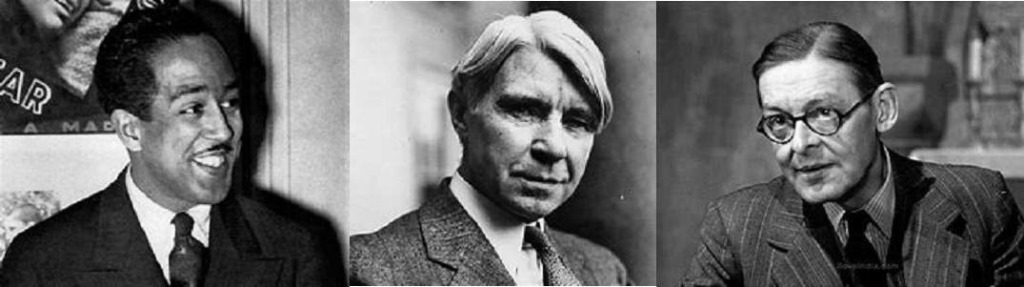
10 The Negro Speaks of Rivers by Langston Hughes One of my favorite pieces I’ve done this year. It’s been rare lately that I get to create, record and present an out-and-out electric guitar centered piece like this. This one would place higher except that it was released last winter and its February listens aren’t counted in the Spring Top Ten. As it happens, a great audio piece for Juneteeth though!
9 Branches by Carl Sandburg Sandburg set his poem specifically in April, but as much of the United States has current drought issues it might also serve as an invocation for some summer rain too. Nice to have this one next to the one above — Sandburg was one of Langston Hughes’ models when the younger poet created his own poetic voice.
Limits on recording time this year have led me to present more pieces as simpler and more immediate acoustic guitar and voice arrangements, some of which, like this one, seem to work pretty well.
On electric guitar: Langston Hughes, acoustic guitar: Carl Sandburg, and on whistling bats with baby faces: T. S. Eliot.
.
8 What the Thunder Said Part 3 by T. S. Eliot Each April this project has presented a part of the landmark Modernist poem “The Waste Land.” This April I completed that long task with the final section of the poem “What the Thunder Said.” One of the few pieces this Spring where I got to deploy my orchestral instruments forcefully. Player below, alternatively this highlighted hyperlink.
Wait, before I reveal that, let me take a moment to describe what the Parlando Project does: we take words, most often other peoples’, most often poetry, and combine them with original music and present them to you as audio pieces.
I’ve chosen to use other peoples’ words almost entirely because I’m most comfortable writing about that transaction between a writer and myself as reader, composer, and performer in the midst of passing something on to you as another reader and listener.* The project doesn’t use poetry for every audio piece, but I like pieces with some mystery and ability to create an impact in less than 5 minutes, and poets are the ones that do that.
The music you hear is created for this project. I don’t use library music or borrowed music, and except for computer drums, I don’t use samples or canned loops. For better or worse, most everything you hear was played or scored by a real person.**
I don’t always make these combinations of music and words “songs” in the traditional sense — though our modern sense of song has changed so much in the last few decades that “song” has become a much looser expectation anyway. I try to make my musical settings as varied as I can, which means that I expect some will be more to any single listeners’ taste than others.
Now I’ve caught up any new visitors on the Parlando Project concept, we can complete our Winter ’20-’21 Top Ten Countdown with the most popular piece.
1 End of the Sky by Frank Hudson (after Thinking of Li Po at the End of the Sky by Du Fu). OK, this one used my words, though I based it off a classical Tang Dynasty Chinese poem. Since I wrote it last autumn, the meaning I extracted from Du Fu and attempted to convey in my modern English extension of his poem has only deepened in resonance for me personally. When it was written I was thinking about a small group of poets that I’ve met with every month for more than 40 years to discuss our work. I’m the youngest in that group by a short interval and we had all been writing for more than a decade when we first met.
More than a half-century of writing for each of us, yet I think of myself as less accomplished than the rest of the group — viewed objectively from amount of publication and such this is certainly true — but I wonder too if they ask their own version of the questions I ask myself about what’s valuable to say and what we may construct to justify a readers time and attention. Du Fu seemed to be dealing with some of those feelings in his poem addressed to fellow poet Li Po.
The poem’s statement, my attempt at faithful translation from Du Fu’s Chinese: “True literature doesn’t care if it is popular, and/It is only demons that care about a poet’s failures!” is one potential answer to those concerns. Poetry may be what we most care about, but the world cares less than that, and in that is a freedom. “How much difference does that make at this late date?” I ask in addition, a line only implied in Du Fu’s poem. And at the age of the poets in my group, “late date” is a general concern.
Since I wrote it, how has this poem changed for me? Those general concerns have been promoted in imminence. I’ll say in too-brief: two are dealing with existential illness. Loss can be at any hand for all of us. Will it, or any of us, be patient?
Du Fu’s poem concluded with an understated but devastating conclusion, something I often find in his work. He writes, our creations and our cares about our creation are like a customary gesture that would’ve been known to poets of his time and place: throwing poems as a gift into a river where a Qu Yuan, a Chinese poet from the past had leapt to his death.
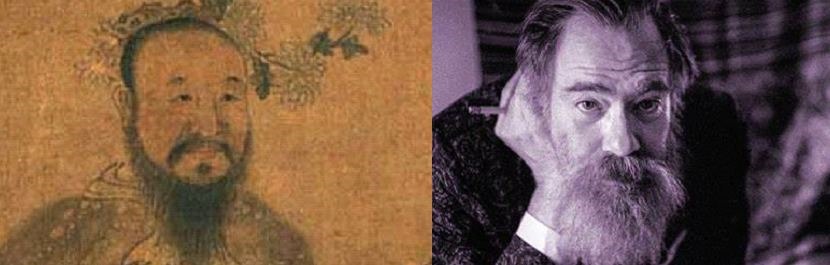
They both ran out of patience. Do you see some resemblance? Qu Yuan and John Berryman, “…who was once handsome and tall as you.”
.
My modern English solution to my poem’s ending echoes Du Fu’s superficially, but differs in detail. This is what I meant to convey in my conclusion: Berryman’s mental illness and chemical dependency — fed by his doubts, feeding his doubts — weren’t his art or some driving force for it, for they understood none of that.
Say that, then, to your doubts: you don’t understand my art! Work instead to make your work more whole for yourself and for some potential audience, no matter how small. All doubt and self-abnegation can do is take away — and life and fate will do that for you anyway, it doesn’t need your help.
The player gadget to hear my performance of “End of the Sky” is below. If you don’t see the player, this highlighted hyperlink is an alternative way to play it.
.
*When I write or talk about myself, and later look at what I said or wrote, I almost always cringe. In only a short remove of time it seems disproportionate, self-involved, and vain. Every artist must have, at least episodically, some level of elevated self-regard, but for me that self-regard is always being chased by another that reminds me of my follies. I’ve lived a long life, and neither of those two have stopped running, an endless chase, which has allowed me to create — but as the pursuer and their prey, I’m often out of breath by the time it comes to talk about or promote it.
**Early Parlando Project pieces were often live band recordings, but with age, change, frailty, and finally the Covid pandemic, they’re increasingly all me multitracking myself. Computer drums are a compromise I’ve perhaps too easily fallen into.
Today’s report on the most listened to and liked pieces featured here over the past quarter will show three experiences of the mystery of winter. So, let’s return to our countdown:
4 Twilight Fallen White and Cold by Joseph Campbell. I seem to have become something of a promotor of this little-known in the United States Irish-born poet who I still know little about. He published a series of poetry collections before the end of WWI, and then his poetic output dropped off, for reasons I’m not yet clear on, though the politics of his country’s decolonization struggle may have contributed. This piece using his words that a lot of you liked and listened to may be the most mysterious of today’s trio.
Best as I can figure it, this winter nature landscape poem may be an expression of his nation’s detracted state and situation, particularly in the invocation of ancient earthworks (raths) and burial mounds — but I cannot plumb the entirety of the refraining line of “wounds of Eliom/weep on me” that I feature in my setting of Campbell’s poem. Eliom is a plural word for gods, sometimes used for polytheistic gods, sometimes used for the singular monotheistic diety, and as it may be here, used for angels. If that’s so, then the starry constellations, the winged vampires, the curlew birds, the floating mists, the carrying sound of the ocean are all the Eliom, the angels in this changed winter nighttime vision.
To hear my setting of Campbell’s poem, you can use this highlighted hyperlink which may open a new window with a player, or in many cases, you’ll see a player gadget below to directly play it.
.
It’s been too long since I’ve said this: thank you for coming to read or listen here. It’s become harder for me to respond to comments or properly promote this project, but I appreciate so much those who come here, listen, and let others know what the Parlando Project does.
..
3 The Snow is Deep on the Ground by Kenneth Patchen. Lawrence Ferlinghetti, whose words we met earlier in this countdown, would sometimes remind folks that he wasn’t really part of the Beat Generation, even if he was associated with others who might have been so thought. Patchen is a similar case, or perhaps more so, in that his poetry career started in the 1930s,
As with many of the best Patchen poems, even the political ones, this is a love poem, delicately poised between the enchantment of love and the world that allows the shattering of it. If one can fully absorb the illumination of this poem, as with some of the best of Patchen, you would cry tears of joy and sadness at the same time.
You can hear my performance of Patchen’s “The Snow is Deep on the Ground” with this highlighted hyperlink, or if you see it, with a player gadget below.
.
2 The Sky is low by Emily Dickinson. Some years back in this project I once compared Emily Dickinson to one of those unexploded, yet potential, bombs that are still unearthed in Britain or Europe from the World Wars. Originally she was found as the creator of curious little poems from an eccentric woman, then as a prescient 20th century Imagist, and now in our deconstructed age we can stare at one of her tiny poems, and like one trying to follow the decent of a single flake of snow in a flurry, fall as far as one can follow.
You can read, or listen to my performance, of “The Sky is low” and find a whimsical nursery rhyme, and find enough enjoyment in that — but let it stick in your memory or repeated ear and a little dialog about predestination, first causes and fate is discernible. To listen, use this hyperlink, or you may see a player gadget to directly play it below.
.
One more post in the Top Ten countdown to go, and then we can move on from the mysteries of winter to the mysteries of spring.
Let’s pickup the countdown of the pieces that drew the most listens and likes over this past winter. Each bold-faced listing is a link to the original post on the piece in case you’d like to read what I wrote back then, and those original posts will also contain links to the full text of the poems used.
7 Thursday by William Carlos Williams. Quite often when reading through early 20th century Modernist poetry, I repeat my surprise of how plainspoken and outwardly simple some of it seems. This poem by Williams is one of those. There’s not a single word in it that would be unfamiliar to a grade-schooler. One need know no complex allusions to anything other than ordinary life. Not all his contemporaries wrote like this. Wallace Stevens will pleasingly stump us with his love of obscure words, T. S. Eliot will ask us to consider how history rhymes its myths, and William Butler Yeats will make English sing with beautiful and metrical word-music. Against that sort of thing, this poem by Williams may seem ordinary. As ordinary as a Thursday.
There’s only one bit of word-trickery in it — and having no other in this short poem should invite us to ponder it: that unusual use of the common word “carelessly” in the context of “I remain now carelessly/with feet planted on the ground….” Carelessly? Huh? How many quick readers would slide over that and not notice anything out of place! In the opening of his poem Williams has told us his dream has come to nothing. Is this dream one of our ordinary nighttime hallucinations or a strong and potentially life-changing imagination for the course of things? He doesn’t say and may perhaps mean either. His stance on this? Back to observing the world standing simply and unmoved with both feet on the ground, “carelessly” in the sense of “without a care” regarding that; with the sense also that the overlords of guilt and ambition or the lure of more surreal and spectacular verse are saying he should care and he’s going to ignore them.
In place of that care, of that “tyranny of the shoulds,”* Williams offers us ordinary life, ordinary words, the meditation of breath. That resilience and carelessness, those two steady feet able to stand up to the sky, is this song. You can hear it with a player gadget that may appear below, or with this highlighted hyperlink that will also play it.
.
6 I wake and feel the fell of dark by Gerard Manley Hopkins. What a combination this makes with Williams’ poem that it happens to sit next to in our countdown! Hopkins’ poem has its speaker also awakening from a non-productive dream “Hours I mean years, mean life” — this dream is clearly both a nightly and a life’s dream. And he’s in the opposite of careless: roiled with distress and self-disgusted guilt over it.
What a combination this makes with Williams’ poem…
The language here is extra-ordinarily charged. Some of us have had such a self-castigating night, but few of us could express it in such a tight compressed form as a sonnet that moves musically and emotionally. Hopkins’ feet are not firmly on the ground at all — he’s rolling and tumbling as the great American floating Blues verse has it — and that’s the nature of Hopkins’ song.
This is the distress half of the engine of the Tao. We may more easily recognize it quickly as great poetry, and should, though without some balancing aspect it cannot long whirl.
My performance of this greatest of his “Terrible Sonnets” can be heard with this hyperlink, or in cases where it appears, the player gadget that may be below.
.
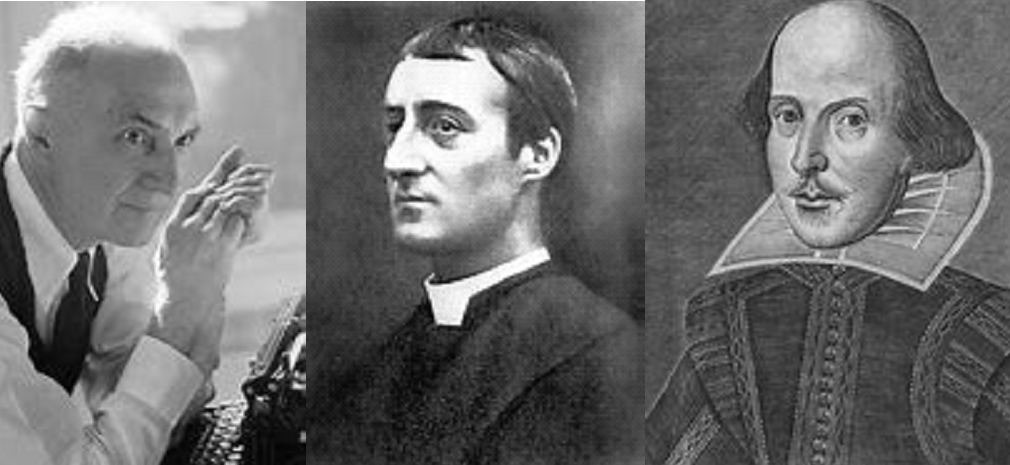
Collar styles of poetry, a retrospective. William Carlos Williams, Gerard Manley Hopkins, and William Shakespeare
Well, the jury’s still out on that one. It is always so with art, as art happens in the present when we look, read, listen, hear. That’s a large part of what this blog is about: encountering stuff written in various ways and times and seeing what we can make of it in the immediacy of a musical performance.
“Sonnet 97: How like a Winter hath my absence been” is neither the calm meditation after a dream’s failure nor the roiling disgust our first pair of poems had. Instead, this sonnet is all about the ambiguity. What kind of ambiguity? Shakespeare will pick several. One of the basest tests of mental state is “oriented to time and place.” This poem certainly isn’t — that’s its most pressing point. Is it winter, summer, fall, or spring? Can’t say for sure. The purportedly male authorial voice dons rhetorical drag and speaks of his sonnets as if they are birthed from a poetic womb as if the addressed “fair youth” is the only begetter in a very patriarchal metaphor for these sonnets. And what’s the true nature of the relationship between that authorial voice and the fair youth being addressed? Complicated. Author as vassal of the ruling class?** Lover? High-minded patronage? Some of all? Well, that’s Shakespeare’s song for us. This hyperlink will play my performance of it, or if you see it, you can use a player gadget that may appear below.
.
*The phrase is psychotherapist and author Karen Horney’s, whose mid-20th century work may still have something useful to say about us today.
**It was while dealing with this sonnet that this aspect of the “Fair Youth Sonnets” first occurred to me. I assume it’s occurred to others, but not being a Shakespeare scholar I can’t say who or where.
I’ve been tardy in many things for this project lately — but let me get on to recounting which pieces were most liked and listened to during the past quarter.
It may be a bit strange to revisit a winter we are glad to be emerging from, but poetry is about remembrance of all kinds of emotions and experiences. Which ones did the Parlando Project readers and listeners most connect with?
As we usually do, this is a countdown, so we start with the 10th most listened to and liked piece, and then over the next few posts we’ll move on to the most popular this winter. The bold-faced titles are links to the original post that introduced the piece in case you want to read what I wrote then.
.
10 Trifles – I Know What Stillness Is by Susan Glaspell. I wanted to do something special for this project’s 500th audio piece, and I decided to try to use some words from my distant relative who was herself a figure in the Modernist revolution of the early 20th Century that I mine for many of the pieces used here. Glaspell is not a poet like most writers I present, but this short scene is from what remains her most famous work: a still effective short play about two women who have accompanied their husbands who are charged with investigating a murder* in a remote 1900 Iowa farmhouse. At this point in the play, we know that a farmer has been strangled there and that his wife, Minnie, has been taken into custody as a suspect, even though there is some doubt that a small, quiet woman could have had the motivation and strength to commit such an act.
While the men continue their very official investigation, the two women discover a dead canary entombed in a fancy box and connect it with the lonely life of the farmwife. Should they tell their husbands what they found?
I solved a difficult problem by treating this scene as “poetic” enough to work with the music and then locating a dialog performance that let me avoid trying to do the voices of the two women myself. I’m also quite proud of the music I composed for this one. You can hear it one of two ways: this highlighted hyperlink, or for some of you, a player gadget below.
.
Susan Glaspell getting her work done. Per the radio-play practical audio-effects tradition: in the wintertime it’s nice to sit next to the crinkling cellophane and work on your manuscript.
.
9 The world is a beautiful place by Lawrence Ferlinghetti. I bent the rules to publish this older performance that Dave Moore and the LYL Band did with my off-the-cuff reading of a piece from Ferlinghetti’s A Coney Island of the Mind collection that so many treasured decades ago. These words are not in the public domain, and I had never received a reply when I sent in inquiry about presenting them here a few years back, but on the occasion of Ferlinghetti’s death I felt I had to share this with you, some of whom are among those that treasured those words.
But maybe some of you hadn’t “met” Ferlinghetti’s words before. Buy or read his book and meet more. Perhaps a few of you have an idea that the label “Beat Poetry” requires a dour and slack protest, a litany of muttered and solipsistic defeat. Maybe that’s not so.
.8 Escape by Georgia Douglas Johnson. I still know little about this “Harlem Renaissance” writer who wasn’t actually located in 1920s New York City. As time for this project gets harder to locate, I still hope to remedy that. Despite my deteriorating ability to complete new pieces, I made an extra effort this year to do work celebrating Black History Month this February, using work found in the landmark The New Negro anthology published in 1925. “Escape” was the one that found the most favor with this Project’s current audience.
Musically, I used the magic of MIDI “virtual instruments” to pay tribute to the Afro-American fiddler tradition, playing the featured violin part on my MIDI pickup guitar. At the end of the recorded performance, I tacked on a verse by the altogether unrelated Moondog, a musician who ironically was connected to New York City. Here’s the link to hear my performance, or if you see it, you can use the player gadget below.
.
*Glaspell was able to use her earlier reporting on an actual Iowa murder case as matter in her ground-breaking play.
Well, this is sort of embarrassing. The Parlando Project is about wandering about in the universe of other people’s words that I might combine with music. I wanted to cast for a wide choice of words because that was part of the core energy of one of the project’s ideas: “Other People’s Stories” and how could my music and the performances illuminate a range of experiences.
You see, I think that the performer—like you, the reader or the listener—should become the co-creator with the author’s text for the fullest experience. I find it rewarding when, in taking my part, I am collaborating with William Butler Yeats, Fenton Johnson, Edna St. Vincent Millay, Du Fu, Emily Dickinson, or Tristan Tzara. Long-time readers here may have noticed that in the past year I’ve increasingly turned to translation from non-English authors, which enforces that need to become the respectful collaborator with the author’s text, but in effect even those authors who wrote in my native language require translation into a performance with music.
I had the damndest dream! I was this 4th century BCE Chinese guy eating breakfast in Minneapolis. And then I awoke, and I was just Walt Whitman, a cosmos.
.
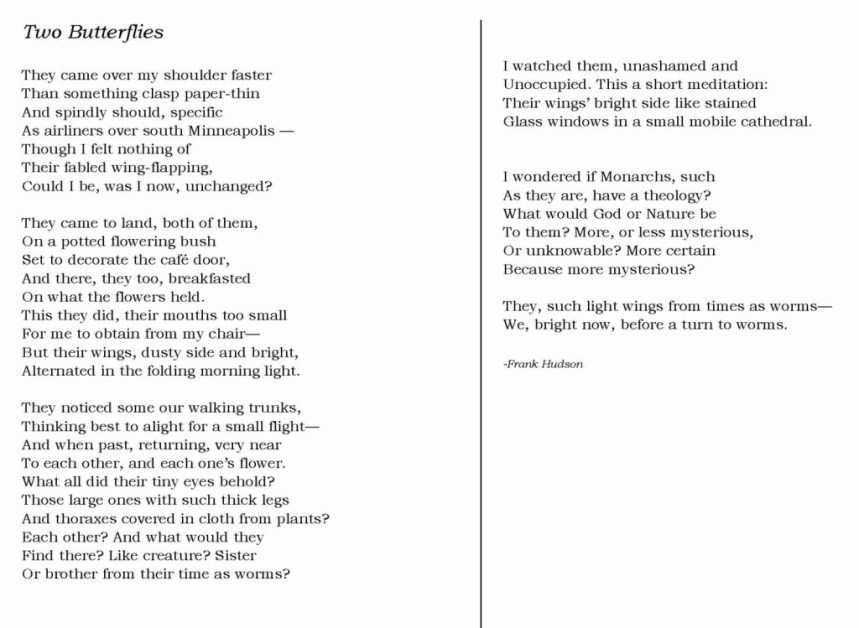
So despite those principles, the most popular piece in terms of likes and listens this past fall was “Two Butterflies,” an exception where I wrote the words as well as the music. In my original post on “Two Butterflies” I didn’t take much time to write about my intent with the poem. Let me do that today.
.
The original experience that brought this poem to my mind was sitting at an outdoor city patio early one morning eating breakfast when I was startled by the pair of butterflies flying past me within inches without stopping on their way to the potted plant near the café’s door. For the next several minutes I was enraptured by them, compelled to watch them experience the same transient morning I was in. I noticed them intent on their connection to the flowers that co-existed with a watchfulness so that they would each take off in a spiral flight when someone else would enter the café for takeout.
Much of the poem then was pure observation, its ideas derived largely from what I selected to report. The effect I was seeking to bring out in the reader in that part of the poem was an intense investment and identification with these creatures and the poem’s speaker. At times the speaker is away and watching, at times he seems as close as one of the butterflies is to the other, or even seeing through their eyes the humans about them.
Then two stanzas from the end, the poem has its turn, its volta. I’m not sure if the way I went was the right way to go. I destroy the imagist mood of the opening three-quarters or so of the poem, but I often quite like it as a reader when a poem destroys its mood or continuity in service of another frame or facet of what it’s portraying.* My readers often note this as a fault, a mistake on my part, but if so, it’s a mistake following my intent here. The poem could end before the last two stanzas, and it’d be more likeable. The casual reader would find that foreshortened poem largely understandable, a pleasant word picture.
The sin I risk in the last two stanzas is pretention—and that’s not a tantalizing sin to me. I fear committing it as much as I fear being caught committing it. To say what I sincerely thought in that morning’s moment is not an air-tight alibi. I pack a lot of metaphysics into those last two stanzas, and most readers don’t want to be waylaid by such. Most of us are too busy competing with or caring for each other to find that useful. For a few moments—and pretentiously, for only a few moments—one morning I was unoccupied enough to think on these things. You, dear reader, are not obligated to do the same. If you’d like to hear my performance of “Two Butterflies” the player gadget will usually appear below. If you don’t see a player, this highlighted hyperlink will also play it.
.
*The desire for this kind of sideways explosion in a poem’s intent or at least a slicing undercutting of its statement was something that I found in my attempt this month to come to terms with the Zhuangzi, and its own Butterfly Dream. Casual readers and even philosophers seem so taken by the implied question in Zhuang Zhou’s Butterfly Dream of how can we be sure if something is dream or reality, and then entirely miss the extra explosion Zhuang Zhou put at the end of his parable: that we find these two states completely distinct, and yet we move between them. Therefore, can we not move between completely different states in our outlook in other matters?
I’ve got Burton Watson’s translation of The Complete Works of Chuang Tzu containing all the inner books of the Zhuangzi, and it’s somewhat slow going to fully grasp despite Watson’s helpful framing and notes, but as promised Zhuang Zhou hops around quickly, hoping perhaps to destroy conventional reading.
Before continuing with our count-down of the most liked and listened to pieces here this past autumn, let me remind newcomers what the Parlando Project does. We take words, mostly other people’s words, usually poetry, and combine them in different ways with original music.
“Oh, you mean you make them into songs?” Well, sometimes, yes. But not always. I don’t always sing the words, thus the project’s name.
“So, it’s spoken word with some music in the background.” You could say that about some pieces, but I want the words and the music to interact, comment on each other. The music isn’t just background.
“Music with chanted words. Are you a rapper?” I wish. Can you imagine the commercial potential of old guys chanting poetry, often to acoustic instruments? House-party! I’ll bring the Gerard Manley Hopkins, Emily Dickinson, and Fenton Johnson! No, I’m not a rapper, but you could say that I’m more a separate branch growing off the roots of things that rap also grew from.
“Are you some kind of beatnik?” Wait, where’s my black turtleneck, I’m going to reverently listen to some cool jazz records now while trying to remember what was so important about being intoxicated first. Oh, what was the question again?
“The last few numbers on the Top Ten had those orchestral instruments. Are you setting poetry texts to music in the tradition of art song?” One limitation of this project is that neither Dave, nor certainly I, possess bel canto voices that can realize what most art song composers do. I’m conceptually doing what art song composers do, but the empirical results reflect my outlook, performance resources, and limitations. Also, like Yeats, I fear that elaborately sung melodies obscure the impact of the words.
OK, back to the countdown. If you’d like to read what I wrote when I first presented these pieces, the bold-faced titles are hyperlinks to that.
4. O Let Me Be Alone Awhile by Emily Bronte. You could feel bad for Emily B. that my Halloween piece using her spellbound poem didn’t make the Top 10, but this one, an introvert’s shout-out that some readers and listeners might have felt was especially appropriate in this pandemic “everyone stay at home” time, did. The player to hear this should be below, but if you don’t see the gadget, you can use this highlighted hyperlink instead.
.
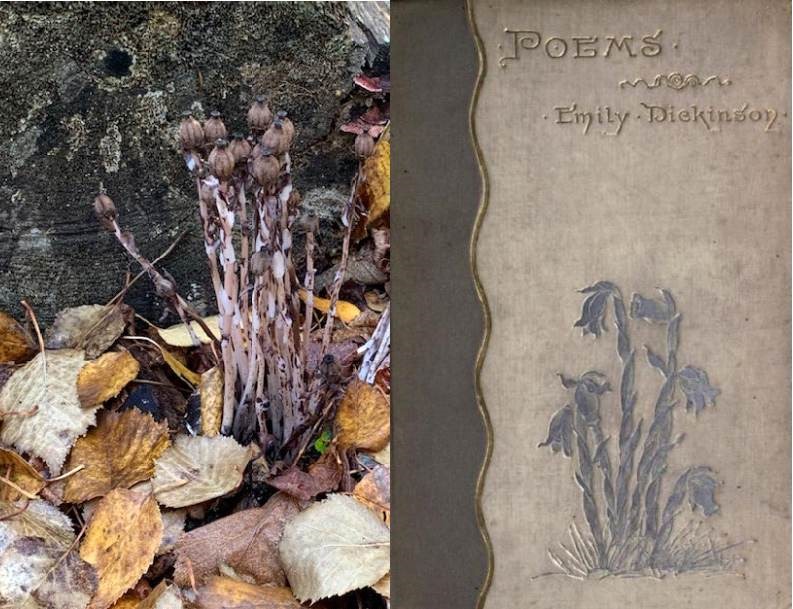
The first edition of Dickinson’s poems featured a picture of Indian Pipe flowers in bloom, but like all flowers, autumn, if nothing else, ends their term. Indian Pipe (also called Ghost Pipe) is a strange plant that doesn’t use photosynthesis, but rather gets its energy from fungus. The picture was chosen because avid botanist Emily liked this unusual plant.
.
3. As if the sea should part by Emily Dickinson. From Emily B. to her American admirer Emily D. we go. For all the mythos about Dickinson’s later years of not leaving her family home, does anyone ever ask if being cooped up in a house with a family half-heartedly uninterested in poetry was all that comforting to her? In her most vital writing years, Dickinson still roamed some physically—and mentally. I’ve had some fun over the years here suggesting musically and graphically that Emily Dickinson would rhyme with Sixties psychedelia. “As if the Sea should part” is certainly mental traveling of the purest sort. The player for this performance is below, or if you can’t see the player, you can use this hyperlink.
.
2. The Listeners by Walter de la Mare. When I started this project I thought I’d be rocking out more often than it’s turned out to be the case. Part of that result comes from being increasingly unable to record with Dave or others, and some from enjoying the novelty of being able to score and play orchestral instruments. My version of de la Mare’s weird minimalist ghost story isn’t crossing the hardcore boundary, but this is a rock band arrangement that sounds good turned up on your speakers. The player to test that claim should be below, or if not, this highlighted hyperlink will play it.
Continuing on with our count-down of the most listened to and liked pieces here this past autumn. A reminder, each of these selections starts with a bold-faced hyperlink to the post where I first presented the author’s piece. There you may find a bit more about the writer and a link to the full text of the poem I used.
7. Her Strong Enchantments Failing by A. E. Housman. Our Halloween series of eerie spell-casting stories drew strong listenership, with this one coming in at number 7. It’s likely just coincidence, but I enjoyed thinking of Housman’s selection as if it could be a response to Emily Bronte’s poem “Spellbound.”
Musically this one combines electric guitar and electric piano, two instruments that don’t sound exactly like their acoustic siblings, but they mesh together just as well. There’s a player gadget below to hear Housman’s “Her Strong Enchantments Failing,” or you can use this highlighted hyperlink if you’re reading this in a reader that doesn’t show the player.
.
6. Truth Never Dies by Anonymous. After encountering this poem extolling the endurance of truth despite human disbelief and ridicule on Kenne Turner’s blog, I just had to try and find out where it came from. In the end I wasn’t able to come up with any likely author despite a day or two of searches, but it now looks likely that “Truth Never Dies” was written in the early part of the 20th century, and the author likely was connected to the Seventh Day Adventists, though a version of the poem appeared in early trade union and temperance publications as well as church bulletins of various denominations.
Now of course most Protestant churches, labor halls, or temperance meetings wouldn’t have a string ensemble at their disposal, but I set “Truth Never Dies” to one anyway. Once again, here’s a highlighted hyperlink to hear it, or you can use the player gadget below.
5. The Dream by Lola Ridge. I may be attracted to lesser-known authors here from time to time, but then in some cases their personal biographies are often as rich in detail and adventures as any better-known poet. Ridge is one example of this. Ridge, like Mina Loy touched scenes on more than one country and continent early in the 20th Century, but like Loy she ended up connected to New York City bohemian circles around the time of WWI. After decades of obscurity, 21st century scholarship is starting to show more interest in Ridge. This poem of hers is as resolutely Modernist as Loy, William Carlos Williams, or Marianne Moore—but in our year 2020 of wildfires, pandemic, political illusions, street demonstrations and disorder, Ridge, and her more than a hundred-year-old poem, seemed to fit our zeitgeist.
Music for this? More strings, though a smaller group of them. Maybe it’s somewhat incongruous to hear my bellowing yap chanting along with bowed instruments, but those are just conventional expectations, and I don’t go to conventions. This is the hyperlink to hear my performance of “The Dream” or you can use the player below.