How did you like that last Carl Sandburg piece? It’s about as majestic as Sandburg goes, what with its extensive catalog of life in its fullness and emptiness. It seemed to me about right to mark the anniversary of this project’s launch, and my late wife, and my son, and my wife and family, and my country, and you. And I much enjoyed making the large-scale orchestra music for it.
But if it catches you in the wrong mood or with a different and certain analysis of life it can seem a bit too new-agey, suffused as it is with non-denominational spirituality.
Sandburg is best taken in large and varied portions. He has many moods and is open-hearted in a way that many poets are not.* Before I reminded myself I should do an anniversary piece earlier this week, I had another Sandburg poem I wanted to present, but I put “Black Horizons” on hold and completed “For You.” These two selections this week can be taken together to form a better picture of Sandburg.**
Sandburg can offer you balm and clarifying anger, and today’s piece is much closer to the later pole. Published in 1922, there’s not much I can think needs updating or footnoting to explain. You can read it, hear it, speak it yourself this month in 2019 and feel it as freshly as when it was written.
Musically, no orchestra today, just drums and percussion, fretless electric bass, acoustic guitar and voice. I tried to add a little color to my I, iii, IV, vi repeating cadence by flatting the 7th in the bass line, after watching Rick Beato on YouTube analyzing some Nirvana songs’harmonic complexities.*** In a more ideal performance I think the piece would work great with a choir or audience singing the refrain.
The player to hear my performance of Carl Sandburg’s “Black Horizons” is below (unless you’re reading this on an iPhone with the WordPress app—in which case, switch to a web browser to see the audio player, or you can subscribe to the audio pieces alone through most podcast services such as Apple Podcasts.)
*Why would that be? In literary circles by the middle of my century, poetry was the literary art devoted to complex, sometimes nearly unfathomable, emotional and perceptive states. A poet I heard read last night used a word “Apophasis,” which means describing something by what it is not, surrounding it with words that are not it. That term also describes a great deal of Modernist poetry. Poetry did this, at least in part, because so much tired verse of the preceding century or two repeated the same few emotional tropes until poets were tired of them. The great models of High Modernism made poetry a cult of misdirection, irony, personae, parody, and beautiful hermeticism. That poetry had power, if to a smaller audience, and one thing this project tries to do with music and performance is inject it with audible expression to illuminate the complex humanity in it.
**Yet they leave something out, the shorter, more purely Imagist Sandburg, a mode of his that I personally love and think deserves to be better remembered. That Sandburg has all the elusiveness and compression that Modernism propounded as a remedy to the overblown “listen to me play the cathedral organ stops of poetic sentiments” poetry it was rebelling against. For examples of the subtle Sandburg see this well-known poem and this deserves-to-be-better-known one.
Because of the more direct and Whitmanesque Sandburg, those Imagist poems are misread. They’re assumed to be slight, in a way that “A Station in the Metro,” “The Red Wheelbarrow” or “Oread” aren’t.
***My son has been learning Nirvana bass lines this year, which is stuff I can’t teach him because I only understand such things long enough to use them and because I lack the mimetic talent to transcribe existing pieces well. While recording this I discovered, to my horror, that I’d more or less forgotten how to play fretless bass while working on orchestration.
****Yes, it takes only seconds to decide. Revolution implies it takes only a little bit longer to implement that realization. We’re nearly 250 years into the American Revolution, and we’re still working on it. Sandburg’s poem is almost 100, and we’re still working on it. “The Sixties” are mostly 50 years old, and we’re still working on it. That’s your choice: still working on it, or giving up working on it.
Did you find yourself agreeing more with H.D. or William Carlos Williams in Thursday’s audio piece taken from Williams’ Kora in Hell? If I was to survey listeners, I’d be surprised if Williams wouldn’t win far more applause. Being that it’s his book, and he controls what H.D. presents before he responds, it wasn’t really a neutral-site debate.
That sort of exchange could remind you of our modern political ads, where candidate A is quoted or shown in some excerpt that appears outlandish, and then candidate B is cut to saying that they think that’s just as outlandish as you think it is, and I’d never take that position, so vote for me. Except, it’s in reverse. It’s Williams, candidate B, who’s taking the more extreme position. Still I think Williams will largely win the audience.
It’s also easy to see this as a male/female dynamic. H.D. makes a suggestion, plausibly insightful, asking only for self-reflection on W.C.W’s part. Williams responds to her, in much more forceful rhetoric, defending his freedom, saying in effect when you say “sacred” I hear “heretic.” I think a great many observers of gender roles would see this as a stereotypical exchange. I agree*, but I could imagine this same exchange with the genders switched—less common, but possible. And it certainly occurs in a same gender situation too.
Something else that came to mind as I read this was a division that was made in an influential essay at mid-century, something that was still current when I was in school. This month I re-read that essay after Kora in Hell and the telling exchange I took from its prologue. It’s by critic Philip Rahv, published in 1939, and its title “Paleface and Redskin”** sets out the framework of its thesis, something that professors still thought relevant when I was being taught. The title is a distinctive dichotomy Rahv had observed in American literature. This paragraph from Rahv’s essay summarized the two types:
…the redskin glories in his Americanism, to the paleface it is a source of endless ambiguities. Sociologically they can be distinguished as patrician vs. plebeian, and in their aesthetic ideals one is drawn to allegory and to the distillations of symbolism, whereas the other inclines to a gross, riotous naturalism. The paleface is a ‘highbrow,’ though his mentality…is often of the kind that excludes and repels general ideas; he is at the same time both something more and something less than an intellectual in the European sense. And the redskin deserves the epithet ‘lowbrow’ not because he is badly educated—which he might or might not be—but because his reactions are primarily emotional, spontaneous, and lacking in personal culture. The paleface continually hankers after religious norms and tends toward a refined estrangement from reality. The redskin, on the other hand, accepts his environment, at times to the degree of fusion with it, even when rebelling against one or another of its manifestations. At his highest level the paleface moves in an exquisite moral atmosphere; at his lowest he is genteel, snobbish, and pedantic. In giving expression to the vitality and to the aspirations of the people, the redskin is at his best; but at his worst he is a vulgar anti-intellectual, combining aggression with conformity and reverting to the crudest forms of frontier psychology.”
Rahv ostensibly doesn’t favor either side. His observation, made by a man who could claim to be an immigrant, outside observer, was that American Lit was binary and divided with authors on one side or the other and no synthesis, and that this was a bad thing. ***
Pale faces and redskins, or 3 artists and some spuds.
It’s easy to see that divide in the H.D. and William Carlos Williams exchange. H.D. in the moment captured in her letter to W.C.W. is paleface, and Williams is redskin. Rahv expends most of his examples on novelists, and Modernist novelists like Hemmingway and Faulkner and Sherwood Anderson he feels all fail to a significant degree due to redman tendencies. But Modernist poets weren’t really in either camp as Rahv defines them. Ezra Pound could be claimed as either, and even in the two early pre-Modernist poems I’ve just presented here he tries on each personae: in “Grace Before Song” a pious poet in service of art who will be personally forgotten and in “In Thus in Nineveh” as an unheralded poet who will be remembered because the people value the lively if imperfect vitality of his verse.
Feel free to consider Rahv’s classification system as silly, outdated, or even distasteful. I myself consider it an amusing parlor game kind of thing, more subjective than Rahv thinks it is, and as subject to superficial oversimplifications as taking a “Which Disney Princess are you” quiz. ****
I wasn’t going to include any audio with today’s post, but after spending a day avoiding completing this post so that I could play with orchestra scoring, I figured I could read a couple more sentences also from Rahv’s 1939 essay backed by a short example of what I was coming up with. The player’s below.
*Even though Williams and English language Modernism in general coincided with the rise of women’s independence and citizenship, and even if women were participants in this cultural revolution, that doesn’t mean that Modernist men were invariably feminist—far from it. There are things to admire about W.C.W. for sure, but even in my limited reading of his work I keep getting this weird vibe from him where women are concerned.
**Yup, Rahv went there with the casual use of the racial slur. As literary culture goes in this era, totally non-remarkable and non-controversial. The first college I attended, where I heard of Rahv’s essay, had named its sports teams The Redmen, a just more polite term. I had a tiny part in asking this name be changed. In Rahv’s defense I’ll say that he was a Jewish heritage immigrant from the Pale of Settlement. If life experience is knowledge, he likely “understood” ethnic slurs as deeply as any of us.
The kind of dichotomy Rahv lays out has analogues in modern discussions on just how street a rapper is, or debates on if performance poetry can be “real poetry.”
***From the luxurious wisdom of history, I found it fun reading the essay to see who of his contemporaries he thought was fatally damaged by this inability to join the strengths of both groups. He seems to give obvious paleface T. S. Eliot a passing grade, though noting that he had to leave America. Rahv says “Faulkner’s horror stories have long ago ceased to have any recognizable value.” History disputes Rahv there. Hemmingway is just a retread Natty Bumppo he says, an arguable case still today (even though I’ll take the other side on that one). Emily Dickinson gets an atta girl notice as a more or less successful paleface. No, additional reflection since 1939 has discovered that Dickinson is a redskin with paleface trappings.
Whose fault is it when a poem is hard to comprehend, to understand? The first thought may be that it’s the fault, or even intent, of the author. Communication via written language has its weaknesses, but we know from our day to day lives that it can convey information successfully. Poetry, particularly poetry of literary repute, has a reputation for frustrating expectations of understanding.
For thoughtful people there should be second thoughts on this matter. If a writer, a poet, asks for a certain level of engagement, knowledge, curiosity, and openness are they always being unfair? I’m willing to grant they can ask too much, but asking too little of an audience of readers has costs as well. Here’s a principle worth remembering as you approach poetry (or other arts): poetry isn’t about ideas, it’s about the experience of ideas. Experience isn’t permanent, one-sided or clearly binary. If we for an instant experience something as a simple truth, a moment of clarity, poetry can express that—but properly comprehended simple truths exist in a contradictory and changing world. Sometimes we can misunderstand a simple poem as much as a more esoteric and confusing one.
Early English Modernist poetry, particularly those poets around the Imagists, wanted to explore these things. It may surprise you, but many of its pioneers before WWI made a choice for clarity, for simplicity. It did to me. I came to the early works late, already steeped in the poetry of the post-WWI High Modernists: Wallace Stevens, T. S. Eliot, Paul Eluard and Dada and Surrealist associated writers. But look at the pre-WWI work of some English modernists, like this poem by T. E. Hulme, a poem that has been identified as the first Modernist poem in English, “Autumn.”*
Autumn
A touch of cold in the Autumn night—
I walked abroad,
And saw the ruddy moon lean over a hedge
Like a red-faced farmer.
I did not stop to speak, but nodded,
And round about were the wistful stars
With white faces like town children.
Does it seem strange to you that such a poem could change things? It’s so un-assuming, so easily grasped. Two homey images that require nothing in the way of pre-requisites to visualize, though it may be helpful to be as Hulme was, a rural person who had migrated from the fields of his childhood.** If one pauses and looks again, notice what’s not here: length, words naming emotions instead of objective description (save the single “wistful” which carries power in its exception) and rhyme. A not strict, but appreciable meter appears gradually with the final three lines, but the previous four are free
Today’s audio piece presents another poem by T. E. Hulme, one that isn’t easily understood at all. Hulme often wrote his pieces to demonstrate the theories of Modern English poetry he wanted to bring to the fore critically, and like “Autumn,” the rest of his extant work has a radical clarity. Hulme scholar and professor Oliver Tearle reports that today’s piece “Conversion” may have literally been a blackboard example of a revamped kind of poetry. If so, those looking at the chalk marks may have been as puzzled then as we are now.
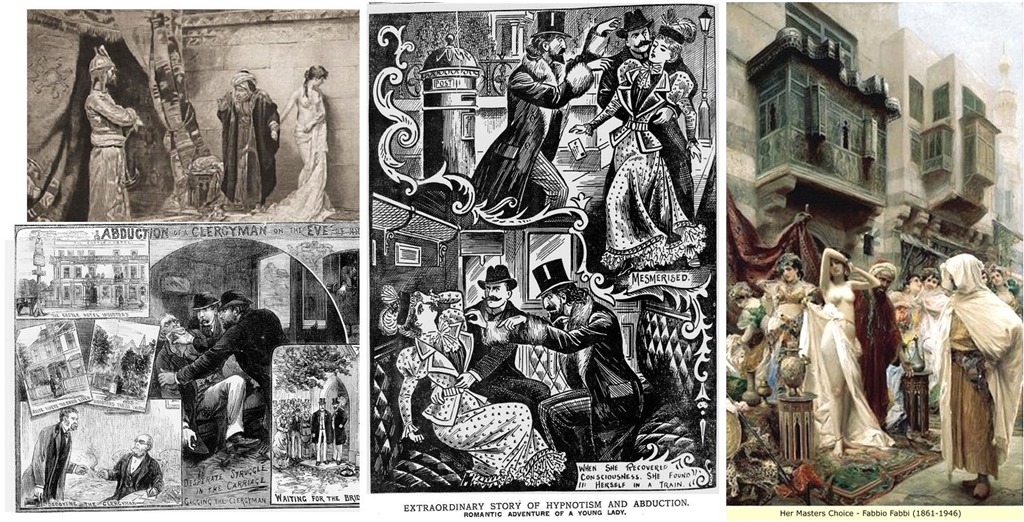
“Conversion” starts off conventionally enough: a walk in nature, and hyacinths are in bloom. It’s beautiful and fragrant. We are altogether conventional here, save for the free verse. Then the next two lines are a clear image, but not necessarily an expected one: imaginarily our poet is drugged and kidnapped. In Hulme’s era a rag soaked in some ether or chloroform was a standard illustrated weekly/pulp fiction trope for this, but flowers as an agent is not unprecedented either (Midsummer Night’s Dream) and in the poem the scent of the flowers is associated with this. For all Hulme’s Modernist intent, this does seem to follow a lot of fairy story plots from Tam Lin to “La Belle Dame sans Merci.” The two lines that end the kidnap incident are uncharacteristically sound rich for Hulme: “Motionless and faint of breath/By loveliness that is her own eunuch.” It’s like Yeats or de la Mare broke into the poem for a moment.
I have a theory, one that greater scholarship or historical knowledge than I have might bolster. The word “eunuch” in the poem is our fuse. Eunuch in the context of Hulme’s time would likely bring to mind the Ottoman Empire and the exotic non-Christian Middle East. Exoticism is a complex thing, elements of fascination and sublimated desires are part of it, as are, alas, stereotypes and racism. But one common trope in the European mind of the time was the kidnapping and sexual enslavement of women in eunuch-run harems of Ottoman rulers. My guess is that’s what Hulme is referring to here, and that it might have been familiar enough to his time and audience to assume the reference would be understandable even in this highly condensed poem. The poem’s hard to explain title “Conversion” could also be fit to this idea.
Mysterious Victorian abductions, non-Christians portrayed as evil so that Europeans can look at pictures of ladies breasts.
That still makes the final three lines hard to follow. Is Hulme’s personae in the poem female, or is this a male-male cross-cultural bondage fantasy? Does it end with the death of the personae or just being carried away in quasi-erotic bondage? Come on Hulme, you may be using some unenlightened xenophobic twaddle for your image here but give us a clue!
“Final river” (Tearle reads the mythological river Styx here, and domo arigato Dr. Tearle) “without sound” seems to lean to drowning death. The one thing I came up with trying to figure this out is the apocryphal tale of the 17th century Turkish Sultan Ibrahim (“The Mad”) who was said to have had his harem of 280 concubines thrown into the Bosphorus to drown, a punishment that otherwise would be fit for a peeping Tom-Turk spying on the ruler’s harem.*** But by now I’m feeling like Wylie Coyote standing on thin air trying to explain those sparse final lines.
Drop all the guesses and dodgy cultural stereotypes, even if we blame the author for them, and “Conversion” may still work to some degree, after all what I think the images set out to do is to convey that the apprehension of beauty can involuntarily change one by confusing our priors. The philosophic idea is not instantly clear, its images are problematic and opaque, but the words and the sounds of them intrigue. This “Beauty will be convulsive or not at all” as André Breton later wrote.
Of our three London-based “School of Images” pioneers, only Pound would later write “High Modernist” poems with such knotty allusive problems. F. S. Flint drifted out of poetry after WWI, and Hulme was killed in that war. Pound admired Hulme considerably, and T. S. Eliot spoke highly of him too. Those two may have chosen to follow the Hulme of “Conversion” more than the Hulme of “Autumn.”
Well, this is a long post, and once more I’ve run out of room to talk much about the music and performance of the piece. I decided to make the musical setting discontinuous to reflect the confusion of the narrative and I hope I’ve brought out the mystery and lyricism of Hulme’s poem in my performance. The woodwind instrument featured at the start and finish of the piece is a virtual instrument version of the duduk, a gorgeous-sounding free-reed instrument that might be found around the shores of the Black Sea. I also couldn’t resist blowing a chorus on the Telecaster, an exotic instrument as old as I am, designed by a radio repairman on our western shores. The player gadget is below. Text of Hulme’s “Conversion” can be found in Terle’s post on the always Interesting Literature blog.
*Like the “first rock’n’roll song” or “the first rap record,” there are probably lots of candidates, but it’s still helpful to have a marker to say about it: “This is different, and points to how things can be changed.”
**One cultural-particular is present: in the sunburnt face and white colored children of its two images, it’s not melaninanicly universal, but the particular in the case of poetry can still speak to us. Around the time Hulme wrote this, Charlie Patton was probably singing the floating blues verse that Son House later recorded “My black mama’s face shines like the sun…”
***”Michael Cohen, I like grand viziers who don’t get caught. I’ve got to get me some of the best people.
Just a couple of posts back I said that early Carl Sandburg poetry can be just as aligned with the ideals of the Imagist school as the Trans-Atlantic poets such as the then contemporary work of Ezra Pound, Amy Lowell, H.D., Richard Aldington, F. S. Flint, T. S. Eliot, William Carlos Williams, and T. E. Hulme was. Yet he’s rarely mentioned as such.* Why might that be?
My guess is that there’s an issue with Sandburg’s more expansive mode, present in some of his work, Whitmanesque in character and scope. The Pound and Eliot school of Imagism wasn’t much on Whitman, charging him with lack of craftsmanship and concision. And then there’s the issue of cultural affinity, which while outside the text, is important. Of the above, only Lowell was from a wealthy background** (and Flint’s childhood seems positively Dickensian) but they all saw themselves as culturally elite. Most were familiar with classical languages, some had Ivy League educations (though none were Oxbridge, save for Hulme who was thrown out after a bit more than a year for rowdy behavior), most had spent time in Europe , even Williams, the most American-focused of these.
Sandburg? Born working class to two immigrants in the Midwest***. Drops out of school at age 13 to go to work. The jobs he had in the first 40 years of his life were modest in prestige, but varied in location and nature. Coal-heaver, farm laborer, Army private, milk-truck driver, political organizer, bricklayer, “The Front Page” era urban journalist. What T. S. Eliot knew about the whole of literature, Sandburg knew about the whole of working-class work and life.
One could make one mistaken generalization from Sandburg’s biography, that like Whitman self-advertised himself, he’d be “one of the roughs,” a man whose art would be artless and as unconcerned with the niceties of aesthetics as the correct fork for which dinner course. But just like the lazy assumption that there’d be no poets in foxholes, the idea there are no aesthetes who punch a clock is bogus. Sandburg’s early work is as concerned with Modernist beauty and style as working-class dignity—and he is very concerned with working-class dignity!
Is today’s Sandburg piece, “Back Yard” an Imagist poem following the three Imagist rules? Let me paraphrase them:
Direct treatment of the thing: that is, the focus in the poem is on the image itself which will be described, instead of the image being a decoration and figure of speech within the body of a poem more concerned with its moral or message for which the image is only a “like” illustration. Conciseness: no extra words, and though not stated, it’s corollary is no less-apt words used only to make the rhyme. And freer rhythms: word-music, like sound-music, is not required to limit itself to only extraordinarily regular and repetitive rhythms.
Direct treatment? The outdoor, summer night scene is just that. One is hardly aware here that it’s an image, it seems like simple reportage. Is it merely the “hardly news” that on a summer night if one is outside, perhaps sitting on an open porch, you’ll hear and see other people outside too?
Concise? Pretty much. It’s not In A Station of the Metro, or The Pool, or The Red Wheelbarrow, there is some re-iteration in it, even a single line refrain, but even by the standards of lyric poetry, this is a short poem. The elements of the scene are evoked, but there’s little extravagant or showy description. One element that many Imagist poems share (though never a formal rule AFAIK) is that colors are used to simply describe objects, though since this is a moonlit night scene the colors are more monochromatic.
A follow up question: how minor and mundane is “Back Yard” really? I can’t claim it’s a poem of great originality—but that’s not the job of every poem, and this is more a poem of the continuity of change, a moment of shared perception, not a striking new vision.
I think its intent, in it’s just over 100 words, is for us to see a chain of life in a Chicago night early in the 20th century; and in its everyday exactness, state those things that might link to a night tonight where we live today. The silver moonlight in the scene seems almost a preservative, everything is frozen in that direct moment. In my night tonight it may not be an Italian boy with an accordion, but Mexican music from the back yard at the end of the block. The couple Sandburg says will marry next month, are now-dead grandparents of people as old as I am. An old man has fallen asleep in the late and waiting moment, his back-yard cherry tree’s fruits held in a moonlit unmoving until his eyes close. He will likely pass on sooner than the marrying couple, and his dreams and those long-ago cherries will be returned to the place that dreams, fruit, and poems go and come from.
The poem closes with a perennial thought delivered in the scene’s description. The clocks, the poet relates, say he too must go. The clocks say that to all of the characters in his poem, and by extension to us, his audience. Sandburg, the artist, the poet, has the job like the moon to fix this moment in silver. Was he thinking here of the silver of his brother-in-law Edward Steichen’s art photographs? What does he mean by the poem’s closing line? What are the “silver changes?” My best understanding is they are the endless succession of such fixed moments. There will be more and more silver changes, a great richness, even as we are entirely not there.
Fancier than my back yard: “Nocturne-Orangery Staircase” (1908). Sandburg occasionally collaborated with his brother-in-law and pioneer in fine art photography Edward Steichen.
For the performance of “Back Yard” I decided to intersperse some other night moments, sung as commentary on Sandburg’s poem. You can hear it with the player gadget below. Want to read along? Here’s the text of the poem.
*Yes, Imagism is only a label, a piece of sticky paper put on some writers and writing. But because Imagism was so vital to the formation of English poetic Modernism, excluding Sandburg, “The Forgotten Imagist” from its usual ranks was part of how he was diminished in the late 20th century. The artistically-chosen stark simplicity of Imagism was admired, but similar directness in Sandburg was seen as populist simple-mindedness. For an example, here’s a long review of a late 20th century biography, where the dagger is that Sandburg’s poetry was “dumbed-down Whitman” and the charge seems to be that he was a pretentious yokel who was also a phony who pretended to be a yokel.
**I’m of the impression that Eliot and Pound’s family had at least upper-middle-class wealth too, but my informal memory is that some estrangement or streak of independence led them to live outside their families’ wealth.
I’m going to do something this time that I’ve done before but is rarely done.
I’m going to revise someone else’s poem without their permission—which I would feel bound to obtain, but the author Orrick Johns is long dead. The last time I did this, it was Rupert Brooke’s work I used, and my excuse was that his fragment that I presented here as “On the Troop Ship to Gallipoli” was likely an early draft left unpolished due to Brooke’s death.
Orrick Johns published “Ollendorf’s Wife” in his first book-length 1917 collection Asphalt and Other Poems. There’s little online to help me make sense of Johns’ life, but it’s probable that Asphalt and Other Poems collected early work Johns had written in his twenties. While most of the poems are short lyrics, Johns works there in several styles. The poems are rhymed, not the free verse of “Blue Undershirts” that made such an impression on William Carlos Williams. The opening section, “Asphalt” is an odd set of doggerel poems in dialect. I have trouble reading dialect poems, and from my vantage point as a mid-20th century man I can’t make out what ethnicity Johns is representing in these poems. There’s a lot of dropped consonants and dere’s, dem’s and de’s. I assume these poems are intended to be proletarian poetry and demonstrate John’s solidarity.
Almost nothing in Asphalt and Other Poems grabbed me. Nothing passed the Emily Dickinson test, there was no spectral cold and the top of my head remained attached throughout. While it was trying to depict its modern world, the music was awkward for me, with some forced poetic diction and conventional sentiments that made it more similar to Margaret Widdemer than Millay or Sara Teasdale, contemporaries that were writing prize-winning short rhymed lyrics at the same time as Johns. Like Widdemer, and unlike Millay or Teasdale, the poetry in this book of Orrick John’s is understandably forgotten.
There was one poem in a section titled “Country Rhymes” that did seem to have a germ of something though.
Johns’ poem as it appeared in “Asphalt and Other Poems”
Like T. S. Eliot, Johns grew up in St. Louis, but unlike Eliot he stayed in the Midwest for college. The “Country Rhymes” section reflects that longer experience, and nowhere better than in “Ollendorf’s Wife.” First off, the poem is generally free verse, with uneven line lengths and sparse rhymes. And it has some vivid images. Ollendorf’s wife significantly has no name of her own in the poem. She works her farm plot assiduously, with no love showing in her face, but also as if it’s her last child. How many children, like her name, go significantly unmentioned? The fields she works, and the farm wife are “drawn together” by a “knowledge…greater” than “each other’s best.”
At its core, this poem works by the things it leaves out, fulfilling Hemmingway’s Modernist theory that you can remove the most important things in a story correctly, and by doing so depict them all the more intensely.
So out of care for “Ollendorf’s Wife,” I revised it, intensifying that paring away of the unneeded, leaving only the cutout cameo around the farm-wife’s charged day in a life. I added nothing really, but took away words that restated something otherwise established, and rewrote lines aiming to make connections stronger. I made one additional repeat of the “day after day” phrase, because there the repetition is the image. Though I intended to perform my revision, I generally wasn’t thinking of making the poem more “sing-able” as I changed things, but I suspect that factor worked its way in as well.
Here’s my revised version of Orrick John’s poem
As I said at the beginning, this is not something that is commonly done. There are poems that use the subscript of “after a poem by…” but those poems that are revised and re-voiced are usually much older or in a different language than the new version. Obviously, such an act could fail as well as succeed. You are the judge in this case. The gadget to hear my performance of my revised version of Orrick John’s “Ollendorf’s Wife” is below.
Last post I rapidly traced poetry from the era of Homer and Sappho and the Confucian Odes, jumped to English language poetry and finally ended with early 20th century Americans. I traveled fast, and simplified much, but it wouldn’t be out of line to say this is a progression from poetry that was expected to be performed with music to a poetry that wasn’t. Widespread literacy and the printing press, and by the Modernist era, a desire to include complex allusions and layers of ambiguity all helped this progression along.
Today let’s start in the 20th Century in America and follow the songwriter’s side of things. Popular songwriting had become industrialized. Composers and lyricists churned out uncountable numbers—and first by sheet music and then by recordings, film, and broadcasts, these productions could be distributed widely. Barriers to entry were low in this business, but rewards for popular success were high. Lyricists came from a wide range of backgrounds—some were middle class, even college educated, but many were immigrants or descendants of recent immigrants for whom English was a fresh language.
As with any mass art or market, much of what they produced was forgettable, a job of work, their ears may have sometimes bent to the muse, but their hands were looking for a paycheck.
Poets and literary critics occasionally paid a little bit of attention to that work in their time. Lively arts and all, some notice was taken.* With the music inspired by Jazz, the cultural force of the music could not be denied, even if the words that came along with it might be condescended to.
Then, in the mid-1930s, a decision was made, outside of music and poetry—a political decision—that eventually changed the course of popular music lyrics. For political reasons both international and U. S. national, the Soviet Union-dominated international Comintern and the U. S. Communist Party decided to switch tactics from a more purist “only the Communist Party is the solution” stance to a popular front position, where anyone to the left of the then rising Fascist forces were considered valid allies.**
In the U. S. this led to such slogans as “Communism is the Americanism of the 20th Century.” On a political level this meant that the Roosevelt New Deal wouldn’t be portrayed as capitalists pushing insufficient reforms to stave off the inevitable revolution, and that actual “card-carrying Communists” would be mixing more generally with socialists, liberals and centrists. But for our purposes, we need to look at how this played out in the cultural sector.
Popular arts, which could have been perceived as hopelessly compromised tools of the capitalist system, became more acceptable; but a more pure, folk expression that was seen as coming directly from and for the workers and the exploited, a music existing outside of the commercial infrastructure of entertainment, was even more ideal.
So here, twenty years before the “Great Folk Scare” of the 1950s were the roots of the folk revival.*** It’s in this pre-WWII period that Pete Seeger and Woody Guthrie came of age and shaped their songwriting. Seeger was a Harvard drop-out and son of two musicologists.**** Guthrie was none of those things. The Popular Front meant that the likes of those two, and many others with high to low culture backgrounds, would mix it up.
My apologies to my Christian readers for posting this example of extraordinary Popular Front songwriting on Easter when it’s more a Good Friday kind of thing. Billie Holiday sings the harrowing “Strange Fruit.”
As songwriters this could have meant dour issue-of-the-month songs cleared by some central committee. And to be honest, each of them sang and wrote some of those, but both of them had Emersonian Individualist streaks.*****
And they listened too, had big ears. Afro-American music and musicians, isolated southern U. S. musicians who songs and styles were time-capsules of old British Isles tunes. Blues and “Hillbilly” music benefited somewhat from being a source and occasional fellow-traveler with this movement.
The Afro-American Harlem Renaissance is shaped by the gravitational pull of this political decision too. Civil Rights before the ‘30s was often aspirational, and though the folk traditions were honored before, this new emphasis on embracing popular and folk arts increased the interest and respect for them among an emerging new Afro-American cultural consensus.
Now we jump ahead again, it’s that un-named but important straddle decade of the late ‘50s to early 60s. Communist connections are poison. Illness had made Guthrie bedridden. Seeger is persevering outside of any first-tier commercial structure as a road-dog performer. “Folk Music” is now a commercial genre with a still bohemian/left-wing underground. Into this we inject the man who will expand the idea of what song lyrics will be allowed to do: Bob Dylan.
You don’t have to like Bob Dylan as a person, performer or songwriter to accept this truth: there are song lyrics before Dylan’s 1963-66 period and there are song lyrics afterward, but song lyrics are a completely different field after the change he proved was possible. This is why an artist as strong in his own right as Leonard Cohen can say in one of his last public statements: “Giving a Nobel Prize to Bob Dylan is like pinning a medal on Mt. Everest for being the highest mountain.”
But a Bob Dylan has causes, has a context in which he can happen. That choice Communist bureaucrats made for pragmatic political reasons in the mid-1930s led to a folk music scene 20 years later in which Afro-American blues and weird old folk music mixes with poetic Modernism inside the mind of one songwriter, and what comes out is strange and compelling.
Song lyrics don’t have to be a piece of work aiming for an established commercial target. Song lyrics don’t have to make clear front-to-back sense the first or the fifteenth time you hear them, they can mystify you and still have listeners. Songs with narrative elements don’t have to progress in a linear manner. Song lyrics can be about anything, can use any kind of imagery. Love songs can be ambiguous. Political points can be made metaphorically. You can combine different kinds of diction, even sample and reference various existing sources, and it doesn’t have to seem out of place or from the lack of original things to say.
One can point to song lyrics that did one or two of these things before Dylan, but after Dylan used many of them together and repeated that demonstration often, many songwriters wanted to try using any and all of these things, and their attempts caused other songwriters to do the same. A chain-reaction occurred.
Modernist poetry had done all these things already, and often—but Modernist poets didn’t write songs, and for the most part they didn’t read and perform their poetry charismatically. Some Beat poets, that faction of the Modernist movement that had vowed to remain resolutely bohemian, who had read their poems in front of jazz combos, recognized this was a different level of music combined with words. Allen Ginsberg heard a copy of Bob Dylan’s second LP in 1963. As the first side of that record moved inward toward the ouroboros groove in its middle, as “A Hard Rain’s a-Gonna Fall” played, he says he wept. Did he weep, feeling he was now displaced? Did he weep because this not yet 40-year-old poet might be replaced by this just over 20 singer-songwriter? No.
He wept, with an outlook of gratitude, because “There’s a saying among the Buddhists. If the student is not greater than the teacher, then the teacher is a failure.”
A long excerpt from “A Hard Rain Is a-Gonna Fall” with Ginsberg’s statement cut in.
Good story. But this was far from the end of the matter. A great many important poets and critics didn’t feel Ginsberg, or any of his Beat cohort, were very good poets. Therefore, Ginsberg’s say-so didn’t make Dylan a “real poet.”
You can’t say songwriting accepted or didn’t accept Bob Dylan, because acceptance is too meager a word for what happened—he changed how songwriting worked. The question of poetry “accepting” Bob Dylan, or songwriters in general, is still open.
Will I ever answer the question in the title? I beg your patience. This is by far the longest piece ever published here, even though I’m skimming over a lot of things. In Part Three I’ll finally get down to the answer that makes the most sense to me.
For an audio piece today I’ll suggest this one, one of the rare times here that I perform my own writing, a live version of “On First Hearing Blonde on Blonde” by the LYL Band. The audio player is below. Thank you for reading and listening! Part Three, that should be the conclusion, comes soon.
*Decades after this era in 1990 literature professor Phillip Furia published his book The Poets of Tin Pan Alley which helped convince this fan of more “authentic” songwriters that these commercial lyricists were not without considerable art.
**As in the case I’ll make later regarding Dylan, please don’t let any personal feelings or judgements you may have regarding Communism or the Comintern blind you to the historical connections here.
***I can’t not mention one poet and musician who jumped the gun on this, Carl Sandburg, who published his important folk song collection American Songbag in 1927. And for length reasons, I’ve largely left out the 20th century development of Afro-American blues and jazz. Charlie Patton didn’t wait for the Comintern to get in touch with him to forge his new alloy of styles.
****One of his father’s prize students was Modernist composer Henry Cowell. His step-mother, Ruth Crawford Seeger was in some opinions the most significant female American Modernist composer of the first half of the 20th century.
*****We can think of songs like “Where Have All the Flowers Gone,” “Bells of Rhymey,” “Plane Wreck at Los Gatos,” or “This Land is Your Land” as exceeding requirements for that kind of song. Abel Meerpool’s “Strange Fruit” is an excellent example of a lyric, written as a song, that would stand alongside poetry intended for the page.
A bit earlier this month we presented a landmark very short Imagist poem, Ezra Pound’s “In a Station of the Metro.” 14 words, and a prime example of the Modernist’s reaction to the rhetorical flourishes of a worn-out 19th century. Today I’m going to release a Robert Frost response, a 47-word rejoinder, a spring poem with some winter snow left in it.
Frost was born 145 years ago this week. His relationship with Pound is complex. On one hand Pound could view himself as responsible for launching Frost’s career, writing the first substantial review of Frost and seeing to it that his poems were published in Poetry magazine. Without Pound’s endorsement, Frost had submitted poems there which had been rejected.
Frost tells the story of their initial meeting, with Frost’s first book A Boy’s Will so newly published in England that he himself hadn’t gotten a hold of a copy. F. S. Flint (a too-often-forgotten pioneer of British Modernism) had met Frost at a bookstore reading, shortly after Frost had moved to England. Flint noticed Frost’s American shoes and insisted that he must meet his countryman Ezra Pound, now also residing in London. Frost later went to Pound’s apartment, and this is how Frost recounted their meeting:
[Pound] said, ‘Flint tells me you have a book.’ And I said, ‘Well, I ought to have.’ He said, ‘You haven’t seen it?’ And I said, ‘No.’ He said, ‘What do you say we go and get a copy?’ He was eager about being the first one to talk. That’s one of the best things you can say about Pound: he wanted to be the first to jump. Didn’t call people up on the telephone to see how they were going to jump. He was all silent with eagerness. We walked over to my publisher; he got the book. Didn’t show it to me—put it in his pocket. We went back to his room. He said, ‘You don’t mind our liking this?’ in his British accent, slightly. And I said, ‘Oh, go ahead and like it.”
Even in prose, there’s some Frost-ian ambiguity it his account. He notes in passing that the American Pound was putting on a British accent. And his sly quote of Pound “You don’t mind our liking it” before Pound has read it—a subtle dig at poetic politics that—and who’s the “our” here. Pound (and Flint too) were promoting a poetic movement, Imagism—poetry that used direct, concise treatment of “a thing” without any extra words whatsoever.
Frost never liked a movement that included more than him.
And to some degree this soon led to a break between the two poets. Pound thought that Frost fell short on the “use no extra word” dictum of Imagism. He apparently offered to help Frost learn to excise those surplus words—and though similar offers from Pound were taken up by literary giants like T. S. Eliot and Ernest Hemmingway, Frost refused it.
There was a second catch. In Pound’s review that launched Frost, Pound wanted to make a point of Frost’s rejection by American editors, and he was loudly saying this in an American magazine (one of those that had, in fact, rejected Frost). Many musicians and music fans will quickly recognize Pound’s move here. This is the punk/indie/”street cred” claim. This artist has too much honesty and individualism and lacks the subservient guile to please the suits and the mainstream! The problem here was that Frost was a middle-age man with a family—he wanted to cross-over to those editors. Frost thought Pound was pulling this move to show what a discerning critic he was more than to promote Frost as an outsider artist.
But note too in Frost’s account of his first fateful meeting with Pound, the subtle admission he makes about himself. “Oh, go ahead and like it.” He wanted, needed the help—by any means necessary.
Oddly, if you were to read Pound’s short review today, you might be surprised that it worked to launch Frost at all. There are condescending elements, Frost is almost treated as some idiot-savant country bumpkin. And worse for Pound, he goes on record as the first man to misread Frost as simple and earnest (the same mistake that I made as a teenager, but then I’m not Ezra Pound).
A patch of old snow, blossoms on wet dark bough not included
Here’s the text of Frost’s poem I use today and here’s Pound’s 14-word Imagist flagship. Look at Frost’s first stanza. Sure, Frost’s is rhymed and metrical, though Pound uses a near rhyme that many miss. If Frost ended there, his poem is purely Imagist. “Old” in front of snow isn’t a wasted word. We need to know it’s spring now, and that the snow is past its sell-by date. And it’s an interesting choice to say “blow-away paper” instead of blown-away—more immediate, and it indicates that its transient nature is inherent, not something acted upon from without.
Frost’s second stanza? Pound’s editor’s pencil might have suggested he’s restating the image from the first stanza, but Frost might have countered by noting that he’s making clear this isn’t just any crumpled scrap paper the snow is being made equivalent to, but a newspaper or other publication, with “small print.”
Here’s the Imagist difference. In conventional poetry, the images, the similes and metaphors, are only decorative—look, clever I can compare this to this. In Imagist poetry this comparison shouldn’t be just decorative—it’s the meaning of the poem. This last edition of winter is “yesterday’s papers.” And bilaterally, wrong-headed reviews in Poetry? They will pass like the lonely grimy snow-bergs.
The last line, “If I ever read it,” is Frost’s touch. Pure Imagism doesn’t like to draw conclusions, even enigmatic ones. Does it mean one thing? I think it predominantly says, it’s the past, I’ve endured, it’ll soon be gone completely. The poem first appeared in Frost’s third book, the first to be published in America not in England. Frost was on his way. But there’s an undercurrent—with Frost there always is. Is that small print an edition of The Book of Nature? After all, we also know this: winter will return, and should we not read what it has written to us?
Frost will do that too in many of his greatest poems.
This morning I ask myself, what a strange way to spend a weekend full of news and melting snow, reading the small print about two poetic innovators at cross-purposes to each other.
Musically, I wanted to let loose a bit for this one. I’ve been playing acoustic guitar for many recent pieces, so I wanted an unleashed electric guitar. The wild spring bird-whistles near the end are feedback between the guitar’s pickups and the amplifier.
Should I stop for a moment in our count-down of the most liked and listened to pieces this past winter to describe briefly what the Parlando Project is? After all, there are always new people coming upon this stuff.
What we do is take various people’s words, mostly poetry, and we combine them in various ways with original music. The music too is not one style. Sometimes we sing the words, but not always, or even usually. Sometimes we read them or chant them or talk-sing them. Singing gives a particular effect to the words, and though I admire many examples of art-song, including some examples that use the same texts that I’ve used, I think there are other facets of the poetry that can be shown with other performance styles.
I wish we had more modern or semi-modern poetry here, but very soon in this project I determined that the effort to obtain the rights to creatively engage with work still in copyright protection would reduce the amount of encounters we could produce.
Limits and restrictions often engender creativity though. I’ve found that being largely restricted to the pre-1923 public domain world still allows me centuries of material to pour over, and there seem to be a great many under-appreciated and forgotten writers to discover. A lot of what I end up using is work from the first part of the 20th century, the Modernists that established the world of literature we are still continuing and reacting to. It’s been fascinating to experience this early formative time of Modernism by adapting and performing their words.
Now let’s return to our countdown with numbers 4, 3, and 2 in popularity this winter. Yes, they’re all early-20th century Modernists. And one poet takes two slots in the countdown today.
4. A Winter’s Tale. D. H. Lawrence is another novelist who was also a poet. In my youth he was probably better known for his novels, and their spicy rep in the mid-century world no doubt helped his youthful readership. I recall reading some Lawrence poems in the sixties and I remember liking them then, but I have to say that my interest in them didn’t continue. Now in this project, in this century, I’ve run into him again. The Imagists who kicked off British literary Modernism considered him one of them.
I liked this poem of his, even though I still can’t say for sure what’s going on in it, but we often can forgive that in the context of music and words. My musical setting for an early 20th century poem kind of took some small inspiration from the late 20th century music of Mark Hollis (of Talk Talk) who died last month.
D. H. Lawrence asks “Is that a Mexican poncho, or is that a Sears poncho?”
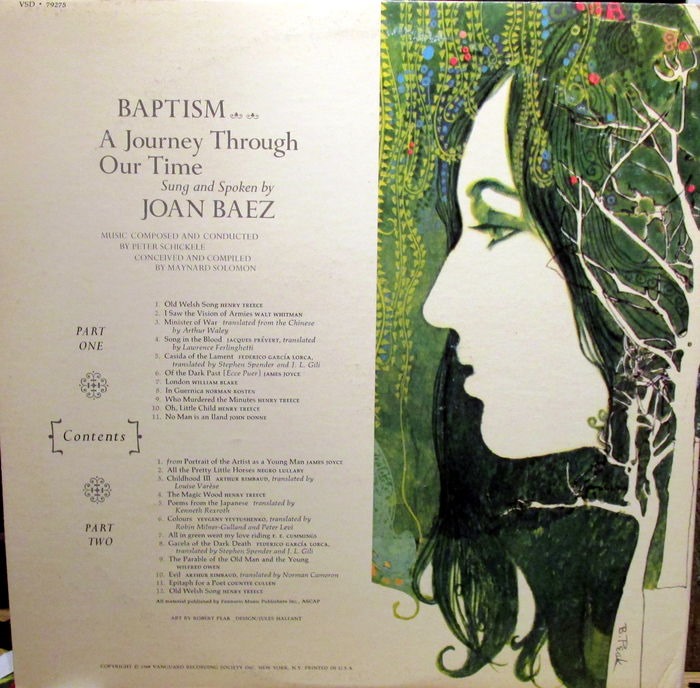
3. Gacela of the Dark Death. Here’s another work that I translated into English myself for presentation here, a poem of passion and wit from Spanish poet Federico Garcia Lorca. I actually first heard this poem as part of a project that attempted to do something like what the Parlando Project does: Joan Baez and Peter Schickele’s 1968 LP Baptism. Baez read Stephen Spender’s translation of Lorca’s poem earnestly there, and the poem’s title would lead one to read it as sorrowful. As I translated Lorca’s Spanish I sensed a more playful and mocking attitude in some of the images, and my performance tries to bring that out from my translation. As part of conveying the emotional range of the piece, I sang the opening and closing sections while speaking the middle of the poem—an example of how singing and speaking words changes the experience of them.
Baez and Schickele do Parlando 51 years ago
2. Self-Pity. D. H. Lawrence again, but a different kind of poem from “A Winter’s Tale.” Shorter, and superficially an Imagist poem, it so clearly makes its “no whining” point that it was once used in a film by a drill sergeant. Poetry that makes straightforward self-improvement/empowerment points was not that common in early Modernism, and it’s not the usual way to literary cred these days either. I’m not sure why that would have to be. There’s an audience that likes it, and the 19th Century revered some poets who plied lessons like this poem does, although usually with many more words and stanzas. My best guess is that artists, particularly now in an era when literary poetry is something of an outsider art, like novelty and rebelliousness too much to settle for earnest self-improvement.
Well, this poem isn’t one of my favorites, but you know something: I need its message some days as much as anyone. I may have worked extra hard on the music I wrote and performed for it to compensate for that.
So what will be the most popular piece from last winter? I’ll be back soon to reveal that.
Here’s a piece for today’s U. S. holiday: President’s Day.
Long-time readers here know that’s not going to be simple, but it may be interesting.
For some time in this project I’ve thought I’ll have to deal with Vachel Lindsay. In the early days of poetic Modernism a century ago, when no one knew exactly how that movement would turn out, Lindsay was a force to be reckoned with, with a life story and approach to his art that was so outsized, that if he hadn’t actually existed, and instead you created him as a character, you would be charged with unrealistic and exaggerated imagination.
In the great American tradition of bohemian artistry, Lindsay was not well-off, not Ivy League educated, nor born in some cultural capitol. By force of will he decided that he would make his way in the increasingly business-oriented world of the 20th Century as a poet.
How’d that work out? Better than you might imagine, if only for a time. He made most of his bones touring the country intensively, reciting his poetry in a flamboyant style. Much like the life of a musician, it worked only to the degree that he was able to keep up a relentless road-dog touring schedule. Between tours, what time he had to write was also the time that he fell into debt and doubt.
If you think that poetry should be, at least in part, a spoken art form, Lindsay was there before. If one wants poetry to be appreciated as a popular form, with no academic prerequisites, Lindsay lived that. If you want poetry to be a force for social good, Lindsay too. Slam poetry? Lindsay was doing that before there was a name. Poetry inspired by and linked with vernacular music? Lindsay, a century ago.
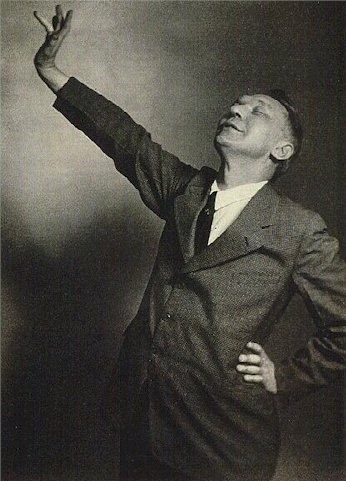
Vachel Lindsay is not doing the hokey-pokey here, but performing poetry.
So why haven’t I presented Vachel Lindsay before today? Three reasons.
One, he wrote a lot of bad or flawed poetry. Awkward, sentimental, not particularly striking in imagery, and despite his spoken word and musical inclinations, not always in tune with my sense of music.
Secondly, though he always claimed his heart was in the right place, his treatment of other cultures was so clumsy and ignorant that it’s too often indiscernible from racism. This isn’t a close call, or some case of modern politically correct revisionism, even in his own era this was noticed. It was more than 50 years ago when I first ran into one of his set pieces, “The Congo,” and from that I figured I was done with Vachel Lindsay.*
These are both general reasons why Lindsay is not seriously considered along with his contemporary Modernists of the early 20th Century. But there is another, more personal reason: I fear the Vachel Lindsay in myself. When I see in my own writing awkwardness and flawed art, when I stop to consider the un-earned audacity of my own spoken word and musical expression, when I catch myself assuming that good intentions are sufficient, when I write here of other cultures and experiences, and despite my provincial and limited knowledge of them, perform works associated with them—then I fear I’m becoming my own variation of Vachel Lindsay. I continue to do those things anyway, stubbornly—again, like Lindsay.
Art is not just a place to model human potential. It’s also a revelation of human failures. Bad art can inspire good art. Failures illuminate as much as successes.
With that long introduction, let me now tell you that today’s piece, “Abraham Lincoln Walks at Midnight (in Springfield Illinois)” is still worthy of four minutes of your attention. Unlike China or the Congo, Lindsay knows Lincoln’s adult hometown of Springfield Illinois, as it was his hometown too. “Abraham Lincoln Walks at Midnight” is not a piece that extends language, it has no clever images that re-calibrate how you experience something, its word-music is not so beautiful that you’d be drawn to it before you even care what it’s about. We have long celebrated Abraham Lincoln as the President of our greatest national traumatic event, the American Civil War, fought over our greatest national sin, slavery. So, the poem has only an emotional, empathetic message, but this is all art delivers to us however plain or fancy the wrapping.
President’s Day is not a simple holiday today. Here’s my performance of Lindsay’s Lincoln poem. I kept the music simple enough and in that hometown key of C. The high melody part that sounds like a synth patch is actually 12-string guitar run through a lot of time and modulation effects and a compressor. The player is below:
I can’t say what day this happened, but it was sometime in 1916 in Davenport Iowa. A well-off, Harvard-educated man in his mid-thirties named Witter Bynner was visiting a former Harvard classmate Arthur Davison Ficke in the latter’s elegant home. Besides family wealth, both men shared an interest in the arts, and both were published poets and art critics. A variety of fine-arts could have been discussed by these highly educated men, more so than any yet-to-be-invented concerns that random recently-young men might discuss today. Bynner later recalled the high-spirited discussion got raucous enough that Ficke’s wife asked the men to take it outside.
What the F.T.D! Nijinsky as the spirit of the rose
We know where the conversation started: Bynner had recently seen a new modern ballet, The Spectre de la Rose based on a poem by Théophile Gautier with music orchestrated by Hector Berlioz from a piano piece by Carl Maria von Weber. I don’t know who the dancers were in the performance Bynner had seen, but the titular role of the spirit of the flower was first danced by Nijinsky, and the piece’s choreography ended with the extravagant gesture of Nijinsky leaping out of a stage-set window and disappearing as if he had flown off into the ether of the rose’s wafted scent.
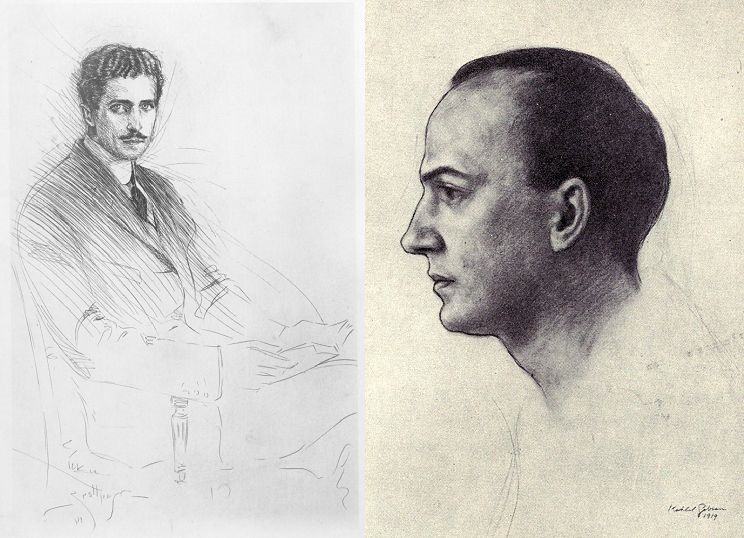
Arthur Davison Ficke and Witter Bynner. Bynner’s portrait is by Kahlil Gibran.
The two men retired to a cross-town hotel room with a bottle of whisky. Bynner had had an idea while watching that ballet. The romantic artistic styles of his birth century were now being challenged by new 20th Century modes. The kind of poetry that the pair wrote: carefully crafted metrical, rhymed verse was being challenged by new verse. It too had extravagant expression, but not only did the new free verse not care about symmetrical forms, it didn’t seem to care about extracting from its expression sense or meaning—things didn’t mean, they were, in these new poems. And some of the new poets were so deadly serious about how important this was! They wrote manifestos about how poetry should work without the old frameworks, yet they didn’t seem to care about how meaning worked!
The levels of the whiskey in the bottle lowered quietly as the levels of whisky in the two loud poets increased. Here was the plan: Oh, this was so good! They would write a bunch of these new poems, just whip them out while they were good and drunk and no longer bound by anything other than sounding like these new Imagist, Vorticist, Futurist poets. Great fun! So much so that nine more sessions and nine more bottles followed in close succession.
Intoxication didn’t stop these two educated, upper-class men from some structure and planning. They’d publish the poems under assumed identities. Bynner, a gay man, was to be Emanuel Morgan, a painter/poet who had dallied in Europe and dug the French poetic influences. Ficke, the straight, goyim man with day job as a lawyer, was to be an exotic eastern-European Jewish poetess Anne Knish. Later that year they roped in another well-off child of local Midwestern privilege, Marjorie Allen Seiffert, whose contributions would be signed as Elijah Hay*, who would be (like Ficke) a cisgender lawyer/poet. Ficke was drafted to write the new movement’s manifesto**, and Bynner supplied the name, taken from the ballet: “Spectrism.” Prophetically anticipating the birth a dozen years later of Andy Warhol there, these Spectra poets were said to be living in the Pittsburg area. Well, maybe it wasn’t Warhol. Maybe Pittsburg was chosen because it was half-way between the East Coast-based Bynner and the Midwestern Ficke, or perhaps they shrewdly judged it as sufficiently nowhere to evade detection.
They submitted Spectrist poems to magazines and some were published. They submitted a manuscript of the drunken hotel room poems to their own publisher and had a good laugh when it was accepted (they did tell the publisher about the hoax after the acceptance however). Perhaps the strangest publication was a “theme issue” of Alfred Kreymborg’sOthers magazine. Others: A Magazine of the New Verse was the publication of the Modernist Avant Garde in America, promoting William Carlos Williams, Carl Sandburg, Marianne Moore, Fenton Johnson, Mina Loy, Man Ray, H. D. and Wallace Stevens. If it was “free” or “new” or “modern,” Others was associated with it. It seemed particularly open to redefining sexual and gender roles. Recent “theme issues” before the Others’ Spectra issue for January 1917 had focused on Spanish-American poets and “A Woman’s Number” (which included work by Seiffert).
Mysteries of the Spectrism. The 1916 published collection and the 1917 special issue of Others.
What would happen if the Spectra hoax occurred this year? I’m certain there’d be considerable criticism of the perpetrators. Other than the inherent dishonesty the goes into a hoax (though “honesty” is always ambiguous in art) the audacious usurping of the Anne Knish persona by a WASP scion of wealth would draw additional condemnation for sure. Rich white men tweaking the always struggling to stay in business little magazine Others seems particularly cruel on the face of it.
You’d also expect pieces to be written about how the hoax “proves” that Modernist poetry is, consciously or unconsciously, a hoax itself; that Spectrist poetry had shown that if the right signals are made, any word-jumble will pass as art. And yes, that happened after Bynner revealed the hoax in 1918, just as it would likely happen now.
Interestingly, at least in my limited research into this, the 1918 response did not seem to include much if any anger toward the perpetrators though. Class, ethnic and gender privilege might have shielded them. Perhaps even those who might have standing to complain were cowed by the perpetrators prestige and power, or maybe they hadn’t developed an analysis of “cultural appropriation” yet. AFAIK, Ficke, Bynner, and Seiffert never suffered “you’ll never work in this town again” repercussions.
Those fooled by the hoax generally followed a line that the Spectrist poems, regardless of the author’s intent, had some vitality as Modernist expression anyway.*** As the 20th century progressed, automatic writing, cut-up, exquisite corpse, chance and computer-generated composition, found poetry, psychedelic poetry composed while intoxicated, and more would be tested as tactics. Spectra might have started in Davenport Iowa not at the Cabaret Voltaire in Switzerland, but does Dada require intent to be Dada? Can one draw a line from the Ficke’s Spectrist manifesto to the First Surrealist Manifesto?
For myself, more than the philosophical and aesthetic questions, I wonder at the personal impact, and not just on the hoaxed. Modernism had not yet triumphed in its campaign to take over poetry in the 1916-1918 era, but all three of the Spectra hoaxers began to agree with the hoaxed that when they freed themselves from their birth personas and the formal rules of poetry and meaning, that something else emerged that their poetry hadn’t seen before they put on the mask. All three later wrote some free verse as their careers continued and Modernism won the post-WWI war for literary respectability.
On the other side, I’d suppose that the Spectra hoax may have helped give impetus to New Criticism and it’s move to establish objective criteria for what makes a poem good, even if it’s Modernist in language, structure and word-music.
What of the poems themselves? I read the original Spectra book and found it disappointingly forgettable. There are some good lines, but fewer than pure what-the-hell wild improvisation should have engendered. You can laugh at the unhidden humor present in some of the poems, and I can recognize and smile at some of the references to common early Modernist tropes that they are parodying. I was drawn more to Ficke/Knish than Bynner/Morgan, and couldn’t help but think that Ficke, part-way down that bottle of whisky, might have found his invented exotic anima therapeutic.
Therefore, I’ve chosen to perform one of Ficke’s Spectra poems today, “Opus 131.” I think Ficke—a son who grew up in a house wealth-filled with his father’s world-spanning art collection and who had followed his father into the practice of law—may have needed something more, may have wanted something that Millay or Kreymborg or Mina Loy had, even in their not-having. He may have wanted to leap out of that hotel room window, like Nijinsky in that ballet, and never come down.
Here’s my performance of Ficke/Knish’s Spectra poem:
*Although it’s usually not filed under “hoax” there’s a fairly long tradition of women writing under masculine pen names, from the three Bell/Bronte sisters onward. Davenport itself was home to Octave Thanet, a successful popular writer born Alice French.
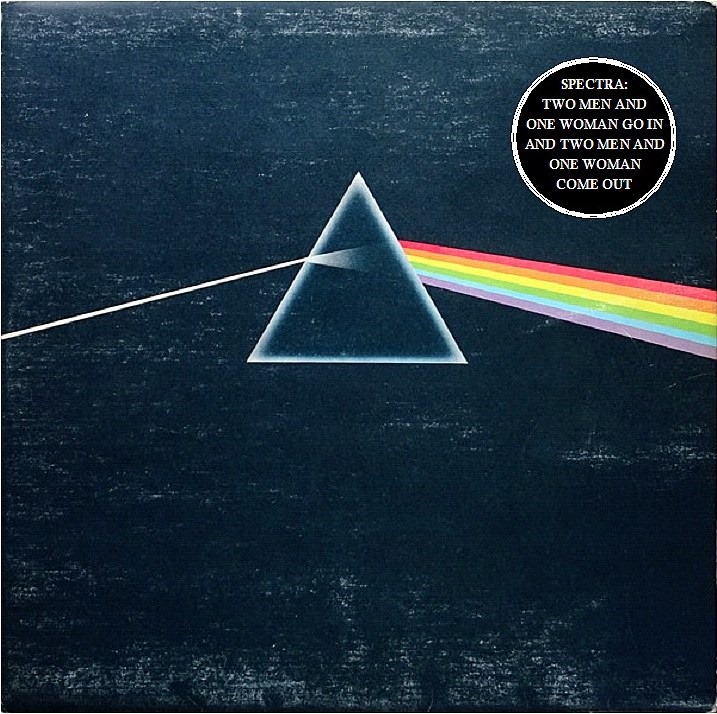
**Sample lines from the manifesto: “The theme of a poem is to be regarded as a prism, upon which the colorless white light of infinite existence falls and is broken up into glowing, beautiful, and intelligible hues… Just as the colors of the rainbow recombine into a white light,— just as the reflex of the eye’s picture vividly haunts sleep,— just as the ghosts which surround reality are the vital part of that existence,—so may the Spectric vision, if successful, synthesize, prolong, and at the same time multiply the emotional images of the reader.” I can only think of the cover of Pink Floyd’s Dark Side of the Moon.
***However, the funniest critical quote from before the hoax was revealed was William Carlos Williams remark that he preferred the Elijah Hay’s Spectrist poems to Anne Knish’s because the “Woman as usual gets all the theory and—as usual—takes it seriously whereas the male knows it’s only a joke.” Mirror upon mirror in that quote.






 Frank Hudson