He Wishes for the Cloths of Heaven

Here’s a romantic poem by William Butler Yeats, in both senses of that word. “He Wishes for the Cloths of Heaven”  is Romantic in the literary and artistic sense in that it seeks to reconcile personal emotional experience with some sublime otherness through imagination, and it’s romantic in the sense that the poem takes a courting stance, that it’s an expression of love for another.

Yeats is one of those “bridge” poets who did substantial work in both the 19th and the 20th centuries. Always fiercely lyrical, he was able to recast his poetry so it continued to be read into the Modernist era. This poem, though written in the 19th century—and proving it by using an entirely antique word “Enwrought” to start off its second line—remains in circulation as some lovers still recall its ending.

It’s a short poem, only eight lines, so it can’t waste time.*  The first four lines are devoted to a nicely rendered image of the sky and a richly embroidered cloth, the sort of thing that would indicate high fashion when it was written. Of course, this is self-consciously an image on the poet’s part, he acknowledges that he’s made it as poets make images, as a new way to apprehend reality.

Oliver Tearle, over at the always Interesting Literature  blog, points out that prime English Modernist T. E. Hulme made his own version of this sky/cloth image only a few years after Yeats when he wrote his “The Embankment.”  Hulme saw himself as setting out to overthrow Romanticism, and I’d suppose it’s possible that he could even have been thinking of Yeats’ poem as he created his different one. Considering the two poems together makes for an interesting contrast.**

After those first four lines, Yeats goes on to reference something that was once a widely-known tale—just as untrue, but just as commonly known as Washington copping to chopping down the cherry tree. In the English mythical tale, Walter Raleigh, acting as a paradigm of Elizabethan courtly love and devotion was said to have taken off his expensive cloak and laid it over a muddy spot on the road so that Queen Elizabeth wouldn’t soil her royal footwear. And so it is that Yeats says he’d make this beautiful image and then allow his beloved to trod all over it.

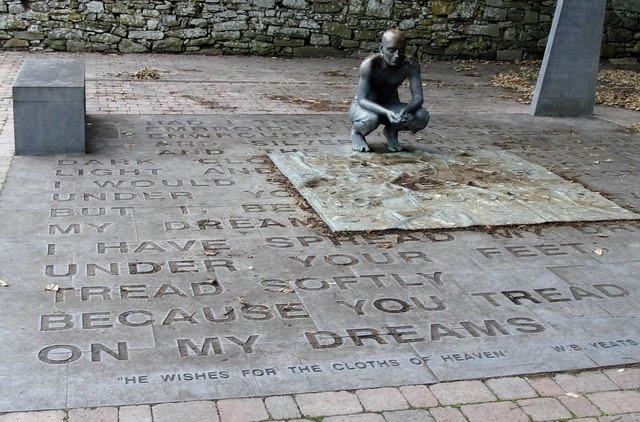
Yeats monument at Drumcliff

Yeats’ poem enwrought by sculptor Jackie McKenna in Drumcliff Ireland. Photo by Eric Jones.


There’s also something more here than just self-abasement or Yeats’ confidence in his brand of detergent: by saying he could put the plane of the heavens underneath his beloved, he’s also saying his poetry could take her to Heaven. But blink and you’d miss that implication.

Yes, the closing three lines are the poem’s best remembered, still quoted by those who have put themselves in the danger of love, or the danger of love refused. Romantic and romantic, and like most anything by Yeats, it just sounds so good! I performed it with acoustic guitar, electric bass, and a bevy of woozy keyboards, and you can hear it with the gadget I have spread below under your feet (or finger or mouse). Click softly.


*Here’s the text of the poem for those who like to read along. When the poem was originally published, Yeats used a persona as the poem’s speaker. Aedh was a kind of John-Keats-besotted nebbish character from what I read, and in doing so, Yeats is hedging his bets on the poem’s Romanticism, kind of a “I’m just asking for a friend” deal. When he included the poem in later collections, he dropped the persona.

**Here’s Tearle’s run-down of how Yeats’ does it in this poem, which also has links to his post about Hulme’s “The Embankment.” To hear my performance of Hulme’s “The Embankment,” you can click here. Beside producing one of the best daily literature blogs, I owe Dr. Tearle for introducing me to the work of T. E. Hulme, the pioneering Modernist poet and theorist who I’ve often featured here.

Sara Teasdale’s I Am Not Yours or the Love Song of Ernst Filsinger

Sara Teasdale wrote some of the saddest love poems I’ve ever read.

Less-well remembered than she should be, for a time about 100 years ago Teasdale was the most popular and esteemed love poet in America. In 1918 she won the Pulitzer prize for a new collection of her poetry, labeled right there on the cover with the title “Love Songs.”

Harriet Monroe, the founder and editor of Poetry,  the indispensable American poetry journal of the day, said of Teasdale “She was as delicate as a lily, but under the white-petaled perfume one felt in her presence an impassioned intensity of feeling which her brief lyrics were then beginning to express.”

So, what did Teasdale know about love? More and less than you might expect. Born in 1884 in a wealthy and religiously conservative St. Louis family, she was protected and sheltered* until she was nearly 30 when her poetry career took her away from St. Louis to New York and Chicago.

As her poetry expresses, she dearly wanted to fall deeply in love, but she also wanted the independence to write, and though she moved in bohemian circles during a time of great social change, she’d internalized some of her family’s conservative values.

Romantic stories revel in love triangles, but Sara Teasdale, the woman who’d get the Pulitzer Prize as a love poet was about to deal with a love rhombus. She was crushing on a young poet she admired, John Hall Wheelock. She told Wheelock he was “The greatest living poet.” He wasn’t, though he was flattered. Wheelock, like Teasdale’s family, was a bit of a blue-blood, and he respected Teasdale’s poetic talents, but he was not interested in marrying her.

Then there was Vachel Lindsay, a literary phenom of the time, who had vagabonded about the U.S. trading his poems for meals and then bootstrapped that into touring the country’s speaking halls giving flamboyant readings of his chanted poetry. Lindsay, unlike Wheelock, wanted to marry Teasdale, and he plied his troth by dedicating books of his poetry to her**, but the reserved and sheltered Teasdale was both intimidated by his bluster and worried about his ability to provide the kind of stable home that would allow her to continue writing.

Who’s the fourth rhombus side? A St. Louis businessman, Ernst Filsinger. Like the other two, Filsinger appreciated Teasdale’s poetry, and like Lindsay he wanted to marry her. Problem solved? Well, Teasdale wanted to be deeply, mutually in love, and she wasn’t sure she loved Filsinger that much.

Sara Teasdale's Love Rhombus

Tuning up for her Pulitzer-winning “Love Songs” Teasdale was tempering her intonation with three men.


Wheelock says that Teasdale asked him to decide who she should marry. “You know Vachel. I want you to meet Ernst. And I want you to tell me what to do. Which of these two good men should I marry? Should I marry Vachel Lindsay, who’s a genius and whose poetry I love? Or should I marry this fine, tall, dark, good-looking businessman who seems to care for my poetry?”

Wheelock may not have been the greatest living poet in 1914, but he seems a sensible sort of guy.*** He says he told Teasdale she  must make the choice. She replied that no, he had to tell her which to marry, that she wouldn’t blame him if anything went wrong. OK, he said, he didn’t see her being happy with Lindsay “I don’t think you are one who could live in the kitchen doing all the housework and scrubbing the floors.”

She married Filsinger.

The next year she published the poem I used for today’s piece “I Am Not Yours”  in a collection titled Rivers to the Sea,  whose title came from a poem by Wheelock. “I Am Not Yours”  also appears in her  Love Songs  collection that won the Pulitzer.

It’s possible to read this poem quickly and read it as a crush poem, a supple lyric about being madly in love with someone, where the title and opening phrase is poised rhetorically in the moment before love’s inevitable consummation will occur, as a poem written by someone who realizes her autonomy, but is willing to submit it to overwhelming passion. Teasdale’s poetry was not just prize-winning, it was popular in its time. Someone might read this poem at a wedding. It’s likely that Teasdale, who wrote this the same month as she married, wrote it thinking of hers.

Go ahead, listen to it now. Here’s the player gadget.


So how did things turn out for the Sara Teasdale love rhombus?

Wheelock lived until 1973. In his memoir of his life in publishing he said that the best way to edit poets is to not edit them. “If a person needs to have his poems edited, then he’s not a poet, because poets are perfectionists, and by the time they get through with all their agonizing work on a poem, either they’ve ruined it by revising too much or it’s the way it should be.” He’d tried to apply that principle to Teasdale’s marriage choice.

Vachel Lindsay may have been too odd and flawed to ever last long, but the Eliot and Pound wing of cultured expatriate High Modernism crushed him by the late 20s, and the mid-century New Criticism could barely bother with the effort to find the grievous lapses in good taste in his “higher vaudeville.” In 1931, depressed by his inability to keep his debts at bay as his touring revenue dried up, he drank Lysol and killed himself.

At first Sara Teasdale’s marriage seemed to work. Filsinger allowed her to concentrate on her writing, but she eventually felt the loss of not being lost in passion. In 1929, while Filsinger was overseas on a business trip, she headed west to a state with easier divorce laws and informed him by telegram. By the Thirties, Teasdale’s lyricism and complex emotional content fell out of favor with High Modernism/the New Criticism too.**** The poet who had won the Pulitzer Prize for a book called Love Songs  felt unloved and forgotten. A little over a year after Lindsay’s death, she took an overdose of prescription meds and died in a filled bathtub.

And Ernst Filsinger? No one cares for the biographies of businessmen much after they die. We are not likely to sing the book he authored Exporting to Latin America  to music decades later. His obituary claimed he gave the first transatlantic after-dinner speech by radio in 1929, speaking from Berlin to the National Foreign Trade Council sitting in Baltimore. Who now notes what he said? He died in China in 1937. In his memoir, Wheelock says he heard Filsinger too committed suicide, but I have no confirmation of that. Is it possible that he, Prufrock-like, heard the mermaids singing, but pointedly, personally knew they had, at least once, sang for him?

Even if we largely ignore it, we store away beautiful things like prize-winning lyric poetry, so we can read and hear what Sara Teasdale wrote the month she married. Listen again to “I Am Not Yours”  or read it here. Looking to be the I that is I, but longing to get lost in love and knowing she was not, speaking of her light, a mere candle lit at noon, and asking for it to be plunged, put out.

As you read this, I tell you again that the first duty of an artist is to survive

Love poetry if it’s any good is as varied and complex as love is, as life is. Sara Teasdale wrote some of the saddest love poems I’ve ever read.


*Like Elizabeth Barrett Browning, Teasdale also had some kind of long-standing (and hard to diagnose via remote historical methods) illnesses. This only increased the family’s protectiveness.

**Another admiring poet who dedicated work to Teasdale was Witter Bynner. Bynner was gay.

***Wheelock eventually had a long career in publishing, and he prided himself with befriending, scouting and signing poets from Louise Bogan and Conrad Aiken to May Swenson and James Dickey. His memoir is The Last Romantic: A Poet Among Publishers.

****Teasdale was born in St. Louis only four years before T. S. Eliot, even if she seems like she was born to a different generation, one both before and after Eliot. Their families, though Midwestern at their birth, shared similar New England backgrounds, and Teasdale attended a private St. Louis prep school founded by Eliot’s parents, and that was located next door to Eliot’s home until he was 16. One wonders if the two young poets were aware of each other as children, but Eliot left town at 17, Teasdale’s sheltered upbringing reduced the chances of social interaction, and Teasdale’s family were staunch Baptists while the Eliots were Unitarian.

Oh, and by the way, that Prufrock of Eliot’s first great poem? Prufrock was the name of another St. Louis businessman. If Eliot considered other name options from his St. Louis youth, Filsinger was less iambic as a name. Teasdale could have sounded its own connotations, but it wouldn’t fit with measuring with coffee spoons.

Love’s Greatest Hits

“If music be the food of love, then play on…” So said Shakespeare and Peter Green’s Fleetwood Mac. Here at the Parlando Project we explore music and words (mostly poetry) crushing on each other, and some of our most listened-to audio pieces feature aspects of love. So, for Valentine’s Day here’s a countdown of our most popular pieces that feature love.

As it happens this “Top 10” also does a good job of showing the variety of music and ways we integrate the words with the music. I often think I spend the majority of the posts here talking about the words we use, but love, like music, often prefers “to speak without having anything to say,” the thing that music does.

10. Vegetable Swallow words by Tristan Tzara. When I translated this Dada poem I wasn’t expecting it to form the recognizable poem of desire that appeared. Musically I set this to something that is unorthodox rock. The keyboard parts don’t really work the way rock keyboards usually work, but the second half features an electric guitar solo that while it’s not rock, meets it at least half-way.


9. Love is Enough words by William Morris. More plainspoken than Tzara about the value of love in a world that doesn’t seem to want to contain it. Here the LYL Band is in garage band mode, with the usual keening combo organ of that Sixties’ genre along with two guitars, bass and drums.


8. The Heart of the Woman words by William Butler Yeats. One of the limitations I need to deal with in this project is that I’m not a very good singer, so it was particularly audacious here for me to perform Yeats’ poem of tender devotion acapella. One of the things I love about traditional folk music field recordings is that they often capture singers who are not perfect in pitch or in other qualities that make one say “what a singer!” That quality brings a different reflection on humanity and the words being sung.


7. Sonnet 130 My Mistresses Eyes Are Nothing Like the Sun words by William Shakespeare. I loved the episode of Upstart Crow  where everyone and Shakespeare’s wife takes the bard to task for this too honest love poem that deconstructs every phony and limiting idea of beauty in his era’s poetry. Bonus Black History Month points to the possibility that the poem’s famous “Dark Lady” might have African ancestors. Musically, we leave rock’n’roll behind for 12-string acoustic guitar, bass, recorder and a string quartet.


6. Rosemary words by Edna St. Vincent Millay. One of my personal favorite musical performances from the more than 300 I’ve presented here in the last three years. I was trying to recreate the sound of the acoustic band The Pentangle, and I’m still shocked and pleased at how close I could get. Millay’s poem has a new broom sweeping out the old, failed love to make ready for a new one.


5. Sonnet 43 What Lips My Lips Have Kissed words by Edna St. Vincent Millay. Our first repeat appearance by a poet in this list, and there’s a tinge of romantic regret in this one, but also there’s some satisfaction in a life of romantic independence. A massively underrated poem! Another small string group arrangement here with some spare piano, but also electric bass and drums.


Allegory of Music by Laurent de La Hyre

Actual photo of my anima recording another Parlando Project piece. “Yeah, it needs more theorbo.”


4. Let Us Live and Love words by Thomas Campion. Another variation on the carpe diem poem that starts as Campion’s Elizabethan English translation of Roman poet Catullus, and then branches off to his own take. The music here is blues: acoustic guitar and slide guitar with harmonica. I don’t play bottleneck slide guitar much with the Parlando Project, but listeners for some reason seem to like the pieces where I do.


3. Tender Buttons words by Gertrude Stein. Another one where I outright tried to cop the style of another band, this time Captain Beefheart and His Magic Band. I remain surprised at the number of listens this one has accumulated, and even when I posted this I wondered how many are out there that appreciate both Gertrude Stein and Captain Beefheart. More than I expected you brave souls!

Even more than the Tristan Tzara poem, this one abstracts desire and love; but particularly in its closing section, that’s what I read was there expressed in Stein’s cubist language. It’s possible that, though the language is different, Stein is making something of the same point as Shakespeare’s Sonnet 130 does, that desire starts at skin deep and cares little how it’s attired or to what it’s compared to. Beefheart did much the same thing lyrically as Stein—but also musically, reassembling shards of blues music and visual emotions.


2. Sonnet 18 Shall I Compare Thee to a Summer’s Day words by William Shakespeare. More rock band instrumentation used in a different way than usual. The tolling piano sure ain’t doing no boogie-woogie, for this poem is yet another carpe diem argument, presented only slightly differently. As always in carpe diem, “we’re all going to die” is the unlikely come-on, and Shakespeare isn’t making the “mistake” of his Sonnet 130, opening this one by saying his beloved is better than, rather than lesser than, a common poetic trope; but as the poem continues he makes the ego-drenched claim that he’s the better love partner because he’ll put you in a poem that’ll make you immortal.

How’d that work out for the love object? Lots of conjecture as to who might be the “fair youth” or the “dark lady” in those sonnets (or if Shakespeare is, well, capable of just making the whole thing up) but in fact, we’re more concerned with Shakespeare than his romantic partners. We treasure the valentines, not the fleshy and independent lovers that they may have been addressed to, and we hold them while their erstwhile subjects are dust without names.

Doesn’t seem fair does it? Maybe for Valentine’s today the best thing is to skip the questions of appropriate metaphor and honor that partner, and to return to poetry and song tomorrow?

I can’t be serious, can I? This project needs more listeners and readers!


1. Love and Money words by Dave Moore. Can this be? An original song by Dave, who has contributed words, music, vocals, inspiration and keyboards to this project from the start is more popular than Shakespeare? How could this be?

Could it be the elemental and essential nature of the pairing in the title and the rest of the lyrics? I was considering some slavery stories as I first considered Dave’s lyrics, that added some weight for me, but Dave’s words are free-floating as far as time and place. So, I’m not going to knock the words, but maybe it’s the funky way his electric clavinet and the rest of the LYL Band jells on this one.


Happy Valentine’s Day to every reader and listener here!

How Do I Love Thee

Here’s the plot of a story. It’s a difficult one to tell without it sounding like a romance novel—yet as best as history knows, it’s what happened.

There was this woman who grew up in a rich family whose wealth came from exploiting slave labor in colonial Jamaica. Shortly after she reaches adulthood the family fortunes take a severe blow as Britain outlaws slavery. The men of the family might think this the work of do-gooders with their onerous regulations ruining their business, but our woman aligns with the do-gooders, holding for the abolition of slavery and writing poems for that cause. In fact, she’s a very prolific writer, and has been writing since she was near Hilda Conklin’s age. In 1840 when William Wordsworth dies, she’s even considered a British poet laureate candidate. Well no, that didn’t happen. Woman and all I suppose.

Now let’s add some more difficulties for our heroine. She’s got a long-standing opiate addiction based on a hard to diagnose and painful chronic illness. And there’s some domestic tyranny to go with all this. Her father has forbidden his children from marrying.

That stipulation seems odd. There’s one theory, one that our heroine had some belief in: she may have been creole, that is, mixed-race.

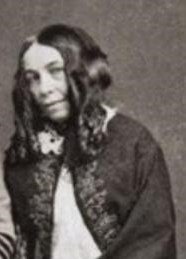
Elizabeth Barrett Browning crop

Elizabeth Barrett Browning, who believed she had “African blood”


None the less, as a woman of letters, her writing was free, and circulated widely. Her poetry found an admirer in another poet, Robert Browning, though he was at that point less successful than our heroine. They began to correspond and fell in love. Eventually there was a dramatic elopement. Her family condemned her and disowned her, but the love match seems to have sustained her for the rest of her life.

Other than her thought that she might have an African ancestor mixed in with the atrocity of slavery*, this story, Elizabeth Barrett Browning’s story, was once very well-known.

As romantic as the Elizabeth Barrett Browning/Robert Browning story was considered in its day, I can’t help but think how a supermarket tabloid or Internet gossip site would treat this today. I can see the blurb:

“Unable to shake drugs, Liz escapes abusive home with stranger!”


Shortly after her marriage, she wrote a series of sonnets to the love of her life. In 1850 the love sonnets were published as Sonnets from the Portuguese**,  and today’s piece is the most well-known of them. Indeed, it’s likely the most loved Victorian love poem, and no matter the excess of old-fashioned sounding “Thees” in it, it’s still hanging around as one of “Poetry’s Greatest Hits” as we approach Valentine’s Day.

Clasped_Hands_of_Robert_and_Elizabeth_Barrett_Browning_By Harriet Hosmer

Sculpture of Elizabeth Barrett Browning and Robert Browning’s clasped hands


Even if you feel too modern for it, or are concerned that the level of devotion expressed in it doesn’t seem consistent with a healthy independent self-image*** one should still be grateful for Elizabeth Barrett Browning, if only because she and the Bronte sisters were the chief models for Emily Dickinson.

To hear my performance of Elizabeth Barrett Browning’s “How Do I Love Thee,”  use the player below.


*This theory is not universally accepted, and as far as I know was first suggested in 1995 by Julia Markus in her book Dared and Done  about the marriage. As I read of this, I was struck by the coincidence of having just presented Jean Toomer’s striking Modernist love poem, written by another writer with ambivalence about his mixed-race ancestry.

**The collection’s title was first chosen because there were Victorian-era worries that the book, with its somewhat scandalous subject of a woman expressing agency in love, might need to be presented as a translation of an anonymous foreign author. It also referred to Robert Browning’s pet name for Elizabeth, “My little Portuguese,” likely based on her darker coloration.

***By the way, I do not recommend footnotes for any of you who may send someone a Valentine-poem.

Her Lips are Copper Wire

Today’s piece brings the Parlando Project to 300 published audio pieces since we officially launched in August 2016. Is that a small or large number? Both. Certainly, a great deal of effort has gone into it, including effort to not use the same kind of poem throughout, and to vary the music that meets up with the words; but I can viscerally feel the smallness of that number when I come upon another poem, yet another author, I was not aware of, and I am struck by that encounter.

John Keats’ sonnet said this was like seeing an unknown Pacific Ocean for the first time. Emily Dickinson famously said it was that “If I read a book and it makes my whole body so cold that no fire can ever warm me, I know that is poetry. If I feel physically as if the top of my head were taken off, I know that is poetry.” I still get those moments. This project has presented a good number of “Poetry’s Greatest Hits;” and like my last post, even there I’m often surprised at how unfamiliar those “well-known” poems can be when looked at anew. But I so enjoy this when I’m working with a poem I don’t know, one I’ve never seen, one that seems as new as it is new to me.

John Keats’ sonnet said this was like seeing an unknown Pacific Ocean for the first time. Emily Dickinson famously said it was that “If I read a book and it makes my whole body so cold that no fire can ever warm me, I know that is poetry. If I feel physically as if the top of my head were taken off, I know that is poetry.” I still get those moments.

And so it was last month when I first saw Jean Toomer’s “Her Lips are Copper Wire.”  This is not a poem that sneaks up on you, it starts right-out with its audacious title, and then every stanza of it draws you deeper in, until you reach the end and the poem’s tongue is in your mouth, and you are, like it, incandescent.

I knew the name Jean Toomer, but only as a name. I’d filed him away in the mental-drawer “Harlem Renaissance,” and that’s a place that’s difficult to go to with this project because most of the work of this between-the-world-wars blossoming of Afro-American culture is not yet in the public domain. Still, I was drawn in, I had to start looking.

Huzzah! this is another of the works from the year 1923, now freed for other artists to respond to. I then spent some time this month getting at least a shallow grasp of Toomer’s life and outlook, enough effort to say that there’s a great deal more there to apprehend. Toomer himself had an ambiguous relationship with being classified as part of the Harlem Renaissance, or even with being an Afro-American artist, and he may have gone even beyond Robert Hayden’s insistence that he was an artist who was Afro-American, not an Afro-American artist. Modern scholarship has unearthed paperwork where he was classed as white, possibly by his own doing.

Like most Afro-Americans, Toomer was mixed-race. He was light-skinned enough to “pass.” His first wife was white, and after he was widowed, so was his second—and least we forget, many U. S. states held those marriages as a criminal act in his time. And since the first duty of an artist is to survive, I’m not going to rush to second-guess his motives from my ignorance. And after all, a lighter skin tone didn’t immunize Toomer from racism—no American, whatever their ethnic background or genetic mix can escape it.

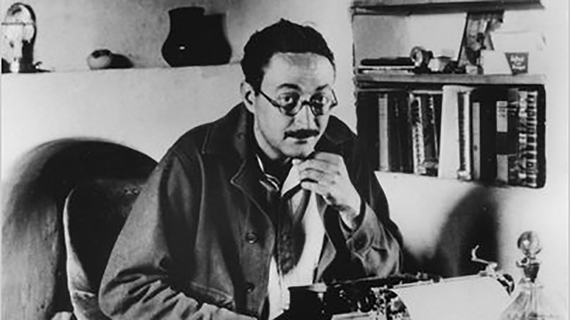
Jean_Toomer_ca._1920s.jpg

American writer Jean Toomer. The typewriter is manual, the poem is electric.

For now, let me leave the artist’s life, and those great and momentous social issues, and return to his work.

How does this poem capture you, stop you in your tracks? It starts out in an intermittent state. Is the opening stanza paraphrasing a lover’s soft conversation about lights along a street, or is it a metaphor that the lights in fog have been diffused to be in a synthesic vision like the sound of whispers? I think it’s both. We’re already moving down the dual and parallel lines of a circuit. And the sound! Whisper itself is an onomatopoeic word, the long O sounds of globes and posts sound a misty near-rhyme, and the next line’s march of short E sounds sways away.

Then Toomer adds another strain to the music and duality, the touch of the breath of the close whisperer. We’ve fallen in closer.

The “telephone the power-house” stanza seems to me to be like unto a blues interjection that I love in classic pre-war blues recordings, were the singer tells the audience, breaking aside from his melodic form, something that he wants his audience to know that he’s wise to, before returning to the melody.

And then we return to the ghosts of electricity,* softly howling or humming, in the bones of her face, and the circuit is completed, closed, and we’re there in mouth’s embrace.

What a love poem! I suppose one can step back from that and note that the lover is objectified, that there is a loss of power in that. But the poem’s very conceit seems to answer that objection, with its jolt of that closed and illuminated circuit. In Toomer’s poem, like in Paul Eluard’s great Surrealist love poem, in the end we may be seeking the state where we may speak without having a thing to say.

What a poem for the 300th audio piece here, for Black History Month, and for the month of Valentine’s Day! And so, to hear my performance and musical combination of Jean Toomer’s “Her Lips are Copper Wire,”  use the player below. If you can’t see the player gadget, this highlighted hyperlink is an alternative way to hear it.

*Bob Dylan couldn’t anachronistically have influenced Jean Toomer any more than he could have done so for T. S. Eliot. But it is possible that Dylan might have known Toomer’s poem when he wrote “Visions of Johanna.”   Michael North believes it possible that Toomer may have got his metaphor from early Imagist Richard Aldington, since Toomer had noted Aldington’s statement that a successful poem elicits “a sudden shock of illumination.”

Residents of crackling-dry winter Minnesota may wonder if Toomer could have had a more direct inspiration. As my wife and I say to each other when our lips touch and a static charge jumps the gap with a cupid-tiny bow-string snap: “Still got that spark.”

To His Coy Mistress

I can’t remember exactly when I first encountered Andrew Marvell’s “To His Coy Mistress,”  but it was far enough back that I earnestly identified with the poem’s narrator and his desires to find or convince a romantic partner.

That poem I read then is not the poem I read today, but even back in my misty youth I probably appreciated the wit of it along with the point of its argument. When I took a quick look at how “To His Coy Mistress”  is currently viewed, I see that appreciation for the poem’s wit and artifice has increased in the past few decades. It may not be possible to determine just how invested Marvell was in convincing the lady in question versus showing off his poetic chops, or even how sincere he was in his variation on the classic “carpe diem” argument that if you don’t go to bed with me, now!,  that you (currently comely love object) clearly  don’t realize that you’ll be a rotting corpse soon.

How romantic that! Here’s a box of candy too—by the way, do you know that such foods high in sugar and fat will likely lead to cardiovascular and other diseases—not to mention tooth decay and gum disease? No? Well, let me tell you….

I’m not sure how often throughout history that real and actionable knickers came flying off at this idea—but poets love it. If love, death, and beauty are the  poetic stuff, any chance to mix all three is impossible to resist.

I normally feel I have to come up with some supposition to perform one of these pieces, and what I decided here was that as a polemic, Marvell’s poetic swain means it. Which doesn’t mean he isn’t going to have some fun talking about it. Even my teenager/reader could smile at that exaggeration of the delay of traveling to India to look for jewels first,*   but did I appreciate then the auction-like absurdity bidding up the hotness of his sweetie? Do I hear a hundred years? Two-thousand! Do I hear a-three…a-three…a-three—thirty-thousand,  sold!!

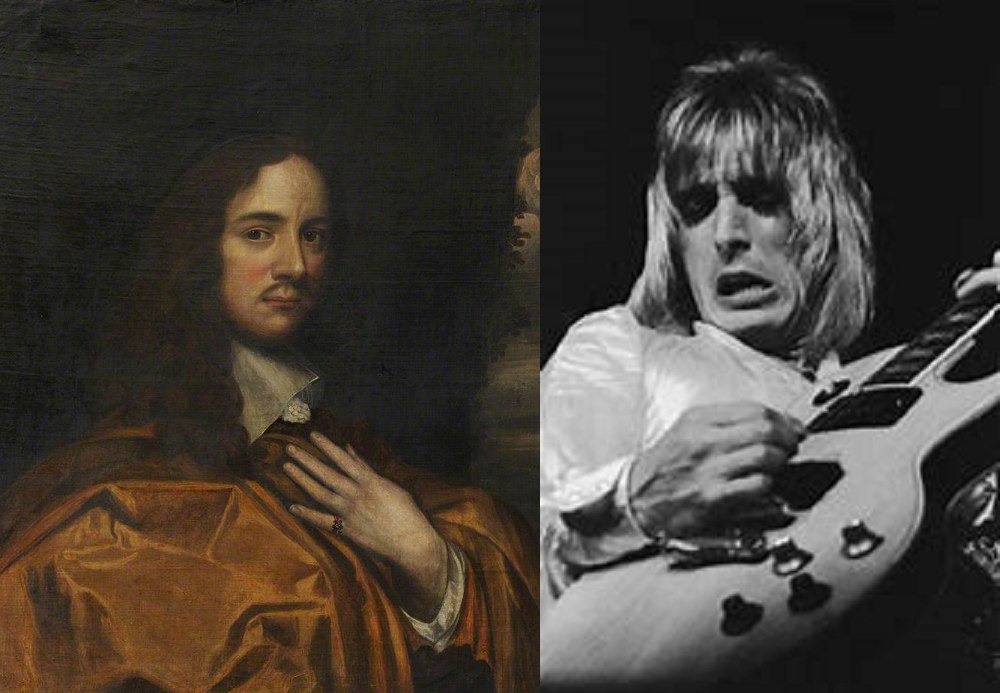
Andrew Marvell and Mick Ronson-two chaps from Hull

Random blokes from Hull: Andrew Marvell and Mick Ronson. Ronson looks like he just saw the cartoon below; Marvell, like he just burped.


But I think he’s serious with the unforgettable and oddly accented “At my back I always hear/Time’s wingèd chariot hurrying near.” And deflowering worms and cremated dusty lust may be over the top, but he’s not beneath crypt-keeper humor in this.

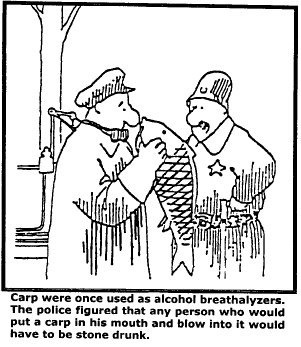
Carp Breathalyzers!

Carpe Diem! I think this is taken from a Dick Guindon cartoon. There are those who think that Dick Guindon was one of the greatest one-panel newspaper cartoonists ever. We call some of them Minnesotans.


As the poem rushes to its conclusion, I think some of the urgency passes beyond the bar of exaggeration for humorous effect. The poem’s last two couplets, which I think sincere, are as strong in my estimation as the more famous and remembered ones earlier in the poem.

For all of Marvell’s “To His Coy Mistress”  “poetry’s greatest hits” status, isn’t it odd that we don’t remember what I think are the poem’s four strongest lines, the ones that the poem ends with? Is it all about the chase and not what happens when we catch?

Here’s the player to hear my performance of Marvell’s poem with the LYL Band:


*It wasn’t until this month as I worked on this that I found out what the poem’s companion to the Indian Ganges trip,  “by the tide of Humber,” was on about. Turns out that the Humber is an estuary/river near Hull in northeastern England. It happens to be where Andrew Marvell was from, as well as (a few centuries later) Mick Ronson, the guitarist/arranger for David Bowie.

Gacela of the Dark Death

Here’s a piece using a fresh translation I made this month of a Spanish poem by Federico García Lorca. I’m sure there’s much to say about Lorca from those that know his work better than I do. That group of Lorca admirers includes many other artists whose work I respect, so it’s about time to present something by him here.

I’m told that a Gacela is a traditional Spanish form, but that Lorca’s poem follows the form only in spirit. Because Lorca was executed during the Spanish Civil War, not long after this poem was written, some view it as reflecting his experience of the war, but I get the impression that death elements were present in Lorca’s work even before the war. While encountering this poem in order to translate and perform it, I came to believe there’s a compound commentary on human mortality and more here.

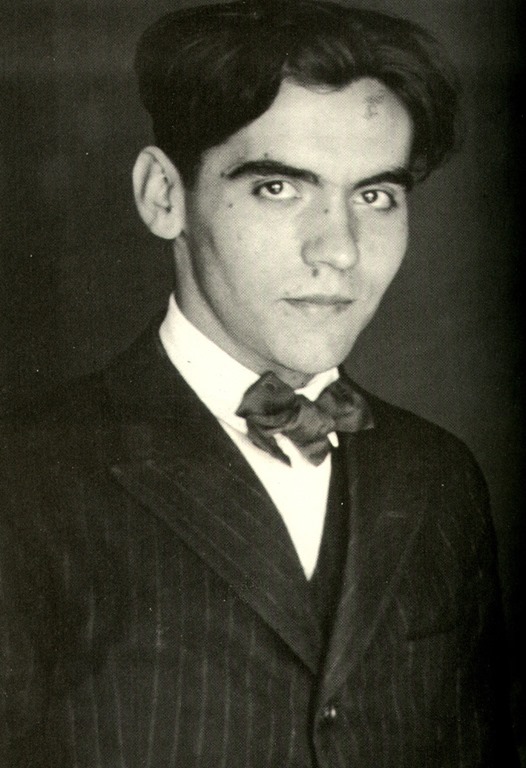
Federico_Garcia_Lorca

Federico García Lorca, a poet with open heart dreams


The poem opens and closes with a refrain that ends with a strong, bloody, and yet ambiguous last line carrying the image of a boy wanting to cut his heart. I chose not to overdetermine that image because I believe its ambiguity should remain. It could be an image of desire, or of self-harm, or emotional outreach—so let it be any or all of those things.

The middle portion of the poem, which I chant rather than sing, has a tone in my reading that has humorous elements, even if that seems to go counter to other readings of the text I found. When this section starts with what sounds like folk aphorisms about the dead, I take them as dark humor. In the next line “No quiero enterarme de los martirios que da la hierba” I decided for the only time in my translation to intentionally make the image stronger to American readers, by making the hierba, the grass, “leaves of grass” to connect to Whitman and his great image forged in the American Civil War. I can’t be sure, but I spent a long time on that stanza’s moon with a snake’s mouth image, “la luna con boca de serpiente” and what with the punch line about that mouth always working before dawn got me asking the question if this was a vampire image, which I decide to refer to sideways by determining that fangs were what serpent’s mouth means. Consistently in this stanza Lorca is giving us death images, but he’s also saying he doesn’t want to hear them.

I think the next stanza is meant to be humorous too, starting off with the wanting to sleep (perchance to dream?) for a moment to maybe as long as a  century—but “pero que todos sepan que no he muerto,” “let everybody know I’m not dead” as I translate it. Yes, like Hamlet he wants to compare sleep and death, but he’s playing with it. I’m at a loss if the “pequeño amigo del viento oeste,” “little friend of the west wind” is referencing something. It sounds almost like a children’s story or lullaby. I think this stanza’s concluding line is so wonderful that it transcends mood and attitude: “soy la sombra inmensa de mis lágrimas,” “I am the immense shadow of my tears.”

This stanza’s concluding line is so wonderful that it transcends mood and attitude: “soy la sombra inmensa de mis lágrimas,” “I am the immense shadow of my tears.”

The final chanted stanza before we return to the sung refrain also seems to me to be playing with death. Are we meant to take the insects here as accomplices of the grave’s earth? But this sounds like a boyish schoolyard dispute “He threw ants at me!” And what’s with the scorpion claw? As a northern North American I don’t deal with actual scorpions (hey, tropic readers, let me tell you about black flies…) but isn’t it the stinger that’s the weapon? I’m left wondering if there’s some idiom here that I just don’t know, even some kind of schoolboy pestering like unto a “noogie.”

And then the poem returns to a variation of the refrain, mysterious, beautiful, and I think serious. As to the intent of the poem, I felt I could perform the mystery and commit to the humor I found in the middle section without knowing the poem’s heart entirely. I think you can listen to it the same way. It is a darkly playful meditation on death? A comment on the outbreak and casualties of a civil war? Or is it a longing for childhood life and adventurous dreams? Or a love poem to a young man in Lorca’s life at the time the poem was written? Walt Whitman could sing all those things together, so why couldn’t Lorca?

I felt I could perform the mystery and commit to the humor I found in the middle section without knowing the poem’s heart entirely. I think you can listen to it the same way.

Musically, I sought to contrast the two refrain sections from the poem’s middle one. I was going to play my nylon string guitar for a Spanish flavor on this. Sadly, when I opened its case this week I found that its bridge had come completely off the top. Oh well, my battered Seagull Folk guitar had to stand in. My orchestration brings a bassoon part forward.

You can hear my performance of my English translation of Federico García Lorca’s “Gacela of the Dark Death”  with the player gadget below.

The Story of Dave Moore and Love Songs

Don’t worry, we’re only taking a break from our regularly scheduled mix of various words (mostly poetry) with original music to tell the history of the Parlando Project’s alternate voice Dave Moore. So far in our story, he’s gone from poet to pioneering Twin Cities indie band lyricist to full-fledged songwriter to singer-songwriter-keyboardist for a two-person band of poets with instruments in about two years. If you’ve been following along, I’m the other poet.

How did this turn out?

Returning to 1980 after the release of the Lose Your Lunch Band’s Driving the Porcelain Bus  recording, the two-man-poet-band thing seemed to be a problem. Around this time a handful of Twin Cities indie rock bands had eked out a local circuit of venues that would book them. This was all very tentative, and only sufficient to give bands the initial toe-hold on a career, and it wasn’t really open to something as sparse and loose as we were. Could we possibly have tried to push that square peg, a “hardly rock band,” into that circuit?

Perhaps. We started looking to fill out the band, with the drummer being the biggest problem. I had started to dabble with electric bass, and Dave’s Farfisa combo organ had left-hand gray keys which could be dedicated to keyboard bass duties in the Ray Manzarek mode. The first third was Jonathan Tesdell, a guitarist who had a set of congas, and who was drafted out of a commune down the street. Jonathan practiced and played with us for a few gigs on electric guitar, but I can’t recall us ever even trying the congas as a replacement for a more rockist drum set live. But after a few months, Jonathan left town, traveling light. I once heard that his Gibson Firebird electric guitar that he sold before packing for travel was bought by The Replacements’ Bob Stinson.

Next up was a very talented guy who I believe was working then in the live comedy and theater scene,* Dean Seal. Dave somehow recruited him**, and Dean played drums and bass. Of course, not at the same time, a limitation we overlooked because he was willing to play with us. Dean could write great songs as idiosyncratic as Dave’s, and he had a good singing voice (later recordings with Mr. Elk and Mr. Seal demonstrate his cabaret-ready performance chops***). Dean later went on to a long and unique career, leading the Minnesota Fringe Festival for several years, and in this century becoming a UCC minister who combined his theater and comedy experience with religion.****

A fully operational LYL Band

Performing “Magnetized,” the rarely seen, full LYL Band live in the ‘80s. L to R: unknown drummer (see below) Dean Seal, Dave Moore, and Frank Hudson


Alas, Dave and I had sort of lost the fire to play out around the time Dean joined up. I’m not even sure if Dean could have been the singing drummer (harder than it looks) and songwriting voice that could have given Dave a rock-club ready band. With us, Dean played mostly electric bass, and he took a liking to a cheap Japanese copy of a Gibson EB0 bass that I had found in a second-hand store. We traded basses, mine for his similarly low-quality Made In Japan bad-translation-of-a-Fender bass. That instrument sits next to me as I type this, and I still play it often on pieces you hear here. Somewhere in the later ‘80s the LYL Band went, as press-releases still say these days, “on hiatus.”

Why? When I asked Dave today he said he hadn’t thought of that, but as we chewed it over I think it was the matter of both of us, in committed relationships and needing to pay the rent and bills at the lower edges of the economy, gradually converting the concept of the public band to a private joy.

But as that was, almost imperceptibly to us, happening, Dave’s songwriting took one more turn. The goth and gothic Fine Art lyrics and the agitprop and Dada characters of the early LYL songs were joined by unconventional and sincere love songs.

It’s more than 30 years ago, but I can still remember the first time I heard Dave sing this song, as I have heard Dave sing many songs before or since, stone cold fresh. We didn’t often discuss songs before playing them. Unless specifically working out a live set, we didn’t work out arrangements, run through the changes or discuss accompaniment. We just let it happen for fun or failure.

So, there we are in the 1980s. Dave’s standing at the Montgomery Wards electric piano, I’m no doubt sitting with my Cortez 12-string acoustic guitar with a DeArmond soundhole pickup. I’ve programmed a simple three-drum beat on a Mattel Synsonics electronic drums toy. I hit record on the cassette recorder. Dave hammers out some chords and I figure out the key and some kind of pattern as quick as I can. He begins to sing—and I suddenly realize this is, surprisingly, a love song, a damn fine love song, though still uniquely Dave. What do I think next? Well, that I had better not screw this up. Playing lead/melody lines on a 12-string has a catch: the two highest string courses are tuned in unison, but move to the G string and lower, and they jump up to courses tuned an octave apart. Listening to this now, I can still feel how I kept that in mind as I played. If music be the food of love, don’t lose your lunch.

I have some later, better-recorded versions of “(I Think I’ve Lost My) Total Recall.”  The lyrics Dave wrote as a younger 30-something were good then, but when I perform or listen to this song now, thoughts of memory loss mixing with love are real as well as art representing the impact of love. As songs occasionally do, it’s gone from heartfelt to heartbreaking—but this is the moment I first heard it, and so, excuse the archival audio quality and listen.


As a bonus, although also low-fi, here’s what a putative ‘80s LYL Band as a fully realized rock band would sound like. We’d planned this gig at a Native American center with Dean Seal playing drums or bass on alternate numbers. We’d setup and sound-checked ourselves, and then left our instruments sitting on stands at the end of the building’s gym. As we left for the rest of the event before we played, four guys, unknown to us, went over to our instruments, and began to play them. They were pretty good as I recall, sort of blues-rock. We figured there was no reason to stop the better, volunteer musicians. They played a short set, maybe two or three songs or so. Later that night, the drummer asked if he could sit in for our set on Dean’s drums. Trusting in chance, that’s what happened. The song “Magnetized”  is a Dave Moore lyric, another love song, but I think I wrote the music and sang it here. Once more it’s a cassette recording, taken from the vocal PA that night. You can hear me slightly off-mic trying to let the band know when I’m going to the bridge and walking over to let the rhythm section know that it’s time to end the tune.


*Someone should write a book on that circa ‘80s Twin Cities comedy scene, and yet oddly enough no one has. Louie Anderson, Liz Winstead, Joel Hodgson, Kevin Kling, Jeff Cesario—and I could go on—were all starting out in the Twin Cities in this era.

**Dave remembers he was working as a record store clerk for a time at the Wax Museum on Lake Street, and his manager there, knew Dean, and probably introduced them. Dave doesn’t recall knowing anything about Dean’s theater and comedy work then, only that he played bass.

***One story is that when Mr. Elk and Mr. Seal recorded an album at Prince’s Paisley Park they did it so quickly that it was the least expensive recording ever made there. Here’s some of their work.

****Here’s an article that touches on Dean’s 21st century take on Christianity.

The most popular Parlando Project piece for Summer 2018 is…

Since I’ve been keeping track, one thing has been consistent with the most popular piece each season: it’s been by a poet not widely known or read in the United States. So previously we’ve seen on top after a season of your listening: my translation of Dada principal Tristan Tzara’s The Death of Apollinaire,”  the better-known-in-the UK Edward Thomas’ Adlestrop,”  the too-often overlooked Chicago Modernist Fenton Johnson’s The Banjo Player,”  and Frances,  the teenage love poem by George Washington, whose career as a poet never really took off.

This has happened even though I’ve featured (multiple times) most of the popular canon of pre-1923 English-language poets touched by the Modernist movement of the 20th Century: Frost, Yeats, Sandburg, Millay, Pound, Williams and Eliot.

Pat yourself on the back: the listeners here are open to a variety of writing, and they don’t necessarily need to have a name they already know attached to the words.

Still, it’s surprising that it’s surprising that we have Emily Dickinson coming in at the top spot this past summer.

Dickinson (along with Frost and Yeats) seem to be special cases with The Canon, in that all three have retained some level of popular readership and presence in that still-existing oral-tradition of memorization, even into our current century, without being denigrated into the bin of “not-great poetry.”

Our Summer 2018 most liked and listened to audio piece is “Ample Make this Bed.”  Like many Dickinson poems it’s extraordinarily compressed, just eight lines—and like so many of her poems it invites us in and then mystifies us. Most of us have made a bed, and some of us have even been instructed in how to complete that task correctly. Here, with “Ample Make this Bed,”   we may get six lines into the eight and we haven’t left domestic normality other than the ironic satisfaction with a job, that if done excellently, will stand forever. Ah, if only any domestic housekeeping task can stand ‘till judgement day, rather than the few hours until it needs to be done again!

The poem’s final two lines are so modestly telling and beautiful. Until them, no rhyme—and then internal rhyme and end-rhyme rush in! And the synesthesia of “yellow noise,” an image which could have been informed by Dickinson’s mysterious medical syndrome which included photophobia, but needs no biographic detective work to strike us boldly.

Is “Ample Make this Bed”  about death, domestic drudgery, love, or the unstoppable passage of time? Emily Dickinson seemed to have taken care with her poetry, to make it ample and arranged to last until judgment day, so it’s likely intentionally undetermined—or mystically, exactly, all of those things united.

Musically, I’m quite proud of my music and performance of all the various parts with this one. If you missed it last July, why not go ahead and listen to it now. And if you like it, please let others know about what we do here.

Cold Is the North Wind, and Why Did Confucius Collect a Book of Songs Anyway?

Here’s one more musical piece from the anthology of ancient Chinese poetry collected by Confucius and his school and known as the Confucian Odes  or The Book of Songs.

This one may be my favorite, though my performance of it dates to a time before I could find literal translations to check against the extant English ones. Perhaps even more so than our last piece, “Wild Plums,”  this presents itself as an expression of lover’s desire. You might find it similar to the Bible’s Song of Songs in that regard.

When I was young and looked at commentary on the Song of Songs,  I was surprised to find that some scholars believed it to be a spiritual metaphor rather than some too-hot-for-school love poetry. My take then: those scholars must be prudes.

With the Confucian Odes,  remember that the Confucians thought their collection of folk-poetry was not just a piece of cultural curation, but required reading for advanced participation in society—not just for poets or humanities majors, but also for politicians and bureaucrats, a class the Chinese Empire needed a great many of. There is commentary on “Cold Is the North Wind”  that says then that this song expresses a hardship or grievance experienced by some province or another, or that the lover’s desire is a metaphor for political concern. After you listen to “Cold Is the North Wind”  you may think that must be willfully obtuse. “What part of the ‘I’m lonely, it’s cold in this bed alone, and I want you right here, don’t they get?” you might be thinking.

In both cases, the Song of Songs  and “Cold Is the North Wind,”  I’ve come to a slightly different view. Poetry, sometimes when it’s at its best, binds the image and what it’s representing in a way that doesn’t privilege one over the other. William Carlos Williams’ Red Wheelbarrow  isn’t some symbol which we need to decode as a handy emoji for the usefulness of tools in ordinary work, and “Aha! We’ve solved the poetry puzzle for today!” it’s also a freaking red wheelbarrow in a chickenyard and it’s wet with rain in a way we can feel and see if we allow that. Separated lovers are separated lovers, and their ache we can feel, but that ache specific to that need and pleasure is something we can feel again in other intensities. And that act of listening to these words (or listening to them on the page) binds us to the poem in the way the poet binds the image to the things the image is like.

There’s something there for future bureaucrats and politicians.

There was a time, also in my youth, when we thought songs might be able to do that. Someone who listened to Bob Dylan, Aretha Franklin, John Coltrane, Patti Smith, or other Smiths and Jones would be changed not necessarily into record store clerks or musicians but into more empathetic people whose imaginations would be wider than the immediate space around them. To what degree were we wrong? One provisional answer: “not entirely.”

Chinese Throne

“So, I’m writing this tweet. What makes the best metaphor: low IQ, sick, ugly, dumb, dog, failing or FAKE? I’m a genius myself, but poetry is an elite WITCH HUNT, and I could use a little help casting this spell. What, you can use poetry to listen, not just to speak good?”

If there was a modern Confucian school sitting somewhere in the English-speaking world, what would they collect to instruct future government members and business functionaries?

The player to listen to my performance of “Cold Is the North Wind”  is below. If you’ve been checking out the archives of over 250 other combinations of various words and original music on the right, you might notice that “Cold Is the North Wind”  appeared here several years back, before the official launch of this blog. With today’s post, it will now be available to those that follow the audio pieces via Apple Podcasts, or through other podcast services.

Does the way you view this blog not show the player? Well, then this highlighted hyperlink can play the performance.