Night, and I Traveling

When I started this project a few years ago I didn’t realize that I’d have to largely work with poetry which is in the public domain. This can still disappoint me, but there’s been a welcome side-effect.

This limitation caused me to look deeply into the first couple decades of the 20th century for texts to use. I knew a little about the pioneers of Modernist poetry in English, or thought I did—but as things often go, the more you find out, the more you find out you don’t know.

I had carried the impression in my younger years that Modernist English poetry started out with “Prufrock”  and “Hugh Selwyn Mauberley” and that it soon moved on toThe Waste Land”  and Wallace Stevens with his multi-section poems set off by roman numerals. All stuff with moments of beauty and extravagant language, but also a bit heavy-lifting if one wanted to take it all in, much less wonder what the poet was on about.

But when you look for the actual beginnings, you find Imagism in the time before WWI—and the poems are much more modest: often short, sub-sonnet length, and they aren’t out to wow you with the elaborateness of their imagery, which is concrete and immediate.

Are these slight poems, ones lacking the impact that the weight of a few hundred lines and some quotes from Latin or Tudor poetry could bring? You can read them that way. Absorb them like a short paragraph in a novel that you are rushing through to get to a waypoint of a plot, and then they may seem so.

But the men and women that wrote these poems didn’t intend these poems to be slight. They intended revolution or rejuvenation of the poetry of their language. Compression. Concision. The leaving out all express sentiment to be replaced by a call for their readers to be involved, to see the certain things the poem described and to feel them as fresh experience, not as an allusion to ideas about the experience.

Well here’s a poet and poem I didn’t know about before this project, and one that isn’t classed as one of the pre-WWI Imagists as far as I know, even though this poem is—intentionally or not—exactly an Imagist poem. The poet’s got more names than Du Fu, for he didn’t always write or name himself in English: the Irish poet Joseph Campbell, AKA Seosamh Mac Cathmhaoil, and Joseph McCahill.

Joseph Campbell

No, not the “Power of Myth” guy, the other Joseph Campbell


Like many Irish poets of the turn of the 20th century he was involved in trying to end the colonial status of Ireland. He lived in Ireland the colony and the free state, England and the United States. He wrote lyrics to traditional Irish melodies, plays and other stuff (including a memoir of his imprisonment during the struggle for Irish Independence).

But here’s one of his poems, first published in 1909, and as Imagist as anything by Pound, H.D., Flint, T. E. Hulme, William Carlos Williams, or Sandburg were writing around then:

Night, and I travelling.

An open door by the wayside,

Throwing out a shaft of warm yellow light.

A whiff of peat-smoke;

A gleam of delf on the dresser within;

A woman’s voice crooning, as if to a child.

I pass on into the darkness.


Like Frost’sStopping by Woods on a Snowy Evening,”  Campbell’s “Night, and I Traveling”  takes place in the old, unlit, rural night. And instead of a dark copse of trees, it’s a country house, perhaps more a hut, that the traveler pauses beside. What does Campbell see?

Light from a hearth burning peat, that not-quite-coal that served the country people of his time. There’s a dresser and some small array of porcelain dishes displayed on it. There’s an ambiguous line: he hears inside the hut “A woman’s voice crooning, as if to a child.”

Why did Campbell choose “as if” for two of his 46 words? Well, practically he might not have seen the woman, much less the child. It may be meant to suggest that the child is being lullabied to sleep and this may be the reason the traveler doesn’t even consider helloing to the home’s inhabitants. Or it could mean that the child is no longer home, grown and left for elsewhere, or even dead.

I don’t think I’m imagining that later implication, though it’s not explicit.

The last line is rich in ambiguity too, though it seems to suggest it’s resolving that spare line that preceded it. Is our traveler passing on into the darkness like the child who has left home or has left life? Or is he a traveler who has “miles to go before he sleeps” who cannot stop and rest or talk to those who live in the hut? Or is the traveler perhaps a person who knows or suspects he’ll never even have such a meagre but real home like the one he’s passing? I know too little of Campbell’s life as of this point to weigh that last possibility against his own biographical facts.

You’re free to hear the poem as saying any one, or all, of these things. It’s still a charged moment even without it being defined exactly—perhaps even more so for that. I’m not Irish, but it seems to me to be a concise emblem of Ireland at his centuries’ turn.

Musically, I used a 12-string acoustic guitar with tambura and sitar drone accompaniment today. I can’t say it’s authentic Irish music, but then Celtic music in the 20th century picked up a lot of things like alternative guitar tunings brought by a Scottish-Guyanese man traveling from Morocco and bouzoukis from Greece. To hear my music and performance for this poem, use the player below.
 

Amy Lowell’s November

To my knowledge, there’s no situation, no case, in the Modernist revolution of English poetry quite like that of Amy Lowell, who for around a decade from 1915 to 1925 made herself a significant force in the popularization and dissemination of short free verse,*  yet was often derided by others writing in this style, and whose own concise verse was largely forgotten until this century.

That her name and place in Modernism survived at all, it was largely because of her brief connection with the original Imagists in London which led to a running feud with Ezra Pound. Pound said that Lowell’s promotion of the same poetic principles that he had been propounding was a descent into “Amygism.” It wasn’t just Pound, D. H. Lawrence said of her work “In everything she did she was a good amateur.” Witter Bynner, the literary-hoaxster who wanted to mock this form of Modernism tagged the overweight Lowell as the “hippopoetess.”

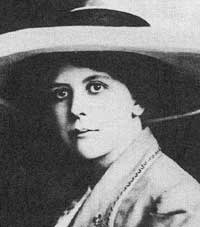
Young Amy Lowell

The young Amy Lowell. “Does this hat make my…oh, forget it…”


What was their beef? Was it that she was a woman and she was generally considered a lesbian? Even though the early-20th century Modernists often fail contemporary standards for wokeness, the Modernist movement included other women** and gay artists. Likewise, Lowell was eccentric, but that too was no mark of uniqueness in their artistic world.

I should make it clear, that even though I often write here of encountering writers from this era as I present their work, I’m not an expert or scholar on the era, and there’s a great deal I don’t know. But my quick read of the situation is that Lowell was seen by Pound and many of his cohort as a wanna-be. She came from a wealthy and prestigious family.*** She seems to have bought her way into some of her influence—but once again, wealthy arts patronage can’t be what makes Lowell unique. That was common then as it is now.

What made her unique is that she wasn’t content with being a patron, she believed herself a poet and a critic, and worked extraordinarily hard in her short career at exercising herself in those roles. Controversy may be good for short-term fame, but some of the most lauded poets of her time didn’t think much of her work as hierarchies and canons were being formed by those that outlived her death in 1925. Did they make their judgements cavalierly because they didn’t like her as a person or by reputation?

Let me cut to the chase: I don’t know. I’ve probably encountered a few Amy Lowell poems over the years, and none of them left an impression on me. But transient mood and expectation and the randomness of anthologized selections could account for that. As this project has come to use a lot of poetry from Amy Lowell’s contemporaries, I’ve figured that someday I should tackle one of hers if I found something I thought I could do something with. And this fall, her poem called “November”  was brought to my attention.****

November

I can’t find any good Internet links to this poem, so here it is.


What did I notice about it? “November”  follows the style of the early Imagists, including the one thing that I’ve come to recognize about early Imagist writing that later Modernism came to reject: the modesty and directness of its statements. You could knock Lowell and say that when she wrote this she had Pound, T. E. Hulme, F. S. Flint, H. D., and so on to model this poem on. But if you believe, as I’ve come to, that this mode of poetry was abandoned too soon for longer, more elaborate and esoteric statements, then continuing to use those valid methods is no crime.

The trick of this kind of compressed poem is how to be simple and subtle at the same time in some way that the reader will find a working expression of beautiful. After finding “November”  worthwhile, I quickly looked at a few other shorter Lowell poems and I’m not sure she consistently manages that, but I believe this one does. Even famous and much anthologized poems in the Imagist style can be read quickly as superficial “Is that all there is?” poems. Their simplicity asks for a engaged reader, not one blown-over by some kind of surface filigree.

As with our other autumn poems, this one touches some common tropes: leaves, bare branches, dark, rain. But Lowell keeps this fresh, where many other poems would seem to just be checking off the boxes. The leaves’ color is secondary, we are subtly asked instead to hear the sound of the crisp leaves rattling against the walls of the poet’s house. Yes, there are fallen leaves too, but they gather under the evergreen pines, sheltered there. The lilac bushes sound-move with the rich word “sweep” against the overhead starlight.

And that translates then to an interior scene where the sheltered poet is too under the lights, a lamp, writing, perhaps handwriting with a sweep of the hand. And another unshowy, but well-chosen, phrase says what the subject is: “The emptiness of my heart.”

Let’s pause there for a moment. Is that a simple epithet for longing? Yes it is, but there are others for that too that weren’t chosen, and “The emptiness of my heart” is more ambiguous than most, for it may indicate a feeling of unworthiness and unreciprocity too—but then to think to explore that, to write of it, to experience it in an autumn moment, is a self-reflection that a callused always cold and empty heart will never do.

The poem’s closing image, following up on that, gives us one more sheltered, or barely sheltered thing: the cat who “will not stay with me” and is huddled in a window casement.

In summary, there is considerable complexity of feeling encoded in these images without the emotions being explicitly named and listed, but rather invoked in the Imagist manner. And the poem hides its craft so that one may not notice it reading quickly, particularly the subtle repetitions in the three scenes. I chose in my performance to repeat the writer under the lamp scene once more at the end to emphasize that I heard that key point the other two scenes turn around.

Musically, I worked on this performance yesterday which was Joni Mitchell’s birthday, so I wanted to try something in an unfamiliar alternate tuning. And today is Bonnie Raitt’s birthday, so it was good that the one I settled on (G minor DGDGBbD) worked well when played with a bottleneck slide. You can hear how Amy Lowell worked with that music using the player below.


*A year after her death in 1925 she was awarded the Pulitzer Prize for poetry, and besides editing and helping to publish several anthologies of Modernist verse, she promoted it by popular lectures and articles in mainstream publications. Louis Untermeyer in his summarizing American Poetry Since 1900  published in 1923 says that “No poet living in America has been more fought for, fought against and generally fought about than Amy Lowell.” But to speak about her poetry (which he does praise) he writes first about her work as promoter and provocateur: “Her verve is almost as remarkable as her verse” indicating that the element of celebrity and controversy was already masking her actual poetry.

**Oddly, the path in the 20th century seems to have been to increasingly under-rate, value, and remember women poets of the Modernist era as the century went on. By the time I came along to encounter Modernism in school 50 years later it was a sausage-fest—but the 21st century is working to re-evaluate that. Canons and reputations are one thing, but every poem and its poet lives or dies each time a reader encounters it. That’s always a present act.

***Some of the Modernists came from what appear to be upper middle-class families, though of those, some had broken family ties and their financial support in some way. How much richer was Amy Lowell? I don’t know for sure, but I suspect noticeably so. Wealthy and gay poet Bynner had to reach for the body-shaming to find something to ridicule Lowell.

****Once more, I first saw this poem at the Interesting Literature blog.

The most popular Parlando Project piece for Summer 2019 is…

Before I reveal the most listened to piece during this just past summer, indulge me in a little “shop talk” as I report a few things about how the listenership for the audio pieces and readership for this blog have been going this summer.

Listenership on the audio continues to be somewhat volatile. June’s listenership was pretty good, July’s was excellent, and then August’s listenership fell to average at best, and early September followed that August trend.

This could just be “noise in the signal.” Or it could say something about seasonal variations in listenership. Spotify Parlando audio piece listenership (which I get broken out separate from those that listen on the player in the blog posts and those who catch the audio pieces on podcast services like Apple Podcasts, Stitcher, Player.fm etc.) didn’t follow the pattern, rising throughout the summer. Spotify has just started allowing their podcast audio to be added to playlists with the newest version of it’s mobile app, and this could help in the future, as it’s a convenient way to collect favorites (or to be honest, skip the ones you don’t care for).

And that last factor could be part of it too. It could be that folks just liked the July audio pieces more. My series on Spoon River Anthology, performed particularly poorly in numbers of audio listeners, something I wouldn’t have predicted. I’m comfortable with the thought that the deliberate eclecticism of genres I use will lead to differing responses. Still, the abject listenership failure of what I think of personally as one of my best pieces: August’s “Fiddler Jones”  from that Spoon River series kind of bummed me out. Oh well, pieces sometimes get a second wind once they enter the long tail of our archives. Maybe that one will.

For a guy who likes data, the readership of this blog has a completely different trendline. That’s been on an upward slope ever since the launch of the blog, and then last April we had a huge readership jump during our U.S. National Poetry Month celebration, nearly doubling our best previous month’s readership. Readership held up all summer, and August, the same month that disappointed for listenership, set a new highest readership. There’s a week to go yet in September, and it’s already second only to that new readership high, and on track to surpass it before the month ends. Go figure…

So what was the most popular piece this past summer?

Back Yard by Carl Sandburg. Well this piece does sound pretty good too, and Sandburg is deserving of this level of attention. Not only does Sandburg not get enough credit for the Imagist integrity of his early 20th century verse, but this poem is lovely sounding. Sandburg’s “Back Yard”  is ready to take the fixative of the silver moon rain and change into a moment, which then changes into another moment—always still, always changing. Always still, always changing. Ah, life….

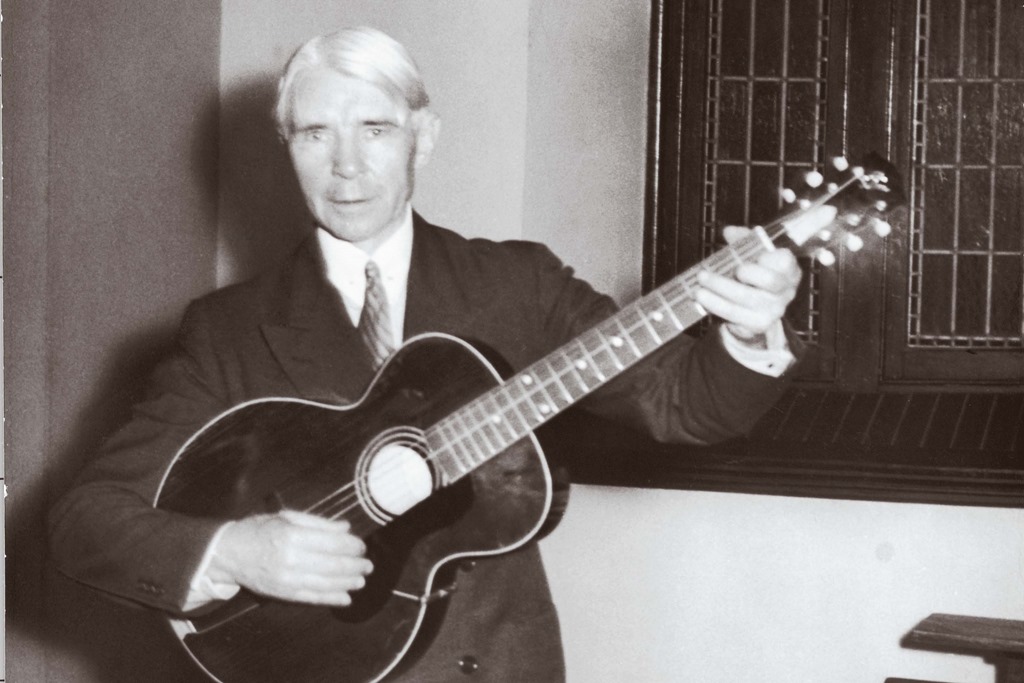
Carl Sandburg in living black and white

Americana artist looks to break through with his hip voicing of the Fsus chord


Things I find odd about how Sandburg has been judged: first there’s the judgement that he’s just not subtle enough, when I say those critics can’t see the subtleties—which if I’m right, proves my point; and secondly, the evaluation that his poetry is just broken up prose mislabeled as verse. That would be odd, Sandburg has an important secondary career as a popularizer of what we came to call “folk music” in the U. S. and was serious enough about developing his guitar chops that he asked Andres Segovia for a lesson. There’s music behind many a Sandburg poem, like this one, and composers more accomplished than I find it.

It may well be that the word-music of poetry and the music—of well, music—are two separate fields to be judged differently with different instrumentation, rules, and aesthetics. But until this is shown to be surely so, I tend to trust the judgement and tastes of musicians and composers over the judgement and tastes of literary critics and theorists on these matters.

Give a listen to Sandburg’s “Back Yard”  with the player below. If you’d like to follow along with the text, you can read it here. And really, thanks for listening and reading along as we encountered music and words here this summer in order to see what we find!


Parlando Project Summer 2019 Top Ten part 1

It’s that time again, when we look back on the past months and see what pieces were the most liked and listened to this summer. I do it countdown style, so here we start with the 10th, 9th, and 8th most popular pieces this season.

10. Pods (Neponset) by Carl Sandburg.  Do I say Sandburg is the forgotten Imagist too often? Maybe, but to my mind this is one of the finest short Imagist poems I’ve come across in my wanderings through early Modernist verse. Another thing I keep trying to counteract: the idea that Sandburg is simplistic and that his verse is absent the levels of ambiguity and ineffability that “great poetry” is said to offer. This 7-line poem about a small Illinois village with gardens and the train passengers traveling to see scenic wonders is an example.

My family has to put up with an amount of interruption by the focused and repetitive work of producing these pieces. Listening to the process of composition, when it involves (as it sometimes does with me) a lot of trial and error is  trying—but listening to the final mixing stages is excruciating. I mix at modest volume levels, but I’ve been told that headphones are not to be trusted in that work—so they hear these pieces sometimes being wiggled this way, and wrung out that way, over and over.  Not a good way to appreciate a piece.

So, it was a surprise this summer when my wife came in and told me this one sounded like one of the best ones I’ve done. Maybe it made it to number 10 because it stands to be listened to more than once?


9. I Saw a Peacock by Anonymous.  Long a leading composer in the folk music field, Anonymous can also craft a pretty good Surrealist poem with a humorous trick: the line breaks lead you to connect the thing previous with the last part of the line—when the “real” and much more mundane connection (as opposed to the wondrously apocalyptic thing you believe you’ve heard) is in the next line, after a breath pause of the line break.

I’ve read that this poem impressed Margaret Atwood in her early childhood with the wonder that poetry could create.

I seem to be working more and more with string and other orchestral compositions this summer. Part of that is that I’ve always been drawn to things that mix the attack-envelope of percussion instruments with the varieties of note length that stringed instruments, particularly bowed string instruments, can create—but it’s also because I was able to afford some additional orchestral instruments to play via my guitar’s MIDI pickup or with my little plastic keyboard this summer.


Here Be Monsters

Didn’t work? OK, try Black Mountain school with polka. No? Dubstep Hildegard von Bingen! Hard Bop Thomas Hardy! Still coming? Tell the gunner to give’em both barrels then. No, no! Not those barrels…


8. For Once, Then, Something by Robert Frost. Here’s an example of why I’m particularly grateful to the hardy listeners of these pieces. While I’m constrained by difficulties in obtaining permission to present writings still in copyright, I hope that you can see that I vary the type and the outlook of the poetry and other writing that I can and do use. I try too to mix Poetry’s Greatest Hits with deep cuts from esteemed poets, and more than a little of the lesser-known but worth considering.

Of course, for some (Many? Most?) the idea of poetry as an everyday thing that is not some mix of fearsome and intended obscurity, snores-ville decorative excess, and hoity-toity crap for those with nothing better to do has already removed them from reading or listening here.

Well then, as I’ve described this project from the beginning, I combine these words, mostly poetry, with various music. While people might just ignore poetry, they actively hate music that they don’t like. That disgust leads some (Many? Most?) to cling to a genre of music they find most able to please them, and to mark other sonic places as “here be monsters”—hideous creatures that disrespect what is right in music.*

Music doesn’t know what’s right and proper. It just wants to sound itself.

So how many people are out there who want to hear even the beloved, famous, respected American poet Robert Frost chanted to a pulsating Electronic Dance Beat arrangement?

Well, if you are the kind of people who read, listen, follow, and help propagate what the Parlando Project does, there are enough of you to make this the 8th most popular piece this past summer!


*By the way, if you don’t like some of the audio pieces that are presented here, that’s OK, even expected. Given that I’m pushing my capabilities as a composer and musician, you might even agree with my intent, yet not wish to negotiate my actualities. That’s part of why I like to mention that we vary things: you may like the next one that comes out, or enjoy taking a look at the nearly 400 pieces we have in our archives.

The Parlando Project audio pieces are available on Spotify. With the current Spotify mobile app you can even create playlists of your Parlando favorites—and exclude your “not so much favorites.”

A Misplaced Landmark in Modernist Poetry Part 3

Were you surprised or puzzled when I introduced this series on the Spoon River Anthology  by comparing it to the later bleak Modernist landmark “The Waste Land?”  I would have been. Not only is it often (usually?) left out of recent timelines of significant events in Modernist poetry’s emergence, the single epitaphs I recalled from it, the book’s “greatest hits,” were more similar to the ones I’ve presented so far here than to the bulk of Spoon River.  My first two Spoon River  posts: “Cooney Potter”  and “Fiddler Jones”  are ostensibly wistful, and while Cooney’s notice of the driving of his family and himself to increase his wealth and holdings has darker undertones, he’s telling this in the context of regret and guilt. He might even be exaggerating his faults.

Other unrepresentative Spoon River  “greatest hits” include the glowing and mildly tragic elegy for the putative love of the young Abe Lincoln’s life “Anne Rutledge,”  and “Lucinda Matlock*”  the stoic toting up of a full life by a pioneering settler who tells us she outlived (in a dual sense of the word) her troubles. The book’s opening introductory poem, “The Hill”  in its death-comes-to-us all catalog of outcomes remains elegiac. We might expect bittersweet with a strong flavor of nostalgia in the whole book. That’s how I’d cataloged Spoon River  informally in my mind.

SpoonRiverAnthology_cover

File under horror, not reminiscence


Reading the Spoon River Anthology this month has changed my understanding of it. Overall, the view of life and values in it is far more bitter than sweet. Many epitaphs are accounts of cruelty or unmitigated evil. Most relationships can be summed up (and are) as a grudge of one sort or another. It’s a harrowing read in its entirety if you are paying attention all the way through. With only a hint of the supernatural in it, it’s a horror story,  the mitigating moments and elements only relief before another crime or creep comes around the corner.

Today’s piece is perhaps the most chilling one in the entire book, as cold as a lynching poem—** and with gender replacing race, that’s approximately what it is. As I said when introducing last April’s sections of “The Waste Land”   this is not material for everyone.  It’s not poetry that soothes, reassures, or delights its attentive reader.  Masters is going to tell the story in first person, a somewhat unusual choice, and the narrator is going to fiercely understate in but 12 lines. Here’s a link to the text of “Minerva Jones” to follow along with.

As I said when introducing last April’s sections of “The Waste Land”   this is not material for everyone.  It’s not poetry that soothes, reassures, or delights its attentive reader.

We learn that Minerva Jones*** thinks of herself as the village poetess, and that some part of the village loves to taunt her, perhaps for her pretension, perhaps for lack of conventional femininity, perhaps just because she stands out as not conforming. Her father in his separate epitaph says he’s taunted for being Welsh and poor, so add that to her “crimes.”

And then she’s attacked by a village ne’re-do-well “Butch” Weldy, motivated by and/or knowing he’ll be excused by the village because of the above supposed transgressions of Minerva’s. We are given absolutely no details of the attack, another authorial choice. Many, and I, read this attack as rape. I think Masters intends that assumption. The choice to include no details of the attack itself could be discussed at length. It could be revealing of the speaker’s shame or decorum. It could be mental shock transcending even death. It could even be a level of what could be published at that time. Does that choice add or detract from the power of the poem? I suspect that varies from reader to reader. Think here of one of the core practices of Imagism:**** that one leaves out the core ineffable thing so that it may still be invoked by what is included.

Minerva tells us her attacker “left me to my fate with Doctor Meyers.” Here the story-telling gets more fractured and confusing, as this telling alone indicates that she sought medical treatment after the attack ends. However, in the context of other Spoon River poems that touch on this incident, the most likely reading is that a pregnancy resulted from this rape and her visit to Dr. Meyers was weeks later and for the purpose of seeking an illegal abortion.

At this point I’m more willing to say that Masters has made a narrative error, or at least disassociated one of the most powerful images in the entire book from its vivid context. Only by reading the other epitaphs dealing with this episode would it be clear to the reader that when Minerva Jones says in her sparse account: “And I sank into death, growing numb from the feet up/Like one stepping deeper and deeper into a stream of ice” that Masters has her acutely describing the feelings of a body undergoing hemorrhagic shock as she bleeds out in Dr. Meyers office. If one can distance oneself from the empathetic horror we may feel of the incident Masters is describing, these two lines are also Imagist: immediate, not mere decoration:

Anything that follows such a cruel situation and powerful lines must trail away. The next two lines have the power of pathos, posed as a question, not a command, and then the final two lines break with Imagist rules by stating emotions directly. After all the elision of the poem, many will forgive Masters for the value of these lines’ contrast with the cold account.

What happens next? Does Masters resolve this story? As they used to say in the days before binge referred to media consumption: stay tuned.

I too made a curious choice in performing “Minerva Jones.”  I could have gone with a big orchestral sound, something I’ve been exploring this summer. Then I’ve been thinking I’m missing the element here of loud “rawk” with guitars and band. And synthesizer/electronic sounds are almost a stereotypical way to express horror. Even solo acoustic guitar would be a conventional choice—many traditional ballads are as cold and bleak in their description of violence.

Totally out of the blue, and perhaps not correctly, I chose to instead use something out of my not-quite-jazz side. Dampened drums in a solid backbeat, always a good signifier of fate, a fretless bass line in a rolling walk, a chord progression sketched on piano that subtly violates expected cadences and harmonies, and then the guitar top line emphasizes the G-flat that adds stress to the harmonic structure. Like Masters, I fiercely understated. Did it work? The player is below.


*Rutledge is one of a handful of real people with real names included in the Anthology, but a great many others are thinly disguised real people from Masters hometowns or Chicago (some of whom weren’t dead, and recognized themselves), Matlock for example is his paternal grandmother at whose farm Masters spent time at in his childhood.

**Several times here I’ve considered poems about American lynchings for presentation. I’ve so far pulled back, and the why of that is complex. Dealing with the emotions brought forward in the Minerva Jones story walloped me, and I had to step away unable to continue work on this for a while.

***Is she related to Fiddler Jones I asked last time? Possibly, but I can’t recall that being established in the book, while Minerva’s connection to other epitaphs is made explicit. If she is, then there’s possibly a comment on how poetry is treated by the town (and presented by Masters) and music. Music is a recognized good, poetry something between an oddity or a fault. Two professions are probably overrepresented in the small town of Spoon River, mirroring Masters’ own life: poets (there are at least three) and lawyers and judges (I lost track, but there are many).

****While writing the Spoon River  poems, Masters once called his work “Imagiste” indicating that he thought the term fitting. Pound’s A Few Don’ts by an Imagiste”  along with F. S. Flint’s short report on “Imagisme  was published in Chicago-based Poetry in the spring of 1913 as Masters was thinking about how to shape his Illinois material; and though this has been less remembered later on, Chicago colleague Carl Sandburg was committed to using Imagist principles.

I’m indebted for some of this detail about Masters’ process to the only full-length Edgar Lee Masters biography extant: Herbert K. Russell’s 2005 book.

Black Horizons

How did you like that last Carl Sandburg piece? It’s about as majestic as Sandburg goes, what with its extensive catalog of life in its fullness and emptiness. It seemed to me about right to mark the anniversary of this project’s launch, and my late wife, and my son, and my wife and family, and my country, and you. And I much enjoyed making the large-scale orchestra music for it.

But if it catches you in the wrong mood or with a different and certain analysis of life it can seem a bit too new-agey, suffused as it is with non-denominational spirituality.

Sandburg is best taken in large and varied portions. He has many moods and is open-hearted in a way that many poets are not.*  Before I reminded myself I should do an anniversary piece earlier this week, I had another Sandburg poem I wanted to present, but I put “Black Horizons”  on hold and completed “For You.”  These two selections this week can be taken together to form a better picture of Sandburg.**

Sandburg can offer you balm and clarifying anger, and today’s piece is much closer to the later pole. Published in 1922, there’s not much I can think needs updating or footnoting to explain. You can read it, hear it, speak it yourself this month in 2019 and feel it as freshly as when it was written.

Carl Sandburg Rocks Out

Brothers and Sisters, the time has come for each and every one of you to decide whether you are going to be the problem or whether you are going to be the solution! You must choose Brothers, you must choose! It takes five seconds, five seconds of decision, five seconds to realize your purpose here on the planet! It takes five seconds to realize that it’s time to move, it’s time to get down with it! Brothers, it’s time to testify and I want to know, are you ready to testify? Are you ready? I give you a testimonial: Carl Sandburg!” ****


Musically, no orchestra today, just drums and percussion, fretless electric bass, acoustic guitar and voice. I tried to add a little color to my I, iii, IV, vi repeating cadence by flatting the 7th in the bass line, after watching Rick Beato on YouTube analyzing some Nirvana songs’ harmonic complexities.***  In a more ideal performance I think the piece would work great with a choir or audience singing the refrain.

The player to hear my performance of Carl Sandburg’s “Black Horizons”  is below (unless you’re reading this on an iPhone with the WordPress app—in which case, switch to a web browser to see the audio player, or you can subscribe to the audio pieces alone through most podcast services such as Apple Podcasts.)


*Why would that be? In literary circles by the middle of my century, poetry was the literary art devoted to complex, sometimes nearly unfathomable, emotional and perceptive states. A poet I heard read last night used a word “Apophasis,” which means describing something by what it is not, surrounding it with words that are not it. That term also describes a great deal of Modernist poetry. Poetry did this, at least in part, because so much tired verse of the preceding century or two repeated the same few emotional tropes until poets were tired of them. The great models of High Modernism made poetry a cult of misdirection, irony, personae, parody, and beautiful hermeticism. That poetry had power, if to a smaller audience, and one thing this project tries to do with music and performance is inject it with audible expression to illuminate the complex humanity in it.

**Yet they leave something out, the shorter, more purely Imagist Sandburg, a mode of his that I personally love and think deserves to be better remembered. That Sandburg has all the elusiveness and compression that Modernism propounded as a remedy to the overblown “listen to me play the cathedral organ stops of poetic sentiments” poetry it was rebelling against. For examples of the subtle Sandburg see this well-known poem and this deserves-to-be-better-known one.

Because of the more direct and Whitmanesque Sandburg, those Imagist poems are misread. They’re assumed to be slight, in a way that A Station in the Metro,” “The Red Wheelbarrow  or Oread  aren’t.

***My son has been learning Nirvana bass lines this year, which is stuff I can’t teach him because I only understand such things long enough to use them and because I lack the mimetic talent to transcribe existing pieces well. While recording this I discovered, to my horror, that I’d more or less forgotten how to play fretless bass while working on orchestration.

****Yes, it takes only seconds to decide. Revolution implies it takes only a little bit longer to implement that realization. We’re nearly 250 years into the American Revolution, and we’re still working on it. Sandburg’s poem is almost 100, and we’re still working on it. “The Sixties” are mostly 50 years old, and we’re still working on it. That’s your choice: still working on it, or giving up working on it.

Conversion

Whose fault is it when a poem is hard to comprehend, to understand? The first thought may be that it’s the fault, or even intent, of the author. Communication via written language has its weaknesses, but we know from our day to day lives that it can convey information successfully. Poetry, particularly poetry of literary repute, has a reputation for frustrating expectations of understanding.

For thoughtful people there should be second thoughts on this matter. If a writer, a poet, asks for a certain level of engagement, knowledge, curiosity, and openness are they always being unfair? I’m willing to grant they can  ask too much, but asking too little of an audience of readers has costs as well. Here’s a principle worth remembering as you approach poetry (or other arts): poetry isn’t about ideas, it’s about the experience of ideas. Experience isn’t permanent, one-sided or clearly binary. If we for an instant experience something as a simple truth, a moment of clarity, poetry can express that—but properly comprehended simple truths exist in a contradictory and changing world. Sometimes we can misunderstand a simple poem as much as a more esoteric and confusing one.

Early English Modernist poetry, particularly those poets around the Imagists, wanted to explore these things. It may surprise you, but many of its pioneers before WWI made a choice for clarity, for simplicity. It did to me. I came to the early works late, already steeped in the poetry of the post-WWI High Modernists: Wallace Stevens, T. S. Eliot, Paul Eluard and Dada and Surrealist associated writers. But look at the pre-WWI work of some English modernists, like this poem by T. E. Hulme, a poem that has been identified as the first Modernist poem in English, Autumn.”*

Autumn

A touch of cold in the Autumn night—
I walked abroad,
And saw the ruddy moon lean over a hedge
Like a red-faced farmer.
I did not stop to speak, but nodded,
And round about were the wistful stars
With white faces like town children.

Does it seem strange to you that such a poem could change things? It’s so un-assuming, so easily grasped. Two homey images that require nothing in the way of pre-requisites to visualize, though it may be helpful to be as Hulme was, a rural person who had migrated from the fields of his childhood.**  If one pauses and looks again, notice what’s not here: length, words naming emotions instead of objective description (save the single “wistful” which carries power in its exception) and rhyme. A not strict, but appreciable meter appears gradually with the final three lines, but the previous four are free

Today’s audio piece presents another poem by T. E. Hulme, one that isn’t easily understood at all. Hulme often wrote his pieces to demonstrate the theories of Modern English poetry he wanted to bring to the fore critically, and like “Autumn,”  the rest of his extant work has a radical clarity. Hulme scholar and professor Oliver Tearle reports that today’s piece “Conversion”  may have literally been a blackboard example of a revamped kind of poetry. If so, those looking at the chalk marks may have been as puzzled then as we are now.

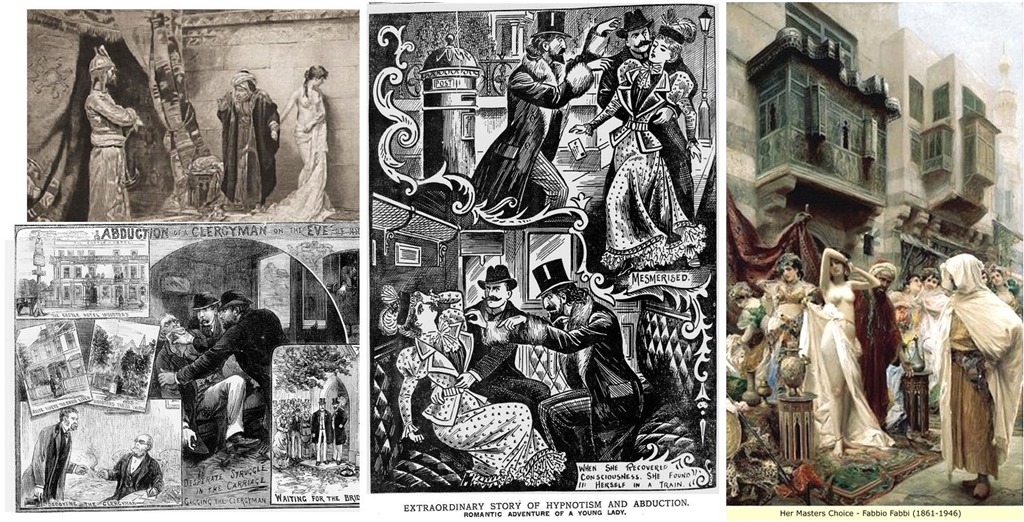
“Conversion”  starts off conventionally enough: a walk in nature, and hyacinths are in bloom. It’s beautiful and fragrant. We are altogether conventional here, save for the free verse. Then the next two lines are a clear image, but not necessarily an expected one: imaginarily our poet is drugged and kidnapped. In Hulme’s era a rag soaked in some ether or chloroform was a standard illustrated weekly/pulp fiction trope for this, but flowers as an agent is not unprecedented either (Midsummer Night’s Dream)  and in the poem the scent of the flowers is associated with this. For all Hulme’s Modernist intent, this does seem to follow a lot of fairy story plots from Tam Lin to “La Belle Dame sans Merci.”  The two lines that end the kidnap incident are uncharacteristically sound rich for Hulme: “Motionless and faint of breath/By loveliness that is her own eunuch.” It’s like Yeats or de la Mare broke into the poem for a moment.

What happens next? I’m not sure anyone can explicate the final three lines in a way that we all will say “ah hah!” to. Did Hulme’s inspiration fail him? Are we just not paying enough attention? Even Tearle, the man for whom I’m indebted for introducing me to Hulme, seems puzzled.

I have a theory, one that greater scholarship or historical knowledge than I have might bolster. The word “eunuch”  in the poem is our fuse. Eunuch in the context of Hulme’s time would likely bring to mind the Ottoman Empire and the exotic non-Christian Middle East. Exoticism is a complex thing, elements of fascination and sublimated desires are part of it, as are, alas, stereotypes and racism. But one common trope in the European mind of the time was the kidnapping and sexual enslavement of women in eunuch-run harems of Ottoman rulers. My guess is that’s what Hulme is referring to here, and that it might have been familiar enough to his time and audience to assume the reference would be understandable even in this highly condensed poem. The poem’s hard to explain title “Conversion” could also be fit to this idea.

Victorian abduction and harem images

Mysterious Victorian abductions, non-Christians portrayed as evil so that Europeans can look at pictures of ladies breasts.


That still makes the final three lines hard to follow. Is Hulme’s personae in the poem female, or is this a male-male cross-cultural bondage fantasy? Does it end with the death of the personae or just being carried away in quasi-erotic bondage? Come on Hulme, you may be using some unenlightened xenophobic twaddle for your image here but give us a clue!

“Final river” (Tearle reads the mythological river Styx here, and domo arigato Dr. Tearle) “without sound” seems to lean to drowning death. The one thing I came up with trying to figure this out is the apocryphal tale of the 17th century Turkish Sultan Ibrahim (“The Mad”) who was said to have had his harem of 280 concubines thrown into the Bosphorus to drown, a punishment that otherwise would be fit for a peeping Tom-Turk spying on the ruler’s harem.***  But by now I’m feeling like Wylie Coyote standing on thin air trying to explain those sparse final lines.

Drop all the guesses and dodgy cultural stereotypes, even if we blame the author for them, and “Conversion”  may still work to some degree, after all what I think the images set out to do is to convey that the apprehension of beauty can involuntarily change one by confusing our priors. The philosophic idea is not instantly clear, its images are problematic and opaque, but the words and the sounds of them intrigue. This “Beauty will be convulsive or not at all” as André Breton later wrote.

Of our three London-based “School of Images” pioneers, only Pound would later write “High Modernist” poems with such knotty allusive problems. F. S. Flint drifted out of poetry after WWI, and Hulme was killed in that war. Pound admired Hulme considerably, and T. S. Eliot spoke highly of him too. Those two may have chosen to follow the Hulme of “Conversion”  more than the Hulme of “Autumn.”

Well, this is a long post, and once more I’ve run out of room to talk much about the music and performance of the piece. I decided to make the musical setting discontinuous to reflect the confusion of the narrative and I hope I’ve brought out the mystery and lyricism of Hulme’s poem in my performance. The woodwind instrument featured at the start and finish of the piece is a virtual instrument version of the duduk, a gorgeous-sounding free-reed instrument that might be found around the shores of the Black Sea. I also couldn’t resist blowing a chorus on the Telecaster, an exotic instrument as old as I am, designed by a radio repairman on our western shores. The player gadget is below. Text of Hulme’s “Conversion”  can be found in Terle’s post on the always Interesting Literature blog.


*Like the “first rock’n’roll song” or “the first rap record,” there are probably lots of candidates, but it’s still helpful to have a marker to say about it: “This is different, and points to how things can be changed.”

**One cultural-particular is present: in the sunburnt face and white colored children of its two images, it’s not melaninanicly universal, but the particular in the case of poetry can still speak to us. Around the time Hulme wrote this, Charlie Patton was probably singing the floating blues verse that Son House later recorded “My black mama’s face shines like the sun…”

***”Michael Cohen, I like grand viziers who don’t get caught. I’ve got to get me some of the best people.

Back Yard

Just a couple of posts back I said that early Carl Sandburg poetry can be just as aligned with the ideals of the Imagist school as the Trans-Atlantic poets such as the then contemporary work of Ezra Pound, Amy Lowell, H.D., Richard Aldington, F. S. Flint, T. S. Eliot, William Carlos Williams, and T. E. Hulme was. Yet he’s rarely mentioned as such.*  Why might that be?

My guess is that there’s an issue with Sandburg’s more expansive mode, present in some of his work, Whitmanesque in character and scope. The Pound and Eliot school of Imagism wasn’t much on Whitman, charging him with lack of craftsmanship and concision. And then there’s the issue of cultural affinity, which while outside the text, is important. Of the above, only Lowell was from a wealthy background** (and Flint’s childhood seems positively Dickensian) but they all saw themselves as culturally elite. Most were familiar with classical languages, some had Ivy League educations (though none were Oxbridge, save for Hulme who was thrown out after a bit more than a year for rowdy behavior), most had spent time in Europe , even Williams, the most American-focused of these.

Sandburg? Born working class to two immigrants in the Midwest***. Drops out of school at age 13 to go to work. The jobs he had in the first 40 years of his life were modest in prestige, but varied in location and nature. Coal-heaver, farm laborer, Army private, milk-truck driver, political organizer, bricklayer, “The Front Page” era urban journalist. What T. S. Eliot knew about the whole of literature, Sandburg knew about the whole of working-class work and life.

One could make one mistaken generalization from Sandburg’s biography, that like Whitman self-advertised himself, he’d be “one of the roughs,” a man whose art would be artless and as unconcerned with the niceties of aesthetics as the correct fork for which dinner course. But just like the lazy assumption that there’d be no poets in foxholes, the idea there are no aesthetes who punch a clock is bogus. Sandburg’s early work is as concerned with Modernist beauty and style as working-class dignity—and he is very concerned with working-class dignity!

Is today’s Sandburg piece, “Back Yard”  an Imagist poem following the three Imagist rules? Let me paraphrase them:

Direct treatment of the thing: that is, the focus in the poem is on the image itself which will be described, instead of the image being a decoration and figure of speech within the body of a poem more concerned with its moral or message for which the image is only a “like” illustration. Conciseness: no extra words, and though not stated, it’s corollary is no less-apt words used only to make the rhyme. And freer rhythms: word-music, like sound-music, is not required to limit itself to only extraordinarily regular and repetitive rhythms.

Direct treatment? The outdoor, summer night scene is just that. One is hardly aware here that it’s an image, it seems like simple reportage. Is it merely the “hardly news” that on a summer night if one is outside, perhaps sitting on an open porch, you’ll hear and see other people outside too?

Concise? Pretty much. It’s not In A Station of the Metro,  or The Pool,  or The Red Wheelbarrow,  there is some re-iteration in it, even a single line refrain, but even by the standards of lyric poetry, this is a short poem. The elements of the scene are evoked, but there’s little extravagant or showy description. One element that many Imagist poems share (though never a formal rule AFAIK) is that colors are used to simply describe objects, though since this is a moonlit night scene the colors are more monochromatic.

A follow up question: how minor and mundane is “Back Yard”  really? I can’t claim it’s a poem of great originality—but that’s not the job of every poem, and this is more a poem of the continuity of change, a moment of shared perception, not a striking new vision.

I think its intent, in it’s just over 100 words, is for us to see a chain of life in a Chicago night early in the 20th century; and in its everyday exactness, state those things that might link to a night tonight where we live today. The silver moonlight in the scene seems almost a preservative, everything is frozen in that direct moment. In my night tonight it may not be an Italian boy with an accordion, but Mexican music from the back yard at the end of the block. The couple Sandburg says will marry next month, are now-dead grandparents of people as old as I am. An old man has fallen asleep in the late and waiting moment, his back-yard cherry tree’s fruits held in a moonlit unmoving until his eyes close. He will likely pass on sooner than the marrying couple, and his dreams and those long-ago cherries will be returned to the place that dreams, fruit, and poems go and come from.

The poem closes with a perennial thought delivered in the scene’s description. The clocks, the poet relates, say he too must go. The clocks say that to all of the characters in his poem, and by extension to us, his audience. Sandburg, the artist, the poet, has the job like the moon to fix this moment in silver. Was he thinking here of the silver of his brother-in-law Edward Steichen’s art photographs? What does he mean by the poem’s closing line? What are the “silver changes?” My best understanding is they are the endless succession of such fixed moments. There will be more and more silver changes, a great richness, even as we are entirely not there.

Edward Steichen Nocturne-Orangery Staircase

Fancier than my back yard: “Nocturne-Orangery Staircase” (1908). Sandburg occasionally collaborated with his brother-in-law and pioneer in fine art photography Edward Steichen.


For the performance of “Back Yard”  I decided to intersperse some other night moments, sung as commentary on Sandburg’s poem. You can hear it with the player gadget below. Want to read along? Here’s the text of the poem.


*Yes, Imagism is only a label, a piece of sticky paper put on some writers and writing. But because Imagism was so vital to the formation of English poetic Modernism, excluding Sandburg, “The Forgotten Imagist” from its usual ranks was part of how he was diminished in the late 20th century. The artistically-chosen stark simplicity of Imagism was admired, but similar directness in Sandburg was seen as populist simple-mindedness. For an example, here’s a long review of a late 20th century  biography, where the dagger is that Sandburg’s poetry was “dumbed-down Whitman” and the charge seems to be that he was a pretentious yokel who was also a phony who pretended to be a yokel.

**I’m of the impression that Eliot and Pound’s family had at least upper-middle-class wealth too, but my informal memory is that some estrangement or streak of independence led them to live outside their families’ wealth.

***Sandburg’s home-town area, the Quad Cities and its surroundings in Iowa and down-state Illinois, was a surprising well-spring of writers in his time.

The Most Popular Parlando Project audio piece this past spring is…

Here’s something I’ve noted in the years I’ve been doing this: these quarterly Top 10 lists advantage pieces posted earlier in the season since they have more weeks to accumulate listens and likes. So it was quite an achievement for D. H. Lawrence’s “A Winter’s Tale”  posted near the end of February to make it to number 4 in our last-winter countdown, but it happens. After all, this time, “They Say Life is Precious”  released in the middle of May this year, made it to that 4th position in our spring’s list.

Still, past the earliest days after posting there’s a predictable drop off slope. Listens are “front-loaded” as people notice it as a new post or podcast, and after that it’s mainly the explorers and those who find things from a web search. I am gratified that many of you check out our archives and listen to the nearly 350 audio pieces we’ve already presented, but the sheer number of pieces means that the long-tail listenership tends to be spread between those hundreds of pieces, making repeat appearances in the Top Ten rare—but we have one this time, one all the way at the top.

And it’s that D. H. Lawrence piece, “A Winter’s Tale.”  I can see how: a large number of folks were still discovering and listening to it in March, and after the expected dip in April, more people actually listened to it in May than April. But I don’t really know the why.

D. H. Lawrence’s poetry* is not exactly forgotten, but he’s still better known as a novelist—but that could help if the interest in novelists is greater than that for poets.

Was it the music I wrote and played for it? My music for “A Winter’s Tale”  was rather explicitly ‘80s related, what with the piece’s arpeggiating synths and big reverbed drums. I do rather like what I accomplished there, both the recording and the ideas of the musical arrangement still sound good to me, and so perhaps they did to you. One memory I have of doing the piece was wanting to remember to make use of silence. I always need to remind myself to do that, and too often I don’t obey. Listening to Mark Hollis’ music as I wrote and arranged this piece may have made that reminder stronger this time.

Shakespeare-Hollils-Hendrix-Lawrence quadrent

OK, some of you guys must have helped make this spring’s Number One.


Was it the title? Shakespeare** seems to be a reliable boost to interest over the years (sort of like putting Jimi Hendrix on the cover of a guitarist magazine), and Lawrence’s title is shared with a Shakespeare play. Was it Lawrence or Shakespeare drawing those later listens, or the combined power of both?

Like I said, I don’t know why, but thanks for listening and reading this spring! There’s still a fair amount of In Real Life and studio re-organization putting pressure on the amount of new music I can put together, but I still hope to be dropping new audio pieces this summer and writing about my experience with the words.

So here it is, as we approach summer, the enigmatic story of D. H. Lawrence’s “A Winter’s Tale” that’s just a click on the player below away.


*I’ve called Carl Sandburg “The Forgotten Imagist.” His early poetry uses the Imagist rules, but despite the way he wrote, Sandburg as a person doesn’t “read” as an Imagist: an immigrant’s child who wasn’t seen in Paris and London, and who wrote often about the world of work and those who sought and were bound to it, he doesn’t seem the aesthete (even though he was, in part, that). D. H. Lawrence too doesn’t inevitably get called an Imagist, even though his verse shared some Imagist characteristics and he was published in the movement’s anthologies. Lawrence was never viewed as a theoretician or leader in Imagism, and socially he mixed with poets like Edward Thomas and Witter Bynner who were outside the movement. Is he too a forgotten Imagist, or just “Imagist-Adjacent?”

**One measure of Shakespeare’s strength to draw listeners is a piece I did taken from Shakespeare’s play “Twelfth Night”  which I still find embarrassing. After seeing what friend of the blog Weekesgaehl could do with her actual acting chops I figured I’d give it a go with a short scene from the play to frame a song found in it. The song turned out just OK, but my “acting” lead-in makes me cringe. Tragic fate and the draw of Shakespeare made sure a whole lot of people listened to that one—and continue to listen to that one—sustaining my embarrassment.

The Parlando Winter 2018-19 Top Ten part 3

Should I stop for a moment in our count-down of the most liked and listened to pieces this past winter to describe briefly what the Parlando Project is? After all, there are always new people coming upon this stuff.

What we do is take various people’s words, mostly poetry, and we combine them in various ways with original music. The music too is not one style. Sometimes we sing the words, but not always, or even usually. Sometimes we read them or chant them or talk-sing them. Singing gives a particular effect to the words, and though I admire many examples of art-song, including some examples that use the same texts that I’ve used, I think there are other facets of the poetry that can be shown with other performance styles.

I wish we had more modern or semi-modern poetry here, but very soon in this project I determined that the effort to obtain the rights to creatively engage with work still in copyright protection would reduce the amount of encounters we could produce.

Limits and restrictions often engender creativity though. I’ve found that being largely restricted to the pre-1923 public domain world still allows me centuries of material to pour over, and there seem to be a great many under-appreciated and forgotten writers to discover. A lot of what I end up using is work from the first part of the 20th century, the Modernists that established the world of literature we are still continuing and reacting to. It’s been fascinating to experience this early formative time of Modernism by adapting and performing their words.

Now let’s return to our countdown with numbers 4, 3, and 2 in popularity this winter. Yes, they’re all early-20th century Modernists. And one poet takes two slots in the countdown today.

4. A Winter’s Tale.  D. H. Lawrence is another novelist who was also a poet. In my youth he was probably better known for his novels, and their spicy rep in the mid-century world no doubt helped his youthful readership. I recall reading some Lawrence poems in the sixties and I remember liking them then, but I have to say that my interest in them didn’t continue. Now in this project, in this century, I’ve run into him again. The Imagists who kicked off British literary Modernism considered him one of them.

I liked this poem of his, even though I still can’t say for sure what’s going on in it, but we often can forgive that in the context of music and words. My musical setting for an early 20th century poem kind of took some small inspiration from the late 20th century music of Mark Hollis (of Talk Talk) who died last month.


D H Lawrence in Mexico 1923

D. H. Lawrence asks “Is that a Mexican poncho, or is that a Sears poncho?”


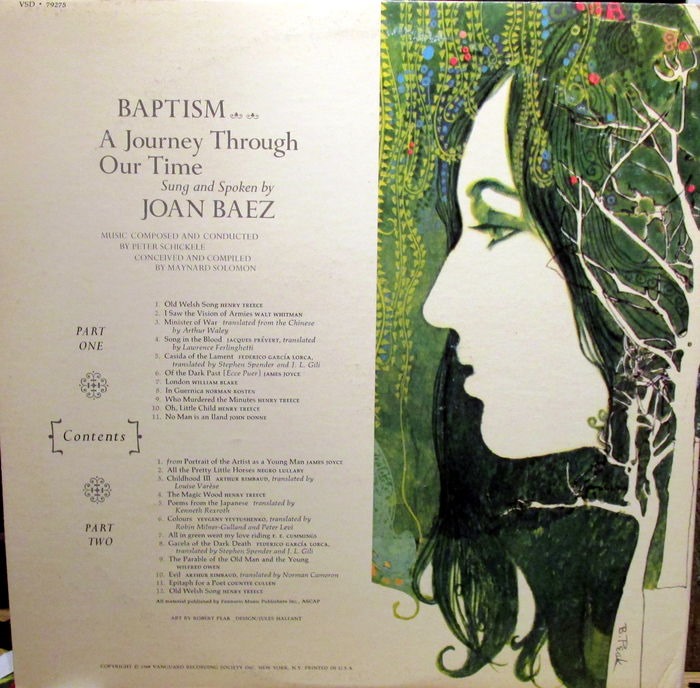
3. Gacela of the Dark Death.  Here’s another work that I translated into English myself for presentation here, a poem of passion and wit from Spanish poet Federico Garcia Lorca. I actually first heard this poem as part of a project that attempted to do something like what the Parlando Project does: Joan Baez and Peter Schickele’s 1968 LP Baptism.  Baez read Stephen Spender’s translation of Lorca’s poem earnestly there, and the poem’s title would lead one to read it as sorrowful. As I translated Lorca’s Spanish I sensed a more playful and mocking attitude in some of the images, and my performance tries to bring that out from my translation. As part of conveying the emotional range of the piece, I sang the opening and closing sections while speaking the middle of the poem—an example of how singing and speaking words changes the experience of them.


Baptism back cover

Baez and Schickele do Parlando 51 years ago


2. Self-Pity. D. H. Lawrence again, but a different kind of poem from “A Winter’s Tale.”  Shorter, and superficially an Imagist poem, it so clearly makes its “no whining” point that it was once used in a film by a drill sergeant. Poetry that makes straightforward self-improvement/empowerment points was not that common in early Modernism, and it’s not the usual way to literary cred these days either. I’m not sure why that would have to be. There’s an audience that likes it, and the 19th Century revered some poets who plied lessons like this poem does, although usually with many more words and stanzas. My best guess is that artists, particularly now in an era when literary poetry is something of an outsider art, like novelty and rebelliousness too much to settle for earnest self-improvement.

Well, this poem isn’t one of my favorites, but you know something: I need its message some days as much as anyone. I may have worked extra hard on the music I wrote and performed for it to compensate for that.


So what will be the most popular piece from last winter? I’ll be back soon to reveal that.