Dave Moore’s Cathedral

Here’s a surreal, enigmatic, and yet compelling story by Dave Moore that I adopted and combined with some orchestral music I composed for it several years ago. Dave wrote this during a period when he had returned to Iowa to help is aged father who was dying, and while nothing in the piece refers directly to that situation, this reader feels something of that experience is present in its absence in this.

Dave’s father was a Protestant minister, and so church buildings of various sizes would have been part of his upbringing. And the mysterious boxes within boxes that the story’s protagonist must pack may be a visual image for the tasks of dealing with the stuff of wrapping up a life. But neither of those things can completely anchor the way this tale unwraps itself.

Easily the strongest, most enigmatic, and potentially objectionable image in the tale is the encounter with a young woman. A listener may meet this image in the story and react to it quickly (or thoughtfully) as an intrusion of some kind of male gaze trope, that thing that can be a tiring and reductionist frame on the real lives of half of humanity. But to my reading of this, it is the core image of this piece and it’s remarkably faceted with a cubist/surrealist multiplicity of reflections: an anima, a reminder of the exiled female in the masculine church, a strange mixture of sexuality, ambivalent reactions to sexuality, and yet also with a bit of the nature of parental caretaking roles reversing themselves. Many a time when I revisit this image by listening to this piece, I see something new in it.

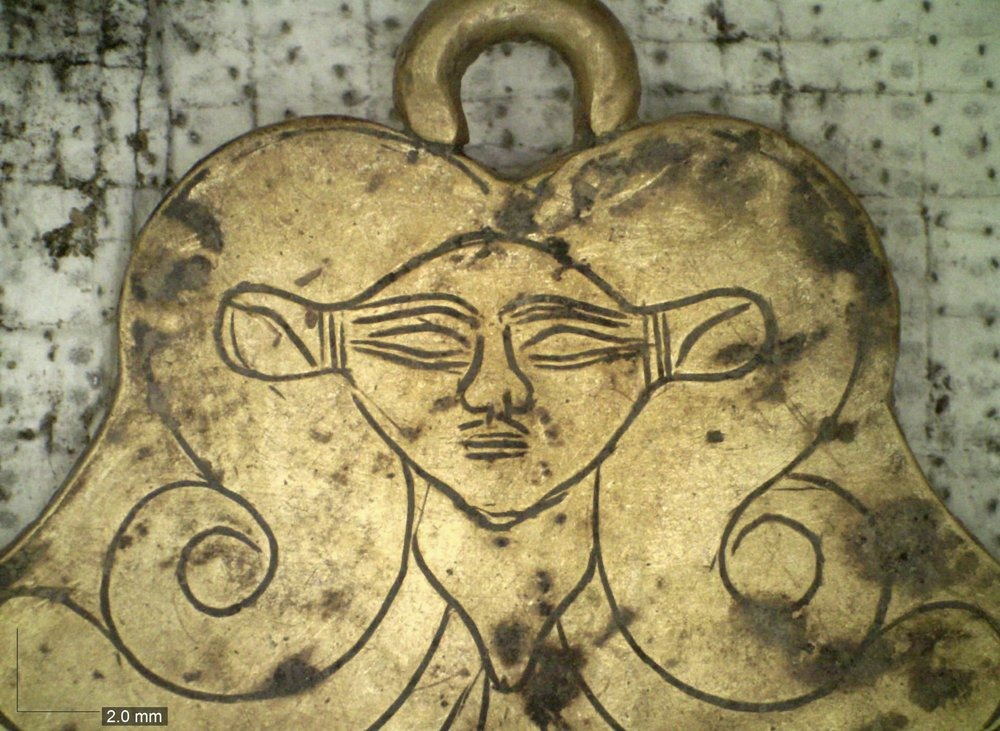
Hathor pendant from Pylos gravesite

Gold pendant depicting Hathor, an African goddess, unearthed in a Greek tomb dating from the time of Homer

.

Long time readers here will know that I admire Dave’s work, and once more I thank him for his contributions to this project with his voice and keyboard playing—but for you that is of little matter. Perhaps my specific and not necessarily popularly aligned taste, or knowing Dave and the circumstances around this pieces creation including that it’s my own music and performance that presents it here, distorts my evaluation of this image; but listen to this piece and see if you agree that the strange encounter at the center of this dusty and enigmatic tale is a remarkable image worth contemplating.

The player gadget to hear “The Cathedral”  is below. If you are reading this in a reader or reading view that hides that player gadget, this highlighted link may allow you to listen to the audio piece. There is no text to link to today, so you’ll need to experience this less than 4 minute story by hearing it.

.

Longfellow’s Harvest Moon

What value is mystery and strangeness to gratitude, to a sense of thanks? Let me try an experiment with you here.

American Thanksgiving still retains a degree of its nature as a harvest festival, and so when looking for a text to use today I came upon this one by highly unfashionable poet Henry Wadsworth Longfellow. Looking at the poem on the page one can see why modern poetic esteem may have passed Mr. Longfellow by. It’s a sonnet, intricately rhymed (ABBAABBA CDECDE), an antique skill that we no longer appreciate as much. Its imagery is both pat and removed from most of our daily lives, a rural landscape at night before the coming of electric lights, where moonlight can illuminate reflective objects and cast discernable if low-contrast shadows. Harvest signs include loaded wagons (“wains” is the charming old word for wagons chosen perhaps for rhyming needs), bundled sheaves of grain after reaping by hand, the changing of the bird population, falling leaves. In summary, we have imagery that is largely meaningless or lacking impact to us today in our modern America. It looks like stuff that is, and justly is, filed away in dusty poetry collections.

Harvest Moon

An illustration for “The Harvest Moon” from an 1880 edition of Longfellow poems

.

But what if we were to experiment a bit with Longfellow, and make him stranger and more mysterious? After all, this past rural world is now alien to most of us as some far-off land. And Longfellow, who we mistake as a rote poet here, has a subtle point to make, one that cultured British people might excavate and polish if this were a poem by Shelley or Keats, but which Americans may be too willing to overlook due to the old modes of Longfellow’s poetry.

In today’s performance of Longfellow’s “The Harvest Moon”  I attempt that act of mysteriousation. It started with breaking up the lines and underemphasizing the end-rhyme. This lets it act as an occult undercurrent, rather than a regular chime we know is coming. I sing the words as if this is new and not fully understood to the singer or listener. And as I often do here, I make the music I wrote and performed carry a lot of the load. The main harmony is carried by a 12-string acoustic guitar, which is playing primarily suspended chords, chords that remove the 3rd of the scale that makes a chord major or minor, and replaces that significant note instead with a not fully discordant but unexpected 2nd or 4th. The bass plays a busy but similarly unsettled melody line under this. And as a final signal that we are to regard this old American landscape with a time-tourists’ eye, and not as an old poem full of discarded conventions, I play a higher melody line and drone on a sitar,*  an instrument from another continent.

All that distancing effect is to force the listener to hear this poem as if it may have some meaning other than a decorative picture of a quaint and therefore meaningless scene. Longfellow outright begs us to do this in the text when he writes “All things are symbols.” This poem is late Longfellow, he’s nearly 70 when he wrote this, his America has passed through a horrible civil war, his life has passed through multiple family sorrows, and he is now an old man. The songbirds gone here are but counters perhaps, but his life of poetry is nearing its close. He’s spent his life helping establish that there can and should be an American poetry, that there can be American poets. We are them. Our grandparents and great-grandparents are the children asleep in those strange and now far-off curtained rooms. We are the piping quails, grounded birds gorging on the grain-seeds fallen to the under-shadows of the harvested sheaves.

Let us be grateful, let us be thankful, for those before us. Wrong and right they labored for us. Enslaved and wrongful masters they planted and harvested on lands that cannot forget the exiled feet of those before us. How strange, that it was exiles and the tempest-tossed that appropriated this place. Exiles creating exiles. There is a mystery in that.

The player gadget for my performance of “The Harvest Moon”  should be below. If you don’t see the player gadget, you can try to use this highlighted hyperlink to hear it instead.

.

*If you visualize me sitting cross-legged on a damask pillow with incense wafting in paisley curlicues while plucking on that elaborate musical device, it may be good for the effect of the piece—but in the spirit of full disclosure I’m playing a MIDI guitar here which allows my plucking to be translated into the notes and sounds of that difficult to maintain and master South Asian instrument.

In German November, or What? Nietzsche was a poet?

As a person educated in the mid-20th century this is what I knew about Fredrich Nietzsche: he was a philosopher who was all the rage in the late 19th and first half of the 20th century and he had this thing about achieving a more perfected human condition. Oh, I knew one more thing about him, something that discouraged all other curiosity: the Nazis liked him, saw him as an intellectual forerunner of their decidedly non-intellectual movement.

I know only a little more than that now. In the past few years it’s become accepted knowledge that the Nazi connection was to a large degree accidental. Nietzsche’s sister was his literary executor,* and she was a Nazi fan-girl who did a great deal to forge that linkage; and since the Nazis were nationalists, the available idea that there was a notable German cultural figure whose contradictory writings could dab some intellectual cologne onto their bully-boy stink was useful.

I vaguely knew that one of my childhood heroes George Bernard Shaw had admired him, but I had no idea how many leftist and anarchist figures rated Nietzsche. Remember Gustav Landauer, the German Anarchist theorist and grandfather of the famous director and improv comic pioneer Mike Nichols, brutally killed in the post WWI revolutionary activity in Germany? He was said to be influenced by Nietzsche too.

But this fall, while reading a blog I follow,** I learned another thing: that Nietzsche was also a poet. Which shouldn’t be news to me I guess, but it had never occurred to me, even though as a philosopher Nietzsche seemed to be something of a human quote machine who could turn out memorable phrases. And today’s text, “In German November,”  was the example that introduced me to that fact.

November Sadness by  Heidi Randen

Ah sunflower! Weary of cold and $%*@! snow.

.

I know only a little about German literary Romanticism, but what I know makes Nietzsche’s poem part of that tradition: worship of nature, doomed love—Damn! There’s even a prominent talking flower for Odin’s-sake! This can seem very twee in summary, but Nietzsche redeems it with his gift for language and characterization. Unlike other translations I’ve done here, this one’s poetic images and plot moved rather easily into English.

This is autumn: it — it just breaks your heart.”

After the poem establishes its “This is Autumn…” refrain by opening with it, the first full stanza has a graceful post-equinox image of a now lower sun against a mountain that would please Wang Wei. The poem’s second scene, set in a orchard with post-frost fruit starting to rot mixes sex and death tropes effectively. And then there’s that talking flower.

It takes some nerve to carry that scene off both as a writer and as a performer. I felt I had to push myself as a singer to portray the sunflower, and part of the reason I’ve started to put chord sheets up for some of my compositions here is to encourage better singers to improve on my attempts.

German November My Translation for song

Simple chords, but this one has opportunities for a singer.

.

Because Nietzsche’s German moves fairly easily to English my translation doesn’t differ that much from the one in this link, which also provides you with the original German. One choice/change I made: I wanted to emphasize the existential angst of the sunflower and to strengthen an image—and so the original German: “in ihrem Auge glänzet dann/Erinnerung auf” gains a repeated word “memorial” reflected in the dying flower/eye. I also thought the implied pause in Nietzsche’s refrain: “This is autumn: it—just breaks your heart.” could be emphasized further by repeating the “it” for a stutter effect.

As I mentioned above, I went for it in this performance, and given my limits as a singer it may not be to everyone’s taste, but it was the best I could do given the more limited recording opportunities I have these days. The player gadget to hear it is below. Thanks for reading and listening in whatever November wherever you are.

.

*Nietzsche died in 1900, late enough to give his ideas access to the early 20th century’s cultural ferment, but with the benefit that the proponent of those ideas wasn’t around to contradict the uses interpreters put them to.

**Byron’s Muse. I like to think I’ve outgrown youthful goth romanticism, which fits badly with my aged frame and less virginal connections to death, but Byron’s Muse sometimes reminds me that artistically there is still some attraction there.

O Let Me Be Alone Awhile

I’m going to take a walk around to get to a good small poem by Emily Bronte today. It won’t be a walk about the English moors, alas, but it’ll have to do in this otherwise wild and windy place we call the Internet.

My spouse and I have a worthwhile understanding that we are both a sort of introvert. Definitions vary between peoples and time, but one short definition of an introvert is that they are the people that gain strength and restoration from solitude rather than from gatherings of people. One can easily suspect that writers and their close allies, the readers, may be more likely introverts, but of course that’s not always so. That indispensable pioneer French Modernist Apollinaire*  was famously sociable within his element, a joyous bohemian boulevardier. Other writers, even while writing, seek out crowded places filled with voices and humanity to concentrate on their silent work. August Wilson, the great 20th century American dramatist, liked to write in cafes and coffee shops, places where other peoples’ voices were staging their own improvised plays.

But we can’t be sure that those two, or others like them, still aren’t introverts. My wife is good in typical social situations. I’m not. I’m so bad at social interactions that I’m sure I often leave a bad first, second, or last impression.**  Still, one thing that joins most introverts is that however well we perform the social whirl, it tires us out—and when we need to recharge it’s not a different self-selected group, even a group of friends or family, that we seek in order to recharge, instead it’s solitude.

So, I have a phrase that I use with my wife when she needs to recharge: “Oh, have a good time at your Introverts’ Support Group.” Which of course isn’t a group—it’s time alone.

I have a phrase that I use with my wife when she needs to recharge: “Oh, have a good time at your Introverts’ Support Group.” Which of course isn’t a group—it’s time alone.

This sort of time alone is particularly hard for non-wealthy women to find. In Bronte’s time a great deal of domestic and family labor was assumed to be their unquestionable duty, something that modern times and insufficient good intentions haven’t eliminated. I have some idea of the particular domestic duties of Emily Bronte admirer and like-named Emily, Emily Dickinson, but less of Bronte’s own family obligations, but I assume they were considerable.***

In our current Covid-19 age of shelter in place recommendations, the pressures of everyone at home may make more and more of us like unto residents of an isolated parsonage in the North of England like the Bronte’s. If so, today’s Emily Bronte poem, written it says in her collected poems on Sunday December 13th, 1840, may still speak to us. Arithmetic tells me Bronte would have been 22 when she wrote this. Here’s a link to the complete text in case you’d like to follow along.

Emily_Brontë_by_Patrick_Branwell_Brontë

Introvert Irony: the only image we have of Emily Bronte is a group portrait painted by her brother of her with her sisters.

.

On publication this poem bore the title “Retirement,”  but I’ve chosen not to use it as I don’t think Bronte is using the word in the sense most of us use it today. I believe the sense she intends is more at a wish to retire (as one would “retire to bed”) to rest and refresh oneself after a day of labor.

Indeed, the scene she wishes for and describes may be staged in sleep and dreams—though if so, her dreams are outside, alone, and in God’s nature. My wife’s most favored respite spots are walking in parks, nature reserves, and around wild lake shores. For introverts like Emily Bronte, my wife, and I, a concertedly apprehended nature is the other that somehow comforts us.

When we last did an Emily Bronte poem as part of this project, it was her spooky poem “Spellbound”  in which the poem’s speaker seems to be suspended in the air figuratively or in imaginative actuality. Interestingly, in today’s joyous poem, the speaker speaks poetically of “wings,” and a wish to “quit this joyless sod,” and so is again in “mental flight” somewhere between heaven and earth. Just as if I wondered if A. E. Housman’s spell-caster’s poem and Bronte’s were in conversation, and if Emily Dickinson’s bird and hope poem was reacting to an Emily Bronte bird and hope poem, Bronte herself returns to an airborne state in today’s poem.

Wishing all the readers and listeners here the companionship and solitude they need and desire, and, and but, in the proper mixture!  The player gadget to hear my performance of Emily Bronte’s “O Let Me Be Alone Awhile”  is below.

.

*102 years ago this month, Apollinaire died of the 1918 great influenza pandemic while still weakened from a wound he suffered in combat during the final days of WWI. The flu virus got him before he could see the end of that war, as noted in Tristan Tzara’s moving poem that I translated and presented here three years ago.

**I have something of the novelist’s eye for how those interactions can go wrong, but the social klutziness to do it all wrong anyway.

***Wikipedia says she did “most of the cooking, ironing, and cleaning” for her family.

O honey-bees, come build in the empty house of the stare

I have my partisan convictions, you may have them too. And yes, our particular governmental and economic  institutions are imperfect instruments. Natural forces only partially in our control and as small as a virus and as large as a changing atmosphere are still arrayed against not just our nation, but our planet. Proud racial and ethnic caste systems divide our forces against these things.

How to be humble and not loose heart? How to rejoice if there are things to do? Well, I believe that without joy we cannot achieve any needed changes or maintain any necessary things—but there’s much I don’t know, and as with all the things I think or say, my beliefs and actions are less important than yours, particularly if you are younger than I am. Laugh at all that clap-trap about named generations with variant but supposedly sharp an defended borders and a fixed list of characteristics like some crummy astrological sign summary. You are, or you need to be, The Greatest Generation.

White House and the US Capitol

William Butler Yeats said about his country a century ago: O honey-bees/Come build in the empty house of the stare.
.

I hope to have new audio pieces with posts  in the next week, and there are lots of them already posted here. Here’s one of those older pieces you may not have heard yet, featuring the words, voice, and keyboard playing of Dave Moore titled “No Common Ground.”  The player gadget to hear it is below.

.

Election Day

I recall being on the shores of Lake Superior, North America’s great internal sea, on the morning of the last U. S. Presidential election, a day very early in the run of this Project. The lake and wind were calm, and I was out alone at dawn at a place where you could hear the water-lapped gravel stones at one part of the shore clinking against others.

I arose this morning at dawn in my diverse urban neighborhood and rode and old bicycle down to a low creek near the border of the city. That waterway is running low, exposing the ragged banks it used to wear. On the way back I picked up a take-out breakfast and rode past my voting place where I saw some of my fellow citizens entering and exiting to do what I had already done a few weeks ago.

I am ill at ease for my country, my family, and myself, something that accelerated throughout this year. I’ve read all the information, added to it all my speculations, but I have no source or way of knowing if that helps. It seems likely that my country’s fate will be decided in varied places across a continent, by a group of people I don’t know, by rank strangers like and unlike me.

We call that system democracy. Our republic filters and strains that democracy, weighs us unequally. There are days that call to mind diverted poet Winston Churchill’s famous line “Democracy is the worst form of government except for all those other forms that have been tried from time to time….” and other days were my mind’s ear hears singing poet Leonard Cohen*  intoning that “Democracy is coming (slight, sly, pause…) to the U.S.A.

Our Books

Books and votes and viruses and a world that weighs them with a right thumb in your eye and a left thumb on the scales. And you? Close your fist to protest. Open your fist to read, to vote, to grasp each others hand.

.

I know some come to this blog to find something other than politics and self-assertion, and others as a break or supplement to earnest efforts at those things. Readership and listening stats here have never been higher, even as many of you have no-doubt been as troubled as I have been this year, so I feel the call to leave you with something today. I have picked a text from a writer that I often turn to in troubles: Carl Sandburg. When I first presented this audio piece, I said that Sandburg had seen every evil and injustice I had seen, would not deny what he had seen, but still retained an embrace of humanity. So, I’ll give you a selection again from his “The People, the Mob”  for this election day. The player gadget should appear below.

.

*That Cohen died on the eve of that last U. S. Presidential election still seems like an epitaphic metaphor.

.

The Listeners

I have one more audio piece for our Halloween celebration, this one using a mysterious poem by Walter de la Mare. The way it goes about being scary is unusual—weird even.

After you read or hear it today, how would you describe what’s frightening about it to someone else who doesn’t know this poem, “The Listeners?”   Would you find that a hard task? Our previous two Halloween pieces have easy anchors to something describably frightening. Even though those two are short poems, you could point out their fright potential just as one could blurb a Stephen King novel or a horror genre film. Bronte’s “Spellbound”  has its character held unable to move as cold night approaches. While it’s not “spelled out” (and there’s a jump scare for you: boo! language play!) it is implied that this immobile state has the character suspended in the air. And Housman’s “Her Strong Enchantments Failing”  has poisons and weapons drawn and multiple deaths assured.

OK, now watch a movie in your mind of de la Mare’s “The Listeners”  with the sound off. A man rides up to a somewhat elaborate house in a woods at night. Close up: you see his hand knocks on the door. And he knocks again. And one more time—oh the heavy suspense—he knocks a third time. No one comes to the door. Back to wide shot: he rides off. Gripping! I was on the edge of my seat! Goosebumps!

Now of course suspense, fright, that sense of out-of-joint weirdness are all subjective feelings inside an audience. Nothing is assured to be delivered by any artist or writer’s work, no more than all readers will find something sexy, delicious, or beautiful. But almost nothing happens here, and that little is not unusual, at least in the days when the horse was unremarkable transportation, back before we Zoomed or IM’ed our associates instead of riding over to them.

But if you listen to “The Listeners”  (hey, is that title a clue?) you may get that ghost story jolt that de la Mare intended. After enjoying this as a poem (full text here) or in my song version, let’s look at some details of how de la Mare casts his spell.

First off, the poem is full of assertions of silence. For something that’s not a there, there—it won’t shut up about it. Helping us endure the author pointing and asking us to notice that, some of the descriptions of silence are quite nice I think, particularly the last one: “The silence surged softly backward.” And oddly, to enforce our sense of the silence, sound effects are used in a couple of places to richen the silence. We can hear the mouth of the horse grazing early in the poem as his rider goes to the door. And as the rider mounts up to leave, we can hear the sound of the leather stirrup strap stretching as his sole meets the stirrup and then the differing sound of the horse’s shoed hooves when they strike a rock in the forest trail away from the house. What we hear enforces the feeling of silence.

Dialog (strictly speaking, monologue) is used sparingly, but it finally tells with the rider’s final utterance. This is no chance encounter, though the rider is called “The Traveller” he’s not a curious passerby or a man looking for a cup of oats for his empty-tank horse. That this is an unexplained appointment is a wonderful choice! Like the silence it can let us fill it with detail.

I just got done exchanging new work this month with a small group of poets that have been doing this for decades. I’m sure many of my responses were suggestions to clear something up or to expand something the poem seems to start but doesn’t finish. And the same was likely said about my work. I thought my advice was valid when I gave it, if only from an example reader, but “The Listeners”  points out there’s no law that a poem needs to answer every expectation—maybe instead there’s a statute that says that at least in a small yet significant way it needs to surprise or even confound expectation.

And yes, that title: “The Listeners”  really helps here. The rider knows they’re there somehow, just not in the state or mood to answer. Like the silence, their nonappearance is silhouetted with outlines of absence.

The Listeners Turn2

She Don’t Care About Time. Walter de la Mare’s writing had an affinity for the weird, so David Crosby’s anachronistic cape seems fitting.

.

I went with one of my favorite rock music sounds today, the 12-string electric guitar, an instrument made indispensable for a short time in my youth by The Byrds’ Roger McGuinn. The 12-string electric is an unusual instrument today, as rare to see in a guitar store as a horseman is on the road now. I bought mine a couple of decades ago because I love the sound McGuinn and his engineers developed for it, which I exploit today. The player to hear my presentation of Walter de la Mare’s “The Listeners”  is below. if you don’t see the player, this highlighted hyperlink will also play it. Thanks for being one of the Parlando Project’s listeners.

.

Her Strong Enchantments Failing

Here’s another Halloween short poem with a supernatural spell and struggle in it, this time by British poet A. E. Housman. I found it spookily similar to Emily Bronte’s short poem from last time—but while Bronte’s poem wrung its fear from being frozen, this one is more hot-blooded.

Housman retains a degree of non-academic popularity in England but is less well known here in the United States. Academics on both sides of the Atlantic soured on his poetry during the 20th century as it didn’t hew to the Modernist ways of expression, because they viewed much of his verse as sentimental, not complex and allusive, and he often dealt with humble English characters. He’s not alone in that fate, but it’s somewhat ironic in that Housman was himself a formidable scholar, specializing in classical Latin poetry.

I found Housman’s language in “Her Strong Enchantments Failing”  as brisk and unemotional as an epigraph, despite its fantastic element. It would be easy to present as a pulp tale that starts with a statement about a failing spellcaster that by the fourth line has a knife at her neck. It moves as fast as any hardboiled fiction. Here’s a link to the text if you’d like to check it out.

The final two stanzas give us the summary, the box score, of a battle between the spellcaster and the knife-wielder. There’s no rigmarole of dice throws, just the final inning laid out as the poem ends with each character left a mystery.

All we know of the spellcaster, she with the weakened spell, is that she’s viewed as some kind of evil principal portrayed as at ease with killing. We’re told less about the other character, only that he’s young and a man, and that he’s got the upper hand holding the blade.

…this poem and Emily Bronte’s ‘Spellbound’  from last time have strange correspondences…”

Housman seems to be taking the young man’s side in the tale. His opponent is called the “Queen of air and darkness” here. I said this poem and Emily Bronte’s “Spellbound”  from last time have strange correspondences, perhaps only coincidental—but in Bronte’s “Spellbound”  the subject is held, apparently suspended, frozen in the darkening air. If we jam the poems together, our knife holding young man is a spellcaster too, and as today’s episode opens with a “previously on the Parlando Project…” connection, he was able to freeze our Queen, destroy her fearful towers and vials of poison. Bronte’s “Spellbound”  character isn’t described, but perhaps she shares Emily Bronte’s gender, and we sympathize and shiver with her for the length of Bronte’s poem. Bronte says the spell that binds her character is from a tyrant.

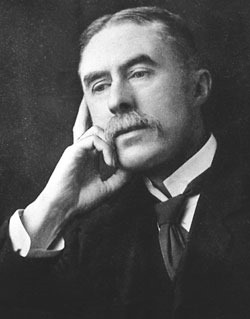
A E Housman

A. E. Housman, humble classics scholar, thinking how he could beat Emily Bronte in a fantasy boss fight

.

There’s nothing that says the young man who is ready to kill an evil spellcasting Queen in Housman’s poem is not themselves a spellcaster and maybe not a humble freedom fighter either. After all, to slightly alter the old saw, who wants to bring a knife to a spellcasting fight? In my performance I couldn’t help but start to sympathize with this doomed formerly formidable Queen, even it she’s evil, or said to be so.

Well, that’s two good weird-tales poems now in our celebration of Halloween. The player to hear A. E. Housman’s “Her Strong Enchantments Failing”  may be below. Don’t see it? Not an enchantment failure, it’s just that some blog readers won’t show that. Here’s a highlighted hyperlink that will also play it.  There may be time to do a third Halloween tale yet this month. Check back to see.

.

.


Emily Bronte’s Spellbound

Let’s begin our celebration of Halloween here at the Parlando Project with a setting of a short poem by Emily Bronte that starts “The night is darkening round me.” What a marvelous short poem it is too.

Halloween here in the northland of Minnesota is in some years an early winter holiday, and this late year’s late October seems one of those. I’ve awakened to temperatures in the teens Fahrenheit already this month, snow and ice are on the ground, and of course it’s already twilight at 6 pm. So, given that the speaker in Bronte’s poem is enchanted by a spell, it’s easy to see this from my landscape as a Halloween poem, but if you are farther south you can consider it a Winter Solstice one. And if you live in the tropics? Well, I do promise “Other People’s Stories” here.

My wife and I live by the Norwegian proverb about there being no bad weather, only bad clothes. Our love gifts tend not to be lingerie or sharp dress duds, but things like merino wool and handlebar pogies*.  We each try to keep up outdoor activities in the winter, and as long as you are active, such clothing works well.

But Bronte opens up in a different situation. It’s night. It’s cold. It’s windy. And our poem’s speaker has been spellbound out in it. They can’t leave. The poem, short as it is, tolls a refrain over and over, the speaker “cannot go.”

spellbound

I played this with the eerie, hook-like appendage guitarists call “a capo,” so it sounds in Bb in the recording.

.

And the second stanza says the weather is getting, what? Worse! There’s already heavy snow on the tree branches. Where is the speaker bound in this spell in the foreboding night with a further storm coming on?

Not even hunkered down in a sheltered area or behind a windbreak. They are frozen (not soon to be a metaphoric word!) somewhere between the sky’s clouds and the winter, snow-covered wastes below. When I read this poem, I pictured the spellbound speaker held supernaturally some distance in the air (makes it easier to view the snow-load on those tree branches), but if you are less fantastic you could view them on a ridge or hillside and able to view lowland areas below, but still more than minimally exposed to the weather. I’ve even read a reading where the writer thought that Bronte had placed the speaker in Purgatory, and the clouds are heaven and the lower wastes hell. Well, Emily Bronte was a PK** and all, so that’s not impossible, but I’ll still take the picture with what Bronte gives us, stark as it is—and in its moment, without any route to salvation.***

Other close readers note the subtle change in the last “cannot go” refrain. The speaker says “I will not…go” the last time, not “I cannot…go.” Do they want to be in this predicament? Is there a kinky love bond with the tyrant who has them trapped in the spell? Plausible reading. My sensibility hears this “will” as a final realization that there’s no way out from the spell, that the speaker is not just temporarily trapped and cannot go, but they will be so in any future they can see.

So, a Halloween-scary poem. Back in the “real world” that we hope is safe enough to tell each other scary stories, we can reflect how this trope of being in a situation of oncoming dread and not being able to move is a common bad dream. Or if you, or someone you know, suffers from S.A.D. (Seasonal Affective Disorder) you may find the winter darkness brings on a torpor that’s hard to break out of.

A simple setting for today’s piece: guitar, bass, and piano. The weather’s too cold and dark to drag an orchestra outside I guess. I plan to be back with more Halloween spells this week, time allowing, so check follow, or check back. The player gadget to hear my performance of Emily Bronte’s “Spellbound”  also known as “The Night is Darkening Around Me”  is below. No player? This highlighted link will also play it.

.

*Pogies are neoprene hoods that allow one to operate bicycle controls inside their wind and warm shelter while wearing only normal gloves rather than bulky insulated mittens. They are the only solution that really works for subzero F. cold on bikes.

**PK means “Preachers Kid.” A class that Parlando Project alternate voices Dave Moore and my wife share with me. One thing this experience usually leads to is a youthful exposure to a lot of sermons. “Heaven and Hell” may not just be someone’s favorite Black Sabbath LP—or it may be, but one has yet another context for that.

***In its short, stark, three stanza format that could repeat in any order, and it’s no way out of here situation, this poem is sort of Emily Bronte’s “All Along the Watchtower.”  Except, Emily’s speaker has no one to talk this doom over with. A like-named Emily, Emily Dickinson, would appreciate the solitary nature of this kind of Bronte poetry. Earlier in this blog we discussed that Dickinson’s “Hope” in her famous “Hope’ is a thing with feathers”  poem may have been quoting Emily Bronte.

Sensuality

It occurs to me that since I’m an English speaker this project focuses on poetry in English, and though I’m an American, I do give a fair amount over to it to poetry from England itself. But that said, even when I’m not working on a translation* some of that English language poetry is written by writers for whom English is a colonial language.

Irish writers certainly lead that contingent here. If only for Mr. Yeats, this is unavoidable. English language South Asian writers have appeared here too, though South Asian musical influences on me contribute more often. Jamaican Claude McKay reminds me of the easy intersection of colonialism and racism. Afro-American writing in general, even for the native-born American, is often concerned with the issues of colonialism, since it’s more than a metaphor to say that Afro-American communities are treated as colonies in America. If I offend or irritate some white readers with that statement, let me offer this question as a small balm: to what degree does American literature and American poetry, taken as a whole, have aspects of dealing with colonialism?

Those bearded Smith Brothers of American poetic independence Longfellow and Whitman both had to plead that American subjects and American civic ideals were worthy along with their verse. Emily Dickinson didn’t seem to care that she didn’t write quite like her British influences, but to not care in one’s independence is an anti-colonialist stance inherently, isn’t it? Even into my century, Eliot and Pound got to have the immigrants’ revenge: to sit in Europe and reform poetry in English, while obscuring their Missouri and Wisconsin roots. The eventual 20th century American hegemony obscures this accomplishment, but I’ve got to hand it to those two cheeky fellows.

So, who’s left out in the former English colonies here? It seems odd that I haven’t found an in-the-public-domain Canadian to present, given that I live in Minnesota—or Baja Canada as it’s been called. A single Leonard Cohen parody doesn’t seem to be enough. Well how about Australia? Irish-New Zealander-Australian-American quadruple bank-shot Lola Ridge can’t cover all this by herself! Well, there is one other, one that I’ll present again today: Kenneth Slessor.

Kenneth Slessor shipboard with coat

Does this look like a sensualist to you? Kenneth Slessor, shipboard “With my hands in my pockets and my coat collar high”

.

What would one have to overcome to be a Modernist Australian poet in the first half of the 20th century? As an American I can only guess. For starters, remoteness would be a significant issue. These days, when I post around midnight here in the American Midwest, folks read these posts in Australia right off in their afternoon before my North American neighbors have awakened. But 100 years ago? As an American I can suspect there was little interest in London literary circles in that time about what they might be missing in the antipodes. If the Irish, descendants of enslaved Africans and Bengalis had to worry about being seen as inferior human species, the descendants of European settlers in America and Australia had the lower but still significant prejudices that they were rubes from the sticks who didn’t know enough to do anything worthwhile.

I’m not going to say that Slessor is Yeats, Pound, or Eliot to the world, nor is he Tagore to his homeland. I said this month you might not have heard of Lola Ridge, but I’ll guess Slessor is even less well-known to world-wide English speakers. He doesn’t seem to have had a particularly interesting life. There aren’t juicy stories about who he rubbed elbows or other bodily parts with. His poetic output is modest: his career poetry collection published in Australia is 100 poems. As far as his typewriter’s mileage reports show, he was a working daily journalist for most of his life, though that includes a very important to his poetry stint as the official embedded Australian journalist to cover his country’s participation in WWII.**

I don’t know how many of his poems are as remarkable as “Sensuality.”  As I’ve apologized this month, my scholarship, such as it is, includes a shocking lack of wide/deep reading. What little scholarship I’ve read on Slessor doesn’t even care much for this poem of his. I may have a bad or non-representative taste, but to me it’s a remarkable poem formally, emotionally intense, and for an apparently heterosexual middle-class male the just-as-it-says-on-the-tin sensuality of it (expressed within the Modernist manner of largely avoiding labeled emotion-words) still surprises. I suspect that’s part of the poem’s lack of esteem problem, for even if it’s entirely Modernist in it’s word-music; Imagism and the Modernism that followed most often reduces the senses to sight with a side-dish of sounds. Taste, smell, and touch are numbed. If one of the singular symptoms of Covid-19***  is that taste and smell go away, then poetry has been suffering from this for a long time. Sight seems high ruler of sense in much poetry, the intellectual sense allied with visual art, reading and higher learning. So, a poem without that seems to have failed in presenting compelling images.  I joke here a lot about the patriarchal assumptions positing “lady brains” that are not up to vigorous art, and yet now I must suggest that the male sensorium of a lot of English-language poetry is lacking in being able to draw meaning in from most of the senses.

It’s been more than 10 years since I first encountered Slessor’s “Sensuality,”  and the performance of it I present today is from shortly after I came upon it. Open yourself to feeling it as you read the text linked here, or listen to my performance of it with the player gadget below.

.

*As I am right now: one from German, one from French—as well as catching up on some overdue work with a small circle of poets who’ve read each others’ work for some decades now.

**I’m not certain, but “Sensuality” may have been written during that WWII stint. Some of the imagery (“Boilers and bells” “Petrol and sea”) make me think of the closed-in setting of a troop ship. If so, this poem bears a kinship to one of the most popular pieces in this entire project, my revised version of Rupert Brooke’s fragment about being on a troop ship heading to a WWI rendezvous with the doomed ANZAC landing at Gallipoli.

***The phrase in “Sensuality”  about “touching Plague” has a currency today. If Covid-19 takes away taste and smell for some of those who get it, our necessary preventions take away touch too.