Wisconsin

One thing I like about the Parlando Project is how things we present end up reflecting on each other. Some of that I plan, but some of it just comes up.

Today’s piece “Wisconsin”  completes our series of pieces by songwriters who have won the Nobel Prize for literature, starting with Bengali Rabindranath Tagore who wrote thousands of songs, many of which are still sung today; then moving on to William Butler Yeats, who believed his poetry should be chanted to music and commissioned an instrument and a touring performer, Florence Farr, to realize his conception; and now today, Bob Dylan, the Midwestern American who has written hundreds of songs and whose birthday we’ll celebrate this month.

But “Wisconsin”  and Bob Dylan continues another topic, one from the last post, where I introduce the thoughts that enjoyment of a type of music is subjective, that the experience of the same music is subject to strange mutations of context in the passage of time, and that the judgement of merit and pleasure from music are two different things.

wagner opera costumes

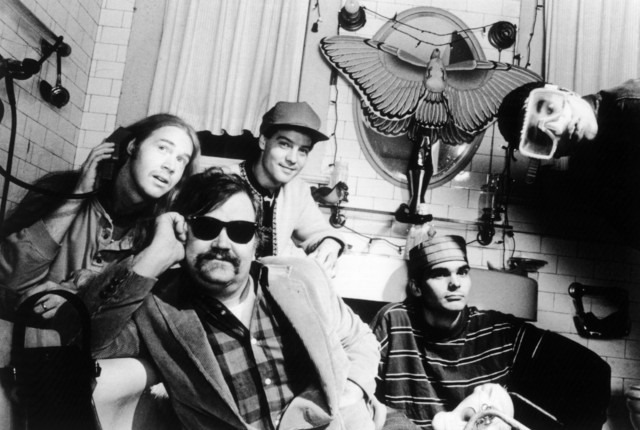
A jam band looking to tune their banjo in the hills and feast on milk and cream


Like the lengthy operas of Richard Wagner or the exploratory playing of jam bands, Bob Dylan has never been universally appreciated. There’s evidence from his earliest years as a performer that this was intentional on Dylan’s part: to accept the freedom to perform in ways that caused part of an audience to reject his approach. Doing this in order to endear himself to another audience that would be attracted by this difference, this freedom, and yes—to a degree—to the power of the exclusion of that other audience.

This is not an unusual artistic stance. The artist who claims that audiences of Philistines cannot understand their work—and who may also aim steadfastly to make that claim true—is common enough to have been a comic stereotype from classical times. But Dylan distinguishes himself from that not only by becoming hugely influential, changing and expanding how songs will be written in English in a matter of a few years, but also because he was willing to change the nature of what audience he was repelling and attracting regularly, almost as if he had an over-arching artistic goal to say that this repel/attract response to art was a thing that we should examine with skepticism.

So one moment you are supposed to love or hate him because he’s an earnest politically-engaged folkie rejecting pop music and hedonism; and then you are supposed to love or hate him because he’s a loud rock’n’roll hip cynic deep into drugs and pop culture; and then you are supposed to love or hate him because he’s a Nashville country-music-factory family man embracing simple truths—but wait, now he’s not only that, he’s what, a Christian!? And then he’s someone adrift, trying to make records every wrong way in an era when everyone is making bales of money making records. Then he unplugs and makes two fine acoustic guitar records in his garage with not one self-written song, which only a handful notice; and then he makes five records in the last two decades that are either embraced or rejected as he writes songs full of richly imperfect characters and anti-heroes defiant and defeated. And now he has the nerve to ask us to listen to him singing songs Frank Sinatra would have sung. And all these twists and turns leave out three wonderful records that don’t fit these scenarios: “Blood on the Tracks”, “Desire”,  and “The Basement Tapes”— any one of which could be the masterpiece of most other songwriters’ careers.

Despite all this change, and more than 50 years as a notable performer, there are those who consistently don’t like his singing, don’t think much of his musicianship, who feel that the historic influence of his writing is somehow an embarrassing overachievement. Some of those people are musicians as well, some of them are smart and perceptive people, some of them hold to the duality of Bill Nye’s great sentence, who feel that like Richard Wagner’s, “Dylan’s music is better than it sounds.” How many of these people are sincere, how many are more at envious? How many are just smarter than I am, with better or different musical taste? How many can’t absorb Bob Dylan for the same mysterious reasons some can’t digest milk or gluten? Some of each.

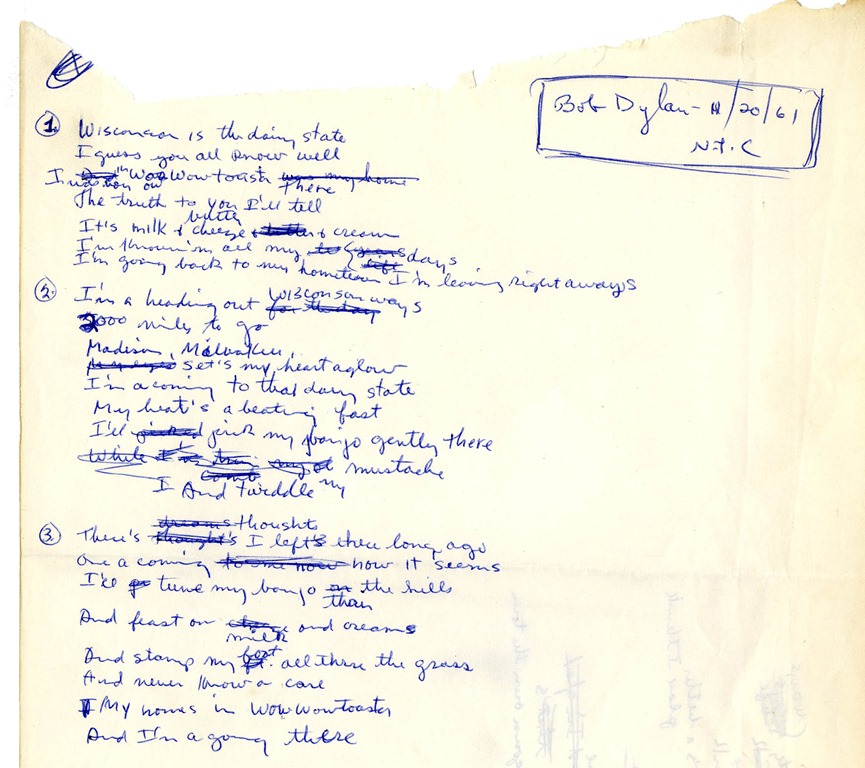
Now let’s take today’s Bob Dylan episode. “Wisconsin”  is a set of words, never used by Dylan, written when he was around 20. A handwritten manuscript was put up for auction last month with a minimum bid of $30,000, and I don’t think it made that minimum. Notices about the auction liked to poke fun at the unimportance and artlessness of the lyrics, particularly in the context of that songwriter getting a Nobel. Well, the Parlando Project is the place “Where Music and Words Meet,” and in this case the words are waiting for music and performance to animate them. On the scribbled page they are puppets without hands in them, so the LYL Band put their hands in.

dylan_wis_song

The Nobel is a long way off, but even the 20-year-old Dylan is revising what seems like off-the-cuff stuff

It turns out that the formula of nonsense and normality, commonplace and commotion, when animated with who-the-hell cares energy makes a fine rock’n’roll song. And you don’t need $30,000 to have that, you can get it here for nothing. Just click on the player below.

The Death of Col Bruce Hampton

It’s probably one of the best quotes in the history of music criticism: “I’ve heard that Wagner’s music is better than it sounds.” The man who said it was a 19th Century American humorist Bill Nye. No, not the Science Guy, the other Bill Nye.

Bill Nye SG greyscaleEdgarwbillnye

The Nye on the right summed up challenging music in a sentence.


Nye’s great one-liner points out that unfamiliar music may gather approval of those who appreciate its novel approach while leaving a puzzlement as to what pleasure may be derived from it. In the late 19th Century, Richard Wagner’s music was radical. It was heard by many as having stretched the harmonic bonds of symphonic music past enjoyable boundaries. Nowadays Wagner is more in danger of seeming preposterously old-fashioned. He’s just the thing to let you know that Elmer Fudd is a fuddy-duddy when he breaks out into re-purposed Wagner and sings “I Shooot a Waaabittt!” in cartoons. Wagner’s music hasn’t changed, but fashions, expectations and experience have changed.
 
Back around 1970 a band from Atlanta Georgia called “Hampton’s Grease Band” released their only album. The story is told that it sold the second fewest copies ever in the history of their record label, who dropped them right after its release. There are reasons for that. Most cuts were over 10 minutes long. The music was eclectic and the beats eccentric—but what really unsold the record to many audiences were the vocals and lyrics by Bruce Hampton, who rasped like a southern Captain Beefheart with an outlook that mixed Dixie and Dada in quantities you didn’t want to get near enough to the caldron to measure.

This stuff still sounds avant-garde, but Hampton kept evolving after this band’s failure. He self-applied the conventional southern honorific “Col.” to his name, but he always kept a big streak of weird in his music, and by the 90’s another musical movement he helped form made odd music with obscure lyrics and long improvised instrumental passages commercially viable. The usual label for the groups who played this music was “jam bands.”

I could write more about jam bands, but since I need to move on, I’ll say that they were an attempt to invent jazz as if jazz had never existed before. By this I don’t mean to say they were wholly ignorant of jazz or prejudiced against it; what I mean to say is that they created as if they were starting the idea of jazz all over, more or less from scratch. Just as the Pre-Raphaelite Brotherhood thought they could start medieval religious paining all over again or William Morris’ Art and Crafts movement sought to start an artisan practical crafts industry out of nothing, they didn’t seek to learn from and extend the existing practices so much as to do a complete reboot.

Bruce Hampton and band

Everything but the kitchen sink—ah, maybe we need to include that too.


Now we’re back in the hipster territory that I’ve been discussing in the last few posts. Depending on which generation and which sub-cultural alignment you have, jam bands can be an example of an ignorable genre of music that can only be endured for extra-musical reasons, or an organic expression of music that refuses to be contained and regimented by the formulas of other commercial music. It’s that double-edged nature of the hipster label people throw around as if a label was an analysis. Are they “hip” to something novel that has unconventional value, or are they bogus “-sters” consumed by useless difference for its own sake? And if you’ve read the other posts this month, you’ll realize I’m not just talking about one generation or one sub-culture here.

My guess is that’s it’s always some of both, and the exact proportions cannot be discovered while it’s happening.  Perhaps, like improvised music itself, it has to happen for sober judgements to be made later.

And how can one tell who’s the poser and who’s the sculptor of something new? Persistence is one test. Remember William Blake’s great proverb on persistence: “If a fool would persist in their folly, they would become wise?” Here’s Bruce Hampton on patience and persistence:

I’ve gotten everything I’ve ever wanted – 20 years after I wanted it. And that’s been perfect for me to not get things when I want them because I’m not ready for them when I want them.

Today’s audio post, “The Death of Col. Bruce Hampton”  presents an sincere account of the unusual death of Bruce Hampton earlier this month: on stage, performing at a tribute to his 50 years of making adventurous music, surrounded by scores of other musicians who learned from him. You may still find his music better than it sounds. He played and sang a lot notes over a lot of time. Some of them were right, and some of them were wrong for the right reasons.

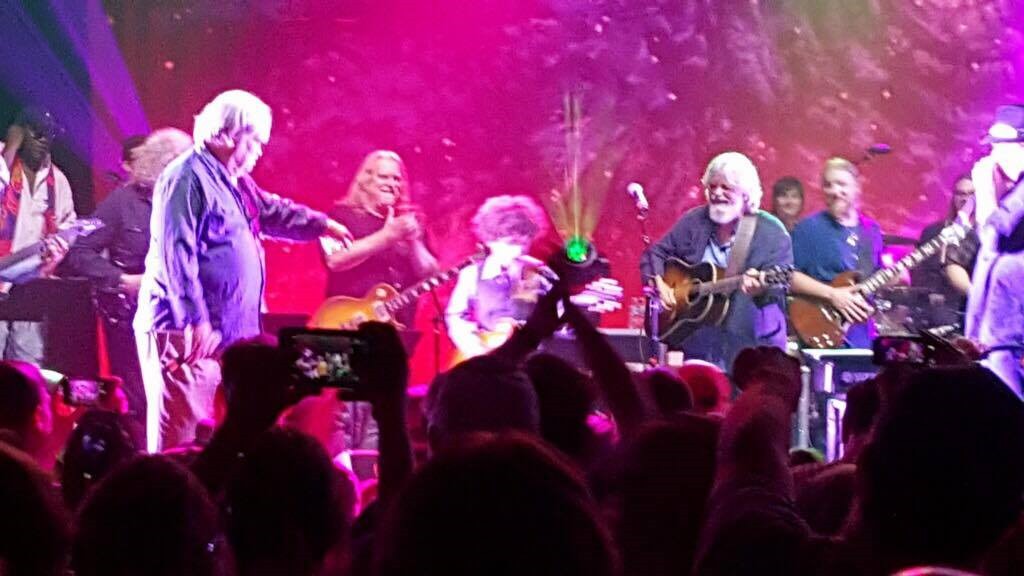
bruce-hampton last jam

Col. Bruce Hampton at his last concert says keep playing


To hear my audio piece “The Death of Col. Bruce Hampton”  use the player below.
Up-Hill

Last post I compared late 19th Century cultural hipsters with early 21st Century urban cultural revivalists.  Did modern natural-fiber clad, skin-inked and perforated young people study up on William Morris’ Arts & Crafts movement and visit museums to absorb the Pre-Raphaelites? Some perhaps, not all. And the same can be said for what is carried onward from punks, hip-hop kids, hippies, beatniks, and so on. I’m too old, and too little a sociologist to answer this definitively.

I can say that when I tried to discover what kind of music I wanted to make in the 1970s I copied imperfectly many musicians from the previous decades as well as my contemporaries working down the river in New York City. And those NYC contemporaries? They too were looking backward to move forward. What had been overlooked? What had gone out of fashion for no good reason? What had been uncompleted? So, in listening to them, I was listening to their understanding and misunderstandings of the past too.
 
One of our principles with the Parlando Project is “Other People’s Stories.” Part of the above is “my story”—but my musical story is really made up of other people’s stories.
 
Tracing the path of influence is often hard to do. Today’s piece Up-Hill  is an example. The words were written by Christina Rossetti, that sister of the Pre-Raphaelite Brotherhood. Obviously, she’s familiar with the Pre-Raphaelites and their circle—but she’s also deeply interested in a Christian religious revival, and that too gets reflected in “Up-Hill.”  Would she have known Anna Coghill’s poem that was set as the hymn Work for the Night is Coming?”  That’s unknown to me, but “Up-Hill”  and “Work for the Night is Coming”  are both poems understood in context as being Christian devotional, while containing not a single specific utterance about a deity, salvation, or an afterlife. With revivals, context changes things.

Christina Rossetti

Christina Rossetti thinking about an up-hill journey?


And here’s another way that influence is hard to trace: it becomes unconscious. As I was writing the music for “Up-Hill”  I was mostly interested in varying my customary harmonic cadences while keeping it to just two or three chords, a short number that often works best for performance with the LYL Band. And “Up-Hill”  is, after all, a work of beautiful simplicity, saying something profound without pretentious elaboration.  I settled on a simple I V IV I progression, and tried it with the band last month, but my vocal wasn’t working. Trying again this month, the unconscious struck.

VU - Shall I Meet Other Wayfarers At Night

“Shall I meet other Wayfarers at night?” The Velvet Underground  certainly think so.


I didn’t realize until I was working out the rhythm track that I was falling into a Velvet Underground groove, like the one they used in I’m Waiting for my Man,”  a tune that is also understood as devotional in context—though to drugs, not a deity. Both songs feature a journey to a destination (up-hill or up-town), both engage in conversation along the way. Was this subconscious choice a sly comment on Christina’s brother Dante Rossetti’s addictions? A comparison of recovery to salvation, or of addiction to salvation?  No, the groove was just working, and it helped me get a better vocal down. If I understood anything about what I was choosing while doing, it was that I was linking sub-cultures and following the near invisible web connecting Other People’s Stories.

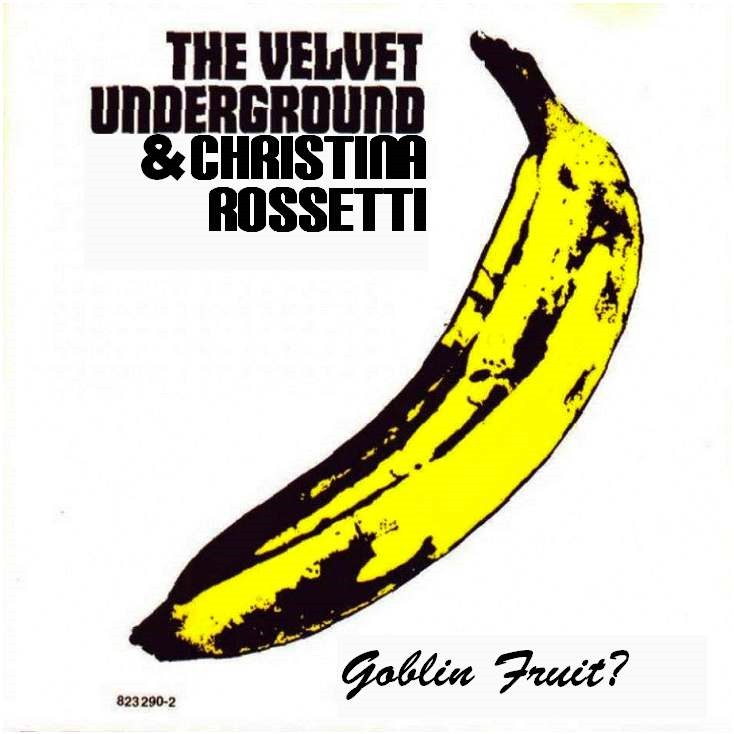
Velvet Underground and Christina Rossetti Cover

So what would that sound like? Use the player below to find out.


Same as always, the player should appear below.to hear the performance of “Up-Hill.”  And keep sharing the links, subscribing, and telling folks about the Parlando Project.

Love Is Enough

I drove to Des Moines Iowa this past weekend for a wedding of a niece. The reception was in a tap room attached to a small indie brewery. My 12-year-old son asked “Why is it in a brewery?”

I asked my son if he knew what a hipster was. “Yes, it’s someone who always needs to have the latest iPhone the day it is released.” My son likes to remind me that he is not  a millennial, and that he will have no truck with their ways.

I laughed and said that it’s more than that though. I tried my best to explain, doing badly, as I usually do when speaking. What I was aiming to say was that hipsters are interested in things that are different and off-beat, that in doing so they often revive things from the past and redo them in the now different context of the present. This kind of rebellion against the too-ordinary incumbent culture eventually changes the culture, remaking cities and what they offer. “When I was a kid and went to Des Moines, there were no small breweries serving their own beer, or restaurants that serve those Asian noodles like you like. Instead I’d get to go to Bishop’s Cafeteria.”

“What did you like about Bishop’s?” my wife asked.

“I liked that you could choose your own desert. Usually something with whipped cream on top.”

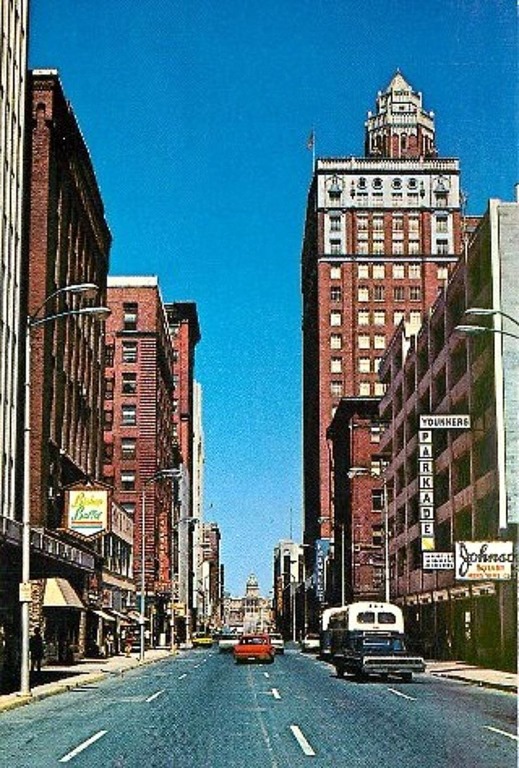
Des Moines Early 60s

News from Nowhere: Des Moines dreams of hipsters to come. Shop at Younkers, eat at Bishop’s.

Now that isn’t a complete explanation of what a hipster is either. Nor does it tell how hipsters are seen and labeled by others, or that to call someone a hipster generally has a negative connotation. If you want a hyper-precise definition with lots of reasons to be wary of being called a hipster you can read one here.

Every cultural change movement like this gets made fun of, and provides lots of rich examples of foolishness. And unlike frankly political change movements which often generate mutual veneration between generations, many cultural rebels see the next generation of young novelty seekers as a bad, devolved outcome; while the young often find and fix their cultural novelty in rejecting the enthusiasms of their immediate predecessors. Can anyone be sure that hipsters are any more or less authentic than punks, hippies, beatniks, or swing era hepcats and so on? I can’t. Is some rampant cultural appropriation going on? Yes, and that has its foolish and even harmful side-effects for all these cultural movements—but are their benefits as well? I believe there are, and anyway, rigidly contained cultural silos seem stifling.

This rejection of immediate predecessors, doesn’t mean an inevitable total rejection of the past. Small breweries were common in America a century ago. Beards, mustaches, fedoras—the clichéd markers of the male hipster, all are revivals of past fashions.

Remember with the Christina Rossetti poem last month. I mentioned her brother Dante Gabriel Rossetti’s boys club “The Pre-Raphaelite Brotherhood?” Formed by art students, they signed their paintings with a “PRB” as secret tag for their movement. They hated the classical art and design standards of their day, and even though they were living in the original Steam Punk era, instead of fetishizing brass, well-oiled gear trains, and leather, they propagated their love for Medieval art and hand-made crafts.

Dante Gabriel Rossetti - Ford Madox Brown 1867

Dante Gabriel Rossetti. Can he interest you in some beard oil?

Sound familiar? The Pre-Raphaelites seem to me to be late 19th Century versions of early 21st Century hipsters. If they were ironically enjoying Midwest beer in a can, would they have signed their paintings “PBR”?

Today’s audio piece is William Morris’ “Love Is Enough.”  Morris was intimately connected with the Pre-Raphaelites. Like them, he was fascinated with Medieval art and culture, but he was a man with many interests—many more than I can touch on this time—including writing influential fantasy and speculative fiction. In that vein, we’re going to time-travel the Englishman William Morris like we did with Americans Walt Whitman and Emily Dickinson, so that this 19th century poet can sing a nugget of garage band blues with the LYL Band.

Watts painting of William Morris

William Morris fading into the wallpaper. He did just about everything but start a brew pub.

This one is a good song for a wedding and for lovers. To hear “Love Is Enough”  use the player gadget below.

Soul Selector Blues

Sometime around the end of the 19th Century, a century that had seen accelerating change in technology and social order, new artistic movements began to flower on either side of the Atlantic. In the UK the Arts and Crafts movement and the Pre-Raphaelite Brotherhood looked backwards at things that had disappeared or were nearly gone, and revived them within a the new context of their present day. Interest in neglected folk-cultural traditions of nations began to arise. Others looked to new orders: utopianism and socialism. The seeds of what would be called Futurism began to take shape, a worship of the inherent art in technology.

Here’s a funny thing: all these things mashed-up in the ferment of the times. Some of the artists held to several or even all of these beliefs, participating in more than one of these seemingly different or even opposed movements. Call this brew “Modernism,” for the one thing that united it was a desire for something new, or at least new for the times, to be produced.

As the 20th Century got underway, American artists forged ahead in these movements. The reasons for that are multifold, but one is that they had a head start: Walt Whitman and Emily Dickinson and the Emersonian Transcendentalists had already pioneered distinctly American ways to be modern.

Let’s leave the salons and literary magazines now for a moment. Here’s something else that was happening at the same time, with only spotty distribution beyond its creators. Some African-Americans, presented with nominal freedom, economic serfdom, social repression, and what must honestly be called a sub-human classification by many learned men, continued to come to terms with European instruments and tempered scales, combining them with the already juicy stew of American music and the remembered modes of Africa. They produced their own Modernism, something that eventually got called “The Blues.”

Lyrically, this was an inherently skeptical art. As it percolated through commerce, the Blues got re-defined as a sad song of loss, and loss certainly is part of its subject matter, but the outlook of the original Blues writers was not simply that. A lot of it was satiric comment, and when the Blues dealt with the desire and farce of love and lust, as it often did, it wasn’t just about loss.

I could go on and on about the Blues, but for the moment, I’ll ask you to just absorb this: when William Butler Yeats was having a harp built to chant his poems to, as he believed the Celtic griots of old had done; and when Ezra Pound, Robert Frost, HD, Amy Lowell, William Carlos Williams, Gertrude Stein or T.S. Eliot were inventing their strain of Modernist poetry, often abroad, some other Americans were back in the States retuning guitars and looking for the notes between the keys of the piano with their own poetry that sought to “make it new.”

Emily Dickinson is a special case in so many ways, but one of those ways is that although she wrote much of work during the Civil War in the middle of the 19th Century, she was only published much later in the century. Her poems, so stripped down, so skeptical of received notions, so vivid in fresh images that didn’t map easily to conventional meaning, fit right in with work being written 50 years later by the Modernists.

Emily Dickinson Uncrowned Queen of the Blues 2

Warning: time travel plots often are ridiculous.


Today’s episode “Soul Selector Blues”  takes this time travel one step further. What if Emily Dickinson was a serf on the Dockery Plantation in Mississippi early in the 20th Century? Maybe she’d tune a guitar to “Spanish” and grab a slide to get those in-between notes, and then what would have been “The Soul Selects Her Own Society”  would come out like this.

To hear the LYL Band cover “Delta Amherst” Emily D’s classic 78 r.p.m. side “Soul Selector Blues” use the player below.


Spring Grass

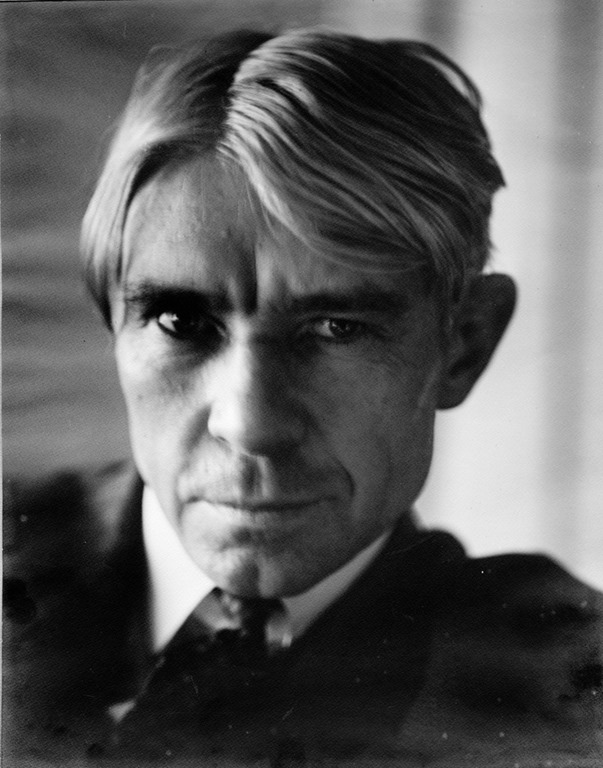
Did I just say it’s been awhile since I featured a piece with words by Carl Sandburg? I started this Sandburg piece early this month thinking it would appropriate for the onset of spring and National Poetry Month. It fairly short order, I came up with the general chord progression I wanted to use, one which is somewhat ambiguous as to key-center (D, A,  F# minor, E, with the cadence generally descending from D, but resolving either the A, the E, or the F# minor, and with a single B minor thrown in).

I liked this musically when I laid down the initial acoustic guitar track of the chords; but I intended to add additional parts to fill out the arrangement, and when I started that, I found I had given myself more of a challenge than I had anticipated. A better orchestrator than myself would have had less trouble I suspect, but I finally came up with something I felt I could accept yesterday.

Carl Sandburg Rocks Out

Carl Sandburg rocks out, no fancy arrangement needed.


If you search for other Carl Sandburg pieces that have been part of the Parlando project, you can see how fond I am of Sandburg as a writer of short poems. For someone who writes generally in free verse, Sandburg’s work has been set to music more often that one might expect. As I worked on “Spring Grass”  I assumed someone else had taken a crack at it, but I put off looking at that to concentrate on my own musical problems. This morning I did some searching and found that there are at least two other settings besides mine, one done by the young Phillip Glass, a composer I very much admire.

Phillip Glass Spring Grass

This guy probably had less trouble with his orchestration.

 
I find one word Sandburg used here intriguing: “spiffed,” which is obscure enough in his poem that I’m not sure what it means. At first I thought it was a nice onomatopoeic sound for the wind horse in the poem snorting gently near the poet’s face—and perhaps it is—but if I read Sandburg’s sentence right, it’s the spring grass smell riding on the wind that “spiffed” the author. Does he mean “spiffed up,” the only idiom I know that uses that word? I’ve never heard “spiffed” without the “up” myself.

Well, the word-mystery doesn’t stop the poem, there’s enough mystery in Spring itself.  Enjoy the rest of #npm17 and keep telling folks about the Parlando Project and our combining of various music and various words in various ways. To hear my version of “Spring Grass” use the player that appears at the end.

What Is It the Rain Dissolves

Writers often like to compose their written works in their heads while walking, and poets, all the more so. It seems natural—the walking footsteps and the metrical foot compare apace.
 
I too have done this; and with poetry in particular, composing lines while away from any paper or screen may also help winnow out the more memorable flow from forgettable stumbles. But my old joints now rebel more at morning walks, and my later day is filled with daily work on the Parlando Project and the mundane tasks of living.
 
My solution to this is that great 19th Century invention: the bicycle. In wheeled weightlessness, I am able to roll along through nature and the city morning’s opening scenes: the gloved gardeners, the obedient dog owners, the students at their stops, the hopeful sidewalk joggers, the babies held crooked in the left arm as the right sweeps the straps from the child car seat. I do this in all weather, rain and snow included, not wanting to miss one act of the theater of the seasons.

Novara Safari Smaller

Can you fit #npm17 and #30daysofbiking into one post? Sure.

 
It’s April, the National Poetry Month in this country, and I ride in the experience of that Chinese birdsong that Du Fu and Meng Haoran heard once and I hear now, and I know that the birds need no translation.  One Sunday dawn, as rain threatened, the sun shined through the clouds as if they were translucent filters. The steeples of the churches and peaks of houses, illuminated thus, were indeed rose and violet as Emily Dickinson promised to tell us.

April isn’t just #npm17, it’s also serving up #30daysofbiking, and with the two in the same month I’ve said, “Emily Dickinson should have gotten a bicycle!” She could have maintained her thoughts’ enclosure, pedaled surely between the skeptics and the believers, and served her self-reliance within a somewhat broader world. Alas, she was just a bit too early for the modern bicycle—but it was close. Her mid-life “preceptor” Thomas Wentworth Higginson was a proponent of the bicycle and of women bicycling. Higginson, speaking about one of the early long-distance cyclists said:

“We found that modern mechanical invention, instead of disenchanting the universe, had really afforded the means of exploring its marvels the more surely. Instead of going round the world with a rifle, for the purpose of killing something – or with a bundle of tracts, in order to convert somebody – this bold youth simply went round the globe to see the people who were on it.”

Higginson, although speaking about my chosen ride, the acoustic motorcycle, seemed to be foreshadowing Robert Pirsig there.

19th Century lady and bike

A soul selects her own velocipede


Once more, a long preface to a short piece today. When I started the Parlando Project I thought I’d avoid that. Is another reason that April is National Poetry Month from the nursery rhyme “April showers/Bring May flowers?” Today’s piece “What Is It the Rain Dissolves”  was written on a bicycle on a morning ride in a light rain. I passed two kids trying to master skateboards and later a woman coming the other way on her bicycle, arms bare except for some elaborate tattoos.
 
Emily, is that you?

To hear the LYL Band perform the song “What Is It the Rain Dissolves”  use the player below.

To A Friend Whose Work Has Come To Nothing

Given that poetry contributes the great majority of the words to the half of the  Parlando Project “Where Music and Words Meet,” it’s reasonable to suspect, if you are reading this, that you like poetry. That’s too bad. Even during the National Poetry Month and #npm17 that were are talking about this April.

You see, poetry is often a frustrating thing. That high-flown language may be artful, but it’s an earful too. If you were seeking directions to escape some emergency, would you want your rescuer to choose the most precise and beautiful words, words that say more about what a clever speaker your rescuer is than about which way you must turn and where the dangers are?

Do you love the dense allusions and surprising metaphors of poetry? Do you admire the narrative fracturing and careful examination of the shattered facets that expose the common lie of ordered stories? The next time you are searching for how to work some complex gadget or system, do you want your tutorial or manual to scatter its tale in novel ways?

Speaking of too simple statements, here’s one: that there are people who simply like poetry. No, most people who like poetry sometimes, hate poetry sometimes; just as most people who like music, hate music sometimes. The intensity of the like times does not decrease the intensity of the hate times. I think it’s important that poetry tries to capture the allusiveness of things. I continue to admire some poems I don’t really understand—that’s what the music is for, both the poem’s own music and the external music we apply to the words here at the Parlando Project. But there are times when you just want a poet to come out and say what they’re getting at.

The words to today’s episode, by William Butler Yeats, are clear in their meaning. “To A Friend Whose Work Has Come To Nothing”  is an example of “occasional verse,” a poem written in response to an event. In this case, almost everyone has forgotten the event, but the sentiments of the poem apply broadly anyway. Yeats has such a musical way of expressing himself, he could have flown off on some obscure path and we might have followed him anyway. As it turns out, the things he leaves out here, the particulars of the dispute, probably help the poem survive as a general piece of council.

Still, I’m a curious and literal sort. Who was the “Friend Whose Work Has Come To Nothing,” and what was the work? It was written about and perhaps to a man named Hugh Lane who wanted to donate his substantial modern art collection to a museum he proposed that Ireland should fund. And the man who would lie unashamed to oppose this? A newspaper publisher who opposed the gallery.

Hugh Lane

Yeats gave him good advice, but he didn’t tell him to not get on that boat.

What happened to Hugh Lane, whose work had come to nothing? About a year after Yeats wrote this poem, Lane went down when the Lusitania  was torpedoed during WWI. And his art collection? His will seemed to leave it to the British National Gallery after his proposal to fund the Irish museum failed, but Ireland disputed this will, and later in the 20th Century, after Lane’s and Yeats’ deaths, Lane’s collection was again on display in Dublin Ireland. So eventually, in prosaic history and after the work of some lean solicitors, Lane’s work succeeded.

Dublin City Gallery

The Dublin City Gallery where most of Hugh Lane’s collection ended up

Today’s audio piece is brief, so take a listen to the LYL Band performing “To A Friend Whose Work Has Come To Nothing” by clicking on the player below or with this highlighted hyperlink.

.

Mr Nelson

It often takes a while to know who has died.

When Prince died a year ago, the shock-wave for fans was breath-taking, the air went out of the room, and for each of them there was something that went missing when they got the word: the promise of new music, a memory of concert or a night of dancing, a period of their youth now seemingly past all reliving, and probably a dozen or more other private things.

If it seemed impossible that Prince had died, it was because it was impossible that he had lived. About him it could be said that he could dance like James Brown, sing like Marvin Gaye, play guitar like Jimi Hendrix, write a song like Curtis Mayfield—and arrange it all, and play it all, and record it all for himself or other artists. He was the most astonishingly broad musical artist of our time.

And he did this over and over, for decades, to the point that no one could ever really keep up with all he did. I suspect the longer time we now have will allow us to discover, in his work, things that are still overlooked, ideas that he had that somehow weren’t understood, things we skipped over because we thought Prince should be doing something else.

Tonight, as I write this, I’m struck by one other thing: has there been enough recognition that Prince was in the vanguard of bringing women instrumentalists into the context of the rock band? Let’s propose a rock band gender integration variation of the Bechdel Test: name a successful band with two prominent women instrumentalists before The Revolution that wasn’t a “all-girl band.1” Every example that comes to mind (and it’s not like there are hundreds of them) stops the count of women players at one. I can think of only two 2, and neither achieved a modicum of the cultural prominence of Prince’s band.

Prince and the Revolution

It’s a little known fact that Prince was about two feet taller than the rest of the Revolution.


And he did it again performing with his late career power trio, 3rdEyeGirl.

That’s just a part of his career of course—but please, this isn’t some kind of rote identity politics thing, or merely a piece of trivia like “Name a band with two left-handed Canadians?”. This is half the human race!

With the Parlando Project I get to audaciously tackle the work of a lot of great writers. I use their words unashamedly and try to find something I can relate to you about their work. For some reason, perhaps because Prince Rogers Nelson embarrasses me as musician, I’ve been hesitant to post this episode, and to share this modest musical piece The LYL Band wrote and performed about his leaving.

But I’m going to do it anyway. The best parts of this piece “Mr. Nelson”  are the work of Dave Moore: most of the words and the electronic piano part. Footnotes at the end of this post for the obsessives. The audio player for “Mr. Nelson” is right below this. You can dance if you want to.


County Joe MacDonald and his All Star BandJoy of Cooking

Guy in the middle isn’t Prince.                  Joy of Cooking, pioneers.

 
1 I exclude the “all-girl band” not to denigrate the talents of those who performed in them, or because a band somehow needs men to be valid, but because however intended, the result in the 20th Century cultural context was seen largely for its novelty value.

2 The two bands I can think of: Joy of Cooking and the Country Joe MacDonald led “Paris Sessions” era All-Star Band.

Intro to The Waste Land

Readers of these posts may recall a discussion of the theory that Emily Dickinson’s reclusive nature in later adulthood was caused by epilepsy and that her poem “I Felt a Funeral In My Brain”  may have been describing the auras experienced around epileptic seizure events.  I think it’s an interesting idea, a plausible one, but I also warned against reductionist explanations for art.

Even recognizing that danger, I’m about to risk that sort of thing again, for what I think are good reasons.

Is T.S. Eliot’s “The Waste Land” introduced to students later and less often now than it was in my youth? If so, I suspect this is because “The Waste Land”  does not present itself as a friendly introduction to poetry. It seems proudly obscure. There’s no frank self-expression in it where a recognizable author/speaker tells us about their life and outlook. Instead, there’s a flurry of voices and characters that are barely, if even that, introduced.  And there’s no interesting story, no fable or tale with a twist that carries us along. There’s a shortage of obvious similes, no “fog comes on little cat’s feet” to introduce metaphor.

In my youth, all these shortcomings of “The Waste Land”  as a teaching tool were overlooked because it was a landmark in the rise of Modernism, that defining artistic movement of the first half of the 20th Century, and because it was full of the stuff that made up a Liberal Education: foreign phrases, cosmopolitan settings, wide-ranging cultural references to other literary works from across time.

Waste Land title page

I always find that a little Latin and Greek on the title page helps perk up the reader.

And now? The odds are that if T.S. Eliot was to stand up at a Moth story-telling stage or a slam poetry event and deliver “The Waste Land”  in whole or in part, that boos, snores, or some variety of non-pleasurable puzzlement would result. We are inured to a different kind of poetry, confused enough, bothered enough, by modernity and its incessant messages that Eliot’s fragments shored up against ruins seems to offer us no balm, no pleasure of recognition.

I’ll offer two keys, two aspects of “The Waste Land”  that can allow you entry into it. The first is: it’s intensely musical. The imagery, outside of “The Waste Land’s” overriding dry vs. wet scheme, never strays far from sounds, and all those unintroduced voices are like new strains in a composition. No wonder the Parlando project is drawn to it, because we believe that one can appreciate poetry without understanding its meaning, in the same way that you can appreciate music without being able to somehow explicate it.

The second entry point, the one that risks being reductionist, is that this is a poem written by someone suffering from depression. Whatever voice is speaking in the poem, it is heard and reflected out the mouth of someone who feels it has all gone wrong, someone who cannot fully trust any other feeling other than that—other than the emotion of fear that that is the reality that any other feeling would mask. Although it must sacrifice the music, the incandescent reading of the “The Waste Land”  by Fiona Shaw illuminates this aspect.

Today’s episode is just a part of the first part of “The Waste Land,”  but it’s the part the begins in April, our National Poetry Month. I don’t know if Eliot intended to refer to Chaucer’s “Canterbury Tales” prologue (our last episode), but it sure seems to rhyme. The opening of Eliot’s series of tales has, like Chaucer’s prologue, rain, flowers, journeys and travelers; and later in the poem Eliot will in bring birdsongs and churches. And Chaucer, who begins singing in Spring merriment, introduces at the end of the prologue the promise of “Strange strands,” and tells us that the pilgrims may be taking the pilgrimage because they have been sick.

Fiona Shaw’s il miglior fabbro performance of the whole “The Waste Land” will take almost a half-hour to view. My audio piece for today will take less than 3 minutes and has music. To compare to the “Prologue to the Canterbury Tales”  check out the previous post here. If you want to hear Nobel Prize winner Bob Dylan taking a run at the same part of “The Waste Land”  as I performed—and making his own connection to Walt Whitman’s “When Lilacs Last In the Dooryard Bloomed”  in Eliot’s opening lines, you can hear that here. But give mine a try first, using the player gadget that appears at the end of this post. Thanks for the likes and shares over the past few months, and as part of April’s #npm17, feel free to link to this blog or share this post on social media.