Prologue to the Canterbury Tales

One way to get experience is to seek it through the directed travel of a pilgrimage. Many religious traditions include the idea of a such journeys, and one side-effect of a shared destination is the mingling of travelers from diverse setting-off points along the trail.

In the Middle Ages, in England, one pilgrimage had the greatest potential to bring a diverse group together, the pilgrimage to the Cathedral of Canterbury where the sainted Thomas Becket had been assassinated. A series of stories ostensibly told by various tellers together for this trip became the great early work of English literature: Geoffrey Chaucer’s “The Canterbury Tales.”

April is National Poetry Month in the US, and though this celebration’s founders give no exact reason for April being chosen, two widely known poems explicitly start in April, and whether it’s cause or effect, I think of these poems when I think of April and National Poetry Month. The oldest of these, is today’s post “The Prologue to the Canterbury Tales”  which begins:

“Whan that aprill with his shoures soote
The droghte of march hath perced to the roote”

Now I know I’ve let slip too many typos in these notes before today, but that’s not a particularly bad day at the keyboard—instead, it’s Chaucer’s version of English as spoken in the 15th Century. It’s a challenge to read this in the original pronunciation, though I once was delighted when a skilled classical music DJ mic checked at 5:45 AM one morning with a perfect rendition of this Prologue in Middle English. I’m not going to attempt the same; today’s episode uses a modern English version for clarity, and in consideration of my thicker tongue.

Musically I’m not in the Middle Ages or in Canterbury for this piece either. I’m going to use the 12-string guitar once more. There is no shrine here in the Twin Cities of Minnesota, but for some reason three of best players of this troublesome priest of an instrument came to prominence here: “Spider John” Koerner, Leo Kottke, and Steve Tibbetts. For this episode, the 12 String’s musical tale is told in the character of Steve Tibbetts—or rather a modest imitation on my part using Tibbetts’ distinct stringing of the 12 string, which uses octave strings only on the two lowest courses of the 12 string with unison string pairs on the rest.

Cortez 12 string Tibbetts Stringing Closeup

More thick strings, fewer skinny ones, setting up a 12-string Tibbetts-style

.

To hear the 12 string strung that way, and to hear about the English April in Chaucer’s report, use the player that appears below. Don’t see the player? Well, this highlighted hyperlink will also play it.


.

Experience

Here’s another piece by Dave Moore. Dave plays almost all of the keyboards on the LYL Band music you hear here on this blog, and without his contributions I’d get tired of hearing my own voice all the time myself. Today’s audio piece “Experience”  started out intended as a poem, as Dave explains:

“My friend Ethna mentioned the Common Good Books poetry contest, which paid cash, on the theme of experience.

Naturally the next word in my mind was prurience, which in this version I ‘eschew.’ although I changed the printed version to ‘avoid.’  Still, I love the roll of ‘eschew prurience.’

I set out to state that every moment is an experience, and most of them are accidents, which constitutes the glory of the show.  But – But seriously…
When I brought this lyric to a LYL session, I draped it around a tune, trying to see how the words spilled over the dam.  Thus edified, I tinkered with it some before submitting to Common Good.

Of course, I lifted ‘life is but a joke’ from Dylan’s ‘All Along the Watchtower,’  but it worked so well in the stanza (is it a chorus?) of philosophy. I chose to leave the ‘do’ and ‘done’ lines as ironic music which states the case.

So, am I experienced?  Conclusively, I can say yes or no.”

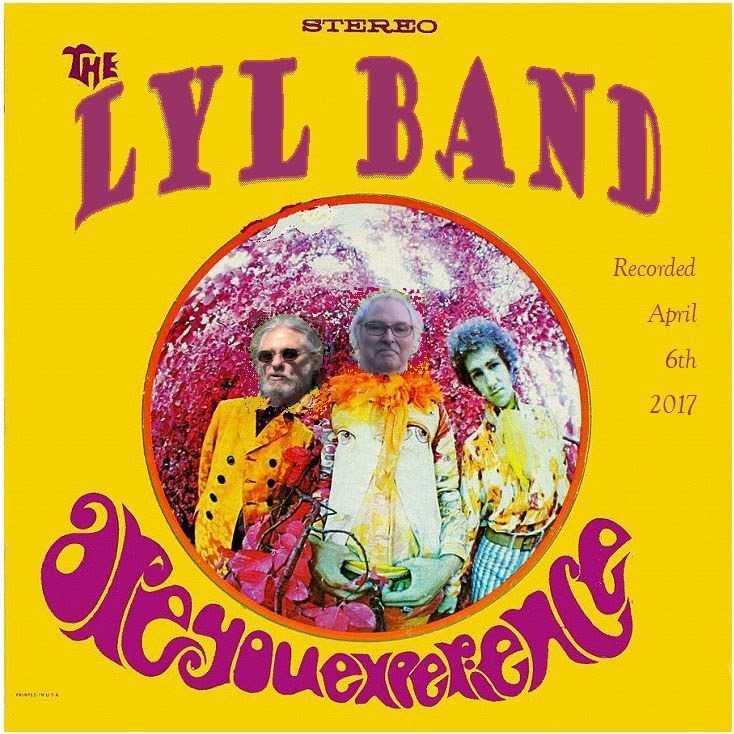
LYL Are You Experience Faces

“For those of another generation, he’s all but to make fun of,
but they do not understand the experience…”  Eric Burdon

Experience is an interesting topic for this book store’s contest. William Blake titled one of his collections of short lyrics “Songs of Experience,”  after which I cannot think of the word without thinking of Blake—but Blake also put much store in the auguries of innocence. Ralph Waldo Emerson toured the country as a speaker, but his contemporary Emily Dickinson famously constricted her travels as she grew up. Emerson’s mind worked best traveling widely, as in his essays. Dickinson mind produced compressed words pinned in a matrix of her famous dashes, and it’s Dickinson’s poetry that we are more likely to turn to today.  “Like a dream, experience is being where you are” Dave says.

Vinyl lovers, don’t be mislead by the cover shown above, The LYL Band’s version of Dave’s “Experience”  doesn’t feature Stratocasters on fire, which is not say that we won’t do that later. Use the player below to listen to “Experience,”  or some innocent instrument might get hurt.

The Lake Street Testament

The most popular TV show of my youth was a strange yet derivative series called “The Beverly Hillbillies.”  The basic device of this comedy was as old as Shakespeare’s rude mechanicals, and as common as 19th and 20th Century perennials like hillbilly plays, Ma and Pa Kettle films and even minstrel shows.

Beverly Hillbillies Confederates

Both of these statements are true:
A. The Beverly Hillbillies support your 2nd Amendment rights
B. They are portrayed as fools who constantly misunderstand the modern urban world


They all work the same way, and the joke never seems to grow old: rural folks are stupid, prone to exaggerating for comic effect all errors in human logic. They are above all inexperienced, leading to all kinds of misunderstandings; and they are peculiar in their language: misuse of words or odd pronunciations are rife. Abstractly, this is the ore of comedy gold, but culturally these traits are being applied to an “other,” a group that can safely be made fools of to demonstrate the audience’s superior understanding.

One trap of that kind of comedy: the dumber the writer thinks the audience is, the dumber the writer believes he must make the characters, until they lack all worth, delight and surprise. While one could worry about such authors violating political correctness, the worse danger to the authors’ career is for the audience to figure out that they are being played for rubes through a play about fools.

I was young when “The Beverly Hillbillies”  was going strong, and living in a very small town in a rural state, but I found this show funny. I never occurred to me that my own inexperience might be blinding me to the idea that I could be part of this bumpkin class, at least in some people’s eyes. My little town was progressive, proud of its school, and besides I didn’t think like those silly folks, I knew full well that richer folks’ houses could have a swimming pool in the back yard and that they were called just that, not See-Meant Ponds.

But my youth and my small town were  a course of inexperience. I was forever mispronouncing words and authors’ names because I had never heard them spoken—I had only seen them written on the page. I was, and yet wasn’t, those stock comic characters.
 
Is there any value in small towns? I believe there is. I’ll give you one example before I move on: in small towns there is no surplus of conscripts, everyone needs to do their part. Slacking doesn’t mean someone else does it, it means it doesn’t get done, and there’s no escaping that knowledge. I’m afraid that in my old age and life in a big city, I’ve become just such a slacker.

And there’s one other value to such a youth: going from a smaller, less varied place to a larger and more diverse one gives an eye a very sharp lens to look at things. I’m not sure movement the other way works as well. If one looks in the big end of the telescope, everything you point the small end at looks tiny and indistinct. It’s no accident that a very large group of writers follows that biographic path from town to city.
 
All this leads to today’s piece, “The Lake Street Testament,”  which is an urban story through and through.
 
The path of a long build up like this to a short ending is another comic staple: the Shaggy Dog Story. Earlier here you’ve seen me write about the essentially comic dimensions of the human condition, particularly when talking about Leonard Cohen, Mose Allison, and Phil Dacey. This piece takes that thought into this religious season and puts it on Lake Street, which is a main commercial east/west street through the center of Minneapolis, as urban a road as exists anywhere.

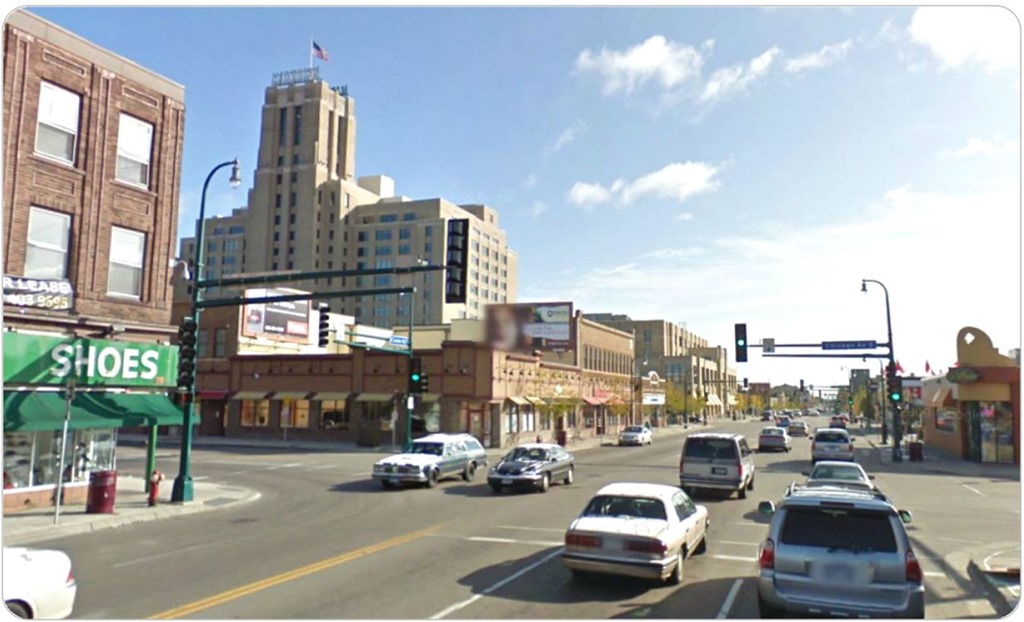
Lake Street

Lake Street in Minneapolis Minnesota. No palm trees, no movie stars.


The audio player below will let you hear the story of “The Lake Street Testament.”

Theater of the Seasons

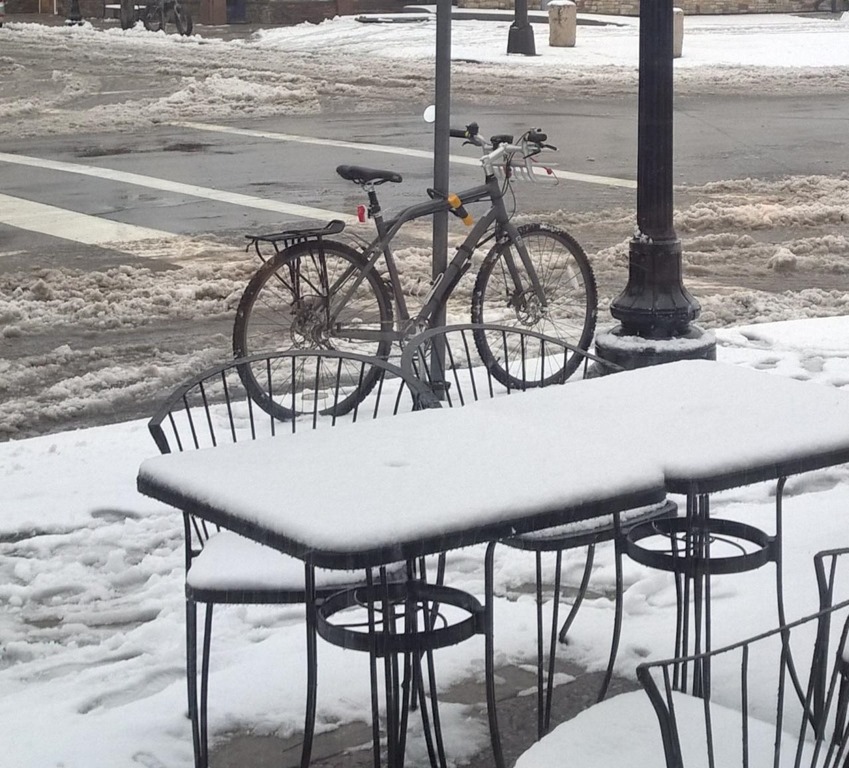
Monday night here in Minnesota it snowed. As I took my pre-teen son to school in the morning, he looked at the inch of fresh snow on the spring ground and said “Mother Nature is drunk. Shut her down!”

I rode my winter bike to breakfast that morning, and the trees overhanging the street were shedding overnight ice chunks that their budding branches were rejecting in the morning. As this shrugging hail fell on my ski helmet, it bounced off with a “ping!” like marbles or ping pong balls, and popped onto the icy street like broken ornaments.  A few hours later, in the late afternoon, I rode again to the grocery store in considerable sunlight. The streets were dry and I was in shorts and a T shirt.

studded tires and slush on the patio tables

Plenty of patio seating available for Tuesday breakfast


Minnesotans have a well-worn phrase for our edition of the book of nature. It’s not a hand-bound collection of poems like our New Englander Emily Dickinson’s, but a play script. “The Theater of the Seasons” we call it. Famously, we try to hide emotions here, but we sure do enjoy a little drama with our weather forecasts, keeping an eye peeled for news of storms that can kill or injure you. Sitting in the upper Midwest we can receive weather sweeping up from the Gulf of Mexico or dropping down from the Northwest Territories. So, particularly in Spring and Fall, the Theater of the Seasons plays in repertory here in Minnesota.

Today’s audio piece is short, less than 2 minutes long, and it’s called“Theater of the Seasons,”  expanding on that phrase a bit. I think you’ll enjoy it. The player gadget appears at the end of the post, as usual.

As part of this blog’s participation in National Poetry Month, we’re trying to provide even more audio pieces like this that you can stream. If you know someone who might enjoy words combined with music like this, why not take this month to let them know about us and our Parlando Project, or share this or another favorite on your own blog or chosen social media site.

Triad

I find it a wonderful “Parlando – Where Music and Words Meet” coincidence that one of Christina Rossetti’s sonnets and one of David Crosby’s songs share a title, “Triad.”

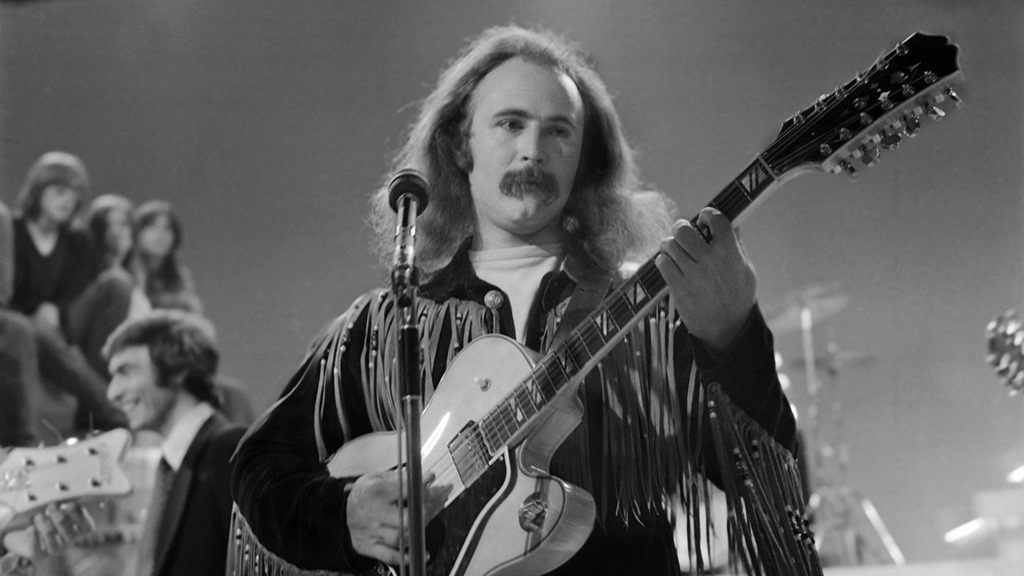
David Crosby is a musician and songwriter who first came to prominence in The Byrds and then as part of another triad, Crosby Stills and Nash. When I first came upon his songwriting many years ago, I was attracted to his distinctive abstract melodic and harmonic sense. Almost no one before, and few since, wrote music for songs that sound like his did then, with the exception of some Joni Mitchell tunes. Lyrically Crosby styled himself as unconventional as well. His “Triad”  is a blissful ode to free love—well at least free love as long as David Crosby is the one explaining how things will be.

David Crosby

David Crosby’s song starts by asking “You want to know how it will be?” and then he mansplains it


Christina Rossetti was a pioneering British 19th century female poet. Her biographical triad was that she had two brothers William Mitchell Rossetti and Dante Gabriel Rossetti, also writers, who went on to form the Pre-Raphaelite Brotherhood. Hmmm, “Brotherhood”—I wonder if girls get to join? Not officially, though she was used a model in some of their paintings.

Girlhood of Mary

Her brother Dante used Cristina Rossetti as the model for the Virgin Mary, far right.


Christina Rossetti’s “Triad”  is a not-so-happy look at romantic love, and the writer is none-so-sure how it should be either. Rossetti draws her portrait of three women who once sang together. One the stereotypical harlot, one the blue spinster, one the smooth compliant wife. Each of them finds the dead end of the limited paths available for passionate women. Conventionality decrees the hot harlot is shamed and the cold virgin dies for love, but Rossetti steps outside conventionality to tell us that the “temperate” spouse grew gross in her compromise until left with the devastating line droning “in sweetness like a fattened bee.” How much has changed since Rossetti’s Victorian England in this regard? Some things, not all things. New Rules are still rules, look at who makes them.

Musically here with our “Triad”,  the LYL Band somewhat refer to the psychedelic vibe of Crosby’s musical style to accompany Rossetti’s sad and lovely words. To hear it, use the player that appears below.

Biking on the Greenway with My Son and Bob Stinson

Minnesota goes wild in spring when it finally gets warm, and so today, which promises to touch 70 degrees, will surely display this. Like the day described in today’s episode, I’ll probably go for a bike ride with my young son, and we’ll ride on The Greenway, a several-mile-long reclaimed railroad cut that runs, as time does, east and west through the middle of Minneapolis.

Raising a child as a musician, writer, and sometime bohemian brings extra questions. Do you want your child to follow the most conventional and unquestioning path? Certainly not. You encourage them to question things, even allowing that this will encourage them to question you. You look at your own life backwards as you look at theirs coming forward, and wish them adventures, but only so much. You know there will be hardships and wrong choices, but you hope only enough to be instructive. As an artist you may worship art, but you’re not sure you’re comfortable with them adopting all the tenants of that religion.

Today’s piece “Biking on the Greenway with My Son and Bob Stinson”  speaks of this from the seat of a bicycle.

Bob Stinson was the animating force in The Replacements, an ‘80s alt-rock band that never tried to split the difference between insouciance and not giving a @#*&. As a guitarist he was an anarchist, and the band accidentally worked like the NY Dolls, the Kinks, or the Rolling Stones, with a great front man who had the lyrical wit and the staggering lead guitarist who embodied the music’s soul.

replacements on the greenway

The Replacements sit and wait for The Greenway bike path to come through. Bob Stinson, middle left.
The guy on the left is an artist. The guy on the right played in Guns and Roses. The guy on the middle right, writes songs.

The Replacements’ front man, Paul Westerberg, was quickly indicted as a fine rock’n’roll songwriter, which damaged the band because songwriting implies loitering with intent to commit James Taylor. The band rebelled by making sure that a regimented presentation of a set of songs was not the aim. On any given night, this could be inspiring or a shambles: Dada or do-do. Being blotto on stage to the point you couldn’t hide it was almost a requirement, and for no member of the Replacements more than for Bob Stinson.

Eventually the dichotomy demanded an ostomy, and Bob Stinson was asked to leave the band he founded. Things did not go well for Bob without his artistic outlet, and chemical dependency played out its run until he died, his body worn out at 35.

Self-destruction aside, you can see that as path of purity. Chasing after success and an ego-driven desire to rise above others can harm too. The addict and the monk believe they have two different gods, but the penitents have the same scourge. Negation and creativity; deny this, so that that can emerge, is part of the religion of art.

Music, Minneapolis, and life are different now 30 years later, and that’s the place my child and I now live in. Somewhere 30 years on from today will be the place they will live in, no longer young, if they survive rebellion and conformity, if they find the balance between the worship of the self and self-destruction.

This is National Poetry Month, so in the spirit of the Replacements, this is a post more about music, and the music in “Biking on the Greenway with My Son and Bob Stinson”  is not all that polished, tossed off by the LYL Band in one take. Still, you might enjoy clicking on the player below and listening to it. If you don’t see a player, this highlighted link will open a new tab with its own audio player.

Song of the Wondering Aengus

William Butler Yeats, when he spoke admiringly about the ubiquity that songwriters like Rabindranath Tagore could achieve, had already made his forays into setting his poems to music. As a sometime playwright, and a founder of the Abbey Theater in Ireland, he was already familiar with the dimensions performers can bring to words. Around the turn to the 20th Century he began to forthrightly seek to combine his poetry with music. Working in collaboration with musicologist and luthier Arnold Dolmetsch and performer Florence Farr he had a psaltery (a stringed instrument like a lyre or small harp) constructed, and Farr (a fascinating figure in her own right) then performed Yeats poems with it.

FarrPsaltry

Farr with the psaltery showing Joanna Newsom how to rock it

Yeats and Farr’s performance style was not a conventional art song setting of the poet’s words sung to a melody. Yeats explicitly rejected that (even though his words have often been set to melodies in the years since). Rather he thought the words were best chanted or intoned in a rhythmic and somewhat elongated speech.  Such performances are controversial then, and I would suppose they would be controversial now as well. George Bernard Shaw called Farr’s chanting “A nerve-destroying crooning,” but Ezra Pound and other early 20th century modernists took note, and they were influenced by these performances to add a more incantatory and musical element to their poetry.

Now let us break in our story for about half a century.

In the late 1950s an actor and folk singer Burl Ives recorded an album of Irish songs, and one of them was “The Wondering of Old Angus”, a Yeats poem sung to melody that Ives claimed he learned from Sara Allgood, another actor who had performed with the Abbey Theater group and would have likely known of the Farr performances. Around the same time, another folk singer, Will Holt began singing the Yeats poem to a very similar melody, using Yeats’ title “The Song of the Wandering Aengus.”  Then in 1962, Judy Collins, having learned the song from Holt, made it the title song of her album “Golden Apples of the Sun,”  which is where I first heard it.

No one seemed to know where the tune Ives, Holt, and Collins used came from. Those knowledgeable in traditional Irish tunes do not recognize it. Some credited Holt for it. However, early in the 21st Century a man named Bill Kennedy writing in the folk-song forum mudcat.org linked the tune to a transcription made by Dolmetsch accompanying a Yeats essay “Speaking to the Psaltery”  re-published in the Saturday Evening Post in 1907. The tune there of course was not meant to be sung, as Yeats discussed in this essay, but it is recognizably the one used by Ives, Holt, and Collins in their singing renditions.

So the tune may well be Yeats’ own, or perhaps it was composed by Farr or even Dolmetsch. Since the words are Yeats’, I’m going to call it, and make him the composer; and if so, that makes Yeats yet another singer-songwriter (along with Tagore and Dylan) to have won the Nobel prize.

But he didn’t sing it, nor did he intend the words to be sung. Since we at the Parlando project are working in something like the same vein, here’s a version, using more or less that tune, but chanted not sung as Yeats suggested. Instead of the psaltery, I used fretless electric bass, some bowed strings and Mellotron to elaborate the tune. To hear it, use the player below, though neither Bernard Shaw nor I will be responsible for any nerve destruction.


NOTE: I just noticed that I miss-typed “The Song of the Wandering Aengus” into “The Song of the Wondering Aengus” here. Oh my. This could be nerve destruction, or my hurry to get ready for a recording session this afternoon. Well, he is wondering after all!

Maiden with a Lamp

When it was announced that Bob Dylan had been awarded the Nobel Prize for Literature there was a substantial reaction asking if songs could be literature—no, that’s not right, I’m mischaracterizing much of the reaction I read as if it was an honest inquiry into this question. No, the reaction I read was more of a conclusion that songs could not be literature, and so this Nobel award to Bob Dylan was a break with tradition, a loosening of standards.

This is complex subject, one I’ll probably return to, as I have much to say on this; but missed in the hoopla and questioning was this fact:  Bob Dylan was the second singer/songwriter to win the Nobel Prize for Literature.

In 1913 Rabindranath Tagore was awarded the Nobel Prize, the committee citing:

“Because of his profoundly sensitive, fresh and beautiful verse, by which, with consummate skill, he has made his poetic thought, expressed in his own English words, a part of the literature of the West”.

In 1913 when the prize was given, Tagore had only one such work they could be talking about: “Gitanjali,”  a 1912 collection of his song lyrics that Tagore had translated himself from Bengali into English prose poems.

Gitanjali title page 1912

The title page of the original English edition


Tagore is a fascinating man and artist, with achievements in so many fields that you might think I’m making him up. He wrote every kind of literature, started a university, seriously pursued modern painting, and gave Gandhi the title “Mahatma.” But he was no dabbler at songwriting, having written over 2000 songs. He’s even the only composer to score a hat trick for national anthems, having written the national anthems of India, Bangladesh and Siri Lanka.  His songs are so pervasive in Bengali culture that his thousands of songs have become their own genre.

tagore with Gandhi

“Let me lay it on you Mohandas: it means ‘Great Soul.”  Also, there’s this girl in Detroit who I’m going to call the Queen of Soul.”

Poet William Butler Yeats wrote enviously in his introduction to Tagore’s “Gitanjali”  of the power of songs:

“These verses will not lie in little well-printed books upon ladies’ tables, who turn the pages with indolent hands that they may sigh over a life without meaning, which is yet all they can know of life, or be carried by students at the university to be laid aside when the work of life begins, but, as the generations pass, travelers will hum them on the highway and men rowing upon the rivers.”

This spring as I read Tagore’s “Gitanjali,”  I hoped to find there on the page what is promised in Yeats’ introduction and what would normally be guaranteed by such acclaim. I failed at this. I couldn’t find it. The English of the prose translations seemed so archaic, the expression stilted, the voice vague. From accounts I’ve now read, this seems to be an acknowledged problem; and it appears that, for whatever reasons, Tagore purposely framed his translated work in an incomplete way. In the longer term, I will seek some of the newer translations. In the short term, I stood back and remembered something.

Song. These are songs.

Not only are they missing their music, but songs, like plays, are works for individual voices and talents to embody. Their creators are not claiming the real, complete thing exists on the page, that they are performing them mutely with ink on the white page. No, they expect, demand, that someone step in them, surmise their meaning, fill the blank white space with emotions, and speak them.

All art is like this really. Songs admit it. Songwriters generously say: I need you to fill these things, your humanity is better than any of my approximations.

So, today’s episode is the second of my attempts to bring something to a piece from Tagore’s “Gitanjali”  using his original prose translations, as that’s all I have for now.  With the last post here, “Light,”  I tried to meet Bengali music partway, but this time I’m staying firmly in the Western side, maybe even a bit on the Country and Western side. As I read this piece on the page I heard it as sounding like one of those weird Lee Hazelwood arrangements from a few decades ago, but since I was producing this myself, I had to sing the Nancy Sinatra part as well.
 
If you wonder about the floating light ceremony mentioned in the song I call “Maiden with a Lamp,”  it may be this one.

To hear me perform my vaguely C&W version of “Maiden with a Lamp,” use the player below.


Light

What is lost when poetry is translated? Robert Frost thought it outright: “Poetry  is what is lost in translation.” Those who’ve read my notes here on the Parlando project know that I hold that poetry is words that want to sing. Those sound effects of the flowing sound of words, the call and response of rhyme, the beats of the dancing syllables—all that music can hardly be asked to make it past the visa-check at the translation station on languages’ borders.

In recent posts here I translated two poems from classical Chinese. As a non-Chinese speaker, I could not even hope to convey what musical effects the originals had.  To better see this as English speakers, let us look the other direction, and think about what Emily Dickinson’s “I’ll Tell You How the Sun Rose” (featured in our last post) would lose if we were to translate it to classical Chinese.

Would Dickinson’s poetic music carry over? In English we have the movement of the common meter/ballad meter in her poem, a beat that is ingrained in those who sing common Christian hymns or know secular songs using this meter in the folk and popular music fields.  Since this is a common form in our culture, we are primed to move to this meter, and rich associations may arise from other times we have felt the same beat. All that is most likely lost in translation.

There’s a pun in the first line. The sun “rose” and is pink. Puns won’t likely make it across the border.

Dickinson rhymed her poem. Translators sometimes choose to create rhyming poems in their destination language, but adding this degree of difficulty to the task may cause other defects in translation as the rhyme is sought.

English sometimes has an advantage when one translates to and from it, because it is the language of a much-invaded island, which was then taken up by a polyglot country across the ocean. English as we know it today is full of words with Latin and Germanic origin, echoes of French, Spanish, German, and even more. Occasionally, puns or even rhymes can be saved when the foreign language has these connections. And metric rules for accents and syllables can be somewhat portable across the European range.

But what if we were to translate from English to classical Chinese? I’ll take an audacious shot at Dickinson’s first verse. The English gloss from the ideograms resulting might go like this:

Tell Sun Rise
Ribbon Sequence
Towers Wet Purple-Quartz
Squirrel Messengers
Hills Unpinned Hats
Birdsong Started
Soft Talk Inside
Sun Recognized

Well, there’s something still there isn’t there, even if we as English speakers see the losses. What remains is Dickinson’s attention to an ordinary event with extraordinary details. And there’s some musical structure remaining: parallelism, theme and variation that doesn’t rely on beats or syllables that can still peak through.

Today’s episode is an English translation from the original Bengali by its own author, Rabindranath Tagore. Despite having attended school in England, despite familiarity with English as a resident of a then colonial province of the British Empire, despite some rumored editorial assistance from renowned English language poet William Butler Yeats, and despite Tagore’s well-attested to genius, “Light”  was published in English in 1912 as a prose translation.

tagore-einstein2

Some amateur violin player (left) meets up with Rabindranath Tagore (right)

 
Paradoxically this may be due to the original’s musicality. I’ll have more to say on Tagore next time, but for now just know that Tagore was a composer and songwriter, and that his songs are widely known and appreciated by millions of Bengali speakers.
 
So, to try to restore some of the impact originally present in this piece, I composed and played a rather dense musical accompaniment for Tagore’s translated words. I did this in ignorance of if Tagore had his own melody for this poem in Bengali. Besides animation and illumination of his English prose, I aimed to combine some of my appreciation his native region’s music and Western electric guitar based music. To hear Rabindranath Tagore’s “Light”  with my music and performance, use the player below.

I’ll Tell You How the Sun Rose

After our short trip to Chinese translation, let’s return again to Emily Dickinson, who is observing another morning.

This LYL Band performance of “I’ll Tell You How the Sun Rose”  is a bit imperfect. Alternative Parlando Project reader Dave Moore takes the lead here, but he and I are singing instead of our usual recitative, and we’re caught at the top of our singing range as well. Dave even bobbles a word in the line “The hills untied their bonnets.” So, yes, this leads to some imperfection—but this lyric is so perfect that perhaps it can carry us along anyway.

I suggest you listen to this piece now and then read my discussion of what I see in it afterward. Dickinson, like a good melody, doesn’t require understanding before enjoyment. The player to hear it is at the bottom of this post.

“I’ll Tell You How the Sun Rose”  begins with a homespun 19th century village dawn, and the singer starts right off almost bragging that they can tell us how the sun comes up. As proof, Dickinson unleashes a string of lovely, singing metaphors for sunrise, looking down from the dawn only once to let us see the squirrels running about as if with the news of the day. She concludes this section with finest simplicity: “That must have been the sun!”

Isn’t that a strange way to sum up dawn? It comes up and it’s already past tense, like Meng Haoran’s morning in the last post, and Dickinson comments on this common splendor as if she’s a surprised alien from another planet who has never seen the sun. Her boast that she can tell us “how the sun rose”—something she and all of us should already know, set in nothing more special than a prosaic town—becomes instead a small, whispered, apprehended wonder.

In the second section, Dickinson shifts gears so smoothly that no matter how many times you read or hear this poem you will never notice. There is a little engagement of the gears as she says of sunset “I know not,” unlike our first gear’s “I’ll tell you;” but we’re soon on to a rural scene with the sun rays like children climbing up and then down a stairway over a hedge or fence row (a stile).  At that point, there’s a bustle in your hedgerow as the dusk becomes a grey robed “dominie,” a strange and archaic word perhaps even in Dickinson’s 19th century, and a sure stumper for any modern English speaker.

A dominie is a Latin word meaning the leader of a congregation, a minister, a pastor—and ‘pastor” is derived from the word for shepherd—and that’s just what our grey dusk becomes as it leads the children of the dawn, now dusk, away like a flock, closing the bars, closing the gate, so that they cannot return.

Some readers are so charmed by Dickinson’s first section that they feel it is pedantic to think that this sunset section is describing a passage to death, “The undiscovered country from whose bourn, no traveler returns,” so no wonder that Dickinson moved from “I’ll tell you” to “I know not.”

That dominie seems so removed from the pleasant village of the first section, so foreign. Another subtle word choice contrasts the two sections. There’s only 88 words in this piece, and five of them are colors. “Rose” puns for dawn pink in the first line and then dawn is “amethyst,” a word for both purple and a semi-precious stone. The sunray children are “yellow”, and our strange dominie is dusky “gray.” The stile sunset stairway that the sunray children are climbing is “purple.” So out of our five colors, one of them is roughly the same color. In the first section, it’s semi-precious and wondrous, but in the second it’s just purple—a ruling, royal color perhaps—but those sunset ray children’s steps are ruled over not ruling, not shining like the amethyst steeples of the dawn.

stile sunset

Putting on the stile


Did you listen to the performance of “I’ll Tell You How the Sun Rose”  before reading all this? I feel a bit here as if I’m acting  like that dominie myself, leading you past the plain and beautiful dawn, over the stile, and closing the gate to simply hearing the sound and the manner of expression of Dickinson. Too often we make too much of the meaning of poetry, and particular the deeper meaning of poems. Just as Meng Haoran’s poem from last time can be understood well enough to be enjoyed by children, this poem too can be enjoyed as compressed observation. Perhaps it’s because I am an old man, one who has tried to write and make music for many years, that I care to see what is underneath the sun rays, to look over the stile, and to find what is inside Emily Dickinson’s expression.

To hear the LYL Band perform “I’ll Tell You How the Sun Rose,”  use the player below.