There Will Come Soft Rains

A single work of art can inspire and be reformed by others as it lives—or rather, if it lives, as there is no choice in the matter. No work of art once it has escaped its creator lives for one moment more except by this process.

There’s a fair chance that someone coming upon this post via search for its title will believe it’ll be about Ray Bradbury’s work of the same name, and I will touch on that story, but short as Bradbury’s 1950 story is, this project is about the compression, sound, and stepping-order of words, as in poetry; and Bradbury’s story is also not clearly free for us to reuse. But Sara Teasdale’s poem, “There Will Come Soft Rains”  meets all our requirements.

There Will Come Soft Rains - Wood

Ray Bradbury’s story that used Teasdale’s title was adapted by Wally Wood for a Weird Tales comic book. Read the whole thing here.

.

I’ve presented Teasdale’s words here several times, and it’s possible that I could have discovered her work (as I have many others) because of the Parlando Project. But it just so happens, I discovered Teasdale on a Tom Rapp record, long before this project began. Rapp sang Teasdale’s “I Shall Not Care”  in company with a passage of Shakespeare. Yes, as a short-lyric poet, Teasdale can stand up in that kind of company.

I probably need to turn in my SciFi credibility badge, but I don’t recall reading Bradbury’s famous story before today, so I now know Bradbury’s story because of Teasdale’s poem.*  I’m sure this is in reverse of many.

I suspect Bradbury is also the vector by which Teasdale’s poem was included in the Fallout  video-game universe. As with Bradbury’s “Soft Rains,”  Fallout  is set in a midcentury-modern sense of the future, and it’s not hard to fit Teasdale’s 1918 poem into that. Indeed, many read Teasdale’s poem and assume that it’s explicitly post-apocalyptic. However, Teasdale wrote and published this poem near the end of World War I, and the poem’s final sentence conditions itself with a “would,” however definite it is about that natural world’s indifference to mankind’s existence and its wars. She could  only be speaking of the landscapes of the WWI battlefields—settings that still bear the scars of the trenches, tanks, bombs, and burial grounds of that war still a century later. WWI’s depersonalized industrial warfare, aerial bombardment, and chemical weapons did open up some thoughts of wider casualties from modern war, even in a pre-atomic age.

Teasdale’s WWI poem is now read as something of a pioneer in presenting that idea of an apocalyptic post-war future. Several years later, but still pre-World War II, came H. G. Wells Things to Come  a novel and then movie, and Stephen Vincent Benét’s story “By the Waters of Babylon,”  and that later could have been part of the inspirational universe Bradbury drew from for his own story that adds another I to the post World War series.

All these: Teasdale’s poem, and Bradbury’s, Benét’s, and Wells’ prose, explicitly use war’s casualties as the measurement of mankind and his civilization’s impermanent nature. Today we might add our insults on nature itself as another potential cause for self-destruction.

So today, let’s revisit Teasdale’s spring poem of indifferent beauty. It’s short, as is my musical presentation of it. The player to hear it is below.** After you click on it, can I remind you, just as briefly, that this project would appreciate more readers and listeners. I’ve focused my energies on researching, creating, and writing about these pieces—and so a great deal of the audience growth over the past few years has come from folks like you passing on the word about this.


.

*One thing that puzzles me is the explicit days that Bradbury sets his story in, their calendar-ness framing his narrative: August 4th and 5th. Bradbury’s story (set in the year 2026) seems very much based on the particulars of the 1945 atomic bombings of August 6th and 9th that ended WWII, and I see that the dates were subject to some rethought on his part (the original publication had the story begin on April 28th.) Teasdale only set her poem in spring, but in his specificity did Bradbury want to imply some the-last-days-another-choice-could-be-made point in choosing August 4 and 5?

**You don’t see any audio player? Your Bradburian household computer hasn’t failed, it’s just that some ways of reading this blog won’t show such a player. You can hear my musical performance of the Teasdale poem with this link in that case.

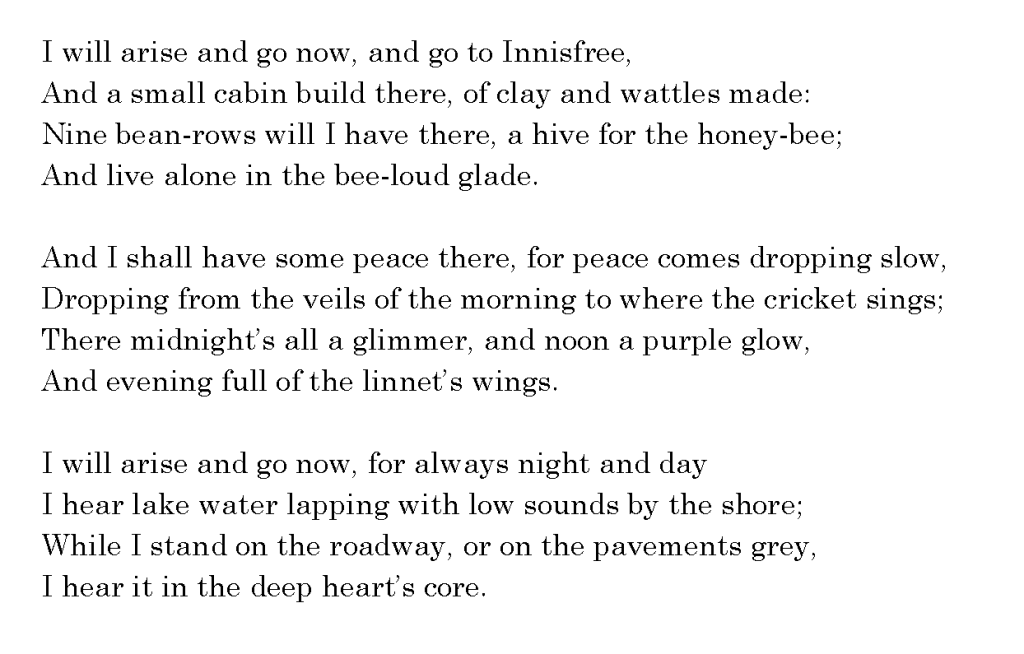
The Lake Isle of Innisfree

Last time we had a young man, an American walking in Paris in 1913 who came upon his poem leaving the Metro. Today, another young man, an Irishman in London in 1890, is walking too. He comes to a shop window, drawn by the sound there of water splashing. Looking in, he saw a fountain on display, its upward spray buoying up a ball.

The sound of water instantly brought memories of his childhood home on the coast of Ireland—and as he had been reading Thoreau’s account of his stay at Walden Pond, a small personal fantasy occurred to him of building and living in a self-sufficient cabin on a tiny island back home. Because that Irishman was William Butler Yeats, a poem came from that shop-street window, “The Lake Isle of Innisfree.”

william-butler-yeats-irish-poet-and-dramatist-in-his-study-at-woburn-buildings-london

If one can’t have a solitary wattled cabin, at least one can have books

 
That poem is now one of those beloved “Poetry’s Greatest Hits.” A few years back it topped a survey by an Irish newspaper as its readers’ favorite poem, and though I can’t find a picture of this, I’ve read that it’s been printed on a page of Ireland’s passports since 2013.

Lake Isle of Innisfree

Ireland’s favorite Irish poem was written in a foreign country


Of course, like most any Yeats poem it sounds lovely. Its language is straightforward, and there’s not much that needs explication. For a sound medium, it’s not always that a poem’s strongest images are sounds, but here the sounds of lapping water, bees’ hum-resonance, crickets, and a bird’s wings in flight carry the story.

Pound too, with his “In a Station of the Metro”  chose to use nature images in his Paris subway poem; but Yeats makes it plain that he’s stuck in the city, walking the grey pavement, not some country path. Thoreau had presented himself as the practical man in his book, making empirical living experiments. Yeats presents himself as the Romantic, helping imagine an Ireland—then viewed conventionally as a poverty-blighted colony—as an Eden, another locus amoenus. Another unusual choice Yeats makes is switching around the way we might describe night and day: night “a glimmer” and noon “purple glow.” Even though this was written before the dawn of urban lights dimming the night starfield, that’s the glimmering I sense, and if Irish coasts are foggy, noon could have a diffused glow. 1890 London might have fog and coal-fired air pollution too, maybe London fog didn’t glow, and maybe something beyond “light pollution” dimmed the stars.

This weekend’s St. Patrick’s day has become an occasion for the Irish diaspora to look toward its former homeland; and this poem, which speaks with Yeats’ humble yet beautiful specifics, invokes generally the homesickness of travelers, exiles, and immigrants. The specific in poetry often does that, the personal history that’s included standing for us all. This morning, as I filled my mouth with the word “peace” that Yeats wrote down twice in his poem, I could think of the island of New Zealand, and other travelers, exiles, and immigrants.

To hear my performance of Yeats’ “The Lake Isle of Innisfree”  use the player gadget below. If you don’t see the player (some blog readers won’t show it) then this highlighted hyperlink will also play it.


In a Station of the Metro

As we were going to school this morning, my son and I were listening to reports from the South by Southwest event in Austin this week. The guy on the radio was explaining that while SXSW has broadened over the years, it’s still the place to go for Alternative Music.

“I wonder where you go if you’re looking for an alternative to Alternative Music?” I asked out-loud. Not the most original thought, but I’ve never liked labels even though we all use them.

My son—who’s reminded me for several years now that he is not a Millennial—replied “Well, I only listen to lowercase!”

Proud of that boy.

Well of course, Alternative Music or Indie music, or whatever you call it isn’t really a Millennial thing. It’s more of an outgrowth of Generation X* in the last century. And that in itself was just the next name stuck on whatever Dave and I were doing 40 years ago when someone thought Punk was the label. And then, scratch-off the sticky paper from a Punk from those days and most likely you’d find someone who was once a young Hippie. And Hippies were just kids that Beats thought hadn’t wised up yet.

I don’t know all that much of what Ezra Pound thought of the Beats, but I recall in the 1950s Allen Ginsberg wrote Pound in St. Elizabeth’s hospital where he was serving his commitment as crazy, the alternative to his prison cage for WWII treason.**  Ginsberg later met him in 1967 and Pound sorta-kinda apologized for the—you know, anti-Semitism and stuff.

But back in 1913, before either world war, Pound was trying to figure out modern poetry in English. If it would be, what it should be. He had some materials to reuse: medieval vernacular poetry, classical Chinese and Japanese poetry, some of the modern French poets, and he wasn’t the only smith at the poetry-forge either, Brits T. E. Hulme and F. S. Flint were working at this too.

Late 19th Century English poetry tended to be enwrought in the cloths of heaven, lofty abstract metaphors and repetitions of what were considered the usual Romantic poetic sentiments. Those poems sounded poetic, sure, but were they? But if so much of that was thrown out, what would be left, what could replace that?

In such a mood, in such preparation, Ezra Pound stepped out of a subway station in Paris. Something in the urban crowd he saw there struck him and he wrote a modest 30-line poem that is unknown to you and me. Pound did not like his 30-line poem. It may have sounded poetic, it may have looked poetic, but it seemed false. He wrung out the false and the result was two lines, the famous Imagist poem “In a Station of the Metro”  that begins “The apparition of these faces…”

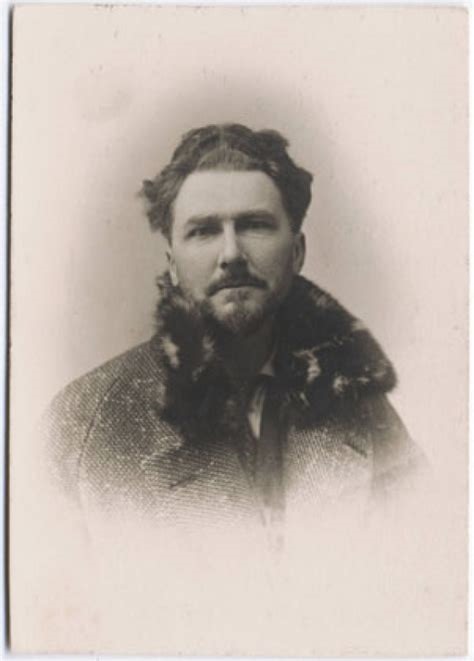
Young Ezra Pound bundled up

Ah dude, nice marmot! The young Ezra Pound


I’ve used an excerpt of an account that Pound published three years later about his experience and aims in creating “In a Station of the Metro”  to begin today’s audio piece. I sometimes think of Pound as gruff, inward looking, full of unusual words and quotes from various languages I do not speak, a portrayal of a learned hermit that both of us want to leave alone. But if I’m to take him at his word as he tells this story, he is the transit-riding 20-something Pound, struck by ordinary daily beauty and not wanting to betray it with ordinary poetry.

What do the 14 words of “In a Station of the Metro”  tell us? It’s spring—for tree blossoms, like Meng Haoran’s famous short Chinese poem, are the central image. Perhaps there’s been a rain-shower while Pound was in the subway. He climbs up the stairs and unexpectedly the faces in the street are not cast down out of the no-longer rain. Perhaps the sun is peeking through. They are beautiful without saying, as blossom flowers are. As blossom flowers are, some would have been knocked down by rain, some nourished, and none will be even spring-forever.

To hear my performance of Pound’s account of how he came to write it, followed by the poem itself, use the player below.


*Has anyone fully blamed Billy Idol for that name? Idol claims he took his first band’s name from a 1950s book, but conceptually I’ve always wondered if Richard Hell and his song “Blank Generation”  was the fountainhead.

**Pound had remained in Italy where he had settled before WWII. Enamored of various esoteric theories he thought congruent with Italian Fascism, he recorded radio broadcasts which were characterized as propaganda for the enemy during the war. Captured after the fall of Mussolini, he was at first imprisoned as a traitor in an outdoor cage.

Everyday Alchemy

I don’t have much to say yet about Genevieve Taggard, who wrote the words I perform today. Unlike (for example) Jean Toomer she’s not one of those writers who are only names to me, because until this month I’d never heard of her. I came upon Taggard reading John Dizikes’ Love Songs,  a lively group biography of nine women in the poetic milieu of New York City during the first part of the 20th Century. I’m only halfway through the book, and he’s starting to tell about Taggard.

Genevieve Taggard

Genevieve Taggard


I’m told that, like Millay and Teasdale, Taggard began writing with a nuanced eye about love, that subject that combines not just desire and it’s thwarting, but also easily branches into the nature of relationships between people. I have so far read only two or three of Taggard’s poems from this era, but overviews of her career mention that after the Great Depression and the rise of Fascism, she was one of the writers who moved to direct political engagement on the leftist side, which in the ‘30s in the U.S. most often meant alignment with the Communists.

Taggard died fairly young in 1948, and her career never reached any heights to fall from. As it was, the second half of that century that I share with her was not very kind to many of those who made that move. For some their Red past was overlooked if they themselves acted as if they had overlooked it too. Some recanted their former beliefs, and of course there are reasons one might do that.*

Why would this harm an American artist like Taggard who didn’t live until the rise of an anti-Stalinist and non-Soviet Union aligned New Left? This was the era of the New Criticism, which took the stance that politics was an inferior non-Parnassian and transitory arena compared to art, and besides many of the New Critics “private” political views were conservative. Poor Taggard. Writing about love was considered a minor poet’s subject, the sort of thing non-serious women were prone to do, but leaving that and engaging in party-line political action wouldn’t gain anything from New Criticism either.

None of Taggard’s work is in print and I may never get around to finding, much less reading, her politically engaged work, so I can’t really speak to its quality.**

I figure I’ve just lost half my readers now, and I’m unsure why I brought this up, other than when I read “Everyday Alchemy”  at the end of a chapter in Dizikes’ book, I was transfixed. Is this a political poem or a love poem? This is a poem that is both heartfelt and sharp in its analysis. Like much great art it’s balanced on razor’s edge, one half clear-eyed on the unfairness of the emotional burdens placed on women by men, and one-half equally sure that society gives poor and working-class men no other peace. In eleven lines Taggard speaks volumes on this. It’s nearly 100 years old, yet has it outdated? As poetry it works well too, ringing word-sounds via consonance and assonance, fragmented phrasing in a relentless dance. This is what it sounds like when doves cry.

Everyday Alchemy

If you’d like to read along while you listen, here’s the text of Taggard’s poem.


When I say a love poem can be as complicated, as analytical as any, “Everyday Alchemy”  would be a great example. I’m told the 1930’s Taggard considered most of her early poetry about love as a mistaken focus after she moved on to her later political stuff. However, observers note that this poem, published in her first love-poem book For Eager Lovers, was reprinted again in her reputedly socialist realist volume Calling Western Union  in 1936. This poem works both ways.

Here’s my performance of this remarkable poem, available with the player gadget below.


*This is a complex story, and I’m skipping over so much history and passion here, but it’s one of those things that is impossible to summarize adequately in a couple of sentences.

**I am seeking to get a hold of her 1930 biography The Life and Mind of Emily Dickinson  via my local library system however.

The Snow Man

I’m sure many readers here are enjoying spring or its imminent promise. In Minnesota, not so much. It was 4⁰ F. when I awoke this morning, and everyone is already flinching for another snow-storm due this weekend. So let’s have one more winter piece, this time by Wallace Stevens from his landmark collection Harmonium, “The Snow Man.”

Abandoned Winter Schwinn 1080

Not the first sign of spring.


Over at the Interesting Literature blog, Oliver Tearle reminded me that Stevens was influenced by John Keats as a younger man, and in his reading of “The Snow Man”  he has Stevens’ poem as a statement of his break from that youthful connection. Keats, and the romantics of his sort, were great fans of the pathetic fallacy and have no shame in ascribing to any landscape or natural object feelings and personality that the poet can address.

Even if we think that talking Keatsian nightingales bearing messages is an absurdly old-fashioned trope, we’ve never left the idea that weather or a landscape is supposed to mean  something. Book, movie, poem, song video—if we’re given a bleak winter picture we’re usually led to understand that death, suffering, despair, scarcity, loss, or the like is what’s being conveyed.

In “The Snow Man”  Stevens describes a winter scene. Snow-trimmed trees in an icy wind which is carrying refracting snow crystals. Stevens’ conclusion from this is ironically—well there’s no other way to put it—cold. We’re not supposed to draw any meaning from it, other than meaning-free is-ness.

It just so happens, that Keats wrote his own short lyric poem about winter “In the Drear Nighted December.”  And yes, there’s immediately an emotion attributed to a bare-branched tree wind-whipped by sleet and then to a frozen brook in Keats’ poem.

What’s that emotion? Happy.

Woah—why happy? Because Keats has these landscape features also in a state of simple is-ness. They reckon no loss from summer, know no delay ‘till spring.

Keats Buddhist koan is “to feel and not to feel it.” Stevens, “Nothing that is not there and the nothing that is.” These two poems approach in seeming opposition, but merge in agreement.

The Snow Man

A Modernist sculpture of American poet Wallace Stevens


One other thing in “The Snow Man”  to note: where’s the titular snow man? Perhaps including one in Stevens’ scene would add a connotation of jolly play, or the impermanence of artistic making—but if that’s so, why call the poem “The Snow Man?”  Could it be a mind trick, the equivalent of instructing “Imagine a winter scene, but I don’t want you to see a snow man in your imagination. Make very sure  you don’t even think a little bit about a jaunty snow man or an elaborately constructed one now melting…?” Tearle’s solution is that the snow man is the speaker of the poem, the “nothing that is” there, the cold observer that we don’t see because we’re looking from his cindered eyes.

My performance of Wallace Stevens’ “The Snow Man”  can be played with the gadget below. If you’d like to read along, the full text of the poem and Oliver Tearle’s short discussion of it is here. Want to hear Keats’ “In the Drear Nighted December?”  We presented it here a while back as part of the Parlando Project, and we have over 300 other audio pieces archived here ready to listen to.


3D Blues

Man Ray was sort of Man Ray’s real name. His family immigrated to the U. S. in the 19th Century and like many families they changed their name along with their country, and so Radnitzky became Ray. His birth first-name was Emmanuel, which would be conventionally shortened to Manny, and with just a bit more compression you arrive at Man.

I think I’ve mentioned in passing that in my 20s I developed an interest in Dada and Surrealism. I’d never pass myself off as a scholar of these subjects, it was more a matter of feeling that some of their ideas resonated with ones I had already been using. As evidence of my lack of scholarship, I’ll mention that I had always assumed Man Ray was French. Well, no. He grew up and began his career in Brooklyn and moved to Paris in his early 30s, before he could speak any French, That must have increased the Dada potential of the move!

Man Ray always felt free to range about in media and approaches. He was creating Dada assemblages and “ready-mades” by 1920 and Andre Breton called him one of the “pre-Surrealists” who had been creating art in harmony with that movement before it was officially a movement. Man Ray pioneered the idea that photography could be non-representational, made short experimental films, but also shot portrait photographs. And, luckily for this Project, he also wrote poetry. Ray once said that his artistic credo was seeking pleasure and liberty. “I simply try to be as free as possible, in my manner of working and in my choice of subject. No one can dictate to me or guide me.”

His short poem “Three Dimensions”  was published in Alfred Kreymborg’s NYC-based Modernist magazine Others  in 1915. As I understand Ray’s poem he’s looking at houses at night, not a city but outer borough or suburban scene. They’re lit up, representing the lives within. I suspect he’s punning when he says the luminous houses, walled off and oh so separate, should not be viewed “as masses.” They seem weightless, but in their separations the are as well not “The Masses.” The dark spaces between the houses, the hedges and walls, are then compared to shawl-covered heads as would’ve been worn by old women in his day. Ray concludes, still recognizing the separateness of the houses and the lives within, but perhaps with a hint of their potential. Mystery and curiosity are separated when we know that if they were to be combined they would combust!

So, what can I do with Man Ray’s poem?

Glover Ray and Ray

Glover, Ray and Ray. Tony Glover on blues harp, Dave Ray on 12-string guitar, and a Man Ray self portrait


Dave Ray* was a singer and guitar player. In the early ‘60s he was part of Koerner Ray and Glover. I guess you could call Koerner Ray and Glover a group, though they themselves didn’t.** Dave Ray was 20 years old when KR&G released their first LP***, half-a-decade younger than when Robert Johnson first recorded a side, and much, much younger than Leadbelly was by the time John and Alan Lomax recorded him. Ray kept up playing his whole life until it ended while he was still too young in 2002.

KR&G formed in Minneapolis and were part of the early days of the West Bank and other folk music scenes here. I can’t say for sure (I’m a late arrival), but Dave Ray was probably one of the reasons that the Twin Cities area has a higher percentage of 12-string guitar players than anywhere else.**** Shortly after I moved to the Twin Cities in the ‘70s I bought a cheap 12-string at a record store on Hennepin Ave. It seemed mandatory, like learning the snow-emergency parking rules.

Cortez 12 string 1080

Why yes I can prove I’m a Twin Cities guitarist: here’s my 12-string.


Today I made a Dada assemblage. I’ve recast Man Ray’s “Three Dimensions”  as “3D Blues”  and I played it on that still surviving 12-string—not as well as Dave Ray could have done it, but then it wouldn’t exist if I hadn’t done it. The old 12-string has a soundhole pickup which I played through a little combo amp. KR&G started all acoustic, but Dave Ray often played plugged in later in his career. I rearranged some lines and phrases in Man Ray’s poem to fit it into a blues form. You can read Man Ray’s original here. You can hear my revision with the player gadget below.


*As far as I know, Man and Dave aren’t related. Dave Ray’s youngest brother, the equally well-named Max Ray, played the saxophone with the Wallets and still plays around town. If I was to Kevin-Bacon-game Man Ray and Dave Ray, Max Ray and the Wallets would be my move.

**Koerner Ray and Glover never broke up because they never joined up, performing solo or in various combinations from the first to the last. Dave Ray claimed they should have been truthfully billed as “Koerner and/or Ray and/or Glover.” Koerner made a record with Willie Murphy back in the 60s. Tony Glover wrote an important early instructional book on how to play blues harmonica as well as writing about the new Rock music that emerged later in the 60s.

***That first LP was called Blues, Rags and Hollers  and just like it says on the cover, they played a wider-range of material than what was labeled “Blues” as time went on.

****Both Koerner and Ray played 12-string guitar, in the tradition of Leadbelly and Blind Willie McTell. As time passed, the blues 12-string tradition became forgotten in many places, and I’d encounter people online who thought acoustic-guitar blues must be played on small-bodied 6-strings or resonator guitars.

He Wishes for the Cloths of Heaven

Here’s a romantic poem by William Butler Yeats, in both senses of that word. “He Wishes for the Cloths of Heaven”  is Romantic in the literary and artistic sense in that it seeks to reconcile personal emotional experience with some sublime otherness through imagination, and it’s romantic in the sense that the poem takes a courting stance, that it’s an expression of love for another.

Yeats is one of those “bridge” poets who did substantial work in both the 19th and the 20th centuries. Always fiercely lyrical, he was able to recast his poetry so it continued to be read into the Modernist era. This poem, though written in the 19th century—and proving it by using an entirely antique word “Enwrought” to start off its second line—remains in circulation as some lovers still recall its ending.

It’s a short poem, only eight lines, so it can’t waste time.*  The first four lines are devoted to a nicely rendered image of the sky and a richly embroidered cloth, the sort of thing that would indicate high fashion when it was written. Of course, this is self-consciously an image on the poet’s part, he acknowledges that he’s made it as poets make images, as a new way to apprehend reality.

Oliver Tearle, over at the always Interesting Literature  blog, points out that prime English Modernist T. E. Hulme made his own version of this sky/cloth image only a few years after Yeats when he wrote his “The Embankment.”  Hulme saw himself as setting out to overthrow Romanticism, and I’d suppose it’s possible that he could even have been thinking of Yeats’ poem as he created his different one. Considering the two poems together makes for an interesting contrast.**

After those first four lines, Yeats goes on to reference something that was once a widely-known tale—just as untrue, but just as commonly known as Washington copping to chopping down the cherry tree. In the English mythical tale, Walter Raleigh, acting as a paradigm of Elizabethan courtly love and devotion was said to have taken off his expensive cloak and laid it over a muddy spot on the road so that Queen Elizabeth wouldn’t soil her royal footwear. And so it is that Yeats says he’d make this beautiful image and then allow his beloved to trod all over it.

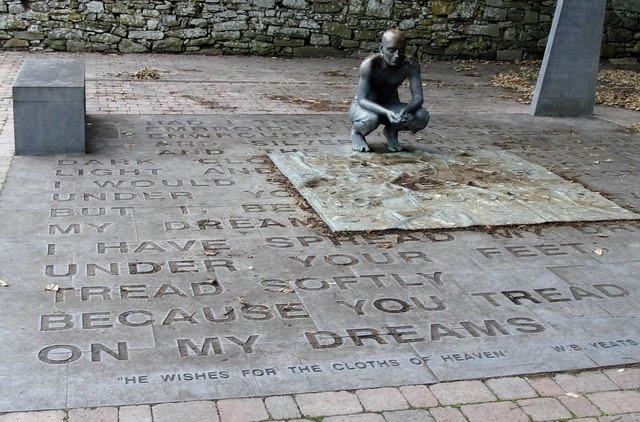
Yeats monument at Drumcliff

Yeats’ poem enwrought by sculptor Jackie McKenna in Drumcliff Ireland. Photo by Eric Jones.


There’s also something more here than just self-abasement or Yeats’ confidence in his brand of detergent: by saying he could put the plane of the heavens underneath his beloved, he’s also saying his poetry could take her to Heaven. But blink and you’d miss that implication.

Yes, the closing three lines are the poem’s best remembered, still quoted by those who have put themselves in the danger of love, or the danger of love refused. Romantic and romantic, and like most anything by Yeats, it just sounds so good! I performed it with acoustic guitar, electric bass, and a bevy of woozy keyboards, and you can hear it with the gadget I have spread below under your feet (or finger or mouse). Click softly.


*Here’s the text of the poem for those who like to read along. When the poem was originally published, Yeats used a persona as the poem’s speaker. Aedh was a kind of John-Keats-besotted nebbish character from what I read, and in doing so, Yeats is hedging his bets on the poem’s Romanticism, kind of a “I’m just asking for a friend” deal. When he included the poem in later collections, he dropped the persona.

**Here’s Tearle’s run-down of how Yeats’ does it in this poem, which also has links to his post about Hulme’s “The Embankment.” To hear my performance of Hulme’s “The Embankment,” you can click here. Beside producing one of the best daily literature blogs, I owe Dr. Tearle for introducing me to the work of T. E. Hulme, the pioneering Modernist poet and theorist who I’ve often featured here.

Kidnaped

I can’t let February and Black History month go by without another poem, so let’s return to the man who could be said to have established Afro-American poetry in the United States, Paul Laurence Dunbar.

Although he lived into the first few years of the 20th century, Dunbar as a poet is fixed in the previous century, and his poetic models are all of that time. He died young, only 33, and who can tell how he would have grappled with the Modernist wave that was starting on both sides of the Atlantic at the time of his death.

While other contemporaries were attending college, racial prejudice and lack of money meant that Dunbar would instead seek to make his way immediately as an author, and that aim shaped his work to meet the needs of the commercial market for poetry then.

He got some bootstrap help from the owner of a bicycle shop in his hometown of Dayton Ohio, a guy named Orville Wright. Orville would later do some preliminary work that eventually led to frequent-flyer miles, but mostly Dunbar had to be good, as the market defined good, and he had to get good fast.

There were no Afro-American models he could look to in this endeavor, but Dunbar could instead use Henry Wadsworth Longfellow and the American Fireside Poets associated with him. Longfellow was less than a decade dead when Dunbar started publishing poetry, and Longfellow was no small thing to aspire to—he was one of the best-known and best-selling American authors of his time, regardless of genre.

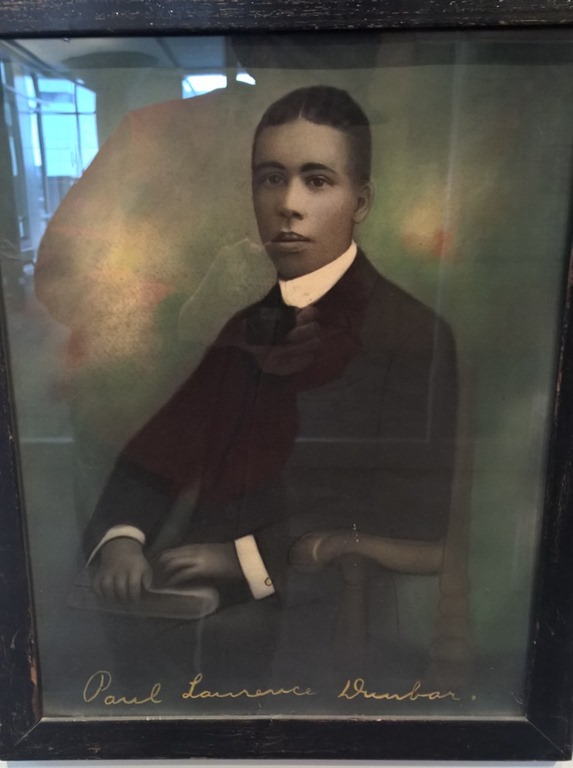
Dunbar book and pencil note insideDunbar portrait smaller

Pride in Dunbar’s poetry created additional markets. Collections of his poems, as the penciled note in this edition reflects, were sold door-to-door, and portrait photos were produced to demonstrate that American people of color could rise to literary fame.


Dunbar’s poem “Kidnapped”  could be the sort of thing the market might be buying, with just an extra touch of wit. It opens with the poet boasting of a carefree heart, but by the next stanza we (and the poet) come upon “Learned Dr. Cupid.” Cupid’s not the usual fat cherub with bow and arrow, but a capitol S “Scientist” with a net. What for? Why, to catch butterflies, which metaphorically and metamorphically the poet and/or his heart can be taken for. And cue tidy ending: this captured heart is “passing sweet.”

Simple.

Wait!

Dunbar could be aiming to produce a tidy innocent love poem that a publication would be glad to pay for and publish—something ready to snip out and share with your valentine—but stop and examine that metaphor. Authoritative Science did what? What’s the term Dunbar uses? “Kidnaped.” He says he’s to take it as “sweet” this happened.

Longfellow wrote impassioned anti-slavery poems, but he didn’t write this poem. Paul Laurence Dunbar, the son of two enslaved people did.

As to my music this time, every line resolves up or down to E♭ and I think of it as major key, but that constant return to the key center creates a mood, and the number of minor chords it moves from adds a rub between minor and major. This isn’t conventional western pop-music harmony but give a listen (or two) to it anyway. The player is below.


Abraham Lincoln Walks at Midnight

Here’s a piece for today’s U. S. holiday: President’s Day.

Long-time readers here know that’s not going to be simple, but it may be interesting.

For some time in this project I’ve thought I’ll have to deal with Vachel Lindsay. In the early days of poetic Modernism a century ago, when no one knew exactly how that movement would turn out, Lindsay was a force to be reckoned with, with a life story and approach to his art that was so outsized, that if he hadn’t actually existed, and instead you created him as a character, you would be charged with unrealistic and exaggerated imagination.

In the great American tradition of bohemian artistry, Lindsay was not well-off, not Ivy League educated, nor born in some cultural capitol. By force of will he decided that he would make his way in the increasingly business-oriented world of the 20th Century as a poet.

How’d that work out? Better than you might imagine, if only for a time. He made most of his bones touring the country intensively, reciting his poetry in a flamboyant style. Much like the life of a musician, it worked only to the degree that he was able to keep up a relentless road-dog touring schedule. Between tours, what time he had to write was also the time that he fell into debt and doubt.

If you think that poetry should be, at least in part, a spoken art form, Lindsay was there before. If one wants poetry to be appreciated as a popular form, with no academic prerequisites, Lindsay lived that. If you want poetry to be a force for social good, Lindsay too. Slam poetry? Lindsay was doing that before there was a name. Poetry inspired by and linked with vernacular music? Lindsay, a century ago.

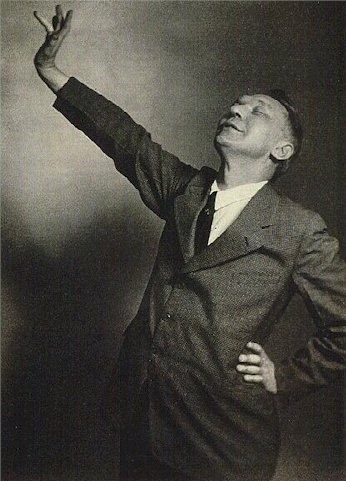
Vachel Lindsay strikes a pose

Vachel Lindsay is not doing the hokey-pokey here, but performing poetry.


So why haven’t I presented Vachel Lindsay before today? Three reasons.

One, he wrote a lot of bad or flawed poetry. Awkward, sentimental, not particularly striking in imagery, and despite his spoken word and musical inclinations, not always in tune with my sense of music.

Secondly, though he always claimed his heart was in the right place, his treatment of other cultures was so clumsy and ignorant that it’s too often indiscernible from racism. This isn’t a close call, or some case of modern politically correct revisionism, even in his own era this was noticed. It was more than 50 years ago when I first ran into one of his set pieces, “The Congo,”  and from that I figured I was done with Vachel Lindsay.*

These are both general reasons why Lindsay is not seriously considered along with his contemporary Modernists of the early 20th Century. But there is another, more personal reason: I fear the Vachel Lindsay in myself. When I see in my own writing awkwardness and flawed art, when I stop to consider the un-earned audacity of my own spoken word and musical expression, when I catch myself assuming that good intentions are sufficient, when I write here of other cultures and experiences, and despite my provincial and limited knowledge of them, perform works associated with them—then I fear I’m becoming my own variation of Vachel Lindsay. I continue to do those things anyway, stubbornly—again, like Lindsay.

Art is not just a place to model human potential. It’s also a revelation of human failures. Bad art can inspire good art. Failures illuminate as much as successes.

With that long introduction, let me now tell you that today’s piece, “Abraham Lincoln Walks at Midnight (in Springfield Illinois)”  is still worthy of four minutes of your attention. Unlike China or the Congo, Lindsay knows Lincoln’s adult hometown of Springfield Illinois, as it was his hometown too. “Abraham Lincoln Walks at Midnight”  is not a piece that extends language, it has no clever images that re-calibrate how you experience something, its word-music is not so beautiful that you’d be drawn to it before you even care what it’s about. We have long celebrated Abraham Lincoln as the President of our greatest national traumatic event, the American Civil War, fought over our greatest national sin, slavery. So, the poem has only an emotional, empathetic message, but this is all art delivers to us however plain or fancy the wrapping.

President’s Day is not a simple holiday today. Here’s my performance of Lindsay’s Lincoln poem. I kept the music simple enough and in that hometown key of C. The high melody part that sounds like a synth patch is actually 12-string guitar run through a lot of time and modulation effects and a compressor. The player is below:


*Here’s a recording of Lindsay reading part of “The Congo” which gives some idea of his performance style and also his manifold issues with understanding and appropriating African experience. And here are some excerpts of remarks on the poem and Lindsay.

Sara Teasdale’s I Am Not Yours or the Love Song of Ernst Filsinger

Sara Teasdale wrote some of the saddest love poems I’ve ever read.

Less-well remembered than she should be, for a time about 100 years ago Teasdale was the most popular and esteemed love poet in America. In 1918 she won the Pulitzer prize for a new collection of her poetry, labeled right there on the cover with the title “Love Songs.”

Harriet Monroe, the founder and editor of Poetry,  the indispensable American poetry journal of the day, said of Teasdale “She was as delicate as a lily, but under the white-petaled perfume one felt in her presence an impassioned intensity of feeling which her brief lyrics were then beginning to express.”

So, what did Teasdale know about love? More and less than you might expect. Born in 1884 in a wealthy and religiously conservative St. Louis family, she was protected and sheltered* until she was nearly 30 when her poetry career took her away from St. Louis to New York and Chicago.

As her poetry expresses, she dearly wanted to fall deeply in love, but she also wanted the independence to write, and though she moved in bohemian circles during a time of great social change, she’d internalized some of her family’s conservative values.

Romantic stories revel in love triangles, but Sara Teasdale, the woman who’d get the Pulitzer Prize as a love poet was about to deal with a love rhombus. She was crushing on a young poet she admired, John Hall Wheelock. She told Wheelock he was “The greatest living poet.” He wasn’t, though he was flattered. Wheelock, like Teasdale’s family, was a bit of a blue-blood, and he respected Teasdale’s poetic talents, but he was not interested in marrying her.

Then there was Vachel Lindsay, a literary phenom of the time, who had vagabonded about the U.S. trading his poems for meals and then bootstrapped that into touring the country’s speaking halls giving flamboyant readings of his chanted poetry. Lindsay, unlike Wheelock, wanted to marry Teasdale, and he plied his troth by dedicating books of his poetry to her**, but the reserved and sheltered Teasdale was both intimidated by his bluster and worried about his ability to provide the kind of stable home that would allow her to continue writing.

Who’s the fourth rhombus side? A St. Louis businessman, Ernst Filsinger. Like the other two, Filsinger appreciated Teasdale’s poetry, and like Lindsay he wanted to marry her. Problem solved? Well, Teasdale wanted to be deeply, mutually in love, and she wasn’t sure she loved Filsinger that much.

Sara Teasdale's Love Rhombus

Tuning up for her Pulitzer-winning “Love Songs” Teasdale was tempering her intonation with three men.


Wheelock says that Teasdale asked him to decide who she should marry. “You know Vachel. I want you to meet Ernst. And I want you to tell me what to do. Which of these two good men should I marry? Should I marry Vachel Lindsay, who’s a genius and whose poetry I love? Or should I marry this fine, tall, dark, good-looking businessman who seems to care for my poetry?”

Wheelock may not have been the greatest living poet in 1914, but he seems a sensible sort of guy.*** He says he told Teasdale she  must make the choice. She replied that no, he had to tell her which to marry, that she wouldn’t blame him if anything went wrong. OK, he said, he didn’t see her being happy with Lindsay “I don’t think you are one who could live in the kitchen doing all the housework and scrubbing the floors.”

She married Filsinger.

The next year she published the poem I used for today’s piece “I Am Not Yours”  in a collection titled Rivers to the Sea,  whose title came from a poem by Wheelock. “I Am Not Yours”  also appears in her  Love Songs  collection that won the Pulitzer.

It’s possible to read this poem quickly and read it as a crush poem, a supple lyric about being madly in love with someone, where the title and opening phrase is poised rhetorically in the moment before love’s inevitable consummation will occur, as a poem written by someone who realizes her autonomy, but is willing to submit it to overwhelming passion. Teasdale’s poetry was not just prize-winning, it was popular in its time. Someone might read this poem at a wedding. It’s likely that Teasdale, who wrote this the same month as she married, wrote it thinking of hers.

Go ahead, listen to it now. Here’s the player gadget.


So how did things turn out for the Sara Teasdale love rhombus?

Wheelock lived until 1973. In his memoir of his life in publishing he said that the best way to edit poets is to not edit them. “If a person needs to have his poems edited, then he’s not a poet, because poets are perfectionists, and by the time they get through with all their agonizing work on a poem, either they’ve ruined it by revising too much or it’s the way it should be.” He’d tried to apply that principle to Teasdale’s marriage choice.

Vachel Lindsay may have been too odd and flawed to ever last long, but the Eliot and Pound wing of cultured expatriate High Modernism crushed him by the late 20s, and the mid-century New Criticism could barely bother with the effort to find the grievous lapses in good taste in his “higher vaudeville.” In 1931, depressed by his inability to keep his debts at bay as his touring revenue dried up, he drank Lysol and killed himself.

At first Sara Teasdale’s marriage seemed to work. Filsinger allowed her to concentrate on her writing, but she eventually felt the loss of not being lost in passion. In 1929, while Filsinger was overseas on a business trip, she headed west to a state with easier divorce laws and informed him by telegram. By the Thirties, Teasdale’s lyricism and complex emotional content fell out of favor with High Modernism/the New Criticism too.**** The poet who had won the Pulitzer Prize for a book called Love Songs  felt unloved and forgotten. A little over a year after Lindsay’s death, she took an overdose of prescription meds and died in a filled bathtub.

And Ernst Filsinger? No one cares for the biographies of businessmen much after they die. We are not likely to sing the book he authored Exporting to Latin America  to music decades later. His obituary claimed he gave the first transatlantic after-dinner speech by radio in 1929, speaking from Berlin to the National Foreign Trade Council sitting in Baltimore. Who now notes what he said? He died in China in 1937. In his memoir, Wheelock says he heard Filsinger too committed suicide, but I have no confirmation of that. Is it possible that he, Prufrock-like, heard the mermaids singing, but pointedly, personally knew they had, at least once, sang for him?

Even if we largely ignore it, we store away beautiful things like prize-winning lyric poetry, so we can read and hear what Sara Teasdale wrote the month she married. Listen again to “I Am Not Yours”  or read it here. Looking to be the I that is I, but longing to get lost in love and knowing she was not, speaking of her light, a mere candle lit at noon, and asking for it to be plunged, put out.

As you read this, I tell you again that the first duty of an artist is to survive

Love poetry if it’s any good is as varied and complex as love is, as life is. Sara Teasdale wrote some of the saddest love poems I’ve ever read.


*Like Elizabeth Barrett Browning, Teasdale also had some kind of long-standing (and hard to diagnose via remote historical methods) illnesses. This only increased the family’s protectiveness.

**Another admiring poet who dedicated work to Teasdale was Witter Bynner. Bynner was gay.

***Wheelock eventually had a long career in publishing, and he prided himself with befriending, scouting and signing poets from Louise Bogan and Conrad Aiken to May Swenson and James Dickey. His memoir is The Last Romantic: A Poet Among Publishers.

****Teasdale was born in St. Louis only four years before T. S. Eliot, even if she seems like she was born to a different generation, one both before and after Eliot. Their families, though Midwestern at their birth, shared similar New England backgrounds, and Teasdale attended a private St. Louis prep school founded by Eliot’s parents, and that was located next door to Eliot’s home until he was 16. One wonders if the two young poets were aware of each other as children, but Eliot left town at 17, Teasdale’s sheltered upbringing reduced the chances of social interaction, and Teasdale’s family were staunch Baptists while the Eliots were Unitarian.

Oh, and by the way, that Prufrock of Eliot’s first great poem? Prufrock was the name of another St. Louis businessman. If Eliot considered other name options from his St. Louis youth, Filsinger was less iambic as a name. Teasdale could have sounded its own connotations, but it wouldn’t fit with measuring with coffee spoons.