Is everyone aligning themselves with autumn already? Here we’re looking back at summer and the audio pieces that the audience made their most liked and listened to, and we’re getting near the top of the countdown, moving toward the most popular single piece of the past three months. Today we look at numbers 4, 3, and 2.
4. Summer Silence by E. E. Cummings. Another one from our “Before They Were Modernists” series, “Summer Silence” is an early E. E. Cummings poem published when Cummings was a college sophomore at Harvard. One doesn’t usually associate Cummings with constrained poetic forms, but “Summer Silence” was written in 1913 in the Spencerian Stanza form, long before he could have learned from Hawk or Susan.
I try to do the best work I can with recording the music compositions here within the rapid pace I’ve accustomed myself to with this project. My equipment is modest, and my recording engineer’s skills are too, but I make the effort. That said, this one was recorded on a cell phone sitting in a cabin on the North Shore of Lake Superior: just me, an acoustic guitar, and a few summer birds that you can hear at the very end that wanted to enjoy July there too. The text of Cummings’ poem is available in the original post linked in bold above.
3. Higginson’s June by Thomas Wentworth Higginson. From another series, one that started before this summer but carried over into it: “The Roots of Emily Dickinson.” Higginson is essential to the Emily Dickinson story, the literary insider who Dickinson sought out in what I think was an attempt on her part to verify the worth of her unprecedented poetry. They met at least once, but the rest of the relationship was carried on via letters, of which we have only Dickinson’s side of the correspondence.
From Dickinson’s replies and Higginson’s later recounting, it’s been summarized that Higginson “didn’t get it,” thinking that her work needed some further polish to appeal to the mid-19th century public. Here in the 21st century we feel pretty smug about Higginson, thinking him like the infamous record exec who passed on the Beatles.*
Higginson had a highly eventful life outside of the Dickinson connection, as I’ve talked about in another post, but one thing I discovered this year was that Higginson at least dabbled in poetry himself. I can find no context for the poem of his I used here, but I speculated that it could be something he wrote in his youth. Whenever and for whatever reasons he wrote it, it is a good short summer lyric. And coincidentally it’s opening two lines could stand as the better judgment of Dickinson’s genius as it does in his poem for summer.
The music for this one is as electronic as “Summer Silence’s” is acoustic. The text of Higginson’s poem to June is also in it’s original post bolded above.
Higginson wrote the preface and helped edit and promote the publication of the first collection of Dickinson’s poems two years after her death. The flowers on its cover are usually called Indian Pipes and they were said to be a favorite of Dickinson’s. It’s a truly odd summer plant, which my living wife found and photographed in Northern Minnesota this year. The other common name for this translucent apparition: the ghost plant.
2. For You by Carl Sandburg. I kept going back to Sandburg this summer, and you the readers and listeners came along with me. Why? I frankly find him healing.
That either of those Sandburg poems could be used as memorials does not make them passive elegies, and “For You” is future-focused—just as it is full of ghosts. I’m not familiar enough to say how English speakers in the British Isles, in South Asia, the Antipodes, or elsewhere feel of the current times and challenges; but in Sandburg’s America when I read or listen to “For You,” I too feel our ghosts and feel our future—close—even if each are unreal as we stand before the great door of a year with great hinges.
*”Guitar groups are on their way out” is the famous rejection phrase, attributed to Dick Rowe of Decca Records. In Rowe’s defense, Beatles producer George Martin has been quoted that the Decca audition performance was not very good and that he wouldn’t have signed them on the basis of it either. A few months later, Rowe took a tip from George Harrison and signed another of those guitar groups, The Rolling Stones. Sometimes you get a second chance.
Continuing the countdown of the audio pieces with the most listens and likes over the past summer, we’ve reached numbers 7, 6, and 5.
7. O My Darling Troubles Heaven by Kenneth Patchen. I do wish I had more pieces with Dave Moore in them this summer. My summer schedule, my studio re-org, and various unscheduled things have conspired against us, and Rudy Giuliani has either not had anything to do with this—or has of course been involved. *
Still, it’s nice to see this piece getting a good number of listens. Patchen helped found the mid-century school of poetry read to Jazz backing, something now considered quaint, but at the time it was being done it was considered impossibly pretentious or inconsequential or narcissistically individualist by many.
Well, either judgement means you shouldn’t be listening to this, but some of you are anyway.
Another good reason to be glad for Dave presenting this is that it’s a further corrective to the Modernist Gloomy Gus tendency. Patchen’s critique of mid-20th century culture was plenty down-beat, and his personal life had enough depressing challenges to reinforce that. But! But! But! His statements of love, the necessity of resistance, and of the joy of art superseding some dreary cultural cod-liver oil pitches for it were about overcoming that—or at least fighting it to a draw.
Musically, this is an older recording where the LYL Band plays in its almost-Jazz mode, which fits Dave’s vocal where he told us last June that he was intentionally trying to recall Patchen’s own phrasing from when Patchen read his work in the post WWII era.
“If you see no hope at all, isn’t it sort of, well, a lie—all your talk about how human beings must love one another?” Painting by Kenneth Patchen
6. Grace Before Song by Ezra Pound. I presented three series this past summer where multiple posts presented different aspects of something. This charming poem was from the series I called “Before They Were Modernists” where I looked at work Modernists wrote before they found their place in the 20th century revolution in art.
Pound of course was the indispensable fomenter, editor, and promotor of literary Modernism in English, known for both his generosity and dismissive opinions.** But this early poem of his is a prayer written in metrical and rhymed verse, and it’s soaked with poetic diction and antique words. Still sounds fine when sung, and if sincere, the poem’s sentiment is admirable however expressed.
If you haven’t listened to it, go ahead and see if you agree.
5. Memory of June by Claude McKay. Speaking of graceful rhymed and metrical lyrics, this one by Claude McKay is full-throated and sounds great. In my post on it in June I wondered if the tantalizing line “for one night only we were wed” might have been an encoded cry of a gay black man who knew full well that marriage was out of the question. In each of these countdown posts, I start the listing with a hyperlink to the original post if you would like to read more about what I said about my encounter with the text at the time.
That’s still an interesting question, but no answer to it is required to appreciate the poem. As with so many compositions this summer I was meshing acoustic guitar with bowed strings and some of my sparse naïve piano.
*I probably should refrain from introducing the impossible to determine quantum state of an American political figure to this cultural discussion, as many of the readers here won’t even know who I’m talking about.
**and eventually, his active participation in Italian Fascism. If one decodes their way through all the masks, certain ugly prejudices and nutball ideals are present in the man’s art—and also beautiful distillations and perceptions that I can sit behind his eyes and share with him. This sort of thing is why I’m sometimes glad that I’m constrained to present here the work of the long dead. If Pound was alive, you and I might well feel it our duty to oppose him in total. As best as I can tell, Pound seems of little use to current English-language Fascists.
In the arts, Pound’s early 20th century Modernist opinions made him the Marie Kondo of poetry. “If it doesn’t spark joy, throw it out” was not one of the famous Imagist rules, but it could have been.
It’s that time again, when we look back on the past months and see what pieces were the most liked and listened to this summer. I do it countdown style, so here we start with the 10th, 9th, and 8th most popular pieces this season.
10. Pods (Neponset) by Carl Sandburg. Do I say Sandburg is the forgotten Imagist too often? Maybe, but to my mind this is one of the finest short Imagist poems I’ve come across in my wanderings through early Modernist verse. Another thing I keep trying to counteract: the idea that Sandburg is simplistic and that his verse is absent the levels of ambiguity and ineffability that “great poetry” is said to offer. This 7-line poem about a small Illinois village with gardens and the train passengers traveling to see scenic wonders is an example.
My family has to put up with an amount of interruption by the focused and repetitive work of producing these pieces. Listening to the process of composition, when it involves (as it sometimes does with me) a lot of trial and error is trying—but listening to the final mixing stages is excruciating. I mix at modest volume levels, but I’ve been told that headphones are not to be trusted in that work—so they hear these pieces sometimes being wiggled this way, and wrung out that way, over and over. Not a good way to appreciate a piece.
So, it was a surprise this summer when my wife came in and told me this one sounded like one of the best ones I’ve done. Maybe it made it to number 10 because it stands to be listened to more than once?
9. I Saw a Peacock by Anonymous. Long a leading composer in the folk music field, Anonymous can also craft a pretty good Surrealist poem with a humorous trick: the line breaks lead you to connect the thing previous with the last part of the line—when the “real” and much more mundane connection (as opposed to the wondrously apocalyptic thing you believe you’ve heard) is in the next line, after a breath pause of the line break.
I’ve read that this poem impressed Margaret Atwood in her early childhood with the wonder that poetry could create.
I seem to be working more and more with string and other orchestral compositions this summer. Part of that is that I’ve always been drawn to things that mix the attack-envelope of percussion instruments with the varieties of note length that stringed instruments, particularly bowed string instruments, can create—but it’s also because I was able to afford some additional orchestral instruments to play via my guitar’s MIDI pickup or with my little plastic keyboard this summer.
Didn’t work? OK, try Black Mountain school with polka. No? Dubstep Hildegard von Bingen! Hard Bop Thomas Hardy! Still coming? Tell the gunner to give’em both barrels then. No, no! Not those barrels…
8. For Once, Then, Something by Robert Frost. Here’s an example of why I’m particularly grateful to the hardy listeners of these pieces. While I’m constrained by difficulties in obtaining permission to present writings still in copyright, I hope that you can see that I vary the type and the outlook of the poetry and other writing that I can and do use. I try too to mix Poetry’s Greatest Hits with deep cuts from esteemed poets, and more than a little of the lesser-known but worth considering.
Of course, for some (Many? Most?) the idea of poetry as an everyday thing that is not some mix of fearsome and intended obscurity, snores-ville decorative excess, and hoity-toity crap for those with nothing better to do has already removed them from reading or listening here.
Well then, as I’ve described this project from the beginning, I combine these words, mostly poetry, with various music. While people might just ignore poetry, they actively hate music that they don’t like. That disgust leads some (Many? Most?) to cling to a genre of music they find most able to please them, and to mark other sonic places as “here be monsters”—hideous creatures that disrespect what is right in music.*
Music doesn’t know what’s right and proper. It just wants to sound itself.
So how many people are out there who want to hear even the beloved, famous, respected American poet Robert Frost chanted to a pulsating Electronic Dance Beat arrangement?
Well, if you are the kind of people who read, listen, follow, and help propagate what the Parlando Project does, there are enough of you to make this the 8th most popular piece this past summer!
*By the way, if you don’t like some of the audio pieces that are presented here, that’s OK, even expected. Given that I’m pushing my capabilities as a composer and musician, you might even agree with my intent, yet not wish to negotiate my actualities. That’s part of why I like to mention that we vary things: you may like the next one that comes out, or enjoy taking a look at the nearly 400 pieces we have in our archives.
The Parlando Project audio pieces are available on Spotify. With the current Spotify mobile app you can even create playlists of your Parlando favorites—and exclude your “not so much favorites.”
It’s perhaps my favorite scene in D. A. Pennebaker’s Bob Dylan documentary Don’t Look Back. Pennebaker has setup this narrative as Dylan tours England in 1965, introduced with shots of British music newspapers touting the teen-aged Donovan as Dylan’s rival. My well-remembered scene is shot in Dylan’s Savoy hotel room, where boffins can pick out various UK music figures sitting about and talking. In the background, there’s Donovan himself, tuning an acoustic guitar as Dylan asks if there’s anyone in the British Isles that is a poet like unto Allen Ginsberg. Dominic Behan is offered. Dylan says nah. Donovan has tuned up and launches into his “I’ll Sing a Song for You.”
“That’s a good song” Dylan chimes in as Donovan sings, and though eyes behind Ray-Ban shades he still seems to be paying respectful attention. Someone says “He plays like Jack man,” not a slur, but referring to Ramblin’ Jack Elliot, the legendary folkie and predecessor to Dylan in the Woody-Guthrie-continuation field.
Dylan takes the guitar from Donovan and launches into “It’s All Over Now, Baby Blue.” The guitar has gathered a capo and Dylan has lost the shades. Donovan lights another filter cigarette and chews on his nails, figures how to be cool.
Now, “rating” Dylan songs is subjective and subject to mood, even for any one person. For this one person, “It’s All Over Now, Baby Blue” gets a lot of respect: a song about love using politics as a metaphor or a song about politics using love as a metaphor? The best metaphors are like that, the thing and the representation can flip places.
So besides the people-watching and the music in a movie about a songwriter that actually has little music in it,* the gist that’s often drawn from this scene is an unhelpful but crucial tip: if you’re ever in a song pull, don’t sing your song just before 1965-vintage Bob Dylan if you can help it.
OK, so I’ve already drifted back to 1965, let’s keep drifting backwards to 1922, and you’re a Modernist poet, not a singer-songwriter. You’re about to be published in The Dial, the sort-of-successor to the mid-19th century American Transcendentalist house organ, now publishing the cream of Modernism in art and literature. Let’s get specific, the “you” you’re playing as you travel back in time is Mina Loy, a woman who’s au fait with the avant garde and whose poetry remains strikingly original even today. Yes, the Modernist movement is going to have its problems with women as artists, but Loy seems fierce.
And the Mina Loy poem that goes into that issue of The Dial is a glorious ode to a visual Modernist: one of Constantin Brâncuși’s series of bird sculptures “The Golden Bird.” Loy’s poem has something the pre-WWI Modernists often had, a joy at the new way of looking and expression.**
The lesson of the Dylan’s Savoy Hotel room is true but unhelpful here. The November 1922 issue of the Dial leads off with a new publication of a poem called “The Waste Land” by T. S. Eliot. You might have heard of it.
Antiquities dealers ask for more than $1,000 for this back issue
Art of course isn’t a competition. “Rating” art is a silly pastime that gets sillier the thinner you try to slice it. The emotional/intellectual transfer happens between art and audience or it doesn’t. Still the unhelpful rule would hold that if you’re trying to make an impression as a Modernist poet, holding up your “read me” sign next to what gets rated a masterpiece isn’t the way to go.
Now, almost a hundred years later, readers and critics are starting to look again at Loy, whose entire career was overshadowed compared to others she worked beside. How successful was her art? There’s no fixed record, because that assay happens every time it’s read or listened to. I think this tribute to Brâncuși stands up, even though it no longer benefits from the early 20th century shock of the new.***
Musically, today’s performance marks my annual tribute on the anniversary of the unfortunate death of the American musician and composer Jimi Hendrix. Each year for September 18th I plug in a Stratocaster electric guitar and try to channel a little of Hendrix’s bird in flight. Hendrix was enormously interested in the electric guitar’s timbral possibilities, so I tried to make my guitar part reflective, chirping with bird song, and gong-like in turn. You might easily think: this is my Savoy hotel room moment. You could be right, but I persist. My performance of Loy’s piece praising Brâncuși’s sculpture is available with the player below. The text of her poem is here if you want to follow along.
If you ever find yourself, regardless of the unhelpful rule and your careful plans, as a Donovan next to someone as a Bob Dylan, one choice is: go ahead anyway. I’m glad Loy did.
*Yup, it’s true. The movie is forever showing Dylan about to go on stage and then it cuts to another backstage scene. This may have been necessary for music-rights issues, but the movie Pennebaker got was all the more unique because of this.
**RaulDukeBlog has sagely commented here about the gloomy-gus nature of so much of 20th century High Modernism. T. S. Eliot’s poem helped turn it that way, even if it was a personal expiation to break out of that. Two World Wars and surrounding atrocities certainly didn’t help cheer up the arts, and our present state is damp with sodden things that can only be dried with some fire that joy sparks. Another reason to go back earlier in Modernism, and to look at the kindling of artists like Loy and their pure enthusiasm for breaking out of entrenched tropes.
***A famous anecdote about Brâncuși’s work has it that at one point when the statue was being transported to the U.S. the customs officials refused to believe the abstract form was a sculpture at all, and it was instead classified as a metal ingot.
Long time readers will know the Parlando Project is generally about the encounter with, and performance with music, of other people’s words. But I have mixed in words I’ve written here from time to time.
Today’s piece combines both threads. I wrote it, but it was engendered by reading another poet who publishes online as well as on paper.
I actually don’t read many poet’s blogs. This is likely because I’m searching through and reading a lot of other poetry that is in the public domain and free for this project to use. So when it comes time to take a break and catch up with other folks in the blogging community, I may be reading about music, history, politics, or visual art. I do follow one blog almost entirely devoted to the blogger’s own poetry: Robert Okaji’s “O at the Edges.”
Okaji posts often, and I’d describe his poetry as solidly in the post-WWII Surrealist tradition. A typical* Okaji poem will have strong lines with images often formed from opposites or unlikely combinations. In many of his poems you may not recognize exactly what he’s getting at, as he often approaches his poems “meaning” in the Surrealist tradition of surrounding it with miscellaneous statements.
I too can stay puzzled by the elusive “meaning”, even though I’ve read a good deal of Surrealist poetry and spent a fair amount of my 20s focused on writing in this manner, and then cautioned readers here that the lyric poetry I most enjoy is not so much about ideas, but the experience of ideas.
In most human writing we’re tasked with being clear, and even in poetry, poets often choose to puzzle us as readers only a little bit, asking readers to focus on only a small set of questions around the meaning in a poem. I happen to believe that the arts work best in multiplicities. Writers that ask readers to puzzle more make the poems that ask readers to puzzle less work better—and vice versa; just as music that avoids expectations and common methods of loveliness makes simpler and more consonant music stronger—and the converse of that too.
And remember, Okaji is a writer of striking images. Outside of the stand-and-deliver classrooms where we are asked to tremble out the “real meaning” of poems, one can simply take pleasure in the thought-music of an image.
You do not have to write Surrealist poetry to treasure the infusion an unexpected, even inexplicable, image can give you. Trying to write poetry without reading poetry is like trying to write music without listening to music. How many times when I’m listening to music do I hear something and suddenly realize: you can do that in music! Okaji’s work may inspire you, even if you do not write in his style.
So a little over a month ago I’m reading this August post and poem of his, “A Herd of Watermelon,” and one couplet attracted me so much, I started writing my own poem immediately, which now has become this post and piece: “Don’t Frighten the Garden.”
Magritte had his apples, but Texans go for bigger fruit
Other than Okaji’s image of a herd of watermelon able to bolt, what else did I take from him for inspiration? Well, his scene and scenery has been to some degree Texas-based and I’ve been thinking a little more of Texas myself because my father’s family spent time in that state, and one of his brothers, an uncle of mine who was born in Texas, had just died this summer.
And so my watermelon herd is Texian.
I wrote my first few lines fairly quickly, and the rest of the poem developed over a month or so to full 14-line free-verse sonnet length. The final couplet seemed almost another voice coming in over the air as I composed it. Here I was, happily in Surrealist Texas free-verse land, when all of a sudden an Alexandrine pair of lines breaks in at the end! Did the spirit of Mallarmé know I was coming for him next?
Here’s the text of my poem “Do Not Frighten the Garden:”
I’ve been playing more guitar lately, trying to maintain what I call, in my more pretentious moments, “my technique.” So, surreally, today’s music is orchestral. However, the top line melody was actually played on guitar, which—via the magic of a MIDI pickup—played the violin you hear. I also was able to make effective use of a timpani virtual instrument that’s new to my collection of orchestral colors. Give a listen to it with the player below.
*Okaji is more eclectic in his style than I can briefly outline here. Nor is all of his poetry elusive with its denotative meaning. Among other things I like that he does: English translations of classical Chinese poetry.
One of the issues with being half-learned is that one can fall into traps and tasks that are more difficult than you expected. This week I thought, why don’t I translate some Mallarmé? Alternate voice here Dave Moore had given me a book on him for my birthday (which I haven’t had time to read yet, too busy with this project…) but having recently translated and performed another poem by Apollinaire, I was reminded how often the English language Modernists looked to the preceding French Symbolists for inspiration.
So, I look. I see lots of sonnets, which is good. I like short poems personally and I aim for shorter pieces here for performance too. And short should make for a shorter translation task. On one hand, I have my unfamiliarity with French other than my il y a longtemps high school. On the other hand, I’ve tackled French Dada and Surrealist work, so a 19th century Symbolist should be no harder.
The hard to translate word here would be: “Oops.”
Turns out Mallarmé focused on esoteric philosophical ideas and the ideal in his art and manner. Maybe the rough English language analog would be Wallace Stevens, but with Stevens I can lay back and enjoy the color and sound of his English language words without having to worry about translating them into another language, and Mallarmé is very compressed and obscure in his tropes. There’s a reason that 20th century Dadaists found him congenial despite his dour and spiritual outlook: in French he may be interesting without one needing to understand what he’s intent about.
The 16 line poem I picked to translate, “Saint” is an earlier one, one reckoned to be less obscure than later Mallarmé. I’m not sure how much that helped.
I read one report “Mallarmé was…widely considered incomprehensible—the standard joke was to request a translation of his work into French…” I read that several hours into my translation. I laughed pretty hard.
You go for the cheap pun Frank. Look here: I wrote “phalange.” Is that not singular? My friend Manet’s painting of me will enlarge on this point!
Mallarmé’s “Saint” isn’t incomprehensible. It’s even an admirable poem with something to portray about the ideal nature of music. It probably helps if one has some background in Roman Catholic liturgy as one reads it, but imagery requiring a bit of understanding of other cultures can be a feature not a bug.
Here it is in French, in one of three slightly different versions I eventually came upon:
Saint
A la fenêtre recélant
Le santal vieux qui se dédore
De la viole étincelant
Jadis selon flûte ou mandore,
Est la sainte pale, étalant
Le livre vieux qui se déplie
Du Magnificat ruisselant
Jadis selon vêpre ou complie:
A ce vitrage d’ostensoir
Que frôle une harpe par l’Ange
Formée avec son vol du soir
Pour la délicate phalange
Du doigt que, sans le santal
Ni le vieux livre, elle balance
Sur le plumage instrumental,
Musicienne du silence.
Native French speakers: feel free to mock my audacity to render this. For those interested in translation, I’m going to allow you to look over my shoulder as I worked on this. Note: I almost never try to render rhyme schemes or meter from one language to another. Like Stevens in English, this poem sounds lovely in French even if you can’t figure it out. In English I tried to instead vividly render the images, which is my preference in translation, even if it can lead to approximations and out and out bad guesses. And then to put that to some English word-music that may not reference the other language’s “tune.”
Here’s what I came up with:
Saint (Cecilia)
The window frames
The worn fretboard
Of the splendid viola—
Once played music with flute or mandolin.
There’s the pale saint, opening,
Spreading the old book.
Mary’s Magnificat falls out—
Once for vesper or compline.
This window is a monstrance.
She holds her harp, an angel’s
Customary evening wing,
Played by the delicate phalanx
Of fingers. Without a fretboard,
Without the old book, she strums
On the instrumental plumage,
A musician of silence.
First Stanza. This is an extraordinarily difficult image to figure out, and some of the guesses others have made are not a concrete image, which could even be Mallarmé’s intent. There’s clearly an instrument mentioned, a viol (a larger predecessor to our modern viola, and I imagined a viola da gamba, a wonderful “early-music” instrument for which the viol name was used). I rendered it as viola so that moderns might have a more common instrument in their minds eye. I did the same for “mandore” an ancestor of the now more familiar mandolin. Mallarmé may have meant to add an ancient music air to this, and I could have gone the other way with the instrument names (Stevens would have).
One of the chief problems is some read this description as an instrument that’s out of sight (“recélant” can mean to harbor or to conceal—and a window concealing?). Idealist Mallarmé could have intended it out of the frame. But I wasn’t sure, and I’d rather the reader know about it clearly, particularly as it opens the poem. And his description is puzzling—a point made of it being personified as sandalwood for one thing. Sandalwood is a hardwood. You probably wouldn’t use it to make the soundboard of an instrument, which functionally and surface-area-wise would be the main part. But it can be used for necks and particularly for finger/fretboards. Even though Mallarmé repeats sandalwood later in the poem, and there are fragrance and ceremonial connections with the wood and word, I decided to call it a fretboard, to help us see the instrument. There’s another issue with Mallarmé’s description: the instrument is “étincelant” and yet also “dédore.” I decided that the instrument is “splendid” but also “worn” in the area of that hardwood fretboard: i.e. this is a fine instrument that has been well and often played.
Second Stanza. This one is more straightforward. Cecilia is the “sainte pale” (named specifically in early versions of the poem) and she’s opened a book which seems to contain the score of a setting to Mary the mother of Jesus’ famous passage called the Magnificat in Roman Catholicism. I decided to add the “Mary’s” to the Magnificat just to help listeners hear the word as a proper noun. And something happens regarding the Magnificat: “ruisselant.” This word, best as I can figure has a sense of streaming or trickling. At first I thought the image is that the music represented by the score is magically sounding itself as Cecilia the patron saint of music opens the old book. But I don’t think we are to hear music as the poem develops, and so I wondered if the meanings of ruisselant infer running downhill. I decided that the score of the Magnificat falls out of the book, making itself known, but not making a sound or allowing it to be used to aid the music making, just as in stanza one Cecilia is not availing herself of a fine and once oft-used viola.
Third Stanza. Tougher again. This stanza contains the strongest image of the poem, the fusing of an angel’s bird-like wing with the somewhat-like shape of a harp—and Mallarmé wants to stuff other ideas into the four lines too. I decided that the specific and technical term “monstrance” cannot be replaced: it’s a glass altarpiece holder of a sacred object. Wallace Stevens would have loved to have used that word! The obscurity of the word adds some mystery I think, and no simply understandable single word replaces it. With the stanza’s last word I fell into thinking Mallarmé intended to pun on “phalange” (phalanx) which is from the Greek, meaning a massed formation (usually of soldiers or police)—but also fingers, similarly grouped together in disciplined order when playing an instrument. I decided to use phalanx because either words’ use for fingers is somewhat obscure in English (outside of medical usage) but I liked the idea of the delicate phalanx of soldiers or riot troops. But I think phalange may be singular in French, and if so, I may have misunderstood Mallarmé’s intent. My sin is falling in love with the image.
Fourth Stanza. Home stretch! Easier again, and choices already made set it up. In my reading Mallarmé is saying Cecilia has her spiritual intent on ideal music, the impossible music made with the mythical wings of angels and the impossible music made by strumming a bird’s feathers—such a fine image because it works bidirectionally! Actual music has been left behind as once, and not now (“jadis,” twice in the poem). She no longer needs the viola or the score.
She’s become the unheard melodies that idealist Keats says are sweeter than heard ones.
CeCe, you’re messing up the form again! It’s a 12 bar minor blues with a 4 bar tag I’m going to modulate counter-clockwise on the cycle of 5ths each second chorus, and then—what you do mean, “Wing it?”
In performance, I had to resort to heard music so that the estate of John Cage didn’t sue me for plagiarism. I thought I might try to reference the Velvet Underground when it featured the pale saint John Cale on keyboards and viola. But neither the drum part nor the rhythm guitars I settled on had that VU feel. None-the-less I went ahead and created a top line using viola and a keening combo organ.
Last time I repeated the short poem several times so that I could show the different ways it could be expressed. Today’s short musical piece gathers a sort of meditative power if played on repeat. The player is below.
One of the nice things about this project is that I’m still running into poets that were essentially unknown to me. This is like one of the joys of my youthful musical life: digging through used LP records or a bin of “cutouts” looking for an interesting title, some compelling cover art, or an intriguing song listed, and bringing home a record that as far as I could tell, no one else knew.
In theory this process is easier now, expansive catalogs of recordings available instantly for streaming, but I’m not sure if my son or anyone currently young will do a revised version of that. I suppose part of that was the imminence of the next object, the foot-square cardboard housing with or without wear, perhaps with someone’s name scrawled on the corner against sibling or dorm room misappropriation of the thing, or the shameful diagonal corner amputation, branding the still shrink-wrapped “cutout” record a failure of expectations.
But for poetry, particularly for poetry before 1924 that is in the public domain, there is no lost former ubiquity of sources for discovery of the less-known or passed by, and happily the Internet makes them near alike in availability: Robert Frost and Edna St. Vincent Millay—or Fenton Johnson and Charlotte Mew. And so I can come upon work by Louise Bogan who published just over 100 poems in a long 20th century lifetime where she was perhaps best known then as being the poetry editor of the New Yorker magazine for a few decades.
Louise Bogan. I got nothin’ snarky to say today.
I’ve only started to sample her work, but she has a very interesting voice. One could compare her to Millay, and like Millay a complex examination of love and romance seems to be a prime subject, and like Frost she uses metrical and rhymed verse while having a thoroughly Modernist outlook.
Other than the vagaries of fate and the culture of her time, there’s no reason for her work not to be better known. Take today’s example. “Song” is as condensed in expression as it’s title might lead you to expect. It’s a love song of a kind, but its kind isn’t conventional. Unlike some other poems of Bogan’s, there’s also not a single unusual poetic or high-culture signifying word in it. It could have been written yesterday, and it could be sung yesterday as a song for general non-literary or art-song consumption, streamed on Spotify* or iTunes.
And of course, thanks to the magic of the Parlando Project, it now is. Also thanks to the current limitations of the Project, I had to sing it, but then it’s better that it’s sung than not. If somewhere out there there’s a charismatic singer for this, that would be wonderful.
Bogan’s “Song” is a request, a command, a begging cry, a lament, a report, a prayer, a need, a meditation, a love song. You can hear it with the player gadget below. The full text of “Song” is here. You may note that I come in singing with stanza two in the version I present. I think of this song (as I performed it) as a repeating cycle capable of expressing all of those things above, so it can start with either stanza. I also repeated the opening lines of each stanza, a tactic ingrained in me by blues singers.
*Speaking of which Dept. The audio pieces featured here have been, from the beginning, available from the same places that you get podcasts, such as Apple podcasts and the like. Spotify also has podcasts in it’s app, and as of late this summer you can add Parlando Project pieces like this one to a Spotify playlist on the Spotify mobile app, which seems like a good way to spread the news about what the Parlando Project does.
How much do we know about Emily Dickinson as personality, as a living person? I can’t say that we know much at all. Originally, she was marketed as cypher, an enigma, a hermit/shut-in, and this reflected a valid aspect of the later parts of her life. The self alone is not a no-place, but it’s a hard-to-know place. In my lifetime there’s gradually been an understanding that it’s not the whole picture however.
Her youth seems to have included an above average circle of experiences for a woman of her class, time, and place. And her most productive writing years, those of her early thirties, seem a middle ground, with some travel amid mysterious and undetailed accounts of illnesses.
Her poetry, still revolutionary, no longer needs the biographical mystery to market it, but that doesn’t stop us. Its domestic strangeness makes some of us look for a Baedeker to help figure out the sites and landscape.
I say this because it appears that yet another attempt to portray a living Emily Dickinson is upon us. In 2017 we had A Quiet Passion portraying an intellectually vital person dealing with a rigid society, and only this year we had Wild Nights with Emily which tried to illuminate Dickinson’s emotional life and the revolutionary artistic aspects of her work. Both of these films have to deal with issues that any biopic about an author will: watching people write is boring second-unit stuff, connecting written work designed for the page to a visual performance is not straightforward, and what writers record in books is not a one-to-one reflection of their own personality and character. I’m willing to cut filmmakers some slack because of these unavoidable issues.
None-the-less, Dickinson, one of the tentpole series that Apple TV+ has announced for its nascent Netflix/Amazon Prime/Hulu streaming video competitor this fall, is raising eyebrows and guffaws. Here’s the trailer.
Midway through Emily and Lavina rock-out in their underwear on ukulele and banjo.
Let me summarize some comments the trailer has drawn:
“That’s crazy pants”
“Instead of the classy story-telling Apple has promised for its new video service, this looks like a CW* series.”
“What were they thinking?”
“Portraying a famous recluse as a wild child? Really?”
Well I’m not going to predict anything (I’m bad at it). The hyper-fast cutting of the trailer should almost come with a strobe-light seizure warning and makes it even harder to determine how the series will work than a run-of-the-mill promotional clip, a form already infamous for misrepresentation. I’m not going to throw stones at the EDM soundtrack of the trailer though. Indeed, I’d hope Dickinson is as audacious as I’ve been here in mixing “wrong” music with older art.
A worry is that if it tries to modernize Dickinson without comic awareness and savvy, it could be unintentional comedy that goes nowhere. As with previous Dickinson movies, I suspect it will give in to the dramatic temptation to compress and confuse the time-line of Dickinson’s life. I know nothing of the show-runner’s previous work, but title-role-actor Hailee Steinfeld was great with vitalizing 19th century dialog in the Coen Brothers’ version of True Grit.
A list of recurring characters gives hope that the show will try to deal with some of the formative influences on Emily Dickinson: Susan Gilbert, the eventual sister-in-law and possible romantic partner, Benjamin Newton, generally recognized as a mentor to the young Dickinson who died at age 32, and George Gould, who Genevieve Taggard identified as once engaged to Emily and who might have continued to serve as a connection to outside literary and cultural forces per Taggard’s biography.
I’m even more heartened by the presence of actor Chinaza Uche in the regular cast, which indicates that Amherst’s African-American presence will be included. How complex will they allow that element to be?
Much of what we know about these people comes from Emily Dickinson’s letters, a form in which Dickinson performed, taking a series of personae. Within a variety of frames and masks understood and puzzling to the recipients, she herself remains unrevealed while revealing. The letters don’t tell us how Emily was like to be around, they tell us the ways that Emily wants to express herself on paper. Tantalizing and frustrating for biographers—when Dickinson writes of her life, the enigmatic poet side comes out.
Today’s piece is an example. Indeed, if one wants to contrast Walt Whitman to his fellow American mid-19th century poetic innovator Dickinson by saying that Whitman was able to write free verse while Dickinson was content to write irregular stanzas with looser than “proper” rhymes, passages like this from a letter from Dickinson to Thomas Wentworth Higginson in the spring of 1862 are vers libre without being published as such.
The first “tutor” she mentions in this letter is usually identified as the doomed Ben Newton, and the second may be Gould, who had to leave Amherst to seek a living, eventually traveling overseas. Other dramatis personae: Emily’s famous dog, Carlo, and her piano, the instrument she was known to have played in the home with some skill. But what is the terror since September? Illness? Artistic sturm und drang? It’s tempting to say that the letter-passage’s sundown and the hills reference another famous Dickinson poem, but what is the noise in the pool? Is it “public—like a frog?”
So, regardless of how entertaining, enlightening, or disastrous Dickinson turns out to be, there’s evidence for presenting a rather outrageous, self-dramatizing, and rapidly thinking person who relates her own poetry to her life. That is, if the Dickinson of the letters is like the young, living, social Dickinson.
No dance-oriented Dickinson today listeners, and I had to be literal and include some piano due to the reference in the text, though no singing pond-frogs or dogs. The player gadget to hear me perform part of this letter is below. The full text of the letter to Higginson is here.
*The CW is a minor American broadcast TV network that targets its programming at younger audiences. Just to go on the record: as long-time readers here might suspect, I’m not immune to meta-rich transformation of historical subjects with references to modern phenomena. I love Upstart Crow because it sitcom-frames Shakespeare’s life as if it was The Dick Van Dyke Show (which itself was a Sixties recasting of Carl Reiner working on Sid Caesar’s show in the Fifties) with lots of wink-wink anachronisms. Dickinson may not have yet reached the level of dead-white-male canonization that allows Shakespeare to be deconstructed for laughs though.
In Minnesota there’s this thing, The State Fair, that’s hard to explain. Up to a couple-hundred thousand folks show up each day to it, for various hard to describe reasons. There are events, exhibitions, livestock judging, sales booths, musical acts, lots of fried and sweetened food that can be eaten by hand. You could describe it as an overgrown county fair, and as with those, there’s a midway with clanking and spinning rides and games of chance.
Rural and farm folks come to it from around the state, but it’s held in the Twin Cities, a thoroughly urban place, and most of the attendees that fill much of the fairgrounds are from The Cities. Some like me would be once rural folks, or children of rural folks. A place like the Twin Cities is full of those, people remembering that place not present in location or time, À la recherche du temps perdu, “In search of lost time.”
I came to the Twin Cities in the 70s, not directly from the small-town Iowa of my youth, but from New York, where there are fewer intimate thoughts of farmlands. Shortly after arriving, a woman I was in love with told me there was this guy on the local classical music radio station, who was no longer playing Liszt and lieder, but rather other stuff—Beach Boys, folk music, whatever. And she said: he tells stories about this small town he’s made up.
I stopped her there. I admired her smarts, the things she knew, but I know how those stories go I said: We’re ignorant and out-of-touch, those rude mechanicals. As the urban-cool Bart says in Blazing Saddles when introducing the Waco Kid to the little town: “You’ve got to remember that these are just simple farmers. These are people of the land. The common clay of the new West. You know… morons.”
“No, he’s different. If you listen, you’ll see.”
He had a 6-9 morning show. We listened together. He’d spin humorous stories of invented events and institutions between records. Some of it was sort of like Jean Shepherd’s shtick, still playing in New York on WOR radio when I left, but as she had said his take on small town life was different. His stories then often had a delicate balance between young Twin Cities residents, some of them college students with literary aspirations such as myself, and their hometown folks. He was generationally close to the former, but he often had them play their pretentions toward great changes for humor against the set in their ways but caring older generation back at the hometown. From my seat then between those two worlds, this was a high-wire act, and he stayed out of falling into the netting or sawdust.
He was also forming up a weekend radio show, that graveyard of radio without the reliable drive-time slots. He’d perform them live anywhere locally there was room for the hundred or so attendees. He modeled it on the radio country music variety show, something that still existed in my youth, but except for the Grand Ole Opry had died out. But instead of country music acts, most of which would have little interest to a metropolitan public radio audience then, he stocked his traveling stage with young musicians that played the West Bank bars and coffee houses around the Twin Cities. Some of these players played trad jazz or blues, some were folkie singer-songwriters, some were from the more museo-wings like Leo Kottke or bluegrass revisionists, others from a variety of old-time-music revivals. In recent decades everyone knows what to call this mixed-bag: Americana. But in the 70s no one did. This weekend show, Prairie Home Companion, sort of helped make that category up.
A man I knew once charged with programming a radio network liked to say regarding the success that show eventually had: “Prairie Home Companion is a lousy idea for a show—except for a show with Garrison Keillor.” A lot of folks doubted that thought, and while some attempts to do “something like, only….” have had decent runs, no one else ever made it work to the degree Keillor did.
There seems to have been a reason that the younger, moved to the cities generation in his stories often had writerly ambitions, because Keillor continuously worked a side career as an author of short stories, poems, novels, columns and opinion pieces. The thing that connected that side and the radio show was “The News from Lake Wobegon,” a varying length monologue that came near the end of each show.
This wasn’t standup, it was storytelling. Unlike the comic and parodistic skit elements that became an increasing part of the show over its run, it wasn’t read direct from a script radio-drama-style, but told, and written entirely by the host. This was the small town and its history he’d made up in its most concentrated and alive form. It had that live performance immediacy. Occasionally there’d be short dead air pauses, some intended. There’d be things repeated, some as intended refrains. Moods and directions would be mixed, sometimes turning within the course of a sentence as it does in ordinary recounting. Is he thinking, and that thought interrupting his story?
Sometimes it was a rousing tale, a good-hearted shaggy dog story on some foible. Other times along with the humor was sentiment, mood pieces buffered inside rueful rural characters. Occasionally, framed through some youthful ambition, there’d be poetic asides and lines such as the passage I bring to your attention today.
Even with the framing, it was a very pure thing, and like most things of that sort, some loved it and others found it somewhere between meh and tiresome. Keillor had a slow, even-voiced recitative, a sighing oboe that could reassuredly uncoil some from a basket while leaving others sleeping inside.
Say it with me, long-time readers: “All Artists Fail.” I last posted 5 minutes of wailing electric guitar arpeggios over my fresh translation of a hundred-year-old French avant garde poem. I’m not going to throw shade based on either some idea of universal criteria for art or a proper recipe for entertainment.
I remember hearing a version that included the passage I perform today. Did I hear it live on the radio on a Saturday night decades ago? Did I hear it later, on a distributed recording? I can’t say for sure, but as this ending summer was beginning, I was on the northern shores of Lake Superior. The cabin I was in, when some spitting rain opened the pores and raised white hairs on the smooth surface of the lake, had a couple of books. One was a book length collection of pieces from the radio show re-cast as linked short-stories and published after Keillor’s first retirement from live performance in the 1980s.* Reading them was a good afternoon, but only this single small passage was drenched in déjà vu.
Still raining, still dreaming. Keillor reframed monologues from the show he’d ended into a book for my rainy afternoon years later.
The ‘80s jacket author photo surprised me. Neither the bearded ‘70s guy with the light suit nor the older man I remembered.
The State Fair in Minnesota means the end of summer, a lost time that can be returned to and can’t be returned to. Here are a few sentences that a man once wrote and spoke on the radio. I’ll speak them today. Gave them a title of convenience and the music I composed on my naïve piano and then performed with a small orchestra setting using three woodwinds, a flute, and a few strings. My thought is that Keillor’s words could sound different to you when not performed by him, illuminated differently in the Parlando Project manner. The player is below.
Poetry as an immediate witness to momentous history is not a common thing. Poems of events tend to autobiography, deaths, love, births, personal injuries and triumphs. Today’s piece has both elements—memorable on both counts.
Guillaume Apollinaire is a major figure in Modernism with an influence across the arts as a critic and theorist. He popularized the term Cubism, invented the term Surrealism, and using his own name “Orphism” helped explain and formulate abstract expressionism. In the era surrounding WWI his influence and omnipresence was stronger from his base in Paris with French-speakers than Ezra Pound’s was for English-speakers from London. As a poet Apollinaire bridges the 19th century Symbolists to the Dada and Surrealism to come, and though he wrote in French, many of the English-language Modernists looked to French models for their verse.* While his work is experimental with form and language, it’s also very open-hearted and joyous in a way I associate with later 20th century American Frank O’Hara.
“The little car” tells of a day of Apollinaire’s that would change his life. On that biographic matter alone it would be of interest to literary historians. But it also tells us about the early days of the most influential event in Modernism, the outbreak of WWI. Apollinaire’s poem is comparable to W. H. Auden’s better-known beginning of WWII poem “September 1, 1939.”
So, let’s begin talking about the poetry as history today.
World War I started over a series of days earlier in the month of August 1914, kicked off by a ham-handed assassination in the Balkans at the end of June, followed by a slow enactment of various alliances and agreements plunging the whole world into warfare over the course of weeks (or in the case of the U.S., years).
Unlike the reputation of WWI as a brutal struggle of attrition between trenches, the opening August weeks were fast-moving. German troops cut through Belgium taking over that country in short order, putting them at the northern border of France as they met the French army. Large military movements and formations just slightly modernized from the Napoleonic era, that still included cavalry charges and fife and drum, met modern artillery and rapid firing weapons. Aerial bombings were introduced to warfare (though ground-based actions were more deadly to civilians). Soon amplified by propaganda, there are widespread accounts of bestial atrocities by the advancing army.**
Before the events of today’s poem, which self-dates itself to the end of August 1914 and into the following September day, during the Battle of the Frontiers, France’s army had suffered its largest single day of deaths and casualties in this or any war before or since, a staggering total of 27,000 killed in one day, with a figure of 300,000 casualties. The French army was reeling, withdrawing back toward Paris, which was the Germans’ objective in this first month of the war.
Apollinaire and his friend the artist André Rouveyre are in Deauville on the northern, English Channel coast of France. The poem doesn’t say, but I’m assuming they feel that the German advance is threatening their location, and so they do what threatened people unsure of the future often too, they head for home, Paris, not weighing that the French capital is the objective of that invading army.
Here’s my new translation of Apollinaire’s “La petite auto” used for today’s performance
That they leave “a little before midnight” is not just an image of imminent dark change, it also may say something of a necessity not to wait, or perhaps a decision that traveling at night, as difficult as it might be with primitive headlights, may be safer under the cover of darkness.
The poem continues with a series of Symbolist images, assembled in whatever order, as a Cubist painting might be. These are not mere inventions. Although expressed symbolically, they are reportage. Indeed, some of the symbolic events which may seem mundane to us in our world, would be accounts of dreadful wonder in 1914: men fighting in the sky, submarine monsters of war—the masters/merchants of war with their opulent and extraordinary wares.
Another feature of this poem is that the text begins to wander on the page and eventually is laid out in a manner that Apollinaire called “Calligrammes” to form the shape of “The little car” of the title.*** I’ve not included that concrete poetry text in my new translation for reasons of length and focus on the spoken potential of the piece.
The poem ends with Apollinaire and Rouveyre arriving in Paris on the afternoon of September 1st. I note the poem says they stopped for a bit in Fontainebleau, just south of Paris, which indicates that they took a round-about route that day since Fontainebleau is south-east of Paris though they were coming from the north-west of Paris.
The “mobilization posters” he speaks of that were being put up as they pulled into town tell of the irony of their route to escape the Germans. The German army is now threatening Paris itself, advancing to between 20-30 miles from the city, and legend has it that the French army was able to redeploy quickly by dragooning the entire taxi-fleet of Paris.****
What happened after the events recounted in this poem? Apollinaire fought in WWI for his adopted country France, and in 1916 was seriously wounded. Still weakened by the wounds, he’s felled by the infamous flu epidemic of 1918, two days before the end of the war that would reshape and extend Modernism, as Tristan Tzara would say in his moving elegy “He would have rather enjoyed the fact of victory.”
Many of Apollinaire’s WWI generation lived on as forces in my post-WWII lifetime, as still-living actors in the culture, but Apollinaire was not to be one of them. So influential as he was in the early-20th century’s cultural ferment, it could be said that his death during the war was the single most important cultural casualty, more important than the death of promising poets such as Edward Thomas or Wilfred Owen because Apollinaire, like another casualty, T. E. Hulme, was more than just a writer, he was a leader and promoter of ideas. You can make the case that his death is the same magnitude as some alternate-time-line where the world lost Picasso in 1918. Or you could make another judgement: he was so effective in the pre-1918 years, and the Modernist urge was so strong and then intensified by a world war that made the old artistic forms seem like a cavalry charge against machine guns, that his continued life was not crucial. That’s a cold debate. His friends sure missed him, and kept working.
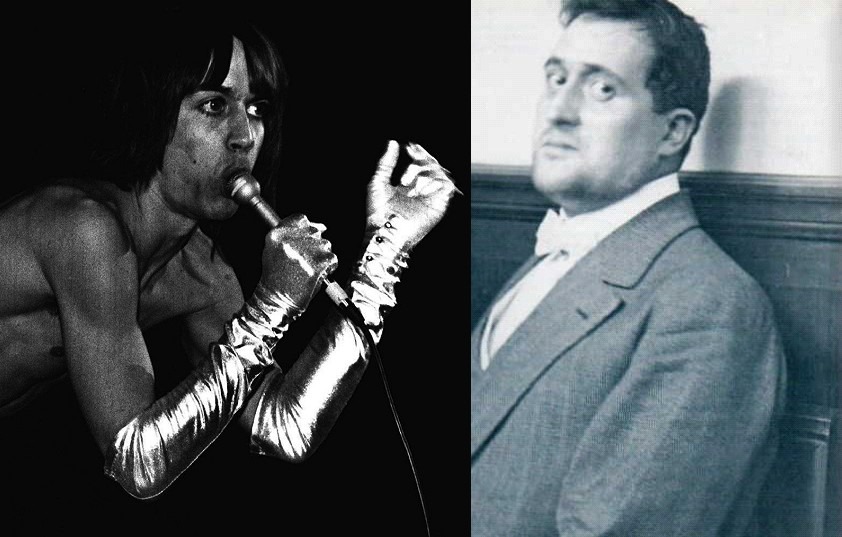
Dionysus and Apollinaire.
Musically I’ve had this thought lately that I’ve avoided use of some of my most basic musical genres. And Iggy and the Stooges are the definition of that. They started as an art project, making free-form noise on stage, with Iggy Pop, a converted blues-band drummer as their front man. Somehow they decided that the most elemental and elementary expression, however untutored and unvarnished was the way to go. Iggy Pop’s lyrics were the “Blue Undershirts” of 60s rock, the rejoinder to “you call that poetry.” A song such as “1969” from their debut LP is a bored and hedonistic critique of a year deep in another war, cultural and shooting. Robert Lowell it’s not. It’s really not. No, it’s really really not.
For this performance I’ve enlisted my son, the “in his first year of it” bass player and singer, who from his interest in punk and indie-rock can explore that aesthetic with a fresh set of fingers. Conceptually, this song is inspired by the Stooges “1969” because here we have (with “The little car”) two songs about war across a nation,***** but in my tribute I simplified the Stooges’ typical 3 chord trick into a 2 chord chug. Of course, to my son the Vietnam era is exactly as old as WWI was to Iggy and the Stooges. All wars should be so old.
The player for our performance is below. Click on play and turn it up.
*And the French in turn sometimes looked to American Walt Whitman, who never found full favor with the English language avant garde, making the French vers libre writers poetic money-launderers!
***E. E. Cummings was heavily inspired not only by Apollinaire’s dropping of punctuation, but his freeness with placement of text on the page.
****The taxis that saved Paris legend may not hold up. But my favorite part of this linked story? The account that the taxi owners kept the meters running and presented a bill to the government after the battle. Paging Joseph Heller or Milo Minderbinder to the white courtesy phone.
*****Or not—at least by intent. On the rattling plastic luggage record players of the time, I always heard Iggy Pop’s opening lines in 1969 to be “It’s 1969 OK/War across the USA.” Some cover versions say I’m not the only one who heard “war” as part of the folk process. The published lyrics and close listening with headphones say Iggy was singing “All across the USA.” Well, excuse me while I kiss this guy. The Iliad was carried by an oral tradition long before it was written down. Regression analysis says Homer wrote it about some sunny Mediterranean partying and dancing. The homoerotic and warfare parts were just misheard by the folks in the back row.




 Frank Hudson
