Tell me where is Fancy bred: Shakespeare the Songbird Poet

In writing about Sara Teasdale last time here I mentioned that she has been grouped with a set of 20th century female poets as a “Songbird Poet.” The implied charge here is that these poets are less concerned with the deep meaning of poetry and are content to just make pleasant word-music.

If we are to attend the deeper meaning school, I’d have an opening to report that in nature the songs of birds are not all pleasant and meaningless – for they sing for desire, for companionship, to legislate territory, and for existential defense among other things. If birds are likely deficient in theology and philosophy, I’m too ignorant to know if a sense of avian metaphor is present.

I, of course, am being stubbornly literal there, Teasdale appears to be without feathers and everyone should know this, save for those who are sure the female mind is insufficient and therefore may have doubts. One of the things we may claim as humans is that we are a flexible sort of creature of many moods and levels. One kind of song, one kind of poetry? There’s no handy phone app that can identify our songs as one sort of human.

So, even if calling them “songbird poets” is plausibly belittling, as a person in this Project I have to say that making a song, something one appreciates uttering, can be a worthwhile thing. Here’s another minor poet who I’m sure we’ve kept in a parlor cage as a songbird, one William Shakespeare. This tidy little song, from his play The Merchant of Venice, talks about idle, surface-deep, love (“Fancy”). But wait – like is often the case with the Songbird Poets, there’s a more complex message inside it. In the play, one of a pair of lovers is given a test: a choice of three boxes and selecting the correct one will allow them to marry. Shakespeare, prefiguring the ding-dong theme played when the Jeopardy game-show contestants are making their final answer and wager, provides this song to fill the stage time as the lover thinks it over.*
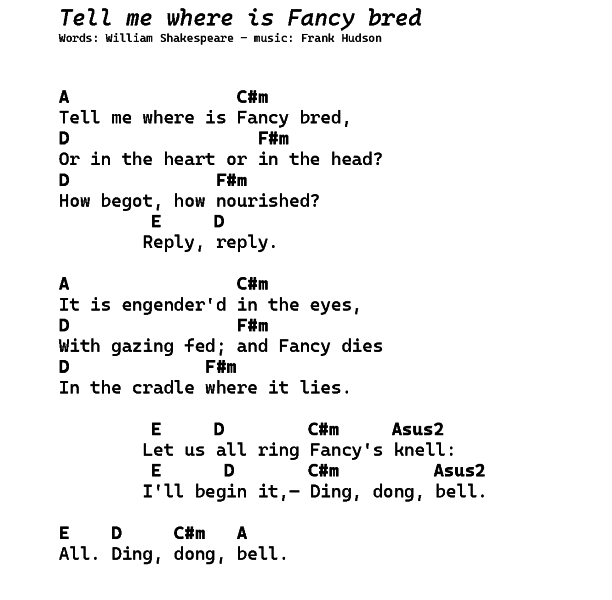
Tell me where

I made a point to write this one entirely with my ham-handed skills on keyboards.

.

As a poem it seems simple doesn’t it. Sure, there’s some now-archaic language in it, but to modern readers or listeners, that probably only makes it seem more the nursery rhyme.

But it turns out there’s a little bit of metaphysics in the modest verse: where does “Fancy,” that insubstantial, fickle, flimsy love come from? From the mysteries of the heart and its desires? From some reasoning of the mind? Nope. It’s all from looks – all “I’d hit that” surface the singer warns – it’s hardly born, and it’ll die. Finally, the singer asks us to celebrate the death of that kind of infatuation, and joyously ring its funeral bell, as time is up and the lover must make their decision.

So, is a little song like a Fancy: never more than a flimsy, momentary thing? Or can it tell us something about food, partnership, where we are, where the predators are?

Well in the present case of my performance of Shakespeare’s song, I’m the dun, leaden box since I needed to use my voice for this, and I made a simple pealing accompaniment with a viol, a reed pump organ, and a harpsichord. You can choose to hear it with the audio player gadget below. No gadget? It hasn’t flown south in a honking V arpeggiation, it’s just hiding in the brush cover of some ways of reading this blog. I offer this alternative then, a highlighted link that will open a new tab with its own audio player.

.

*I believe that none of the music used in Shakespeare’s plays in his lifetime has survived. Merv Griffith, himself a gameshow host and producer, wrote the tune used on Jeopardy. I haven’t watched that long-running TV show in decades, yet his tune (in its original version) is still stuck in my head.
September Midnight

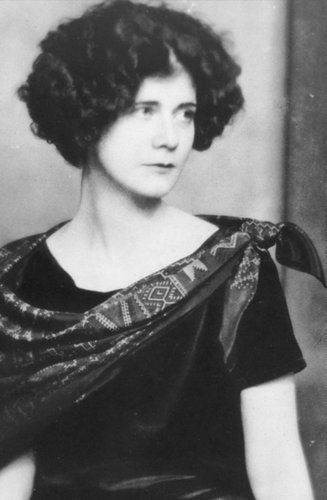
Well, as more-or-less promised, here’s a return to literary poetry that may probably meet audience expectations: a season-appropriate poem by American poet Sara Teasdale titled “September Midnight.” Teasdale’s been a long-time favorite here, which goes back to one of my models of setting literary poetry to music. She’s one of a group of American female poets firmly in the early-20th century Modernist era, reflecting by degrees a Modernist outlook, but without adapting Modernist poetic language and prosody. Others I’ve presented here multiple times with this stance would include Edna St. Vincent Millay and Elinor Wylie, or even Dorothy Parker and Margaret Widdemer.

Canon-wise I sense a push-pull with these poets. On one hand they provide a female poetic outlook that coincides with important cultural movements for women’s equality, but on the other hand they – somewhat like the “Georgian Poets” in Britain – get marked down for not getting on with the new prosody. Of course, sexist blinders enter into this – the very idea of writing from a woman’s perspective is still often weighed as “slight” by the male dons of poetry, who might be Modernist in verse but old-school patriarchs regarding what’s important. For much of their century, the more through-going Modernist women poets like Amy Lowell, Marianne Moore, Mina Loy, and H.D. had to dance backwards in high heels while Robert Frost’s metrical-syllabic net balls were allowed to freely score points with vers libre Modernists.

And all this happened as it slowly dawned on the summary American literary establishment that Emily Dickinson was quite possibly America’s greatest poet. All of which doesn’t necessarily make Sara Teasdale some sort of upper-level-of-the-Pantheon “great poet” in current 21st century estimate.*

Which brings me back to a point I make repeatedly: poetry isn’t some serial single-file hierarchy, which might well direct us to only read the top ten or so – or to carefully guard against anyone paying the slightest attention to poets ranking numbers 238 and below or something. Poetry isn’t poetry, singular – it’s poetries.

Poetry like Teasdale’s likes to be sung out loud, even if there are elements of old-fashioned poetic diction that come along for the ride. That means that this Project puts it thumb on the scale for her work.

Teasdale was a contemporary of T. S. Eliot in St. Louis Missouri, then a commercial hub in the middle of the U.S., but like Eliot her family has roots in New England. Like Dickinson, I can sense the American spiritual thread of Transcendentalism in her fabric, particularly when she writes about nature, as in this poem. Transcendentalists tend to see nature not simply as a handy metaphor for the divine or highest reality, but the very incarnation of it. Transcendentalist scripture isn’t a bound book of thoughts and laws, it’s the Book of Nature, observed.

September Midnight

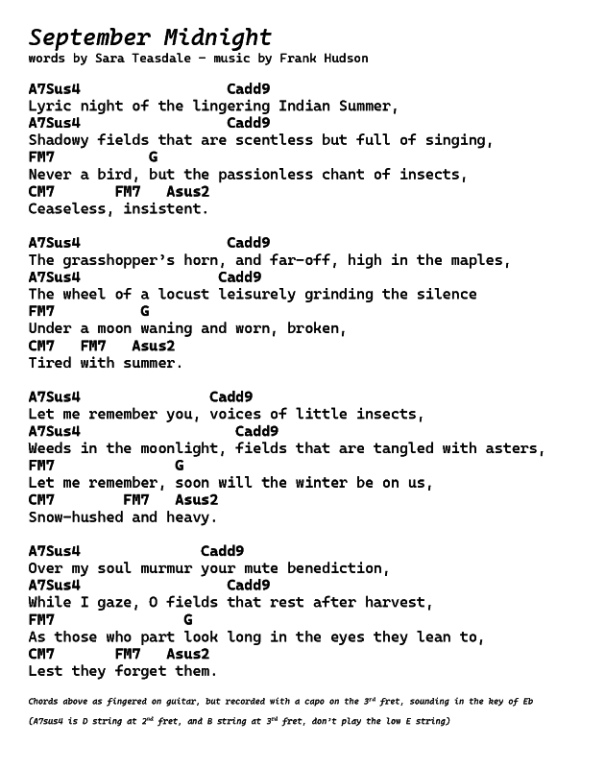
Chord sheet in case your grasshoppers and locusts want to sing this with you.

.


So besides falling easily into a singing voice (even one as limited as mine) her “September Midnight”  is a Transcendentalist hymn I think, and the lesson it wants us to take after our breath and voices finish with it is that we do not presume to go to some heaven after we die, but that heaven (as in the sublime reality) is with us in the creation we are presently living.**

My song performance of Teasdale’s poem can be heard with the audio player below. If there’s no audio player to be seen, it’s not that you’ve forgotten our present heaven, but more likely that the way you’re reading this post eliminates showing the graphical audio player gadget. “If the doors of perception were cleansed everything would appear to man as it is, infinite,” wrote Blake. I write that you can click on this highlighted link and a new browser tab will appear with its own audio player – not quite the same thing, but there’s music in it.


.


*Rankings inevitably become silly, and it’s hard to keep them contained into casual, personal preferences – but still one can fairly observe a 20th century progress with Dickinson from “somewhat interesting and eccentric” to “wow, there’s some deep stuff incredibly condensed into its own original and attractive prosody.”

**I’m thinking today of Annie Dillard, whose work I paid some slight attention to back in the Seventies where parts of what we later think of as The Sixties™ happened. I saw in an obit that she’s yet another American figure who left off from poetry to find an audience. Her one book of poems was quickly eclipsed by the audience for the prose of her second book, Pilgrim at Tinker’s Creek.  Dillard’s “Tickets for a Prayer Wheel”  briefly returned to print more than 20 years ago, and I’ve located and ordered a copy of it.

(Note: as I was proofreading this post, a notice came back that my order for “Tickets for Prayer Wheel”  has been cancelled – now unavailable from that store. I’ll try to re-order this afternoon.)

Let No Charitable Hope

Elinor Wylie once was a reasonably successful poet, back in the last decade that was called The Twenties. I informally group her with some other American women poets of that time: Sara Teasdale, Edna St. Vincent Millay, Dorothy Parker, each of whom wrote often about the complexities of love and relationships. Though none of this group had careers of extended success,* Wylie’s poetry career arc was exceptionally short, contained entirely within the 1920s — though it was preceded by a few years of being a gossip item for a series of romantic elopements and divorces. I wrote a bit about that element of her life a few years back, but it seems that Wylie was playing at the Kardashian-family level of tempestuous celebritydom in her time. Read my link if you want a summary of the tea.

Young Elinor Wylie

Elinor Wylie. Runaway socialite and 1920s poet.

.

So how good was her poetry? Clearly better than the usual celebrity with a book of poetry. She’s highly musical and concise, an irresistible draw to my Project, and while ranking art is a foolish game, her best work stands up well against the trio I associated her with. Today’s piece uses a poem that was called one of her best works when I first read it as poets.org’s Poem-a-Day a year ago. Here’s a link to the poem’s text if you’d like to read along. I myself wouldn’t rank it that high if I somehow needed to rank her poems, though the musicality alone compelled me to set it with music this week. Why do I prefer, for example, her “Velvet Shoes?”  “Let No Charitable Hope”  is a bit abstract, despite the eagle and antelope that are cited in passing and the woman trying to get substance from a stone,** while “Velvet Shoes”  is as sensuous an experience in imagery as in sound. But as a complaint, “Let No Charitable Hope”  probably still connects. Many of us, maybe more for those women reading, are familiar with being misapprehended, of having a hard enough time maintaining one’s own hopes, and to then be asked to try to match the hopes of others. What does Wylie mean by her ending smile in the poem? Is she smiling at how mistaken the apprehension was, or is she allowing herself to smile at her own small lofting of her own hopes?

You can hear my musical performance of Wylie’s poem with the audio player below. I went all-out on the weird chords for this one, so it may not be to all tastes. Is your screen so woozy from fear of odd voicings that it’s obscured any such audio player? No, some ways of reading this blog suppress that player gadget, so I provide this highlighted link that will open a new tab with its own audio player.

.

*Like Wylie, Teasdale died young. Parker and Millay’s political commitment damaged their later careers. The New Morning of the The New Woman of the 1920s had its backlash as well — but this isn’t simple. It’s hard to maintain an artistic career in general, Parker suffered from writerly alcoholism, and some who shared Milay’s politics didn’t think her later work was as good as literature.

**One more concrete image occurs in the poem: masks. The line “Masks outrageous and austere” was sonorous enough for Tennessee Williams to cop it later on. As if sometimes does for me, I thought of masking as in autism, though the syntax of the poem’s last stanza seems to have masking being applied to the years, not the poem’s speaker’s smiling face. Still, I’d expect some ASD readers would see the disconnect of the “charitable hopes” of others viewing them verses their own internal reservoirs of hope and intent.

Endless Circle

Here’s another poem by the lesser-known American poet Genevieve Taggard. Taggard was sometimes classed with a group of woman poets of the first part of the 20th century, all of whom suffered from the rise in the 1920s of “High Modernism” that held that longer poems with elevated metaphors referencing prior literature and art were the mark of seriousness in poetry.

Robert Frost* was able to hold out against this to some degree, but most female poets had a harder time of it. Three poets I’ve presented here multiple times: Edna St. Vincent Millay, Sara Teasdale, and Elinor Wylie all suffered from this change in the culture. Before this change in our last century’s Twenties, they were all prize-winning American poets, and all had achieved a reasonable degree of readership and fame. Somewhere nearing 100 years ago, all of these figures started to be classed as writers of unserious work: merely pretty verse. By the second half of the century when I went to school none were taught in my classes. Not part of the canon.

The poet, professor, and blogger I’ve referenced here earlier this year, Lesley Wheeler, recalls the term “The Songbird Poets,” which exclusive of it’s dismissiveness seems apt to me. The whole idea of poetry as song rather than an impressive castle of elaborate and complex images was in retreat—but all of them could write the kind of short poem that sings off the silent page. I can’t resist turning up the volume on them for this project.

Was their gender part of the downward reassessment? No need to make too fine a point about it: yes. To the degree that the critics and canon formers had an objective criteria, it was to see an excess of emotional content in their work, and they wished for a poetry where rote sentimentality was reduced or eliminated entirely and where overt emotional language was replaced by states revealed in those complex and often academic images.

But one can’t take emotional content out of art, whose whole Unique Selling Proposition is to transfer the experience of experience between one mind and another.  Those who’ve followed our yearly April dive into that High Modernist checkpoint T. S. Eliot’s “The Waste Land”  know that it has a harrowing emotional core, so harrowing that Eliot himself seemed embarrassed by it later in his career. By the time I was introduced to it in the second half of the 20th century this aspect of that medley of lyric poems was absent in the syllabus.

I maintain that song, the word-music of a poem, its structure, order, and how it rhymes its observations, can (just as much as some cool classical image formulating an objective correlative) powerfully contain and convey emotion. “The Songbird poets” were vastly underappreciated for the complexity of their examination of emotion and the human condition. Let us judge these means again as we look at Taggard’s poem. We may be able to look at these works and see what the previous generations couldn’t appreciate: The form her verse takes here is integral to the impact of this poem.

Endless Circle Text


This is a poem that holds itself in a mysterious balance, a Mobius loop of a story fulfilling its title. My reading of it is that it’s a love and death poem that portrays neither as final by its spare and graceful text. As I understand it, it opens with lovers under a tree, who by the second stanza have aged and edged into a death, a transition they mark “laughing and leaping” as if rebirth into youth.

The first verse is then repeated, and I’m feeling it ambiguously. Are they a new generation of young lovers under a tree, fated to love and weep, or has the poem’s singer moved on to a new love, a new desire fated to end in weeping—or are our lovers buried under the tree now, their spirits recalling life?

I don’t always know where the musical accompaniment ideas come from for this project. Sometimes I realize after the fact that I’ve been channeling some musical idea subconsciously. After I finished the mix on my performance of Genevieve Taggard’s “Endless Circle”  I suddenly realized that I may be musically recalling The Incredible String Band, a Scottish group from the weirder fringes of “The Sixties.” I admired their asymmetrical and unafraid to wander song structures and their wide-ranging combinations of various instruments, but I’m always hesitant to recommend them to others because their vocals are (like mine often are) more than a little pitchy.

If that part of my music here bothers you, today’s piece will then. This piece called out to be sung, even if mine is the only voice I have available to sing it today. The player to hear “Endless Circle”  is below.


*William Carlos Williams also fought against this, but he seemed to have felt this academic turn hurt his work’s standing. Marianne Moore is a conspicuous example of a woman who was able to buck the trend by writing every bit as cool and hermetic as any of the Modernist men. Frost himself seemed to write fewer of the short lyrics that his early books featured and turned to longer blank-verse narratives. And another Parlando Project favorite, Carl Sandburg, mixed in longer, more Whitmanesque epics, and turned to his Lincoln biography.

Over in the British Isles I don’t think things worked out quite the same. Why this might be is too long a subject for this post, much less a footnote.

**If you want to read a long impression of what it’s like to listen to an Incredible String Band Sixties album with an open mind and an ambiguous conclusion you could click here: “Makes Syd Barrett sound like Neil f’ing Diamond” it says. Or if you’re too young for that writer’s simile to hit home, think of the weirdest chronic-infused hip-hop mix tape you could imagine, only it’s played by two white guys and their girlfriends on a shed-load of acoustic instruments instead of samples and loops, and autotune clearly hasn’t been invented yet. Or if you’re brave, you could take the adventure and listen to one of their records yourself. Yes, an excess of “canyons of your mind” hippie naivete in the lyrics too, something that Taggard’s form and concision here contrasts with, but there may still be some charm in their work since there’s little danger of it taking over the world these days.