Fall 2018 Parlando Project Top 10 Numbers 10-8


Here we go with our quarterly run down of the most liked and listened to audio pieces over the past season. We’ll be counting up to the most listened to piece over the next few days as we approach winter solstice. Who’ll chart? The most famous poets with their best-loved words? The literary poets’ poets? The poems of the now largely forgotten figures I like to dig up sometimes?

10. “Seventeen Almost to Ohio,” words by Paul Blackburn arranged by me.  Where does Paul Blackburn fit now? Probably in the poets’ poet bin, though he’s also verging on forgotten. He doesn’t seem to have benefited from connections to a poetic movement, though he had them in overplus. He’s sometimes associated with the Black Mountain School, though he himself says he wasn’t really. He visited Ezra Pound and shared Pound’s interest in imaginative translation and the old French Provencal poets, and he is there connected to the original English language Modernist movement. He was based in New York coincident with the New York School of poets though he’s never mentioned as one in any summary roundup I’ve read. The Beats touched edges with the New York School—and with Blackburn, and again there are similarities in their approaches. Perhaps the most significant connection is that Blackburn was a leading NYC-based encourager of spoken and recorded poetry, including being the original organizer of the St. Marks poetry readings, a spoken word radio host, and a recordist of many other poets reading.

“Seventeen Almost to Ohio”  comes from an aside Blackburn made while recording Mina Loy in 1960, where he (apparently) spontaneously recalls an event from his own youth while asking Loy about hers at the dawn of Modernism. I lightly edited and arranged his anecdote and then composed the music.
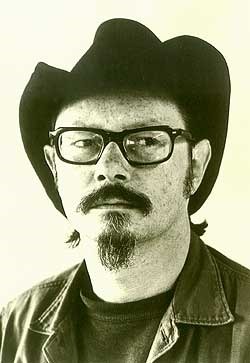
Cowboy_Paul_Blackburn

Paul “Does Jeff Tweedy look like me when he looks in the mirror” Blackburn


9. “Fog”, words by Carl Sandburg.  Early Modernists were fascinated by extreme compression and very short poems, and anthologists since then so often include Pound’s “A Station in the Metro,” Williams’ “The Red Wheelbarrow,”  and this 21-word Sandburg poem. And because it so baldly displays its central metaphor of fog and cat, the poem is often used to introduce grade-school children to metaphor.

In writing about “Fog”  this fall I wondered if there’s anything we’ve overlooked for over a century in this short poem, and came up with this question: Might it matter what kind of cat it is?
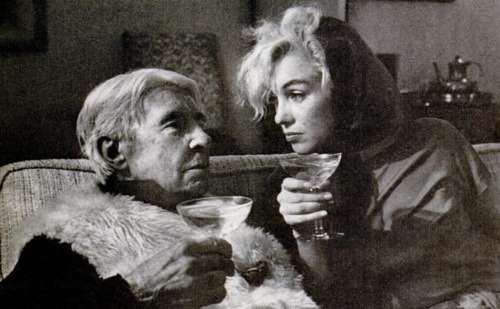
 

Carl Sandburg, Marilyn Monroe and some cocktails, 1962
Marilyn: Carl, Carl, you simply must tell me what kind of cat it was!
Carl: In good time, my dear—but first I need to finish inspiring Sonny Bono’s Sixties look.


8. “The Temple of Summer,” words by Frank Hudson.  Well, I’m almost as short-winded as the Sandburg of “Fog”  in this 31-word Mellotron drenched goodbye to summer. Longtime readers here will already know of my devotion to the sound of this primitive attempt at a sampling instrument used memorably in many late 60s and 70s British Prog-Rock recordings. The real thing is finicky, bulky, and hard-to-find and maintain, but the Mellotron’s sampling of real instruments to strips of recording tapes, whose notes can then be played by a keyboard press, is an easy trick for the computer-hosted Virtual Instruments that the Mellotron inspired and I use.
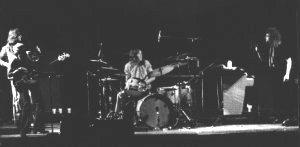
King Crimson with Mellotron on stage

Robert Fripp, on the right with King Crimson, declared after dealing with voltage issues on tour: “Tuning a Mellotron, doesn’t”


Want to nerd out on things Mellotron? This site looks very complete, and for the dabblers, they have just a listing of all the English Top 30 singles that used a Mellotron, which might refresh your memory on where you’ve heard that sound before.


The most popular Parlando Project piece for Summer 2018 is…

Since I’ve been keeping track, one thing has been consistent with the most popular piece each season: it’s been by a poet not widely known or read in the United States. So previously we’ve seen on top after a season of your listening: my translation of Dada principal Tristan Tzara’s The Death of Apollinaire,”  the better-known-in-the UK Edward Thomas’ Adlestrop,”  the too-often overlooked Chicago Modernist Fenton Johnson’s The Banjo Player,”  and Frances,  the teenage love poem by George Washington, whose career as a poet never really took off.

This has happened even though I’ve featured (multiple times) most of the popular canon of pre-1923 English-language poets touched by the Modernist movement of the 20th Century: Frost, Yeats, Sandburg, Millay, Pound, Williams and Eliot.

Pat yourself on the back: the listeners here are open to a variety of writing, and they don’t necessarily need to have a name they already know attached to the words.

Still, it’s surprising that it’s surprising that we have Emily Dickinson coming in at the top spot this past summer.

Dickinson (along with Frost and Yeats) seem to be special cases with The Canon, in that all three have retained some level of popular readership and presence in that still-existing oral-tradition of memorization, even into our current century, without being denigrated into the bin of “not-great poetry.”

Our Summer 2018 most liked and listened to audio piece is “Ample Make this Bed.”  Like many Dickinson poems it’s extraordinarily compressed, just eight lines—and like so many of her poems it invites us in and then mystifies us. Most of us have made a bed, and some of us have even been instructed in how to complete that task correctly. Here, with “Ample Make this Bed,”   we may get six lines into the eight and we haven’t left domestic normality other than the ironic satisfaction with a job, that if done excellently, will stand forever. Ah, if only any domestic housekeeping task can stand ‘till judgement day, rather than the few hours until it needs to be done again!

The poem’s final two lines are so modestly telling and beautiful. Until them, no rhyme—and then internal rhyme and end-rhyme rush in! And the synesthesia of “yellow noise,” an image which could have been informed by Dickinson’s mysterious medical syndrome which included photophobia, but needs no biographic detective work to strike us boldly.

Is “Ample Make this Bed”  about death, domestic drudgery, love, or the unstoppable passage of time? Emily Dickinson seemed to have taken care with her poetry, to make it ample and arranged to last until judgment day, so it’s likely intentionally undetermined—or mystically, exactly, all of those things united.

Musically, I’m quite proud of my music and performance of all the various parts with this one. If you missed it last July, why not go ahead and listen to it now. And if you like it, please let others know about what we do here.

Summer 2018 Parlando Top Ten, Part Three

I’m going to move on up the countdown of the most liked and listened to pieces during the past summer, but first a short summary about what the Parlando Project does, and an even more compressed explanation of why we do it.

The Parlando Project combines various words, mostly written by others, most often poetry, with original music. I am Frank Hudson. I write, arrange, play, and record most the music here. I don’t do that because I’m a great composer, or even an average musician. I do this because it’s the most cost-effective and time-efficient way to create this much music this quickly.

Other musicians contribute parts, and another voice, Dave Moore, relieves you from hearing my voice every time. Ideally there’d be more pieces with more musicians, and more variety of voice; but such an ideal world would require a great deal of organization, maybe even funding and the organization it takes to seek that. The pieces could be better realized, but when I look at the history of such more professional and polished presentations, it seems likely that there would be many fewer pieces. Take a random walk through the archives on the right here: the Parlando Project is now marching toward 300 pieces combining those various words with music. I’m unaware of any not for profit group who’s made available anything like this many poetry plus original music encounters.

Why do I do this? Because I’m still excited by those encounters. Most often these words have been designated to pages, and in some cases, little-read pages. They are the condensed observations of many human beings, potentially vivified by silent music there in the inky words. How can I wake them up and dress them in those other musical sounds that don’t speak in words? You’re listening here, you know that can be intriguing, and so I will not say more now on this.

Why do I do this? Because I’m still excited by those encounters. Most often these words have been designated to pages, and in some cases, little-read pages. They are the condensed observations of many human beings, potentially vivified by silent music there in the inky words.

Now let’s resume our countdown as we get to some of the pieces you liked and listened to the most these past three months.

4. The Destruction of Sennacherib. For around 100 years students in the English-speaking world usually got a strong dose of the British Romantic poets as part of literature classes: Keats, Coleridge, Shelley, Blake and George Gordon, Lord Byron. Here’s the weird thing about that: not a one of these men seem to be good classroom examples for young scholars. Messy, often foreshortened lives; lots of sex, drugs, and what was rock’n’roll before there were Afro-Americans with electric guitars and re-voiced saxophones.

Take this little piece, sure it’s a Bible story, but a field strewn with corpses isn’t exactly happy Schoolhouse Rock fun-time, regardless of the unstoppable flow of Byron’s verse even without adding the instrumental music.


Shelley Shelley and Byron

Mary Goodwin Shelley thinks of doing something different with her hair.  Hit the riff harmonized in fourths: “We all came out to Cologny, on the Lake Geneva shoreline. To make stories with Lord Byron. We didn’t have much time…”


3. Fire and Sleet and Candlelight. Elinor Wylie was heavily influenced by those British Romantics and lived through events that echoed the scandals of Shelly and Byron in her own foreshortened life. Did this help her compose this tale of a life as a series of troubled trials and tests? One could easily suppose this to be so. Still, this piece’s title and something of the life as a trial by fire narrative strongly references an old and pious English Christian folk-hymn, the “Lyke Wake Dirge.”  Combining frightening with beautiful is not an easy thing to do, so it takes more than merely having the life-experience to create something like this.

This audio piece is an example of why I realize these pieces so often by playing all the parts myself. Actually collecting the equivalent of a chamber orchestra and a place to record them would take more than a full summer’s work alone.


2. Morituri Salutamus. There turned out to be a lot of daylight between the other pieces and the top two this past quarter. And this one is the greatest surprise, as its words are taken from a longer homecoming-speech-as-poem by that now most un-fashionable poet Henry Wadsworth Longfellow.

Still, I could relate to this section, which is the opposite of those romantic “live fast, die young, publish posthumously” proposals of the troubled romantics. “Morituri Salutamus”  is the cry of an aged artist refusing to quit, hampered by unavoidable age instead of youthful self-sought excess.

I have no idea of the age-demographics of listeners here, so I don’t know if that was the hook for “Morituri Salutamus”  this summer. Regardless of the pull of taking in experiences as wildly and widely as possible as a way to more intense artistic expression, I’ll admonish younger readers here that the primary duties of an artist are to survive and to actually do the work that survival allows. Like homecoming and graduation speeches in general, this matter is likely eye-rollingly obvious and simplistic to the bravest young listeners. That’s OK, I’ll be back tomorrow with the piece that was even more popular and modern than Longfellow.

Summer 2018 Parlando Top Ten, Part Two

Continuing on with our countdown of the most liked and listened to audio pieces during this past summer here at the Parlando Project, today we’ll look at the pieces that came in 7 through 5 as we move up the list to the most popular piece.

7. The Hunter. Maybe, with Internet audiences, it’s the cats? I’ve playfully included pictures of William Carlos Williams with said cats in a few posts, and Williams, who sometimes thought he was overlooked as an American Modernist while he was alive, seems to be holding an audience, even though his poetry doesn’t present itself with open, easily accessible sentiments. His even more difficult “St. Francis Einstein of the Daffodils  almost gave Williams two appearances here this summer, falling just a couple of places back from the top ten. Or maybe it’s the informal American language that he uses? Other American Modernist contemporaries of Williams: T. S. Eliot, Ezra Pound, or Wallace Stevens often liked to drop leaves from a Word of the Day calendar into their poems, while the New Jersey doctor generally didn’t. Maybe there’s something here with Williams like the cats: familiar and domestic, intriguing, but not seeking to please? After all he once said: “I didn’t ask you to understand anything, only to listen.”


6. The Apotheosis of Harlan Ellison. I’ve warned readers already that this summer’s top ten has too many pieces where I wrote the words, and that’s not representative of what this project is about—and so, here we have the second of three pieces in this summer’s top ten where I wrote the words I perform. Well, at least this one is about someone else, the long-time critic, writer and SciFi anthologist Harlan Ellison.


James the imagined  author vs Jimi the reader of SF

I talked about how Ellison helped encourage Octavia Butler, but what if avid SF reader Jimi Hendrix had decided to go the literary route?


5. Beloved. My words again, although as I tried to explain in the original post here including it, I was inspired by a statement Bobby McFerrin once made about music, how it touches you inside on that sensitive flap of skin named the eardrum. Given that news this past week has included stories about unwelcome touches, that metaphor goes both ways.


WCW with a baby

Excuse me, while I kiss this baby. If cats and William Carlos Williams brings in readers, how about W.C.W. and babies?


Back soon with numbers 4 through 2 in our look back at Summer 2018’s most liked and listened to combinations of words and music.

Summer 2018 Parlando Top 10

It was an odd summer traffic-wise for the audio pieces of the Parlando Project, with listens quite slow in the first half of the season, and then picking up to the point that August listens were a near record. That increase in traffic (new listeners?) may be why we had no older, pre-summer audio pieces that made this season’s Top 10 (though one, Poetry,”  made a valiant run at it).

As we’ve done the last few Top 10 lists, we’re going to count down in trios until we get to number 1, starting with number 10.

10. Crushed Before the Moth.  The Bill James style stat-freak in me has threatened to do a poet/listener batting-average post on which writers seem to get the most and least response. Without really running the numbers, my impression is that Emily Dickinson, who like Frost and Yeats retains a general readership as well as scholarly cred, still doesn’t always hit it out of the park in listens when the audio pieces use her words.

I’m reminded here of one of my favorite bits of baseball trivia, what pair of brothers hit the most major league home runs? The true baseball fan will have many candidates to choose from. The three DiMaggios? (Dom was a very good player, and some have heard of Joe). Or the Alou trio (who once made up an entire outfield of brothers). Or Boyers, Boones or Alomars. But the answer is Hank and Tommy Aaron. Hank had 756 home runs, Tommy crushed only 13—but add it up, and the Aarons come out on top not just alphabetically.

Emily Dickinson’s sister-in-law and confidant, Susan, is not a famous poet, but she shows a bit of the same Emily Dickinson flare in her poem we used for this. Emily has that Hank Aaron level achievement, but Susan had her at bats too.


9. Seventeen Almost to Ohio.   In the several years I’ve been doing this, I still love how pieces arise obliquely as I look for material and research its context. At the end of July, I was looking for more info on Mina Loy, the fascinating Modernist whose work was forgotten for decades and now seems to be attracting increasing scholarly interest. This led me to a tape made in 1960 of Loy being interviewed about her work. The interviewer, Paul Blackburn has now entered that vale of forgottenness himself, but besides being a serious poet with a strong interest in the audio value of poetry, he was a promoter of other poets, so I naturally feel an affinity for him. The Loy interview tape has moments of interest, even though Loy seems distracted and at times uninterested in her own long-past work, and Blackburn, true to our Other Peoples’ Stories ethos, encourages her, but doesn’t fill the gaps by yapping-on himself about, well, himself—as I fear I would have done. Yet, for a minute or two, he does  do that, and this ad lib description of hitchhiking trip from his own youth was so striking I had to form it into what it sounded like to me, a beautiful little poem. It’s one of my favorite pieces from last summer as well as for the listeners here.


My Wars Are Laid Away in Books

Like side-trips? Want to read how a poet who’s fallen into the Forgottenness Zone still bumps around after being laid in books? Edie Jarolim, the teller of this tale, blogged it here — and the more extensive version of her story is here.


8. Plum Tree Blossoms on 40th Street.  The vast majority of the words used here for the audio pieces are not mine. That’s by intent. Both Dave Moore and I have written since our teens, but when I started the Parlando Project I thought that the special jump, the bridging of a gap, that occurs when you perform a piece and others listen may be intensified if the performer too is making the jump across the gap to the writer, just as they are asking the audience to do. This summer’s top 10 will violate that principle three times, probably more than it should.

A number of things I’ve written this year have focused on memory and time, and how they can be experienced in odd ways. How we can intensely experience a past event as if it’s still going on in its full dimensionality, or in “Plum Tree Blossoms on 40th Street,”   how we may fill in sensory information and intensity in remembered events long after they have happened, even though at the time they were occurring they seemed mundane. The routine of biking to school is to my son is just another day to him now, but it can be transformed into something else much later. Artists believe they can access that special intensity and meaning instantly, without nostalgia and the confining frame of memory, and that may be a necessity for their work to be created—but in another sense, what’s the hurry?

The Most Popular Parlando Project Piece for Spring 2018

I’ve already mentioned in this count-down that I’m sometimes surprised at what Parlando Project pieces are the most listened to. It’s not just that it isn’t always the best-known poems, a surprise factor that I’ve already mentioned, but that it sometimes isn’t a performance that I think I pulled off well.

Such is the case with the repeat number one in this countdown covering activity this past spring: Fenton Johnson’s “The Banjo Player.”  My personal discovery of Fenton Johnson goes back to reading James Weldon Johnson’s 1922 anthology The Book of American Negro Poetry.  Fenton Johnson’s work included there immediately stood out for me in its range of expression, from the hymn-like “God Is In the All Time”  through the startling confrontation of spirituality with reality in “A Dream,” to the frank and compressed expression of despair in “Tired.” I vowed to do my best to present Johnson’s range here.

Fenton Johnson

Fenton Johnson

Which lead me to perform “The Banjo Player.”  It’s frankly a humorous piece, though if one pauses after the laugh, there is a serious point being made. Explaining jokes always risks creating more comedy, but the serious point embedded in the joke here is that the banjo playing songster in the poem knows something of his value, but he still feels like he’s a failure because an otherwise uncharacterized woman called him a troubadour, and he’s not even sure if that’s a compliment.

That problematic name for the banjo player is the only way we can characterize that woman who spoke it. Is she, like Fenton Johnson himself, a member of the Talented Tenth, Afro-Americans who had gone to college and who had been charged in the early part of the 20th Century to “raise” the race with their achievements? Or is she a white Modernist admirer of para-literary poetry? We can’t say for sure, and since either is meaningful, the poem works either way; but I lean to the later if only for the word she used.

As so often with Modernism, you can trace something back to Ezra Pound. Just as the Pre-Raphaelites before him, or some hipsters today, Pound looked to the past to find models for a changed, modern future. One source he used was classical Chinese and Japanese poetry, but another was medieval European troubadour poetry.

So even at his lightest, Fenton Johnson makes a sophisticated point here, one that he reinforces by using a location, “The Last Chance Saloon,” in both “The Banjo Player” and his now most-anthologized poem, “Tired.”  In the former it’s a place of some solace, in the later it’s the place were the absence of dignity is numbed.

Returning from those more important points to my issues with my performance of “The Banjo Player.”  I tried to cop a little of that Afro-American banjo tradition. It just seemed the inescapable choice for this. I think I failed, if only because I’m not a banjo player. Such things may be inevitable with the production schedule I’ve practiced with the Parlando Project this past couple of years (something I’ll talk about soon), but to be honest, I’m slightly embarrassed that this piece is listened to so much.

But that’s because of me, not Fenton Johnson. Below is the gadget for my performance of “The Banjo Player,”  but consider listening to some of the other pieces I’ve presented using the words of Fenton Johnson too.

Parlando Spring 2018 Top 10-Part Three

We now come to the top half of our count-down of the most listened to and liked pieces during the past three months. But what if you’re new here, and you wonder what this Parlando Project does?

In short, we take various words, mostly poetry, combine them with original music, and perform them. My intent at the start was not to do this the same way each time, to vary our approach as much as we could. We’ve been doing this for a couple of years, and there are now over 220 Parlando Project pieces available here if you search through our archives. From time to time, as I look at what we’ve done, I seem to notice a “style” developing, and while I have no objection to that arising organically from my predilections and limitations as a musician, performer or composer, when I hear that I usually ask myself “What can I try that’s different?”

The poems are not always the famous ones, I like to mix in some “deep cuts,” but it just so happens that these three recently popular ones are all pretty well-known, but maybe we can bring something new to them?

In position number four we have Emily Dickinson’s “We Grow Accustomed to the Dark.”  Last time I talked about how I’m finding that Modernist poetry in English moved from a recognizable natural landscape freshly observed in it’s early poems to a more interior landscape, another darker country where new dialects of language and syntax seemed the natural tongue of that region. It may well be that WWI, with its unstoppable socially-accepted murders, was a cause for this change. The rise of Freud contributed too. But more than half-a-century before WWI, and decades before Freud published, Emily Dickinson, spurred by American Transcendentalism and her own individual genius, was exploring some of those same places.

When Dickinson gets furthest inside her own head and tries to use her mutation of mid-19th century language to describe it there, she can be inscrutable; but when she’s half-way there like in this little masterpiece, she’s exploring poetic areas that won’t be visited again until the 20th Century.

This is another of the pieces where I think my music works particularly well. Perhaps you’ll agree. Player below:


Funny how these count-downs seem to form a sequence. From Dickinson’s dark we move to the  third place piece, by that little-known poet William Shakespeare, with one of his sonnets about The Dark Lady, “My Mistress’ Eyes are Nothing Like the Sun.”  When we wasn’t supplying titles for late 20th Century Sting CDs, or writing a play here and there, Shakespeare wrote a collection of sonnets that are full of ideas woven of memorable phrases.

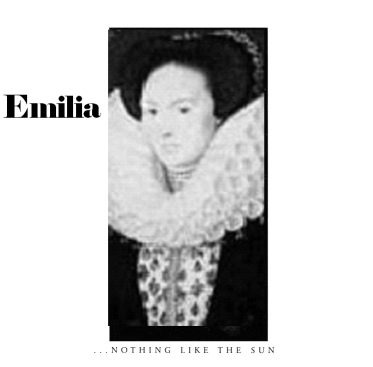
Emilia Lanier Nothing Like the Sun

Emilia Lanier, musician, poet and possibly Shakespeare’s Dark Lady.


I’ve always loved the sonnet, even shared a few of mine here. It just seems the perfect length for a lyric poem, long enough to develop two or three ideas costumed as images, but not so long that one will find them frayed and soiled at the cuffs before it’s done.

Hear my performance of Shakespeare’s Sonnet 130, “My Mistress’ Eyes are Nothing Like the Sun”  with the player gadget below.


And now we’re up to the second-most popular piece this past quarter, Marianne Moore’s “Poetry.”  Shakespeare’s poem in slot number three declares his love by saying the things his beloved isn’t. Poet Moore’s poem about poetry starts off famously by saying she “too dislikes it,” and goes on to tell us what she feels works an doesn’t work as poetry, including the poem’s other famous line about poetry’s goal, to show “imaginary gardens with real toads in them.” I think here again of those early Imagist poems, with their unromantic and ordinary things made into central images: T. E. Hulme’s red-faced farmer standing for the moon or Aldington’s poplar tree as a young woman or F. S. Flint finding the moon taking on the terror of a WWI Zeppelin raid. Toads all, ordinary nature, not the battalions of classical gods or the obligations of sentiment.

This piece’s popularity on Spotify continues steadily, as with “Sky”  from earlier in the count-down, I wonder if it’s the short, somewhat generic title that brings in curious listeners there.

My initial idea of the Parlando Project did not have my voice as the only reader, and the first voice you hear in this version of “Poetry”  is Dave Moore who’s been the voice in a number of pieces over the past two years. The other voices in this performance are two fine poets who’ve spent a lifetime raising toads to see what works in their gardens: Kevin FitzPatrick and Ethna McKiernan. Hear them read Marianne Moore’s “Poetry”  with the gadget below.


That leaves us only the number one to count-down, the most popular piece this past spring. It’s not a well-known poem, and it’s not by a well-known poet. See you back here soon for that.

Parlando Spring 2018 Top 10-Part One

As I’ve done most quarters, I like to look at the most played and liked pieces during the past season and report back here. Usually a few of the results surprise me, they aren’t always my favorite pieces or even the ones that I think came off best.

I do this in classic countdown fashion, so we start off with number ten and move in the next few days up to the number one. The audio pieces for the Parlando Project can be consumed a number of ways. Some listen to them here using the audio gadget on the blog, but others listen by subscribing to us through any of the leading podcast services. The audio pieces are the same, but the blog allows me to write about the pieces in a much richer manner than I can with any of the leading podcast services. However, if you, or someone you know might be interested in just the music and words, this is a handy way to get them on your phone or other handheld. So, if you just want the tuneage, search for Parlando – Where Music and Words Meet on iTunes, Spotify, Google Play Music, or any of the other podcast services. You should find our audio pieces in their podcast sections.

On to the countdown…

Coming in at number Ten is one of the two pieces from May that gathered enough likes and listens to make it, despite having a shorter time frame to do it in, “Letters to Dead Imagists and A Pact.”  I often like to look at who influences the writers we feature here, and this piece lets me do that with short poems from two poets: Carl Sandburg and Ezra Pound. Sandburg tips his hat first to Emily Dickinson and Stephen Crane, while Pound, rather grudgingly, acknowledges Walt Whitman. Despite being contemporaries with similar lifespans, despite both having connections to the American Midwest, despite Sandburg’s use of the early 20th Century Modernist/Imagist poetic practices as promoted by Pound; these are two very different men outside of their work with pen and typewriter. Interestingly, it’s Sandburg’s work that has an obvious Whitman influence though it’s Pound that points to him. Though Pound thought Whitman too careless in his craft, he’s the one that chose to give Whitman his due here.


Speaking of Imagists, at number Nine, we have the poet Hilda Doolittle and her “The Pool.”  Pound acted as a high-handed branding consultant would with  her, reading her poetry and then scrawling at the bottom of her manuscript her new brand: “H. D. Imagiste.” Doolittle writing henceforth as H. D. went on to a long career, and I’ve read that Hilda herself didn’t care much for the connotations of her family name anyway. Maybe that marketing advice helped, but early H. D. work like “The Pool” is  striking short poetry mixing concreteness and mystery, so maybe it was an inspired choice to use the short and less defined H. D. for a pen name.

Musically, I really like what I came up for this one too.


censor smelling woodcut

“Now is a time for carving…” Pound once decried “the exceedingly great stench” of Whitman’s poetry

At number Eight, let’s welcome to our stage the man who Pound said in our number-ten-holding poem “broke the new wood” in free verse poetry: Walt Whitman. What an odd image for Pound to use! In looking at why he might have chosen that image I found out that Pound’s family established itself in Wisconsin by building a thriving sawmill there, so it may be that Pound is liking Whitman to a pioneering lumberman, bold in seizing the ground and resources he found there, while Pound seems to say he pictures himself more as a William Morris style furniture craftsman or perhaps even as a skilled woodcarver.

Three Session men with Carolyn Hester

Straining at connections, because I love this photo so much: folksinger Carolyn Hester once recorded Whitman’s “O’ Captain,” but the 3 session men behind her appeared on many great folk records of the 60s: guitarist, Bruce Langhorne; bass player Bill Lee, father of filmmaker Spike Lee, and in the middle. the harmonica player with the shayna punim cheeks is known to trivia buffs as the father of Jakob Dylan, the leader of the 90’s band The Wallflowers.


Whitman’s “When Lilacs Last in the Dooryard Bloom’d”  is one of a pair of elegies Whitman wrote responding to the assassination of President Abraham Lincoln, and the one I prefer to the other: “O Captain! My Captain!”  regardless of the feelings some have for that other Whitman poem’s use in the movie Dead Poets Society.  Furthermore, Whitman’s lilacs here are one of the reasons that T. S. Eliot’s landmark of High Modernism “The Wasteland”  begins in spring with that very flower blooming “out of the dead land.”


We’ll have numbers Seven, Six and Five coming back here soon. So don’t touch that dial—wait, this is the Internet, you can touch the dial any time you want—but do check back, as we continue our countdown of the most listened to and liked audio pieces combining various words  with original music here over the past season.

And the most popular piece here last season was…

Musician jokes have a cruel streak, though most musicians love them.


“How can you tell if there’s a drummer knocking at your door?”

“Because his knocking speeds up and slows down, and he doesn’t know when to come in”


“Did you hear about the banjo player who played in tune?”

“Neither did I.”


“How do you get an electric guitarist to turn down?”

“Put sheet music in front of him.”


Here’s my favorite. A doctor, a lawyer, and a musician each win 100 million dollars in the lottery. The doctor is all smiles and says, “Oh, this is great! I don’t have to worry any more about arcane billing codes and insurance bureaucracy. I can just treat my patients!”

And the lawyer claps his hands on hearing, and says, “I’m going to just take all my cases pro bono and never again have to represent someone just because they can hire me.”

The musician though is downcast, he says, “Well, I guess I can keep gigging until the money runs out.”

The most popular piece for the Parlando Project this past Winter was Fenton Johnson’s “The Banjo Player.”  Johnson’s poem is essentially another musician joke, but one elaborated with some telling details observed from Johnson’s early 20th Century life.

The banjo is an African-American instrument, something often forgotten in my time until a few folklorists made efforts to set things straight. Fenton Johnson, born in 1888, just one year after Papa Charlie Jackson, knew that world before the guitar picker became the bluesman.

PapaCharlieJackson_GetAlong

Hype-man ad copy circa 1924 for the first ever to record self-accompanied blues .


Yes, he’s poking a little fun at his banjo player, but Johnson’s real case is for his value. It was a cold 20 and icy this March morning, and Johnson says the banjo player’s music is welcome “as the violets in March.”

And the section where I do a bit of a sticks and harmonica breakdown is the heart of the poem: children, who won’t even be able to pay the banjo player dimes like the adults in the saloon, love him like Santa Claus.

Here’s an irony darker than the joke of the banjo player who doesn’t know what a troubadour is. Fenton Johnson, Chicago’s pioneering Afro-American modernist poet had a life a bit like those three in the lottery joke. There was no 100 million, but he was born into an Afro-American family that had somehow accumulated some wealth. He was able to attend college. He dressed well, drove his electric motor car around the city. Like our joke’s doctor and lawyer, he wanted to use his good fortune and talents for good, to raise the status of Black Americans, the present task then for the early 20th Century “Talented Tenth.” And so, he established literary magazines, hoping to start a Chicago variation of the Harlem Renaissance, to promote the arts. But he was also like the musician in the lottery joke. Slowly, as literary magazines often do, those enterprises drained his efforts and his finances. He spent the last half of his life living on diminished means, his pioneering verse forgotten by all but a handful in Chicago.

There’s probably a good novel, play, or movie in Fenton Johnson’s story, but here at the Parlando Project we ask only that you listen for a few minutes to the compressed expression of poetry and some music, best as I can make it. The player is below.


Well that’s it for our look back that most liked and listened to pieces this past Winter. I’ll return soon with some new audio pieces.

March 2018 Parlando Top 10 Part 1

It’s time for that quarterly exercise where we look back for the most popular audio pieces here at the Parlando Project over the past season. I’m going to follow the format we used last time, and break the countdown into four episodes. I base the popularity on the number of likes following their posting here, and the streams the audio pieces received directly from the blog, or on iTunes, Spotify, or other podcast sources. Let’s start the count from the 10th most popular as we move up the list to number 1:

10. Rosemary

Even though these pieces were listened to in the Winter for most of our listeners*, Edna St. Vincent Millay’s words have a kind of spring-cleaning of the heart vibe, and so may be apropos for opening the windows and letting the curtains blow around—or at least they will in a few weeks when it warms up here in the northern part of the northern hemisphere. I awoke to 10 degrees Fahrenheit and snow and polished ice myself today.

I rather liked the music I wrote and performed for this one, just as I have liked going back to Millay to reassess the strengths she brought to poetry. Millay’s popular reading audience, once substantial, hasn’t completely disappeared, and there’s a welcome re-assessment of her poetry starting in academic circles.


9. Stopping by a Woods On a Snowy Evening

I’ve featured Robert Frost’s words quite a bit here, perhaps to atone for my dismissal of him when I was a teenager as the kind of worthy poetry in our schoolbooks that we needed to move beyond. Two things were key to my learning to love Frost: his uncanny ability to write lyrical verse that sounds natural, and my finally noticing the dry wit and stoicism that underlies most of his work.

Frost, alone of his American generation, has retained a level of popular appeal and critical approval. He’s double-edged in maintaining that. Some are captured by the surface of his poetry, hearing and maintaining in their memory the catchy moral-of-the-story “big choruses” of Frost. In this poem, it’s the “I have promises to keep, and miles to go before I sleep” at the ending. Others listen carefully to the verses, the parts other than the lines we most remember, the parts we can come back to and find that we’ve forgotten were there. When I came to work musically with this poem, I’d forgotten those. There’s no lovely woods to see in this dark night. He may be lost. He’s so dark and alone that he can hear snowflakes sweeping across snowbanks between the jingle of his rig’s harness bells.

Musically, I was obligated to add shaker bells percussion to stand for those harness bells, but then, more obscurely, I decided to add a South-Asian tambura drone for the sweep of snow.


amedeo-modigliani-pierre-reverdy

Modigliani’s portrait of Pierre Reverdy


8. Clear Winter

I was a terrible French student in my little Iowa high school and my little Iowa college. I seem to have no ability with languages, and less than no ability to handle those accents and the reforming of the mouth that makes speaking a foreign language possible. But I love poetry translation. I feel like a paleontologist removing the clods of sediment from a skeleton. Slowly, painstakingly, there it is, just as it was in its moment of sudden! But then my task shifts, and I must become the process of fossilization, to find the minerals of English that can fill in for the sinew and feathers of it’s original language.

I had a great time with the challenge of Pierre Reverdy’s “Clair Hiver.” I’m unsure of the accuracy of the “tea-kettle” section of my translation, but I fell in love with it, and could not abandon it, even if the light behind Pierre Reverdy’s eyes cannot reach the little anteroom behind mine.


*web stats I get for the streams tell me I have as many recent listeners in Australia as I have in Texas—and one listener in New Zealand. Bret, please tell Jemaine that there’s a lot of good stuff to read and listen to in the archives you’ll see listed by months on the right.