Today’s report on the most listened to and liked pieces featured here over the past quarter will show three experiences of the mystery of winter. So, let’s return to our countdown:
4 Twilight Fallen White and Cold by Joseph Campbell. I seem to have become something of a promotor of this little-known in the United States Irish-born poet who I still know little about. He published a series of poetry collections before the end of WWI, and then his poetic output dropped off, for reasons I’m not yet clear on, though the politics of his country’s decolonization struggle may have contributed. This piece using his words that a lot of you liked and listened to may be the most mysterious of today’s trio.
Best as I can figure it, this winter nature landscape poem may be an expression of his nation’s detracted state and situation, particularly in the invocation of ancient earthworks (raths) and burial mounds — but I cannot plumb the entirety of the refraining line of “wounds of Eliom/weep on me” that I feature in my setting of Campbell’s poem. Eliom is a plural word for gods, sometimes used for polytheistic gods, sometimes used for the singular monotheistic diety, and as it may be here, used for angels. If that’s so, then the starry constellations, the winged vampires, the curlew birds, the floating mists, the carrying sound of the ocean are all the Eliom, the angels in this changed winter nighttime vision.
To hear my setting of Campbell’s poem, you can use this highlighted hyperlink which may open a new window with a player, or in many cases, you’ll see a player gadget below to directly play it.
.
It’s been too long since I’ve said this: thank you for coming to read or listen here. It’s become harder for me to respond to comments or properly promote this project, but I appreciate so much those who come here, listen, and let others know what the Parlando Project does.
..
3 The Snow is Deep on the Ground by Kenneth Patchen. Lawrence Ferlinghetti, whose words we met earlier in this countdown, would sometimes remind folks that he wasn’t really part of the Beat Generation, even if he was associated with others who might have been so thought. Patchen is a similar case, or perhaps more so, in that his poetry career started in the 1930s,
As with many of the best Patchen poems, even the political ones, this is a love poem, delicately poised between the enchantment of love and the world that allows the shattering of it. If one can fully absorb the illumination of this poem, as with some of the best of Patchen, you would cry tears of joy and sadness at the same time.
You can hear my performance of Patchen’s “The Snow is Deep on the Ground” with this highlighted hyperlink, or if you see it, with a player gadget below.
.
2 The Sky is low by Emily Dickinson. Some years back in this project I once compared Emily Dickinson to one of those unexploded, yet potential, bombs that are still unearthed in Britain or Europe from the World Wars. Originally she was found as the creator of curious little poems from an eccentric woman, then as a prescient 20th century Imagist, and now in our deconstructed age we can stare at one of her tiny poems, and like one trying to follow the decent of a single flake of snow in a flurry, fall as far as one can follow.
You can read, or listen to my performance, of “The Sky is low” and find a whimsical nursery rhyme, and find enough enjoyment in that — but let it stick in your memory or repeated ear and a little dialog about predestination, first causes and fate is discernible. To listen, use this hyperlink, or you may see a player gadget to directly play it below.
.
One more post in the Top Ten countdown to go, and then we can move on from the mysteries of winter to the mysteries of spring.
Let’s pickup the countdown of the pieces that drew the most listens and likes over this past winter. Each bold-faced listing is a link to the original post on the piece in case you’d like to read what I wrote back then, and those original posts will also contain links to the full text of the poems used.
7 Thursday by William Carlos Williams. Quite often when reading through early 20th century Modernist poetry, I repeat my surprise of how plainspoken and outwardly simple some of it seems. This poem by Williams is one of those. There’s not a single word in it that would be unfamiliar to a grade-schooler. One need know no complex allusions to anything other than ordinary life. Not all his contemporaries wrote like this. Wallace Stevens will pleasingly stump us with his love of obscure words, T. S. Eliot will ask us to consider how history rhymes its myths, and William Butler Yeats will make English sing with beautiful and metrical word-music. Against that sort of thing, this poem by Williams may seem ordinary. As ordinary as a Thursday.
There’s only one bit of word-trickery in it — and having no other in this short poem should invite us to ponder it: that unusual use of the common word “carelessly” in the context of “I remain now carelessly/with feet planted on the ground….” Carelessly? Huh? How many quick readers would slide over that and not notice anything out of place! In the opening of his poem Williams has told us his dream has come to nothing. Is this dream one of our ordinary nighttime hallucinations or a strong and potentially life-changing imagination for the course of things? He doesn’t say and may perhaps mean either. His stance on this? Back to observing the world standing simply and unmoved with both feet on the ground, “carelessly” in the sense of “without a care” regarding that; with the sense also that the overlords of guilt and ambition or the lure of more surreal and spectacular verse are saying he should care and he’s going to ignore them.
In place of that care, of that “tyranny of the shoulds,”* Williams offers us ordinary life, ordinary words, the meditation of breath. That resilience and carelessness, those two steady feet able to stand up to the sky, is this song. You can hear it with a player gadget that may appear below, or with this highlighted hyperlink that will also play it.
.
6 I wake and feel the fell of dark by Gerard Manley Hopkins. What a combination this makes with Williams’ poem that it happens to sit next to in our countdown! Hopkins’ poem has its speaker also awakening from a non-productive dream “Hours I mean years, mean life” — this dream is clearly both a nightly and a life’s dream. And he’s in the opposite of careless: roiled with distress and self-disgusted guilt over it.
What a combination this makes with Williams’ poem…
The language here is extra-ordinarily charged. Some of us have had such a self-castigating night, but few of us could express it in such a tight compressed form as a sonnet that moves musically and emotionally. Hopkins’ feet are not firmly on the ground at all — he’s rolling and tumbling as the great American floating Blues verse has it — and that’s the nature of Hopkins’ song.
This is the distress half of the engine of the Tao. We may more easily recognize it quickly as great poetry, and should, though without some balancing aspect it cannot long whirl.
My performance of this greatest of his “Terrible Sonnets” can be heard with this hyperlink, or in cases where it appears, the player gadget that may be below.
.
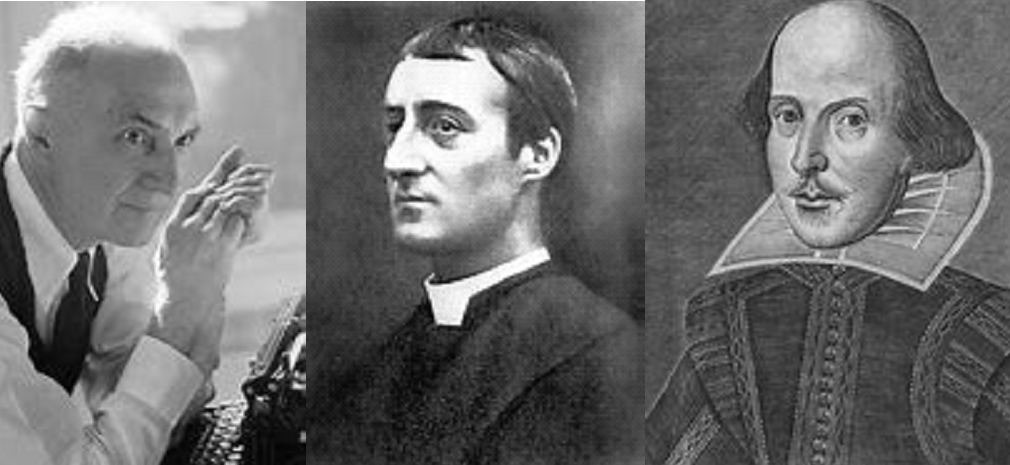
Collar styles of poetry, a retrospective. William Carlos Williams, Gerard Manley Hopkins, and William Shakespeare
Well, the jury’s still out on that one. It is always so with art, as art happens in the present when we look, read, listen, hear. That’s a large part of what this blog is about: encountering stuff written in various ways and times and seeing what we can make of it in the immediacy of a musical performance.
“Sonnet 97: How like a Winter hath my absence been” is neither the calm meditation after a dream’s failure nor the roiling disgust our first pair of poems had. Instead, this sonnet is all about the ambiguity. What kind of ambiguity? Shakespeare will pick several. One of the basest tests of mental state is “oriented to time and place.” This poem certainly isn’t — that’s its most pressing point. Is it winter, summer, fall, or spring? Can’t say for sure. The purportedly male authorial voice dons rhetorical drag and speaks of his sonnets as if they are birthed from a poetic womb as if the addressed “fair youth” is the only begetter in a very patriarchal metaphor for these sonnets. And what’s the true nature of the relationship between that authorial voice and the fair youth being addressed? Complicated. Author as vassal of the ruling class?** Lover? High-minded patronage? Some of all? Well, that’s Shakespeare’s song for us. This hyperlink will play my performance of it, or if you see it, you can use a player gadget that may appear below.
.
*The phrase is psychotherapist and author Karen Horney’s, whose mid-20th century work may still have something useful to say about us today.
**It was while dealing with this sonnet that this aspect of the “Fair Youth Sonnets” first occurred to me. I assume it’s occurred to others, but not being a Shakespeare scholar I can’t say who or where.
I’ve been tardy in many things for this project lately — but let me get on to recounting which pieces were most liked and listened to during the past quarter.
It may be a bit strange to revisit a winter we are glad to be emerging from, but poetry is about remembrance of all kinds of emotions and experiences. Which ones did the Parlando Project readers and listeners most connect with?
As we usually do, this is a countdown, so we start with the 10th most listened to and liked piece, and then over the next few posts we’ll move on to the most popular this winter. The bold-faced titles are links to the original post that introduced the piece in case you want to read what I wrote then.
.
10 Trifles – I Know What Stillness Is by Susan Glaspell. I wanted to do something special for this project’s 500th audio piece, and I decided to try to use some words from my distant relative who was herself a figure in the Modernist revolution of the early 20th Century that I mine for many of the pieces used here. Glaspell is not a poet like most writers I present, but this short scene is from what remains her most famous work: a still effective short play about two women who have accompanied their husbands who are charged with investigating a murder* in a remote 1900 Iowa farmhouse. At this point in the play, we know that a farmer has been strangled there and that his wife, Minnie, has been taken into custody as a suspect, even though there is some doubt that a small, quiet woman could have had the motivation and strength to commit such an act.
While the men continue their very official investigation, the two women discover a dead canary entombed in a fancy box and connect it with the lonely life of the farmwife. Should they tell their husbands what they found?
I solved a difficult problem by treating this scene as “poetic” enough to work with the music and then locating a dialog performance that let me avoid trying to do the voices of the two women myself. I’m also quite proud of the music I composed for this one. You can hear it one of two ways: this highlighted hyperlink, or for some of you, a player gadget below.
.
Susan Glaspell getting her work done. Per the radio-play practical audio-effects tradition: in the wintertime it’s nice to sit next to the crinkling cellophane and work on your manuscript.
.
9 The world is a beautiful place by Lawrence Ferlinghetti. I bent the rules to publish this older performance that Dave Moore and the LYL Band did with my off-the-cuff reading of a piece from Ferlinghetti’s A Coney Island of the Mind collection that so many treasured decades ago. These words are not in the public domain, and I had never received a reply when I sent in inquiry about presenting them here a few years back, but on the occasion of Ferlinghetti’s death I felt I had to share this with you, some of whom are among those that treasured those words.
But maybe some of you hadn’t “met” Ferlinghetti’s words before. Buy or read his book and meet more. Perhaps a few of you have an idea that the label “Beat Poetry” requires a dour and slack protest, a litany of muttered and solipsistic defeat. Maybe that’s not so.
.8 Escape by Georgia Douglas Johnson. I still know little about this “Harlem Renaissance” writer who wasn’t actually located in 1920s New York City. As time for this project gets harder to locate, I still hope to remedy that. Despite my deteriorating ability to complete new pieces, I made an extra effort this year to do work celebrating Black History Month this February, using work found in the landmark The New Negro anthology published in 1925. “Escape” was the one that found the most favor with this Project’s current audience.
Musically, I used the magic of MIDI “virtual instruments” to pay tribute to the Afro-American fiddler tradition, playing the featured violin part on my MIDI pickup guitar. At the end of the recorded performance, I tacked on a verse by the altogether unrelated Moondog, a musician who ironically was connected to New York City. Here’s the link to hear my performance, or if you see it, you can use the player gadget below.
.
*Glaspell was able to use her earlier reporting on an actual Iowa murder case as matter in her ground-breaking play.
Sunday is World Poetry Day and I should do a piece about poetry and poets to mark it. The specific idea of World Poetry Day is to celebrate every nations’ poetry, something I try to do here with fresh translations sometimes, but for today I’ve decided to use works by two American poets. The United States is still a young nation, still used to using the cruder tools of youth to impress itself upon the world, but our poets have had their innings, so today I’ll sing them to the rest of the world. First up: Wallace Stevens.
It’s not uncommon for poets to write poems about art or the art of poetry itself, but Stevens did this often. So it’s no surprise that “A High-Toned Old Christian Woman” starts off with an assertion about poetry, even though the rest of the poem seems to progress into an argument about religion and religious propriety. Here’s a link to the full text of Stevens’ poem in case you want to follow along.
Stevens’ poem slows down our understanding of what it means using two tactics. First, it gives us at best one-half of a conversation: a little like hearing a person talking on a phone in public where the other party is inaudible. It takes considerable effort in comprehension to settle on what issues and points are being addressed in the poem’s speaker’s argument. I’m not totally certain I grasp them myself despite several readings and going on to perform the piece. Our high-toned old Christian woman may be expressing outrage at some more pagan and unfettered artistic expression on Stevens’ part. Stevens’ response is to point out that art has its own religion of a sort, its own myths and beliefs. That unheard party, the HTOCW, seems to make an objection regarding Stevens’ or art’s outrageousness derived from its beliefs and theoretical constructions, and Stevens’ then parries with a short aria on the extremes of Christian asceticism bellowed over a tink-tank Vachel-Lindsay-ish Salvation Army band. In summary he’s claiming they are alike: that the HTOCW and her co-religious cohort and he the poet both have their own guiding constructions (supreme fictions), their own expectation of meaningful belief and actions that promise — well, what do they promise, or rather assuredly deliver?
He’s not sure. A poet’s masque (a play) performed on earth may aspire to cosmic importance, but we can be sure the planets will not be all that moved. And the most fervent displays of religious piety can’t move the heavenly spheres who would at most judge them as unserious “hullabaloo.”
The second way Stevens intentionally slows down our comprehension is with language, the stuff and lexicographic music of his poetry. Most any stanza of a Stevens’ poem is equal to a “Word-A-Day Calendar,” and this poem doesn’t disappoint: nave, citherns, peristyle, masque, epitaph, flagellants, muzzy, and hullabaloo are not common modern English language words, and I’ll wager that most readers, even the most educated among us, would be hard pressed on getting 100% on a definition test with that list.* I’ve always “read” Stevens as having fun with his use of these obscure words, and in many cases here he’s punning on their sound, so we think we understand something we hear in a performance from the sound, while on the silent page they remain stumpers. Making someone a nave/knave is to fool them. A peristyle projecting upwards sounds like a periscope from a WWI U-boat or trench. A masque might as well be a mask. Flagellants with muzzy bellies sounds like flatulence from fuzzy bellies.
And while not an obscure word, “palm” is repeated several times in the poem with different meanings pressed onto it by context. It first seems to be Christian praise, as in the arrival of Jesus into Jerusalem on Palm Sunday, a moment of triumph to be followed by Good Friday (and then, yes, for believers, Easter). In its second mention, the poet might earn laurels, palms of honor for their work, but like the praise of the crowd it may be fleeting, pace what I call Donald Hall’s Law. And lastly, the palm plants become hands I think, the two seemingly opposed, the two sides — the prim believer and the pagan poet that the poem has satirized — I believe, palm to palm, a pair making a prayer.**
Let’s look at the poem’s end at last: Stevens seems to be saying that salvation by faith in art or religion is unclear. Widows wince when doubt says they may not meet their husband in heavenly reward or when that doubt (or belief) is sung impiously by some poet who calls his art, his mythology, the “Supreme Fiction.” God and the muses are both winking at us, telling us that we only half have an understanding, flirting with us on that unknown stage of our best fictions.
Stevens was a famous late-starter, publishing his first poetry collection Harmonium where AHTOCW first appeared at age 44. Millay was already on to her second collection featuring First Fig at age 28.
.
What then to make of the poem I combine with it, a short poem with plain words that many feel they understand at first sight: Edna St. Vincent Millay’s “First Fig,” the one that begins, as so many have memorized, “My candle burns at both ends.”*** Is this not also a poem of faith in poetry? Yes, with the same limits and lack of assuredness. Is it also one half a debate with another point of view? Yes too, though it be a short epitaph “unpurged from bawdiness.”
In effect, “First Fig,” the opening poem in Millay’s A Few Figs from Thistles, is the title poem, the dedication of that short collection that set out the Millay outlook on youth, freedom, and autonomy sexual and otherwise. It made her famous for a while, and unlike Stevens’ knotty poems, hers (and herself) seemed understandable. Here’s its full text.
We understand this poem quickly to say: that one may, from our passions artistically — or otherwise in that mere and yet larger life — expend or risk so much that we allow it to be foreshortened, but that we believe that intensity is illuminating, possibly worth the sacrifice. Note, there’s no explicit conclusion. Millay’s poem doesn’t say outright it’ll be worth it, and other poems in A Few Figs from Thistles are not sure either. Its illumination is brief, a night in length it says. Yet a poem we think we understand, that we might memorize and carry in our muzzy brains may change as we project its light on different walls.****
Given Stevens’ satiric and philosophic wordiness, I came to think pairing it with Millay’s short heart-song would be a worthwhile contrast, each stronger with their lights against the ground of the other. You can listen to the performance and see if that’s valid — but before I go, is there one thing we don’t understand about Millay’s short poem?
Well, there’s the title. It’s such a short poem, yet we forget that there’s this added pair of words. I’d guess that many that know or have even memorized the poem forget the title. One thought was that it might be referencing an idiomatic English expression: “I don’t give a fig about…” which could easily be given an intensifying modifier “I don’t give a single (or the first) fig about…” I had assumed that fig, like the euphemistic interjections sugar or darn, was just a word used to replace a ruder word that started with the same letter-sound. I even wondered: was that idiom around when Millay wrote her poem in 1920? Well, just as I wouldn’t know muzzy or cithern fully when I read Stevens, it turns out I was off a bit. The idiom seems to date back to Shakespeare’s time or even more, which is odd in that the fig isn’t even a native fruit in England. It comes from Spanish and Italian; and it’s not only a word but it has a Mediterranean hand gesture to illustrate the thought, involving the thumb placed between two raised fingers. The intent in gesture or word in this idiom is to refer to low pink-toned lady parts, and in the patriarchal context then it’s an expression of contempt.
Did Millay know the derivation of the idiom? I don’t know — but she likely knew the non-etymological meaning of the phrase. In the context of the one-side of the debate that “First Fig” is presenting, that indicates that the speaker doesn’t give a single fig for the off-screen speaker who disapproves of the possible costs of passion.
Long post, but two poems for this World Poetry Day! The player gadget is below, or if it isn’t, this highlighted hyperlink will also play my performance of Wallace Stevens’ “A High-Toned Old Christian Woman” and Edna St. Vincent Millay’s “First Fig.”
.
*Ones I’d miss or get half-credit for? I knew citherns were an instrument from my interest in unusual instruments, but I wouldn’t be able to describe one definitively. I probably once knew peristyle from an early interest in classical theater, but had forgotten its meaning. Muzzy was dark to me and would have been a clear miss. A good dictionary then or the Internet now allows us to decode the original denotative meanings, but these still keep us from understanding Stevens too soon. And they can just be fun to come upon in a poem!
**This blog post and close reading, perhaps from more knowledge about Stevens’ biography, posits the HTOCW to be based on Stevens’ mother.
***If HTOCW may be Wallace Stevens’ mother, one of those that had memorized Millay’s “First Fig” was my father, who once or twice recited it to me. What caused him to memorize it, or to read Millay? I never knew. He never lived a bohemian life, and as far as I know he lived a modest, constant, and long life. I can guess however why he recited it to me, who did have my bohemian modes and times: to say that he knew something of that, or that I could have faith that something worthwhile could come from that.
****I’m increasingly seeing readings that see coded (intentionally or unconsciously) in this poem an expression of Millay’s bisexual/polyamorous autonomy.
Here’s a piece celebrating our Spring springing forward that’s also appropriate for America’s celebration of Irish heritage on St. Patrick’s Day. It consists of three short poems by the Irish poet Joseph Campbell.* I put them together as I think they somehow increase their individual power presented that way. I call the combination “Sail-Moon-Sheep.”
Campbell was also an artist. Here are his own illustrations for the three poems I used today: “Sail Answers Sail,” “The Moon,” and “Sheep.”
.
Campbell is one of the more fascinating discoveries I’ve made while doing this project. As far as I can tell he’s largely unknown in the United States, even though he spent some time here between the World Wars. And while it’s harder for me to assay his position in Irish arts and culture, he doesn’t seem to be highly esteemed and remembered there either.
What draws me to present him then? First, he seems to be an early Modernist poet, who writes in a mode those pioneers used — one that I think bares reconsidering today: short poems that present charged emotional states by physical description while eschewing both tired conventional metaphors or overly elaborate original imagery. A hundred years ago there was a name for this kind of writing. It was called Imagism. It rose as a force in opposition to established literary styles, flourished briefly attracting both writers we still celebrate and even some not-inconsiderable popular interest, and then was largely discarded for further evolutions of Modernism.
Campbell didn’t always write in this style, but he did so often enough for me to have work to present here. I’m not sure exactly where or when he picked up this mode of poetic expression. Today’s pieces are from a 1917 poetry collection of his called Earth of Cualann, a year when Imagism would have been in more common currency as a poetic style, but he seems to have used it occasionally before 1910 when he might well have been independently inventing it — or he could have had some as yet undiscovered connection to the small pre-WWI Anglo-American group in London that would give the Imagist style a name.
Chinese ideograms for sail (or rather, boat), moon, and sheep (though more at goat I gather). Some of Campbell’s poems seem to me to work very much like classical Chinese poetry too.
.
Secondly, he is like Yeats, intimately involved in the Irish cultural renaissance** that was an engine driving to Irish political independence. Indeed, in that second event he seems even more involved, perhaps to the detriment of his poetic career.*** My 20th century brought forward many anti-colonialist artists, but America has it’s own colonialism (both internal and external) and English language eloquence on these matters may be useful to us. Often when reading Campbell I think that aside from some simple translations of particulars I could be reading a poem by someone of American-Indigenous heritage and culture. Campbell’s connection to nature and his native landscape is deep and inescapable.
If one reads a book of Campbell’s poems, this repeated connection to the landscape and its history is so deep that it’s impossible to not think of it as an Imagist expression of a spiritual or religious feeling**** in the poems, even where that is not overtly mentioned. I know next-to-nothing of Campbell’s religious beliefs. Catholic Christianity is sometimes invoked, and at other times a Neo-Pagan-like stance seems to be displayed.
Well, it’s so like this project to say a whole lot about three very short poems from Campbell’s Earth of Cualann that I present in the expectation that they hang together as a portrait of Spring, and then a Spring in a nation in need of renewal. It’s an Irish man’s depiction, and let us celebrate that too, but perhaps I’ve opened you to some further ways to consider that.
*As I must always say when mentioning his name — no, not that Joseph Campbell — this is another man who also used a Gaelic name Seosamh MacCathmhaoil.
**It would not surprise me if the instigators of the Afro-American Harlem Renaissance featured here last month were not aware of the power of Irish elevation of Irish art, history, artists, and culture as a pre-requisite to self-determination as well as a significant argument for their value as citizens. And in other anti-colonialist cross-pollination: consider the mutual admiration of Rabindranath Tagore and William Butler Yeats, or Gandhi’s example to Martin Luther King.
***Imprisonment and exile, for two examples, were involved. Knowing a little now of some of the impassioned factions even among and between the Irish Nationalists, I fear finding out more of Campbell’s actual political beliefs, alliances, and possible revolutionary actions. It’s also plausible that it may have reduced his stature in Irish literature, as political opponents divided by violence often are unconcerned with merely literary merits.
****Remember, Imagism expects there to be few, if any, overt use of words naming emotions or reactions to what it is depicting. It expects — and when it works, it may even compel — the reader or listener to supply their own internal emotional reaction and impact from the poem’s description of a charged moment.
Some people live so long as to make time and its boundaried eras seem a foggy measure. Such a man was Lawrence Ferlinghetti, the American poet, painter, and bookstore owner who predates and post-dates the Beat poetry scene — or for that matter the Hippie scene, and our century’s activist eras and its search for peace and justice. If you are a fan of generational short-hand (I’m not) you will notice that every one of those eras was widely denounceable as impractical, delusional, and in most ways inferior to those that came before that.
“Thank you for your service” is the reflex response nowadays. Surely due, but I think also of his post-war service, helping promote a new more vernacular American poetry via his work, encouragement, bookstore and small press. His own 1958 poetry collection A Coney Island of the Mind was immensely popular,* and seeing it or Allen Ginsberg’s Howl and Other Poems (which Ferlinghetti published**) in their paperback black and white form was once a common marker in smoky apartments during my youth.
Around the time this Project was beginning I performed a couple of Lawrence Ferlinghetti poems live with The LYL Band. I’d actually hoped to get permission to post those performances someday, but emails to City Lights garnered no replies. Hearing today of his death, and thinking of his life that well-lived, I thought inescapably of this poem of his from A Coney Island of the Mind entitled “The world is a beautiful place.” I’ve decided to post our performance here in the spirit of gratitude and in memoriam. If any rights owner objects, let me know, and I will remove. The player gadget for our performance is often below, but this highlighted hyperlink will also work if you don’t have the gadget on your screen. If you want to read silently, or read along, here’s a link to the text of Ferlinghetti’s poem.
.
Want to hear another version of “The world is a beautiful place?”
*Some accounts say Coney Island is the most popular poetry collection ever published in English. I’m not sure of that.
**Was Howl a big “get” that he was lucky to land for City Lights? Not exactly. He was put on trial for publishing it, and Ferlinghetti figured he’d go to jail. The Fifties judge, to some surprise, ruled it not obscene.
Continuing in my celebration of Black History Month, I’m going to return to the 1925 anthology that is often thought of as the launching point of the Harlem Renaissance, The New Negro. This book’s editor Alain Locke wanted to demonstrate the breadth of new expression by Afro-Americans in his time, and so concentrated on young and living artists for the most part. In traveling back to 1925 to visit this book, I have to readjust myself to the way Locke and his alternate presenters frames these young artists compared to how someone might do so today.
Each essay I’ve read so far in The New Negro is written in a careful and august style. Don’t get me wrong, the style is not overly academic, and the introductory essays don’t descend into esoteric terminology. It appears that Locke wanted this book to speak to any educated person, white or Black — and probably to non-American’s too. But there’s a focus on the fine arts and how Afro-American work may be measured favorably in those fields — and then some discomfort with the popular arts where Afro-Americans are also increasingly visible to white folks.
There are some complex reasons for that, more than today’s post will have time to go into in any depth. The simplest heading for a large concern there is “minstrelsy,” the long-standing and once highly popular American tactic of using Black characters to represent unvarnished and unrepentant foolish and clownish behavior,* extended often through the use of white actors or artists portraying Black characters. In the popular arts, some of the breakthrough “cross-over” artists of Locke’s time were working off the grounds of this comic and derogatory white approximation of Blackness, giving them back a Black reflection of a racist white reflection of Blackness. Tough way to work!
Midway through I’ve come to the book’s section on music, and in this case Locke himself leads off that section with an essay somewhat different from the main thrust of the book, a lengthy appreciation of “The Negro Spirituals,” a folk music form with almost entirely anonymous composers that came to cultural attention in the 19th century, not in his modern 20th. Locke deftly deals with the dialect of those lyrics, and even at times concedes a judgement of simplicity on the music, countering by pointing out the — well — spiritual concerns, and the evident depth of feeling. He points out that European composers had long been drawing on that continent’s folk music and orchestrating it for concert halls** and suggests the same may be a path for Spirituals going forward.
The next essay in the Music section of The New Negro does speak to a 20th century Afro-American form, one not yet considered a fine art: “Jazz At Home” by J. A. Rogers.*** Rogers has a lot to say in his essay, and for someone like me who many decades later became interested in Blues, Jazz and their descendant forms, it’s interesting to see how one intelligent Afro-American in the middle of the emergent “Jazz Decade” of the 1920s viewed this music. Here’s a few excerpts that will give you the flavor:
The Negroes who invented [Jazz] called their songs the ‘Blues,’ and they weren’t capable of satire or deception….[Jazz] is a release of all the suppressed emotions at once, a blowing off of the lid, as it were. It is hilarity expressing itself through pandemonium; musical fireworks…..in idiom — rhythmic, musical and pantomimic — thoroughly American Negro; it is his spiritual picture on that lighter comedy side, just as the spirituals are the picture on the tragedy side. The two are poles apart, but the former is by no means to be despised and it is just as characteristically the product of the peculiar and unique experience of the Negro in this country.
Jazz, it is needless to say, will remain a recreation for the industrious and a dissipater of energy for the frivolous, a tonic for the strong and a poison for the weak. For the Negro himself, jazz is both more and less dangerous than for the white — less, in that he is nervously more in tune with it; more, in that at his average level of economic development his amusement life is more open to the forces of social vice….Yet in spite of its present vices and vulgarizations, its sex informalities, its morally anarchic spirit, jazz has a popular mission to perform. Joy, after all, has a physical basis. Those who laugh and dance and sing are better off even in their vices than those who do not…. It has come to stay, and they are wise, who instead of protesting against it, try to lift and divert it into nobler channels.”
The “Um, actually…” annoying and opinionated pedant in me wants to correct him at times,**** which when you think about it, is presumptuous. I’ve got decades of scholarship and hindsight that I didn’t have to do myself to prop me up. Rogers couldn’t listen to Charlie Patton records anytime he wanted to in 1925, so if he thinks Blues was sorrowful and was “incapable of satire or deception” I can’t bring him my evidence back to his time. And if he views Jazz in 1925 as merely happy-go-lucky, is he a reliable first-hand witness to his time and place that I’m not — or is he reflecting the types of Jazz that found the quickest acceptance by broader audiences including whites? Rogers lived long enough that it’s possible he could have listened to “A Love Supreme” before he died, and if so he would have found there the spiritual jazz expression he predicted.
So here I am, some other kind of fool, writing this introduction to — what? — some introductory essays, because directly following Rogers essay in our 1925 book is today’s piece, a poem by another writer who was totally unknown to me: Gwendolyn B. Bennett. She gives us an example of how poetry differs from the typical essay, and it’s not hard to think that Locke consciously chose that position, because her poem extends his and Rogers’ essays, giving us a set of words that are aware of the ideas they wrote about, but Bennett is telling sharply how those ideas feel.
Bennett’s poem, which she called just “Song” is too good to be overlooked, and so despite my current limitations with creating musical pieces I felt I had to present it. One choice I had to make in inhabiting it was just what was Bennett’s overriding stance on the dialectic between Black musical expression — even sincerely joyful Black expression — within an ignorant majority white culture. As in Rogers’ essay, Bennett’s poem seems to be balancing, recognizing the salve of joyful music, and the grace of Black joy and art against Black sorrow. I cannot ask Bennett, but I decided this piece’s performance needed to bring forward the white culture not quite grasping the Black performers’ balancing act, keying off things like the compressed eloquence of lines like “Breaking heart/To the time of laughter/Clinking chains and minstrelsy/Are welded fast with melody.”
In so doing maybe I bring a little white history to Black History Month. After all, it is presumptuous for a white guy to perform a Black woman’s poem, but I can bring my experience of ignorance.
To hear Bennett’s poetic summary of the dues Afro-American music owes to Black History, and my attempted illumination of what non-Black America owes to that art — however ignorantly — use the player below. Or if you don’t see the player, this highlighted hyperlink will also play my performance. Want to see the poem’s text? Here’s a link to that
.
*My cultural curiosity causes me to note that the trope of finding some outsider group to assign the most unalloyed foolishness to for what will be read by the insider group as humor is widespread. See the Rude Mechanicals in Shakespeare, dumb Polish/Irish/Scandinavian/Italian, etc. immigrant jokes, and hillbilly plays. Of course in America, the ways these ready-mades were employed using Black faces on top of the outrages of slavery was extraordinarily cruel.
**Locke also points out the historical link between Spirituals and educated culture in that many of the pioneering Black colleges had raised funds by touring Afro-American choirs presenting arrangements of these songs.
***Oh man, there is nowhere near enough time to discuss Rogers! He doesn’t seem to have been a music writer, but is instead a self-educated and often self-published crusading polymath with an unquenchable interest in every unlit corner of Black history. His books helped inspire a young Henry Louis Gates Jr.
****This is one of my worst personal characteristics. Hopefully I keep it away from you dear reader. Rogers is so concerned with uplifting the race, that he seems to have internalized (from white critics?) a fear that Jazz and Jazz lovers are backwards and that their effects were achieved naively. And many of the most popular jazz records of the 20s were fast numbers that stressed novelty effects, like this one by “The Original Dixieland Jazz Band.” White guys. Um, actually…
How many poems celebrate the poet’s dream, or dreams? This one doesn’t.
It’s fair to say that American poet William Carlos Williams had a curmudgeonly streak. In this poem from his 1921 collection Sour Grapes he holds the line for the style that early Modernists had championed to break free from the poetic fancies that preceded them. By the 1920s the Modernists were moving on to new things, and it’s safe to say that many of them had developed new fancies. Indeed, in three-years-time the first Surrealist Manifesto would be published. The Surrealists went further than our usual sentiments about the value of an individual’s personal dream presented in the context of following one’s dream with the idea that it would integrate into our plans for work or a place in society. The Surrealists didn’t want to domesticate one’s dreams to society, they wanted to bring the full wildness of dreams to the fore and let society make whatever of it.
But, here’s Williams’ poem “Thursday,” which you can find by following this link. First off, I see that he uses very plain language here, and there’s little trickery or poetic obscurity in his manner of speech either. There are no references to ancient myths, no quotes from Latin or Greek, or even Elizabethan English. He starts by noting the ubiquity of dreams, and at least for the purposes of this poem, he doubts their worth. I like the choice of words he uses here for why he’s going to skip the value of his dreams aspirational or Surrealist: “carelessly.” In other words: I don’t care about that all, at least in this poem’s now. Instead, he spends the body of the poem inhabiting the body of the poet — as we the reader may too if we come along with Williams.
WCW at the wheel. “Yeah, but I’m driving and we’ll have some good ol’Imagism and none of that pretentious stuff.”
.
This is part of what I found intriguing when, as part of this project, I revisited the original English-language Modernists early work. I loved Surrealism as a young poet. I liked Dada referencing nothing and T. S. Eliot referencing whole libraries. But before those evolutions existed, what Modernism first used in English to break free and “make it new” was very concrete and radically simple: the presentation of the experience of brief charged moments that could include the revolutionary act of taking notice of the mundane and unexalted.
Like just a “Thursday” in Williams’ life, in your life, in mine.
The player gadget to hear my performance of Williams’ “Thursday” should be below, but if your blog reading software doesn’t show it, this highlighted hyperlink will do the job too. More work with piano this time and a return of an orchestra section. I keep hoping to return to more fierce electric guitar soon here. We’ll see.
Today’s piece is a winter poem for troubled lovers, but in the wandering tradition of this project, we’re going to go somewhere else on our way there.
Next week there is to be an inauguration of a new American President. It’ll be the 13th new President in my lifetime. Though I remember witnessing all these inaugurations in part through news reports, photographs and recorded footage; to the best of my recall, I have only watched two as they happened. Which ones? Most recently, I watched Barack Obama’s first inauguration in 2009 while working in a place with a newsroom; and then, before that, as a schoolchild I watched John Kennedy’s inauguration.
I believe this is so because in our democracy we have a tradition of our Presidential terms ending and beginning uneventfully and with a comforting regularity. It’s not that we citizens ignore that there’s a new President, but the event itself happening is largely unremarkable.
Kennedy’s inauguration in 1961 was contemporaneously recognized as a post-WWII milepost, the Presidency passing to a young former enlisted man in that war, moving us beyond a country ruled before by 19th century men. As I said, I was a schoolchild. My class watched it on a single gray TV set placed up high in front of our schoolroom instead of our usual lessons. I don’t think I was alone in the audience for that event in thinking it was important to pay attention to what was said, watching for news of a new era we knew was new.
Obama’s election and inauguration said something about America recognizing it had changed its evaluation of people of color.* It’s become a mark of sophistication and analysis to say that was an illusion, disproven by everything wronged people and close examination brought forward then, and since then. I thought, and think, we’re in the midst of things. If more know that now, the marker post of Obama can still tell us where we’ve come from and where we can go.
Is it a coincidence that both of those Presidential Inaugurations had a poet read a poem as part of the ceremony? That’s not a common choice: Kennedy was the first President to ever do so, and only one other President, Clinton, did so besides Obama.
Now, as it happens, I hope to watch the Inauguration next Wednesday, because this one seems more precious to me, more extraordinary, something not to be taken for granted. I will not watch it expecting or requiring great words — no need anyway, because the event alone now has a greatness thrust upon it. Yet coincidence or not, there will be a poet, a particularly young one, reading next week: Amanda Gorman, all of 22 years old.
There are several videos of Gorman reading on the web, but I wanted to bring forward what she says here about her poem for Independence Day, which starts with Phillis Wheatley and mentions that she’s speaking in the Washington-Longfellow house that day. It occurs to me that Gorman seems to be essaying a kind of civic American poetry that Longfellow might recognize.
.
So, now I’m ready to return to today’s piece, one using the words of American poet Kenneth Patchen’s poem “The Snow Is Deep on the Ground.” If you’d like to follow along with the text, here’s a link to the poem. “The Snow is Deep on the Ground” seems to fit my times, and perhaps it fits yours too, and so we may think of it as my unofficial poem for this January’s Presidential Inauguration.
What did Patchen intend with the repeated image here of deep snow? As a northerner I know one thing it portends, a restriction of movement, and it’s often too a trope of accumulated time. I read something now in the image that Patchen may not have intended, restricted as I am in movement by our current epidemic and having just endured a cloddish act of insurrection deep in whiteness. It seems, or we hope it is, that that “war has failed.”
Patchen says the snow is beautiful though — but specifically it’s beautiful in a fallen state, something meteorologically and theologically true in Patchen’s poem.
The poem’s third stanza has muffled terrors. What a strange and yet strong line “Only a few go mad” is! And the whiteness “like the withered hand of an old king” undercuts any sense of simple winter landscape beauty. To say twice “God shall not forget us” implies this is in question, doesn’t it?
The poem has it what we know more than we know by faith: our love, our lovers. How beautiful it is to be loved, to love. And to know that after talking of politics in a world where lies and flags are used as shields and lances to beat each other with!
My performance of “The Snow Is Deep on the Ground” can be heard with the player below, or if you don’t see that, with this highlighted hyperlink. The musical core today is my naïve piano playing, over some drums and small percussion instruments. To add some character to the string bass part I doubled it with a synth-bass. Thanks for reading and listening, particularly as my ability to produce new pieces is reduced right now.
.
*There was something else about that Presidency. I’ve lived a long life, and yet in all those years Barack Obama is the only President I’ve ever had who was younger than me.
Well, this is sort of embarrassing. The Parlando Project is about wandering about in the universe of other people’s words that I might combine with music. I wanted to cast for a wide choice of words because that was part of the core energy of one of the project’s ideas: “Other People’s Stories” and how could my music and the performances illuminate a range of experiences.
You see, I think that the performer—like you, the reader or the listener—should become the co-creator with the author’s text for the fullest experience. I find it rewarding when, in taking my part, I am collaborating with William Butler Yeats, Fenton Johnson, Edna St. Vincent Millay, Du Fu, Emily Dickinson, or Tristan Tzara. Long-time readers here may have noticed that in the past year I’ve increasingly turned to translation from non-English authors, which enforces that need to become the respectful collaborator with the author’s text, but in effect even those authors who wrote in my native language require translation into a performance with music.
I had the damndest dream! I was this 4th century BCE Chinese guy eating breakfast in Minneapolis. And then I awoke, and I was just Walt Whitman, a cosmos.
.
So despite those principles, the most popular piece in terms of likes and listens this past fall was “Two Butterflies,” an exception where I wrote the words as well as the music. In my original post on “Two Butterflies” I didn’t take much time to write about my intent with the poem. Let me do that today.
.
The original experience that brought this poem to my mind was sitting at an outdoor city patio early one morning eating breakfast when I was startled by the pair of butterflies flying past me within inches without stopping on their way to the potted plant near the café’s door. For the next several minutes I was enraptured by them, compelled to watch them experience the same transient morning I was in. I noticed them intent on their connection to the flowers that co-existed with a watchfulness so that they would each take off in a spiral flight when someone else would enter the café for takeout.
Much of the poem then was pure observation, its ideas derived largely from what I selected to report. The effect I was seeking to bring out in the reader in that part of the poem was an intense investment and identification with these creatures and the poem’s speaker. At times the speaker is away and watching, at times he seems as close as one of the butterflies is to the other, or even seeing through their eyes the humans about them.
Then two stanzas from the end, the poem has its turn, its volta. I’m not sure if the way I went was the right way to go. I destroy the imagist mood of the opening three-quarters or so of the poem, but I often quite like it as a reader when a poem destroys its mood or continuity in service of another frame or facet of what it’s portraying.* My readers often note this as a fault, a mistake on my part, but if so, it’s a mistake following my intent here. The poem could end before the last two stanzas, and it’d be more likeable. The casual reader would find that foreshortened poem largely understandable, a pleasant word picture.
The sin I risk in the last two stanzas is pretention—and that’s not a tantalizing sin to me. I fear committing it as much as I fear being caught committing it. To say what I sincerely thought in that morning’s moment is not an air-tight alibi. I pack a lot of metaphysics into those last two stanzas, and most readers don’t want to be waylaid by such. Most of us are too busy competing with or caring for each other to find that useful. For a few moments—and pretentiously, for only a few moments—one morning I was unoccupied enough to think on these things. You, dear reader, are not obligated to do the same. If you’d like to hear my performance of “Two Butterflies” the player gadget will usually appear below. If you don’t see a player, this highlighted hyperlink will also play it.
.
*The desire for this kind of sideways explosion in a poem’s intent or at least a slicing undercutting of its statement was something that I found in my attempt this month to come to terms with the Zhuangzi, and its own Butterfly Dream. Casual readers and even philosophers seem so taken by the implied question in Zhuang Zhou’s Butterfly Dream of how can we be sure if something is dream or reality, and then entirely miss the extra explosion Zhuang Zhou put at the end of his parable: that we find these two states completely distinct, and yet we move between them. Therefore, can we not move between completely different states in our outlook in other matters?
I’ve got Burton Watson’s translation of The Complete Works of Chuang Tzu containing all the inner books of the Zhuangzi, and it’s somewhat slow going to fully grasp despite Watson’s helpful framing and notes, but as promised Zhuang Zhou hops around quickly, hoping perhaps to destroy conventional reading.