Fall 2020 Parlando Project Top Ten, numbers 4-2, and what is it that you’re trying to do anyway?

Before continuing with our count-down of the most liked and listened to pieces here this past autumn, let me remind newcomers what the Parlando Project does. We take words, mostly other people’s words, usually poetry, and combine them in different ways with original music.

“Oh, you mean you make them into songs?” Well, sometimes, yes. But not always. I don’t always sing the words, thus the project’s name.

“So, it’s spoken word with some music in the background.” You could say that about some pieces, but I want the words and the music to interact, comment on each other. The music isn’t just background.

“Music with chanted words. Are you a rapper?” I wish. Can you imagine the commercial potential of old guys chanting poetry, often to acoustic instruments? House-party! I’ll bring the Gerard Manley Hopkins, Emily Dickinson, and Fenton Johnson! No, I’m not a rapper, but you could say that I’m more a separate branch growing off the roots of things that rap also grew from.

“Are you some kind of beatnik?” Wait, where’s my black turtleneck, I’m going to reverently listen to some cool jazz records now while trying to remember what was so important about being intoxicated first. Oh, what was the question again?

“The last few numbers on the Top Ten had those orchestral instruments. Are you setting poetry texts to music in the tradition of art song?” One limitation of this project is that neither Dave, nor certainly I, possess bel canto voices that can realize what most art song composers do. I’m conceptually doing what art song composers do, but the empirical results reflect my outlook, performance resources, and limitations. Also, like Yeats, I fear that elaborately sung melodies obscure the impact of the words.

OK, back to the countdown. If you’d like to read what I wrote when I first presented these pieces, the bold-faced titles are hyperlinks to that.

4. O Let Me Be Alone Awhile  by Emily Bronte.  You could feel bad for Emily B. that my Halloween piece using her spellbound poem didn’t make the Top 10, but this one, an introvert’s shout-out that some readers and listeners might have felt was especially appropriate in this pandemic “everyone stay at home” time, did. The player to hear this should be below, but if you don’t see the gadget, you can use this highlighted hyperlink instead.

.

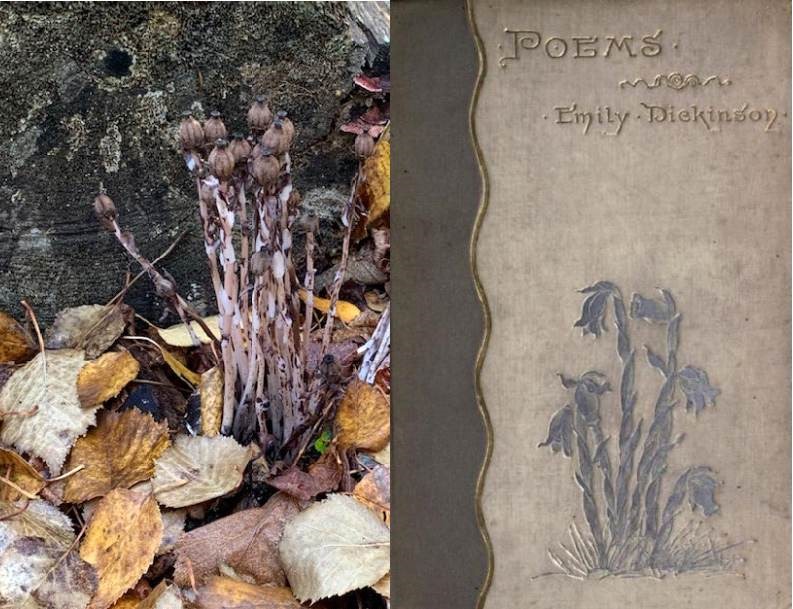
Autumn Indian Pipe and Dickinson Poems cover

The first edition of Dickinson’s poems featured a picture of Indian Pipe flowers in bloom, but like all flowers, autumn, if nothing else, ends their term. Indian Pipe (also called Ghost Pipe) is a strange plant that doesn’t use photosynthesis, but rather gets its energy from fungus. The picture was chosen because avid botanist Emily liked this unusual plant.

.

3. As if the sea should part  by Emily Dickinson.  From Emily B. to her American admirer Emily D. we go. For all the mythos about Dickinson’s later years of not leaving her family home, does anyone ever ask if being cooped up in a house with a family half-heartedly uninterested in poetry was all that comforting to her? In her most vital writing years, Dickinson still roamed some physically—and mentally. I’ve had some fun over the years here suggesting musically and graphically that Emily Dickinson would rhyme with Sixties psychedelia. “As if the Sea should part”  is certainly mental traveling of the purest sort. The player for this performance is below, or if you can’t see the player, you can use this hyperlink.

.

2. The Listeners  by Walter de la Mare.  When I started this project I thought I’d be rocking out more often than it’s turned out to be the case. Part of that result comes from being increasingly unable to record with Dave or others, and some from enjoying the novelty of being able to score and play orchestral instruments. My version of de la Mare’s weird minimalist ghost story isn’t crossing the hardcore boundary, but this is  a rock band arrangement that sounds good turned up on your speakers. The player to test that claim should be below, or if not, this highlighted hyperlink will play it.

.

Fall 2020 Parlando Project Top Ten, numbers 10-8

It’s time to count-down the audio pieces that you liked and listened to here most this past autumn. But before I get to the count-down I’ll mention that new pieces are getting harder for me to produce for a number of reasons. As of now, I still plan to produce some additional examples of what the Parlando Project does: combining various words (mostly poetry) with various original music (as varied as I can make it). Still, given the over 500 pieces already posted here, there will be a lot to explore while you’re waiting. What are those pieces like? Or unlike? Well, our quarterly top-tens are one way to see.

In each of the listings below and in the coming days, the bold-face titles are also links to the original posts where the pieces were presented in case you’d like to see what I wrote about them then.

10. The Poetry of the Root Crop  by Charles Kingsley.  I love coming across a remarkable poem I’d otherwise never come upon unless I was working on this project. “The Poetry of the Root Crop”  is largely unknown, and its author Charles Kingsley is too. No one seems to care much about his poetry, and even his lonely web biographic sketches barely mention it. I remember one I read saying his poetry was “competent.” Oh my. We poets are claimed to be a grandiose lot, and “competent” is a pen-knife between the ribs, not even a public execution. Kingsley the man is also lesser known, particularly here in the U.S., which might be unfair and yet favorable to us enjoying his poem. Considering Kingsley as a thinker and active force in his time has me going over this project’s many presented authors and recalling that while many had ideas I could agree with, they are often mixed with other prominent ideas and convictions that appalled me.

Poems can be about ideas, though they are not the ideal container for them as such I think. We are blessed that “The Poetry of the Root Crop”  isn’t a manifesto, though it uses some cultural markers as part of its scenery. What it is, what poetry is, is an apt container for communicating the experience of experience. Kingsley’s experience of a graveyard and/or garden can change how you see the thing yourself. To have that transference between minds isn’t merely “competent” I think. If you don’t see the player gadget to hear this piece, this link will also play it.

.

large tree stump 800

Snow started falling. I could hear the angel calling…He started to sing. He sang ‘Break it up, oh,  I don’t understand. Break it up, I can’t comprehend…”

.

9. No Common Ground  by Dave Moore.  Oh, how I miss having more of Dave Moore’s voice here. The pandemic has separated many artists, and performers most of all. How cruel this illness has been to have one of its earliest American super-spreading events to be through a group of people singing with each other!

So, it’s ironic that Dave’s piece that found so many listeners this Fall is about our chosen separations, one that I thought particularly apt for our current year when I reposted it on November 7th. The player gadget for “”No Common Ground”  is below, or as an alternative, this highlighted link for those that can’t see the gadget.

.

8. Back Yard  by Carl Sandburg.  I think it likely that Carl Sandburg had some ideas I don’t agree with, but I don’t look for them too hard, because I’m so grateful for the feeling of fellowship I often feel with him. “Back Yard”  too is not a manifesto, though it’s not hard to see its experience of the experience of an urban immigrant night as a statement by a son of a Swedish immigrant. Part of what I plan when I return to new pieces here is to talk a bit about our experience of the common ground of darkness as winter solstice approaches here in the Northern Hemisphere, and while Sandburg talks here of summer, his night somehow holds more than broad daylight can.

“Back Yard”  has continued to draw listens since it was first posted here two summers ago, and this September, as summer was leaving us, there was another strong spike in listens. My stats tell me I have listeners here who are approaching summer solstice below the equator, so this one is right on time for you.

Oh, there are a few words you’ll hear in the background that aren’t Sandburg’s. Some other angel’s alchemy from the common ground graveyard/garden of Kingsley’s poem perhaps? You can use the player to hear those night voices, or this alternate, highlighted link.

.

The Butterfly Dream

Literature is the time-travel tourists’ Baedeker, an excellent way to visit the experience and outlooks of those no longer alive. Setting the Wayback Machine now…

The 4th century B.C.E. was a pretty busy time for philosophy. Over in Greece Aristotle was homeschooling some teenager who’d become Alexander the Great. For some reason I had teachers back in my teenaged years who were Thomists—so I myself got a limited dose of Aristotle back in those only slightly less-ancient years.

Not enough to conquer the world apparently.

In some other reality, perhaps I’d have been exposed to the Chinese classics. And from what I understand another 4th century worthy, Zhuang Zhou,*  is a pretty big deal there, not only in philosophy but in Chinese literature and arts.**  His collected teachings, the Zhuangzi,  is a core Taoist text alongside Taoism’s founder Lao Tzu’s.

Anyway, I’ve just started searching for an available English translation of Zhuangzi,  and I may have found one a couple of days ago, but just as I am no scholar of Thomas Aquinas or Aristotle, I at this point know little about Zhuang’s writing. One thing that the overviews of it let me know is that he used humor extensively.

painted tapestry showing Zhuang and two butterflies

Picture of two butterflies dreaming of Zhuang Zhou, or…

.

So how did I come upon Zhuang if I haven’t read him? Back in October I presented a poem I wrote earlier this year called “Two Butterflies.”   It’s been connected with a famous parable from the Zhuangzi,  usually known as “The Butterfly Dream.”   And so, to throw some light on whatever unconscious connection my muses may have had to the Zhuangzi,  I figured I’d perform a rendition of Zhuang’s famous parable that you can hear below.

Late Fall - a leaf in new lake ice photo by Heidi Randen 1024

A picture taken today at the shore edge of Lake Superior. Zhuang also wrote: “They cling to their position…sure that they are holding onto victory. They fade like fall and winter—such is the way they dwindle…they drown in what they do.”

.

Musically, I had a couple of itches to scratch with today’s piece. One? I’ve been listening again recently to some modern disciples of a school of acoustic guitar playing that is sometimes called “American Primitive Guitar.” I don’t care much for that label, even if it was coined by John Fahey, it’s chief progenitor. It traditionally uses flat-top, steel-strung, acoustic guitars (a design variation perfected in the United States before WWII) and it’s informed by some of the tunings and techniques of early 20th century Afro-American Blues musicians, mixed with an appreciation for a variety of Asian musics and some Modernist “classical” composers. The other personal desire? I’ve been missing playing bass in the mode that makes it a lyrical equal to the rest of an ensemble. As a composer, I know the value of the simple bass line too, but sometimes I want it to sing away.

The player gadget to hear my recounting of Zhuang Zhou’s “The Butterfly Dream”  should be below. If you don’t see it (some blog readers and reader view options don’t show it) you can use this highlighted link to play it. I apologize to any Chinese speakers for my attempt at pronunciation of Zhuang’s name. I did my best on that, though I’m likely wrong.

.

*OK, you probably know the drill if you’ve followed along with this project’s presentation of other classical Chinese authors. Zhuang’s name is also rendered as Chuang Tzu, Chuang Tse, and Chuang Chou. And he also was referred to as Zhuangzi, which seems to be the more settled name for the book of his parables and teachings. The shorter part of his name is an honorific, meaning “master,” but given the difficulties with spelling out Chinese names in the western alphabet, I’ve decided not to call him Jam Master Zhuang.

**The later master poet Li Bai would be one example of a writer highly influenced by the Zhuangzi.  How far can Zhuang and Taoism’s influence be found? Martin Buber referenced him, and Wikipedia says that Taoist thought has been claimed by anarchists as foundational to their political philosophy.

Dave Moore’s Cathedral

Here’s a surreal, enigmatic, and yet compelling story by Dave Moore that I adopted and combined with some orchestral music I composed for it several years ago. Dave wrote this during a period when he had returned to Iowa to help is aged father who was dying, and while nothing in the piece refers directly to that situation, this reader feels something of that experience is present in its absence in this.

Dave’s father was a Protestant minister, and so church buildings of various sizes would have been part of his upbringing. And the mysterious boxes within boxes that the story’s protagonist must pack may be a visual image for the tasks of dealing with the stuff of wrapping up a life. But neither of those things can completely anchor the way this tale unwraps itself.

Easily the strongest, most enigmatic, and potentially objectionable image in the tale is the encounter with a young woman. A listener may meet this image in the story and react to it quickly (or thoughtfully) as an intrusion of some kind of male gaze trope, that thing that can be a tiring and reductionist frame on the real lives of half of humanity. But to my reading of this, it is the core image of this piece and it’s remarkably faceted with a cubist/surrealist multiplicity of reflections: an anima, a reminder of the exiled female in the masculine church, a strange mixture of sexuality, ambivalent reactions to sexuality, and yet also with a bit of the nature of parental caretaking roles reversing themselves. Many a time when I revisit this image by listening to this piece, I see something new in it.

Hathor pendant from Pylos gravesite

Gold pendant depicting Hathor, an African goddess, unearthed in a Greek tomb dating from the time of Homer

.

Long time readers here will know that I admire Dave’s work, and once more I thank him for his contributions to this project with his voice and keyboard playing—but for you that is of little matter. Perhaps my specific and not necessarily popularly aligned taste, or knowing Dave and the circumstances around this pieces creation including that it’s my own music and performance that presents it here, distorts my evaluation of this image; but listen to this piece and see if you agree that the strange encounter at the center of this dusty and enigmatic tale is a remarkable image worth contemplating.

The player gadget to hear “The Cathedral”  is below. If you are reading this in a reader or reading view that hides that player gadget, this highlighted link may allow you to listen to the audio piece. There is no text to link to today, so you’ll need to experience this less than 4 minute story by hearing it.

.

The Cenotaph

Remembrance of warfare is a complex thing. There are forces for forgetfulness and memorial fighting inside us regarding war, and the entropic forces of time passing put a thumb on the scale as years pass. This Wednesday was once Armistice Day, the day when, for a mere two decades or so, countries celebrated solely the end of “The War to End All Wars.” In America this date eventually became Veterans Day, a holiday to celebrate all those who served in the military, particularly during wars—whereas we already had a spring holiday, Memorial Day, established in the years after our Civil War, to decorate graves of the fallen and to remember their deaths.*

In Great Britain and other countries in the Commonwealth, November 11th continued as the Remembrance Day, and the deaths of WWII or other subsequent conflicts were incorporated, and the holiday remained unchanged, save for the erosions of time. It remains a solemn day. The Sunday nearest the 11th has royal celebrations in London centered around a memorial there, The Cenotaph,** and it’s still customary on the 11th hour of the 11th day of the 11th month to pause for a couple of minutes of silence to remember those who died seeking to reach that Armistice Day. This results in an odd divide: Armistice Day was generally a festive, celebratory holiday in 20th century America with joyful parades celebrating surviving veterans.

But that is just the surface of the complexity of the remembrance of war, where the questions of the wisdom or justification for a particular war are adjacent to the undeniable sacrifice of the war’s dead. Those questions are left to the war’s survivors who, from some level of power or acquiescence, made those judgements. In America, so fraught are those two strands of thinking about wars, that we have come to strictly segregate these two issues, out of fear or concerns that to speak of the evils of wars is to speak evil of our dead countrymen, or that to speak of the folly of some wars would denigrate the last full sacrifice.

The_Cenotaph_the_Morning_of_the_Peace_Procession_by_Sir_William_Nicholson

This painting by William Nicholson shows the temporary London cenotaph that was put up for the first Remembrance Day in 1919. Note the flowers strewn at it’s base, and a woman adding to them in this portrayal by Nicholson and echoed in Mew’s poem.

.

Today’s piece, “The Cenotaph,”   was written by a British poet, Charlotte Mew in time for the first anniversary of the Armistice, the first Remembrance Day, in 1919. Here’s a link to the full text if you’d like to follow along. It begins with nods to conventional rhetoric about the sorrow of those who lost loved ones, it voices sentimental tropes of the dead in “splendid sleep” and the grave as a bed. I was not sure how to perform those lines. Mew’s poem is complex, not just in syntax and some long lines and sentences that can trip up the breath. If one was to read it with only casual attention, more than three-fourths of it can seem a conventional Victorian poem of mourning—but read or listen to it all the way through!  It ends with a statement of anger so shocking that it should make you reconsider how you read the opening body of the poem. No spoilers here—it’s best to experience this by reading the poem or listening to my performance via the player gadget below.

In my performance I tried to subtly undercut some of those early phrases, but I’m not sure if I (or anyone) can successfully portray the totality of Mew’s poem. Musically I got to write a fanfare, something I hadn’t done before now, and then there’s a quieter, contrasting motif played at the end on a bassoon and two English horns.

.

*In some ways the American Civil War experience was similar to the British WWI experience, as the levels of mass casualties Americans suffered in the mid 19th century conflict previewed the shocking casualties the British and Commonwealth soldiers suffered in WWI. America entered WWI late and suffered proportionally fewer deaths from the combat.

**The London Cenotaph in Whitehall, central to Remembrance Day activities in England, particularly since the advent of mass media, is not the only one. Many other cities erected their own versions. Cenotaph means “empty tomb” and the imposing markers were meant to be local sites for decorating and mourning the war dead that were largely buried near foreign battlefields as the logistical challenges of so many dead prevented them from being repatriated. Mew is not in fact describing the particular London Cenotaph in her poem, for when she wrote her poem it didn’t even exist yet, though it was planned and a temporary structure was in place by the first Remembrance Day in 1919. So like Keats’ “Grecian Urn”  it’s not a  cenotaph, but the concept of a great war memorial in the center of the marketplace that she grapples with.

Mew’s 1919 poem appears to be the first WWI poem to discuss the Cenotaph concept. I’ve yet to find the text of a 1920 poem by pacifist veteran Max Plowman written after the monument was completed, and there is this remarkable 1922 poem by Ursula Roberts, also called “The Cenotaph”  that seems to echo Frances Cornford’s non-war-related “To a Fat Lady Seen from the Train”  from 1910.

Final Soliloquy of the Internal Paramour

American poet Wallace Stevens constantly spoke in his poetry about the creation of art. This sort of “art looking at itself” move has a danger of being too self-referential and one might fear that it would sit with the reader as unresolved as being between two mirrors. I think today’s subtle poem works, despite those risks, and we’ll see if my performance of it brings out something that you may not have noticed in it.

Stevens, though wordier than Emily Dickinson*, often has his poetry seem like a riddle or puzzle, and though his poems have a surface beauty one can see right off, they also sometimes work like a lawyerly contract with the reader, full of obscure words and fine-print sub-clauses that you may not fully understand.

Let’s listen to Stevens read his poem himself.

One can hear background noises outside the room in this recording, so Stevens’ voice is heard here “Out of all the indifferences.”

.

He’s not a bad reader, he does an acceptable job of bringing out the structure and word-music of this poem—but it’s emotionally flat, a default setting for many poet-readers. I think the theory is: if his words are good, well selected and ordered they should be able to convey all. If I listen carefully, I hear just a tiny touch of ruefulness in his voice as his poem nears its end, but it’s just a touch.

So, let’s look at the words again, not just that they might sound unusual and mysterious. Here’s a link to the full text if you’d like to follow along.

There’s an overall image in this poem laid out in the somewhat fussy title: that thing that causes us to create art—in Stevens’ case, poetry—is like a paramour. That is, it’s like a desired lover (and “paramour,” that somewhat unusual word he chooses, has strong associations with an illicit or secret lover). But wait, it’s an “Interior Paramour.” It’s something within ourselves. That internal duality will be dealt with in his poem.

At times he seems confident in speaking of this cause to create art, but look closely at the shading, the little codicils in his statements. “For small reason” we think our imagination is good. We are “poor,” not particularly perceptive or wise, we only choose out of the richness of all things some single thing that we’ll prize over all those things we are indifferent to. We do this to impose or create this intimacy we feel with our art, this imagined, chosen, second self, this internal paramour his title speaks of.

But, but…“God and the imagination are one!” Surely, this is praise.

Look carefully, “We say,” Stevens says: it’s but our  claim. A God in actuality is some higher candle. What we feel we have, in our separate imaginations selected into art, that art that may cohere out of shared human centrality—is a smaller, lower light, shedding on a smaller circle: us perhaps and our work in the moment of imagination choosing creation, or that resulting work and a reader or listener.

That’s the internal paramour, the shame-feared, secret love inside us when we create. It’s a small lit space we make in darkness, where occasional readers or listeners see something like what we saw. Being together with little creation is enough. Being together with some audience out of all the indifferences is enough.

Today’s music is based obliquely on the Velvet Underground, a pioneering indie rock group that explored areas that later groups also chose to explore. On one level they seemed to be like unto a rock band: two guitars, drums, and a further musician who might play keyboards, electric bass or bowed strings–but their genius was to put those things together differently, to use those voices in uncharacteristic ways. How will listeners react when you do that? Well, for a lot of them it will be to reject it as worthwhile music, though some may see a new possibility. Some art comforts. Some art unsettles. Being together with some audience out of all the indifferences is enough.

Here’s an 8 minute animated anecdote about the Velvet Underground’s first official performance. How indie was that band in its early days? The original drummer quit when he heard they took this paying gig. He felt such commercialism violated their art.

I should note that I was reminded of this poem when the Fourteen Lines  blog included it last month. I immediately thought I’d like to perform it, but it sounded like it was later Wallace Stevens. I did a quick web search to see when it was first published and the return said in Harmonium,  Stevens’ first book-length collection which is in the public domain. I let out a shout and began work on the composition and performance I present today. It was only this morning as I started writing this post that I found that it was, just as I suspected from the title, from late in Stevens’ career when he was as old as I am now, and is therefore likely to still be in copyright, even though Stevens himself has been dead for 65 years. I feel conflicted about going ahead and presenting what I worked on and came up with, but have decided to take this route: if whoever holds the rights to Stevens work objects to this non-commercial use, let me know, I’ll gladly remove it.

My performance of “Final Soliloquy of the Interior Paramour”  seeks to be unsettling. The two guitars don’t work like rock band guitars are supposed to work. The drums and their beat are strange, not tying things down as the instrument’s rhythms slide instead of lock. The organ plays low, driving somewhere you can’t see. And I chant Stevens’ words as if I know where they’re going, and yet I can’t yet say where that is yet. That’s what I feel when I create music or poetry. The player to hear it is below. Like some early Velvet Underground tunes, it may sound better around the third time you listen to it. But if you don’t like it, remember I promise various words and various music here, there are other selections available in our archives.

Thanks for sharing this little light by reading or listening tonight.

.

*Stevens was an actual lawyer. Dickinson came from a family of lawyers and I suspect either absorbed this manner of written discourse or may have inherited it along with her mental firmware.

Two Butterflies

My wife remarked this morning that nature is often more beautiful than it needs to be—and if you need a testimonial to that, I present butterflies. What a marvelous structure their wings are, as if the most intricately colored flowers could fly. And fly they do—and unlike birds, they often seem to have no compunctions about flying near us oversized and under-winged creatures.

Butterflies close up

The Wordsworths didn’t carry a device that let them take pictures of lake country daffodils, but here’s the pair of butterflies that inspired today’s poem by flying over my shoulder.
.

This is a prelude to today’s diversion from our usual practice here of using “Other People’s Stories,” other writer’s words, for these encounters and performances. Since I wrote the words this time, I’ll have less to say about what I’ve found out about the author and how I react to their experience. Not that creative writing doesn’t lead to that sort of thing—far from it—but in a way I’ve already chosen how to present those things inside the poem that is today’s text.

I will say this instead: the course of this project, though it takes energy that I might apply to my own writing, as helped my own poetry. As a chronic and justified self-doubter, finding the variety of strengths and weaknesses in a range of others’ work gives me hope in my own attempts—but more importantly, each time I figure out how to present and perform the variety of words (mostly poetry) for the Parlando Project, I must find what is worthwhile, what is valid, vivid, and engaging. It’s a commonplace that reading and studying poetry helps figure out how you may write it, but performing  it helps you understand how to advocate for it, how to let its soul out.

In recent years I’ve increasingly watched other poets read their work. Regardless of the level of accomplishment I might recognize in their words, it’s not uncommon on all levels to hear them read it as if apologizing for the interruption, as if they themselves aren’t sure what to advocate for in what they wrote. Some do this because performance isn’t easy for many people (let me present another testimonial: my singing voice). I believe some do it because to fail with a level of over-florid reading, with too much Am-Dram-Ham, would be such an embarrassing failure. Even to purposefully aim for some anachronistic disinterested beatnik cool could be an unforgivable mistake.

Well that danger is  there. I’ve heard poets read with an attitude that what they are reading is important that I don’t share.*  That disconnect doesn’t make me like the poet or poetry in most cases either—but think of the automatic failure of not claiming the worthwhile nature of what we do. A danger of failure is not a license to aim for it. If performing your work as if it isn’t worthwhile is your defense, consider changing what you write so that you can more unabashedly attempt to claim an audience’s attention.

Yes, a great many poets (I’m one) are driven by doubts. Perhaps you are too. Poetry, like nature, like butterflies, is writing that is more beautiful than it needs to be. That beauty is there to illuminate those limits and doubts. Are they, limits and doubts, ugly? It depends, but illumination changes them.

Two Butterflies

Attentive readers might connect this breakfast scene with this summer’s earlier piece “Breakfast in a Pandemic.”  Yes, same outdoor seating.  City Lights Books is welcome to contact me for a potential chapbook “Breakfast Poems.” This month I think of the woman in that earlier poem who stoppeth one of three to ask “If you had to choose between Trump and Covid, which would you choose?” Now? We don’t have to choose!
.

There’s little room left to talk about my poem, but hopefully it speaks for itself. The poem expects the reader to know two pieces of information: the proverbial “Butterfly Effect” where small things like the flapping of an insect wing can change complex systems, and the metamorphical life stages of butterflies where the lithe butterfly begins life as a devouring worm-like caterpillar. The player gadget to hear my performance is below.

.

*My teenager, a Douglas Adams reader, has asked when I’ll feature Vogon poetry here, but then they think most of what I present here is close enough to Vogon poetry in effect. Poetry audiences, or those that fear being press-ganged into being part of a poetry audience, often recall Adams satire—but yes, many of us writers of poetry think of it too.

A Dream Within A Dream

I don’t know if this is still so, but in my mid-20th century youth it wasn’t unusual for children to read some of the American 19th century worthies in ways not unlike the Young Adult books of today. So before I was old enough to take drivers ed, I’d read Tom Sawyer and a smattering of other Twain, some shorter Longfellow poems (the epics didn’t attract), and lots of Edgar Allan Poe. In a year or so I would start to read Keats and Blake and move on to literature as school assignments.

Other than availability, I’m not sure what drew me to the Poe. The gothic stuff may have attracted me for its examination of human oddness, and I recall the hyper-rational side of the detectives or adventure stories like “The Descent into the Maelstrom”  pleased me. His poetry worked well enough, though I was not yet committed to poetry.

Did the antiqueness of the settings and language bother me? I don’t remember that being an issue. No, the world of Poe or Twain wasn’t the world of colorful tailfins and gray TV, but it seemed tolerably close to my own.

My Poe phase didn’t last long, and even finding out that some of the French poets who would intrigue me in my 20s had first or second-order influence from Poe didn’t make me want to re-read him. My casual judgement that I’d rather read something else has continued, and so today’s piece, “A Dream Within A Dream”  is Poe’s first appearance in this project.

Edgar Allan Poe

Mad, bad, and daguerreotype to know. Edgar Allan Poe.

.

“A Dream Within A Dream”  is not overly florid nor is it chained to a too-simplistic, toe-tapping rhythm. Grains of sand and tormented seashores may be over-used tropes, but this poem doesn’t pass these off as priceless revelation, only handy counters to make the poems stark point: that since life is transitory itself, those things that one creates within it, however placed in the scale from practical to fanciful while alive, are in a final judgement as substantial as dreams. It’s implied that—like many a poet, writer, or artist—the poem’s speaker’s life work was judged while alive pretty close to the not-useful, fanciful side. The poem’s tone seems sad about that, but then it has that subtle valedictory dig: the same holds true for those who think they are doing more important things.

This poem was first published in the last year of Poe’s life, and as Poe struggled to earn enough as a professional writer, it’s ironic that the Wikipedia article on this poem says that the next month the owner of the publication ceased paying writers.

This Wednesday, October 7th is the anniversary of Edgar Allan Poe’s death under mysterious circumstances where he was found dazed and confused in Baltimore and died after a short hospitalization there. Oddly, I didn’t know that I would be writing this on the eve of that anniversary, so maybe some of Poe’s sand grains have washed up here?

Poe still attracts musical settings, so maybe it’s time for me to weigh in with my efforts. It’s been awhile since I ventured into the world of synth created sounds, which are the dream created inside the dream of music. So, today’s piece let me use some weirder analog synth sounds that make no claim to reality. Though the featured sounds today are entirely digital, created inside a modern computer,  they are imitating analog synthesis waves with grains of ones and zeros, and I got to wiggle knobs to control parameters in real time just as the early analog synth players did.

Silicon music, like Poe’s grains of beach sand, the anonymous Internet sea will take almost as quickly as they are made. So before they slip away, you can use the player below to hear my performance of Edgar Allan Poe’s “A Dream Within A Dream.”

He Bids His Beloved Be At Peace

My time and energy is short tonight, so this post will reflect that, but I wanted to present this supple poem by William Butler Yeats written near the end of the 19th century, but, I think, applicable in our American year 2020.

How many of us as couples, as friends, as families this year have felt the need to be support and comfort for them; or in return, needed that from others? A year of shocks, changes, challenges, revelations, of noise and force. Cold deaths, hot fires. This past Tuesday’s national image of that televised, trampled talking over, the faulty assay that volume and audacity can just as well substitute for truth. That absurd equation that one can talk the longest and take the least responsibility. Is that what words are for, is that all  they are for?

I came upon this poem in another blog I read: Stuff Jeff Reads.  There the author figures that in this poem Yeats is using esoteric imagery, drawn from the poet’s well-known attraction to and participation in various hermetic organizations. I think he makes a good point, though some imagery may, without being directly decodable as some secret in-group code, be read by the receptive reader or listener, even if they are a non-adept. The full text of this poem appears in Jeff’s blog that I Iink here in case you want to read along.

Two images, one with physical mass, one auditory are weaved through this short poem. The massive one is the horse and in its plural sense, the Horses of Disaster. In Yeats’ 19th century the horse was still a large part of military force* and one of the largest animals that would be encountered daily in much of his British Isles. Our age may reduce that intimate knowledge. Someone like me, never part of the horsey set, who kept his small purse away from horse racing stakes, and rural in his youth in a tractor and truck sense, can only rely on fairs, events, and exhibitions to feel something of what Yeats’ horses meant to his contemporary reader. To stand, as I have, near a draft horse or to watch horses run at full gallop, and to imagine in my sparser memory that collection of momentum and force, is to feel something Yeats intended to convey.

But there may be accrued in the sparcer memory, that lack of daily familiarity something too. The horse, the Horses of Disaster, are more mysterious, more occult in daily fact than they may have seemed to a reader in 1896. One can often get out of the way of an actual run-away horse—our modern Horses of Disaster, not so much.

Self-Portrait by Leona Carrington

“Vanity of Sleep, Hope, Dream, endless Desire” The picture is “Self Portrait (Inn of the Dawn Horse)” by Leona Carrington, a Surrealist who deserves to be better known.

The other image, the auditory or conceptual one the poem weaves, is tumult—uproar, confusion—by definition, unpredictable, illogical, chaotic, the body and hooves one cannot sidestep easily.

So, I read this poem as a spell—and Yeats artistry is striking regardless of the efficacy of magical beliefs or practices.**  There is after all, the spell we cast with those we love and comfort. Come, the world will carelessly or concertedly hurt you, but I will not.

The player to hear my performance of Yeats’ “He Bids His Beloved Be At Rest”  is below. Don’t see a player? Then you can use this highlighted hyperlink. Wishing you justice and mercy.

.


*Consider the similar imagery in James Joyce’s “I Hear an Army.”

**I think of a saying I’ve always loved: “If wishes were horses, there’d be a whole lot more road-apples.”

The most popular Parlando piece this past summer was…

Forever and Crumbling.  So if I disregard the outsized number of listens Hopkins’ poem got, this summer’s most liked and listened to was another Emily Dickinson-based piece where I joined two short and somewhat abstract Dickinson poems into what I thought was an interesting combination. I called my combination “Forever and Crumbling.”

“Forever”  talks about the localized instant we all live in, that Dickinson lived in too. “Crumbling”  talks about decay happening from a chain of those instants. In theory the two pieces, that Dickinson wrote separately, change/enlarge when related to each other. That and my musical performance of them is my contribution. Your likes and listens say that some of you found that worthwhile.

I’ve sat here most of the morning and now into the afternoon trying to write something useful in addition. If we are charged to “live in the moment,” 2020 makes that especially challenging. If we seek to halt and reverse the cobwebs and rust on our ideals and nation, like Dickinson’s “Crumbling”  it will take more than an instant’s act. Nothing I wrote today brings what I can believe adds anything to our instant in time or repairs our current state of dilapidation. When I first posted this piece in the first week of June, I felt the same awkwardness. I have faith (or is it only habit?) that art and beauty have worth, but it takes a lot of faith some days.

Wishing all of us justice and mercy, and some wisdom to see a balance of those.

.