Wild Nights Wild Nights

Thomas Wentworth Higginson may have exaggerated a bit, speaking then of “dread.” But it was 1891, and he had taken on editing the surprisingly vast literary legacy of Emily Dickinson for its first substantial publication. In this task, he was a lucky find, for though he had engaged in a lengthy correspondence with Dickinson when she was still alive—the real rarity was that he was a thoroughgoing radical, a Transcendentalist comfortable with heterodoxy, an uncompromising abolitionist who raised and lead a company of Afro-American soldiers in the Civil War; and rarer yet in his time, a stalwart feminist who knew and worked with pioneering American feminists Lucy Stone and Susan B. Anthony.
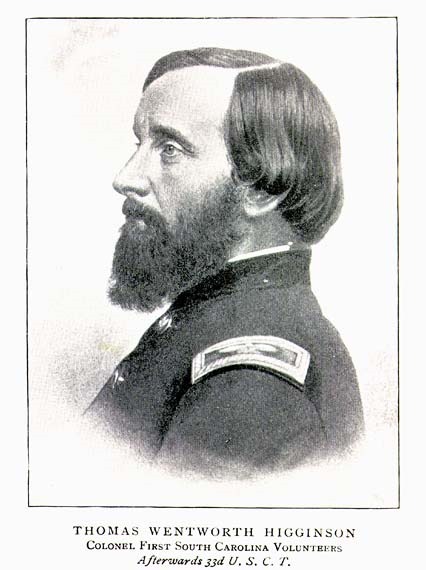
Thomas Wentworth Higginson in uniform

Abolition, Transcendentalism, Civil War, Women’s Suffrage and rights
Higginson wasn’t going to keep a little keep a poem about desire bottled up


So, fear of controversy was not in Higginson’s nature. Still “dread” was the word he used:

One poem only I dread a little to print—that wonderful ‘Wild Nights,’—lest the malignant read into it more than that virgin recluse ever dreamed of putting there. Has Miss Lavinia (Emily Dickinson’s surviving sister, and the one who found the large cache of poems at Emily’s death) any shrinking about it? You will understand & pardon my solicitude. Yet what a loss to omit it! Indeed it is not to be omitted.

What dread could a little 12-line poem cause? Dickinson’s “Wild Nights Wild Nights”  appears to be a poem about unembarrassed female desire. Even with suggested subtext supplied for for lines like “Rowing in Eden,” it probably seems less shocking today. Still, let’s give Higginson some credit. He not only didn’t want to censor it, he maintained it needed to be included for publication.

Even if we’re not shocked by an erotic element, let’s not forget: it is an Emily Dickinson poem. It’s terribly concise. It sings off the page, yet with such short lines, just three to five syllables long. It’s memorable. When I mentioned it to my wife as the next piece I was working on, she nearly knew it by heart.

But most strangely, though it starts like an ardent valentine, it finishes either in disconnected thoughts blurred by lust, or with something altogether less conventional. Setting humptastic subtext aside, why would one row in Eden? You’re in paradise! Where do you want to go? Do you need to stock your ship up with the fruit of knowledge against the scurvy of faith? And you’ve made it to port in the last stanza. Again, let’s leave the “made it past third base” metaphors behind for a moment. Why are you exclaiming the sea when you’re in port? I even wonder if Dickinson is slipping in a pun here: “Ah! the sea!” sounds like “Odyssey.” Is Emily’s wild-nighter an Odysseus looking to getting back on the boat and back to sea?

I don’t know exactly what Dickinson is getting at there. It’s her characteristic level of concision: pretty, but sharp pieces of glass, leaving lots of slant light to refract.
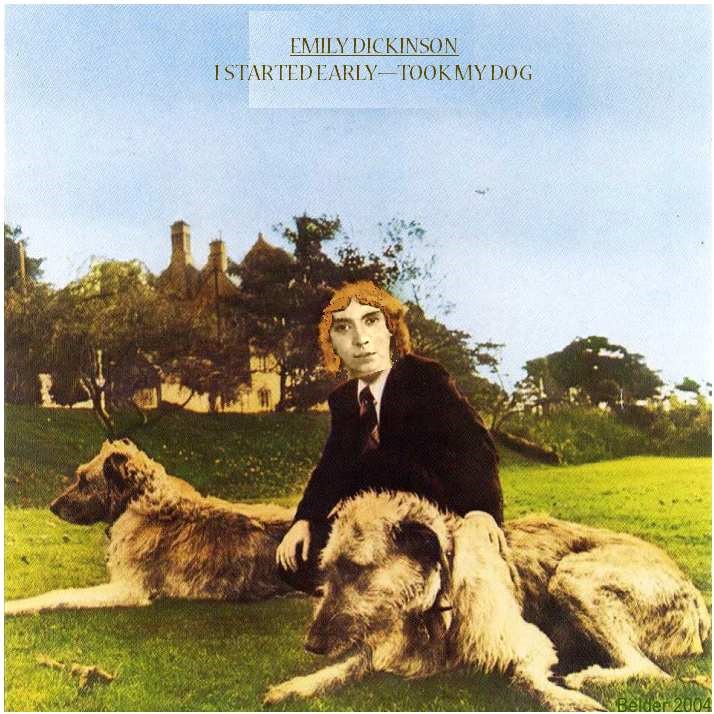
Veedon DIckinson

Poetic license. Yes, I know “Wild Night” is on Tupelo Honey


We’ve followed the Parlando Project goal of varying the music with Dickinson poems so far, even casting her as a classic blues singer. For “Wild Nights Wild Nights” I wrote a more rocking R&B thing this time. I relaxed a bit with the vocal this time too: tossing it off in one take while playing the acoustic rhythm guitar part. The opening lines of Dickinson’s poem reminded me of Van Morrison’s song, and so I slipped a few mutated lines near the end. Play the performance with the gadget below. You can dance if you want to…


Somewhere or Other

Today’s audio piece is another by Christina Rossetti, connected through family with the Victorian art and literary movement that called itself the Pre-Raphaelite Brotherhood. In their painting and artwork, the Pre-Raphaelites often appeal to me. The paintings sometimes have a stunning, oversaturated palette; and they are fond of symbolic and esoteric subjects which fill the paintings with interesting details.

John Melhuish Strudwick  When Apples Were Golden and Songs Were Sweet

Eb Bb , Ab Eb , then Fm Fsus4 Fm, and Ab Eb Ebsus4 Eb—flat keys are murder
on guitar, just so Frank can play simple black key stuff on keyboards

Many associated with the PRB wrote poetry as well, but when I’ve gone looking for pieces I can present as part of the Parlando Project, the brothers in the brotherhood just didn’t do much for me. Surprisingly, the poet who did was Christina Rossetti.  I don’t recall if she was even included in the “New Criticism” curated English literature anthologies of my school-age youth. She isn’t a poet with a lot of flash and filigree. A poem like today’s has not a single arresting image, and its language is simple too.  Using the criteria of the Modernists who came to dominate the assessment of poetry in the 20th Century, this poem should have nothing to recommend it.

So, what does it have or do, why did I bother to write some music for it and perform it for you?   Well, first it has a refreshing modesty of expression. This is a song of longing from first to last, a universal human experience. And the subject of the longing, is it for an earthly partner, the age-old “when will the right one come along” wish? Or is it for an otherworldly, completing partner, a presence beyond the moon and stars? Despite Rossetti’s homey words, it could be either, and the alteration of “near or far” with “far or near” in the 2nd and 3rd verses encourages us to see it both ways.

If one must choose which supposition, I lean to the spiritual object, and if so, the image, such as it is, if off-screen here: earthly love may stand for the longing for religious meaning and connection. The last couplet, the dying leaves falling on “turf grown green” is strangely incoherent, and it reminds me of some of images or rebirth and salvation in British folklore, leading me that way.

But if could also be a song of simple earthly longing for a suitable partner. Adding music to Rossetti’s “Something or Other”  both adds decoration to the simple words and allows the listener to relax in that ambiguity without a need for an immediate conclusion.

John Melhuish Strudwick - Saint Cecilia

See, E flat is so easy on piano, even saints can play it.
Both of today’s paintings are by  Pre-Raphaelite John Melhuish Strudwick


Today’s music for Rossetti’s poem combines acoustic guitar with some cello and strings integrated with a couple of piano parts in the background. It’s another short one, so go ahead and use  the player below to listen to it.


Let Us Live and Love

A while back here there were several episodes where we discussed songwriters as literary figures, using the springboard of Bob Dylan getting the Nobel Prize for Literature. Dylan was the third songwriter to receive this award, preceded by William Butler Yeats and Rabindranath Tagore. But the Nobel prize is not really all that old, and the idea of the singer-songwriter is older. We know little about how the ancient Greeks performed their poetry, but accounts consistently say that it was accompanied by music, and in the case of at least Sappho of Lesbos, it’s specified that the lyricist played the lyre as well. Similarly in ancient Hebrew, David and his harp, or the west African griots and their Koras, and so on.

So, despite the idea that lyrics sung to music mark an inferior art, or that performing poetry to music is an affectation hardly to be endured, history says this was not always so. Of course, the way it’s done can please or not please, and it’s still possible that such performances are an obsolete form that we’ve now superseded with hugely popular and culturally significant poetry chapbooks and small press poetry collections—I kid! I kid!

Today’s piece is by just such a singer-songwriter, an Englishman born in 1567, Thomas Campion. He wrote his lyrics, wrote music for them, and was an accomplished lutenist, so the chances are that he was discovered by John Hammond and played the authentic Elizabethan blues music he misheard from 78 r.p.m. discs of Catullus. Well no, doubting Thomas, once more I Kyd.

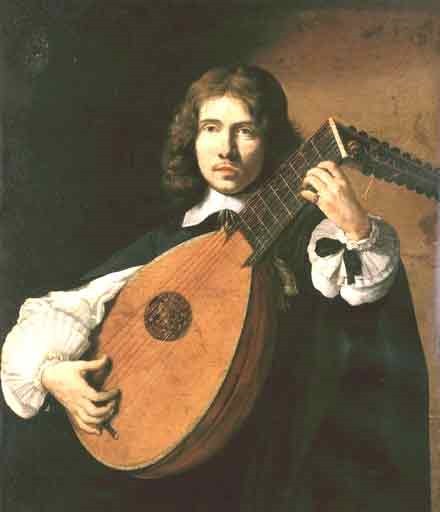
Thomas Campion with Lute

Poetic Campions compose. Thomas Campion with his lute.
If he looks glum it’s because it’s two centuries until Martin Guitars is established, and 350 years until the Telecaster.

He did write lovely songs, in a style I can’t come up with a way to present. “Let Us Live and Love”  was one. You can hear it sung beautifully to his tune here. So instead of exploring my counter-tenor range, I’m going to go with a sort of loose skiffley blues in my performance.

I’m going to lean on my blues audacity hard here, because the poem is addressed to the singer’s lover, Lesbia. Beavis and Butthead style giggles are breaking out in the back, I can hear you.  Turns out Campion took the lover’s name and the idea for his first verse of his lyric from a Latin poem by classic Roman poet Catullus, before taking off on his own thoughts on the matter. Classics scholars explain this by saying the Sappho of Lesbos’ association in classical times was more at a widely experienced lover, not necessarily a lesbian one.

Catullus Comforting Lesbia over the Death of Her Pet Sparrow and Writing an Ode

OK, OK, forget the one about you might as well have sex with me.
How about this, we’re all going to die, just like that bird, and…


Another category “Let Me Live and Love”  could be put in would be a “Carpe Diem” poem, which is not the Department of Natural Resources limit on the number of bullheads you can catch, but is more Latin meaning: “seize the day,” which in the case of poems usually doesn’t mean seize the day for fishing. Instead, Carpe Diem poems usually offer this proposition: “We’re all going to die, so you might as well have sex with me.” Seriously. Poets have actually made that seem like a smooth line.

The twist Campion puts on Carpe Diem is to bend it around a bit. His song has it that you already love me, and that makes the idea that we’re all going to die bearable. That’s at least a little more flattering.

To hear my performance of Campion’s “Let Us Live and Love”  use the player below.


The Heart of the Woman

There’s two things that attracted me to T. E. Hulme, the lesser-known Modernist poet and theoretician that I’ve featured a few times this summer. The first is the sense in his poetry and critical writings of the limits of humankind. The other is his poetry’s surprising modesty and restraint, something embodied in the very brevity of its poetic expression and his images linking the mundane and the cosmic.
 
This was a man who wanted to overthrow hundreds of years of poetic tradition, and a person whose stubbornness kept him in trouble with authority figures throughout his youth, and yet Hulme expresses himself in these spare lines, as if the first lesson he’s teaching himself is to know his own limits. This seems to be Hulme’s problem with Romanticism as he saw and opposed it: humankind is not limitless, though our imagination says otherwise.
 
Today’s piece, William Butler Yeats’ “The Heart of the Woman”  moves in opposition to that outlook, but not in opposition to that expression.
 
Here in North America, many in the southern region are spending this week either cleaning up from a massive hurricane or clenching their jaws in anticipation of an even larger one due to strike this weekend. Peaceful, Rousseauean nature this ain’t. Hobbes is is a weatherman.

Hurricaine Irma

“Come in she said, I’ll give you, shelter from the storm.”

Yeats’ poem is as measured and modest as one of Hulme’s, though it is rhymed and metrical. When one is a good as Yeats is at that, one hardly notices the form. 12 lines, not even a sonnet in length. Like Hulme, this is no great ode of endless argument. On the face of it, it’s a love song, a basic trope of Romanticism, the reason we talk about human attraction and pairing as “romantic.” Its images are centered on a couple embracing.

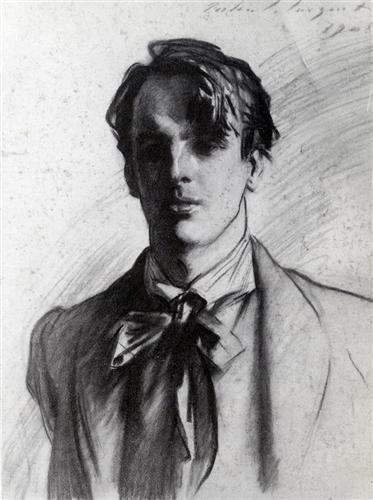
Yeats by Sargent
Why Mr. Yeats, I didn’t realize you were, well, dreamy, without your glasses

But look closely in those dozen lines. The woman who’s singing it, has left religion (“prayer and rest”) and family, and has followed a lover’s invitation into what is introduced as “gloom”. Merely the dark of night?

No, in Yeats’ lovely line, darkness is found inside the “Shadowy blossom” of her hair which will hide the lovers from the “bitter storm.” Now we are fully in the Romantic world, where our own darkness may be willful, wishful, blissful, ignorance of the “hiding hair and dewy (blurry) eyes.”

Are there any more Romantic and romantic three lines as Yeats’ final three that conclude this piece? If there are, I can’t recall any at the moment. That the simple murmurs of human breath can seem to equal a hurricane’s—is that glorious or folly or both?
 
In the spirit of defying human limits, this is the first time you’re going to hear me sing a Parlando Project piece acapella. And though Yeats’ poem doesn’t rule out the same romantic faith on the part of the “he” in this poem, I’m somewhat troubled by the idea that romantic devotion is presented here as female, from the poem’s title onward, so I’ll undercut that by singing this. My less-able singing voice is one reason that we chant or speak-sing a lot of Parlando Project material, but my young son’s carefree acapella singing is reminding me of the value in the singing voice. To hear “The Heart of the Woman,”  use the player gadget below.

Fall 2017 Parlando Project Top 10

It’s time to report the most popular audio pieces posted here over this increasingly busy summer. Before I get to this season’s Top 10 countdown, I want to thank everyone who has listened, followed, liked, or shared our posts and audio pieces on social media or on other blogs. I don’t have time (or perhaps the talents) to do all the promotion that some other blogs do, so it’s the kind words and enthusiastic work that you readers/listeners do that has spread the news about this combination of various words with various music.

Lots of changes from our last Top 10, so let’s get started. There should be a player gadget after each piece on the list, so you can easily hear the audio combining those words with music we create and perform as part of the Parlando Project.

10th place? Turns out it’s a three-way tie for 10, and since the three pieces demonstrate the variety I seek to present here, let’s just dispense with tie-breakers and list all three audio pieces that are tied at number 10..

“Sonnet 18”
  is, so far, our only Shakespeare selection. Shakespeare is, or course, inescapable, and setting Shakespeare’s sonnets to music isn’t a rare thing either, but one of the good things that comes from the Shakespeare phenomenon is that a listener can hear a lot of different takes on one text. I choose to bring out the brag in this one.

“A Summer’s Night”  uses a poem by Paul Laurence Dunbar, the first widely published Afro-American poet who died tragically young in 1906. A lot of Dunbar’s success during his lifetime was with dialect pieces which he had ambiguous feelings about. He sometimes said that he wished to be known more for his poetic work in standard English, something that “A Summer’s Night”  demonstrates.


“On the Troop Ship To Gallipoli”  demonstrates a small bit of artistic courage on my part to pay tribute to the real-world courage of Rupert Brooke, who died in service to his country in WWI. The “Great War” redrew the world’s maps, overturned several empires, and it also drew a literary dividing line, as post-war poetry embraced Modernism which made the poetic stylings of Brooke seem decades old only a few years after he wrote them. Those who lived through that time often adapted to the new ideas of modern poetry, but Brooke never had that chance. So, in this piece I recast a late fragment of Brooke’s words as if it was an Imagist poem.

In 9th place, we have “Zalka Peetruza (who was christened Lucy Jane),”  which uses a poem by journalist and poet Roy Dandridge, who coincidently like Dunbar, was another Ohio Afro-American. By evidence of this poem, Dandridge deserves to be better known than he is, as it’s a tart observation of the art of getting over while Black, in this case by passing one’s self off as exotic.

8th place goes to a bit of a surprise, my slightly Beefheartian musical setting of two sections of Gertrude Stein’s “Tender Buttons.”  Don VanVliet (Capt. Beefheart) and Gertrude Stein were both uncompromising artists who hoed their own rows, so I viscerally made the connection in creating this piece.

7th is Sir Walter Raleigh’s damning litany “The Lie.”  It’s a poem I’ve loved since my youth and I don’t think one has to add much musical vengeance to amplify Raleigh’s words. 400 years old, and still pissed off.

6th slot goes to one of my translations, Rainer Maria Rilke’s “The Dark Interval.”  I did this translation a few years ago, and it was intended to be a somewhat freer variation. As I learn more, I think my assumptions on what the poem was getting at were wrong, but this looser version got 20 more listens that it’s more literal translation I also presented here this summer.

Halfway to number 1, at number 5, is Parlando Project alternative reader Dave Moore’s tale “I Was Not Yet Awake.”  Dave also plays many of the keyboard parts you hear here, including the organ part on this.  “I Was Not Yet Awake”  is short for a story, but longer than many pieces we present here. Dave’s story is so well told that it still managed to pick up a lot of listens this summer.

At number 4, dropping down from two straight appearance as number 1, is “Frances,”  a teenaged George Washington’s acrostic love poem. That’s still a marvel, as week after week I look at stats and see that it’s still getting listens, long after its appearance here last February.

Top 3 time! In position 3 is “The Death of Apollinaire,”  my translation of Dada principal Tristian Tzara’s surprisingly sincere eulogy for the multi-national poet and critic Guillaume Apollinaire, who invented the term “Surrealism” and helped weave together many of the strands of European Modernism before he died from complications of wounds he suffered in WWI.

And in position #2, up one place from 3rd in the last Top 10, is Dave Moore enigmatic song “Love and Money.”  It may offer an American answer to the question the Beatles once asked in “Can’t Buy Me Love.”

adlestrop Station

“The steam hissed. Someone cleared his throat. No one left and no one came…”

Position number 1 is another return, and an even higher rise in the chart due to the large number of listens over this summer: “Adlestrop,”  British poet Edward Thomas’ famous moment on train platform on a hot June 24th 1914, were nothing much happens, but everything palpably is.

The poem portrays the train’s stop as unscheduled, but research into train schedules (see them here in this blog post at The National Archives) says otherwise. Adding this element was a conscious choice by Thomas.

It’s a much-loved poem for many reasons. Some find extra resonance in the lines describing calmness in the tiny village train stop, the literal calm before the storm of WWI, and that’s a fine thought for those that hold it, but I believe the poem exists beyond those associations. “Adelstop’s”  closing lines are sublime even without that particular war, that particular trauma to that specific nation, and as it was, to the ending of the life of its author Thomas, who became another of the poets killed in that war.

The Nymph’s Reply to the Shepherd

There’s a long tradition of “the answer record” in pop music, where another artist responds to a hit record with an opposing viewpoint. Christopher Marlowe’s 1593 “The Passionate Shepherd to His Love”  (our last post) received a similar diss from Sir Walter Raleigh with his “The Nymph’s Reply to the Shepherd,”  which is today’s. Who will folk-rock the mic harder? Feel free to re-listen to Marlowe’s inning before considering Raleigh’s reply, Marlowe’s player is just below:

As I mentioned last time, these poems with their shepherds and lovers, called Pastorals, were proudly artificial, and set in a completely stylized and relaxed world of affection and sufficiency. You may find any desire to dwell in this unreal world strange and old-fashioned, but perhaps we imagine now another kind of locus amoenus/“pleasant place” to dream of going to, to escape the world.

Christian_Wilhelm_Ernst_Dietrich_-_A_pastoral_landscape_with_Diana_and_her_Nymphs,_1754

“Then he was all about rural handicrafts all of sudden. Was he even interested in me?”
“Well, it’s not like taking care of sheep is that hard. A child with a tambourine can do it!”

 
Raleigh’s “The Lie”  has already demonstrated here that Raleigh had no patience with romanticism. So, he’s primed to take on “The Passionate Shepherd,”  but he also notices another weakness in Marlowe’s argument: the Shepherd promises pleasures, presumably mutual pleasures to his lover, but he isn’t stopping there. He’s going to demonstrate his commitment by throwing an entire Etsy shop at her: beds of roses, caps, vests and belts made from woven wildflowers, wool dresses and wool lined slippers. And bling! Gold buckles, coral and amber buttons.

So, Raleigh composing the nymph’s reply has three arguments to make. All those hand-made crafts on offer? Doesn’t move me Shep. Outdoor animal husbandry? Not as romantic as you make it out to be in May, and those wool slippers better be warm if I’m going to be traipsing after some sheep come January. Lastly Shep, you’re all hot and bothered about me now, but just how lasting is all that? I appreciate the offer, but let’s just say I’m keeping the wool lined slippers and you can go try your line on some other nymph?

Wool Lined Slipper

I’m not even sure what a kirtle is, but I understand cold feet at night

Musically, this is another piece inspired by a 1960s folk-rock sound. I was thinking specifically about the musical style of Fred Neil’s Capitol records as I arranged this. I used a minor key chord progression somewhat related to the major key one I used for “The Passionate Shepherd,” and once again I sung this one. Raleigh, if downbeat, is just as lyrical as Marlowe in his answer. Marlowe has pretty lines like “By shallow rivers to whose falls/Melodious birds sing madrigals,” but Raleigh has “The flowers do fade, and wanton fields/To wayward winter reckoning yields.” So, use the player just below to hear Sir Walter Raleigh’s response in song.

The Passionate Shepherd to His Love

Let us leave the Modernists for a moment, for a trip to an imaginary land, a locus amoenus, a pleasant place, within whose bounds certain things hold true: love brings simple riches and complex pleasures ignorant of inconstant affection, and where the cares and complexities of cosmopolitan life, brutal prejudice, and other social constructions fade away.

Such a place can have many names. To the Surrealists it was the unfettered confusion of certain dreams. To the west coast optimists of the Sixties and their cross-Atlantic vibrationalists, it was a new Eden of decorated affection and open-mindedness. To a resident of fetid Elizabethan London, it was the pastoral, a demi-countryside where love was free and the rent non-existent. Shepherds, Pan and Panopticon, willed willing partners to their bowers. It seems like a nice place to visit—and in the mind, even more so.

Christopher Marlowe must have written this pastoral love poem sometime before he died in 1593 (baring any occult forces of the Twilight variety, or the posthumous inspirations that allow Oxfordians to confound Shakespeare’s later plays) but it wasn’t published until a few years after his death. It’s a full-throated exhortation in the pastoral style—with a slippery set of gold-buckled feet at the bottom of its argument as we’ll soon see, though that may not matter. Not only is it lovely sounding, even read flat on the page, the whole point of the imaginary pastoral world and the locus amoenus is that it isn’t real, that it’s the place we want to lie in and be lied to sweetly, within.

Marlowe and Peel

“And we will all the pleasures prove.”  The 19 year old Marlowe and the 29 year old Peel.


In the spirit of all this, today’s audio piece is one of the few Parlando Project selections where I sing, as you can’t really declaim “The Passionate Shepherd to His Love.”   Musically, I chose to use some of the production techniques popular among dreaming optimists in the Sixties, where John Peel’s Perfumed Garden  would be another locus amoenus, another imaginary place, where, in fetid times, we might want to go. This week, 50 years ago, John Peel performed his final  broadcast of that accidental and influential radio show.

To hear Marlowe’s“The Passionate Shepherd to His Love”  performed as if it was a cut being played on the Perfumed Garden, use the player that should appear below.


Raleigh In the Dark Tower

Today’s post uses a very short poem about a famous doomed adventurer written by a too-little-known early modernist soldier-poet.

The words’ author, T. E. Hulme, is a name I kept running into as I read about the connections between modernist American and Irish writers in England at the beginning of the 20th Century. Many of those connections can be traced to a group of writers and artists, led by Hulme, who congregated in London beginning around 1908. It’s there that Ezra Pound, soon to be literary modernism’s greatest promoter, met Hulme, who many view as modernism’s originator. The argument for preeminence comes down to classic one:  who thought of it first vs. who practically introduced it.

So far here I’ve concentrated on Pound’s role, but as I began to look at this circle, I must consider Hulme’s impact as well. And then a few weeks ago, through the wonderful blog “Interesting Literature,” and its founder Oliver Tearle, I finally read some of Hulme’s poetry, his own practical application of his ideas.

T E Hulme

T. E. Hulme, the man whose brief poetic spark set off Imagism


If there’s a reason I hadn’t read Hulme yet, it may be that his poetry isn’t as well known, and there is very little of it—and what there is, is little twice: about 25 poems totaling about 260 lines. That’s right, as disciples of Bill James will quickly recognize, the average for a Hulme poem is shorter than a sonnet, just a bit more than 10 lines. His short poems, as much or more than other famous short Imagist poems like Pound’s “In A Station of the Metro”,  Williams’ “The Red Wheelbarrow”  or Sandburg’s “Fog”  challenge the reader to find worth and significance in a few words and a putatively mundane subject. Today’s piece uses the words of Hulme’s “Raleigh In the Dark Tower,”  and is something of an outlier in Hulme’s poems, as it’s subject is not so ordinary.

I used Sir Walter Raleigh’s “The Lie”  earlier this month, and in writing about this extraordinary condemnation of human failings, I told you what every English schoolkid of certain generations would have learned or known about Raleigh: that he was an Elizabethan English hero, and yet he was executed by the English government.

Raleigh Tobacco Tin

Also to blame for Duke basketball fans


Once more I’m going to have compress Raleigh’s life into shortcuts, some of which are matters of dispute. He lived in a time of brutal Christian religious wars and is said to have witnessed both the St. Bartholomew’s Day Massacre and to be captain of the troops ordered to perform the execution of prisoners after the Siege of Smerwick. He was lifetime soldier of fortune and entrepreneur, a cross between James Bond and Richard Branson. He popularized the potato and smoking tobacco, and so can be blamed for lung cancer and my spreading waistline. His expeditions pioneered European settlement of North Carolina, which means he is partially responsible for both Michael Jordon and insufferable Duke basketball fans. He twice led English expeditions into Guyana in South America, without which we would not have Davey Graham and acoustic guitars tuned to DADGAD. Oh, and he was a writer.

Even during his three separate confinements to the prison in the Tower of London, Raleigh wrote. Or perhaps he wrote because of his confinements? He wrote the first volume of a monumental attempt at a history of the world during one prison stay, but his release ended the chance of the series continuing.

To present Raleigh, Hulme in his conciseness, give us just these few lines:

Raleigh in the dark tower prisoned
Dreamed of the blue sea and beyond
Where in strange tropic paradise
Grew musk

For my music for “Raleigh In the Dark Tower”  I used acoustic guitar and a string quartet. To try to bring out the dream half of Raleigh’s prison I tried to perform a second, higher, vocal line. To represent the prison half of Raleigh’s experience, I repeated the words a second time, as a prisoned day would follow another prisoned day.

More depends on Raleigh’s life than depends on a Red Wheelbarrow, but Hulme lets that be only understood. And Hulme’s Imagist philosophy, a “dry hardness”, would urge fewer romantic dreams and more direct observation, but even in his few words, he allows this prisoner the immediacy of his dreams and voyages.

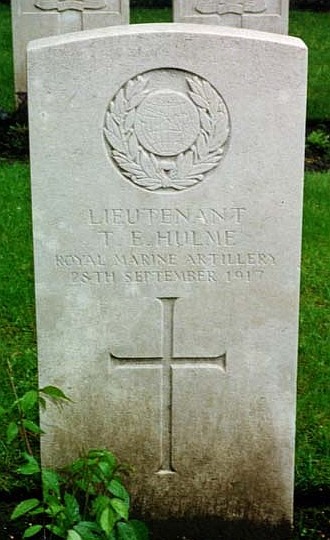
Raleigh would be executed for serving the amoral interests of his country too well, and Hulme would die a soldier on a WWI battlefield believing to the end in the causes of a war that was soon portrayed as absurd.

Hulme grave

Another soldier-poet whose leaf WWI cut short


To hear my music and performance of T. E. Hulme’s “Raleigh In the Dark Tower,”  use the player below.

a new mix of On the Troop Ship to Gallipoli

I don’t plan on making a habit of this, but the next morning after I posted the audio piece where I perform an “Imagist” revision of Rupert Brooke’s late fragment written shortly before his death while serving in WWI,  I wanted to change a few things about the mix.

WWI troop ship

Soldiers on a  World War I troop ship in transit

What’d I change? I delayed the entry of my piano part to a few bars later. I remixed the concluding electric guitar part entirely, it’s now a bit more forward in the mix. And finally I added an E-Bow electric guitar top line over the final section. Why did I make those changes? Just trying to give the piece a bit more sense of “build” as the troop ship steamed along carrying Brooke and his fellow soldiers to the disaster that would be the Gallipoli campaign. The newly added E-Bow part is probably the biggest change. The E-Bow is a clever gadget that magnetically drives a single instrument string as if it was excited by a bow. As the name suggests, it’s sometimes used to give the effect of violin or viola sound coming from a guitar—which Jimmy Page and Eddie Phillips aside, is not designed to be bowed, however I think the part I played sounds less like a orchestral violin and more like an overblown free-reed instrument.

In composing the music for the Parlando Project pieces, I like using different sounds like a writer might use different images or connotative words in text. If you listen, low in the background of the mix I have a Mellotron flute part. Of course this late 20th Century instrument would not have been known to Brooke and his fellow troops, but for those late 20th Century people a low Mellotron flute part brings to mind (ear?) The Beatles “Strawberry Field Forever” or “Lucy in the Sky with Diamonds” or other English rock band recordings of the 1960s, so I was trying to bring in some sense, however anachronistically, of the soldiers thinking of home, and then at end I add that much louder, strident and free-reed sound from the E-bow guitar part.  Similarly my fizzy guitar phosphorescent plankton bow-wave and electric bass thrumming ships engines. Hope it all works for you.

The new mix replaces the old one as of early this morning. To make it easy to hear the new mix, I’ve embedded the player to hear “On the Troop Ship to Gallipoli” below. The explanation of how I revised Brooke’s words, as if he’d been edited by Ezra Pound or had lived long enough to embrace the ideas of modernist poetry, is covered in the previous post here.


On the Troop Ship to Gallipoli

In the past few posts I’ve mentioned how Ezra Pound was more than an exemplary writer, theorist, and promoter for the early 20th Century modernist poetic movement that he called Imagism. He was also an excellent editor.

His most famous blue pencil job remains T. S. Eliot’s “The Wasteland,”  but he also worked with H.D. and Ernest Hemingway, teaching with his editing how to pare away extra words, overused similes, and extraneous authorial sentiment. And once shown, those writers we able to use Pound’s insights to do the create their own pared down, modern styles.

In the last episode, I noted that Pound had been critical of some WWI poems written by Rupert Brooke. Here for example is the first part of Brooke’s most famous war poem “The Soldier:”

If I should die, think only this of me:

That there’s some corner of a foreign field

That is forever England.  There shall be

In that rich earth a richer dust concealed;

A dust whom England bore, shaped, made aware,

Gave, once, her flowers to love, her ways to roam,

A body of England’s, breathing English air,

Washed by the rivers, blest by suns of home.

Written as England entered into WWI, and as Brooke himself rushed to enlist, this poem was embraced by a patriotic public almost immediately. If one shares it’s sentiments, the actual technique of the poetry probably admits no impediments to a reader, even today—but ask yourself, does it have a sense of actual immediacy? As you read, do you share with a fellow human, feeling, seeing, smelling, this experience? What I get as I read it is a thought, where a soldier thinks that if he dies in battle and his body rots overseas, that his body will homeopathically retain its English birth and experience, and that experience, it is inferred, is worth dying for. Why? Well because the poet says so, and he says it with rather polite poetical words. “Die” and “dust” are perfectly good, simple words, but as a description of death and decomposition, they are surrounded by forevers, flowers, air, rivers, and sun—all presumably sweet and genteel.

Rupert Brooke died at age 27 of an illness he contracted while on his way to the Gallipoli campaign in his war, but what if he, like Yeats, had continued to live and react to the developments of his young century? And what if Ezra Pound had gotten a hold of him and showed him how to punch up his verse?

NPG P101(a); Rupert Brooke

Rupert Brooke, charter member of “The 27 Club”


Today’s piece shows what could have happened. One of the last things Brooke wrote was this fragment written on the troop ship in the month he died. Here’s the original:

I strayed about the deck, an hour, to-night

Under a cloudy moonless sky; and peeped

In at the windows, watched my friends at table,

Or playing cards, or standing in the doorway,

Or coming out into the darkness. Still

No one could see me.
I would have thought of them

–Heedless, within a week of battle–in pity,

Pride in their strength and in the weight and firmness

And link’d beauty of bodies, and pity that

This gay machine of splendour ‘ld soon be broken,

Thought little of, pashed, scattered. . . .
Only, always,

I could but see them—against the lamplight–pass

Like coloured shadows, thinner than filmy glass,

Slight bubbles, fainter than the wave’s faint light,

That broke to phosphorous out in the night,

Perishing things and strange ghosts–soon to die

To other ghosts–this one, or that, or I.

What can I, acting as Pound might have, do with this? Well first I can locate the charged images in it, hidden as they are inside Brooke’s extraneous comment. What are they? The soldier pacing at night on his troop ship. He’s staring back inside the ship, looking at his fellow recruits on the way to their first battle. If we have any empathy as readers, we don’t need to be told anything about what he’s feeling if it can be conveyed by what he’s seeing. What are our charged images? The troops are playing cards, games of soldier’s chances. They can’t see the poet, and he can see them only imperfectly, backlit by uneven lighting, “coloured shadows,” which is a great image obscured by all the muck about it. And he sees the faint light of a wave’s phosphorescence as bioluminescent plankton are sweep aside by the wake of the ship. The soldiers, and the poet himself, are already in the course of war, like ghosts, fleetingly seen, or only partially and incorporeally seen.

Have you tried the exercise where you make a poem by taking a marker and blacking out most of page of text, revealing a poem could be in what remains? That’s like what I did with Brooke’s fragment:

On the Troop Ship to Gallipoli

I strayed about the deck, an hour,

Under a cloudy moonless sky.

Peeped in at the windows,

Watched my friends

At table, playing cards,

Standing in the doorway,

Out into the darkness.

No one could see me.

I could but see them

Against the lamplight,

Coloured shadows,

Thinner than glass.

A wave’s faint light,

Broken to phosphorous.

Perishing things and strange ghosts

Steaming to other ghosts,

Only, always.

I removed over a hundred words that didn’t need to be there, which covered up what did need to be there. I don’t need to say that these things relate to each other, putting them in a short poem together makes that clear. I added only one word, choosing to add “steaming” instead of just “to other ghosts” because it’s an action word, and because “steam,” though active and industrious, is another thing that dissipates and disappears.

I have two unfair advantages over Rupert Brooke as I transformed his words. First, he died in service to his country shortly after writing this, so he didn’t have the chance to revise his fragment. Secondly, the place he was going, Gallipoli, and the outcome for so many British and Commonwealth soldiers who were deployed there is now infamous for poor tactics and horrendous casualties. I can simply use “Gallipoli” in the title and magnify the dread of soldiers on their way to battle.

Today’s episode is dedicated to Julie Shapiro, who introduced me to Eric Bogle’s “The Band Played Waltzing Matilda.”  This is a song about Australian troops at Gallipoli, and though I can link to one of my favorite singers, June Tabor’s, version of it, there is nothing but my memory to testify to the devastating version Julie used to perform.

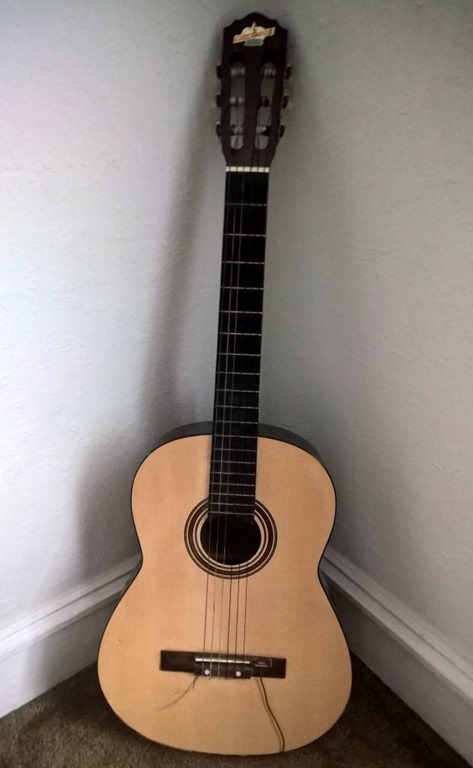
My First Guitar

My first guitar, purchased for $40 in 1974, and played on today’s audio piece


Long post again, no time to talk much about the music for this performance. Perhaps I don’t need to tell, you just need to hear it. Use the player below then for my performance of a revised fragment by Rupert Brooke.