Why bother with little-known poets of the early Modernist age? Well, it’s conceivable that we can better understand the context the better-known poets were operating in by looking at the field the greats stood out from. And frankly, I get a kick out of looking at the left-behinds and odd corners. Like a crate-picker at a used record store, I’m looking for those weird finds that you can’t quite believe exist or that reflect some transitory moment in the culture.
I’ve already mentioned Arthur Davison Ficke in an earlier post as one of the Davenport Group, a bunch of Iowans, who with their rural Illinois cross-river neighbors, made a bit of a splash in American culture in the first part of the 20th Century. Ficke is not as obscure a character as Muriel Strode from our last post, but the separating distances of fame and achievement shrink as time moves on, so you’re not going to run into either of them in any survey course or even specialist literary class in school.
Unlike Strode, I could find out about Ficke’s family background. He grew up in one of Davenport’s richest and most cultured families. His father was a prominent lawyer and had amassed a considerable oriental art collection. After education in Davenport, Ficke was sent to Harvard where he was a classmate of Franklin Roosevelt. After graduation he was granted one of those traditions of the well off, an overseas tour which included travel to Japan.
Throughout his school years, Ficke was drawn to the arts, and yet family expectation dictated that he was to practice law. A career as an art critic and poet therefore progressed alongside lawyering. During WWI, and while serving as a military Judge Advocate, he met Edna St. Vincent Millay and eventually a post-war love affair blossomed. You may see some similarity to Millay in today’s Ficke-written piece, a rhymed, metrical sonnet, a form Millay also worked in.
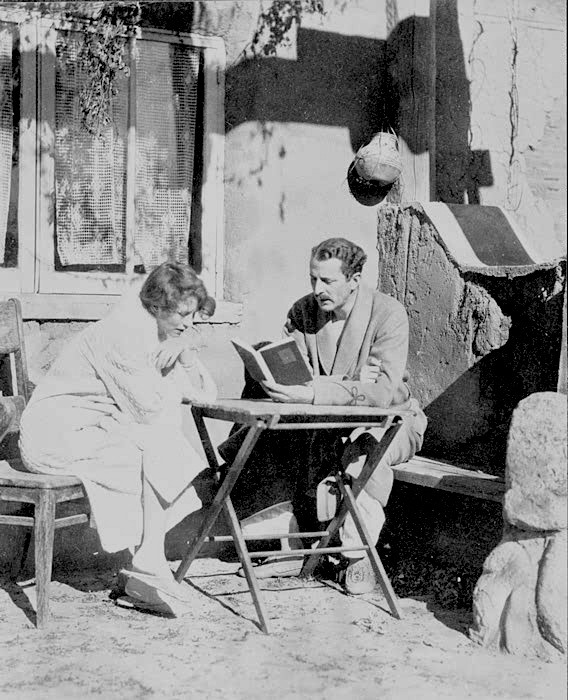
Arthur Davison Ficke with Edna St. Vincent Millay.
Like Millay, Ficke mixed with the Modernists socially while not consistently writing in the new Modernist style. This ambiguity of Ficke’s toward Modernism played out in an event we’ll cover in a future post.
I don’t find Ficke’s poetry as musical as Millay’s, but his“The Book of Lu T’ang Chu” still has its charms. The poem combines Ficke’s interest in the Orient with a subtle observation about art in the modern age. This poem’s ancient Chinese emperor and Ficke himself are now both dust in the wind, as we all will be—but we can still listen to his meditation, set to my new music and performed on acoustic guitar, piano, and an attempt at playing (via a MIDI controlled “virtual instrument”) the Chinese traditional zither that came to the fore during the Tang dynasty, the guzheng. Use the gadget below to hear this.
Those new here may not know that the Parlando Project intentionally varies the words and writers whose work we present, and the types of music that we combine with them. We tend to use poetry as our word source, because compression and musical expression is baked in, but we don’t always use the most famous poets or poems (though I do enjoy trying to find something new in a well-known poem too)*.
Because obtaining rights to present poetry has difficulties, most of what you find here is from before 1923, but that doesn’t mean we won’t surprise or puzzle you with our authors. Today’s piece was written by Muriel Strode, who is an extreme case of biographical and critical obscurity. Almost nothing is known about her, and rather than Wikipedia, or one of the online poetry-promoting orgs or education sites, what info I could gather about Strode is largely from a single blog post.
As it often is with me, finding out a few things about someone opens up further questions. The bare bones reported in Terri Guillements’ blog post, partially informed by surviving relatives, is that Strode was born in 1875 in a rural township in Illinois, south of Galesburg where Carl Sandburg and Don Marquis spent their youth at nearly the same time. Her father was a “naturalist, teacher, and physician” and her grandparents were pioneer farmers and settlers according to Guillements. Her mother died when she was around 13 and her father remarried. At around the same time as her father’s remarriage, it’s said that she left home at age 15 (1890) to attend a business school, and a year later she started work in Long Beach California as a “stenographer and typist.” No context is given on this, but the remarriage and move far away from her childhood home happening at near the same time does lead one to suppose some friction.
The next markers in her life come in 1906, 15 years later. Guillements’ says Strode was able to buy two parcels of land in the Signal Hill area of Long Beach and the same year move to New York City. Also in 1906, Strode published her first book My Little Book of Prayer with Open Court Publishing out of Chicago. Open Court was the closely held venture of a German immigrant who had made it big in the zinc business, Edward Hegeler. Hegeler was a believer in something he called “the religion of science,” discussed briefly and tantalizingly in his Wikipedia entry, and Open Court worked to promote those ideas.
My Little Book of Prayer might seem puzzling without those connections. It’s not a prayer book in the usual American Christian sense. God, even implied, is not present in most of its entries, nor are any conventional religious texts or figures present to an appreciable degree. The entries are short, aphoristic, and poetic enough that one might consider it an early book-length work of American free verse. On the other hand, they don’t exactly seem to want to work as poetry as Pound or the English and European Modernists were re-casting it. My Little Book of Prayer reads more like a self-help book expressed in strongly worded and rhapsodic affirmations. The general attitude is the that with the too-rarely understood right goals and attitudes, human potential is unlimited. You start out thinking this is Stuart Smalley in 1906 guise, then wonder if you aren’t reading a follower of Ralph Waldo Emerson, and finally end up considering if you are reading a very concise American and female Friedrich Nietzsche.
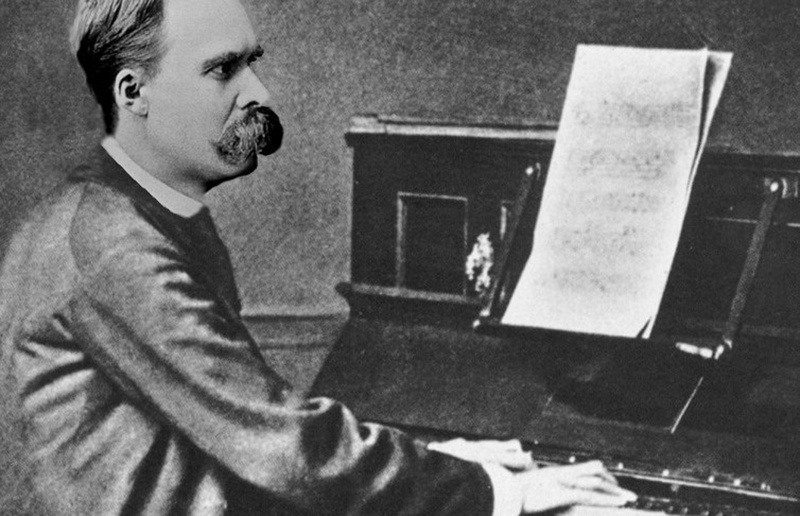
For today’s audio piece we feature Fred “Sonic” Nietzsche on the keys. Makes me think of the Bonzo’s “The Intro & the Outro”—which is a very good thing!
None-the-less at the beginning of The American Century as education, industrialization, science, and an expanded political franchise were in motion, the book seems to have struck some sky’s-the-limit chords. The St Louis Globe-Democrat published this breathless notice:
If you want to know the greatness of a soul and the true mastery of life, apply to the Open Court Publishing Company for a slip of a book by Muriel Strode, entitled simply ‘My Little Book of Prayer.’ The modern progress of sovereign mind and inner divinity from the narrow cell of the ascetic to the open heaven of man made in God’s own image, is triumphantly shown in it, yet a self-abnegation and sacrifice beyond anything that a St. Francis or a Thomas a Kempis ever dreamed of, glorifies the path. To attempt to tell what a treasure-trove for the struggling soul is in this little volume would be impossible without giving it complete, for every paragraph marks a milestone on the higher way.”
How Strode hooked up with Open Court and its philosophy is one mystery. Even Strode’s southern Illinois childhood is not in Chicago’s orbit, and we know too little about her parents’ social class or connections. One theory that occurs to me is that somewhere in that Stenographer/Typist job title was an intelligent and ambitious woman who made social, commercial and philosophical connections with entrepreneurs and businessmen in those 15 “lost years” that may have been in California.
One piece of evidence for that: two years later she married Samuel Lieberman, “the president of an iron and steel firm in Chicago where Muriel had worked.”
Today’s piece, taken from her later work, 1921’sA Soul’s Faring. Instead of Open Court, this one was published by Boni & Liveright, a New York-based imprint much associated with literary Modernism.** By this point someone had dubbed Strode as “The female Walt Whitman,” and her free verse is, if anything, more unabashed and heroic*** than Whitman, which takes some doing. One has to be of the right mind to read much of it—it’s so over the top. The same Nietzschean philosophical concerns remain from her Open Court books, and the individual, roman-numerated, sections are barely longer at times than her earlier aphoristic “prayers.” There may be a growing mysticism entering into the work as well as elements that at times echo deep-ecology thinking about nature.
After reading three of her books, doing this research, and working on incorporating something I took from the XXXV section of her “Songs of the Strong” inside A Soul’s Faring, I still don’t quite know what to make of Muriel Strode. The gushing visionary true-believer attitude, even for a reader such as myself who enjoyed William Blake as a young man and who also appreciates Whitman is just so strong, and some underlying “Like attracts like” Law of Attraction elements seem unavoidable.**** So, I can’t say I’ve become a fan, as much as I must acknowledge her audacity and extremity of expression. Perhaps she’s best taken in small doses, in disconnected aphorisms?
In seeking to maximize that element in Strode’s poetry, I’ve adapted her poem, trimming even this already short work back even more, and turning one of its lines into a refrain. And for music? Well, I told you at the start we like to mix things up. Our last piece was orchestral, featuring strings and English horn, but today’s piece, which I call “I Am the Clod that has Taken Wing” in my adaptation—it’s metal, and of the sludgy type. Maybe in honor of Open Court and the Gilded Age Mr. Hegeler (who must be a Galvanized Age figure), it’s “Heavy Zinc?” Metal is a type of musical expression where you can say anything, no matter how outrageous, and get away with it; so maybe that fits in an odd way, which is what we do here at the Parlando Project. Here’s the player to hear it.
*If you’re not in the mood to adventure into this unusual story of a small town girl who makes her way in the world and some transitory literary notice, our archives here have lots of better-known poets from this same era and before.
**You, and the world, may have forgotten Muriel Strode, but Boni & Liveright were the first American publisher of William Faulkner, Ernest Hemmingway, E. E. Cummings, Jean Toomer, and Hart Crane and the US publisher of T. S. Eliot’s “The Wasteland.” So, between the boards, Strode was in high-lit company.
***There’s also an erotic element in A Soul’s Faring that might remind one of Whitman.
****What we know of Muriel Strode’s life story reads like a romance novel, doesn’t it? Here’s one more novelistic touch, and if you’re a skeptic about the “Law of Attraction,” you’d best ascribe it to a failure of authorship: those two parcels of land Strode bought before leaving California? Turns out about the time A Soul’s Faring was published, they found oil under them. Lots of oil. If you listen to today’s audio piece over and over, and perhaps play it backwards, who knows what riches will come to you.
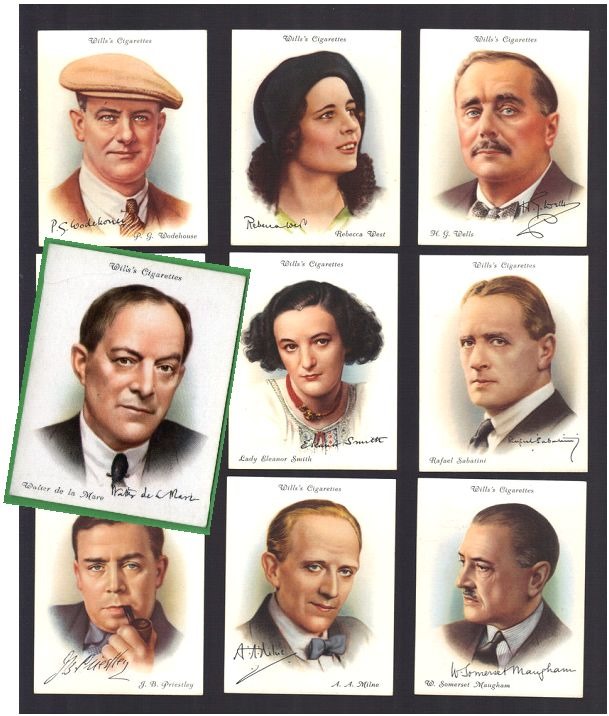
I know nothing interesting about the life of Walter de la Mare—other than he was a successful writer in poetry and prose for roughly half of the 20th century*. There appear to be no interesting movements or manifestos to tie him to, and though his lifetime corresponds roughly to those 20th century Modernists I often like and present here, he’s not considered one of them.
20th century British authors who got trading cards in cigarette packs level fame.
Certainly, his poetry doesn’t sound or look like Modernist verse. It’s frankly musical, and supple yet regular musical verse of his type is not that easy to write in English. Modernists took up with free verse for a number of reasons, partly because they were likewise enamored of the wider and more fanciful rhythms of Modernist music and visual arts, and because they wanted to explore new ways of relating reality, and the tight and formal clothing of metrical forms and rhyming seemed to restrict their range of movement.
There were folks with a Modernist sensibility who worked in rhyme and more regular metrical forms. Early Robert Frost and Edna St. Vincent Millay did. Frost in particular is often writing Imagist poetry with fresh, plain diction that rhymes in the era when his fellow Modernists were immerging.
Today I use a short poem of de la Mare’s, “Winter,” and the first thing that struck me about it is the word-music. Every line rhymes, and with perfect, not partial rhymes. Though de la Mare uses common rhyming words, the poem seems effortless, there are no lines that seem twisted to make the rhyme. But notice something else about “Winter:” the way it treats its matter, as opposed to its music—that’s close to the Imagists credo. It directly shows a winter scene. The opening lines “And the robin flew/Into the air, the air,/The white mist through;” are solidly in the Imagist mode. That opening “and” making sure we know this is an immediate experience. The entire second stanza too is Imagist through and through. Nothing is “like” anything. This is a real, immediate scene, and we stay there. The robin** flying through white mist is a bird flying through white mist, not a mere symbol, a counter for something else. Frozen bushes waver in the slight breeze casting varying reflections from the new rising moon or last sunlight. Yes, what we are apprehending through the poet has connotations, has feelings that will be invoked, but we aren’t told by the writer what they are, he assumes we’re capable of forming those ourselves.
Only in the ending stanza does de la Mare break the rules of pure Imagism. In his last two lines he personifies a speaking star or cardinal direction which speaks the final line. For me this works largely because this contrasts with the rest of the poem. If instead, de la Mare had started with talking stars giving us messages in so many words and continued in that vein through the poem with bushes and birds telling us what the poet wants them to say, the impact of the conclusion would be lessened, and the poem would be trying to work, not just sound, in the old way.
Musically, I unabashedly say I like what I did for this one. The piece began for me with the guitar part, which I was going to play on acoustic guitar, but my family came home early and there’d be no chance to record that with an open sensitive mic, but then many acoustic guitar parts translate well to the Telecaster which I substituted. The bass guitar part is unusual in that it’s played entirely on open strings, a sound that the instrument is rarely allowed to use. But it’s the orchestral parts which really pleased me. There’s a bunch of tracks here combining “real” strings played via a virtual instrument with a somewhat overdriven Mellotron violin mixed in there which brings the string section some grit***. I gave a top line part to an English horn. Use the player just below this to hear my performance of Walter de la Mare’s “Winter.”
English robin showing its all-weather operational capabilities
*I recall reading some of de la Mare’s ghost stories decades ago, but I hadn’t really considered his poetry until I was reminded of that by Toby Darling, who does a lovely job of writing and playing music to sing many de la Mare’s poems to.
**Residents such as I who live in the Northern parts of the U.S. may be surprised that de la Mare has a robin in his winter scene. The American robin is a different species, which migrates south for the winter, and as such the robin here has a strong symbolic association with spring. English robins stay put. The same name for different North American and European species could lead one to read some promise of spring that de la Mare didn’t intend in his poem, in the same way that Robert Frost’s American winter hemlock branch may not have been a Socratic hemlock branch. Anyway, both robins have a bright red-orange breast, which even though de la Mare doesn’t state it, adds a dot of color to the white mist flight.
**The Mellotron was an early, primitive attempt to do what modern “virtual instruments” do. Typically, if a virtual instrument wants to present a “real” violin it will sample a violin playing various notes, and the notes as well with a variety of articulations which are stored and organized as digital audio files to be played later. The 1960’s Mellotron had a simple tape strip of a violin playing a note in one legato articulation assigned to each key of an organ-style keyboard. The former can sound strikingly realistic if care is taken to make use of the various articulations (vibrato, marcato, pizzicato, etc.) while the later sounds artificial despite the tape strips being conceptionally the same. Of course, “artificial” is a state of mind, and the close-but-not-quite sound of a Mellotron instrument always reads as “England” to my ear due to it use on many 1960s and ‘70s recordings by English groups.
I spend an invisible part of the iceberg in this project looking around for material that I think might work combined with music. One thing invariably happens when you look broadly at something: you find connections that you didn’t expect you’d find.
Here’s something I’ve noticed this fall: around 1875 or so, in a small, little-thought-of area of the U.S., a bunch of people were born who went on to leave a mark on our nation’s culture, even if only one of them retains any fame now in the 21st Century (and even that exception is undervalued in my estimation).
Geographically the area I speak of is the region where the Mississippi and Rock rivers meet in the Midwest, which had transitioned from what had been an important point for the Native-American tribes at the beginning of the 19th century and before, to an area that supported settler towns which grew up around river-based commerce and industry. “Transitioned” of course is a passive word for a slow-motion invasion and conquest by the European Immigrant-Americans, which included the short Black Hawk war of 1832 that left a great many Native-American names, but fewer Native-Americans, in the area. Eventually states were created here bearing those native names: Iowa and Illinois.
Who’s in the cohort from this area and time?
My relative*, Susan Glaspell, born in Davenport Iowa in 1876. Glaspell and her husband (George Cram Cooke, also born in Davenport, 1873) eventually midwifed the birth of Modernist American drama in Provincetown Massachusetts and New York City.
Carl Sandburg was born 1878 in Galesburg Illinois. Sandburg was a big noise in the first half of the 20th Century, and I maintain he is now the forgotten Modernist, and a man who strived to weave several important American threads.
Arthur Davison Ficke (born 1883 in Davenport) a now lesser-known, but fascinating figure that I’ve yet to grapple with. Like Ezra Pound, he was drawn to Japanese art, and like his post WWI hot-crush, Edna St. Vincent Millay, he attempted to utilize older forms such as the sonnet in an increasingly Modernist age. As part of this friction, he and his friends Witter Bynner and Marjorie Allen Seiffert (born 1885 in Moline across the river from Davenport) concocted the Spectrist movement, parodying the -ics and-ists schools that were forming in Modernism. Oddly, the parodist seems to have been captured by his game, and Ficke later reconsidered Modernist poetic tactics.
Muriel Strode born 1875 in rural Bernadotte Township Illinois. I haven’t quite gotten a grip on her yet (though she was sometimes styled as “The Female Walt Whitman”), but she wrote a number of books early in the 20th Century combining a sort-of-Kahlil-Gibran-like popular non-denominational spirituality with Nietzschean self-improvement. She’s the most little-known here by far. So little is known about her that one can’t really use biography to help sort out what she’s getting at.
There was even a younger generation that called Davenport it’s hometown. Floyd Dell (born 1887) the editor of The Masses which in the early 20th century linked Modernism with left-wing politics until the red scare of 1917 closed it down, and Bix Beiderbecke (born 1903), the live-fast-die-young jazz composer and cornetist.
They’d make one hell of a roundtable. From the upper left: Susan Glaspell, Carl Sandburg, Arthur Davison Ficke, Floyd Dell, Muriel Strode, and Bix Beiderbecke.
But since we last time touched on Dorothy Parker, let’s present a piece I slightly modified from a poem by Don Marquis, born 1878 in the tiny settlement of Walnut Illinois, but educated in Galesburg. Don Marquis is usually filed (like Parker) as a humorist, but like Parker he worked in various genres including collaboration with the Krazy Kat cartoonist George Herriman. Unlike some of the others here, it appears that Don Marquis’ most consistent connection to Modernism was to satirize it. Today’s audio piece, which I call “The Young Intellectual**” pricked the romantic presumptions the young Modern of his time might suffer from. I updated part of one verse (the original next to last line was “I’ll start a Pale Brown Magazine”) when I performed it, an update I choose just so we can more easily feel offended or amused by his humor now. The player to hear the LYL Band performing this is below.
*My Great-grandfather lived on the Iowa side of these river-towns and worked in war-industry factories there. My father’s mother and her sister also grew up in the Davenport area. Alas, many of them died before I was old enough to ask questions, and one thing I regret about my youth is that I didn’t query those that were around.
**I’m not sure I qualify as an intellectual, but I’m sure I’m not young—so, Marquis can’t be talking about me now, can he. Like Ficke, Marquis also parodied Modernist verse, rather broadly from the examples I’ve read in his Hermione and Her Little Group of Thinkers from 1916. Marquis’ greatest success was a series of later newspaper columns that became a series of books about “archy and mehitabel” ostensibly created and typed by a cockroach hopping on the typewriter keys in Marquis’ office. Archy, the cockroach/author, is also something of a free-verse poet, and Archy’s poems are a much subtler expression.
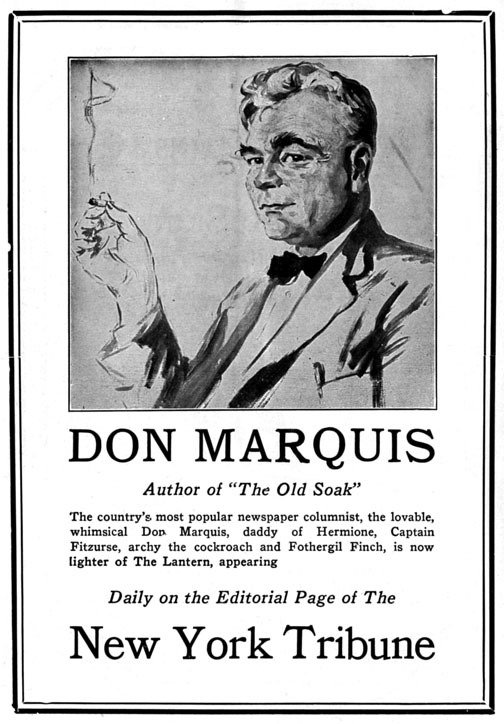
Marq Daddy? He looks like an urban swell here, but the country he comes from they call the Midwest
The year 2018 marches on, as we pass onward past Thanksgiving toward December. I’m quite thankful for the opportunity to continue this project. Time-consuming though it is to do these pieces, it also continues to fascinate me and (one hopes) it also continues to surprise and entertain you. For me there’s considerable enjoyment in trying out or finding out something new, thinking about something, or playing something, different.
Though they may no longer be as well-known, some of McGeehan’s list you and I might recognize: W. E. B. Du Bois, Jane Adams. Others, such as women’s suffrage activist Anna Kelton Wiley and bra designer Mary Phelps Jacob were unknown to me. Three writers get a nod, all three wrote poetry: Amy Lowell, William Carlos Williams and Dorothy Parker.
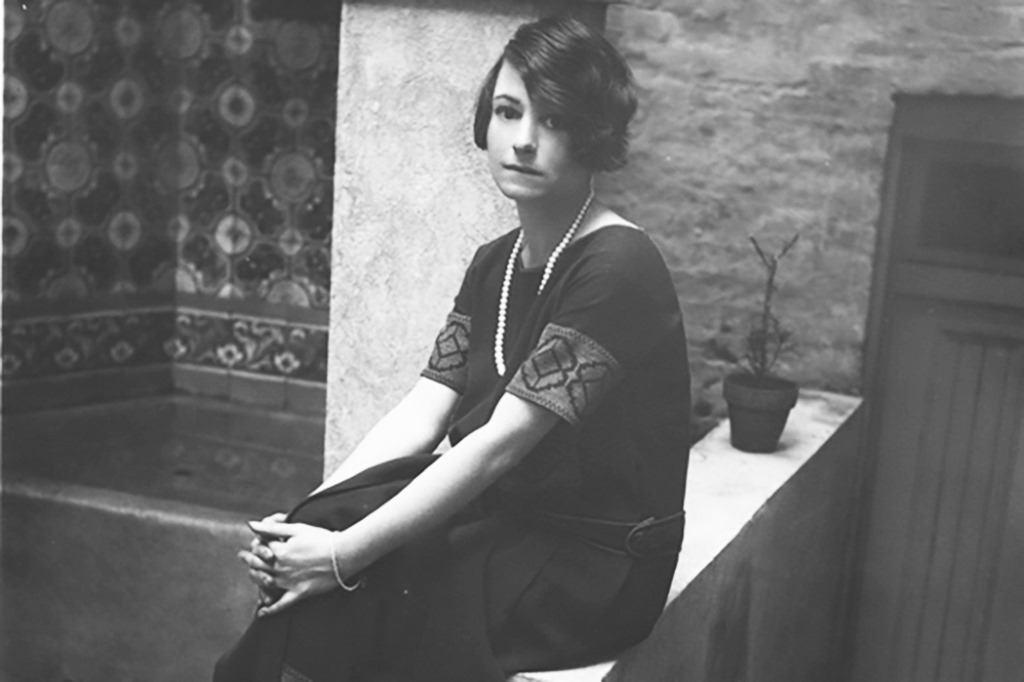
That plant looks like it could use a little water. Dorothy Parker at home in 1924.
Amy Lowell is a literary force I need to address sometime in my own project, though I’ve yet to absorb anything of her poetry. Though I overlooked Williams in my youth, he’s grown on me throughout this project as his public domain, pre-1923, work explores the lyric impulse with eyes whose perspective has been expanded by the Modernist explosion. The third, Parker, is a double surprise. I can see where My Year in 1918’s McGeehan will encounter her, as Parker was writing for magazines (one of My Year in 1918’s chief sources of material), but she’s not some inescapable pantheon writer. And though later in life she became a committed social activist, particularly in regard to African-American civil rights, her WWI self had yet to develop in this regard. But she’s a, a—oh, the never-immortal shame, the art that dare not speak its name—a humorist.
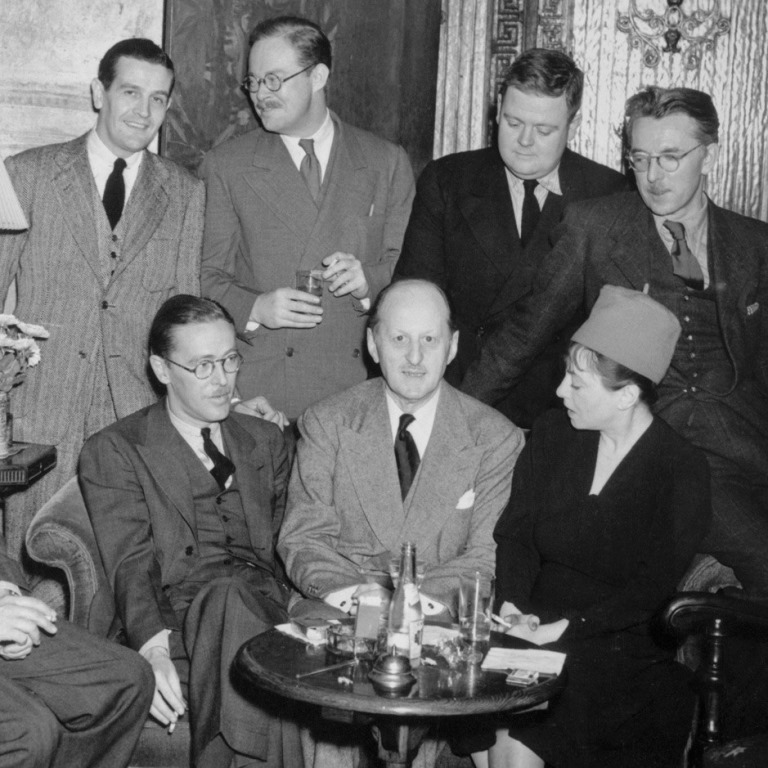
Parker with the Algonquin Round Table group of wits. We don’t know if they’re having lunch with those drinks, but it’s something of a sausage fest anyway. I haven’t seen a caption naming those present, proof that humorists don’t make the pantheon. Besides Parker on the lower right, I think it’s Alexander Woollcott 2nd from left in the upper row, but I’m drawing a blank on the rest.
Humorists, whatever their skill and craft, tend to damage their reputations as literary figures. We like our literary titans dour and serious for the most part. They can scatter a little wit around for decoration or as weaponry, but to be celebrated for their merit—even if that’s all we end up really noting about them, their worthy merit—you need to rise above that. The assumption seems to be: if the point is to make you laugh, the point is ephemeral.
We think too little of humorists as agents of social change, or as participants in the Modernist artistic revolution of the early 20th Century. We do this even after Dada, even after Mark Twain’s now-recognized status as another American who broke Modernist ground before the 20th century.
To take Dorothy Parker seriously (not solemnly) you need to start by acknowledging that she’s fighting with two hands tied behind her back: she’s a woman before women were considered capable of human complexity, and she wants you to laugh at our folly. Parker survives at times wielding dark, survivors’ humor, the sensibility that remembers her poem “Resumé,” a meme in verse about suicide. She might step on a few toes while doing that, and she’ll laugh about it.
Alternate voice here, Dave Moore, has appreciated Dorothy Parker for some time. Several years back the LYL Band covered Alan Moore’s “Me and Dorothy Parker,” and here today is the LYL Band doing a Dave Moore original that expands on Parker’s observations on suicide in his own words.
Parker ended “Resumé” with the punch-line “You might as well live.” I’d add, you might as well create art. After all, even in the worst-case, you’re only burning part of your life-time while struggling with joy and it’s opposite. If there’s no hope, you might as well hope.
Thanks again for reading and listening. Thanks to spreading the word about the Parlando Project. In the Internet world of millions of likes and shares, we’re a small thing, but I’m grateful for you helping keep this little thing going. The player for the LYL Band’s performance of Dave Moore’s “Looking for a Way to Go” is below.
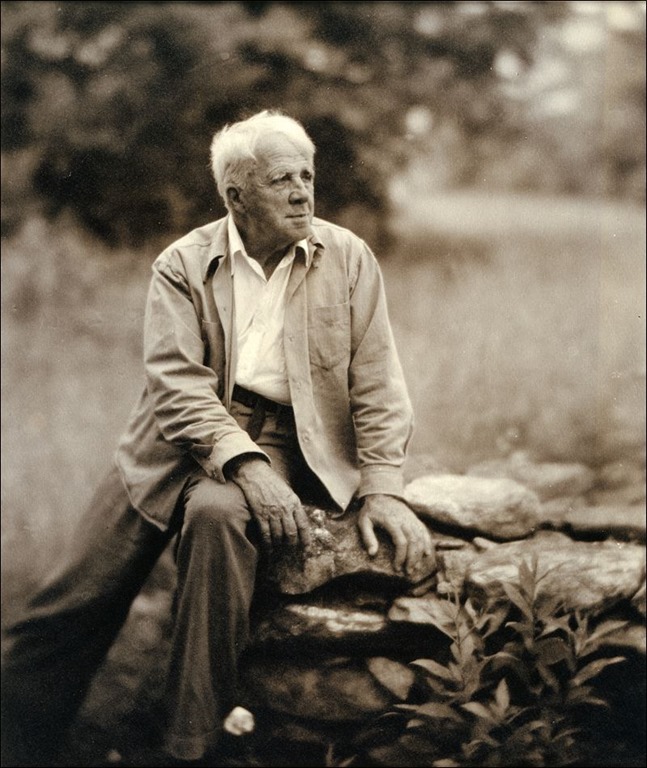
Robert Frost. Wry poet of the good old days—or maybe not?
Today’s piece is instead the hard-boiled Robert Frost. It’s blank verse, but the beat is implied, the sentence structures beat against it, and my performance choice was to not emphasize the meter. What “The Vanishing Red” portrays is, straight up, a racially-motivated murder, and the way Frost tells the tale uses sly ways to frame this story.
He doesn’t get out of the first line before he starts this framing. One of our characters is called the “Red Man” by history. A term roughly equivalent to the N-word for indigenous Americans, but one that in Frost’s time was not considered socially unacceptable.* Frost wasn’t going to shock or disgust his readers in 1916 with that epithet at the start of his poem, like he might some today, but he wants us to know from the start that the race and history of this man is material to what is going to happen—but we don’t meet him yet.
Instead we meet another man, the Miller, who’s talking in a way we might find familiar. He starts out by telling us he’s not guilty of something before he’s even been charged with it, claims too that he’s not one of that PC brigade who “talks round the barn” instead of straight talk, that he’s a get-it-done doer.
Frost adds just a tiny bit of narration after the Miller’s speech. Some may read this narration as excusing the man, but the narrator’s pointing us to think about two things as the story will continue. The narrator says, let’s not consider this as history (“too long a story”) or politics (“who began it”). As we’ll soon see, we’re going to consider this as an Imagist poet would consider it, as a presentation of what Ezra Pound called “an intellectual and emotional complex in an instant of time.” History can be dulled by time. Politics says there are two sides.
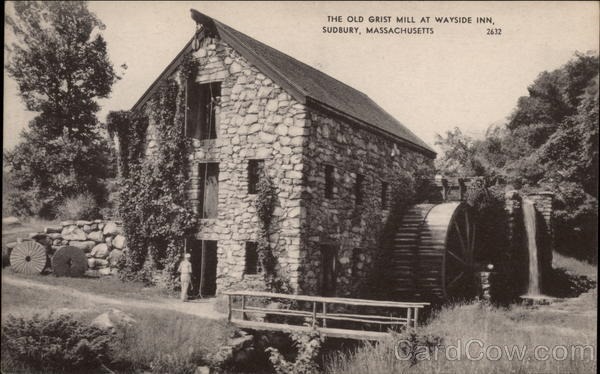
Nostalgic postcard or dark satanic mills? Frost reports, you decide.
But first we have one more exchange of dialog. Our unnamed “Red Man” is at the Miller’s mill, and we hear nothing he says directly, but we do hear what the Miller puzzles about what the other man is communicating. The Miller portrays the other man as without English words, but he interprets some “guttural exclamation” anyway as surprise, and this is somewhat sketchy. Is the native American puzzled by the mill’s mechanism? Surprised at being seen by the Miller?
Is the Miller even reading the other man well? I think not. Afterall, the Miller has another reaction, stronger than his sense of what the other man may be feeling, and Frost’s narrator also doesn’t “talk around the barn:” it’s disgust. But that’s not what our Miller portrays in his next piece of dialog. He acts friendly, offers to show “John” his mill.** Ah, the “Red Man” has a name, he’s not some reductionist cypher for an entire continent’s indigenous peoples, and since it’s an English name, we might surmise that he might even be one of the Massachusetts tribes that attempted to synthesize with the new rulers, taking to Christianity and living in “praying towns.”
And now the Imagist poem begins, ten lines. The Miller opens a trap door and shows John the water-power wheel, and a poem that has been entirely without imagery suddenly gets a vivid image. The wheel’s water forebodingly is like struggling, thrashing fish. The door closes, and the door’s handle (a metal ring) we are told makes enough noise with this shutting to be heard above the noise of the mill. And the Miller returns upstairs, alone. The wheel’s turned around to the beginning of the story where the Miller laughs, though it’s not quite a laugh. He meets a customer carrying more meal to be ground at the mill, who doesn’t understand what has just happened. We ourselves are just understanding what has happened.
What has happened? The racist Miller has thrown John, the “Red Man” into the mechanism and killed him. Frost wants you to feel that by showing you this moment in time, but he also wants you to vividly feel the lack of notice, the vanishing in the title, which isn’t some passive mystery, it’s an act of human cruelty.
Today’s music is two pianos, bass and drums. I’ve been suffering from a cold for the past few days which made completing today’s spoken word component a challenge, and I did miss one phrase in Frost’s text and didn’t get another one completely correct, but you didn’t get to hear any of the coughs and voice cracks from the bad tracks either. To hear “The Vanishing Red” use the player below.
*For example, the college I went to over 50 years ago called its sports teams the Redmen then. I had a tiny part in the beginning of the process to change that.
**Acton Massachusetts had a grist mill and more. I can’t find any pictures of them, but the town still has a Grist Mill Road.
Last time I talked about how hard it is to be sure how Emily Dickinson meant her poems to be read. Some poems seem gentle, some fierce. She sent some to her more conventional friends enclosed in letters or gifts—but some she never shared, and puzzle even hard-core literary critics to this day. When is she applying a clarifying simplicity to complex or profound subjects and when is she undermining simple statements or homey images with subtle side-glances? She’s a small-town 19th Century person, a stalwart reader of the book of nature—and yet she sometimes reminds me of later 20th century urban wits, like Frank O’Hara or even Dorothy Parker as much as she reminds me of Ralph Waldo Emerson. Am I reading this into Dickinson, or is it already there?
Well, I take today’s Dickinson piece pretty much as it seems, a humorous conspiracy with someone, perhaps the reader, wherein lack of credentials or claims to the podium/lily pad are brushed aside. This is a good place to begin observation and then art, or the circle back from art to observation of it, perhaps the best place.
So here’s Emily Dickinson’s “I’m Nobody Who Are You?” as I performed it, available through the player below. And not to shout from the lily pad, but the only reward I get for the time and effort of doing this is you, the audience who listens to these various words from past nobodies who want to talk to us. Thanks for doing so, and if you find something here you like, please let others know about it.
What was Emily Dickinson’s personality like? Biographers have tried to line that question out from the available evidence filled in with supposition; but then none of us present exactly the same face, the same sensibility to all people and at all times. And any of us who are writers may also know that what we write and how we live can differ, even if only in expression.
This is partly why we have so many Emily Dickinsons, not just over time since her emergence on the page in 1890, but now in the present days, depending on reader’s framing. Today’s piece, “Tell All the Truth, but Tell it Slant” can be read as a playful and humorous observation, as a serious artistic credo, as a secret diary of non-conformity, or as a dark observation of human fearfulness. How many Emily Dickinsons had how many intents as she worked out this little poem?
Her dark materials. A silhouette of the teenaged Emily Dickinson.
As I often do with Dickinson performances, I leaned a bit more to a serious mode of expression, which doesn’t preclude the thought that Dickinson would be internally chuckling. I tell myself I’m just trying to channel something I feel as I experience the poem, but I may be also trying to overcompensate for the Dickinson widely assessed in my youth as an eccentric dealer in homilies, a naïve artist without the depth of metaphysical thought that mid-20th Century High Modernism adored. It seemed then to have been an unspoken assumption that Emily suffered from “lady brain,” that imagined biologically-stunted inferior organ with sentiment where exploratory thought would be. Sure, her syntax and imagery had some originality, so we’ll allow her into the anthologies with the serious poets.
My model of humanity is more androgynous than most, but let us allow female associated elements in her artistry, just as we should be sure that there are experiences from gender and class roles in her time and place. But let’s not overdetermine what she did, what she can still do, when we read, perform or listen to her poetry.
As I said, “Tell All the Truth but Tell it Slant” can be read as a light-hearted jape. I even remembered the first line taken for the title on publication as “Tell the truth but tell it slant,” forgetting the “all.” Is that “all” there just for metrical reasons? Because, if that “all” is meant, it changes things doesn’t it. It goes from a reading of “Well, it’s not polite or advisable to go around spouting the whole truth at every occasion” to a more general statement, that the truth is never told directly. And then the second line and its “lies”—surely one of the most punned-on words in English. It that just an easy rhyme? The next line, “Too bright for our infirm Delight” could have been in a William Blake poem.
The second stanza* starts with some inverted order poetic diction, but it may be forgiven, as we finally get to a physical image: lightning and frightened children. Dickinson appears to be siding with the filters, the myths, the accepted consolations of fibs and filigree we buffer the truth with. And perhaps she is. It may come down to how much or how often Dickinson, or you yourself, look away from the truth, how often the wisdom of your fears can help you survive.
In the end in this performance, I thought it might be key to consider who is charged with—or to—“Tell all the truth but tell it slant.” Is it society, or those who speechify to us as if we’re frightened children, who slant the truth? Or is it us, who should tell all the truth, even if we need to put it indirectly so that our audience can discover it, as the world gradually discovered further Emily Dickinsons, for ourselves, in our own time?
Musically, I return to my weird folk-rock sound and I choose to make Dickinson’s first line into a refrain to stress its ambiguity and centralness to the poem. Hear it with the player below.
*One joy of the poem comes in the end of this stanza’s third line: “dazzle gradually” where the meter and consonance of the chiming d and l sounds enchants.
As we celebrate the 100th anniversary of the armistice ending World War One, let’s bring in a writer not primarily known as a “war poet,” Thomas Hardy. Hardy is one of those bridge-poets between the era of the romantic and sometimes sentimental Victorian poets and the Modernists. Though I’m told Hardy never felt at ease in London artistic circles (he was country-born, son of a stone-mason and largely educated through apprenticeships as an architect) his poetry was admired by some of the Modernists. Why might that be? While his language can sometimes seem antique to modern ears, it was his language, the language of a rural 19th century working class Englishman. And while he will write about sentimental subjects, he’ll balance that with a cold eye.
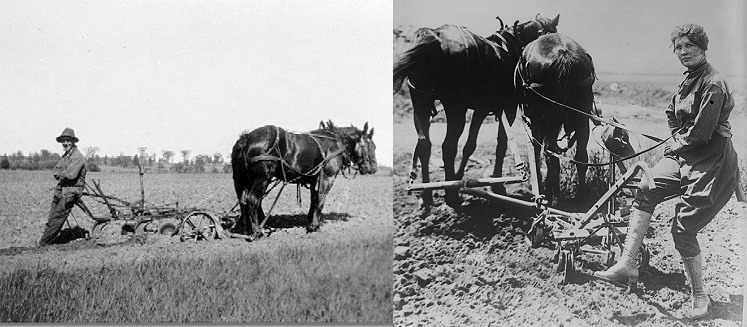
The horse-drawn harrowing time of the Breaking of Nations. But what’s that woman doing behind the horse?
Hardy grew up in a rural, farming district, as I did, and it may have been natural for him to relate the violence of the Great War to that setting. And I love how he does it here with three spare quatrains: the boustrophedon horse-drawn disk or rake plow that is literally breaking the earth*, in contrast with the prophetic “Breaking of Nations” warning from Jeremiah used for the title. Then there’s smoke rising, not a razed town after an army has swept through it, “only” the burning of invasive weeds. And finally, a mysterious third stanza with a mysterious word: wight.
It’s an old word, one of those that came to English with the German Saxons centuries ago. Chaucer knew it, used it in The Canterbury Tales, and as best as I can tell it meant a sort of unimposing person or creature. Sometime later, perhaps after Hardy learned the usage of the word and after this poem was written in 1915**, it’s taken on a supernatural connotation. It’s fairly easy to trace that back to J. R. R. Tolkien’s use of the word in The Fellowship of the Ring written decades after Hardy’s poem. Tolkien was a scholar of the ancestor languages of modern English. Did he know of other usages of the word, or did he simply take a very old word and choose to use it for an undead-spirit slain in battle?
So, in this last stanza, what does Hardy mean by his whispering maid and “her wight.” A flirting young couple? Are they whispering merely to shield their romantic bantering from others? Or is it something weirder? Is this a young woman whose man is off to battle, or even one of the battle-dead? Or, as part of Hardy’s theme are they both immortal ever-returning spirits, whispering because you only barely sense them in our time-bound world?
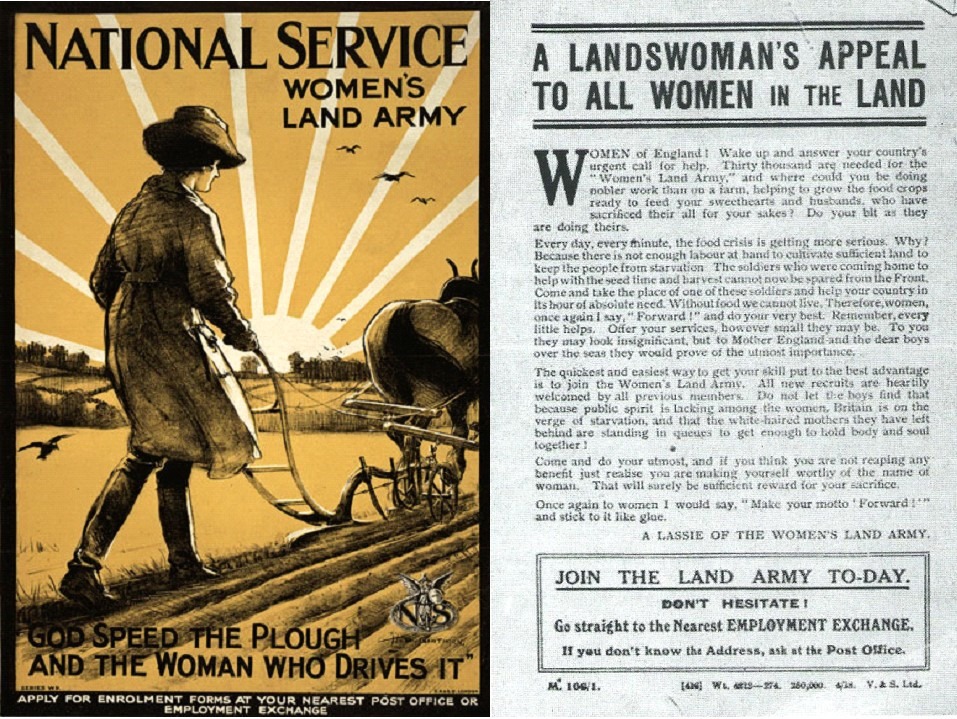
I don’t have the detailed historical knowledge to know how depopulated the farming areas of England were by the need for soldiers during WWI. From Edward Thomas’ poem from last month, “Gone, Gone Again” I get the idea that the absence of farming men was noticeable. And it was at least enough of an issue that England formalized an effort to recruit and train women as replacement farm labor.
Not just whispering to her boyfriend. “There’s not enough labour at hand to cultivate sufficient land to keep people from starvation.” Recruitment ads for the Women’s Land Army in England during World War I.
Well, I just like it that this is blurred. Do the final two lines give us any clues? Why does Hardy say that “War’s annals will cloud into night?” In early drafts, Hardy wrote “fade,” and “cloud” seems a more peculiar choice. In the context of the 2nd stanza weed-burning, I’m thinking he’s saying they will disappear in a cloud of smoke. Also in context of the 2nd stanza, this would make such war records in some future as valueless as weeds, but smoke/cloud again reiterates that there’s something unsubstantial about the couple.
“In the Time of the Breaking of Nations” demonstrates a lot of what I like about short lyric poetry. T. S. Eliot could write a Modernist masterpiece like “The Wasteland” extending to the farthest lengths of lyric expression, 15,000 words—but a poem like this can touch a lot in its 63 words.
It may not be apparent due to the instrumentation used, but I might have been subconsciously inspired by Bob Dylan’s repeating chord progression used for his masterful three-short-stanza song “All Along the Watchtower,” which is very much in the same mode as Hardy’s poem.
Here is my performance of Hardy’s poem. Use the player below.
*Note too, Hardy’s pun on “harrowing.” For another discussion of boustrophedon plowing and time, see this earlier post. Near the end of his life, while visiting a farming museum, my father wanted me and his grandson to know that he’d walked behind a horse-drawn plow.
It’s 1956. World War One had ended less than 40 years ago, instead of 100. Robert Frost is the most celebrated living American poet, and he has traveled back to England to receive honors from both Oxford and Cambridge universities, a symbolic laurel helping to mark the 20th Century acceptance of American poetry into the pantheon of our polyglot language.
Two elderly women follow an invitation to an upstairs to-do in London, where the American poet has just landed. Eleanor Farjeon is one of the pair, then 75 years old, and here’s how she described what happened:
We approached a white-haired man who was talking to T.S. Eliot. ‘It’s Helen and Eleanor, Robert.’ He turned towards us quickly, unmistakably Robert. Were we as unmistakably ourselves? Eliot smiled at us and withdrew a little…. Robert muttered, ‘Well, well, well.’ Soon he and Helen were talking of their grandchildren.
Who are these ladies that broke off the tête-à-tête between the two Modernist poetic titans?
One was the widow of Edward Thomas, the man who Robert Frost called “the only brother I ever had.” The other was the woman who had introduced Edward Thomas to Frost in 1913, Eleanor Farjeon. The poet Edward Thomas is not well known outside of Britain, Farjeon even less so, but none-the-less she had a long and varied literary career as a poet, playwright, children’s book author, and songwriter in a life that spanned from the Pre-Raphaelites to Carnaby Street.
Eleanor Farjeon early and late in her life
Back just before and after the outbreak of WWI, the Frost Family, the Thomas Family, and Eleanor Farjeon were a sort of an extended pod of friendship and affiliations. The Thomas marriage had strains, and Farjeon was in love with Edward Thomas. Thomas’ spouse, Helen, surprisingly cast Eleanor Farjeon not as a rival but as a balm to Edward. And so, between her own writing, and typing manuscripts to help D. H. Lawrence (also hanging around this circle*) Farjeon, like Robert Frost, took to accompanying Edward Thomas on his indefatigable walks around the countryside.
Eleanor Farjeon was still a literary stem cell at the time. She later said “In my youth I dreamed of being a ‘real’ poet, but half way through my life that dream died, and whatever figments of it remained went into writing songs** and verses for children.”
When Edward Thomas decided to enlist and volunteer for the front lines in the war, the pod all shared correspondence with Thomas, a correspondence that continued right up to the very week of Thomas’ battle-death. And after that, they all shared the task of putting his literary affairs in order and promoting the poetry of the man who had only started writing it during that short pre-war period.
Robert Frost and Eleanor Farjeon both wrote elegies for Edward Thomas. It may surprise you, but I’m choosing to use Farjeon’s memorial sonnet here to cap off our Armistice Day series on Edward Thomas, instead of Frost’s poem. Farjeon might have thought of herself as not a “real” poet, but it’s us, the audience, that decides. Her poem may seem to be made of genteel English stuff: gardens, Easter eggs, love tokens, so that it has the patina of an antique valentine—but that’s just the surface. How about those relentless repetitions? You can hear James Joyce or Gertrude Stein tuning up in the distance if you listen for those. Did she mean the punning subtext of the repeated “Eve” with the repeated apples? If this were a Joyce poem we’d assume yes, so why not here? And that surface? It’s a paper scrim she means to tear, to rip—and yet when she does it in the last line, there’s no sound, only an invisible gap, an understated “apology”.
Here is what Eleanor Farjeon said, shortly before her own death, writing again about Edward Thomas and Robert Frost when recounting her last, 1956 meeting with Frost in the company of Thomas’ widow: “We do not lose our friends when they die, we only lose sight of them.”
Here’s my performance of Farjeon’s “Easter Monday (In Memoriam E. T.)” that you can hear using the player below or with this highlighted hyperlink.
*Sounds a bit unconventional for an Edwardian village in 1913 doesn’t it—but any bets on who did the housework?
**And it’s in this guise that Farjeon is likely to be best known in the U. S. Back in 1972, three denizens of that Sixties London: Cat Stevens (later Yusef Islam), Rick Wakeman (later caped-keyboardist of Prog Rock fame) and Paul Samwell-Smith (producer and former bass-player with the Yardbirds) created an arrangement of Farjeon’s hymn “Morning Has Broken” for a best-selling LP and eventual #6 hit single on the Billboard U.S. charts.





 Frank Hudson